GLOBAL NETWORKS : I
ERROL P. BAYONETA
OBJECTIVES
At the end of the lesson the learners are able to:
1. give examples of various activities in one’s daily life that show the concrete effects of
globalization (HUMSS_MCT12If-g-1);
2. explain the concrete effects of globalization to one’s daily life (HUMSS_MCT12-if-g-2);
3. explain the need for collaboration and cooperation to achieve interconnectedness of
people and nations (HUMSS_MCT12-if-g-4); and
a. show the interconnectedness of people and nations (HUMSS_MCT12If-g-3).
Global
Networks
Did you know that in the early and late 1980’s,
one most popular means of reaching out to loved
ones from abroad to their families in the
Philippines was through “voice tapes?” You might
not be aware of it though, but it takes about a
month or months for a taped recorded voice
message to be played by their families using
cassette tape players. Well, that was prior to our
era of today when almost anything can be
accessed in real time despite global distance.
Now, that gave birth to the present concept of
globalization. Generally, globalization was born
out of the inter-linkages of nation – states which
has in varied ways influenced the life of people
worldwide.
We might not be able to enumerate the effects of globalization in our daily lives but in this
module, it will help you deepen your understanding about globalization. Let us now study
the meaning, nature and various activities in one’s daily life that show some concrete
effects of globalization.
Globalization As cited in the Revisitadestatica
(2012), the term globalization refers
to the emergence of an international
network, belonging to an economic
and social system. One of the
earliest uses of the term
"globalization", as known, was in
1930 - in a publication entitled
“Towards New Education” to
designate an overview of the human
experience in education.
Since the invention of the concept, globalization has inspired numerous definitions and has
had a history going back in time to the great commercial and imperialist movements
throughout Asia and the Indian Ocean since the fifteenth century.
• Roland Robertson, a professor of sociology at the University of Aberden, was the first
person who defined globalization as "the understanding of the world and the increased
perception of the world as a whole."
• Martin Albrow and Elizabeth King, sociologists, define globalization as "all those
processes by which the peoples of the world are incorporated into a single world society.
It can be linked to the local, the national and the regional. On the one hand, a connection is
made between social and economic relationships and networks, organized on a local or
national, on the other hand, it connects social and economic relationships and networks
formed on wider scale the regional and global interactions.
It is a process of interaction and integration among the people, companies, and governments of
different nations. A process driven by international trade and investment and aided by information
technology. This process has effects on the environment, on culture, on political systems, on
economic development and prosperity, and on human physical well-being on societies around the
world. For many developing nations, globalization has led to an improvement in standard of living
through improved roads and transportation, improved health care, and improved education due to
the global expansion of corporations. However, globalization has had a negative effect on individuals
who live in developed nations. Some of the factors that cause globalization are migration and labor.
Migration is a movement
to another place, often of
a large group of people.
Labor is defined as work,
especially hard physical
work.
People are more willing
to move between
different countries
today in search for
work. Remittances now
play a large role in
transfers from
developed countries to
developing countries.
Types of
Globalization
Economic
Globalization is the
increasing economic
integration and
interdependence of
national, regional, and
local economies across
the world through an
intensification of cross
boarder movement of
goods, services,
technologies and
capital.
Examples:
• Trans-national trades are companies that extend
beyond the borders of one country example of
these are Unilever and McDonalds
• World Trade Organization is the only global
international organization dealing with the rules of
trade between nations. The WTO has 164 members
and 24 observer governments.
• Foreign Direct Investment is an investment in the
form of a controlling ownership in a business in one
country by an entity based in another country. It is
thus distinguished from a foreign portfolio
investment by a notion of direct control. In 2019,
China and South Korea followed Singapore as the
largest investors in the Philippines.
Social Globalization
is a social
transformation or
process leading to the
achievement of people-
centered development.
Human-centered
development concept
is offered as an
alternative strategy to
bring about a more
equity development
outcome.
Examples:
• UN General Assembly
• Partnership of International Development Programs
• Social Integration, Gender Equity and access to
Social Services
• HIV/AIDS Awareness
Political
Globalization refers to
an increasing trend
toward multilateralism
in an emerging
transnational state
apparatus and the
emergence of national
and international non-
governmental
organizations that act
as watchdogs over
governments.
The government has four distinct roles in addressing
sustainability concerns. These roles are as follows:
1. Policy development
2. Regulation
3. Facilitation
4. Internal sustainability management
Financial
Globalization is a
collective concept that
refers to increasing
global linkages created
through cross-border
financial flows.
Financial integration
refers to an individual
country's linkages to
international capital
markets.
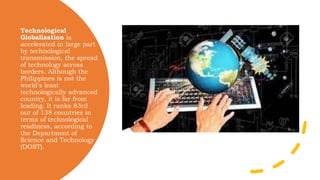
Technological
Globalization is
accelerated in large part
by technological
transmission, the spread
of technology across
borders. Although the
Philippines is not the
world's least
technologically advanced
country, it is far from
leading. It ranks 83rd
out of 138 countries in
terms of technological
readiness, according to
the Department of
Science and Technology
(DOST).
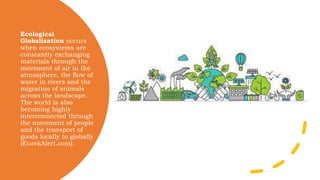
Ecological
Globalization occurs
when ecosystems are
constantly exchanging
materials through the
movement of air in the
atmosphere, the flow of
water in rivers and the
migration of animals
across the landscape.
The world is also
becoming highly
interconnected through
the movement of people
and the transport of
goods locally to globally
(EurekAlert.com).
Geographical
Globalization is defined
as the set of processes
(economic, social,
cultural, technological,
and institutional that
contributes to the
relationship between
societies and individuals
around the world. It is a
progressive process by
which exchanges and
flows between different
parts of the world are
intensified.
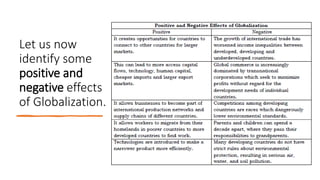
Let us now
identify some
positive and
negative effects
of Globalization.
Interconnections of People and
Nations
Globalization leads to interconnectedness of people and nations, where people refer to a
group of people with commonality, such as religion, culture and language who lives in a
specific area, while nation refers to a larger group of people organized in a specific place,
which embodied an independent government of its country where they can decide on
their own.
Try to imagine how can we connect to our loved ones especially in this time of pandemic
without technologies? Cell phones connect people all over the world like never before.
There are a multitude of platforms through which people can communicate too, including
Facebook Messenger, WhatsApp, Instagram, and Snapchat.
Considering the new normal education, how can we enroll in our online educational
programs in school from anywhere in the Philippines without the different platforms and
access new information on virtual topics?
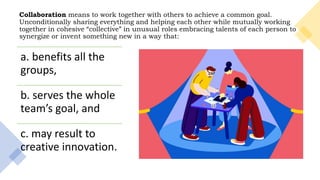
Collaboration means to work together with others to achieve a common goal.
Unconditionally sharing everything and helping each other while mutually working
together in cohesive “collective” in unusual roles embracing talents of each person to
synergize or invent something new in a way that:
a. benefits all the
groups,
b. serves the whole
team’s goal, and
c. may result to
creative innovation.
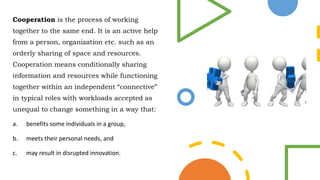
Cooperation is the process of working
together to the same end. It is an active help
from a person, organization etc. such as an
orderly sharing of space and resources.
Cooperation means conditionally sharing
information and resources while functioning
together within an independent “connective”
in typical roles with workloads accepted as
unequal to change something in a way that:
a. benefits some individuals in a group,
b. meets their personal needs, and
c. may result in disrupted innovation.
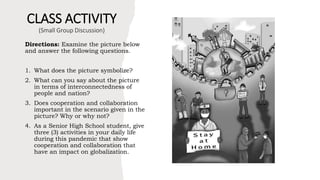
CLASS ACTIVITY
(Small Group Discussion)
Directions: Examine the picture below
and answer the following questions.
1. What does the picture symbolize?
2. What can you say about the picture
in terms of interconnectedness of
people and nation?
3. Does cooperation and collaboration
important in the scenario given in the
picture? Why or why not?
4. As a Senior High School student, give
three (3) activities in your daily life
during this pandemic that show
cooperation and collaboration that
have an impact on globalization.
LESSON 5 - GLOBAL NETWORKS 1.pptx

LESSON 5 - GLOBAL NETWORKS 1.pptx

  • 1.
    GLOBAL NETWORKS :I ERROL P. BAYONETA
  • 2.
    OBJECTIVES At the endof the lesson the learners are able to: 1. give examples of various activities in one’s daily life that show the concrete effects of globalization (HUMSS_MCT12If-g-1); 2. explain the concrete effects of globalization to one’s daily life (HUMSS_MCT12-if-g-2); 3. explain the need for collaboration and cooperation to achieve interconnectedness of people and nations (HUMSS_MCT12-if-g-4); and a. show the interconnectedness of people and nations (HUMSS_MCT12If-g-3).
  • 3.
    Global Networks Did you knowthat in the early and late 1980’s, one most popular means of reaching out to loved ones from abroad to their families in the Philippines was through “voice tapes?” You might not be aware of it though, but it takes about a month or months for a taped recorded voice message to be played by their families using cassette tape players. Well, that was prior to our era of today when almost anything can be accessed in real time despite global distance. Now, that gave birth to the present concept of globalization. Generally, globalization was born out of the inter-linkages of nation – states which has in varied ways influenced the life of people worldwide.
  • 4.
    We might notbe able to enumerate the effects of globalization in our daily lives but in this module, it will help you deepen your understanding about globalization. Let us now study the meaning, nature and various activities in one’s daily life that show some concrete effects of globalization.
  • 5.
    Globalization As citedin the Revisitadestatica (2012), the term globalization refers to the emergence of an international network, belonging to an economic and social system. One of the earliest uses of the term "globalization", as known, was in 1930 - in a publication entitled “Towards New Education” to designate an overview of the human experience in education.
  • 6.
    Since the inventionof the concept, globalization has inspired numerous definitions and has had a history going back in time to the great commercial and imperialist movements throughout Asia and the Indian Ocean since the fifteenth century.
  • 7.
    • Roland Robertson,a professor of sociology at the University of Aberden, was the first person who defined globalization as "the understanding of the world and the increased perception of the world as a whole." • Martin Albrow and Elizabeth King, sociologists, define globalization as "all those processes by which the peoples of the world are incorporated into a single world society.
  • 8.
    It can belinked to the local, the national and the regional. On the one hand, a connection is made between social and economic relationships and networks, organized on a local or national, on the other hand, it connects social and economic relationships and networks formed on wider scale the regional and global interactions.
  • 9.
    It is aprocess of interaction and integration among the people, companies, and governments of different nations. A process driven by international trade and investment and aided by information technology. This process has effects on the environment, on culture, on political systems, on economic development and prosperity, and on human physical well-being on societies around the world. For many developing nations, globalization has led to an improvement in standard of living through improved roads and transportation, improved health care, and improved education due to the global expansion of corporations. However, globalization has had a negative effect on individuals who live in developed nations. Some of the factors that cause globalization are migration and labor.
  • 10.
    Migration is amovement to another place, often of a large group of people. Labor is defined as work, especially hard physical work. People are more willing to move between different countries today in search for work. Remittances now play a large role in transfers from developed countries to developing countries.
  • 11.
  • 12.
    Economic Globalization is the increasingeconomic integration and interdependence of national, regional, and local economies across the world through an intensification of cross boarder movement of goods, services, technologies and capital. Examples: • Trans-national trades are companies that extend beyond the borders of one country example of these are Unilever and McDonalds • World Trade Organization is the only global international organization dealing with the rules of trade between nations. The WTO has 164 members and 24 observer governments. • Foreign Direct Investment is an investment in the form of a controlling ownership in a business in one country by an entity based in another country. It is thus distinguished from a foreign portfolio investment by a notion of direct control. In 2019, China and South Korea followed Singapore as the largest investors in the Philippines.
  • 13.
    Social Globalization is asocial transformation or process leading to the achievement of people- centered development. Human-centered development concept is offered as an alternative strategy to bring about a more equity development outcome. Examples: • UN General Assembly • Partnership of International Development Programs • Social Integration, Gender Equity and access to Social Services • HIV/AIDS Awareness
  • 14.
    Political Globalization refers to anincreasing trend toward multilateralism in an emerging transnational state apparatus and the emergence of national and international non- governmental organizations that act as watchdogs over governments. The government has four distinct roles in addressing sustainability concerns. These roles are as follows: 1. Policy development 2. Regulation 3. Facilitation 4. Internal sustainability management
  • 15.
    Financial Globalization is a collectiveconcept that refers to increasing global linkages created through cross-border financial flows. Financial integration refers to an individual country's linkages to international capital markets.
  • 16.
    Technological Globalization is accelerated inlarge part by technological transmission, the spread of technology across borders. Although the Philippines is not the world's least technologically advanced country, it is far from leading. It ranks 83rd out of 138 countries in terms of technological readiness, according to the Department of Science and Technology (DOST).
  • 17.
    Ecological Globalization occurs when ecosystemsare constantly exchanging materials through the movement of air in the atmosphere, the flow of water in rivers and the migration of animals across the landscape. The world is also becoming highly interconnected through the movement of people and the transport of goods locally to globally (EurekAlert.com).
  • 18.
    Geographical Globalization is defined asthe set of processes (economic, social, cultural, technological, and institutional that contributes to the relationship between societies and individuals around the world. It is a progressive process by which exchanges and flows between different parts of the world are intensified.
  • 19.
    Let us now identifysome positive and negative effects of Globalization.
  • 20.
  • 21.
    Globalization leads tointerconnectedness of people and nations, where people refer to a group of people with commonality, such as religion, culture and language who lives in a specific area, while nation refers to a larger group of people organized in a specific place, which embodied an independent government of its country where they can decide on their own.
  • 22.
    Try to imaginehow can we connect to our loved ones especially in this time of pandemic without technologies? Cell phones connect people all over the world like never before. There are a multitude of platforms through which people can communicate too, including Facebook Messenger, WhatsApp, Instagram, and Snapchat. Considering the new normal education, how can we enroll in our online educational programs in school from anywhere in the Philippines without the different platforms and access new information on virtual topics?
  • 23.
    Collaboration means towork together with others to achieve a common goal. Unconditionally sharing everything and helping each other while mutually working together in cohesive “collective” in unusual roles embracing talents of each person to synergize or invent something new in a way that: a. benefits all the groups, b. serves the whole team’s goal, and c. may result to creative innovation.
  • 24.
    Cooperation is theprocess of working together to the same end. It is an active help from a person, organization etc. such as an orderly sharing of space and resources. Cooperation means conditionally sharing information and resources while functioning together within an independent “connective” in typical roles with workloads accepted as unequal to change something in a way that: a. benefits some individuals in a group, b. meets their personal needs, and c. may result in disrupted innovation.
  • 25.
    CLASS ACTIVITY (Small GroupDiscussion) Directions: Examine the picture below and answer the following questions. 1. What does the picture symbolize? 2. What can you say about the picture in terms of interconnectedness of people and nation? 3. Does cooperation and collaboration important in the scenario given in the picture? Why or why not? 4. As a Senior High School student, give three (3) activities in your daily life during this pandemic that show cooperation and collaboration that have an impact on globalization.
Editor's Notes

  • #6 What does globalization means? Emergence- arise, nangyayari sa boung daigdig especially in terms in economic and social system. At ang term na globalization ay unang ginamit noong 1930 at ito ay naipublished gamit ang titulong “towards new education
  • #7 Simula ng nabuo ang concepto ng globalization, ito ay nag karoon ng ibat ibang kahulogan or meanings sa larangan ng Negosyo at kapangyarihan through out asia
  • #10 Globalization has many good effects in terms of:environment, on culture, on political ,……. developing nations- mga bansa na hndi gaanong mayayaman , like philippines
  • #13 Their branches are not only in one country, but have other franchises or branches in other countries, but they are originally made in Philippines. wto, -sya ang may hawak ng mga rules/patakan in terms in economic ,Philippines is a member of wto. Foreign Direct Investment – ibang natioanilty/lahi ang nag nenegosyo sa isang bansa, notion of direct control- sila ang may concept na magmamahala at sila ang may control sa Negosyo since sila ang may ari ng kanilang Negosyo sa ating bansa.
  • #14 Social Globalization -achievement of people-centered development
  • #15 act as watchdogs over governments- who are they? They are developed countries
  • #16 Developed countries always in control over the purchasing power of developing country’s currency. Financial flows –example ng pag taas ng peso vs dollar.
  • #17 Hndi man tayo ang pinaka huli in terms sa technology but----?
  • #18 constantly exchanging – unti unting nagbabago- While developed countries making their lots of money, they are destroying environment in terms of their toxic waste and most affected of it is developing countries
  • #19 Geographic– has changes over the physical nature of the earth that GLOBALIZATION ALL ABOUT, NOW LET US PROCEED TO
  • #20 POSITIVE- opportunities 1.Negative-inequalities 2.positive-cheaper import, large export 2.Negative-dominated by other multinationals,maximize their profits(ang mayayaman ay nagiging mayaman, ang mahihirap ay nagiging mahirao) 3.positive-pwede tayong mag karoon Negosyo sa iabng coutries 3.negative- developing countries are struggling from environmental standard of developd countries. 4.positive-