Medication using during cardiac
arrest:
Objectives of drug Treatment:
• To correct hypoxia.
• To correct metabolic acidosis.
• Increase cardiac perfusion during CPR.
• Stimulate cardiac contraction.
• Accelerate heart rate.
• Relieve pain &
• Treat pulmonary edema.
EMERGENCY MEDICATION
General Principles:
• All drugs must be given as bolus dose.
• No chance to give wrong dose.
• No time wasted.
• Always flush with 20 ml NS and raising
the arm.
EMERGENCY MEDICATION
Routes of administration:
• Intravenous: Peripheral or Central line.
• Oral route: Via ET tube: Dose is 2.5 times
the IV dose.
• Intracardiac: Cardiocenthesis technique.
• Intra osseous route: For the children
usually.
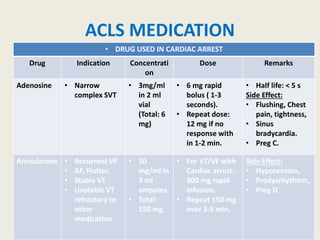
ACLS MEDICATION
• DRUG USED IN CARDIAC ARREST
Drug Indication Concentrati
on
Dose Remarks
Adenosine • Narrow
complex SVT
• 3mg/ml
in 2 ml
vial
(Total: 6
mg)
• 6 mg rapid
bolus ( 1-3
seconds).
• Repeat dose:
12 mg if no
response with
in 1-2 min.
• Half life: < 5 s
Side Effect:
• Flushing, Chest
pain, tightness,
• Sinus
bradycardia.
• Preg C.
Amiodarone • Recurrent VF
• AF, Flutter,
• Stable VT
• Unstable VT
refractory to
other
medication.
• 50
mg/ml in
3 ml
ampules.
• Total:
150 mg.
• For VT/VF with
Cardiac arrest:
300 mg rapid
infusion.
• Repeat 150 mg
over 3-5 min.
Side Effect:
• Hypotension,
• Prodysrhythmic,
• Preg D
Adenosine
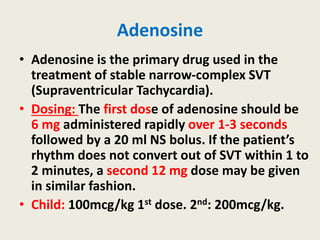
• Adenosine is the primary drug used in the
treatment of stable narrow-complex SVT
(Supraventricular Tachycardia).
• Dosing: The first dose of adenosine should be
6 mg administered rapidly over 1-3 seconds
followed by a 20 ml NS bolus. If the patient’s
rhythm does not convert out of SVT within 1 to
2 minutes, a second 12 mg dose may be given
in similar fashion.
• Child: 100mcg/kg 1st dose. 2nd: 200mcg/kg.
Adenosine
• Caution: Prodysrhythmic, do not give in
preexisting 2nd or 3rd degree block,
Preg C.
ACLS MEDICATION
• DRUG USED IN CARDIAC ARREST
Drug Indication Concentrati
on
Dose Remarks
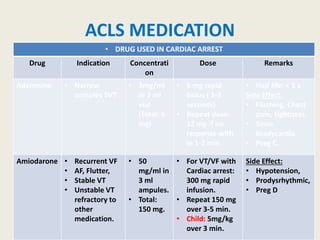
Adenosine • Narrow
complex SVT
• 3mg/ml
in 2 ml
vial
(Total: 6
mg)
• 6 mg rapid
bolus ( 1-3
seconds).
• Repeat dose:
12 mg if no
response with
in 1-2 min.
• Half life: < 5 s
Side Effect:
• Flushing, Chest
pain, tightness,
• Sinus
bradycardia.
• Preg C.
Amiodarone • Recurrent VF
• AF, Flutter,
• Stable VT
• Unstable VT
refractory to
other
medication.
• 50
mg/ml in
3 ml
ampules.
• Total:
150 mg.
• For VT/VF with
Cardiac arrest:
300 mg rapid
infusion.
• Repeat 150 mg
over 3-5 min.
• Child: 5mg/kg
over 3 min.
Side Effect:
• Hypotension,
• Prodysrhythmic,
• Preg D
Amiodarone
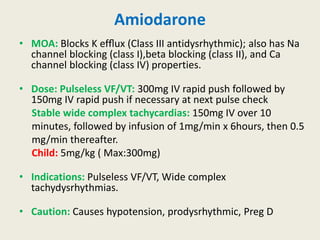
• MOA: Blocks K efflux (Class III antidysrhythmic); also has Na
channel blocking (class I),beta blocking (class II), and Ca
channel blocking (class IV) properties.
• Dose: Pulseless VF/VT: 300mg IV rapid push followed by
150mg IV rapid push if necessary at next pulse check
Stable wide complex tachycardias: 150mg IV over 10
minutes, followed by infusion of 1mg/min x 6hours, then 0.5
mg/min thereafter.
Child: 5mg/kg ( Max:300mg)
• Indications: Pulseless VF/VT, Wide complex
tachydysrhythmias.
• Caution: Causes hypotension, prodysrhythmic, Preg D
ACLS MEDICATION
• DRUG USED IN CARDIAC ARREST
Drug Indication Concentrati
on
Dose Remarks
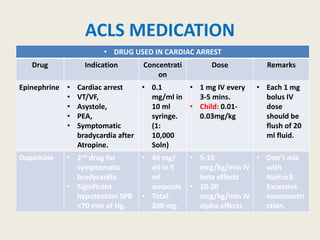
Epinephrine • Cardiac arrest
• VT/VF,
• Asystole,
• PEA,
• Symptomatic
bradycardia after
Atropine.
• 0.1
mg/ml in
10 ml
syringe.
(1:
10,000
Soln)
• 1 mg IV every
3-5 mins.
• Child: 0.01-
0.03mg/kg
• Each 1 mg
bolus IV
dose
should be
flush of 20
ml fluid.
Dopamine • 2nd drug for
symptomatic
bradycardia.
• Significant
hypotention SPB
<70 mm of Hg.
• 40 mg/
ml in 5
ml
ampoule.
• Total:
200 mg.
• 5-10
mcg/kg/min IV
beta effects
• 10-20
mcg/kg/min IV
alpha effects
• Don’t mix
with
NaHco3:
Excessive
vasoconstri
ction.
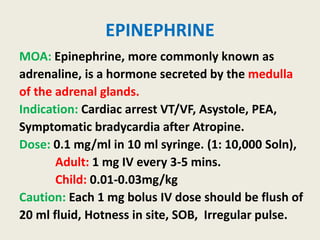
EPINEPHRINE
MOA: Epinephrine, more commonly known as
adrenaline, is a hormone secreted by the medulla
of the adrenal glands.
Indication: Cardiac arrest VT/VF, Asystole, PEA,
Symptomatic bradycardia after Atropine.
Dose: 0.1 mg/ml in 10 ml syringe. (1: 10,000 Soln),
Adult: 1 mg IV every 3-5 mins.
Child: 0.01-0.03mg/kg
Caution: Each 1 mg bolus IV dose should be flush of
20 ml fluid, Hotness in site, SOB, Irregular pulse.
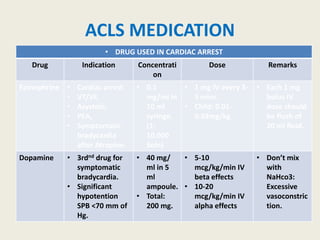
ACLS MEDICATION
• DRUG USED IN CARDIAC ARREST
Drug Indication Concentrati
on
Dose Remarks
Epinephrine • Cardiac arrest
• VT/VF,
• Asystole,
• PEA,
• Symptomatic
bradycardia
after Atropine.
• 0.1
mg/ml in
10 ml
syringe.
(1:
10,000
Soln)
• 1 mg IV every 3-
5 mins.
• Child: 0.01-
0.03mg/kg
• Each 1 mg
bolus IV
dose should
be flush of
20 ml fluid.
Dopamine • 3rdnd drug for
symptomatic
bradycardia.
• Significant
hypotention
SPB <70 mm of
Hg.
• 40 mg/
ml in 5
ml
ampoule.
• Total:
200 mg.
• 5-10
mcg/kg/min IV
beta effects
• 10-20
mcg/kg/min IV
alpha effects
• Don’t mix
with
NaHco3:
Excessive
vasoconstric
tion.
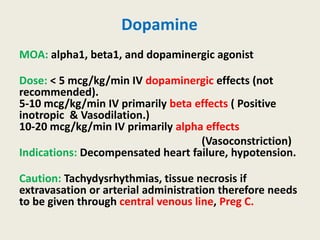
Dopamine
MOA: alpha1, beta1, and dopaminergic agonist
Dose: < 5 mcg/kg/min IV dopaminergic effects (not
recommended).
5-10 mcg/kg/min IV primarily beta effects ( Positive
inotropic & Vasodilation.)
10-20 mcg/kg/min IV primarily alpha effects
(Vasoconstriction)
Indications: Decompensated heart failure, hypotension.
Caution: Tachydysrhythmias, tissue necrosis if
extravasation or arterial administration therefore needs
to be given through central venous line, Preg C.
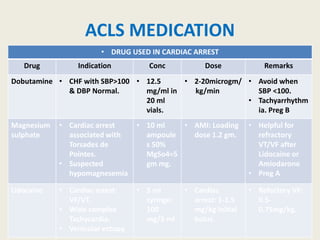
ACLS MEDICATION
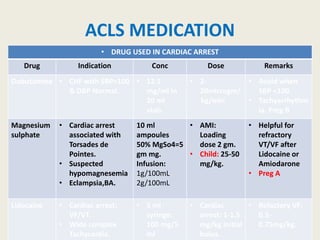
• DRUG USED IN CARDIAC ARREST
Drug Indication Conc Dose Remarks
Dobutamine • CHF with SBP>100
& DBP Normal.
• 12.5
mg/ml in
20 ml
vials.
• 2-20microgm/
kg/min
• Avoid when
SBP <100.
• Tachyarrhythm
ia. Preg B
Magnesium
sulphate
• Cardiac arrest
associated with
Torsades de
Pointes.
• Suspected
hypomagnesemia
• 10 ml
ampoule
s 50%
MgSo4=5
gm mg.
• AMI: Loading
dose 1.2 gm.
• Helpful for
refractory
VT/VF after
Lidocaine or
Amiodarone
• Preg A
Lidocaine • Cardiac arrest:
VF/VT.
• Wide complex
Tachycardia.
• Venicular ectopy.
• 5 ml
syringe:
100
mg/5 ml
• Cardiac
arrest: 1-1.5
mg/kg initial
bolus.
• Refactory VF:
0.5-
0.75mg/kg.
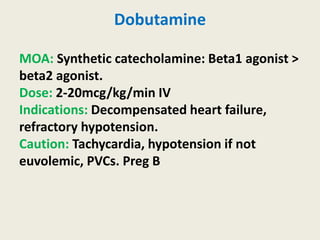
Dobutamine
MOA: Synthetic catecholamine: Beta1 agonist >
beta2 agonist.
Dose: 2-20mcg/kg/min IV
Indications: Decompensated heart failure,
refractory hypotension.
Caution: Tachycardia, hypotension if not
euvolemic, PVCs. Preg B
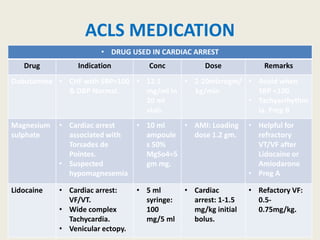
ACLS MEDICATION
• DRUG USED IN CARDIAC ARREST
Drug Indication Conc Dose Remarks
Dobutamine • CHF with SBP>100
& DBP Normal.
• 12.5
mg/ml in
20 ml
vials.
• 2-
20microgm/
kg/min
• Avoid when
SBP <100.
• Tachyarrhythm
ia. Preg B
Magnesium
sulphate
• Cardiac arrest
associated with
Torsades de
Pointes.
• Suspected
hypomagnesemia
• Eclampsia,BA.
10 ml
ampoules
50% MgSo4=5
gm mg.
Infusion:
1g/100mL
2g/100mL
• AMI:
Loading
dose 2 gm.
• Child: 25-50
mg/kg.
• Helpful for
refractory
VT/VF after
Lidocaine or
Amiodarone
• Preg A
Lidocaine • Cardiac arrest:
VF/VT.
• Wide complex
Tachycardia.
• 5 ml
syringe:
100 mg/5
ml
• Cardiac
arrest: 1-1.5
mg/kg initial
bolus.
• Refactory VF:
0.5-
0.75mg/kg.
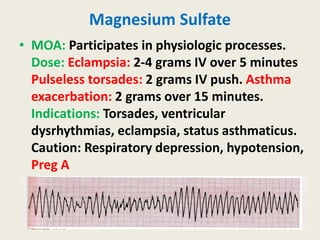
Magnesium Sulfate
• MOA: Participates in physiologic processes.
Dose: Eclampsia: 2-4 grams IV over 5 minutes
Pulseless torsades: 2 grams IV push. Asthma
exacerbation: 2 grams over 15 minutes.
Indications: Torsades, ventricular
dysrhythmias, eclampsia, status asthmaticus.
Caution: Respiratory depression, hypotension,
Preg A
ACLS MEDICATION
• DRUG USED IN CARDIAC ARREST
Drug Indication Conc Dose Remarks
Dobutamine • CHF with SBP>100
& DBP Normal.
• 12.5
mg/ml in
20 ml
vials.
• 2-20microgm/
kg/min
• Avoid when
SBP <100.
• Tachyarrhythm
ia. Preg B
Magnesium
sulphate
• Cardiac arrest
associated with
Torsades de
Pointes.
• Suspected
hypomagnesemia
• 10 ml
ampoule
s 50%
MgSo4=5
gm mg.
• AMI: Loading
dose 1.2 gm.
• Helpful for
refractory
VT/VF after
Lidocaine or
Amiodarone
• Preg A
Lidocaine • Cardiac arrest:
VF/VT.
• Wide complex
Tachycardia.
• Venicular ectopy.
• 5 ml
syringe:
100
mg/5 ml
• Cardiac
arrest: 1-1.5
mg/kg initial
bolus.
• Refactory VF:
0.5-
0.75mg/kg.
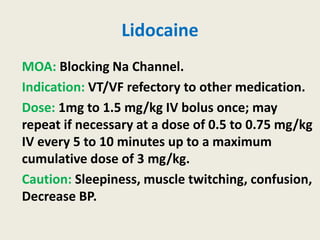
Lidocaine
MOA: Blocking Na Channel.
Indication: VT/VF refectory to other medication.
Dose: 1mg to 1.5 mg/kg IV bolus once; may
repeat if necessary at a dose of 0.5 to 0.75 mg/kg
IV every 5 to 10 minutes up to a maximum
cumulative dose of 3 mg/kg.
Caution: Sleepiness, muscle twitching, confusion,
Decrease BP.
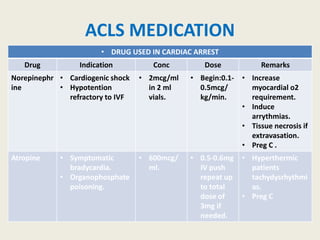
ACLS MEDICATION
• DRUG USED IN CARDIAC ARREST
Drug Indication Conc Dose Remarks
Norepinephr
ine
• Cardiogenic shock
• Hypotention
refractory to IVF
• 2mcg/ml
in 2 ml
vials.
• Begin:0.1-
0.5mcg/
kg/min.
• Increase
myocardial o2
requirement.
• Induce
arrythmias.
• Tissue necrosis if
extravasation.
• Preg C .
Atropine • Symptomatic
bradycardia.
• Organophosphate
poisoning.
• 600mcg/
ml.
• 0.5-0.6mg
IV push
repeat up
to total
dose of
3mg if
needed.
• Hyperthermic
patients
tachydysrhythmi
as.
• Preg C
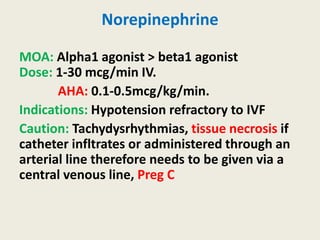
Norepinephrine
MOA: Alpha1 agonist > beta1 agonist
Dose: 1-30 mcg/min IV.
AHA: 0.1-0.5mcg/kg/min.
Indications: Hypotension refractory to IVF
Caution: Tachydysrhythmias, tissue necrosis if
catheter infltrates or administered through an
arterial line therefore needs to be given via a
central venous line, Preg C
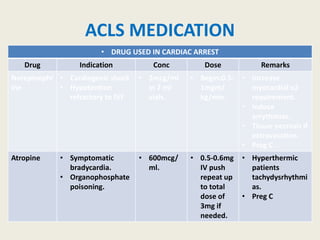
ACLS MEDICATION
• DRUG USED IN CARDIAC ARREST
Drug Indication Conc Dose Remarks
Norepinephr
ine
• Cardiogenic shock
• Hypotention
refractory to IVF
• 2mcg/ml
in 2 ml
vials.
• Begin:0.5-
1mgm/
kg/min.
• Increase
myocardial o2
requirement.
• Induce
arrythmias.
• Tissue necrosis if
extravasation.
• Preg C .
Atropine • Symptomatic
bradycardia.
• Organophosphate
poisoning.
• 600mcg/
ml.
• 0.5-0.6mg
IV push
repeat up
to total
dose of
3mg if
needed.
• Hyperthermic
patients
tachydysrhythmi
as.
• Preg C
Atropine
• MOA: Direct anticholinergic.
• Dose: Organophosphate/carbamate toxicity: 1-6 mg IV
q 3-5 minutes PRN, until dry secretions (can double
dose each time until adequate response achieved)
Pedia: Bradycardia: 0.02 mg/kg IVx1; 0.5 mg max
single dose; 1 mg max.
Adult: Bradycardia: 0.5 mg IV, 3 mg max.
• Indications: Organophosphate/carbamate toxicity,
bradycardia.
• Caution: Hyperthermic patients, tachydysrhythmias,
Preg C. Physostagmin antidot.
Sodium Bicarbonate
MOA: Increases serum bicarbonate (increases buffer stores)
Dose: Hyperkalemia or metabolic acidosis: 50 mEq IV x 1 (1
amp = 50 mEq).
TCA toxicity: 1-2 mEq/kg IV bolus to achieve a serum pH of
7.45-7.55 and QRS narrowing; effective serum alkalinization
unlikely with continuous infusion.
Salicylate toxicity: 3 amps (150mEq) in 1 liter D5W given as 10-
20 ml/kg bolus,then 2-3ml/kg/hr; goal urine pH 7.5-8.0
Indications: hyperkalemia, TCA toxicity, salicylate toxicity,
metabolic acidosis.
Caution: Caution in CHF, overshooting into metabolic alkalosis,
hypernatremia, Preg C
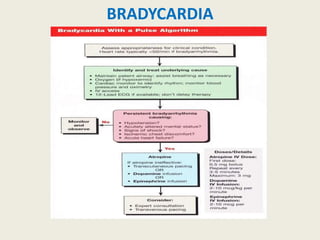
BRADYCARDIA
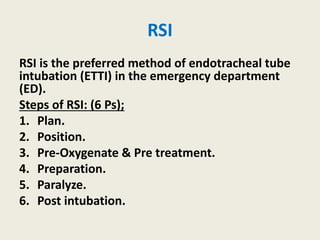
RSI
RSI is the preferred method of endotracheal tube
intubation (ETTI) in the emergency department
(ED).
Steps of RSI: (6 Ps);
1. Plan.
2. Position.
3. Pre-Oxygenate & Pre treatment.
4. Preparation.
5. Paralyze.
6. Post intubation.
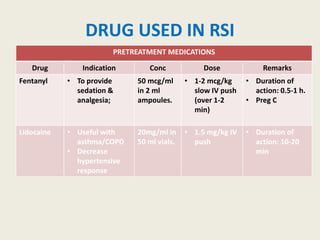
DRUG USED IN RSI
PRETREATMENT MEDICATIONS
Drug Indication Conc Dose Remarks
Fentanyl • To provide
sedation &
analgesia;
50 mcg/ml
in 2 ml
ampoules.
• 1-2 mcg/kg
slow IV push
(over 1-2
min)
• Duration of
action: 0.5-1 h.
• Preg C
Lidocaine • Useful with
asthma/COPD
• Decrease
hypertensive
response
20mg/ml in
50 ml vials.
• 1.5 mg/kg IV
push
• Duration of
action: 10-20
min
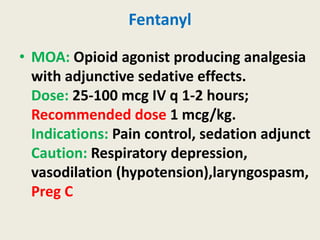
Fentanyl
• MOA: Opioid agonist producing analgesia
with adjunctive sedative effects.
Dose: 25-100 mcg IV q 1-2 hours;
Recommended dose 1 mcg/kg.
Indications: Pain control, sedation adjunct
Caution: Respiratory depression,
vasodilation (hypotension),laryngospasm,
Preg C
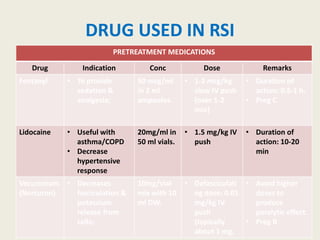
DRUG USED IN RSI
PRETREATMENT MEDICATIONS
Drug Indication Conc Dose Remarks
Fentanyl • To provide
sedation &
analgesia;
50 mcg/ml
in 2 ml
ampoules.
• 1-2 mcg/kg
slow IV push
(over 1-2
min)
• Duration of
action: 0.5-1 h.
• Preg C
Lidocaine • Useful with
asthma/COPD
• Decrease
hypertensive
response
20mg/ml in
50 ml vials.
• 1.5 mg/kg IV
push
• Duration of
action: 10-20
min
Vecuronium
(Norcuron)
• Decreases
fasciculation &
potassium
release from
cells;
10mg/vial
mix with 10
ml DW.
• Defasciculati
ng dose: 0.01
mg/kg IV
push
(typically
about 1 mg,
• Avoid higher
doses to
produce
paralytic effect.
• Preg B
Lidocaine
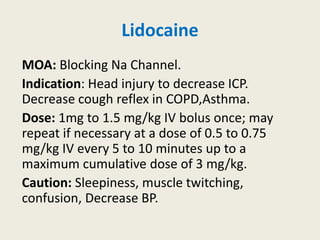
MOA: Blocking Na Channel.
Indication: Head injury to decrease ICP.
Decrease cough reflex in COPD,Asthma.
Dose: 1mg to 1.5 mg/kg IV bolus once; may
repeat if necessary at a dose of 0.5 to 0.75
mg/kg IV every 5 to 10 minutes up to a
maximum cumulative dose of 3 mg/kg.
Caution: Sleepiness, muscle twitching,
confusion, Decrease BP.
DRUG USED IN RSI
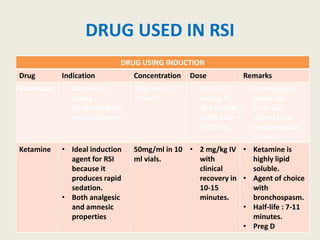
DRUG USING INDUCTION
Drug Indication Concentration Dose Remarks
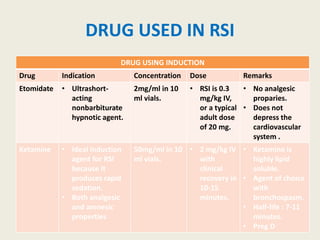
Etomidate • Ultrashort-
acting
nonbarbiturate
hypnotic agent.
2mg/ml in 10
ml vials.
• RSI is 0.3
mg/kg IV,
or a typical
adult dose
of 20 mg.
• No analgesic
proparies.
• Does not
depress the
cardiovascular
system .
Ketamine • Ideal induction
agent for RSI
because it
produces rapid
sedation.
• Both analgesic
and amnesic
properties
50mg/ml in 10
ml vials.
• 2 mg/kg IV
with
clinical
recovery in
10-15
minutes.
• Ketamine is
highly lipid
soluble.
• Agent of choice
with
bronchospasm.
• Half-life : 7-11
minutes.
• Preg D
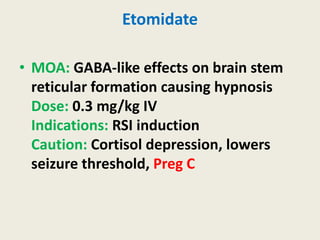
Etomidate
• MOA: GABA-like effects on brain stem
reticular formation causing hypnosis
Dose: 0.3 mg/kg IV
Indications: RSI induction
Caution: Cortisol depression, lowers
seizure threshold, Preg C
DRUG USED IN RSI
DRUG USING INDUCTION
Drug Indication Concentration Dose Remarks
Etomidate • Ultrashort-
acting
nonbarbiturate
hypnotic agent.
2mg/ml in 10
ml vials.
• RSI is 0.3
mg/kg IV,
or a typical
adult dose
of 20 mg.
• No analgesic
proparies.
• Does not
depress the
cardiovascular
system .
Ketamine • Ideal induction
agent for RSI
because it
produces rapid
sedation.
• Both analgesic
and amnesic
properties
50mg/ml in 10
ml vials.
• 2 mg/kg IV
with
clinical
recovery in
10-15
minutes.
• Ketamine is
highly lipid
soluble.
• Agent of choice
with
bronchospasm.
• Half-life : 7-11
minutes.
• Preg D
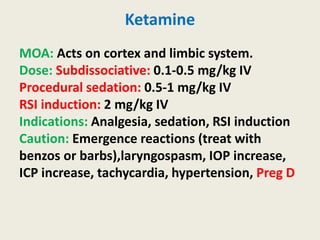
Ketamine
MOA: Acts on cortex and limbic system.
Dose: Subdissociative: 0.1-0.5 mg/kg IV
Procedural sedation: 0.5-1 mg/kg IV
RSI induction: 2 mg/kg IV
Indications: Analgesia, sedation, RSI induction
Caution: Emergence reactions (treat with
benzos or barbs),laryngospasm, IOP increase,
ICP increase, tachycardia, hypertension, Preg D
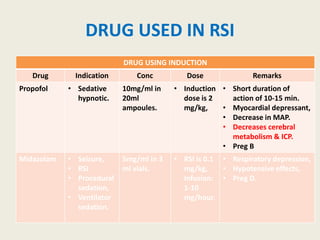
DRUG USED IN RSI
DRUG USING INDUCTION
Drug Indication Conc Dose Remarks
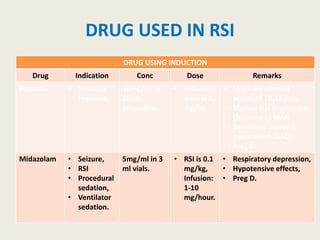
Propofol • Sedative
hypnotic.
10mg/ml in
20ml
ampoules.
• Induction
dose is 2
mg/kg,
• Short duration of
action of 10-15 min.
• Myocardial depressant,
• Decrease in MAP.
• Decreases cerebral
metabolism & ICP.
• Preg B
Midazolam • Seizure,
• RSI
• Procedural
sedation,
• Ventilator
sedation.
5mg/ml in 3
ml vials.
• RSI is 0.1
mg/kg,
Infusion:
1-10
mg/hour.
• Respiratory depression,
• Hypotensive effects,
• Preg D.
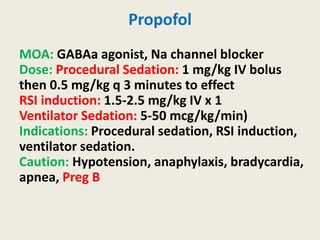
Propofol
MOA: GABAa agonist, Na channel blocker
Dose: Procedural Sedation: 1 mg/kg IV bolus
then 0.5 mg/kg q 3 minutes to effect
RSI induction: 1.5-2.5 mg/kg IV x 1
Ventilator Sedation: 5-50 mcg/kg/min)
Indications: Procedural sedation, RSI induction,
ventilator sedation.
Caution: Hypotension, anaphylaxis, bradycardia,
apnea, Preg B
DRUG USED IN RSI
DRUG USING INDUCTION
Drug Indication Conc Dose Remarks
Propofol • Sedative
hypnotic.
10mg/ml in
20ml
ampoules.
• Induction
dose is 2
mg/kg,
• Short duration of
action of 10-15 min.
• Myocardial depressant,
• Decrease in MAP.
• Decreases cerebral
metabolism & ICP.
• Preg B
Midazolam • Seizure,
• RSI
• Procedural
sedation,
• Ventilator
sedation.
5mg/ml in 3
ml vials.
• RSI is 0.1
mg/kg,
Infusion:
1-10
mg/hour.
• Respiratory depression,
• Hypotensive effects,
• Preg D.
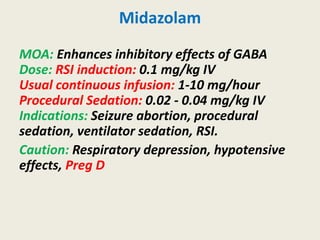
Midazolam
MOA: Enhances inhibitory effects of GABA
Dose: RSI induction: 0.1 mg/kg IV
Usual continuous infusion: 1-10 mg/hour
Procedural Sedation: 0.02 - 0.04 mg/kg IV
Indications: Seizure abortion, procedural
sedation, ventilator sedation, RSI.
Caution: Respiratory depression, hypotensive
effects, Preg D
DRUG USED IN RSI
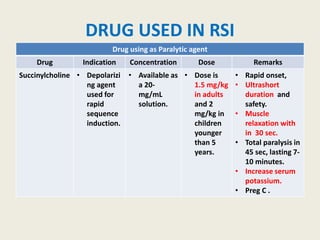
Drug using as Paralytic agent
Drug Indication Concentration Dose Remarks
Succinylcholine • Depolarizi
ng agent
used for
rapid
sequence
induction.
• Available as
a 20-
mg/mL
solution.
• Dose is
1.5 mg/kg
in adults
and 2
mg/kg in
children
younger
than 5
years.
• Rapid onset,
• Ultrashort
duration and
safety.
• Muscle
relaxation with
in 30 sec.
• Total paralysis in
45 sec, lasting 7-
10 minutes.
• Increase serum
potassium.
• Preg C .
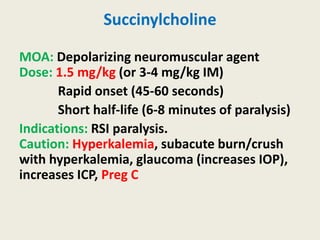
Succinylcholine
MOA: Depolarizing neuromuscular agent
Dose: 1.5 mg/kg (or 3-4 mg/kg IM)
Rapid onset (45-60 seconds)
Short half-life (6-8 minutes of paralysis)
Indications: RSI paralysis.
Caution: Hyperkalemia, subacute burn/crush
with hyperkalemia, glaucoma (increases IOP),
increases ICP, Preg C
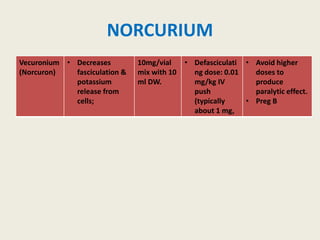
NORCURIUM
Vecuronium
(Norcuron)
• Decreases
fasciculation &
potassium
release from
cells;
10mg/vial
mix with 10
ml DW.
• Defasciculati
ng dose: 0.01
mg/kg IV
push
(typically
about 1 mg,
• Avoid higher
doses to
produce
paralytic effect.
• Preg B
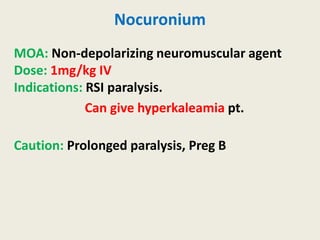
Nocuronium
MOA: Non-depolarizing neuromuscular agent
Dose: 1mg/kg IV
Indications: RSI paralysis.
Can give hyperkaleamia pt.
Caution: Prolonged paralysis, Preg B
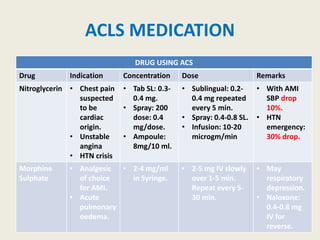
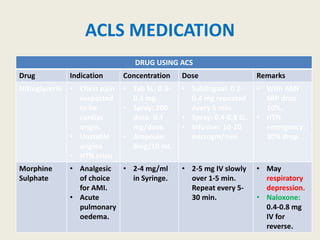
ACLS MEDICATION
DRUG USING ACS
Drug Indication Concentration Dose Remarks
Nitroglycerin • Chest pain
suspected
to be
cardiac
origin.
• Unstable
angina
• HTN crisis
• Tab SL: 0.3-
0.4 mg.
• Spray: 200
dose: 0.4
mg/dose.
• Ampoule:
8mg/10 ml.
• Sublingual: 0.2-
0.4 mg repeated
every 5 min.
• Spray: 0.4-0.8 SL.
• Infusion: 10-20
microgm/min
• With AMI
SBP drop
10%.
• HTN
emergency:
30% drop.
Morphine
Sulphate
• Analgesic
of choice
for AMI.
• Acute
pulmonary
oedema.
• 2-4 mg/ml
in Syringe.
• 2-5 mg IV slowly
over 1-5 min.
Repeat every 5-
30 min.
• May
respiratory
depression.
• Naloxone:
0.4-0.8 mg
IV for
reverse.
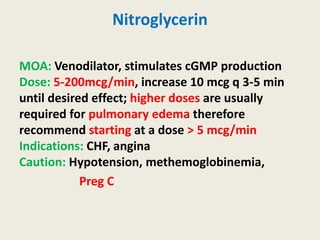
Nitroglycerin
MOA: Venodilator, stimulates cGMP production
Dose: 5-200mcg/min, increase 10 mcg q 3-5 min
until desired effect; higher doses are usually
required for pulmonary edema therefore
recommend starting at a dose > 5 mcg/min
Indications: CHF, angina
Caution: Hypotension, methemoglobinemia,
Preg C
ACLS MEDICATION
DRUG USING ACS
Drug Indication Concentration Dose Remarks
Nitroglycerin • Chest pain
suspected
to be
cardiac
origin.
• Unstable
angina
• HTN crisis
• Tab SL: 0.3-
0.4 mg.
• Spray: 200
dose: 0.4
mg/dose.
• Ampoule:
8mg/10 ml.
• Sublingual: 0.2-
0.4 mg repeated
every 5 min.
• Spray: 0.4-0.8 SL.
• Infusion: 10-20
microgm/min
• With AMI
SBP drop
10%.
• HTN
emergency:
30% drop.
Morphine
Sulphate
• Analgesic
of choice
for AMI.
• Acute
pulmonary
oedema.
• 2-4 mg/ml
in Syringe.
• 2-5 mg IV slowly
over 1-5 min.
Repeat every 5-
30 min.
• May
respiratory
depression.
• Naloxone:
0.4-0.8 mg
IV for
reverse.
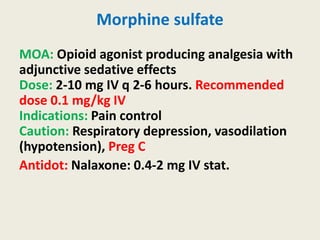
Morphine sulfate
MOA: Opioid agonist producing analgesia with
adjunctive sedative effects
Dose: 2-10 mg IV q 2-6 hours. Recommended
dose 0.1 mg/kg IV
Indications: Pain control
Caution: Respiratory depression, vasodilation
(hypotension), Preg C
Antidot: Nalaxone: 0.4-2 mg IV stat.
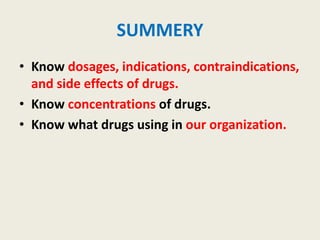
SUMMERY
• Know dosages, indications, contraindications,
and side effects of drugs.
• Know concentrations of drugs.
• Know what drugs using in our organization.
Prevent Cardiac Arrest!!

Acls pharmacology

  • 3.
    Medication using duringcardiac arrest: Objectives of drug Treatment: • To correct hypoxia. • To correct metabolic acidosis. • Increase cardiac perfusion during CPR. • Stimulate cardiac contraction. • Accelerate heart rate. • Relieve pain & • Treat pulmonary edema.
  • 4.
    EMERGENCY MEDICATION General Principles: •All drugs must be given as bolus dose. • No chance to give wrong dose. • No time wasted. • Always flush with 20 ml NS and raising the arm.
  • 5.
    EMERGENCY MEDICATION Routes ofadministration: • Intravenous: Peripheral or Central line. • Oral route: Via ET tube: Dose is 2.5 times the IV dose. • Intracardiac: Cardiocenthesis technique. • Intra osseous route: For the children usually.
  • 7.
    ACLS MEDICATION • DRUGUSED IN CARDIAC ARREST Drug Indication Concentrati on Dose Remarks Adenosine • Narrow complex SVT • 3mg/ml in 2 ml vial (Total: 6 mg) • 6 mg rapid bolus ( 1-3 seconds). • Repeat dose: 12 mg if no response with in 1-2 min. • Half life: < 5 s Side Effect: • Flushing, Chest pain, tightness, • Sinus bradycardia. • Preg C. Amiodarone • Recurrent VF • AF, Flutter, • Stable VT • Unstable VT refractory to other medication. • 50 mg/ml in 3 ml ampules. • Total: 150 mg. • For VT/VF with Cardiac arrest: 300 mg rapid infusion. • Repeat 150 mg over 3-5 min. Side Effect: • Hypotension, • Prodysrhythmic, • Preg D
  • 8.
    Adenosine • Adenosine isthe primary drug used in the treatment of stable narrow-complex SVT (Supraventricular Tachycardia). • Dosing: The first dose of adenosine should be 6 mg administered rapidly over 1-3 seconds followed by a 20 ml NS bolus. If the patient’s rhythm does not convert out of SVT within 1 to 2 minutes, a second 12 mg dose may be given in similar fashion. • Child: 100mcg/kg 1st dose. 2nd: 200mcg/kg.
  • 9.
    Adenosine • Caution: Prodysrhythmic,do not give in preexisting 2nd or 3rd degree block, Preg C.
  • 10.
    ACLS MEDICATION • DRUGUSED IN CARDIAC ARREST Drug Indication Concentrati on Dose Remarks Adenosine • Narrow complex SVT • 3mg/ml in 2 ml vial (Total: 6 mg) • 6 mg rapid bolus ( 1-3 seconds). • Repeat dose: 12 mg if no response with in 1-2 min. • Half life: < 5 s Side Effect: • Flushing, Chest pain, tightness, • Sinus bradycardia. • Preg C. Amiodarone • Recurrent VF • AF, Flutter, • Stable VT • Unstable VT refractory to other medication. • 50 mg/ml in 3 ml ampules. • Total: 150 mg. • For VT/VF with Cardiac arrest: 300 mg rapid infusion. • Repeat 150 mg over 3-5 min. • Child: 5mg/kg over 3 min. Side Effect: • Hypotension, • Prodysrhythmic, • Preg D
  • 11.
    Amiodarone • MOA: BlocksK efflux (Class III antidysrhythmic); also has Na channel blocking (class I),beta blocking (class II), and Ca channel blocking (class IV) properties. • Dose: Pulseless VF/VT: 300mg IV rapid push followed by 150mg IV rapid push if necessary at next pulse check Stable wide complex tachycardias: 150mg IV over 10 minutes, followed by infusion of 1mg/min x 6hours, then 0.5 mg/min thereafter. Child: 5mg/kg ( Max:300mg) • Indications: Pulseless VF/VT, Wide complex tachydysrhythmias. • Caution: Causes hypotension, prodysrhythmic, Preg D
  • 12.
    ACLS MEDICATION • DRUGUSED IN CARDIAC ARREST Drug Indication Concentrati on Dose Remarks Epinephrine • Cardiac arrest • VT/VF, • Asystole, • PEA, • Symptomatic bradycardia after Atropine. • 0.1 mg/ml in 10 ml syringe. (1: 10,000 Soln) • 1 mg IV every 3-5 mins. • Child: 0.01- 0.03mg/kg • Each 1 mg bolus IV dose should be flush of 20 ml fluid. Dopamine • 2nd drug for symptomatic bradycardia. • Significant hypotention SPB <70 mm of Hg. • 40 mg/ ml in 5 ml ampoule. • Total: 200 mg. • 5-10 mcg/kg/min IV beta effects • 10-20 mcg/kg/min IV alpha effects • Don’t mix with NaHco3: Excessive vasoconstri ction.
  • 13.
    EPINEPHRINE MOA: Epinephrine, morecommonly known as adrenaline, is a hormone secreted by the medulla of the adrenal glands. Indication: Cardiac arrest VT/VF, Asystole, PEA, Symptomatic bradycardia after Atropine. Dose: 0.1 mg/ml in 10 ml syringe. (1: 10,000 Soln), Adult: 1 mg IV every 3-5 mins. Child: 0.01-0.03mg/kg Caution: Each 1 mg bolus IV dose should be flush of 20 ml fluid, Hotness in site, SOB, Irregular pulse.
  • 14.
    ACLS MEDICATION • DRUGUSED IN CARDIAC ARREST Drug Indication Concentrati on Dose Remarks Epinephrine • Cardiac arrest • VT/VF, • Asystole, • PEA, • Symptomatic bradycardia after Atropine. • 0.1 mg/ml in 10 ml syringe. (1: 10,000 Soln) • 1 mg IV every 3- 5 mins. • Child: 0.01- 0.03mg/kg • Each 1 mg bolus IV dose should be flush of 20 ml fluid. Dopamine • 3rdnd drug for symptomatic bradycardia. • Significant hypotention SPB <70 mm of Hg. • 40 mg/ ml in 5 ml ampoule. • Total: 200 mg. • 5-10 mcg/kg/min IV beta effects • 10-20 mcg/kg/min IV alpha effects • Don’t mix with NaHco3: Excessive vasoconstric tion.
  • 15.
    Dopamine MOA: alpha1, beta1,and dopaminergic agonist Dose: < 5 mcg/kg/min IV dopaminergic effects (not recommended). 5-10 mcg/kg/min IV primarily beta effects ( Positive inotropic & Vasodilation.) 10-20 mcg/kg/min IV primarily alpha effects (Vasoconstriction) Indications: Decompensated heart failure, hypotension. Caution: Tachydysrhythmias, tissue necrosis if extravasation or arterial administration therefore needs to be given through central venous line, Preg C.
  • 16.
    ACLS MEDICATION • DRUGUSED IN CARDIAC ARREST Drug Indication Conc Dose Remarks Dobutamine • CHF with SBP>100 & DBP Normal. • 12.5 mg/ml in 20 ml vials. • 2-20microgm/ kg/min • Avoid when SBP <100. • Tachyarrhythm ia. Preg B Magnesium sulphate • Cardiac arrest associated with Torsades de Pointes. • Suspected hypomagnesemia • 10 ml ampoule s 50% MgSo4=5 gm mg. • AMI: Loading dose 1.2 gm. • Helpful for refractory VT/VF after Lidocaine or Amiodarone • Preg A Lidocaine • Cardiac arrest: VF/VT. • Wide complex Tachycardia. • Venicular ectopy. • 5 ml syringe: 100 mg/5 ml • Cardiac arrest: 1-1.5 mg/kg initial bolus. • Refactory VF: 0.5- 0.75mg/kg.
  • 17.
    Dobutamine MOA: Synthetic catecholamine:Beta1 agonist > beta2 agonist. Dose: 2-20mcg/kg/min IV Indications: Decompensated heart failure, refractory hypotension. Caution: Tachycardia, hypotension if not euvolemic, PVCs. Preg B
  • 18.
    ACLS MEDICATION • DRUGUSED IN CARDIAC ARREST Drug Indication Conc Dose Remarks Dobutamine • CHF with SBP>100 & DBP Normal. • 12.5 mg/ml in 20 ml vials. • 2- 20microgm/ kg/min • Avoid when SBP <100. • Tachyarrhythm ia. Preg B Magnesium sulphate • Cardiac arrest associated with Torsades de Pointes. • Suspected hypomagnesemia • Eclampsia,BA. 10 ml ampoules 50% MgSo4=5 gm mg. Infusion: 1g/100mL 2g/100mL • AMI: Loading dose 2 gm. • Child: 25-50 mg/kg. • Helpful for refractory VT/VF after Lidocaine or Amiodarone • Preg A Lidocaine • Cardiac arrest: VF/VT. • Wide complex Tachycardia. • 5 ml syringe: 100 mg/5 ml • Cardiac arrest: 1-1.5 mg/kg initial bolus. • Refactory VF: 0.5- 0.75mg/kg.
  • 19.
    Magnesium Sulfate • MOA:Participates in physiologic processes. Dose: Eclampsia: 2-4 grams IV over 5 minutes Pulseless torsades: 2 grams IV push. Asthma exacerbation: 2 grams over 15 minutes. Indications: Torsades, ventricular dysrhythmias, eclampsia, status asthmaticus. Caution: Respiratory depression, hypotension, Preg A
  • 20.
    ACLS MEDICATION • DRUGUSED IN CARDIAC ARREST Drug Indication Conc Dose Remarks Dobutamine • CHF with SBP>100 & DBP Normal. • 12.5 mg/ml in 20 ml vials. • 2-20microgm/ kg/min • Avoid when SBP <100. • Tachyarrhythm ia. Preg B Magnesium sulphate • Cardiac arrest associated with Torsades de Pointes. • Suspected hypomagnesemia • 10 ml ampoule s 50% MgSo4=5 gm mg. • AMI: Loading dose 1.2 gm. • Helpful for refractory VT/VF after Lidocaine or Amiodarone • Preg A Lidocaine • Cardiac arrest: VF/VT. • Wide complex Tachycardia. • Venicular ectopy. • 5 ml syringe: 100 mg/5 ml • Cardiac arrest: 1-1.5 mg/kg initial bolus. • Refactory VF: 0.5- 0.75mg/kg.
  • 21.
    Lidocaine MOA: Blocking NaChannel. Indication: VT/VF refectory to other medication. Dose: 1mg to 1.5 mg/kg IV bolus once; may repeat if necessary at a dose of 0.5 to 0.75 mg/kg IV every 5 to 10 minutes up to a maximum cumulative dose of 3 mg/kg. Caution: Sleepiness, muscle twitching, confusion, Decrease BP.
  • 22.
    ACLS MEDICATION • DRUGUSED IN CARDIAC ARREST Drug Indication Conc Dose Remarks Norepinephr ine • Cardiogenic shock • Hypotention refractory to IVF • 2mcg/ml in 2 ml vials. • Begin:0.1- 0.5mcg/ kg/min. • Increase myocardial o2 requirement. • Induce arrythmias. • Tissue necrosis if extravasation. • Preg C . Atropine • Symptomatic bradycardia. • Organophosphate poisoning. • 600mcg/ ml. • 0.5-0.6mg IV push repeat up to total dose of 3mg if needed. • Hyperthermic patients tachydysrhythmi as. • Preg C
  • 23.
    Norepinephrine MOA: Alpha1 agonist> beta1 agonist Dose: 1-30 mcg/min IV. AHA: 0.1-0.5mcg/kg/min. Indications: Hypotension refractory to IVF Caution: Tachydysrhythmias, tissue necrosis if catheter infltrates or administered through an arterial line therefore needs to be given via a central venous line, Preg C
  • 24.
    ACLS MEDICATION • DRUGUSED IN CARDIAC ARREST Drug Indication Conc Dose Remarks Norepinephr ine • Cardiogenic shock • Hypotention refractory to IVF • 2mcg/ml in 2 ml vials. • Begin:0.5- 1mgm/ kg/min. • Increase myocardial o2 requirement. • Induce arrythmias. • Tissue necrosis if extravasation. • Preg C . Atropine • Symptomatic bradycardia. • Organophosphate poisoning. • 600mcg/ ml. • 0.5-0.6mg IV push repeat up to total dose of 3mg if needed. • Hyperthermic patients tachydysrhythmi as. • Preg C
  • 25.
    Atropine • MOA: Directanticholinergic. • Dose: Organophosphate/carbamate toxicity: 1-6 mg IV q 3-5 minutes PRN, until dry secretions (can double dose each time until adequate response achieved) Pedia: Bradycardia: 0.02 mg/kg IVx1; 0.5 mg max single dose; 1 mg max. Adult: Bradycardia: 0.5 mg IV, 3 mg max. • Indications: Organophosphate/carbamate toxicity, bradycardia. • Caution: Hyperthermic patients, tachydysrhythmias, Preg C. Physostagmin antidot.
  • 26.
    Sodium Bicarbonate MOA: Increasesserum bicarbonate (increases buffer stores) Dose: Hyperkalemia or metabolic acidosis: 50 mEq IV x 1 (1 amp = 50 mEq). TCA toxicity: 1-2 mEq/kg IV bolus to achieve a serum pH of 7.45-7.55 and QRS narrowing; effective serum alkalinization unlikely with continuous infusion. Salicylate toxicity: 3 amps (150mEq) in 1 liter D5W given as 10- 20 ml/kg bolus,then 2-3ml/kg/hr; goal urine pH 7.5-8.0 Indications: hyperkalemia, TCA toxicity, salicylate toxicity, metabolic acidosis. Caution: Caution in CHF, overshooting into metabolic alkalosis, hypernatremia, Preg C
  • 27.
  • 29.
    RSI RSI is thepreferred method of endotracheal tube intubation (ETTI) in the emergency department (ED). Steps of RSI: (6 Ps); 1. Plan. 2. Position. 3. Pre-Oxygenate & Pre treatment. 4. Preparation. 5. Paralyze. 6. Post intubation.
  • 30.
    DRUG USED INRSI PRETREATMENT MEDICATIONS Drug Indication Conc Dose Remarks Fentanyl • To provide sedation & analgesia; 50 mcg/ml in 2 ml ampoules. • 1-2 mcg/kg slow IV push (over 1-2 min) • Duration of action: 0.5-1 h. • Preg C Lidocaine • Useful with asthma/COPD • Decrease hypertensive response 20mg/ml in 50 ml vials. • 1.5 mg/kg IV push • Duration of action: 10-20 min
  • 31.
    Fentanyl • MOA: Opioidagonist producing analgesia with adjunctive sedative effects. Dose: 25-100 mcg IV q 1-2 hours; Recommended dose 1 mcg/kg. Indications: Pain control, sedation adjunct Caution: Respiratory depression, vasodilation (hypotension),laryngospasm, Preg C
  • 32.
    DRUG USED INRSI PRETREATMENT MEDICATIONS Drug Indication Conc Dose Remarks Fentanyl • To provide sedation & analgesia; 50 mcg/ml in 2 ml ampoules. • 1-2 mcg/kg slow IV push (over 1-2 min) • Duration of action: 0.5-1 h. • Preg C Lidocaine • Useful with asthma/COPD • Decrease hypertensive response 20mg/ml in 50 ml vials. • 1.5 mg/kg IV push • Duration of action: 10-20 min Vecuronium (Norcuron) • Decreases fasciculation & potassium release from cells; 10mg/vial mix with 10 ml DW. • Defasciculati ng dose: 0.01 mg/kg IV push (typically about 1 mg, • Avoid higher doses to produce paralytic effect. • Preg B
  • 33.
    Lidocaine MOA: Blocking NaChannel. Indication: Head injury to decrease ICP. Decrease cough reflex in COPD,Asthma. Dose: 1mg to 1.5 mg/kg IV bolus once; may repeat if necessary at a dose of 0.5 to 0.75 mg/kg IV every 5 to 10 minutes up to a maximum cumulative dose of 3 mg/kg. Caution: Sleepiness, muscle twitching, confusion, Decrease BP.
  • 34.
    DRUG USED INRSI DRUG USING INDUCTION Drug Indication Concentration Dose Remarks Etomidate • Ultrashort- acting nonbarbiturate hypnotic agent. 2mg/ml in 10 ml vials. • RSI is 0.3 mg/kg IV, or a typical adult dose of 20 mg. • No analgesic proparies. • Does not depress the cardiovascular system . Ketamine • Ideal induction agent for RSI because it produces rapid sedation. • Both analgesic and amnesic properties 50mg/ml in 10 ml vials. • 2 mg/kg IV with clinical recovery in 10-15 minutes. • Ketamine is highly lipid soluble. • Agent of choice with bronchospasm. • Half-life : 7-11 minutes. • Preg D
  • 35.
    Etomidate • MOA: GABA-likeeffects on brain stem reticular formation causing hypnosis Dose: 0.3 mg/kg IV Indications: RSI induction Caution: Cortisol depression, lowers seizure threshold, Preg C
  • 36.
    DRUG USED INRSI DRUG USING INDUCTION Drug Indication Concentration Dose Remarks Etomidate • Ultrashort- acting nonbarbiturate hypnotic agent. 2mg/ml in 10 ml vials. • RSI is 0.3 mg/kg IV, or a typical adult dose of 20 mg. • No analgesic proparies. • Does not depress the cardiovascular system . Ketamine • Ideal induction agent for RSI because it produces rapid sedation. • Both analgesic and amnesic properties 50mg/ml in 10 ml vials. • 2 mg/kg IV with clinical recovery in 10-15 minutes. • Ketamine is highly lipid soluble. • Agent of choice with bronchospasm. • Half-life : 7-11 minutes. • Preg D
  • 37.
    Ketamine MOA: Acts oncortex and limbic system. Dose: Subdissociative: 0.1-0.5 mg/kg IV Procedural sedation: 0.5-1 mg/kg IV RSI induction: 2 mg/kg IV Indications: Analgesia, sedation, RSI induction Caution: Emergence reactions (treat with benzos or barbs),laryngospasm, IOP increase, ICP increase, tachycardia, hypertension, Preg D
  • 38.
    DRUG USED INRSI DRUG USING INDUCTION Drug Indication Conc Dose Remarks Propofol • Sedative hypnotic. 10mg/ml in 20ml ampoules. • Induction dose is 2 mg/kg, • Short duration of action of 10-15 min. • Myocardial depressant, • Decrease in MAP. • Decreases cerebral metabolism & ICP. • Preg B Midazolam • Seizure, • RSI • Procedural sedation, • Ventilator sedation. 5mg/ml in 3 ml vials. • RSI is 0.1 mg/kg, Infusion: 1-10 mg/hour. • Respiratory depression, • Hypotensive effects, • Preg D.
  • 39.
    Propofol MOA: GABAa agonist,Na channel blocker Dose: Procedural Sedation: 1 mg/kg IV bolus then 0.5 mg/kg q 3 minutes to effect RSI induction: 1.5-2.5 mg/kg IV x 1 Ventilator Sedation: 5-50 mcg/kg/min) Indications: Procedural sedation, RSI induction, ventilator sedation. Caution: Hypotension, anaphylaxis, bradycardia, apnea, Preg B
  • 40.
    DRUG USED INRSI DRUG USING INDUCTION Drug Indication Conc Dose Remarks Propofol • Sedative hypnotic. 10mg/ml in 20ml ampoules. • Induction dose is 2 mg/kg, • Short duration of action of 10-15 min. • Myocardial depressant, • Decrease in MAP. • Decreases cerebral metabolism & ICP. • Preg B Midazolam • Seizure, • RSI • Procedural sedation, • Ventilator sedation. 5mg/ml in 3 ml vials. • RSI is 0.1 mg/kg, Infusion: 1-10 mg/hour. • Respiratory depression, • Hypotensive effects, • Preg D.
  • 41.
    Midazolam MOA: Enhances inhibitoryeffects of GABA Dose: RSI induction: 0.1 mg/kg IV Usual continuous infusion: 1-10 mg/hour Procedural Sedation: 0.02 - 0.04 mg/kg IV Indications: Seizure abortion, procedural sedation, ventilator sedation, RSI. Caution: Respiratory depression, hypotensive effects, Preg D
  • 42.
    DRUG USED INRSI Drug using as Paralytic agent Drug Indication Concentration Dose Remarks Succinylcholine • Depolarizi ng agent used for rapid sequence induction. • Available as a 20- mg/mL solution. • Dose is 1.5 mg/kg in adults and 2 mg/kg in children younger than 5 years. • Rapid onset, • Ultrashort duration and safety. • Muscle relaxation with in 30 sec. • Total paralysis in 45 sec, lasting 7- 10 minutes. • Increase serum potassium. • Preg C .
  • 43.
    Succinylcholine MOA: Depolarizing neuromuscularagent Dose: 1.5 mg/kg (or 3-4 mg/kg IM) Rapid onset (45-60 seconds) Short half-life (6-8 minutes of paralysis) Indications: RSI paralysis. Caution: Hyperkalemia, subacute burn/crush with hyperkalemia, glaucoma (increases IOP), increases ICP, Preg C
  • 44.
    NORCURIUM Vecuronium (Norcuron) • Decreases fasciculation & potassium releasefrom cells; 10mg/vial mix with 10 ml DW. • Defasciculati ng dose: 0.01 mg/kg IV push (typically about 1 mg, • Avoid higher doses to produce paralytic effect. • Preg B
  • 45.
    Nocuronium MOA: Non-depolarizing neuromuscularagent Dose: 1mg/kg IV Indications: RSI paralysis. Can give hyperkaleamia pt. Caution: Prolonged paralysis, Preg B
  • 47.
    ACLS MEDICATION DRUG USINGACS Drug Indication Concentration Dose Remarks Nitroglycerin • Chest pain suspected to be cardiac origin. • Unstable angina • HTN crisis • Tab SL: 0.3- 0.4 mg. • Spray: 200 dose: 0.4 mg/dose. • Ampoule: 8mg/10 ml. • Sublingual: 0.2- 0.4 mg repeated every 5 min. • Spray: 0.4-0.8 SL. • Infusion: 10-20 microgm/min • With AMI SBP drop 10%. • HTN emergency: 30% drop. Morphine Sulphate • Analgesic of choice for AMI. • Acute pulmonary oedema. • 2-4 mg/ml in Syringe. • 2-5 mg IV slowly over 1-5 min. Repeat every 5- 30 min. • May respiratory depression. • Naloxone: 0.4-0.8 mg IV for reverse.
  • 48.
    Nitroglycerin MOA: Venodilator, stimulatescGMP production Dose: 5-200mcg/min, increase 10 mcg q 3-5 min until desired effect; higher doses are usually required for pulmonary edema therefore recommend starting at a dose > 5 mcg/min Indications: CHF, angina Caution: Hypotension, methemoglobinemia, Preg C
  • 49.
    ACLS MEDICATION DRUG USINGACS Drug Indication Concentration Dose Remarks Nitroglycerin • Chest pain suspected to be cardiac origin. • Unstable angina • HTN crisis • Tab SL: 0.3- 0.4 mg. • Spray: 200 dose: 0.4 mg/dose. • Ampoule: 8mg/10 ml. • Sublingual: 0.2- 0.4 mg repeated every 5 min. • Spray: 0.4-0.8 SL. • Infusion: 10-20 microgm/min • With AMI SBP drop 10%. • HTN emergency: 30% drop. Morphine Sulphate • Analgesic of choice for AMI. • Acute pulmonary oedema. • 2-4 mg/ml in Syringe. • 2-5 mg IV slowly over 1-5 min. Repeat every 5- 30 min. • May respiratory depression. • Naloxone: 0.4-0.8 mg IV for reverse.
  • 50.
    Morphine sulfate MOA: Opioidagonist producing analgesia with adjunctive sedative effects Dose: 2-10 mg IV q 2-6 hours. Recommended dose 0.1 mg/kg IV Indications: Pain control Caution: Respiratory depression, vasodilation (hypotension), Preg C Antidot: Nalaxone: 0.4-2 mg IV stat.
  • 51.
    SUMMERY • Know dosages,indications, contraindications, and side effects of drugs. • Know concentrations of drugs. • Know what drugs using in our organization.
  • 52.