■Essential Question:
–What was decolonization & how did
decolonization impact India & Africa?
■Warm Up Questions:
The Post-World War II World
■What will happen in world history in the
years after World War II (1945—today)?
–Examine the next four images &
make a prediction about what will
happen in the world after World War II
(with exception to the Cold War)
–Be prepared to discuss your answers
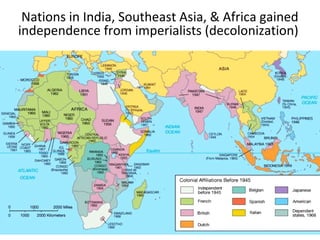
Nations in India, Southeast Asia, & Africa gained
independence from imperialists (decolonization)
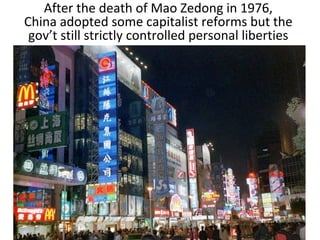
After the death of Mao Zedong in 1976,
China adopted some capitalist reforms but the
gov’t still strictly controlled personal liberties
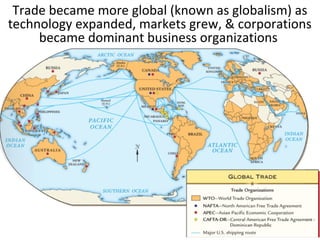
Trade became more global (known as globalism) as
technology expanded, markets grew, & corporations
became dominant business organizations
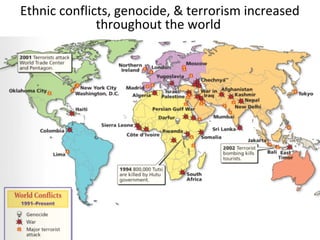
Ethnic conflicts, genocide, & terrorism increased
throughout the world
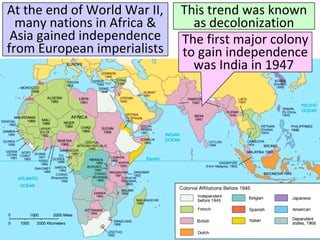
At the end of World War II,
many nations in Africa &
Asia gained independence
from European imperialists
This trend was known
as decolonization
The first major colony
to gain independence
was India in 1947
Title
■ Text
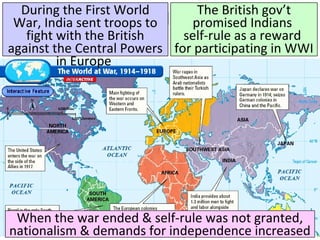
During the First World
War, India sent troops to
fight with the British
against the Central Powers
in Europe
The British gov’t
promised Indians
self-rule as a reward
for participating in WWI
When the war ended & self-rule was not granted,
nationalism & demands for independence increased
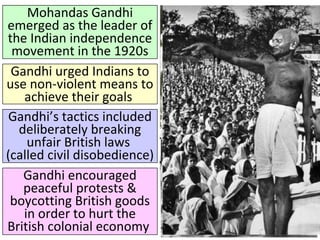
Mohandas Gandhi
emerged as the leader of
the Indian independence
movement in the 1920s
Gandhi urged Indians to
use non-violent means to
achieve their goals
Gandhi’s tactics included
deliberately breaking
unfair British laws
(called civil disobedience)
Gandhi encouraged
peaceful protests &
boycotting British goods
in order to hurt the
British colonial economy
Title
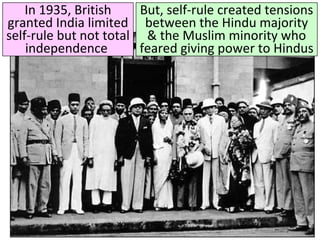
But, self-rule created tensions
between the Hindu majority
& the Muslim minority who
feared giving power to Hindus
In 1935, British
granted India limited
self-rule but not total
independence
Title
■ Text
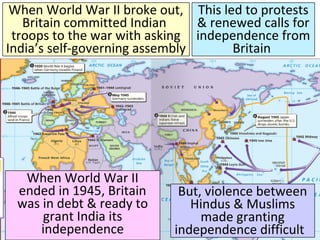
When World War II broke out,
Britain committed Indian
troops to the war with asking
India’s self-governing assembly
This led to protests
& renewed calls for
independence from
Britain
When World War II
ended in 1945, Britain
was in debt & ready to
grant India its
independence
But, violence between
Hindus & Muslims
made granting
independence difficult
Title
■ Text
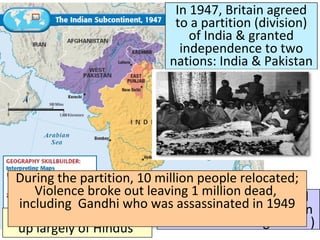
In 1947, Britain agreed
to a partition (division)
of India & granted
independence to two
nations: India & Pakistan
India was a nation made
up largely of Hindus
Pakistan was dominated
by Muslims (East Pakistan
later became Bangladesh )
During the partition, 10 million people relocated;
Violence broke out leaving 1 million dead,
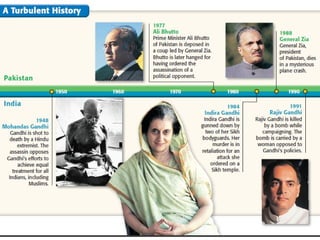
including Gandhi who was assassinated in 1949
Title
■ Text
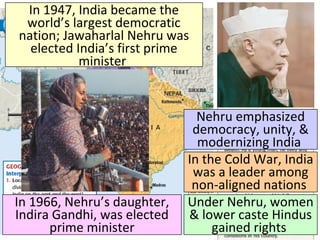
In 1947, India became the
world’s largest democratic
nation; Jawaharlal Nehru was
elected India’s first prime
minister
Nehru emphasized
democracy, unity, &
modernizing India
Under Nehru, women
& lower caste Hindus
gained rights
In 1966, Nehru’s daughter,
Indira Gandhi, was elected
prime minister
In the Cold War, India
was a leader among
non-aligned nations
Title
■ Text
Click here for a brief video on
“INDIA TODAY” and identify three
characteristics of India in the 21st
century
■Essential Question:
–What was decolonization & how did
decolonization impact India & Africa?
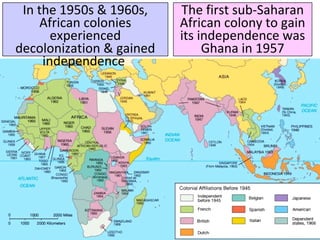
In the 1950s & 1960s,
African colonies
experienced
decolonization & gained
independence
The first sub-Saharan
African colony to gain
its independence was
Ghana in 1957
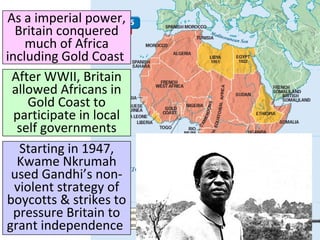
As a imperial power,
Britain conquered
much of Africa
including Gold Coast
After WWII, Britain
allowed Africans in
Gold Coast to
participate in local
self governments
Starting in 1947,
Kwame Nkrumah
used Gandhi’s non-
violent strategy of
boycotts & strikes to
pressure Britain to
grant independence
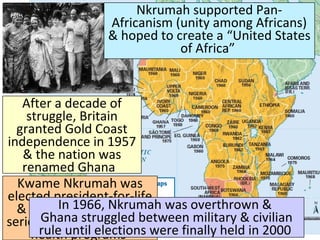
After a decade of
struggle, Britain
granted Gold Coast
independence in 1957
& the nation was
renamed Ghana
Kwame Nkrumah was
elected president-for-life
& began an ambitious
series of road, education,
health programs
In 1966, Nkrumah was overthrown &
Ghana struggled between military & civilian
rule until elections were finally held in 2000
Nkrumah supported Pan-
Africanism (unity among Africans)
& hoped to create a “United States
of Africa”
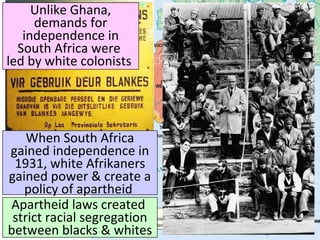
Unlike Ghana,
demands for
independence in
South Africa were
led by white colonists
When South Africa
gained independence in
1931, white Afrikaners
gained power & create a
policy of apartheid
Apartheid laws created
strict racial segregation
between blacks & whites
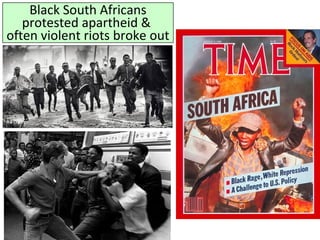
Black South Africans
protested apartheid &
often violent riots broke out
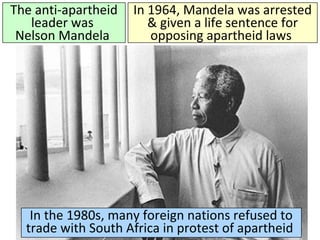
The anti-apartheid
leader was
Nelson Mandela
In 1964, Mandela was arrested
& given a life sentence for
opposing apartheid laws
In the 1980s, many foreign nations refused to
trade with South Africa in protest of apartheid
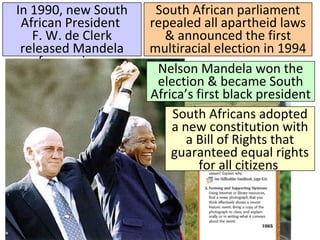
In 1990, new South
African President
F. W. de Clerk
released Mandela
from prison
South African parliament
repealed all apartheid laws
& announced the first
multiracial election in 1994
Nelson Mandela won the
election & became South
Africa’s first black president
South Africans adopted
a new constitution with
a Bill of Rights that
guaranteed equal rights
for all citizens
Not all African independence movements
ended with democracy or without bloodshed
After gaining
independence,
Nigeria erupted in
an ethnic civil war
Ethnic divisions
weakened Kenya’s
government &
led to violence &
rule by dictators
In Congo, a series of
civil wars weakened
the newly-formed
nation
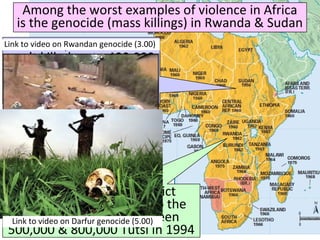
Among the worst examples of violence in Africa
is the genocide (mass killings) in Rwanda & Sudan
In Rwanda, ethnic conflict
between rival clans led to the
Hutus massacring between
500,000 & 800,000 Tutsi in 1994
In Darfur, the Sudanese
gov’t killed up to 400,000
Muslims in an attempt to
destroy an anti-gov’t
rebel movement
Link to video on Rwandan genocide (3.00)
Link to video on Darfur genocide (5.00)
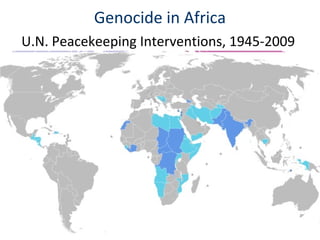
Genocide in Africa
U.N. Peacekeeping Interventions, 1945-2009
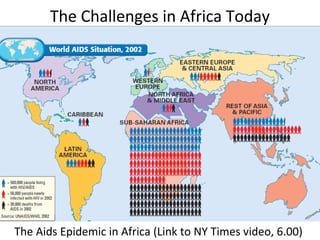
The Challenges in Africa Today
The Aids Epidemic in Africa (Link to NY Times video, 6.00)
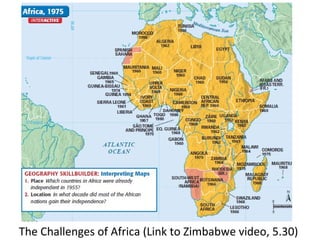
The Challenges of Africa (Link to Zimbabwe video, 5.30)

Decolonization in india_and_africa

  • 1.
    ■Essential Question: –What wasdecolonization & how did decolonization impact India & Africa? ■Warm Up Questions:
  • 2.
    The Post-World WarII World ■What will happen in world history in the years after World War II (1945—today)? –Examine the next four images & make a prediction about what will happen in the world after World War II (with exception to the Cold War) –Be prepared to discuss your answers
  • 3.
    Nations in India,Southeast Asia, & Africa gained independence from imperialists (decolonization)
  • 4.
    After the deathof Mao Zedong in 1976, China adopted some capitalist reforms but the gov’t still strictly controlled personal liberties
  • 5.
    Trade became moreglobal (known as globalism) as technology expanded, markets grew, & corporations became dominant business organizations
  • 6.
    Ethnic conflicts, genocide,& terrorism increased throughout the world
  • 7.
    At the endof World War II, many nations in Africa & Asia gained independence from European imperialists This trend was known as decolonization The first major colony to gain independence was India in 1947
  • 8.
    Title ■ Text During theFirst World War, India sent troops to fight with the British against the Central Powers in Europe The British gov’t promised Indians self-rule as a reward for participating in WWI When the war ended & self-rule was not granted, nationalism & demands for independence increased
  • 9.
    Mohandas Gandhi emerged asthe leader of the Indian independence movement in the 1920s Gandhi urged Indians to use non-violent means to achieve their goals Gandhi’s tactics included deliberately breaking unfair British laws (called civil disobedience) Gandhi encouraged peaceful protests & boycotting British goods in order to hurt the British colonial economy
  • 10.
    Title But, self-rule createdtensions between the Hindu majority & the Muslim minority who feared giving power to Hindus In 1935, British granted India limited self-rule but not total independence
  • 11.
    Title ■ Text When WorldWar II broke out, Britain committed Indian troops to the war with asking India’s self-governing assembly This led to protests & renewed calls for independence from Britain When World War II ended in 1945, Britain was in debt & ready to grant India its independence But, violence between Hindus & Muslims made granting independence difficult
  • 12.
    Title ■ Text In 1947,Britain agreed to a partition (division) of India & granted independence to two nations: India & Pakistan India was a nation made up largely of Hindus Pakistan was dominated by Muslims (East Pakistan later became Bangladesh ) During the partition, 10 million people relocated; Violence broke out leaving 1 million dead, including Gandhi who was assassinated in 1949
  • 13.
    Title ■ Text In 1947,India became the world’s largest democratic nation; Jawaharlal Nehru was elected India’s first prime minister Nehru emphasized democracy, unity, & modernizing India Under Nehru, women & lower caste Hindus gained rights In 1966, Nehru’s daughter, Indira Gandhi, was elected prime minister In the Cold War, India was a leader among non-aligned nations
  • 14.
  • 15.
    Click here fora brief video on “INDIA TODAY” and identify three characteristics of India in the 21st century
  • 16.
    ■Essential Question: –What wasdecolonization & how did decolonization impact India & Africa?
  • 17.
    In the 1950s& 1960s, African colonies experienced decolonization & gained independence The first sub-Saharan African colony to gain its independence was Ghana in 1957
  • 18.
    As a imperialpower, Britain conquered much of Africa including Gold Coast After WWII, Britain allowed Africans in Gold Coast to participate in local self governments Starting in 1947, Kwame Nkrumah used Gandhi’s non- violent strategy of boycotts & strikes to pressure Britain to grant independence
  • 19.
    After a decadeof struggle, Britain granted Gold Coast independence in 1957 & the nation was renamed Ghana Kwame Nkrumah was elected president-for-life & began an ambitious series of road, education, health programs In 1966, Nkrumah was overthrown & Ghana struggled between military & civilian rule until elections were finally held in 2000 Nkrumah supported Pan- Africanism (unity among Africans) & hoped to create a “United States of Africa”
  • 20.
    Unlike Ghana, demands for independencein South Africa were led by white colonists When South Africa gained independence in 1931, white Afrikaners gained power & create a policy of apartheid Apartheid laws created strict racial segregation between blacks & whites
  • 21.
    Black South Africans protestedapartheid & often violent riots broke out
  • 22.
    The anti-apartheid leader was NelsonMandela In 1964, Mandela was arrested & given a life sentence for opposing apartheid laws In the 1980s, many foreign nations refused to trade with South Africa in protest of apartheid
  • 23.
    In 1990, newSouth African President F. W. de Clerk released Mandela from prison South African parliament repealed all apartheid laws & announced the first multiracial election in 1994 Nelson Mandela won the election & became South Africa’s first black president South Africans adopted a new constitution with a Bill of Rights that guaranteed equal rights for all citizens
  • 24.
    Not all Africanindependence movements ended with democracy or without bloodshed After gaining independence, Nigeria erupted in an ethnic civil war Ethnic divisions weakened Kenya’s government & led to violence & rule by dictators In Congo, a series of civil wars weakened the newly-formed nation
  • 25.
    Among the worstexamples of violence in Africa is the genocide (mass killings) in Rwanda & Sudan In Rwanda, ethnic conflict between rival clans led to the Hutus massacring between 500,000 & 800,000 Tutsi in 1994 In Darfur, the Sudanese gov’t killed up to 400,000 Muslims in an attempt to destroy an anti-gov’t rebel movement Link to video on Rwandan genocide (3.00) Link to video on Darfur genocide (5.00)
  • 26.
    Genocide in Africa U.N.Peacekeeping Interventions, 1945-2009
  • 27.
    The Challenges inAfrica Today The Aids Epidemic in Africa (Link to NY Times video, 6.00)
  • 28.
    The Challenges ofAfrica (Link to Zimbabwe video, 5.30)

Editor's Notes

  • #26 http://www.guardian.co.uk/world/video/2008/dec/18/rwanda-genocide http://video.nytimes.com/video/2006/11/06/opinion/1194817106526/the-genocide-in-darfur.html
  • #27 http://1.bp.blogspot.com/_a55xc3j5xRw/S9MBX3lYV4I/AAAAAAAAANM/3Wn3SHUZNb8/s1600/Poverty_conflict_map.jpg
  • #28 http://video.nytimes.com/video/2010/05/09/world/1247467804332/the-battle-against-aids-is-failing.html?scp=23&sq=darfur&st=cse
  • #29 http://choices.edu/resources/supplemental_zimbabwe.php