KWAME NKRUMAH
Grade: 11
Term: 3
Topic: 4 – NATIONALISMS – SOUTH AFRICA, THE
MIDDLE EAST AND AFRICA
Sub-Topic: CHAPTER 5 – KWAME NKRUMAH
M.N.SPIES 1
M.N.SPIES 2
M.N.SPIES 3
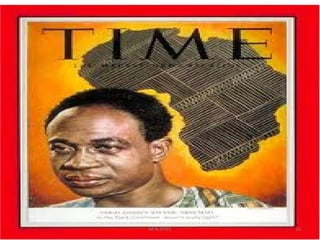
Who was Kwame Nkrumah?
• Kwame Nkrumah was born in the Gold Coast in
1909, was educated in a Roman Catholic mission
school and became a mission school teacher.
• In 1935 he went to the United States to further his
studies.
• Nkrumah spent ten years studying and teaching at
Lincoln University in Pennsylvania.
• He read widely and was attracted to socialist ideas
(Karl Marx), but it was the work of the Jamaican
nationalist, Marcus Garvey (Pan-Africanism), that
made the greatest impact on his thinking and
actions.
M.N.SPIES 4
Who was Kwame Nkrumah?
• In 1945 he moved to London, hoping to study
further there, but after meeting George
Padmore, another leading Pan-African thinker, he
agreed to help organize the Fifth Pan-Africanagreed to help organize the Fifth Pan-African
Congress in Manchester. He then started an
organization to work for the decolonization of
West Africa. In 1947 he was invited to become
the General Secretary of the UGCC and returned
to the Gold Coast.
M.N.SPIES 5
REMEMBER KARL MARX AND MARCUS GARVEY?
M.N.SPIES 6
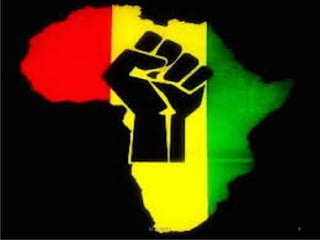
Pan Africanism
• After World War Two, African
leaders, who were mainly educated
intellectuals, decided to fight for
independence. They were alsoindependence. They were also
attracted to the idea that once
independent, African countries
should join together in a pan-
continental union.
M.N.SPIES 7
What is Pan-Africanism?
• Pan-Africanism has two distinct meanings:
1. The togetherness of all people of African
descent, and their cooperation in working for
the
freedom and independence of all Africanfreedom and independence of all African
people everywhere, including Africa and in the
countries of the African diaspora, such as
the Caribbean and the Americas.
2. A movement to unite people in Africa itself,
and for a united continent of Africa.
M.N.SPIES 8
M.N.SPIES 9
The influence of Pan Africanism
• A few educated Africans were able to study
further in Europe or America.
• Those who went to America met African
Americans, descendants of slaves, and manyAmericans, descendants of slaves, and many
of them was deeply influenced by the Pan-
Africanist ideas.
• The most important figures in the Pan-African
movement were WB Du bois, Marcus Garvey
and George Padmore.
M.N.SPIES 10
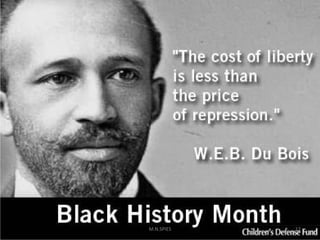
W.E.B. Du Bois and Pan-Africanism
• W.E.B. Du Bois was born in the United
States just after slavery was abolished.
• He was the first African American to be
awarded a doctorate from Harvardawarded a doctorate from Harvard
University.
• He believed that educated people had a
vital role to play in the liberation struggle.
M.N.SPIES 11
M.N.SPIES 12
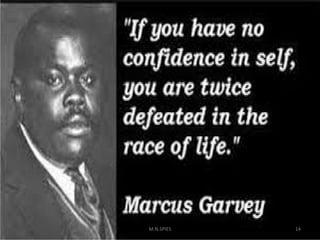
Marcus Garvey and Pan-Africanism
• Marcus Garvey, a Jamaican who spent most of
his life in the United States, stressed the need
to unite all people of African descent to
achieve freedom and equality.
• Garvey called for ‘Africa for the Africans’, an
end to colonialism and the recognition of the
value of African culture.
• He tried, unsuccessfully, to find ways for black
people in the Americas to return to Africa.
M.N.SPIES 13
M.N.SPIES 14
George Padmore and Pan-Africanism
• George Padmore was born in Trinidad, an island in
the Caribbean Sea in 1909.
• His ancestors had been brought from Africa as
slaves to work the island’s plantations.
• Padmore was educated in the USA and while he was• Padmore was educated in the USA and while he was
there, he joined the American Communist Party.
• He spent some years living in Moscow and working
for the Communist International.
• Later, he moved to Europe and became less of a
communist than a leading Pan-African thinker and
writer.
M.N.SPIES 15
M.N.SPIES 16
PADMORE, NKRUMAH AND DU BOIS
• At the Manchester Pan-African congress in 1945,
Padmore met Kwame Nkrumah, who had
recently moved to London from the United
States.States.
• Padmore became a close friend and advisor to
Nkrumah.
• Both men played leading parts in the congress
under the inspired leadership of W.E.B. Du Bois.
M.N.SPIES 17
African socialism
• African socialism is an ideology that was different from other
forms of socialism.
• It emphasised African communal values.
• It wanted Africans to recover African communal values and
socialism that emerged out of African experience.
• African traditional values were stressed: the interests of the
family, the clan and the community came ahead of individualfamily, the clan and the community came ahead of individual
interests.
• African socialism was not the laisser-faire capitalism of the
USA, and it was not the state-dominated socialist system of the
USSR.
• African socialism was an alternative that could borrow from
both systems, but it would be essentially African.
• It was to grow from pre-colonial communal customs and
values.
M.N.SPIES 18
African socialism is a belief in sharing
economic resources in a
"traditional" African way, as distinct
from classical socialism.
Many African politicians of the 1950s
M.N.SPIES 19
Many African politicians of the 1950s
and 1960s professed their support
for African socialism,
although definitions and
interpretations of this term varied
considerably.
M.N.SPIES 20
Kwame Nkrumah’s part in the
creation of an independent Ghana
• On 6 March 1957, the gold Coast
became the first sub-Saharan African
country to obtain independence.country to obtain independence.
Because it was the first, the way it
was achieved became a model that
the British would try to follow
elsewhere in Africa.
M.N.SPIES 21
The Convention People’s Party, 1949
• Nkrumah was soon released from jail after the
February 1948 riots.
• He came out of jail as a national hero. His campaign
for ‘Independence Now!’ attracted massive support,
especially from the youth.
• Later in 1948, he broke away from the UGCC, which
wanted to move more slowly towardswanted to move more slowly towards
independence, and formed the Convention People’s
Party (CPP).
• The CPP’s radical ‘Positive Action’ campaign started
in January 1950.
• It included strikes, boycotts, and mass rallies.
• Nkrumah was arrested again, tried, and condemned
to three years in prison.
M.N.SPIES 22
• While Nkrumah was in jail, the first general
election ever held under a universal
franchise took place in the Gold Coast in
February 1951.
• Although Nkrumah was in jail, pictures of
him were everywhere. The popular
M.N.SPIES 23
him were everywhere. The popular
newspapers all supported the CPP, which
held huge election rallies with the slogan
‘Free-Dom!’. The CPP won 34 out of the 38
elected seats in the legislative assembly
(parliament).
• After the elections, Nkrumah was released from jail and
was appointed as leader of government business in the
legislative council.
• Together with a British adviser, Sir Charles Arden-Clarke,
he started preparing the Gold Coast for independence.
• Many constitutional changes occurred in the next few
years.
• In 1952, the British changed the constitution so that
Nkrumah could become Prime Minister.
M.N.SPIES 24
Nkrumah could become Prime Minister.
• He presented a ‘Motion of Destiny’ to the legislative
assembly which called for independence from Britain.
• It was passed by a large majority.
• In 1954, the CPP won another general election
handsomely, under another new constitution in which
the legislative council became a fully elected one, with
no members nominated by the colonial authorities.
The challenges confronting Nkrumah
before independence
1. He had to make sure there were enough skilled
and experienced people to run an independent
country efficiently.
2. He had to bring together the four regions of the
Gold Coast colony into a single state. The northGold Coast colony into a single state. The north
was largely Muslim and the south was dominated
by the Asante people and largely Christian. There
were many different peoples and cultures and
seven major languages.
3. He was determined to win full independence
without delay.
M.N.SPIES 25
Nkrumah overcame all three of his
challenges.
1. The British helped to train a new Ghanaian civil service,
drawn from the growing numbers of educated young
people.
2. Nkrumah’s decision to use English as the official
language and to call the country ‘Ghana’ were important
unifying factors. The word ‘Ghana’ means ‘warrior king’.unifying factors. The word ‘Ghana’ means ‘warrior king’.
It had been the name of a great kingdom in West Africa
hundreds of years earlier. People felt proud to identify
with it.
3. After their humiliation in the Suez Crisis of 1956, the
British were eager to grant this ‘reliable’ colony its
independence and all Gold Coast’s people wanted it,
even though they differed on some issues.
M.N.SPIES 26
Nkrumah becomes Prime Minister
and Independence
• The CPP won the 1956 election against the NLF
and other opposition parties and, despite some
problems, there was remarkably little violence in
the period before independence.
• At 00h00 on 6 March 1957, The Gold Coast was
born as the independent and unitary state of
Ghana.
• Nkrumah was its prime minister.
• The people hailed him as Osagyefo, which means
‘Redeemer’.
M.N.SPIES 27
Ghana’s beginning as an independent
nation
• In 1957 the former British colony of the Gold
Coast became the independent state of Ghana.
• Kwame Nkrumah, leader of the Convention• Kwame Nkrumah, leader of the Convention
People’s Party (CPP) was its Prime Minister.
• In 1960 Ghana became a republic, with Nkrumah
as its president.
• He was a hero for Africans all over Africa, but by
1966, he had been overthrown by a military coup
and went into exile in Conakry, Guinea.
M.N.SPIES 28
The main reasons he failed to retain the support of
the people of Ghana were:
1. His economic policies were unpopular. His policies
involved harsh and Soviet-style industrialization
including almost complete government control over
the economy.
2. He tried to break the power of the trade unions,
M.N.SPIES 29
2. He tried to break the power of the trade unions,
which had previously been his strongest supporters.
3. He lost the support of the cocoa farmers by not
allowing them to have the full profits from high
cocoa prices.
4. He introduced the Preventative Detention Act,
which allowed people to be detained without trial.
5. Early in 1964 Nkrumah declared Ghana a one-
party state, with himself as life president of both
nation and party. The administration of the
country passed into the hands of corrupt party
officials who helped themselves, rather than the
Ghanaians they were meant to serve.
6. He spent a great deal of money on unnecessary
weapons and equipment for his new defense
M.N.SPIES 30
weapons and equipment for his new defense
force.
7. Like Stalin Nkrumah encouraged a ‘cult of the
personality’ in which he was idealized as the
perfect national leader. Though his lifestyle was
modest, he became remote from the people and
fearful that they were plotting against him.
• Although he was eventually thrown out of the
country, Nkrumah is still considered to be one of
the greatest African statesmen of all time.
• He welded the Gold Coast into a successful
unitary state, which was an example to other
African liberation movements.
• As a lifelong Pan-Africanist, perhaps his greatest
M.N.SPIES 31
• As a lifelong Pan-Africanist, perhaps his greatest
legacy to the continent was the formation of the
Organisation of African Unity (OAU) in 1963.
• It is now known as the African Union (AU) and its
task is to ensure the independence and
development of all Africa’s countries and
peoples.
M.N.SPIES 32
M.N.SPIES 33

Kwame nkrumah

  • 1.
    KWAME NKRUMAH Grade: 11 Term:3 Topic: 4 – NATIONALISMS – SOUTH AFRICA, THE MIDDLE EAST AND AFRICA Sub-Topic: CHAPTER 5 – KWAME NKRUMAH M.N.SPIES 1
  • 2.
  • 3.
  • 4.
    Who was KwameNkrumah? • Kwame Nkrumah was born in the Gold Coast in 1909, was educated in a Roman Catholic mission school and became a mission school teacher. • In 1935 he went to the United States to further his studies. • Nkrumah spent ten years studying and teaching at Lincoln University in Pennsylvania. • He read widely and was attracted to socialist ideas (Karl Marx), but it was the work of the Jamaican nationalist, Marcus Garvey (Pan-Africanism), that made the greatest impact on his thinking and actions. M.N.SPIES 4
  • 5.
    Who was KwameNkrumah? • In 1945 he moved to London, hoping to study further there, but after meeting George Padmore, another leading Pan-African thinker, he agreed to help organize the Fifth Pan-Africanagreed to help organize the Fifth Pan-African Congress in Manchester. He then started an organization to work for the decolonization of West Africa. In 1947 he was invited to become the General Secretary of the UGCC and returned to the Gold Coast. M.N.SPIES 5
  • 6.
    REMEMBER KARL MARXAND MARCUS GARVEY? M.N.SPIES 6
  • 7.
    Pan Africanism • AfterWorld War Two, African leaders, who were mainly educated intellectuals, decided to fight for independence. They were alsoindependence. They were also attracted to the idea that once independent, African countries should join together in a pan- continental union. M.N.SPIES 7
  • 8.
    What is Pan-Africanism? •Pan-Africanism has two distinct meanings: 1. The togetherness of all people of African descent, and their cooperation in working for the freedom and independence of all Africanfreedom and independence of all African people everywhere, including Africa and in the countries of the African diaspora, such as the Caribbean and the Americas. 2. A movement to unite people in Africa itself, and for a united continent of Africa. M.N.SPIES 8
  • 9.
  • 10.
    The influence ofPan Africanism • A few educated Africans were able to study further in Europe or America. • Those who went to America met African Americans, descendants of slaves, and manyAmericans, descendants of slaves, and many of them was deeply influenced by the Pan- Africanist ideas. • The most important figures in the Pan-African movement were WB Du bois, Marcus Garvey and George Padmore. M.N.SPIES 10
  • 11.
    W.E.B. Du Boisand Pan-Africanism • W.E.B. Du Bois was born in the United States just after slavery was abolished. • He was the first African American to be awarded a doctorate from Harvardawarded a doctorate from Harvard University. • He believed that educated people had a vital role to play in the liberation struggle. M.N.SPIES 11
  • 12.
  • 13.
    Marcus Garvey andPan-Africanism • Marcus Garvey, a Jamaican who spent most of his life in the United States, stressed the need to unite all people of African descent to achieve freedom and equality. • Garvey called for ‘Africa for the Africans’, an end to colonialism and the recognition of the value of African culture. • He tried, unsuccessfully, to find ways for black people in the Americas to return to Africa. M.N.SPIES 13
  • 14.
  • 15.
    George Padmore andPan-Africanism • George Padmore was born in Trinidad, an island in the Caribbean Sea in 1909. • His ancestors had been brought from Africa as slaves to work the island’s plantations. • Padmore was educated in the USA and while he was• Padmore was educated in the USA and while he was there, he joined the American Communist Party. • He spent some years living in Moscow and working for the Communist International. • Later, he moved to Europe and became less of a communist than a leading Pan-African thinker and writer. M.N.SPIES 15
  • 16.
  • 17.
    PADMORE, NKRUMAH ANDDU BOIS • At the Manchester Pan-African congress in 1945, Padmore met Kwame Nkrumah, who had recently moved to London from the United States.States. • Padmore became a close friend and advisor to Nkrumah. • Both men played leading parts in the congress under the inspired leadership of W.E.B. Du Bois. M.N.SPIES 17
  • 18.
    African socialism • Africansocialism is an ideology that was different from other forms of socialism. • It emphasised African communal values. • It wanted Africans to recover African communal values and socialism that emerged out of African experience. • African traditional values were stressed: the interests of the family, the clan and the community came ahead of individualfamily, the clan and the community came ahead of individual interests. • African socialism was not the laisser-faire capitalism of the USA, and it was not the state-dominated socialist system of the USSR. • African socialism was an alternative that could borrow from both systems, but it would be essentially African. • It was to grow from pre-colonial communal customs and values. M.N.SPIES 18
  • 19.
    African socialism isa belief in sharing economic resources in a "traditional" African way, as distinct from classical socialism. Many African politicians of the 1950s M.N.SPIES 19 Many African politicians of the 1950s and 1960s professed their support for African socialism, although definitions and interpretations of this term varied considerably.
  • 20.
  • 21.
    Kwame Nkrumah’s partin the creation of an independent Ghana • On 6 March 1957, the gold Coast became the first sub-Saharan African country to obtain independence.country to obtain independence. Because it was the first, the way it was achieved became a model that the British would try to follow elsewhere in Africa. M.N.SPIES 21
  • 22.
    The Convention People’sParty, 1949 • Nkrumah was soon released from jail after the February 1948 riots. • He came out of jail as a national hero. His campaign for ‘Independence Now!’ attracted massive support, especially from the youth. • Later in 1948, he broke away from the UGCC, which wanted to move more slowly towardswanted to move more slowly towards independence, and formed the Convention People’s Party (CPP). • The CPP’s radical ‘Positive Action’ campaign started in January 1950. • It included strikes, boycotts, and mass rallies. • Nkrumah was arrested again, tried, and condemned to three years in prison. M.N.SPIES 22
  • 23.
    • While Nkrumahwas in jail, the first general election ever held under a universal franchise took place in the Gold Coast in February 1951. • Although Nkrumah was in jail, pictures of him were everywhere. The popular M.N.SPIES 23 him were everywhere. The popular newspapers all supported the CPP, which held huge election rallies with the slogan ‘Free-Dom!’. The CPP won 34 out of the 38 elected seats in the legislative assembly (parliament).
  • 24.
    • After theelections, Nkrumah was released from jail and was appointed as leader of government business in the legislative council. • Together with a British adviser, Sir Charles Arden-Clarke, he started preparing the Gold Coast for independence. • Many constitutional changes occurred in the next few years. • In 1952, the British changed the constitution so that Nkrumah could become Prime Minister. M.N.SPIES 24 Nkrumah could become Prime Minister. • He presented a ‘Motion of Destiny’ to the legislative assembly which called for independence from Britain. • It was passed by a large majority. • In 1954, the CPP won another general election handsomely, under another new constitution in which the legislative council became a fully elected one, with no members nominated by the colonial authorities.
  • 25.
    The challenges confrontingNkrumah before independence 1. He had to make sure there were enough skilled and experienced people to run an independent country efficiently. 2. He had to bring together the four regions of the Gold Coast colony into a single state. The northGold Coast colony into a single state. The north was largely Muslim and the south was dominated by the Asante people and largely Christian. There were many different peoples and cultures and seven major languages. 3. He was determined to win full independence without delay. M.N.SPIES 25
  • 26.
    Nkrumah overcame allthree of his challenges. 1. The British helped to train a new Ghanaian civil service, drawn from the growing numbers of educated young people. 2. Nkrumah’s decision to use English as the official language and to call the country ‘Ghana’ were important unifying factors. The word ‘Ghana’ means ‘warrior king’.unifying factors. The word ‘Ghana’ means ‘warrior king’. It had been the name of a great kingdom in West Africa hundreds of years earlier. People felt proud to identify with it. 3. After their humiliation in the Suez Crisis of 1956, the British were eager to grant this ‘reliable’ colony its independence and all Gold Coast’s people wanted it, even though they differed on some issues. M.N.SPIES 26
  • 27.
    Nkrumah becomes PrimeMinister and Independence • The CPP won the 1956 election against the NLF and other opposition parties and, despite some problems, there was remarkably little violence in the period before independence. • At 00h00 on 6 March 1957, The Gold Coast was born as the independent and unitary state of Ghana. • Nkrumah was its prime minister. • The people hailed him as Osagyefo, which means ‘Redeemer’. M.N.SPIES 27
  • 28.
    Ghana’s beginning asan independent nation • In 1957 the former British colony of the Gold Coast became the independent state of Ghana. • Kwame Nkrumah, leader of the Convention• Kwame Nkrumah, leader of the Convention People’s Party (CPP) was its Prime Minister. • In 1960 Ghana became a republic, with Nkrumah as its president. • He was a hero for Africans all over Africa, but by 1966, he had been overthrown by a military coup and went into exile in Conakry, Guinea. M.N.SPIES 28
  • 29.
    The main reasonshe failed to retain the support of the people of Ghana were: 1. His economic policies were unpopular. His policies involved harsh and Soviet-style industrialization including almost complete government control over the economy. 2. He tried to break the power of the trade unions, M.N.SPIES 29 2. He tried to break the power of the trade unions, which had previously been his strongest supporters. 3. He lost the support of the cocoa farmers by not allowing them to have the full profits from high cocoa prices. 4. He introduced the Preventative Detention Act, which allowed people to be detained without trial.
  • 30.
    5. Early in1964 Nkrumah declared Ghana a one- party state, with himself as life president of both nation and party. The administration of the country passed into the hands of corrupt party officials who helped themselves, rather than the Ghanaians they were meant to serve. 6. He spent a great deal of money on unnecessary weapons and equipment for his new defense M.N.SPIES 30 weapons and equipment for his new defense force. 7. Like Stalin Nkrumah encouraged a ‘cult of the personality’ in which he was idealized as the perfect national leader. Though his lifestyle was modest, he became remote from the people and fearful that they were plotting against him.
  • 31.
    • Although hewas eventually thrown out of the country, Nkrumah is still considered to be one of the greatest African statesmen of all time. • He welded the Gold Coast into a successful unitary state, which was an example to other African liberation movements. • As a lifelong Pan-Africanist, perhaps his greatest M.N.SPIES 31 • As a lifelong Pan-Africanist, perhaps his greatest legacy to the continent was the formation of the Organisation of African Unity (OAU) in 1963. • It is now known as the African Union (AU) and its task is to ensure the independence and development of all Africa’s countries and peoples.
  • 32.
  • 33.