Pan Africanism
Pan-Africanism
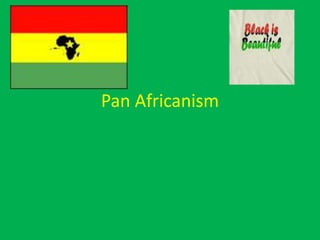
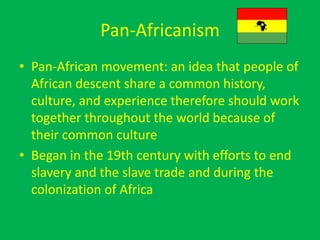
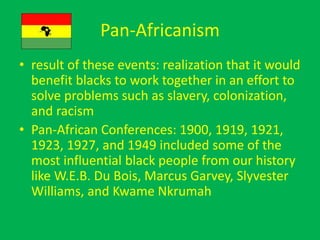
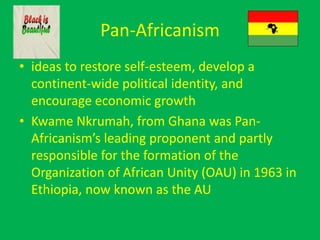
• Pan-African movement: an idea that people of
African descent share a common history,
culture, and experience therefore should work
together throughout the world because of
their common culture
• Began in the 19th century with efforts to end
slavery and the slave trade and during the
colonization of Africa
Pan-Africanism
• result of these events: realization that it would
benefit blacks to work together in an effort to
solve problems such as slavery, colonization,
and racism
• Pan-African Conferences: 1900, 1919, 1921,
1923, 1927, and 1949 included some of the
most influential black people from our history
like W.E.B. Du Bois, Marcus Garvey, Slyvester
Williams, and Kwame Nkrumah
Pan-Africanism
• ideas to restore self-esteem, develop a
continent-wide political identity, and
encourage economic growth
• Kwame Nkrumah, from Ghana was Pan-
Africanism’s leading proponent and partly
responsible for the formation of the
Organization of African Unity (OAU) in 1963 in
Ethiopia, now known as the AU
Pan-Africanism
• OAU was created to create greater unity
among African states
• OAU has 5 goals:
– to promote unity and solidarity among African
states
– to increase cooperation among African states and
enhance their efforts to achieve a better life for
their peoples
Pan-Africanism
– to defend the sovereignty, territorial integrity, and
independence of its members (including sovereign
equality and noninterference in the internal affairs
of its members)
– to eradicate (end/get rid of) colonialism
– to promote international cooperation
Pan-Africanism
• OAU has dealt with problems such as conflict,
colonialism, apartheid, border disputes, and
helped settle disagreements.
• Problems still occur through internal divisions
and financial constraints.
Summary
• Explain Pan-Africanism in a
sentence or phrase.
Independence movements
• Kenya- Gained independence through violent
protests.
• Nigeria – Gained their independence
peacefully.
• South Africa – Independence from Dutch was
violent. British won Boer war. Independence
from Apartheid

Pan Africanism

  • 1.
  • 2.
    Pan-Africanism • Pan-African movement:an idea that people of African descent share a common history, culture, and experience therefore should work together throughout the world because of their common culture • Began in the 19th century with efforts to end slavery and the slave trade and during the colonization of Africa
  • 3.
    Pan-Africanism • result ofthese events: realization that it would benefit blacks to work together in an effort to solve problems such as slavery, colonization, and racism • Pan-African Conferences: 1900, 1919, 1921, 1923, 1927, and 1949 included some of the most influential black people from our history like W.E.B. Du Bois, Marcus Garvey, Slyvester Williams, and Kwame Nkrumah
  • 4.
    Pan-Africanism • ideas torestore self-esteem, develop a continent-wide political identity, and encourage economic growth • Kwame Nkrumah, from Ghana was Pan- Africanism’s leading proponent and partly responsible for the formation of the Organization of African Unity (OAU) in 1963 in Ethiopia, now known as the AU
  • 5.
    Pan-Africanism • OAU wascreated to create greater unity among African states • OAU has 5 goals: – to promote unity and solidarity among African states – to increase cooperation among African states and enhance their efforts to achieve a better life for their peoples
  • 6.
    Pan-Africanism – to defendthe sovereignty, territorial integrity, and independence of its members (including sovereign equality and noninterference in the internal affairs of its members) – to eradicate (end/get rid of) colonialism – to promote international cooperation
  • 7.
    Pan-Africanism • OAU hasdealt with problems such as conflict, colonialism, apartheid, border disputes, and helped settle disagreements. • Problems still occur through internal divisions and financial constraints.
  • 8.
    Summary • Explain Pan-Africanismin a sentence or phrase.
  • 9.
    Independence movements • Kenya-Gained independence through violent protests. • Nigeria – Gained their independence peacefully. • South Africa – Independence from Dutch was violent. British won Boer war. Independence from Apartheid