The Decolonization Process
The end of the European control of
the World
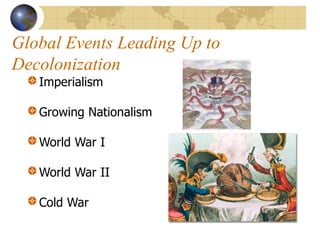
Global Events Leading Up to
Decolonization
Imperialism
Growing Nationalism
World War I
World War II
Cold War
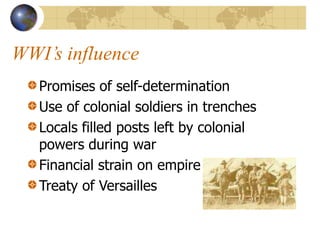
WWI’s influence
Promises of self-determination
Use of colonial soldiers in trenches
Locals filled posts left by colonial
powers during war
Financial strain on empire
Treaty of Versailles
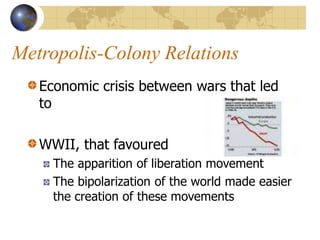
Metropolis-Colony Relations
Economic crisis between wars that led
to
WWII, that favoured
The apparition of liberation movement
The bipolarization of the world made easier
the creation of these movements
Economic crisis and WWII
Metropolis became feeble due to the
economic crisis
Colonies were isolated due to the War
Metropolis inverted fewer money in the
colonies
This helped the Decolonization process
Other aspects of WWII
Increased nationalist uprisings following WWI
(as a result of the global depression)
Costs of empire
US support of anti-colonial liberation
movements
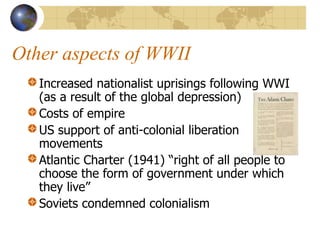
Atlantic Charter (1941) “right of all people to
choose the form of government under which
they live”
Soviets condemned colonialism
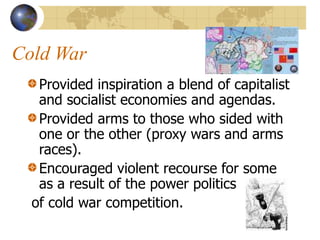
Cold War
Provided inspiration a blend of capitalist
and socialist economies and agendas.
Provided arms to those who sided with
one or the other (proxy wars and arms
races).
Encouraged violent recourse for some
as a result of the power politics
of cold war competition.
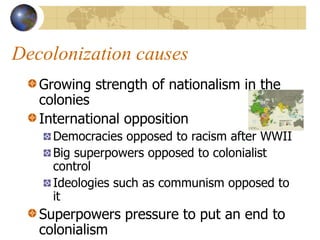
Decolonization causes
Growing strength of nationalism in the
colonies
International opposition
Democracies opposed to racism after WWII
Big superpowers opposed to colonialist
control
Ideologies such as communism opposed to
it
Superpowers pressure to put an end to
colonialism
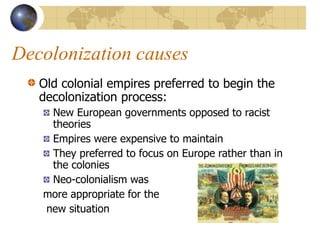
Decolonization causes
Old colonial empires preferred to begin the
decolonization process:
New European governments opposed to racist
theories
Empires were expensive to maintain
They preferred to focus on Europe rather than in
the colonies
Neo-colonialism was
more appropriate for the
new situation
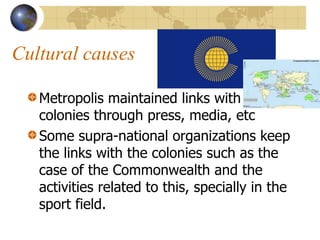
Cultural causes
Metropolis maintained links with
colonies through press, media, etc
Some supra-national organizations keep
the links with the colonies such as the
case of the Commonwealth and the
activities related to this, specially in the
sport field.
Political causes
United Kingdom and France created
`clubs´ to continue their link with the
new independent states
These supra-national institutions were
aimed at helping the new states in
economy, culture and policy
They used to meet with a deter
frequency
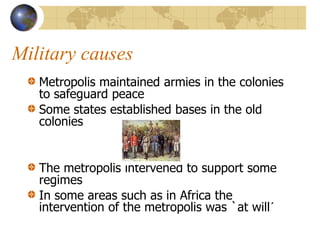
Military causes
Metropolis maintained armies in the colonies
to safeguard peace
Some states established bases in the old
colonies
The metropolis intervened to support some
regimes
In some areas such as in Africa the
intervention of the metropolis was `at will´
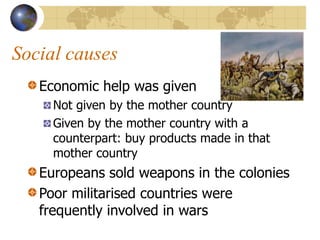
Social causes
Economic help was given
Not given by the mother country
Given by the mother country with a
counterpart: buy products made in that
mother country
Europeans sold weapons in the colonies
Poor militarised countries were
frequently involved in wars
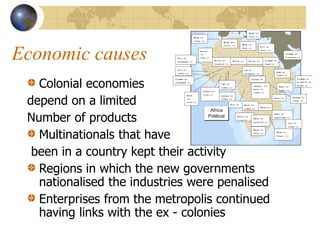
Economic causes
Colonial economies
depend on a limited
Number of products
Multinationals that have
been in a country kept their activity
Regions in which the new governments
nationalised the industries were penalised
Enterprises from the metropolis continued
having links with the ex - colonies
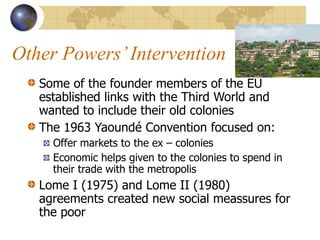
Other Powers’Intervention
Some of the founder members of the EU
established links with the Third World and
wanted to include their old colonies
The 1963 Yaoundé Convention focused on:
Offer markets to the ex – colonies
Economic helps given to the colonies to spend in
their trade with the metropolis
Lome I (1975) and Lome II (1980)
agreements created new social meassures for
the poor
Liberation Movements
They were possible thanks to the
colonial elites, whose sons were
educated in European countries
The new elites defended the national
values
The influence of the communism was
also important
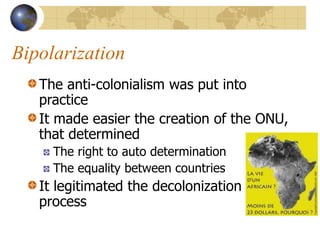
Bipolarization
The anti-colonialism was put into
practice
It made easier the creation of the ONU,
that determined
The right to auto determination
The equality between countries
It legitimated the decolonization
process
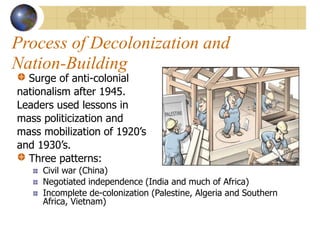
Process of Decolonization and
Nation-Building
Surge of anti-colonial
nationalism after 1945.
Leaders used lessons in
mass politicization and
mass mobilization of 1920’s
and 1930’s.
Three patterns:
Civil war (China)
Negotiated independence (India and much of Africa)
Incomplete de-colonization (Palestine, Algeria and Southern
Africa, Vietnam)
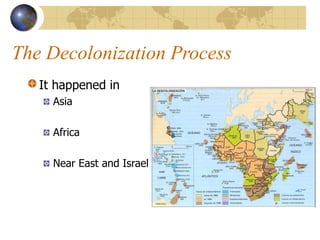
The Decolonization Process
It happened in
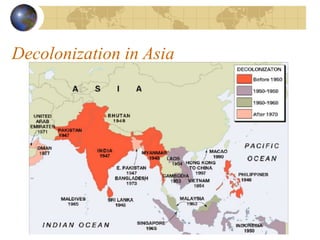
Asia
Africa
Near East and Israel
Decolonization in Asia
China
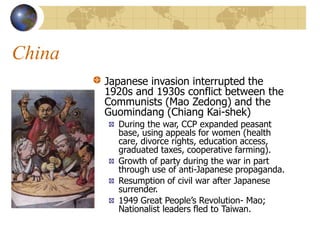
Japanese invasion interrupted the
1920s and 1930s conflict between the
Communists (Mao Zedong) and the
Guomindang (Chiang Kai-shek)
During the war, CCP expanded peasant
base, using appeals for women (health
care, divorce rights, education access,
graduated taxes, cooperative farming).
Growth of party during the war in part
through use of anti-Japanese propaganda.
Resumption of civil war after Japanese
surrender.
1949 Great People’s Revolution- Mao;
Nationalist leaders fled to Taiwan.
India
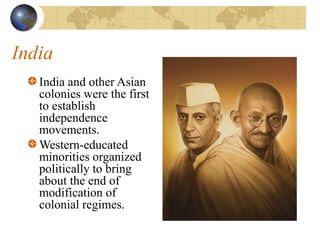
India and other Asian
colonies were the first
to establish
independence
movements.
Western-educated
minorities organized
politically to bring
about the end of
modification of
colonial regimes.
India
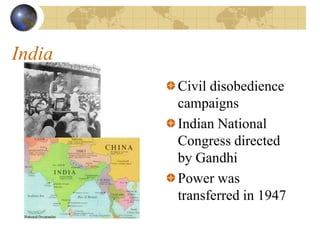
Civil disobedience
campaigns
Indian National
Congress directed
by Gandhi
Power was
transferred in 1947
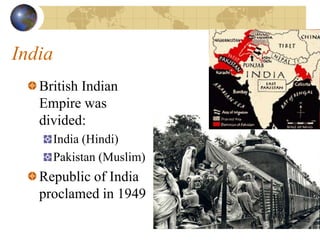
India
British Indian
Empire was
divided:
India (Hindi)
Pakistan (Muslim)
Republic of India
proclamed in 1949
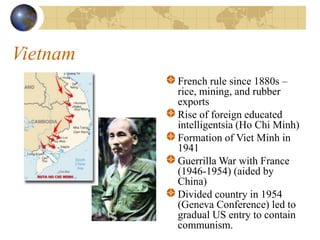
Vietnam
French rule since 1880s –
rice, mining, and rubber
exports
Rise of foreign educated
intelligentsia (Ho Chi Minh)
Formation of Viet Minh in
1941
Guerrilla War with France
(1946-1954) (aided by
China)
Divided country in 1954
(Geneva Conference) led to
gradual US entry to contain
communism.
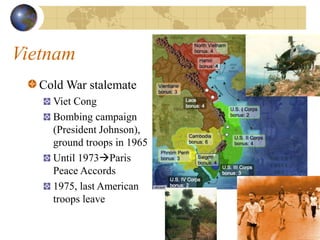
Vietnam
Cold War stalemate
Viet Cong
Bombing campaign
(President Johnson),
ground troops in 1965
Until 1973Paris
Peace Accords
1975, last American
troops leave
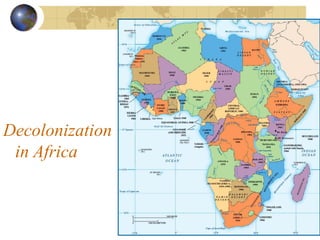
Decolonization
in Africa
Africa
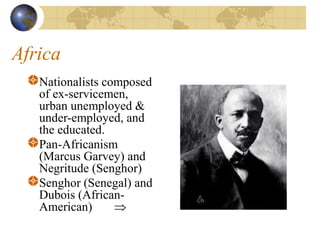
Nationalists composed
of ex-servicemen,
urban unemployed &
under-employed, and
the educated.
Pan-Africanism
(Marcus Garvey) and
Negritude (Senghor)
Senghor (Senegal) and
Dubois (African-
American) 
Africa
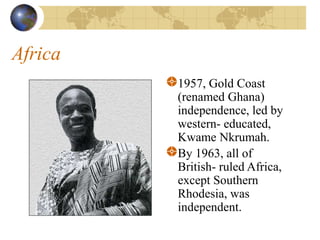
1957, Gold Coast
(renamed Ghana)
independence, led by
western- educated,
Kwame Nkrumah.
By 1963, all of
British- ruled Africa,
except Southern
Rhodesia, was
independent.
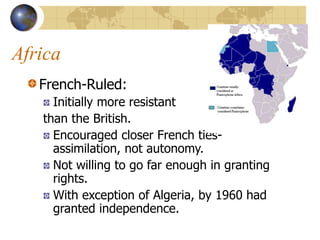
Africa
French-Ruled:
Initially more resistant
than the British.
Encouraged closer French ties-
assimilation, not autonomy.
Not willing to go far enough in granting
rights.
With exception of Algeria, by 1960 had
granted independence.
Africa
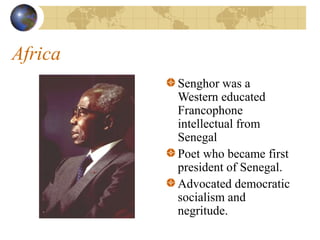
Senghor was a
Western educated
Francophone
intellectual from
Senegal
Poet who became first
president of Senegal.
Advocated democratic
socialism and
negritude.
Africa
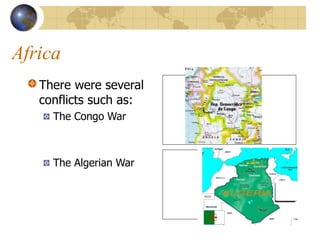
There were several
conflicts such as:
The Congo War
The Algerian War
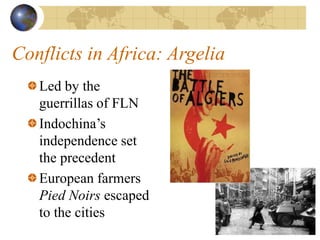
Conflicts in Africa: Argelia
Led by the
guerrillas of FLN
Indochina’s
independence set
the precedent
European farmers
Pied Noirs escaped
to the cities
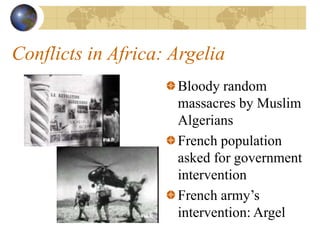
Conflicts in Africa: Argelia
Bloody random
massacres by Muslim
Algerians
French population
asked for government
intervention
French army’s
intervention: Argel
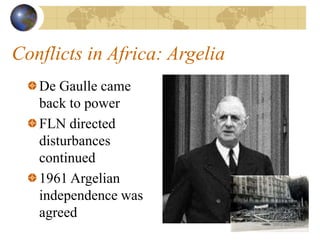
Conflicts in Africa: Argelia
De Gaulle came
back to power
FLN directed
disturbances
continued
1961 Argelian
independence was
agreed
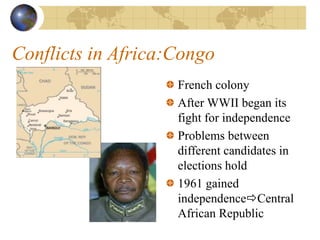
Conflicts in Africa:Congo
French colony
After WWII began its
fight for independence
Problems between
different candidates in
elections hold
1961 gained
independenceCentral
African Republic
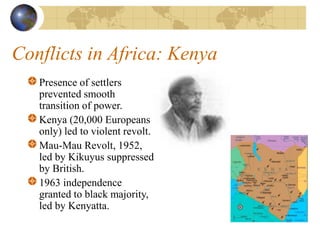
Conflicts in Africa: Kenya
Presence of settlers
prevented smooth
transition of power.
Kenya (20,000 Europeans
only) led to violent revolt.
Mau-Mau Revolt, 1952,
led by Kikuyus suppressed
by British.
1963 independence
granted to black majority,
led by Kenyatta.
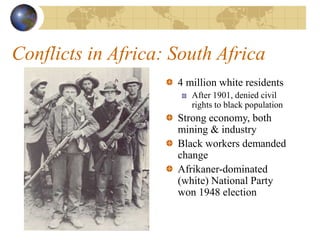
Conflicts in Africa: South Africa
4 million white residents
After 1901, denied civil
rights to black population
Strong economy, both
mining & industry
Black workers demanded
change
Afrikaner-dominated
(white) National Party
won 1948 election
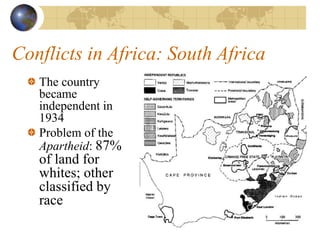
Conflicts in Africa: South Africa
The country
became
independent in
1934
Problem of the
Apartheid: 87%
of land for
whites; other
classified by
race
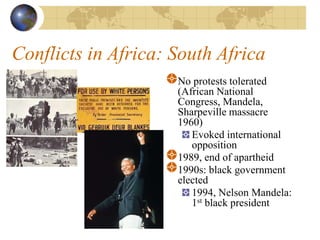
Conflicts in Africa: South Africa
No protests tolerated
(African National
Congress, Mandela,
Sharpeville massacre
1960)
Evoked international
opposition
1989, end of apartheid
1990s: black government
elected
1994, Nelson Mandela:
1st black president
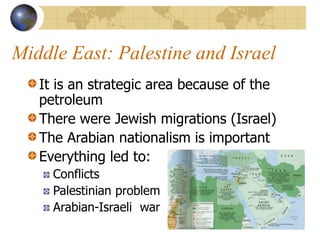
Middle East: Palestine and Israel
It is an strategic area because of the
petroleum
There were Jewish migrations (Israel)
The Arabian nationalism is important
Everything led to:
Conflicts
Palestinian problem
Arabian-Israeli war
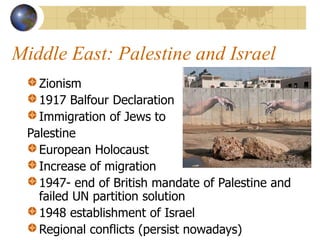
Middle East: Palestine and Israel
Zionism
1917 Balfour Declaration
Immigration of Jews to
Palestine
European Holocaust
Increase of migration
1947- end of British mandate of Palestine and
failed UN partition solution
1948 establishment of Israel
Regional conflicts (persist nowadays)
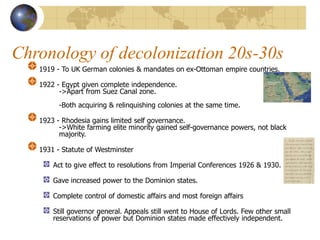
Chronology of decolonization 20s-30s
1919 - To UK German colonies & mandates on ex-Ottoman empire countries.
1922 - Egypt given complete independence.
->Apart from Suez Canal zone.
-Both acquiring & relinquishing colonies at the same time.
1923 - Rhodesia gains limited self governance.
->White farming elite minority gained self-governance powers, not black
majority.
1931 - Statute of Westminster
Act to give effect to resolutions from Imperial Conferences 1926 & 1930.
Gave increased power to the Dominion states.
Complete control of domestic affairs and most foreign affairs
Still governor general. Appeals still went to House of Lords. Few other small
reservations of power but Dominion states made effectively independent.
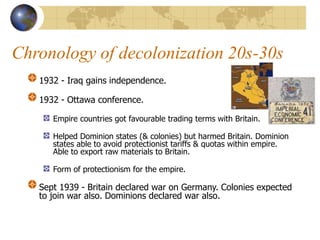
Chronology of decolonization 20s-30s
1932 - Iraq gains independence.
1932 - Ottawa conference.
Empire countries got favourable trading terms with Britain.
Helped Dominion states (& colonies) but harmed Britain. Dominion
states able to avoid protectionist tariffs & quotas within empire.
Able to export raw materials to Britain.
Form of protectionism for the empire.
Sept 1939 - Britain declared war on Germany. Colonies expected
to join war also. Dominions declared war also.
Key factors of decolonization 1918-39
Growth of Socialism
USSR Influence.
Lenin regarded colonies as a stage of capitalism.
Labour governments in the UK.
Socialist attitude was generally anti-colonial.
Population growth across the world.
Growth of the middle classes
Particularly in India.
Problems with world trade
Great depression etc.
Growth in nationalism (?)
Historians disagree on this point.
Colonialism consequences
Psycological: metropolis always thought
about their own interest
The benefit for the ex – colonies was
determined by the metropolis
Advantages of the colonial rule were:
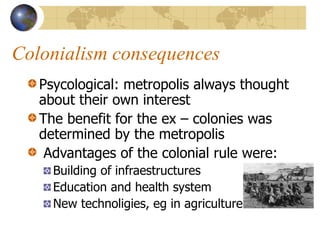
Building of infraestructures
Education and health system
New technoligies, eg in agriculture
Colonialism consequences
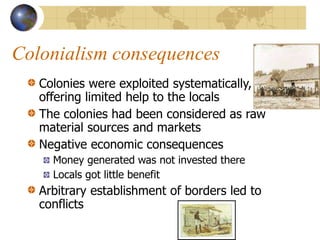
Colonies were exploited systematically,
offering limited help to the locals
The colonies had been considered as raw
material sources and markets
Negative economic consequences
Money generated was not invested there
Locals got little benefit
Arbitrary establishment of borders led to
conflicts
Colonialism consequences
Culturaly, European languages spread,
ruining local culture
Important impact of European
education
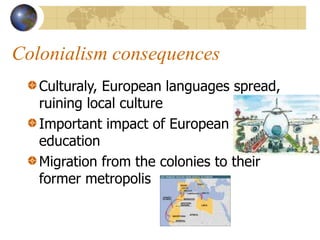
Migration from the colonies to their
former metropolis
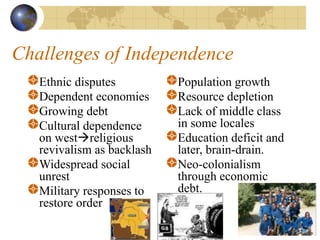
Challenges of Independence
Ethnic disputes
Dependent economies
Growing debt
Cultural dependence
on westreligious
revivalism as backlash
Widespread social
unrest
Military responses to
restore order
Population growth
Resource depletion
Lack of middle class
in some locales
Education deficit and
later, brain-drain.
Neo-colonialism
through economic
debt.
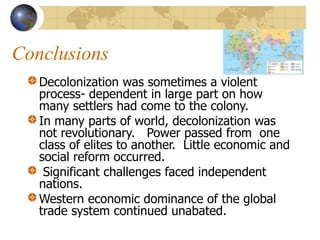
Conclusions
Decolonization was sometimes a violent
process- dependent in large part on how
many settlers had come to the colony.
In many parts of world, decolonization was
not revolutionary. Power passed from one
class of elites to another. Little economic and
social reform occurred.
Significant challenges faced independent
nations.
Western economic dominance of the global
trade system continued unabated.

Decolonization process.ppt

  • 1.
    The Decolonization Process Theend of the European control of the World
  • 2.
    Global Events LeadingUp to Decolonization Imperialism Growing Nationalism World War I World War II Cold War
  • 3.
    WWI’s influence Promises ofself-determination Use of colonial soldiers in trenches Locals filled posts left by colonial powers during war Financial strain on empire Treaty of Versailles
  • 4.
    Metropolis-Colony Relations Economic crisisbetween wars that led to WWII, that favoured The apparition of liberation movement The bipolarization of the world made easier the creation of these movements
  • 5.
    Economic crisis andWWII Metropolis became feeble due to the economic crisis Colonies were isolated due to the War Metropolis inverted fewer money in the colonies This helped the Decolonization process
  • 6.
    Other aspects ofWWII Increased nationalist uprisings following WWI (as a result of the global depression) Costs of empire US support of anti-colonial liberation movements Atlantic Charter (1941) “right of all people to choose the form of government under which they live” Soviets condemned colonialism
  • 7.
    Cold War Provided inspirationa blend of capitalist and socialist economies and agendas. Provided arms to those who sided with one or the other (proxy wars and arms races). Encouraged violent recourse for some as a result of the power politics of cold war competition.
  • 8.
    Decolonization causes Growing strengthof nationalism in the colonies International opposition Democracies opposed to racism after WWII Big superpowers opposed to colonialist control Ideologies such as communism opposed to it Superpowers pressure to put an end to colonialism
  • 9.
    Decolonization causes Old colonialempires preferred to begin the decolonization process: New European governments opposed to racist theories Empires were expensive to maintain They preferred to focus on Europe rather than in the colonies Neo-colonialism was more appropriate for the new situation
  • 10.
    Cultural causes Metropolis maintainedlinks with colonies through press, media, etc Some supra-national organizations keep the links with the colonies such as the case of the Commonwealth and the activities related to this, specially in the sport field.
  • 11.
    Political causes United Kingdomand France created `clubs´ to continue their link with the new independent states These supra-national institutions were aimed at helping the new states in economy, culture and policy They used to meet with a deter frequency
  • 12.
    Military causes Metropolis maintainedarmies in the colonies to safeguard peace Some states established bases in the old colonies The metropolis intervened to support some regimes In some areas such as in Africa the intervention of the metropolis was `at will´
  • 13.
    Social causes Economic helpwas given Not given by the mother country Given by the mother country with a counterpart: buy products made in that mother country Europeans sold weapons in the colonies Poor militarised countries were frequently involved in wars
  • 14.
    Economic causes Colonial economies dependon a limited Number of products Multinationals that have been in a country kept their activity Regions in which the new governments nationalised the industries were penalised Enterprises from the metropolis continued having links with the ex - colonies
  • 15.
    Other Powers’Intervention Some ofthe founder members of the EU established links with the Third World and wanted to include their old colonies The 1963 Yaoundé Convention focused on: Offer markets to the ex – colonies Economic helps given to the colonies to spend in their trade with the metropolis Lome I (1975) and Lome II (1980) agreements created new social meassures for the poor
  • 16.
    Liberation Movements They werepossible thanks to the colonial elites, whose sons were educated in European countries The new elites defended the national values The influence of the communism was also important
  • 17.
    Bipolarization The anti-colonialism wasput into practice It made easier the creation of the ONU, that determined The right to auto determination The equality between countries It legitimated the decolonization process
  • 18.
    Process of Decolonizationand Nation-Building Surge of anti-colonial nationalism after 1945. Leaders used lessons in mass politicization and mass mobilization of 1920’s and 1930’s. Three patterns: Civil war (China) Negotiated independence (India and much of Africa) Incomplete de-colonization (Palestine, Algeria and Southern Africa, Vietnam)
  • 19.
    The Decolonization Process Ithappened in Asia Africa Near East and Israel
  • 20.
  • 21.
    China Japanese invasion interruptedthe 1920s and 1930s conflict between the Communists (Mao Zedong) and the Guomindang (Chiang Kai-shek) During the war, CCP expanded peasant base, using appeals for women (health care, divorce rights, education access, graduated taxes, cooperative farming). Growth of party during the war in part through use of anti-Japanese propaganda. Resumption of civil war after Japanese surrender. 1949 Great People’s Revolution- Mao; Nationalist leaders fled to Taiwan.
  • 22.
    India India and otherAsian colonies were the first to establish independence movements. Western-educated minorities organized politically to bring about the end of modification of colonial regimes.
  • 23.
    India Civil disobedience campaigns Indian National Congressdirected by Gandhi Power was transferred in 1947
  • 24.
    India British Indian Empire was divided: India(Hindi) Pakistan (Muslim) Republic of India proclamed in 1949
  • 25.
    Vietnam French rule since1880s – rice, mining, and rubber exports Rise of foreign educated intelligentsia (Ho Chi Minh) Formation of Viet Minh in 1941 Guerrilla War with France (1946-1954) (aided by China) Divided country in 1954 (Geneva Conference) led to gradual US entry to contain communism.
  • 26.
    Vietnam Cold War stalemate VietCong Bombing campaign (President Johnson), ground troops in 1965 Until 1973Paris Peace Accords 1975, last American troops leave
  • 27.
  • 28.
    Africa Nationalists composed of ex-servicemen, urbanunemployed & under-employed, and the educated. Pan-Africanism (Marcus Garvey) and Negritude (Senghor) Senghor (Senegal) and Dubois (African- American) 
  • 29.
    Africa 1957, Gold Coast (renamedGhana) independence, led by western- educated, Kwame Nkrumah. By 1963, all of British- ruled Africa, except Southern Rhodesia, was independent.
  • 30.
    Africa French-Ruled: Initially more resistant thanthe British. Encouraged closer French ties- assimilation, not autonomy. Not willing to go far enough in granting rights. With exception of Algeria, by 1960 had granted independence.
  • 31.
    Africa Senghor was a Westerneducated Francophone intellectual from Senegal Poet who became first president of Senegal. Advocated democratic socialism and negritude.
  • 32.
    Africa There were several conflictssuch as: The Congo War The Algerian War
  • 33.
    Conflicts in Africa:Argelia Led by the guerrillas of FLN Indochina’s independence set the precedent European farmers Pied Noirs escaped to the cities
  • 34.
    Conflicts in Africa:Argelia Bloody random massacres by Muslim Algerians French population asked for government intervention French army’s intervention: Argel
  • 35.
    Conflicts in Africa:Argelia De Gaulle came back to power FLN directed disturbances continued 1961 Argelian independence was agreed
  • 36.
    Conflicts in Africa:Congo Frenchcolony After WWII began its fight for independence Problems between different candidates in elections hold 1961 gained independenceCentral African Republic
  • 37.
    Conflicts in Africa:Kenya Presence of settlers prevented smooth transition of power. Kenya (20,000 Europeans only) led to violent revolt. Mau-Mau Revolt, 1952, led by Kikuyus suppressed by British. 1963 independence granted to black majority, led by Kenyatta.
  • 38.
    Conflicts in Africa:South Africa 4 million white residents After 1901, denied civil rights to black population Strong economy, both mining & industry Black workers demanded change Afrikaner-dominated (white) National Party won 1948 election
  • 39.
    Conflicts in Africa:South Africa The country became independent in 1934 Problem of the Apartheid: 87% of land for whites; other classified by race
  • 40.
    Conflicts in Africa:South Africa No protests tolerated (African National Congress, Mandela, Sharpeville massacre 1960) Evoked international opposition 1989, end of apartheid 1990s: black government elected 1994, Nelson Mandela: 1st black president
  • 41.
    Middle East: Palestineand Israel It is an strategic area because of the petroleum There were Jewish migrations (Israel) The Arabian nationalism is important Everything led to: Conflicts Palestinian problem Arabian-Israeli war
  • 42.
    Middle East: Palestineand Israel Zionism 1917 Balfour Declaration Immigration of Jews to Palestine European Holocaust Increase of migration 1947- end of British mandate of Palestine and failed UN partition solution 1948 establishment of Israel Regional conflicts (persist nowadays)
  • 43.
    Chronology of decolonization20s-30s 1919 - To UK German colonies & mandates on ex-Ottoman empire countries. 1922 - Egypt given complete independence. ->Apart from Suez Canal zone. -Both acquiring & relinquishing colonies at the same time. 1923 - Rhodesia gains limited self governance. ->White farming elite minority gained self-governance powers, not black majority. 1931 - Statute of Westminster Act to give effect to resolutions from Imperial Conferences 1926 & 1930. Gave increased power to the Dominion states. Complete control of domestic affairs and most foreign affairs Still governor general. Appeals still went to House of Lords. Few other small reservations of power but Dominion states made effectively independent.
  • 44.
    Chronology of decolonization20s-30s 1932 - Iraq gains independence. 1932 - Ottawa conference. Empire countries got favourable trading terms with Britain. Helped Dominion states (& colonies) but harmed Britain. Dominion states able to avoid protectionist tariffs & quotas within empire. Able to export raw materials to Britain. Form of protectionism for the empire. Sept 1939 - Britain declared war on Germany. Colonies expected to join war also. Dominions declared war also.
  • 45.
    Key factors ofdecolonization 1918-39 Growth of Socialism USSR Influence. Lenin regarded colonies as a stage of capitalism. Labour governments in the UK. Socialist attitude was generally anti-colonial. Population growth across the world. Growth of the middle classes Particularly in India. Problems with world trade Great depression etc. Growth in nationalism (?) Historians disagree on this point.
  • 46.
    Colonialism consequences Psycological: metropolisalways thought about their own interest The benefit for the ex – colonies was determined by the metropolis Advantages of the colonial rule were: Building of infraestructures Education and health system New technoligies, eg in agriculture
  • 47.
    Colonialism consequences Colonies wereexploited systematically, offering limited help to the locals The colonies had been considered as raw material sources and markets Negative economic consequences Money generated was not invested there Locals got little benefit Arbitrary establishment of borders led to conflicts
  • 48.
    Colonialism consequences Culturaly, Europeanlanguages spread, ruining local culture Important impact of European education Migration from the colonies to their former metropolis
  • 49.
    Challenges of Independence Ethnicdisputes Dependent economies Growing debt Cultural dependence on westreligious revivalism as backlash Widespread social unrest Military responses to restore order Population growth Resource depletion Lack of middle class in some locales Education deficit and later, brain-drain. Neo-colonialism through economic debt.
  • 50.
    Conclusions Decolonization was sometimesa violent process- dependent in large part on how many settlers had come to the colony. In many parts of world, decolonization was not revolutionary. Power passed from one class of elites to another. Little economic and social reform occurred. Significant challenges faced independent nations. Western economic dominance of the global trade system continued unabated.