Decolonisation
• After the end of World War II, many colonies that had belonged to the
European empires obtained their independence. This process is called
decolonisation.
• The causes of decolonisation were the following:
1. The United Nations defended the right of the colonies to become
independent states.
2. The old empires could not afford having large territories under their
control, as their economies had been greatly affected by WW2.
3. Charismatic, nationalist leaders appeared in the colonies: Sukarno
(Indonesia), Ho Chi Minh (Vietnam), Gandhi (India), etc.
4. The United States and the USSR wanted to expand their areas of
influence, so they supported the creation of independent states.
• In some cases, the decolonisation was peaceful.
• Many British colonies obtained their independence in exchange of
keeping ties with Britain. The Commonwealth included the countries
which agreed to keep cultural and economic relations with Great Britain
after they became independent.
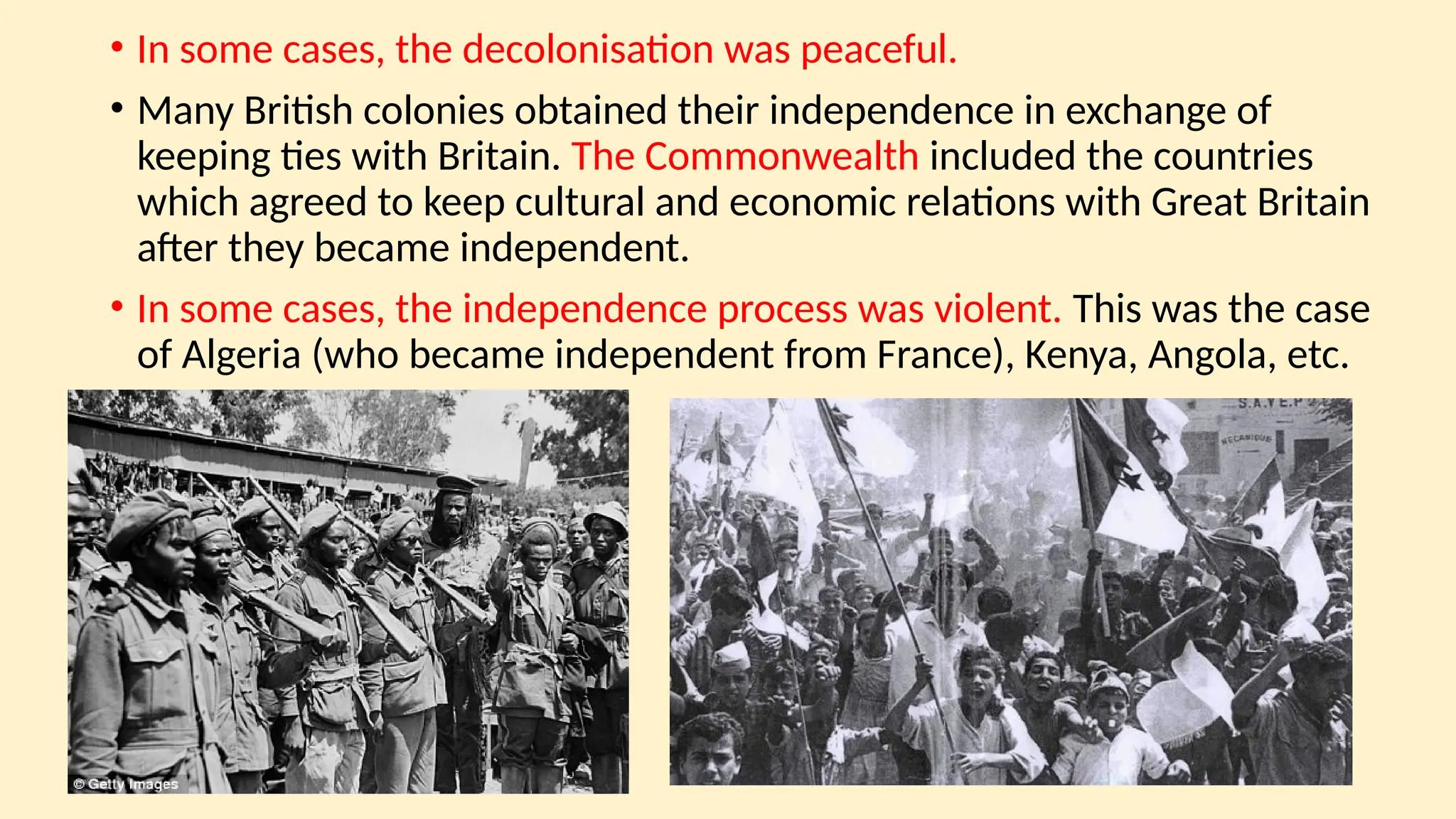
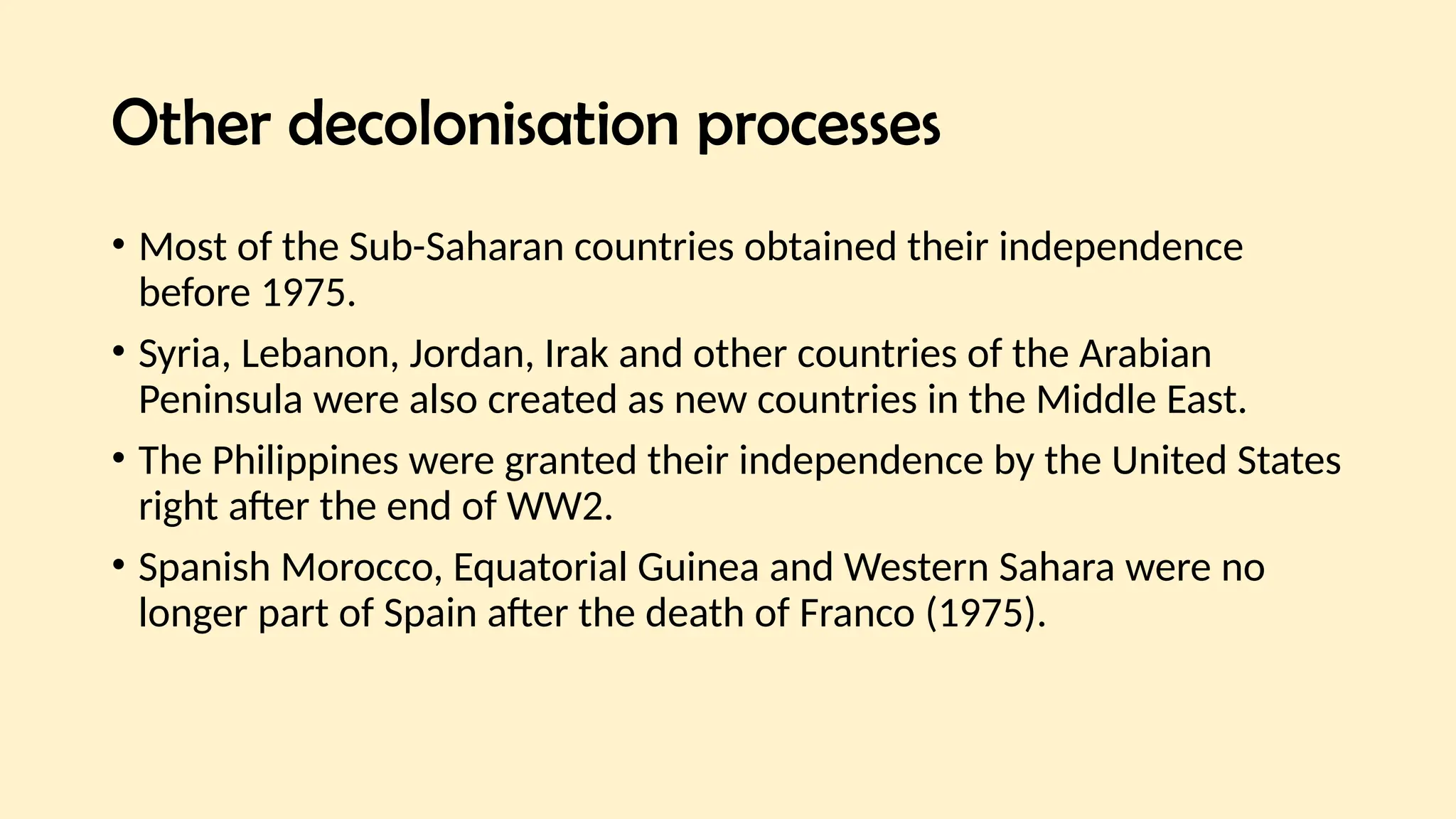
• In some cases, the independence process was violent. This was the case
of Algeria (who became independent from France), Kenya, Angola, etc.
The independence of India
• Mahatma Gandhi (1869-1948) was the leader of the independence
movement in British India.
• Gandhi criticized that the British had impoverished the Indian people.
Thus, he considered that the British had no right to stay in India, and
that they should leave.
• However, Gandhi defended the use of non-violent protest.
• Also, he defended the boycott of the British laws in India because they
were unfair. He also supported civil disobedience. Thus, the Indians
should not pay taxes, collaborate with the British as civil servants or
soldiers, should not buy the products manufactured in Britain, etc.
• During WW2, millions of Indian
soldiers fought for Britain.
• After the war (in 1947) the British
decided to leave India.
• British India included nowadays
Pakistan, India and Bangladesh. The
majority of the people in Pakistan
and Bangla Desh are muslims.
• In 1947, British India was partitioned
in two countries: Pakistan and India.
Bangla Desh obtained its
independence later (in 1971).
The creation of Israel
• After WW2, the United Nations decided that
Palestine (a territory under British rule) should
be divided in two: Palestine and Israel. Palestine
was a territory with Arab muslim population
• The British left in 1948. The partition was not
accepted by the Arabs, so the state of Palestine
was never really created. Also, the rest of the
Arab countries did not recognise Israel.
• Millions of Jews from all over the world
established in Israel.
The Arab-Israeli conflict
• Israel and the Arab countries fought in
several wars. The Six-Day war (1967)
and the Yom Kippur war (1973) were
the two most important conflicts.
• All these wars were won by Israel. As a
result of these conflicts, Israel
expanded territorially.
• The PLO (Palestine Liberation
Organization) led by Yasir Arafat
confronted the Israelis, first with
terrorist attacks, and later trying to
negotiate with Israel.
Yasir Arafat
Other decolonisation processes
• Most of the Sub-Saharan countries obtained their independence
before 1975.
• Syria, Lebanon, Jordan, Irak and other countries of the Arabian
Peninsula were also created as new countries in the Middle East.
• The Philippines were granted their independence by the United States
right after the end of WW2.
• Spanish Morocco, Equatorial Guinea and Western Sahara were no
longer part of Spain after the death of Franco (1975).
The consequences of decolonisation
Although the new countries were optimistic about their future right after
obtaining their independence, they soon had to face several problems:
- The borders were arbitrarily designed, and this caused frequent wars
(both civil wars, and wars between two countries).
- Most countries were not developed technologically, and fell under
economic dependence of the old metropolis, the United States or the Soviet
Union.
- The strong growth of population caused malnutrition and health
deficiencies. The new born countries could not afford maintaining a proper
education system.
- Most of the countries became dictatorships. A small group of people
controlled the economy of the country, while the majority of the population
were extremely poor.
The Third World
• The group of countries which resulted from decolonisation
were called Third World countries (the first and the second
being the capitalist bloc, and the communist bloc).
• Most of these countries tried to get rid of the dependence of
the two super powers.
• In the Bandung conference (Indonesia, 1955) several new
countries gathered and called for peaceful coexistence, and
proclaimed their independence from the intrusion of the US
and the USSR in their internal policies.

Social studies class of decolonisation.pptx

  • 1.
  • 2.
    • After theend of World War II, many colonies that had belonged to the European empires obtained their independence. This process is called decolonisation. • The causes of decolonisation were the following: 1. The United Nations defended the right of the colonies to become independent states. 2. The old empires could not afford having large territories under their control, as their economies had been greatly affected by WW2. 3. Charismatic, nationalist leaders appeared in the colonies: Sukarno (Indonesia), Ho Chi Minh (Vietnam), Gandhi (India), etc. 4. The United States and the USSR wanted to expand their areas of influence, so they supported the creation of independent states.
  • 3.
    • In somecases, the decolonisation was peaceful. • Many British colonies obtained their independence in exchange of keeping ties with Britain. The Commonwealth included the countries which agreed to keep cultural and economic relations with Great Britain after they became independent. • In some cases, the independence process was violent. This was the case of Algeria (who became independent from France), Kenya, Angola, etc.
  • 4.
    The independence ofIndia • Mahatma Gandhi (1869-1948) was the leader of the independence movement in British India. • Gandhi criticized that the British had impoverished the Indian people. Thus, he considered that the British had no right to stay in India, and that they should leave. • However, Gandhi defended the use of non-violent protest. • Also, he defended the boycott of the British laws in India because they were unfair. He also supported civil disobedience. Thus, the Indians should not pay taxes, collaborate with the British as civil servants or soldiers, should not buy the products manufactured in Britain, etc.
  • 5.
    • During WW2,millions of Indian soldiers fought for Britain. • After the war (in 1947) the British decided to leave India. • British India included nowadays Pakistan, India and Bangladesh. The majority of the people in Pakistan and Bangla Desh are muslims. • In 1947, British India was partitioned in two countries: Pakistan and India. Bangla Desh obtained its independence later (in 1971).
  • 6.
    The creation ofIsrael • After WW2, the United Nations decided that Palestine (a territory under British rule) should be divided in two: Palestine and Israel. Palestine was a territory with Arab muslim population • The British left in 1948. The partition was not accepted by the Arabs, so the state of Palestine was never really created. Also, the rest of the Arab countries did not recognise Israel. • Millions of Jews from all over the world established in Israel.
  • 7.
    The Arab-Israeli conflict •Israel and the Arab countries fought in several wars. The Six-Day war (1967) and the Yom Kippur war (1973) were the two most important conflicts. • All these wars were won by Israel. As a result of these conflicts, Israel expanded territorially. • The PLO (Palestine Liberation Organization) led by Yasir Arafat confronted the Israelis, first with terrorist attacks, and later trying to negotiate with Israel. Yasir Arafat
  • 8.
    Other decolonisation processes •Most of the Sub-Saharan countries obtained their independence before 1975. • Syria, Lebanon, Jordan, Irak and other countries of the Arabian Peninsula were also created as new countries in the Middle East. • The Philippines were granted their independence by the United States right after the end of WW2. • Spanish Morocco, Equatorial Guinea and Western Sahara were no longer part of Spain after the death of Franco (1975).
  • 9.
    The consequences ofdecolonisation Although the new countries were optimistic about their future right after obtaining their independence, they soon had to face several problems: - The borders were arbitrarily designed, and this caused frequent wars (both civil wars, and wars between two countries). - Most countries were not developed technologically, and fell under economic dependence of the old metropolis, the United States or the Soviet Union. - The strong growth of population caused malnutrition and health deficiencies. The new born countries could not afford maintaining a proper education system. - Most of the countries became dictatorships. A small group of people controlled the economy of the country, while the majority of the population were extremely poor.
  • 10.
    The Third World •The group of countries which resulted from decolonisation were called Third World countries (the first and the second being the capitalist bloc, and the communist bloc). • Most of these countries tried to get rid of the dependence of the two super powers. • In the Bandung conference (Indonesia, 1955) several new countries gathered and called for peaceful coexistence, and proclaimed their independence from the intrusion of the US and the USSR in their internal policies.