Decolonisation
Amanda Williams
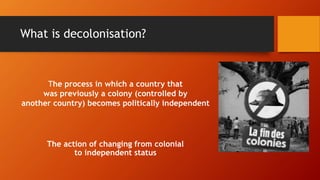
What is decolonisation?
The action of changing from colonial
to independent status
The process in which a country that
was previously a colony (controlled by
another country) becomes politically independent
What were the causes of decolonisation?
• In the Second World War, the colonies had a decisive role in the
conflict; combat had taken place in colonial territories and they
had contributed to the war effort with manpower, raw materials
and production. As a consequence, they believed they had earned
a right to self-determination.
• Nationalist ideas spread together with liberal and Marxist
ideologies. The appearance of charismatic leaders such as
Mahatma Gandhi in India. Ho Chi Minh in Indochina and Sukarno in
Indonesia strengthened these movements.
What were the causes of decolonisation?
• International support from intellectuals, Christian groups and the
UN supported the notion of self-determination and the two world
super powers saw an opportunity to extend their areas of
influence.
• The Conference of Bandung (1955) bought together twenty-nine
decolonized countries in Asia and Africa. The conference
condemned colonialism and racism and denounced the system of
blocs and support the idea of neutrality: this opened an
opportunity for the movement of Non-Aligned Countries
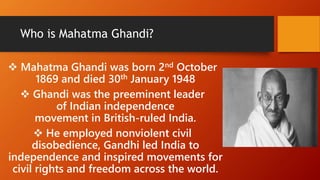
Who is Mahatma Ghandi?
 Mahatma Ghandi was born 2nd October
1869 and died 30th January 1948
 Ghandi was the preeminent leader
of Indian independence
movement in British-ruled India.
 He employed nonviolent civil
disobedience, Gandhi led India to
independence and inspired movements for
civil rights and freedom across the world.
What were the consequences of decolonisation?
• Politics: the new countries had generally been created with arbitrary
frontier and this caused conflict and civil war, giving way to dictatorial
regimes, which were often violent and corrupt. In international politics,
the new countries were relegated to secondary position
• Economy: many countries continued to depend on their old colonial
connections or became reliant on the USA or the USSR. This brought a
new form of covert colonialism known as neo-colonialism
• Society: strong demographic growth and a reduced economy led to a low
standard of living for most of the population. This caused famine,
malnutrition, medical deficiencies and analphabetism
• Decolonization of Asia and Africa occurred during 1945–1960
• Between 1945 and 1960, three dozen new states in Asia and Africa
achieved autonomy or outright independence from their European
colonial rulers.
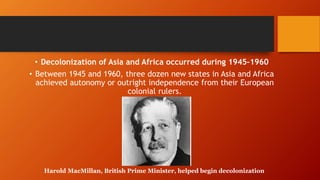
Harold MacMillan, British Prime Minister, helped begin decolonization
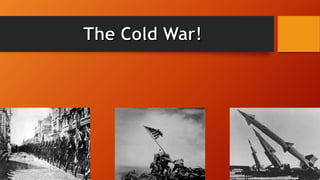
Basic information about The Cold War
 The Cold War started in 1947 at the end of the Second World
War and lasted until the dissolution of the Soviet Union on
December 26, 1991.
 The Cold War is the name given to the relationship that
developed primarily between the USA and the USSR after World
War Two. The Cold War was to dominate international affairs for
decades and many major crises occurred
 This war was unlike other wars in that the two sides never
clashed directly in battle. The fear that the relationship would
end in nuclear war did not materialize.

Decolonisation

  • 1.
  • 2.
    What is decolonisation? Theaction of changing from colonial to independent status The process in which a country that was previously a colony (controlled by another country) becomes politically independent
  • 3.
    What were thecauses of decolonisation? • In the Second World War, the colonies had a decisive role in the conflict; combat had taken place in colonial territories and they had contributed to the war effort with manpower, raw materials and production. As a consequence, they believed they had earned a right to self-determination. • Nationalist ideas spread together with liberal and Marxist ideologies. The appearance of charismatic leaders such as Mahatma Gandhi in India. Ho Chi Minh in Indochina and Sukarno in Indonesia strengthened these movements.
  • 4.
    What were thecauses of decolonisation? • International support from intellectuals, Christian groups and the UN supported the notion of self-determination and the two world super powers saw an opportunity to extend their areas of influence. • The Conference of Bandung (1955) bought together twenty-nine decolonized countries in Asia and Africa. The conference condemned colonialism and racism and denounced the system of blocs and support the idea of neutrality: this opened an opportunity for the movement of Non-Aligned Countries
  • 5.
    Who is MahatmaGhandi?  Mahatma Ghandi was born 2nd October 1869 and died 30th January 1948  Ghandi was the preeminent leader of Indian independence movement in British-ruled India.  He employed nonviolent civil disobedience, Gandhi led India to independence and inspired movements for civil rights and freedom across the world.
  • 6.
    What were theconsequences of decolonisation? • Politics: the new countries had generally been created with arbitrary frontier and this caused conflict and civil war, giving way to dictatorial regimes, which were often violent and corrupt. In international politics, the new countries were relegated to secondary position • Economy: many countries continued to depend on their old colonial connections or became reliant on the USA or the USSR. This brought a new form of covert colonialism known as neo-colonialism • Society: strong demographic growth and a reduced economy led to a low standard of living for most of the population. This caused famine, malnutrition, medical deficiencies and analphabetism
  • 7.
    • Decolonization ofAsia and Africa occurred during 1945–1960 • Between 1945 and 1960, three dozen new states in Asia and Africa achieved autonomy or outright independence from their European colonial rulers. Harold MacMillan, British Prime Minister, helped begin decolonization
  • 10.
    Basic information aboutThe Cold War  The Cold War started in 1947 at the end of the Second World War and lasted until the dissolution of the Soviet Union on December 26, 1991.  The Cold War is the name given to the relationship that developed primarily between the USA and the USSR after World War Two. The Cold War was to dominate international affairs for decades and many major crises occurred  This war was unlike other wars in that the two sides never clashed directly in battle. The fear that the relationship would end in nuclear war did not materialize.