Decolonization
Process of Decolonization and Nation- Building Surge of anti-colonial nationalism after 1945.  Leaders used lessons in mass politicization and mass mobilization of 1920’s and 1930’s.  Three patterns: Civil war (China) Negotiated independence (India and much of Africa) Incomplete de-colonization (Palestine, Algeria and Southern Africa, Vietnam)
Pre-WWII 1931, Britain: Statute of Westminster  converted the British Empire into the British Commonwealth also allowed varying degrees of autonomy
End of WWII 1941 – Atlantic Charter written by Roosevelt and Churchill – affirming all nations the right self determination By the end of WWII, colonialism seemed to contradict the spirit of the Allies fight against Nazi Germany and Fascist Italy Over 200,000 Africans had fought in Europe and Asia for the Allies’ freedom and democracy – most noticed the contradiction
End of WWII In 1945, the 5th Pan African Congress met and discussed the prospect of independence – attending were a number of leaders who would eventually lead their nations to independence In the years immediately after the war, several colonies had achieved independence or were on the road to independence in north east Africa, some peacefully, others not
End of WWII Started a new pan-African nationalism that would spread throughout continent In 1960 the United Nations General Assembly passed Resolution 1514 that supported the end of colonization
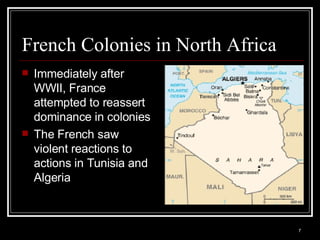
French Colonies in North Africa Immediately after WWII, France attempted to reassert dominance in colonies The French saw violent reactions to actions in Tunisia and Algeria
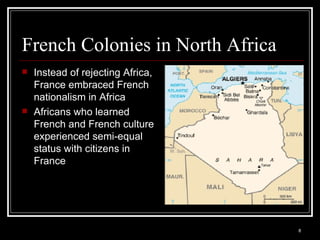
French Colonies in North Africa Instead of rejecting Africa, France embraced French nationalism in Africa Africans who learned French and French culture experienced semi-equal status with citizens in France
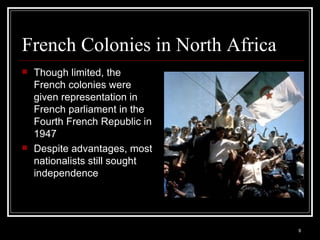
French Colonies in North Africa Though limited, the French colonies were given representation in French parliament in the Fourth French Republic in 1947 Despite advantages, most nationalists still sought independence
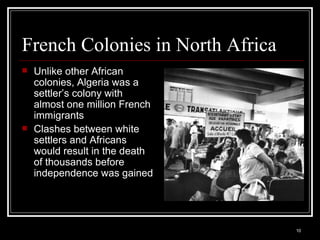
French Colonies in North Africa Unlike other African colonies, Algeria was a settler’s colony with almost one million French immigrants Clashes between white settlers and Africans would result in the death of thousands before independence was gained
West Africa Interaction with Europeans date back to the 1400s West Africans had adopted many elements of western civilization Early ties allowed more opportunities for education and modernization Nationalists in West Africa drew from their own history and western influences
West Africa As a result, independence in West Africa was more “natural” for both the Africans and the European powers Once the Ghana (formerly the Gold Coast) became the first republic in West Africa, the movements in neighboring British and French colonies intensified
Southern Africa South Africa gained independence from Britain in 1910 White minority dominated political and economic institutions Educated Africans began organizing movement to gain power
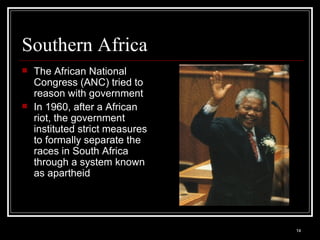
Southern Africa The African National Congress (ANC) tried to reason with government In 1960, after a African riot, the government instituted strict measures to formally separate the races in South Africa through a system known as apartheid
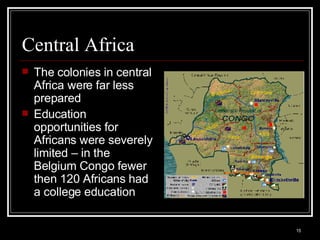
Central Africa The colonies in central Africa were far less prepared Education opportunities for Africans were severely limited – in the Belgium Congo fewer then 120 Africans had a college education
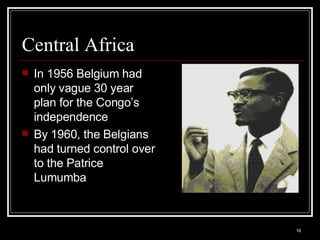
Central Africa In 1956 Belgium had only vague 30 year plan for the Congo’s independence By 1960, the Belgians had turned control over to the Patrice Lumumba
Congo Prime Minister Patrice Lumumba hoped to reform the Congo and take advantage of the its vast natural resources Two mineral rich provinces did not wish to be subjugated by the republic and declared independence
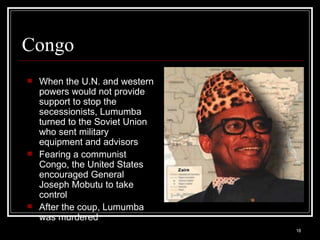
Congo When the U.N. and western powers would not provide support to stop the secessionists, Lumumba turned to the Soviet Union who sent military equipment and advisors Fearing a communist Congo, the United States encouraged General Joseph Mobutu to take control After the coup, Lumumba was murdered
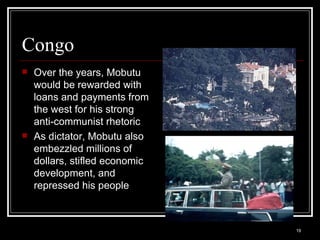
Congo Over the years, Mobutu would be rewarded with loans and payments from the west for his strong anti-communist rhetoric As dictator, Mobutu also embezzled millions of dollars, stifled economic development, and repressed his people

Decolonization

  • 1.
  • 2.
    Process of Decolonizationand Nation- Building Surge of anti-colonial nationalism after 1945. Leaders used lessons in mass politicization and mass mobilization of 1920’s and 1930’s. Three patterns: Civil war (China) Negotiated independence (India and much of Africa) Incomplete de-colonization (Palestine, Algeria and Southern Africa, Vietnam)
  • 3.
    Pre-WWII 1931, Britain:Statute of Westminster converted the British Empire into the British Commonwealth also allowed varying degrees of autonomy
  • 4.
    End of WWII1941 – Atlantic Charter written by Roosevelt and Churchill – affirming all nations the right self determination By the end of WWII, colonialism seemed to contradict the spirit of the Allies fight against Nazi Germany and Fascist Italy Over 200,000 Africans had fought in Europe and Asia for the Allies’ freedom and democracy – most noticed the contradiction
  • 5.
    End of WWIIIn 1945, the 5th Pan African Congress met and discussed the prospect of independence – attending were a number of leaders who would eventually lead their nations to independence In the years immediately after the war, several colonies had achieved independence or were on the road to independence in north east Africa, some peacefully, others not
  • 6.
    End of WWIIStarted a new pan-African nationalism that would spread throughout continent In 1960 the United Nations General Assembly passed Resolution 1514 that supported the end of colonization
  • 7.
    French Colonies inNorth Africa Immediately after WWII, France attempted to reassert dominance in colonies The French saw violent reactions to actions in Tunisia and Algeria
  • 8.
    French Colonies inNorth Africa Instead of rejecting Africa, France embraced French nationalism in Africa Africans who learned French and French culture experienced semi-equal status with citizens in France
  • 9.
    French Colonies inNorth Africa Though limited, the French colonies were given representation in French parliament in the Fourth French Republic in 1947 Despite advantages, most nationalists still sought independence
  • 10.
    French Colonies inNorth Africa Unlike other African colonies, Algeria was a settler’s colony with almost one million French immigrants Clashes between white settlers and Africans would result in the death of thousands before independence was gained
  • 11.
    West Africa Interactionwith Europeans date back to the 1400s West Africans had adopted many elements of western civilization Early ties allowed more opportunities for education and modernization Nationalists in West Africa drew from their own history and western influences
  • 12.
    West Africa Asa result, independence in West Africa was more “natural” for both the Africans and the European powers Once the Ghana (formerly the Gold Coast) became the first republic in West Africa, the movements in neighboring British and French colonies intensified
  • 13.
    Southern Africa SouthAfrica gained independence from Britain in 1910 White minority dominated political and economic institutions Educated Africans began organizing movement to gain power
  • 14.
    Southern Africa TheAfrican National Congress (ANC) tried to reason with government In 1960, after a African riot, the government instituted strict measures to formally separate the races in South Africa through a system known as apartheid
  • 15.
    Central Africa Thecolonies in central Africa were far less prepared Education opportunities for Africans were severely limited – in the Belgium Congo fewer then 120 Africans had a college education
  • 16.
    Central Africa In1956 Belgium had only vague 30 year plan for the Congo’s independence By 1960, the Belgians had turned control over to the Patrice Lumumba
  • 17.
    Congo Prime MinisterPatrice Lumumba hoped to reform the Congo and take advantage of the its vast natural resources Two mineral rich provinces did not wish to be subjugated by the republic and declared independence
  • 18.
    Congo When theU.N. and western powers would not provide support to stop the secessionists, Lumumba turned to the Soviet Union who sent military equipment and advisors Fearing a communist Congo, the United States encouraged General Joseph Mobutu to take control After the coup, Lumumba was murdered
  • 19.
    Congo Over theyears, Mobutu would be rewarded with loans and payments from the west for his strong anti-communist rhetoric As dictator, Mobutu also embezzled millions of dollars, stifled economic development, and repressed his people