1
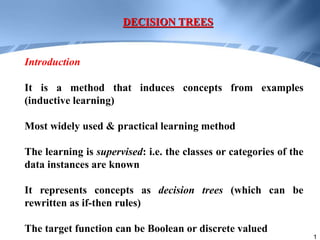
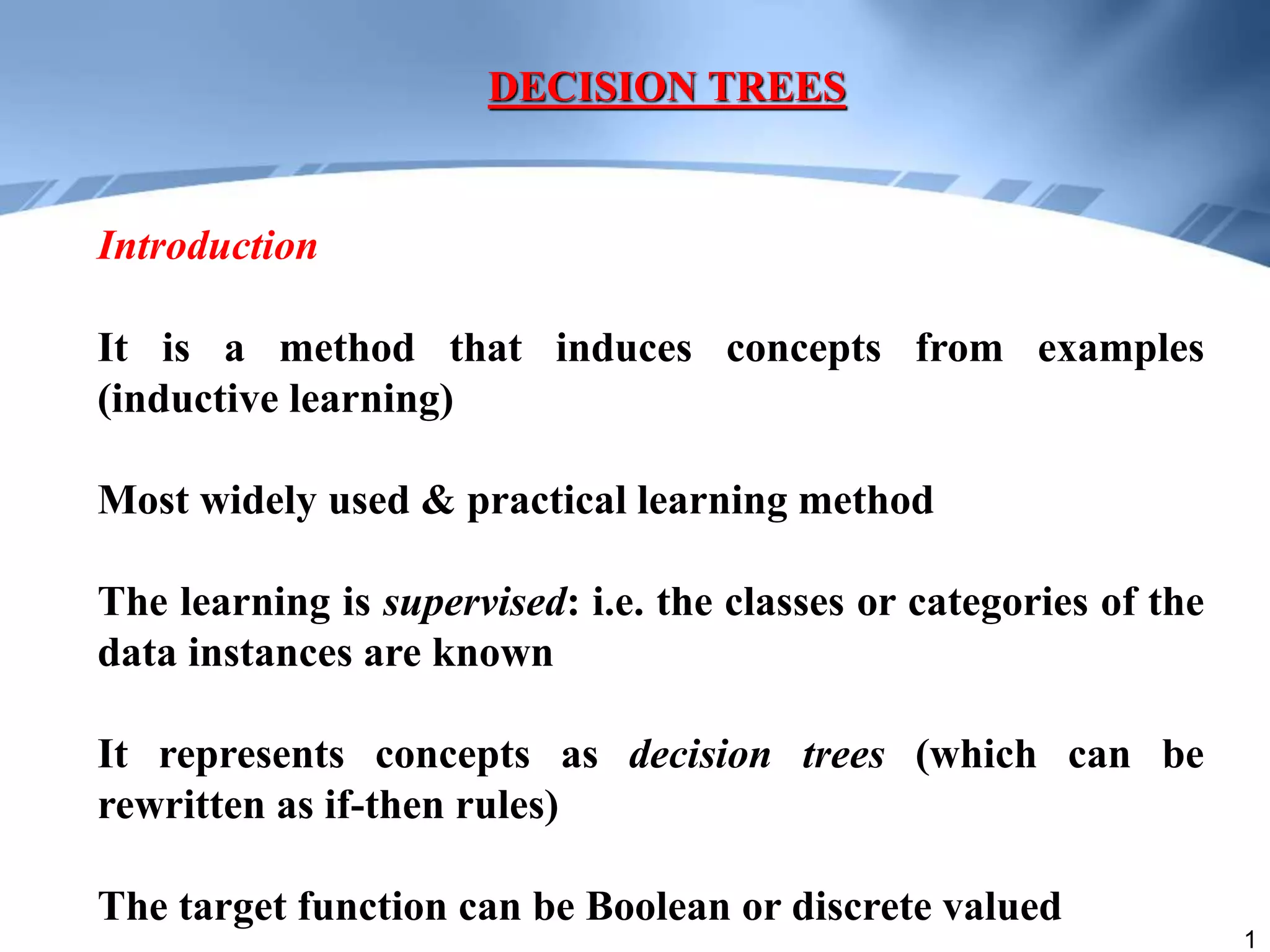
It is a method that induces concepts from examples
(inductive learning)
Most widely used & practical learning method
The learning is supervised: i.e. the classes or categories of the
data instances are known
It represents concepts as decision trees (which can be
rewritten as if-then rules)
The target function can be Boolean or discrete valued
DECISION TREES
Introduction
2
DECISION TREES
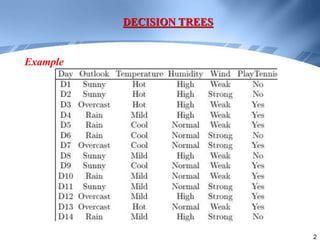
Example
3
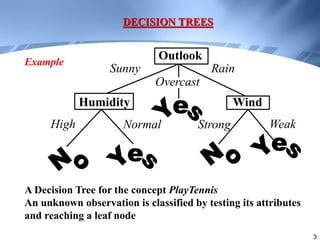
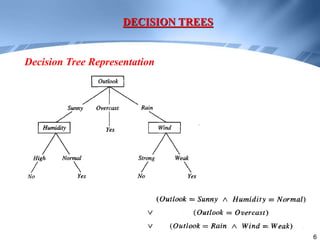
Outlook
Humidity Wind
Sunny
Overcast
Rain
High Normal Strong Weak
A Decision Tree for the concept PlayTennis
An unknown observation is classified by testing its attributes
and reaching a leaf node
DECISION TREES
Example
4
1. Each node corresponds to an attribute
2. Each branch corresponds to an attribute value
3. Each leaf node assigns a classification
DECISION TREES
Decision Tree Representation
5
Decision trees represent a disjunction of conjunctions of
constraints on the attribute values of instances
Each path from the tree root to a leaf corresponds to a
conjunction of attribute tests (one rule for classification)
The tree itself corresponds to a disjunction of these
conjunctions (set of rules for classification)
DECISION TREES
Decision Tree Representation
6
DECISION TREES
Decision Tree Representation
7
Most algorithms for growing decision trees are variants of a
basic algorithm
An example of this core algorithm is the ID3 algorithm
developed by Quinlan (1986)
It employs a top-down, greedy search through the space of
possible decision trees
DECISION TREES
Basic Decision Tree Learning Algorithm
8
First of all we select the best attribute to be tested at the root
of the tree
For making this selection each attribute is evaluated using a
statistical test to determine how well it alone classifies the
training examples
DECISION TREES
Basic Decision Tree Learning Algorithm
9
D13
D12 D11
D10
D9
D4
D7
D5
D3
D14
D8
D6
D2
D1
DECISION TREES
Basic Decision Tree Learning Algorithm
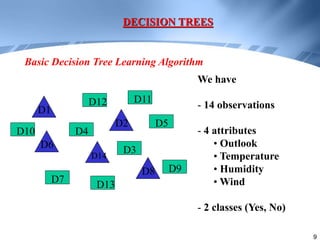
We have
- 14 observations
- 4 attributes
• Outlook
• Temperature
• Humidity
• Wind
- 2 classes (Yes, No)
10
D13
D12
D11
D10
D9
D4
D7
D5
D3
D14
D8 D6
D2
D1
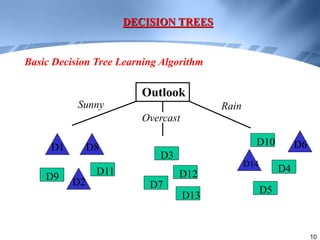
Outlook
Sunny
Overcast
Rain
DECISION TREES
Basic Decision Tree Learning Algorithm
11
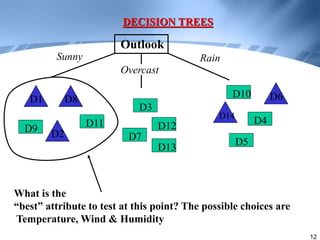
The selection process is then repeated using the training
examples associated with each descendant node to select the
best attribute to test at that point in the tree
DECISION TREES
Basic Decision Tree Learning Algorithm
12
D13
D12
D11
D10
D9
D4
D7
D5
D3
D14
D8 D6
D2
D1
Outlook
Sunny
Overcast
Rain
What is the
“best” attribute to test at this point? The possible choices are
Temperature, Wind & Humidity
DECISION TREES
13
This forms a greedy search for an acceptable decision tree, in
which the algorithm never backtracks to reconsider earlier
choices
DECISION TREES
Basic Decision Tree Learning Algorithm
14
The central choice in the ID3 algorithm is selecting which
attribute to test at each node in the tree
We would like to select the attribute which is most useful for
classifying examples
For this we need a good quantitative measure
For this purpose a statistical property, called information
gain is used
DECISION TREES
Which Attribute is the Best Classifier?
15
In order to define information gain precisely, we begin by
defining entropy
Entropy is a measure commonly used in information theory,
called.
Entropy characterizes the impurity of an arbitrary collection
of examples
DECISION TREES
Which Attribute is the Best Classifier?: Definition of Entropy
16
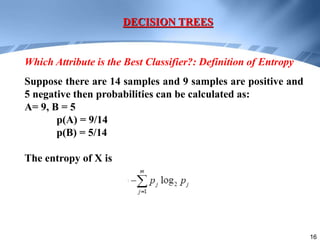
Suppose there are 14 samples and 9 samples are positive and
5 negative then probabilities can be calculated as:
A= 9, B = 5
p(A) = 9/14
p(B) = 5/14
The entropy of X is
DECISION TREES
Which Attribute is the Best Classifier?: Definition of Entropy
17
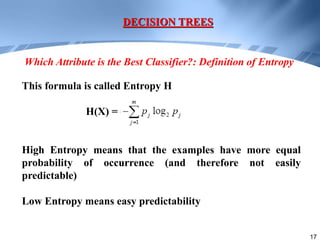
This formula is called Entropy H
H(X) =
High Entropy means that the examples have more equal
probability of occurrence (and therefore not easily
predictable)
Low Entropy means easy predictability
DECISION TREES
Which Attribute is the Best Classifier?: Definition of Entropy
Entropy
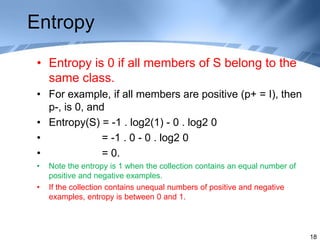
• Entropy is 0 if all members of S belong to the
same class.
• For example, if all members are positive (p+ = I), then
p-, is 0, and
• Entropy(S) = -1 . log2(1) - 0 . log2 0
• = -1 . 0 - 0 . log2 0
• = 0.
• Note the entropy is 1 when the collection contains an equal number of
positive and negative examples.
• If the collection contains unequal numbers of positive and negative
examples, entropy is between 0 and 1.
18
19
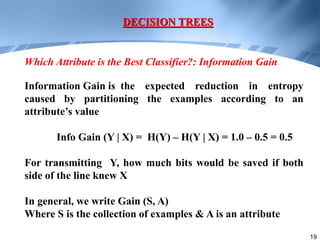
Information Gain is the expected reduction in entropy
caused by partitioning the examples according to an
attribute’s value
Info Gain (Y | X) = H(Y) – H(Y | X) = 1.0 – 0.5 = 0.5
For transmitting Y, how much bits would be saved if both
side of the line knew X
In general, we write Gain (S, A)
Where S is the collection of examples & A is an attribute
DECISION TREES
Which Attribute is the Best Classifier?: Information Gain
20
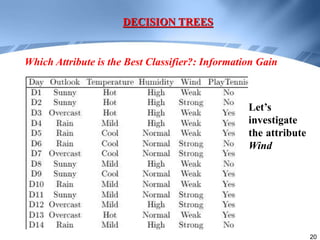
Let’s
investigate
the attribute
Wind
DECISION TREES
Which Attribute is the Best Classifier?: Information Gain
21
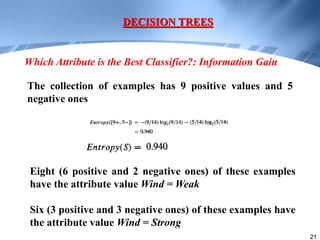
The collection of examples has 9 positive values and 5
negative ones
DECISION TREES
Which Attribute is the Best Classifier?: Information Gain
Eight (6 positive and 2 negative ones) of these examples
have the attribute value Wind = Weak
Six (3 positive and 3 negative ones) of these examples have
the attribute value Wind = Strong
22
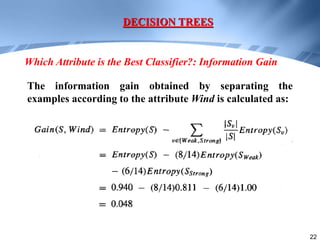
The information gain obtained by separating the
examples according to the attribute Wind is calculated as:
DECISION TREES
Which Attribute is the Best Classifier?: Information Gain
23
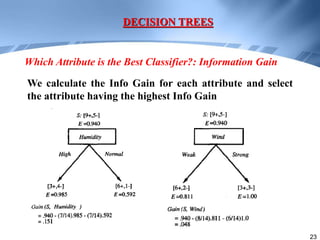
We calculate the Info Gain for each attribute and select
the attribute having the highest Info Gain
DECISION TREES
Which Attribute is the Best Classifier?: Information Gain
24
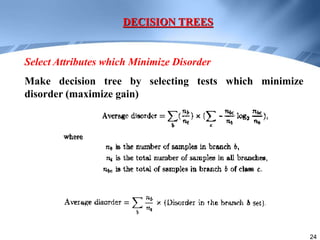
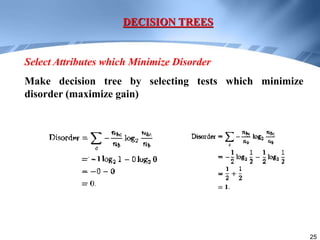
Make decision tree by selecting tests which minimize
disorder (maximize gain)
DECISION TREES
Select Attributes which Minimize Disorder
25
Make decision tree by selecting tests which minimize
disorder (maximize gain)
DECISION TREES
Select Attributes which Minimize Disorder
26
DECISION TREES
Select Attributes which Minimize Disorder
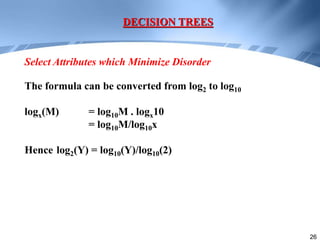
The formula can be converted from log2 to log10
logx(M) = log10M . logx10
= log10M/log10x
Hence log2(Y) = log10(Y)/log10(2)
27
DECISION TREES
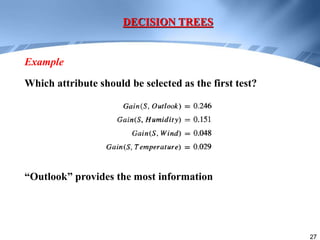
Example
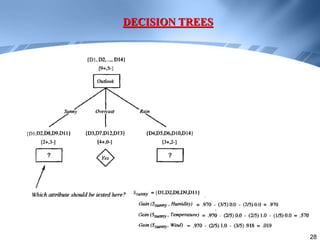
Which attribute should be selected as the first test?
“Outlook” provides the most information
28
DECISION TREES
29
DECISION TREES
Example
The process of selecting a new attribute is now repeated for
each (non-terminal) descendant node, this time using only
training examples associated with that node
Attributes that have been incorporated higher in the tree are
excluded, so that any given attribute can appear at most once
along any path through the tree
30
DECISION TREES
Example
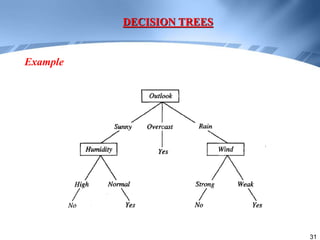
This process continues for each new leaf node until either:
1. Every attribute has already been included along this path
through the tree
2. The training examples associated with a leaf node have
zero entropy
31
DECISION TREES
Example
32
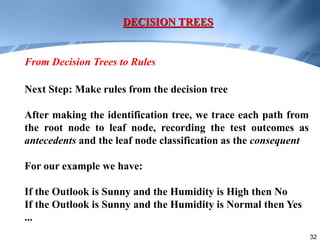
Next Step: Make rules from the decision tree
After making the identification tree, we trace each path from
the root node to leaf node, recording the test outcomes as
antecedents and the leaf node classification as the consequent
For our example we have:
If the Outlook is Sunny and the Humidity is High then No
If the Outlook is Sunny and the Humidity is Normal then Yes
...
DECISION TREES
From Decision Trees to Rules
33
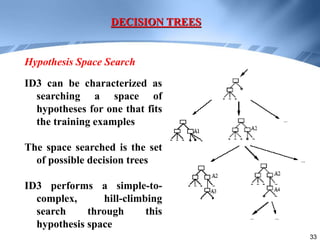
ID3 can be characterized as
searching a space of
hypotheses for one that fits
the training examples
The space searched is the set
of possible decision trees
ID3 performs a simple-to-
complex, hill-climbing
search through this
hypothesis space
DECISION TREES
Hypothesis Space Search
34
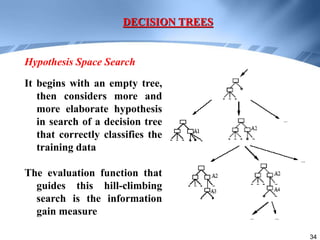
It begins with an empty tree,
then considers more and
more elaborate hypothesis
in search of a decision tree
that correctly classifies the
training data
The evaluation function that
guides this hill-climbing
search is the information
gain measure
DECISION TREES
Hypothesis Space Search
35
Some points to note:
• The hypothesis space of all decision trees is a complete
space. Hence the target function is guaranteed to be
present in it.
DECISION TREES
Hypothesis Space Search
36
• ID3 maintains only a single current hypothesis as it
searches through the space of decision trees.
By determining only a single hypothesis, ID3 loses the
capabilities that follow from explicitly representing all
consistent hypotheses.
For example, it does not have the ability to determine
how many alternative decision trees are consistent with
the training data, or to pose new instance queries that
optimally resolve among these competing hypotheses
DECISION TREES
Hypothesis Space Search
37
• ID3 performs no backtracking, therefore it is
susceptible to converging to locally optimal solutions
• ID3 uses all training examples at each step to refine its
current hypothesis. This makes it less sensitive to
errors in individual training examples.
However, this requires that all the training examples
are present right from the beginning and the learning
cannot be done incrementally with time
DECISION TREES
Hypothesis Space Search

Decision Trees.ppt

  • 1.
    1 It is amethod that induces concepts from examples (inductive learning) Most widely used & practical learning method The learning is supervised: i.e. the classes or categories of the data instances are known It represents concepts as decision trees (which can be rewritten as if-then rules) The target function can be Boolean or discrete valued DECISION TREES Introduction
  • 2.
  • 3.
    3 Outlook Humidity Wind Sunny Overcast Rain High NormalStrong Weak A Decision Tree for the concept PlayTennis An unknown observation is classified by testing its attributes and reaching a leaf node DECISION TREES Example
  • 4.
    4 1. Each nodecorresponds to an attribute 2. Each branch corresponds to an attribute value 3. Each leaf node assigns a classification DECISION TREES Decision Tree Representation
  • 5.
    5 Decision trees representa disjunction of conjunctions of constraints on the attribute values of instances Each path from the tree root to a leaf corresponds to a conjunction of attribute tests (one rule for classification) The tree itself corresponds to a disjunction of these conjunctions (set of rules for classification) DECISION TREES Decision Tree Representation
  • 6.
  • 7.
    7 Most algorithms forgrowing decision trees are variants of a basic algorithm An example of this core algorithm is the ID3 algorithm developed by Quinlan (1986) It employs a top-down, greedy search through the space of possible decision trees DECISION TREES Basic Decision Tree Learning Algorithm
  • 8.
    8 First of allwe select the best attribute to be tested at the root of the tree For making this selection each attribute is evaluated using a statistical test to determine how well it alone classifies the training examples DECISION TREES Basic Decision Tree Learning Algorithm
  • 9.
    9 D13 D12 D11 D10 D9 D4 D7 D5 D3 D14 D8 D6 D2 D1 DECISION TREES BasicDecision Tree Learning Algorithm We have - 14 observations - 4 attributes • Outlook • Temperature • Humidity • Wind - 2 classes (Yes, No)
  • 10.
  • 11.
    11 The selection processis then repeated using the training examples associated with each descendant node to select the best attribute to test at that point in the tree DECISION TREES Basic Decision Tree Learning Algorithm
  • 12.
    12 D13 D12 D11 D10 D9 D4 D7 D5 D3 D14 D8 D6 D2 D1 Outlook Sunny Overcast Rain What isthe “best” attribute to test at this point? The possible choices are Temperature, Wind & Humidity DECISION TREES
  • 13.
    13 This forms agreedy search for an acceptable decision tree, in which the algorithm never backtracks to reconsider earlier choices DECISION TREES Basic Decision Tree Learning Algorithm
  • 14.
    14 The central choicein the ID3 algorithm is selecting which attribute to test at each node in the tree We would like to select the attribute which is most useful for classifying examples For this we need a good quantitative measure For this purpose a statistical property, called information gain is used DECISION TREES Which Attribute is the Best Classifier?
  • 15.
    15 In order todefine information gain precisely, we begin by defining entropy Entropy is a measure commonly used in information theory, called. Entropy characterizes the impurity of an arbitrary collection of examples DECISION TREES Which Attribute is the Best Classifier?: Definition of Entropy
  • 16.
    16 Suppose there are14 samples and 9 samples are positive and 5 negative then probabilities can be calculated as: A= 9, B = 5 p(A) = 9/14 p(B) = 5/14 The entropy of X is DECISION TREES Which Attribute is the Best Classifier?: Definition of Entropy
  • 17.
    17 This formula iscalled Entropy H H(X) = High Entropy means that the examples have more equal probability of occurrence (and therefore not easily predictable) Low Entropy means easy predictability DECISION TREES Which Attribute is the Best Classifier?: Definition of Entropy
  • 18.
    Entropy • Entropy is0 if all members of S belong to the same class. • For example, if all members are positive (p+ = I), then p-, is 0, and • Entropy(S) = -1 . log2(1) - 0 . log2 0 • = -1 . 0 - 0 . log2 0 • = 0. • Note the entropy is 1 when the collection contains an equal number of positive and negative examples. • If the collection contains unequal numbers of positive and negative examples, entropy is between 0 and 1. 18
  • 19.
    19 Information Gain isthe expected reduction in entropy caused by partitioning the examples according to an attribute’s value Info Gain (Y | X) = H(Y) – H(Y | X) = 1.0 – 0.5 = 0.5 For transmitting Y, how much bits would be saved if both side of the line knew X In general, we write Gain (S, A) Where S is the collection of examples & A is an attribute DECISION TREES Which Attribute is the Best Classifier?: Information Gain
  • 20.
    20 Let’s investigate the attribute Wind DECISION TREES WhichAttribute is the Best Classifier?: Information Gain
  • 21.
    21 The collection ofexamples has 9 positive values and 5 negative ones DECISION TREES Which Attribute is the Best Classifier?: Information Gain Eight (6 positive and 2 negative ones) of these examples have the attribute value Wind = Weak Six (3 positive and 3 negative ones) of these examples have the attribute value Wind = Strong
  • 22.
    22 The information gainobtained by separating the examples according to the attribute Wind is calculated as: DECISION TREES Which Attribute is the Best Classifier?: Information Gain
  • 23.
    23 We calculate theInfo Gain for each attribute and select the attribute having the highest Info Gain DECISION TREES Which Attribute is the Best Classifier?: Information Gain
  • 24.
    24 Make decision treeby selecting tests which minimize disorder (maximize gain) DECISION TREES Select Attributes which Minimize Disorder
  • 25.
    25 Make decision treeby selecting tests which minimize disorder (maximize gain) DECISION TREES Select Attributes which Minimize Disorder
  • 26.
    26 DECISION TREES Select Attributeswhich Minimize Disorder The formula can be converted from log2 to log10 logx(M) = log10M . logx10 = log10M/log10x Hence log2(Y) = log10(Y)/log10(2)
  • 27.
    27 DECISION TREES Example Which attributeshould be selected as the first test? “Outlook” provides the most information
  • 28.
  • 29.
    29 DECISION TREES Example The processof selecting a new attribute is now repeated for each (non-terminal) descendant node, this time using only training examples associated with that node Attributes that have been incorporated higher in the tree are excluded, so that any given attribute can appear at most once along any path through the tree
  • 30.
    30 DECISION TREES Example This processcontinues for each new leaf node until either: 1. Every attribute has already been included along this path through the tree 2. The training examples associated with a leaf node have zero entropy
  • 31.
  • 32.
    32 Next Step: Makerules from the decision tree After making the identification tree, we trace each path from the root node to leaf node, recording the test outcomes as antecedents and the leaf node classification as the consequent For our example we have: If the Outlook is Sunny and the Humidity is High then No If the Outlook is Sunny and the Humidity is Normal then Yes ... DECISION TREES From Decision Trees to Rules
  • 33.
    33 ID3 can becharacterized as searching a space of hypotheses for one that fits the training examples The space searched is the set of possible decision trees ID3 performs a simple-to- complex, hill-climbing search through this hypothesis space DECISION TREES Hypothesis Space Search
  • 34.
    34 It begins withan empty tree, then considers more and more elaborate hypothesis in search of a decision tree that correctly classifies the training data The evaluation function that guides this hill-climbing search is the information gain measure DECISION TREES Hypothesis Space Search
  • 35.
    35 Some points tonote: • The hypothesis space of all decision trees is a complete space. Hence the target function is guaranteed to be present in it. DECISION TREES Hypothesis Space Search
  • 36.
    36 • ID3 maintainsonly a single current hypothesis as it searches through the space of decision trees. By determining only a single hypothesis, ID3 loses the capabilities that follow from explicitly representing all consistent hypotheses. For example, it does not have the ability to determine how many alternative decision trees are consistent with the training data, or to pose new instance queries that optimally resolve among these competing hypotheses DECISION TREES Hypothesis Space Search
  • 37.
    37 • ID3 performsno backtracking, therefore it is susceptible to converging to locally optimal solutions • ID3 uses all training examples at each step to refine its current hypothesis. This makes it less sensitive to errors in individual training examples. However, this requires that all the training examples are present right from the beginning and the learning cannot be done incrementally with time DECISION TREES Hypothesis Space Search