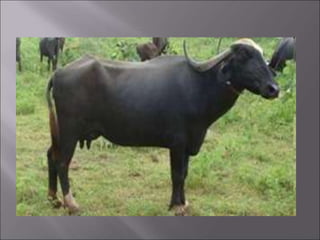
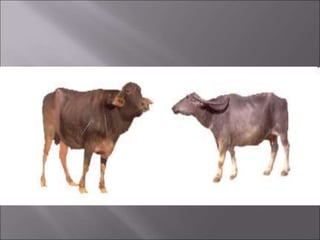
DEFINITION:
 Homogenous, sub-specific group
 Identified with external character from other lllry
defined group in the same species.
(Tuyrton, 1974)
 Kingdom : Animalia
 Phylum : Chordata
 Class : Mammalia
 Order : Artiodactyls
 Suborder : Ruminentia
 Family : Bovidae
 Subfamily: Bovinae
 Genus : Bubalis
 Species : B.arni (B.bubalus)
 Buffalo come under the Tribe Bovini – 3 group
Bovini
Bovina Bubalina Syncercina
(cattle & bison) (Asian buff) (African buff)
 Interbreeding is not possible between these 3.
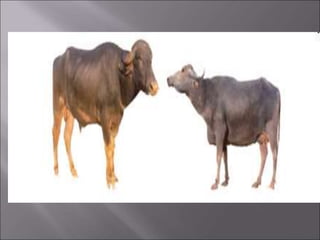
 Asian is lllr to African but differ from cattle by
horn cattle- oval, buffalo- Angular.
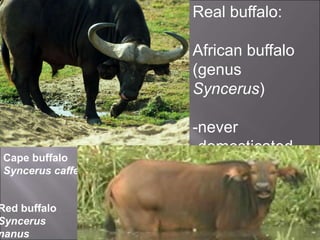
Cape buffalo
Syncerus caffer
Red buffalo
Syncerus
nanus
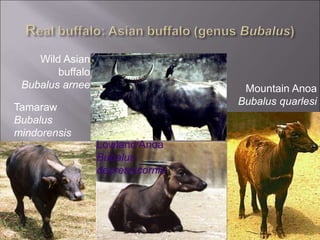
Real buffalo:
African buffalo
(genus
Syncerus)
-never
-domesticated
Wild Asian
buffalo
Bubalus arnee
Tamaraw
Bubalus
mindorensis
Lowland Anoa
Bubalus
depressicornis
Mountain Anoa
Bubalus quarlesi
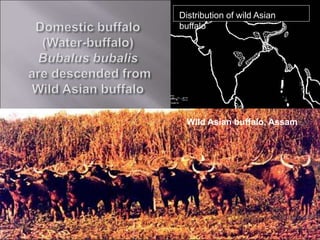
Distribution of wild Asian
buffalo
Wild Asian buffalo, Assam
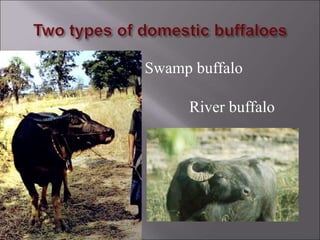
Swamp buffalo
River buffalo
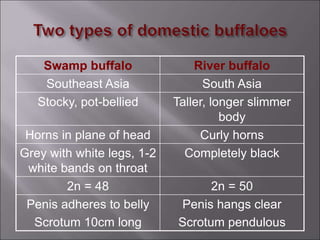
 Swamp buffalo 1st domesticated in China 4000
years ago.
 River in Indo- gangetic region 5000 years ago.
Swamp buffalo River buffalo
Southeast Asia South Asia
Stocky, pot-bellied Taller, longer slimmer
body
Horns in plane of head Curly horns
Grey with white legs, 1-2
white bands on throat
Completely black
2n = 48 2n = 50
Penis adheres to belly
Scrotum 10cm long
Penis hangs clear
Scrotum pendulous
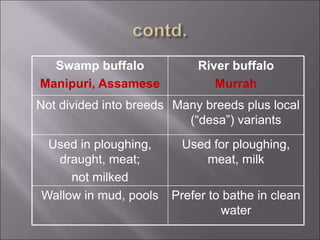
Swamp buffalo
Manipuri, Assamese
River buffalo
Murrah
Not divided into breeds Many breeds plus local
(“desa”) variants
Used in ploughing,
draught, meat;
not milked
Used for ploughing,
meat, milk
Wallow in mud, pools Prefer to bathe in clean
water
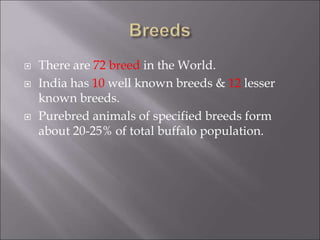
 There are 72 breed in the World.
 India has 10 well known breeds & 12 lesser
known breeds.
 Purebred animals of specified breeds form
about 20-25% of total buffalo population.
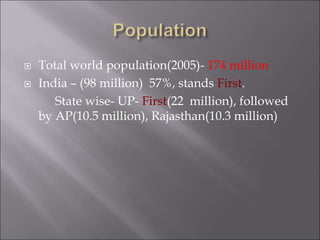
 Total world population(2005)- 174 million
 India – (98 million) 57%, stands First.
State wise- UP- First(22 million), followed
by AP(10.5 million), Rajasthan(10.3 million)
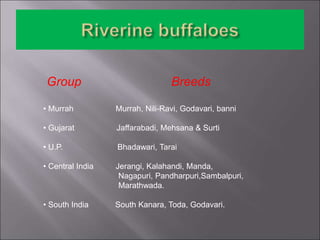
Group Breeds
• Murrah Murrah, Nili-Ravi, Godavari, banni
• Gujarat Jaffarabadi, Mehsana & Surti
• U.P. Bhadawari, Tarai
• Central India Jerangi, Kalahandi, Manda,
Nagapuri, Pandharpuri,Sambalpuri,
Marathwada.
• South India South Kanara, Toda, Godavari.
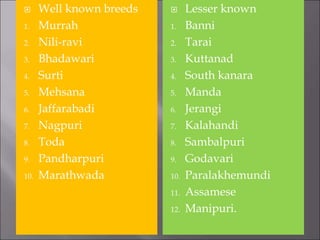
 Well known breeds
1. Murrah
2. Nili-ravi
3. Bhadawari
4. Surti
5. Mehsana
6. Jaffarabadi
7. Nagpuri
8. Toda
9. Pandharpuri
10. Marathwada
 Lesser known
1. Banni
2. Tarai
3. Kuttanad
4. South kanara
5. Manda
6. Jerangi
7. Kalahandi
8. Sambalpuri
9. Godavari
10. Paralakhemundi
11. Assamese
12. Manipuri.
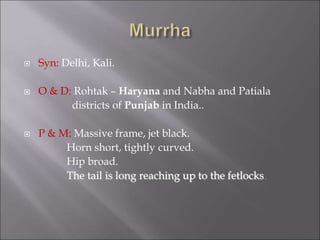
 Syn: Delhi, Kali.
 O & D: Rohtak – Haryana and Nabha and Patiala
districts of Punjab in India..
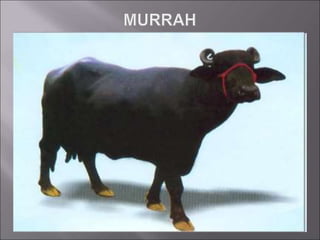
 P & M: Massive frame, jet black.
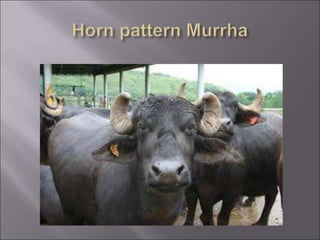
Horn short, tightly curved.
Hip broad.
The tail is long reaching up to the fetlocks.
 Syn: Mehsani
 O & D: Surti (gujarat) x Murrah (haryana)
Banaskantha, Sabarkantha of
Gujarat.
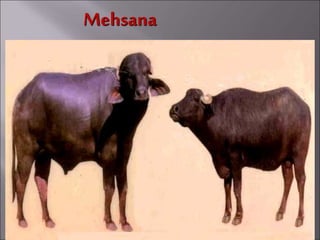
 P & M: Black / brown & white on forehead
Half bent sickle horn
Depression in the middle of FH
 This breed is known for regular breeding &
persistent milker.
Mehsana
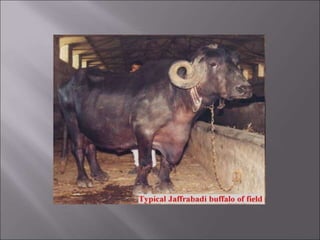
 Heaviest of all indian buffaloes
 Syn: Bhavanagiri, gir, jaffri.
 O & D: Gir forest of gujarat, and also in Kutch,
Jamnagar dist. It was reared by nomads
maldhari
 P & M: Strong, massive body.
Some have white spot on
forehead NAV CHANDRA.
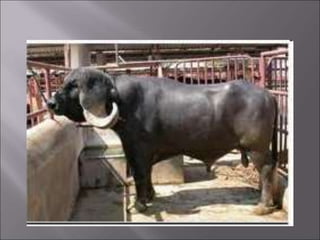
 Convex forehead
 Horns drooping, corrugated, curved upwards
at the tip forming ring like structure.
 Well developed dewlap.
 O & D: Originated from KUNDI through
intense selection in Banni grassland of kutch of
gujarat.
 P & M: Massive frame.
Mostly black, few brown.
Short coiled horn which is align
perpendicular to body.
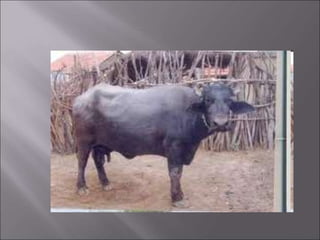
 Syn: Panchkalyani.
 O & D: 1st separate then merged.
Sahiwal of Pak, ferozepur,
Amristar of Punjab.
 P & M: Medium size
White mark on FH, face, muzzle,
HL, tail.
Elongated head bulg at top & dep
between eyes.
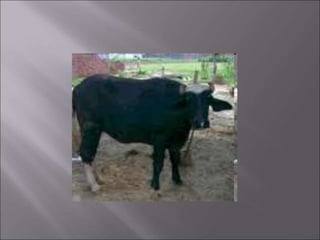
 Blue/ wall eyes
 Tightly coiled horns
 Double chin are unique in this breed
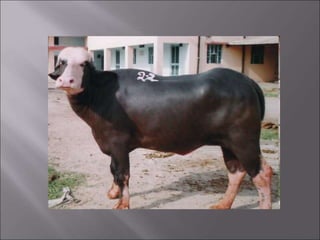
 Syn: Charator, Gujarati, Talabda.
 O & D: Surat dist of Gujarat & adjn of
Maharastra & also in udaipur of Rajasthan.
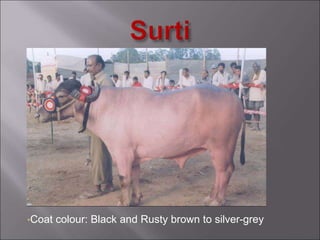
 P & M: Light & compact.
Rusty brown to silver grey hair coat
2 white chevrons- around jowl & on
brisket.
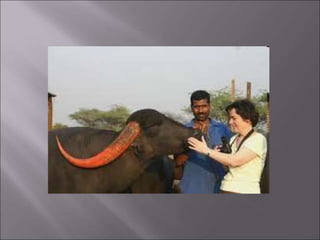
 Horns sickle shape
 FH broad & convex bet horns
 Neck with white collars.
 Tail with white switch.
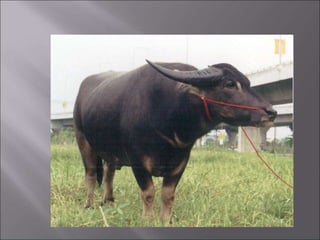
•Coat colour: Black and Rusty brown to silver-grey
 This breed is called as GHEE BOWL of India
 Worlds unique buffalo with highest fat %
among all bovine species.
 O & D: Bhadawar region of UP & also in
agra, etawah, gwalior, shivpuri dist
of MP.
 P & M: Medium size, wedge shape body
Clr: black copper to light copper
2 white line – on lower side of neck
Legs are typical WHEAT STRAW
FH shallow in middle
Horns long turn up with pointed tip
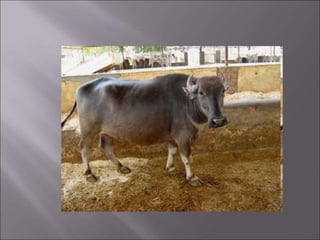
 This breed is known for low maintenance &
high feed conversion
 SYN: Berari, ellichpuri, gaulani, varadi.
 O & D: Vidarbha region of Maharastra
also in Nagpur, Amrawati, Wardha.
 There are 4 strains: purnathadi, ellichpuri,
gaulani, nagpuri.
 P & M: Light & compact
Clr: black with white patches on face,
legs, tail.
In purnathadi strain copper colour with
white patches on FH is common
Horns long reaches the shoulder (sword
like).
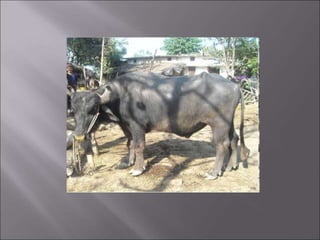
 This breed produce good milk on less feed.
 O & D: Tarai region of UP & parts of
uttarkhand.
 P & M: Medium compact animal
clr: grayish brown to black
Head convex, horn curved most
backward.
Hump sloppy
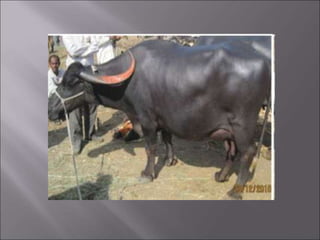
 SYN: Kolahpuri in maharastra
Dharwari in karnataka
 O & D: Pandharpur in maharastra & also
in Karnataka & AP.
 P & M: Medium compact body
Horn are very long, flat, twisted and
beyond shoulder blade.
Nasal bone prominent
 O & D: Paralakhemundi and Gunpur of
Orissa, Mandasa, bobli, srikakulum
dist of AP.
 P & M: Long body loose conformation.
Clr: blackish grey to grey with
brown hairs. Tuft of hairs- knee, pastern.
Horns are long, broad and semicircular.
 Rao (1981), Bidhar (1986) observed 48
chromosomes & suggested it may be Swamp
type.
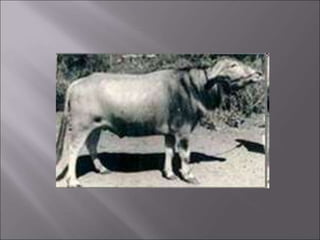
 SYN: Peddakimedi
 O & D: Kalahandi, Naupada of Orissa.
Restricted to hilly region of AP
 P & M: Medium, compact.
Coat hairy ash gray/ gray/ black
Heat tolerant. FH- little protruded.
Face long & curved.
Horns- broad, half curved.
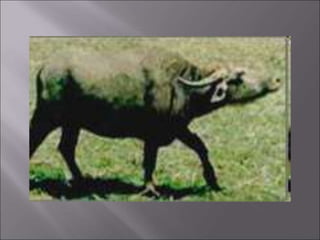
 O & D: Kujanga, Cuttak dist of Orissa.
Local buffalo x Murrah bulls
 P & M: Medium, deep body conformation.
Typical coat colour in adult female
is BROWNISH BLACK
Horns long & loosely curved.
Brisket is prominent.
White mark- FH, leg, tail switch.
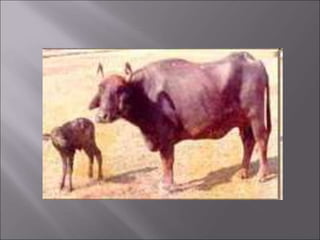
 FH- dish shape, hump absent execpt prominent
ridge at shoulder.
 O & D: Ganjam dist of Orissa, vishakapatnam,
AP.
 P & M: Small size (114cm), short face.
Barrel body, short tail (46cm).
Thin skin cannot withstand high
temperature.
Horn conical, small run backward.
 Useful for ploughing in water logged paddy
field.
 A pair of male can pull 1½ cart of load easily.
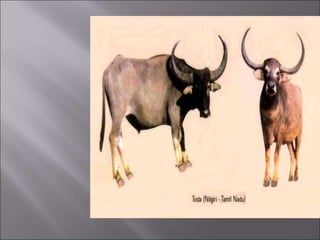
 O & D: Nilgiri hills in Tamil Nadu.consider
sacred by TODA tribes.
 P & M: Medium, powerful
Calf- fawn Adult- ash grey
Dense hair over the body
Horn- crescent shape
Hump, dewlap absent
Legs short, stout.
 O & D: Bargarh, sambalpur of Orissa & also in
Bilaspur of chattisgarh.
 P & M: Large, compact
Calf- long brown hair, Adult- black
FH- distinctly bulge, convex
appearance
Horns- short, semi-circle
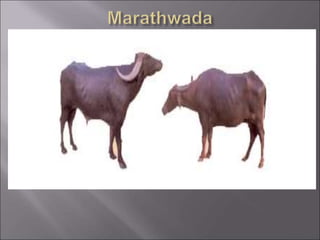
 O & D: Maharastra
 P & M: Medium, compact.
Horns upto shoulder not beyond
Eyes- red tinge
 Peculiarity: high level of domestication, milked
several times without calf.
 SYN: Dudhana, Thadi
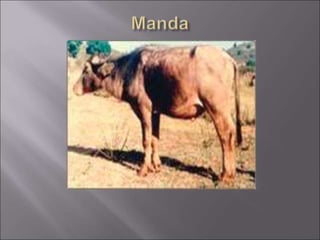
 O & D: Manda of Orissa
 P & M: Ash grey
Tail switch yellow
Arch like red ring around chest is
common
Eyelids have red margin.
 O & D: Native she buffalo x Murrah bull.
East, West Godavari dist of AP
 P & M: Hardy, medium, compact
Black with sparse hair
FH prominent, convex
Navel flap prominent in both sex
 Peculiarity: High milk yeild, good fat, resistant
to diseases, tolerant to high heat & humidity.
Animal breed regularly.
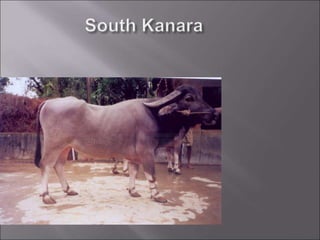
 SYN: Kanara, Kanarese, Malabar.
 O & D: Mangalore, south kanara of
Karnataka, adjoining part of Kerala.
 P & M: Medium, well built body.
Color- jet black to light brown.
Dorsal ridge prominent.
 This breed is owned by sect of Hindu JAIN
BANTS.
 Got significance in local festival.
 Used for race in water bound fields during
annual sports.
 O & D: Kottayam & Alappuzha of Kerala.
 P & M: Small, gray animal.
2 white lines- Brisket & upper part
of ventral side of neck.
Farmers consider this white mark
as purity of the breed.
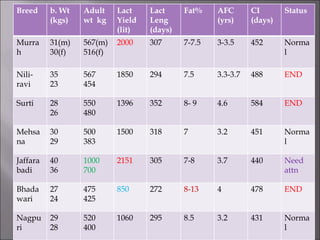
Breed b. Wt
(kgs)
Adult
wt kg
Lact
Yield
(lit)
Lact
Leng
(days)
Fat% AFC
(yrs)
CI
(days)
Status
Murra
h
31(m)
30(f)
567(m)
516(f)
2000 307 7-7.5 3-3.5 452 Norma
l
Nili-
ravi
35
23
567
454
1850 294 7.5 3.3-3.7 488 END
Surti 28
26
550
480
1396 352 8- 9 4.6 584 END
Mehsa
na
30
29
500
383
1500 318 7 3.2 451 Norma
l
Jaffara
badi
40
36
1000
700
2151 305 7-8 3.7 440 Need
attn
Bhada
wari
27
24
475
425
850 272 8-13 4 478 END
Nagpu
ri
29
28
520
400
1060 295 8.5 3.2 431 Norma
l
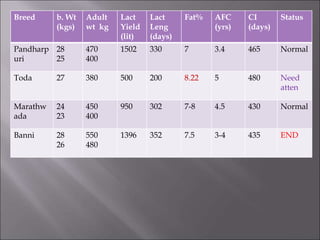
Breed b. Wt
(kgs)
Adult
wt kg
Lact
Yield
(lit)
Lact
Leng
(days)
Fat% AFC
(yrs)
CI
(days)
Status
Pandharp
uri
28
25
470
400
1502 330 7 3.4 465 Normal
Toda 27 380 500 200 8.22 5 480 Need
atten
Marathw
ada
24
23
450
400
950 302 7-8 4.5 430 Normal
Banni 28
26
550
480
1396 352 7.5 3-4 435 END
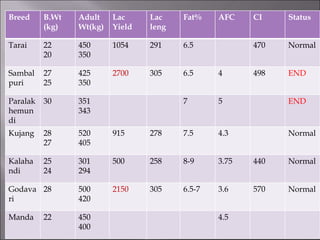
Breed B.Wt
(kg)
Adult
Wt(kg)
Lac
Yield
Lac
leng
Fat% AFC CI Status
Tarai 22
20
450
350
1054 291 6.5 470 Normal
Sambal
puri
27
25
425
350
2700 305 6.5 4 498 END
Paralak
hemun
di
30 351
343
7 5 END
Kujang 28
27
520
405
915 278 7.5 4.3 Normal
Kalaha
ndi
25
24
301
294
500 258 8-9 3.75 440 Normal
Godava
ri
28 500
420
2150 305 6.5-7 3.6 570 Normal
Manda 22 450
400
4.5
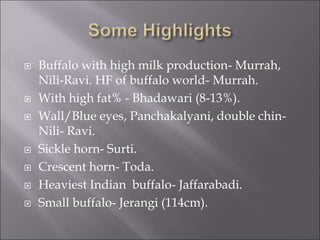
 Buffalo with high milk production- Murrah,
Nili-Ravi. HF of buffalo world- Murrah.
 With high fat% - Bhadawari (8-13%).
 Wall/Blue eyes, Panchakalyani, double chin-
Nili- Ravi.
 Sickle horn- Surti.
 Crescent horn- Toda.
 Heaviest Indian buffalo- Jaffarabadi.
 Small buffalo- Jerangi (114cm).

Buffalo breeds by Dr B.Sunil kumar

  • 2.
    DEFINITION:  Homogenous, sub-specificgroup  Identified with external character from other lllry defined group in the same species. (Tuyrton, 1974)
  • 3.
     Kingdom :Animalia  Phylum : Chordata  Class : Mammalia  Order : Artiodactyls  Suborder : Ruminentia  Family : Bovidae  Subfamily: Bovinae  Genus : Bubalis  Species : B.arni (B.bubalus)
  • 4.
     Buffalo comeunder the Tribe Bovini – 3 group Bovini Bovina Bubalina Syncercina (cattle & bison) (Asian buff) (African buff)  Interbreeding is not possible between these 3.  Asian is lllr to African but differ from cattle by horn cattle- oval, buffalo- Angular.
  • 5.
    Cape buffalo Syncerus caffer Redbuffalo Syncerus nanus Real buffalo: African buffalo (genus Syncerus) -never -domesticated
  • 6.
    Wild Asian buffalo Bubalus arnee Tamaraw Bubalus mindorensis LowlandAnoa Bubalus depressicornis Mountain Anoa Bubalus quarlesi
  • 7.
    Distribution of wildAsian buffalo Wild Asian buffalo, Assam
  • 8.
  • 9.
     Swamp buffalo1st domesticated in China 4000 years ago.  River in Indo- gangetic region 5000 years ago.
  • 10.
    Swamp buffalo Riverbuffalo Southeast Asia South Asia Stocky, pot-bellied Taller, longer slimmer body Horns in plane of head Curly horns Grey with white legs, 1-2 white bands on throat Completely black 2n = 48 2n = 50 Penis adheres to belly Scrotum 10cm long Penis hangs clear Scrotum pendulous
  • 11.
    Swamp buffalo Manipuri, Assamese Riverbuffalo Murrah Not divided into breeds Many breeds plus local (“desa”) variants Used in ploughing, draught, meat; not milked Used for ploughing, meat, milk Wallow in mud, pools Prefer to bathe in clean water
  • 12.
     There are72 breed in the World.  India has 10 well known breeds & 12 lesser known breeds.  Purebred animals of specified breeds form about 20-25% of total buffalo population.
  • 13.
     Total worldpopulation(2005)- 174 million  India – (98 million) 57%, stands First. State wise- UP- First(22 million), followed by AP(10.5 million), Rajasthan(10.3 million)
  • 14.
    Group Breeds • MurrahMurrah, Nili-Ravi, Godavari, banni • Gujarat Jaffarabadi, Mehsana & Surti • U.P. Bhadawari, Tarai • Central India Jerangi, Kalahandi, Manda, Nagapuri, Pandharpuri,Sambalpuri, Marathwada. • South India South Kanara, Toda, Godavari.
  • 15.
     Well knownbreeds 1. Murrah 2. Nili-ravi 3. Bhadawari 4. Surti 5. Mehsana 6. Jaffarabadi 7. Nagpuri 8. Toda 9. Pandharpuri 10. Marathwada  Lesser known 1. Banni 2. Tarai 3. Kuttanad 4. South kanara 5. Manda 6. Jerangi 7. Kalahandi 8. Sambalpuri 9. Godavari 10. Paralakhemundi 11. Assamese 12. Manipuri.
  • 16.
     Syn: Delhi,Kali.  O & D: Rohtak – Haryana and Nabha and Patiala districts of Punjab in India..  P & M: Massive frame, jet black. Horn short, tightly curved. Hip broad. The tail is long reaching up to the fetlocks.
  • 19.
     Syn: Mehsani O & D: Surti (gujarat) x Murrah (haryana) Banaskantha, Sabarkantha of Gujarat.  P & M: Black / brown & white on forehead Half bent sickle horn Depression in the middle of FH
  • 20.
     This breedis known for regular breeding & persistent milker.
  • 21.
  • 22.
     Heaviest ofall indian buffaloes  Syn: Bhavanagiri, gir, jaffri.  O & D: Gir forest of gujarat, and also in Kutch, Jamnagar dist. It was reared by nomads maldhari  P & M: Strong, massive body. Some have white spot on forehead NAV CHANDRA.
  • 23.
     Convex forehead Horns drooping, corrugated, curved upwards at the tip forming ring like structure.  Well developed dewlap.
  • 26.
     O &D: Originated from KUNDI through intense selection in Banni grassland of kutch of gujarat.  P & M: Massive frame. Mostly black, few brown. Short coiled horn which is align perpendicular to body.
  • 28.
     Syn: Panchkalyani. O & D: 1st separate then merged. Sahiwal of Pak, ferozepur, Amristar of Punjab.  P & M: Medium size White mark on FH, face, muzzle, HL, tail. Elongated head bulg at top & dep between eyes.
  • 29.
     Blue/ walleyes  Tightly coiled horns  Double chin are unique in this breed
  • 33.
     Syn: Charator,Gujarati, Talabda.  O & D: Surat dist of Gujarat & adjn of Maharastra & also in udaipur of Rajasthan.  P & M: Light & compact. Rusty brown to silver grey hair coat 2 white chevrons- around jowl & on brisket.
  • 34.
     Horns sickleshape  FH broad & convex bet horns  Neck with white collars.  Tail with white switch.
  • 35.
    •Coat colour: Blackand Rusty brown to silver-grey
  • 38.
     This breedis called as GHEE BOWL of India  Worlds unique buffalo with highest fat % among all bovine species.  O & D: Bhadawar region of UP & also in agra, etawah, gwalior, shivpuri dist of MP.
  • 39.
     P &M: Medium size, wedge shape body Clr: black copper to light copper 2 white line – on lower side of neck Legs are typical WHEAT STRAW FH shallow in middle Horns long turn up with pointed tip
  • 42.
     This breedis known for low maintenance & high feed conversion  SYN: Berari, ellichpuri, gaulani, varadi.  O & D: Vidarbha region of Maharastra also in Nagpur, Amrawati, Wardha.  There are 4 strains: purnathadi, ellichpuri, gaulani, nagpuri.
  • 43.
     P &M: Light & compact Clr: black with white patches on face, legs, tail. In purnathadi strain copper colour with white patches on FH is common Horns long reaches the shoulder (sword like).
  • 46.
     This breedproduce good milk on less feed.  O & D: Tarai region of UP & parts of uttarkhand.  P & M: Medium compact animal clr: grayish brown to black Head convex, horn curved most backward. Hump sloppy
  • 48.
     SYN: Kolahpuriin maharastra Dharwari in karnataka  O & D: Pandharpur in maharastra & also in Karnataka & AP.  P & M: Medium compact body Horn are very long, flat, twisted and beyond shoulder blade. Nasal bone prominent
  • 50.
     O &D: Paralakhemundi and Gunpur of Orissa, Mandasa, bobli, srikakulum dist of AP.  P & M: Long body loose conformation. Clr: blackish grey to grey with brown hairs. Tuft of hairs- knee, pastern. Horns are long, broad and semicircular.
  • 51.
     Rao (1981),Bidhar (1986) observed 48 chromosomes & suggested it may be Swamp type.
  • 53.
     SYN: Peddakimedi O & D: Kalahandi, Naupada of Orissa. Restricted to hilly region of AP  P & M: Medium, compact. Coat hairy ash gray/ gray/ black Heat tolerant. FH- little protruded. Face long & curved. Horns- broad, half curved.
  • 55.
     O &D: Kujanga, Cuttak dist of Orissa. Local buffalo x Murrah bulls  P & M: Medium, deep body conformation. Typical coat colour in adult female is BROWNISH BLACK Horns long & loosely curved. Brisket is prominent. White mark- FH, leg, tail switch.
  • 56.
     FH- dishshape, hump absent execpt prominent ridge at shoulder.
  • 58.
     O &D: Ganjam dist of Orissa, vishakapatnam, AP.  P & M: Small size (114cm), short face. Barrel body, short tail (46cm). Thin skin cannot withstand high temperature. Horn conical, small run backward.
  • 59.
     Useful forploughing in water logged paddy field.  A pair of male can pull 1½ cart of load easily.
  • 61.
     O &D: Nilgiri hills in Tamil Nadu.consider sacred by TODA tribes.  P & M: Medium, powerful Calf- fawn Adult- ash grey Dense hair over the body Horn- crescent shape Hump, dewlap absent Legs short, stout.
  • 63.
     O &D: Bargarh, sambalpur of Orissa & also in Bilaspur of chattisgarh.  P & M: Large, compact Calf- long brown hair, Adult- black FH- distinctly bulge, convex appearance Horns- short, semi-circle
  • 65.
     O &D: Maharastra  P & M: Medium, compact. Horns upto shoulder not beyond Eyes- red tinge  Peculiarity: high level of domestication, milked several times without calf.  SYN: Dudhana, Thadi
  • 67.
     O &D: Manda of Orissa  P & M: Ash grey Tail switch yellow Arch like red ring around chest is common Eyelids have red margin.
  • 69.
     O &D: Native she buffalo x Murrah bull. East, West Godavari dist of AP  P & M: Hardy, medium, compact Black with sparse hair FH prominent, convex Navel flap prominent in both sex
  • 70.
     Peculiarity: Highmilk yeild, good fat, resistant to diseases, tolerant to high heat & humidity. Animal breed regularly.
  • 71.
     SYN: Kanara,Kanarese, Malabar.  O & D: Mangalore, south kanara of Karnataka, adjoining part of Kerala.  P & M: Medium, well built body. Color- jet black to light brown. Dorsal ridge prominent.
  • 73.
     This breedis owned by sect of Hindu JAIN BANTS.  Got significance in local festival.  Used for race in water bound fields during annual sports.
  • 74.
     O &D: Kottayam & Alappuzha of Kerala.  P & M: Small, gray animal. 2 white lines- Brisket & upper part of ventral side of neck. Farmers consider this white mark as purity of the breed.
  • 76.
    Breed b. Wt (kgs) Adult wtkg Lact Yield (lit) Lact Leng (days) Fat% AFC (yrs) CI (days) Status Murra h 31(m) 30(f) 567(m) 516(f) 2000 307 7-7.5 3-3.5 452 Norma l Nili- ravi 35 23 567 454 1850 294 7.5 3.3-3.7 488 END Surti 28 26 550 480 1396 352 8- 9 4.6 584 END Mehsa na 30 29 500 383 1500 318 7 3.2 451 Norma l Jaffara badi 40 36 1000 700 2151 305 7-8 3.7 440 Need attn Bhada wari 27 24 475 425 850 272 8-13 4 478 END Nagpu ri 29 28 520 400 1060 295 8.5 3.2 431 Norma l
  • 77.
    Breed b. Wt (kgs) Adult wtkg Lact Yield (lit) Lact Leng (days) Fat% AFC (yrs) CI (days) Status Pandharp uri 28 25 470 400 1502 330 7 3.4 465 Normal Toda 27 380 500 200 8.22 5 480 Need atten Marathw ada 24 23 450 400 950 302 7-8 4.5 430 Normal Banni 28 26 550 480 1396 352 7.5 3-4 435 END
  • 78.
    Breed B.Wt (kg) Adult Wt(kg) Lac Yield Lac leng Fat% AFCCI Status Tarai 22 20 450 350 1054 291 6.5 470 Normal Sambal puri 27 25 425 350 2700 305 6.5 4 498 END Paralak hemun di 30 351 343 7 5 END Kujang 28 27 520 405 915 278 7.5 4.3 Normal Kalaha ndi 25 24 301 294 500 258 8-9 3.75 440 Normal Godava ri 28 500 420 2150 305 6.5-7 3.6 570 Normal Manda 22 450 400 4.5
  • 79.
     Buffalo withhigh milk production- Murrah, Nili-Ravi. HF of buffalo world- Murrah.  With high fat% - Bhadawari (8-13%).  Wall/Blue eyes, Panchakalyani, double chin- Nili- Ravi.  Sickle horn- Surti.  Crescent horn- Toda.  Heaviest Indian buffalo- Jaffarabadi.  Small buffalo- Jerangi (114cm).