EFFICIENT EWE
MANAGEMENT
SUSAN SCHOENIAN
SHEEP & GOAT SPECIALIST
UNIVERSITY OF MARYLAND EXTENSION
SSCHOEN@UMD.EDU
WWW.SHEEPANDGOAT.COM
WWW.WORMX.INFO
2015 KHSI EXPO, INDIANA, PA
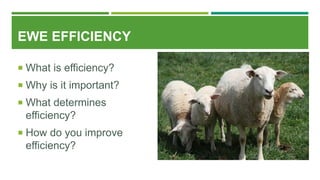
EWE EFFICIENCY
 What is efficiency?
 Why is it important?
 What determines
efficiency?
 How do you improve
efficiency?
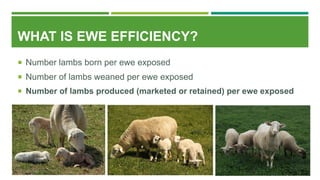
WHAT IS EWE EFFICIENCY?
 Number lambs born per ewe exposed
 Number of lambs weaned per ewe exposed
 Number of lambs produced (marketed or retained) per ewe exposed
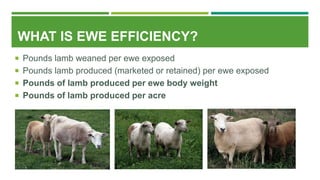
WHAT IS EWE EFFICIENCY?
 Pounds lamb weaned per ewe exposed
 Pounds lamb produced (marketed or retained) per ewe exposed
 Pounds of lamb produced per ewe body weight
 Pounds of lamb produced per acre
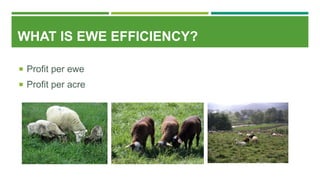
WHAT IS EWE EFFICIENCY?
 Profit per ewe
 Profit per acre
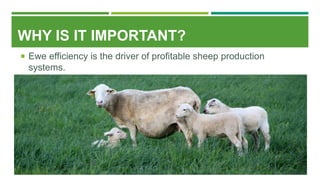
WHY IS IT IMPORTANT?
 Ewe efficiency is the driver of profitable sheep production
systems.
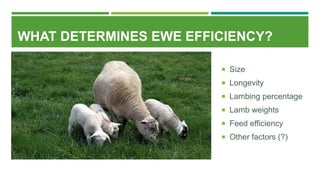
WHAT DETERMINES EWE EFFICIENCY?
 Size
 Longevity
 Lambing percentage
 Lamb weights
 Feed efficiency
 Other factors (?)
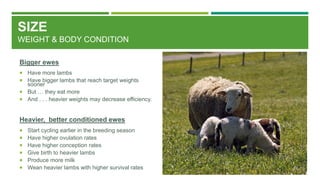
SIZE
WEIGHT & BODY CONDITION
Bigger ewes
 Have more lambs
 Have bigger lambs that reach target weights
sooner
 But … they eat more
 And . . . heavier weights may decrease efficiency.
Heavier, better conditioned ewes
 Start cycling earlier in the breeding season
 Have higher ovulation rates
 Have higher conception rates
 Give birth to heavier lambs
 Produce more milk
 Wean heavier lambs with higher survival rates
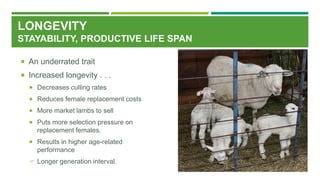
LONGEVITY
STAYABILITY, PRODUCTIVE LIFE SPAN
 An underrated trait
 Increased longevity . . .
 Decreases culling rates
 Reduces female replacement costs
 More market lambs to sell
 Puts more selection pressure on
replacement females.
 Results in higher age-related
performance
 Longer generation interval.
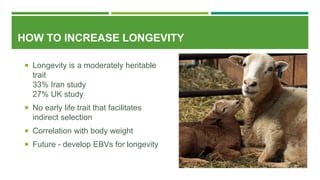
HOW TO INCREASE LONGEVITY
 Longevity is a moderately heritable
trait
33% Iran study
27% UK study
 No early life trait that facilitates
indirect selection
 Correlation with body weight
 Future - develop EBVs for longevity
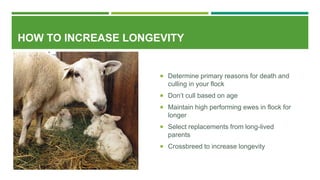
HOW TO INCREASE LONGEVITY
 Determine primary reasons for death and
culling in your flock
 Don’t cull based on age
 Maintain high performing ewes in flock for
longer
 Select replacements from long-lived
parents
 Crossbreed to increase longevity
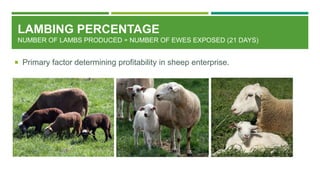
LAMBING PERCENTAGE
NUMBER OF LAMBS PRODUCED ÷ NUMBER OF EWES EXPOSED (21 DAYS)
 Primary factor determining profitability in sheep enterprise.
LAMBING PERCENTAGE
Composite trait
 Fertility
 Litter size (number lambs born)
 Ovulation rate
 Embryo survival
 Lamb survival
 Direct and maternal affects
 Perinatal, pre- and post weaning
Affected by many different
factors
 Genetics
 Nutrition
 Management
 Season
 Age
IMPROVING LAMBING PERCENTAGE:
FERTILITY (PREGNANCY RATE)
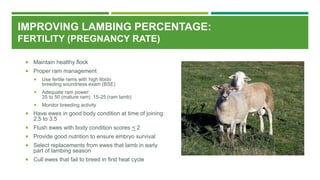
 Maintain healthy flock
 Proper ram management
 Use fertile rams with high libido
breeding soundness exam (BSE)
 Adequate ram power:
35 to 50 (mature ram) 15-25 (ram lamb)
 Monitor breeding activity
 Have ewes in good body condition at time of joining:
2.5 to 3.5
 Flush ewes with body condition scores < 2
 Provide good nutrition to ensure embryo survival
 Select replacements from ewes that lamb in early
part of lambing season
 Cull ewes that fail to breed in first heat cycle
IMPROVING LAMBING PERCENTAGE:
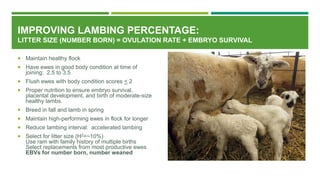
LITTER SIZE (NUMBER BORN) = OVULATION RATE + EMBRYO SURVIVAL
 Maintain healthy flock
 Have ewes in good body condition at time of
joining: 2.5 to 3.5
 Flush ewes with body condition scores < 2
 Proper nutrition to ensure embryo survival,
placental development, and birth of moderate-size
healthy lambs.
 Breed in fall and lamb in spring
 Maintain high-performing ewes in flock for longer
 Reduce lambing interval: accelerated lambing
 Select for litter size (H2=~10%)
Use ram with family history of multiple births
Select replacements from most productive ewes
EBVs for number born, number weaned
IMPROVING LAMBING PERCENTAGE: LAMB SURVIVAL
Timing
 At birth
 0-3 days
 3-10 days
 10 days until weaning
 Post weaning
Causes
 Abortion
 Dystocia
 Starvation
 Hypothermia
 Disease: scours, pneumonia, clostridial
 Digestive problems
 Internal parasites
 Predators
When and why do lambs die?
IMPROVING LAMBING PERCENTAGE
LAMB SURVIVAL (0-10 DAYS)
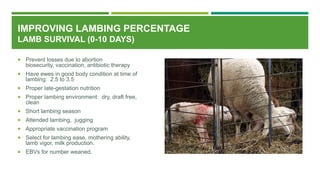
 Prevent losses due to abortion
biosecurity, vaccination, antibiotic therapy
 Have ewes in good body condition at time of
lambing: 2.5 to 3.5
 Proper late-gestation nutrition
 Proper lambing environment: dry, draft free,
clean
 Short lambing season
 Attended lambing, jugging
 Appropriate vaccination program
 Select for lambing ease, mothering ability,
lamb vigor, milk production.
 EBVs for number weaned.
IMPROVING LAMBING PERCENTAGE
LAMB SURVIVAL (10 DAYS UNTIL MARKET)
Pre-weaning
 Short lambing season
 Ewes in good body condition
 Adequate colostrum intake
 Strategic use of coccidiostats
 Good nutrition: supplement forage diet, as necessary to
meet nutritional needs for optimal performance.
 Creep feeding, if pasture or milk production are limiting
factors
 Appropriate vaccination program, usually CDT
 Select for number weaned.
 EBVs for number weaned.
Post-weaning
 Short lambing season
 Appropriate vaccination program, usually CDT
 Good nutrition to support optimal growth rates
 Strategic use of coccidiostats
 Integrated parasite management, including
targeted selective treatment using FAMACHA©
system, Five Point Check©, and Happy Factor
(performance).
 Predator control
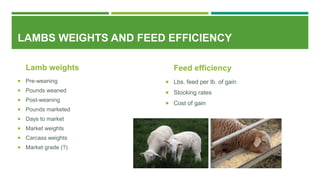
LAMBS WEIGHTS AND FEED EFFICIENCY
Lamb weights
 Pre-weaning
 Pounds weaned
 Post-weaning
 Pounds marketed
 Days to market
 Market weights
 Carcass weights
 Market grade (?)
Feed efficiency
 Lbs. feed per lb. of gain
 Stocking rates
 Cost of gain
IMPROVING LAMB WEIGHTS AND FEED EFFICIENCY
Lamb weights
 Measure growth rates and calculate adjusted
weights and ratios.
 Select for pre- and post-weaning growth in your
own flock.
 Use rams documented to have superior growth
performance
On-farm performance testing
Central ram performance tests (PA, WV, VA)
 Use EBVs for weaning, post-weaning, and yearling
weights.
 Supplement forage diet for optimal performance.
 Crossbreed to improve post-weaning growth.
Feed efficiency
 Determine feed efficiency and cost of gain.
 Use rams documented to have superior feed
efficiency
West Virginia Ram Performance Test
 Hand-feed instead of self-feed
 Whole grains instead of processed grains.
 Improve pasture and grazing management
 Supplement forage diet for better forage utilization
and optimal performance
 Determine optimal ewe size for your production
environment.
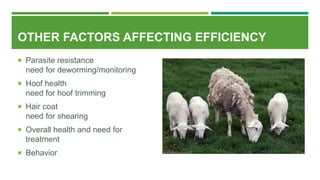
OTHER FACTORS AFFECTING EFFICIENCY
 Parasite resistance
need for deworming/monitoring
 Hoof health
need for hoof trimming
 Hair coat
need for shearing
 Overall health and need for
treatment
 Behavior
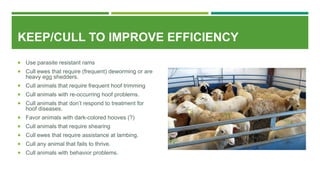
KEEP/CULL TO IMPROVE EFFICIENCY
 Use parasite resistant rams
 Cull ewes that require (frequent) deworming or are
heavy egg shedders.
 Cull animals that require frequent hoof trimming
 Cull animals with re-occurring hoof problems.
 Cull animals that don’t respond to treatment for
hoof diseases.
 Favor animals with dark-colored hooves (?)
 Cull animals that require shearing
 Cull ewes that require assistance at lambing.
 Cull any animal that fails to thrive.
 Cull animals with behavior problems.
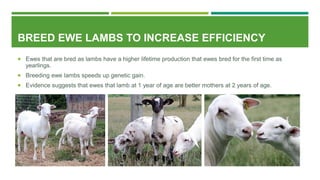
BREED EWE LAMBS TO INCREASE EFFICIENCY
 Ewes that are bred as lambs have a higher lifetime production that ewes bred for the first time as
yearlings.
 Breeding ewe lambs speeds up genetic gain.
 Evidence suggests that ewes that lamb at 1 year of age are better mothers at 2 years of age.
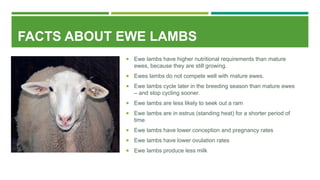
FACTS ABOUT EWE LAMBS
 Ewe lambs have higher nutritional requirements than mature
ewes, because they are still growing.
 Ewes lambs do not compete well with mature ewes.
 Ewe lambs cycle later in the breeding season than mature ewes
– and stop cycling sooner.
 Ewe lambs are less likely to seek out a ram
 Ewe lambs are in estrus (standing heat) for a shorter period of
time
 Ewe lambs have lower conception and pregnancy rates
 Ewe lambs have lower ovulation rates
 Ewe lambs produce less milk
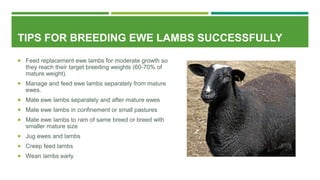
TIPS FOR BREEDING EWE LAMBS SUCCESSFULLY
 Feed replacement ewe lambs for moderate growth so
they reach their target breeding weights (60-70% of
mature weight).
 Manage and feed ewe lambs separately from mature
ewes.
 Mate ewe lambs separately and after mature ewes
 Mate ewe lambs in confinement or small pastures
 Mate ewe lambs to ram of same breed or breed with
smaller mature size
 Jug ewes and lambs
 Creep feed lambs
 Wean lambs early
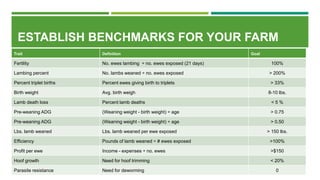
ESTABLISH BENCHMARKS FOR YOUR FARM
Trait Definition Goal
Fertility No. ewes lambing ÷ no. ewes exposed (21 days) 100%
Lambing percent No. lambs weaned ÷ no. ewes exposed > 200%
Percent triplet births Percent ewes giving birth to triplets > 33%
Birth weight Avg. birth weigh 8-10 lbs.
Lamb death loss Percent lamb deaths < 5 %
Pre-weaning ADG (Weaning weight - birth weight) ÷ age > 0.75
Pre-weaning ADG (Weaning weight - birth weight) ÷ age > 0.50
Lbs. lamb weaned Lbs. lamb weaned per ewe exposed > 150 lbs.
Efficiency Pounds of lamb weaned ÷ # ewes exposed >100%
Profit per ewe Income - expenses ÷ no. ewes >$150
Hoof growth Need for hoof trimming < 20%
Parasite resistance Need for deworming 0
THANK YOUR FOR YOUR ATTENTION.
ARE THERE ANY QUESTIONS OR COMMENTS?
SUSAN S CHOENIAN
Sheep & Goat Specialist
sschoen@umd.edu
www.sheepandgoat.

Ewe efficiency

  • 1.
    EFFICIENT EWE MANAGEMENT SUSAN SCHOENIAN SHEEP& GOAT SPECIALIST UNIVERSITY OF MARYLAND EXTENSION SSCHOEN@UMD.EDU WWW.SHEEPANDGOAT.COM WWW.WORMX.INFO 2015 KHSI EXPO, INDIANA, PA
  • 2.
    EWE EFFICIENCY  Whatis efficiency?  Why is it important?  What determines efficiency?  How do you improve efficiency?
  • 3.
    WHAT IS EWEEFFICIENCY?  Number lambs born per ewe exposed  Number of lambs weaned per ewe exposed  Number of lambs produced (marketed or retained) per ewe exposed
  • 4.
    WHAT IS EWEEFFICIENCY?  Pounds lamb weaned per ewe exposed  Pounds lamb produced (marketed or retained) per ewe exposed  Pounds of lamb produced per ewe body weight  Pounds of lamb produced per acre
  • 5.
    WHAT IS EWEEFFICIENCY?  Profit per ewe  Profit per acre
  • 6.
    WHY IS ITIMPORTANT?  Ewe efficiency is the driver of profitable sheep production systems.
  • 7.
    WHAT DETERMINES EWEEFFICIENCY?  Size  Longevity  Lambing percentage  Lamb weights  Feed efficiency  Other factors (?)
  • 8.
    SIZE WEIGHT & BODYCONDITION Bigger ewes  Have more lambs  Have bigger lambs that reach target weights sooner  But … they eat more  And . . . heavier weights may decrease efficiency. Heavier, better conditioned ewes  Start cycling earlier in the breeding season  Have higher ovulation rates  Have higher conception rates  Give birth to heavier lambs  Produce more milk  Wean heavier lambs with higher survival rates
  • 9.
    LONGEVITY STAYABILITY, PRODUCTIVE LIFESPAN  An underrated trait  Increased longevity . . .  Decreases culling rates  Reduces female replacement costs  More market lambs to sell  Puts more selection pressure on replacement females.  Results in higher age-related performance  Longer generation interval.
  • 10.
    HOW TO INCREASELONGEVITY  Longevity is a moderately heritable trait 33% Iran study 27% UK study  No early life trait that facilitates indirect selection  Correlation with body weight  Future - develop EBVs for longevity
  • 11.
    HOW TO INCREASELONGEVITY  Determine primary reasons for death and culling in your flock  Don’t cull based on age  Maintain high performing ewes in flock for longer  Select replacements from long-lived parents  Crossbreed to increase longevity
  • 12.
    LAMBING PERCENTAGE NUMBER OFLAMBS PRODUCED ÷ NUMBER OF EWES EXPOSED (21 DAYS)  Primary factor determining profitability in sheep enterprise.
  • 13.
    LAMBING PERCENTAGE Composite trait Fertility  Litter size (number lambs born)  Ovulation rate  Embryo survival  Lamb survival  Direct and maternal affects  Perinatal, pre- and post weaning Affected by many different factors  Genetics  Nutrition  Management  Season  Age
  • 14.
    IMPROVING LAMBING PERCENTAGE: FERTILITY(PREGNANCY RATE)  Maintain healthy flock  Proper ram management  Use fertile rams with high libido breeding soundness exam (BSE)  Adequate ram power: 35 to 50 (mature ram) 15-25 (ram lamb)  Monitor breeding activity  Have ewes in good body condition at time of joining: 2.5 to 3.5  Flush ewes with body condition scores < 2  Provide good nutrition to ensure embryo survival  Select replacements from ewes that lamb in early part of lambing season  Cull ewes that fail to breed in first heat cycle
  • 15.
    IMPROVING LAMBING PERCENTAGE: LITTERSIZE (NUMBER BORN) = OVULATION RATE + EMBRYO SURVIVAL  Maintain healthy flock  Have ewes in good body condition at time of joining: 2.5 to 3.5  Flush ewes with body condition scores < 2  Proper nutrition to ensure embryo survival, placental development, and birth of moderate-size healthy lambs.  Breed in fall and lamb in spring  Maintain high-performing ewes in flock for longer  Reduce lambing interval: accelerated lambing  Select for litter size (H2=~10%) Use ram with family history of multiple births Select replacements from most productive ewes EBVs for number born, number weaned
  • 16.
    IMPROVING LAMBING PERCENTAGE:LAMB SURVIVAL Timing  At birth  0-3 days  3-10 days  10 days until weaning  Post weaning Causes  Abortion  Dystocia  Starvation  Hypothermia  Disease: scours, pneumonia, clostridial  Digestive problems  Internal parasites  Predators When and why do lambs die?
  • 17.
    IMPROVING LAMBING PERCENTAGE LAMBSURVIVAL (0-10 DAYS)  Prevent losses due to abortion biosecurity, vaccination, antibiotic therapy  Have ewes in good body condition at time of lambing: 2.5 to 3.5  Proper late-gestation nutrition  Proper lambing environment: dry, draft free, clean  Short lambing season  Attended lambing, jugging  Appropriate vaccination program  Select for lambing ease, mothering ability, lamb vigor, milk production.  EBVs for number weaned.
  • 18.
    IMPROVING LAMBING PERCENTAGE LAMBSURVIVAL (10 DAYS UNTIL MARKET) Pre-weaning  Short lambing season  Ewes in good body condition  Adequate colostrum intake  Strategic use of coccidiostats  Good nutrition: supplement forage diet, as necessary to meet nutritional needs for optimal performance.  Creep feeding, if pasture or milk production are limiting factors  Appropriate vaccination program, usually CDT  Select for number weaned.  EBVs for number weaned. Post-weaning  Short lambing season  Appropriate vaccination program, usually CDT  Good nutrition to support optimal growth rates  Strategic use of coccidiostats  Integrated parasite management, including targeted selective treatment using FAMACHA© system, Five Point Check©, and Happy Factor (performance).  Predator control
  • 19.
    LAMBS WEIGHTS ANDFEED EFFICIENCY Lamb weights  Pre-weaning  Pounds weaned  Post-weaning  Pounds marketed  Days to market  Market weights  Carcass weights  Market grade (?) Feed efficiency  Lbs. feed per lb. of gain  Stocking rates  Cost of gain
  • 20.
    IMPROVING LAMB WEIGHTSAND FEED EFFICIENCY Lamb weights  Measure growth rates and calculate adjusted weights and ratios.  Select for pre- and post-weaning growth in your own flock.  Use rams documented to have superior growth performance On-farm performance testing Central ram performance tests (PA, WV, VA)  Use EBVs for weaning, post-weaning, and yearling weights.  Supplement forage diet for optimal performance.  Crossbreed to improve post-weaning growth. Feed efficiency  Determine feed efficiency and cost of gain.  Use rams documented to have superior feed efficiency West Virginia Ram Performance Test  Hand-feed instead of self-feed  Whole grains instead of processed grains.  Improve pasture and grazing management  Supplement forage diet for better forage utilization and optimal performance  Determine optimal ewe size for your production environment.
  • 21.
    OTHER FACTORS AFFECTINGEFFICIENCY  Parasite resistance need for deworming/monitoring  Hoof health need for hoof trimming  Hair coat need for shearing  Overall health and need for treatment  Behavior
  • 22.
    KEEP/CULL TO IMPROVEEFFICIENCY  Use parasite resistant rams  Cull ewes that require (frequent) deworming or are heavy egg shedders.  Cull animals that require frequent hoof trimming  Cull animals with re-occurring hoof problems.  Cull animals that don’t respond to treatment for hoof diseases.  Favor animals with dark-colored hooves (?)  Cull animals that require shearing  Cull ewes that require assistance at lambing.  Cull any animal that fails to thrive.  Cull animals with behavior problems.
  • 23.
    BREED EWE LAMBSTO INCREASE EFFICIENCY  Ewes that are bred as lambs have a higher lifetime production that ewes bred for the first time as yearlings.  Breeding ewe lambs speeds up genetic gain.  Evidence suggests that ewes that lamb at 1 year of age are better mothers at 2 years of age.
  • 24.
    FACTS ABOUT EWELAMBS  Ewe lambs have higher nutritional requirements than mature ewes, because they are still growing.  Ewes lambs do not compete well with mature ewes.  Ewe lambs cycle later in the breeding season than mature ewes – and stop cycling sooner.  Ewe lambs are less likely to seek out a ram  Ewe lambs are in estrus (standing heat) for a shorter period of time  Ewe lambs have lower conception and pregnancy rates  Ewe lambs have lower ovulation rates  Ewe lambs produce less milk
  • 25.
    TIPS FOR BREEDINGEWE LAMBS SUCCESSFULLY  Feed replacement ewe lambs for moderate growth so they reach their target breeding weights (60-70% of mature weight).  Manage and feed ewe lambs separately from mature ewes.  Mate ewe lambs separately and after mature ewes  Mate ewe lambs in confinement or small pastures  Mate ewe lambs to ram of same breed or breed with smaller mature size  Jug ewes and lambs  Creep feed lambs  Wean lambs early
  • 26.
    ESTABLISH BENCHMARKS FORYOUR FARM Trait Definition Goal Fertility No. ewes lambing ÷ no. ewes exposed (21 days) 100% Lambing percent No. lambs weaned ÷ no. ewes exposed > 200% Percent triplet births Percent ewes giving birth to triplets > 33% Birth weight Avg. birth weigh 8-10 lbs. Lamb death loss Percent lamb deaths < 5 % Pre-weaning ADG (Weaning weight - birth weight) ÷ age > 0.75 Pre-weaning ADG (Weaning weight - birth weight) ÷ age > 0.50 Lbs. lamb weaned Lbs. lamb weaned per ewe exposed > 150 lbs. Efficiency Pounds of lamb weaned ÷ # ewes exposed >100% Profit per ewe Income - expenses ÷ no. ewes >$150 Hoof growth Need for hoof trimming < 20% Parasite resistance Need for deworming 0
  • 27.
    THANK YOUR FORYOUR ATTENTION. ARE THERE ANY QUESTIONS OR COMMENTS? SUSAN S CHOENIAN Sheep & Goat Specialist sschoen@umd.edu www.sheepandgoat.