Rural Dairy Farmer Empowerment Program
Vatsalya Empire Ventures Private Limited
www.vatsalyaempireventures.com
www.vevpl.com
Introduction to
dairy farming
Rural Dairy Farmer Empowerment Program
When one looks at dairy farming in India, the success
that million of farmers achieved under -
Operation Flood Programme ( white revolution ) and
thereafter with strong milk and milk product brands
like AMUL, Mother Dairy etc in the organised sector,
this proves the facts that dairying still one of the most
sought after business activity.
Rural Dairy Farmer Empowerment Program
Principles of
Dairy Farm Management
Rural Dairy Farmer Empowerment Program
Profitable Dairy Production is
based on well planned strategies,
strong leadership, strong team
work.
Rural Dairy Farmer Empowerment Program
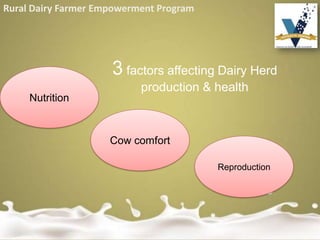
3 factors affecting Dairy Herd
production & health
Nutrition
Cow comfort
Reproduction
Rural Dairy Farmer Empowerment Program
 Three fundamental factors that determine the
health & productivity of a high-potential dairy cow
are nutrition, comfort & reproduction.
Cows need to be well fed, maintained in a
comfortable environment, and bred in a timely
fashion in order to express this potential
Rural Dairy Farmer Empowerment Program
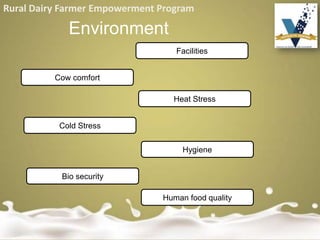
Environment
Facilities
Cow comfort
Heat Stress
Cold Stress
Hygiene
Bio security
Human food quality
Rural Dairy Farmer Empowerment Program
Facilities
Cows need a clean, dry, comfortable place to lie down.
Walking surfaces should provide sufficient traction to
avoid slipping but should not be too abrasive or rough.
Cattle should have constant access to face clean water
and feed with sufficient trough space for the number of
animals in the group to avoid competition between
animals.
Good feed quality demands feed storage facilities that
prevent feed spoilage.
Rural Dairy Farmer Empowerment Program
Cow Comfort
When cows have to stand for long periods because
they cannot lie down in a clean dry area, they may
become lame.
Cows that are lame or have to stand on slippery
surfaces are less likely to show sexual behavior and
hence less likely to become pregnant.
If they are forced to lie in wet dirty areas, the risk of
mastitis is increased. The result can be more
disease & lower production.
Rural Dairy Farmer Empowerment Program
Heat Stress
The large body mass of cows of temperate breeds and
their high metabolism makes them susceptible to heat
stress under hot conditions.
Hot cows eat less, are more likely to become sick and
more difficult to get pregnant.
Providing adequate shade and cooling for cows during
hot weather promotes milk production, reduces mortality,
and improves reproductive performance.
Cows should always have access to fresh clean water.
Rural Dairy Farmer Empowerment Program
Cold Stress
Adult cows are generally more resilient to
cold stress than humans because of their
larger body mass; however, frost damage to
teats can make them more susceptible to
mastitis.
Young calves need more feed during cold
weather.
Rural Dairy Farmer Empowerment Program
Hygiene
Good hygiene will prevent transmission of disease, but waste
management is a significant logistical problem, where cattle are
managed intensively.
Udder health is largely influenced by the level of hygiene
practiced before, during and after milking.
Milking wet, dirty udders increases the risk of mastitis, wiping
cows’ teats with a dirty cloth transmits pathogens between
cows, and failing to sanitize teats after milking provides
opportunity for disease to spread.
Rural Dairy Farmer Empowerment Program
Young calves are particularly susceptible to
pathogens that cause diarrhea, but the risk of
disease is reduced by feeding adequate colostrum,
good milk handling practices and reducing
exposure to manure from other animals.
Hygiene
(contd,,)
Rural Dairy Farmer Empowerment Program
Biosecurity
It is always preferable to prevent the
introduction of disease agents onto the farm.
Biosecurity protocols should be developed to
identify and manage sources from introduced
livestock, people, equipment, feed, wildlife &
water.
Rural Dairy Farmer Empowerment Program
Human food quality
The dairy produces milk for human consumption, and the consumer
expects that the product will be nutritious and safe.
A number of pathogens can infect both animals & humans .
Properly functioning equipment for milk harvesting, cooling & storage
and good milking routines are important for the health of the cows and
for milk quality.
Some medications to treat sick cattle or to
facilitate their reproductive management can have
adverse impacts on milk products or people.
Individual identification, good record keeping of
medication and chemical use, and observance of
withholding periods will avoid contamination of
human food.
Rural Dairy Farmer Empowerment Program
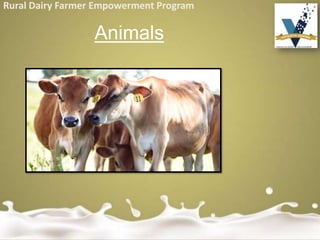
Animals
Rural Dairy Farmer Empowerment Program
There are numerous approaches to
profitability in dairy farming.
Some focus on minimizing input
costs while accepting lower milk
production.
Others use high inputs to maximize
production and profitability.
Rural Dairy Farmer Empowerment Program
The five conditions of animal care to
promote
health, productivity, and longevity are:
1. Freedom from hunger and thirst
2. Freedom from discomfort
3. Freedom from pain, injury or disease
4. Freedom from fear and distress
5. Freedom to express normal behavior.
Rural Dairy Farmer Empowerment Program
Dairy herd health and production:
The cycle of life
Rural Dairy Farmer Empowerment Program
The life cycle of a dairy cow is
predictable and therefore can
largely be managed with
scheduled activities.
Rural Dairy Farmer Empowerment Program
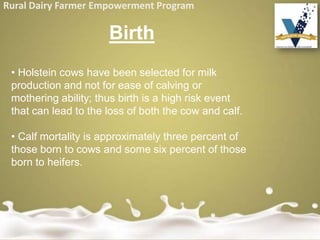
• Holstein cows have been selected for milk
production and not for ease of calving or
mothering ability; thus birth is a high risk event
that can lead to the loss of both the cow and calf.
• Calf mortality is approximately three percent of
those born to cows and some six percent of those
born to heifers.
Birth
Rural Dairy Farmer Empowerment Program
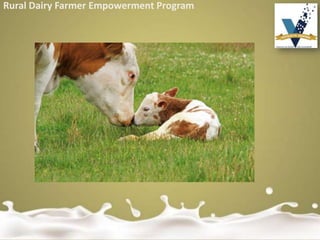
Calf is the foundation of the future Dairy
Herd which signifies the importance of
proper Calf rearing.
A good feeding & Management Program
will result in lower death rate (Mortality),
replacement heifers that start production
early and fast growth resulting in rapid
genetic improvement.
Rural Dairy Farmer Empowerment Program
1. Management Before Birth
2. Management at Calving
3. Feeding the Calf
4. Phases of Calf feeding
5. Calf feeding programs
6. Calf feeding methods
7. Calf feeds
8. Weaning
9. Calf Housing
10.Identification – Ear tagging is most
common and advisable.
Rural Dairy Farmer Empowerment Program
Phases Of Calf Feeding - 4 Phases
Colostrum Phase (1 – 4 days) - Colostrum
Pre-ruminant phase (5 - 30 days) - Milk
Transition Stage (Liquids & dry feeds) - Milk replacer & calf starter
Post weaning stage (dry feeds) - Calf starter
The Calf has low immunity at Birth and therefore must be given
colostrum. The Colostrum has antibodies that protect the Calf
against diseases the mother has been exposed to and their
absorption is highest within 12 hrs after birth and very low after
24 hrs.
Rural Dairy Farmer Empowerment Program
The newborn calf is dependent on Milk for
Nutrition and growth in its early life as the rumen
is not functional.
Introduce calf to Solid Feed: (after 30 days)
As calf is introduced to solid feed, the rumen
starts developing & the calf can be weaned as
soon as it can consume enough dry feed
(1.5% of body weight)
Rural Dairy Farmer Empowerment Program
Calf mortality at birth can be much greater when
heifers are poorly grown, the nutrition of pregnant
stock is poorly managed, the calving area is
disruptive to normal cow behavior, and when sire
selection does not take calving ease
into consideration.
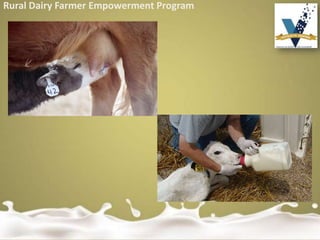
At birth, the calf is immunologically naïve and
highly susceptible to pathogens. Good quality
colostrum promotes calf immunity and should be
fed to calves within six hours of birth.
Rural Dairy Farmer Empowerment Program
Colostrum quality is influenced by:
• The age and health status of the mother
• The timing of colostrum harvest relative to birth
• The hygiene of the equipment used to harvest and
store the colostrum.
As bacteria can multiply in colostrum, it should
either be fed directly to the calf after being
harvested or cooled rapidly to 4C for short-term
storage.
Rural Dairy Farmer Empowerment Program
The risk of calf disease is reduced when:
1- Calves are fed colostrum at birth,
2- Fed milk that has been appropriately handled
and stored,
3- Born and raised in a clean dry area and kept
separate from older calves that could be a source
of infection.
Rural Dairy Farmer Empowerment Program
Heifer conception
The onset of sexual maturity is related more to
body weight than to age. Heifers should weigh
85% of the adult cow weight at the time of
calving.
Weight at joining is related to weight at calving and subsequently
to milk production. Well grown heifers are less
likely to have calving difficulties, will produce more milk and get
back in calf more rapidly than poorly grown heifers
Rural Dairy Farmer Empowerment Program
Calving
Good nutritional management of cows before
calving reduces the risk of metabolic diseases
that can contribute to weakness and
subsequently calving difficulty.
For a good ration to be effective, it needs
to be fed to the right cow for the appropriate
period.
Rural Dairy Farmer Empowerment Program
The four weeks prior to calving are recognized as a
crucial time for dairy cattle.
Cows that are fed and managed well before calving are less
likely to have problems with metabolic diseases such as milkfever,
ketosis, retained placenta, metritis, abomasal displacement or
death.
The health of cows after calving is also influenced by the
environmental conditions at calving and by the quality of care
provided to calving cows.
Cows calving in dirty wet yards are more likely to develop
uterine infections, as do unhygienic practices or excessive traction
by handlers helping calving cows.
Rural Dairy Farmer Empowerment Program
Death
Common causes of death include calving difficulty, mastitis
and metabolic disease nearly all occur within 60 days of
calving.
Strategies to prevent disease and mortality should deal with
the period which spans the four weeks before and the four
weeks after calving.
Rural Dairy Farmer Empowerment Program
Conception
After calving, cows should start into a reproductive
management program with targets established for
average days-to first breeding, efficiency of heat
detection and for pregnancy rate.
Contingency plans should also be in place for cows that
experience calving difficulty, retained placenta, or mastitis so
as to minimize their impact on reproductive performance.
The days between calving and conception dictate the calving
interval and have a large impact on future milk production, herd
structure, and availability of replacement heifers.
Rural Dairy Farmer Empowerment Program
Culling
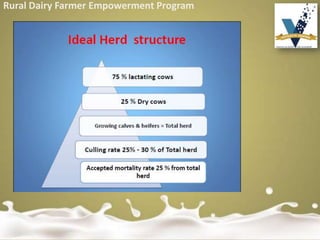
Cows should be culled from the herd toward the end of their
lactation on the basis of a lowered future productive potential.
Culling decisions based on voluntary criteria such as low
production, age and conformation tend to promote herd
productivity whereas those based on involuntary criteria
associated with failure of conception, disease or injury have a
negative impact on herd structure.
Recording the identity of animals culled, stage of lactation at
which they were culled and reason for culling helps to identify
causes of attrition that need to be investigated.
Rural Dairy Farmer Empowerment Program
Dry cows
Cows are dried off 50–60 days before their
projected calving date to allow the mammary
glands to recover.
High-risk periods for new intra-mammary infections
include the early and late dry period and early lactation
the non-lactating or ‘dry’ period provides an
opportunity to treat
existing intra-mammary infections and to prevent
new intra-mammary infections.
Rural Dairy Farmer Empowerment Program
Strategies to reduce the risk of new Intra mammary
infections during the dry period include intra-
mammary therapy at the time of drying off and
implementing
good environmental and nutritional management.
Attention to detail is important when working with
cows—particularly when administering medications as
poor
treatment technique can introduce pathogens
Rural Dairy Farmer Empowerment Program
When milking is stopped, the mammary gland
becomes engorged and some cows may leak milk.
This opens the teat end allowing bacteria to enter
the gland.
Similar engorgement and leakage of milk can
be seen before and after calving.
During these times, the cows must be kept in
a clean environment.
Rural Dairy Farmer Empowerment Program
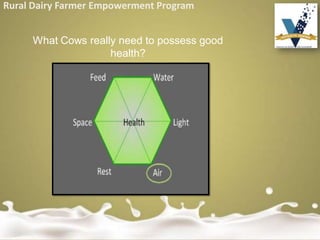
What Cows really need to possess good
health?
Rural Dairy Farmer Empowerment Program
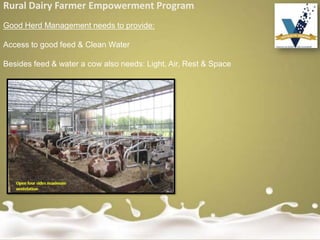
Good Herd Management needs to provide:
Access to good feed & Clean Water
Besides feed & water a cow also needs: Light, Air, Rest & Space
Rural Dairy Farmer Empowerment Program
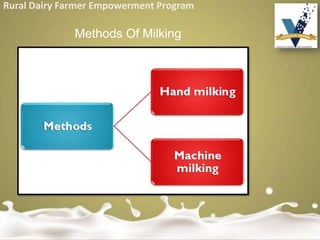
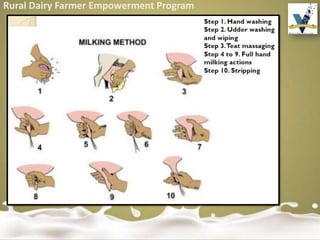
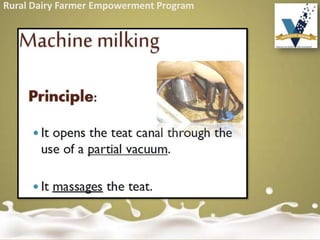
Methods Of Milking
Rural Dairy Farmer Empowerment Program
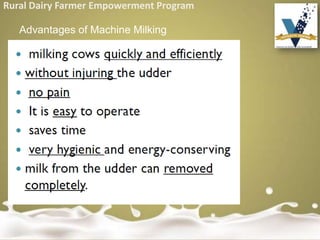
Advantages of Machine Milking
Rural Dairy Farmer Empowerment Program
Organic Milk Production
Organic Milk is produced through
approved methods that integrate
cultural, biological, and mechanical
practices that foster cycling of
resources, promote ecological balance,
and conserve biodiversity.
Land must have had no prohibited
substances applied to it for at least 3 years.
Rural Dairy Farmer Empowerment Program
Organic Dairy farming means raising
animals on organic feed (i.e. pastures
cultivated without the use of fertilizers
or pesticides), have access to pasture
or outside, along with the restricted
usage of antibiotics and hormones.
Rural Dairy Farmer Empowerment Program
According to the Economic Survey of
2015-16, India produces 146 million
tonnes of milk every year, or 18.5 percent
of the total worldwide output, pushing the
country to the top of the global chart. Now,
almost 68 percent of this 146 million
tonnes was found to have adulterants –
ranging from detergent, starch, urea to
white paint – whereby water dilution is the
least of your worries.
Rural Dairy Farmer Empowerment Program
In an organic dairy farm
1. Cows and calves are fed 100% organic feed.
2. Organic crops, hay, and pasture are grown without the
use of synthetic fertilizers and pesticides that have not been
carefully screened and approved for organic use.
3. Land used to grow organic crops must be free of all
prohibited materials for at least three (3) years prior to the
first organic harvest.
4. Non-natural feed additives and supplements such as
vitamins and minerals must also be approved for use.
5. Genetically modified organisms (GMOs, called
“Excluded Methods” in the regulation) are forbidden
Rural Dairy Farmer Empowerment Program
6. Synthetic milk replacers are prohibited. Calves
must be fed on organic milk only.
7. All animals must have access to the outdoors (based on
weather conditions). Animals over six months of age
must have access to pasture during growing season.
8. Restricted usage of antibiotics (only used when cows are
ill). Only approved health care products can be used.
Organic animals may not be fed ANY slaughter more
by-products, urea, or manure.
9. The welfare of the animals must be attended to.
Rural Dairy Farmer Empowerment Program
10. Certain procedures, such as tail docking, are
prohibited. Other procedures, such as dehorning, must
be done so as to minimize the stress to the animal.
11. An organic farmer must keep sufficient records to
verify his or her compliance with the standards.
12. Each farm is inspected and audited every year.
13. Any farm can be inspected unannounced at any
time.
Rural Dairy Farmer Empowerment Program
Organic dairy products must be from
animals that have been under continuous
organic management for at least one year
prior to the production of the milk products.
Rural Dairy Farmer Empowerment Program
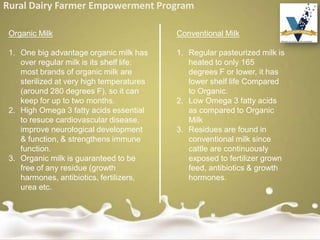
Organic Milk
1. One big advantage organic milk has
over regular milk is its shelf life:
most brands of organic milk are
sterilized at very high temperatures
(around 280 degrees F), so it can
keep for up to two months.
2. High Omega 3 fatty acids essential
to resuce cardiovascular disease,
improve neurological development
& function, & strengthens immune
function.
3. Organic milk is guaranteed to be
free of any residue (growth
harmones, antibiotics, fertilizers,
urea etc.
Conventional Milk
1. Regular pasteurized milk is
heated to only 165
degrees F or lower, it has
lower shelf life Compared
to Organic.
2. Low Omega 3 fatty acids
as compared to Organic
Milk
3. Residues are found in
conventional milk since
cattle are continuously
exposed to fertilizer grown
feed, antibiotics & growth
hormones.
Rural Dairy Farmer Empowerment Program
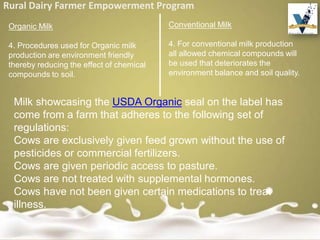
Organic Milk
4. Procedures used for Organic milk
production are environment friendly
thereby reducing the effect of chemical
compounds to soil.
Conventional Milk
4. For conventional milk production
all allowed chemical compounds will
be used that deteriorates the
environment balance and soil quality.
Milk showcasing the USDA Organic seal on the label has
come from a farm that adheres to the following set of
regulations:
Cows are exclusively given feed grown without the use of
pesticides or commercial fertilizers.
Cows are given periodic access to pasture.
Cows are not treated with supplemental hormones.
Cows have not been given certain medications to treat
illness.
Rural Dairy Farmer Empowerment Program
Common Diseases in
Cattle and their
treatment
Rural Dairy Farmer Empowerment Program
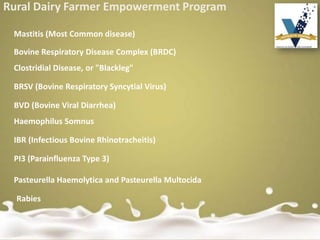
Bovine Respiratory Disease Complex (BRDC)
Clostridial Disease, or "Blackleg"
BRSV (Bovine Respiratory Syncytial Virus)
BVD (Bovine Viral Diarrhea)
Haemophilus Somnus
IBR (Infectious Bovine Rhinotracheitis)
PI3 (Parainfluenza Type 3)
Pasteurella Haemolytica and Pasteurella Multocida
Rabies
Mastitis (Most Common disease)
Rural Dairy Farmer Empowerment Program
Dairy Farm waste Management
Dairy waste management in
particular, is very crucial in view of
the high organic matter and high
nutrient levels contained in dairy
effluents.
Rural Dairy Farmer Empowerment Program
Dairy waste can be effectively treated either with aerobic
or anaerobic processes. The main advantages of the
former consist of low yield, high kinetics, pathogen free
product, and high temperature operation whereas the
latter is a simple, low budget and conservative
technology.
Occasionally, pre-treatment strategies (i.e. wetlands) are
required in order to improve the efficiency of treatment
methodology. Wetlands are a promising technology
applied in order to remove the greater part of nutrients
and minerals contained in milk based products.
Rural Dairy Farmer Empowerment Program
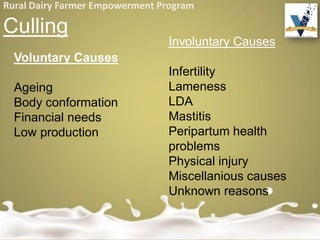
Culling
Voluntary Causes
Ageing
Body conformation
Financial needs
Low production
Involuntary Causes
Infertility
Lameness
LDA
Mastitis
Peripartum health
problems
Physical injury
Miscellanious causes
Unknown reasons
Rural Dairy Farmer Empowerment Program
Thank you
Mail your queries at
vatsalya01admn@gmail.com

Dairy farm cattle management

  • 1.
    Rural Dairy FarmerEmpowerment Program Vatsalya Empire Ventures Private Limited www.vatsalyaempireventures.com www.vevpl.com
  • 2.
    Introduction to dairy farming RuralDairy Farmer Empowerment Program
  • 3.
    When one looksat dairy farming in India, the success that million of farmers achieved under - Operation Flood Programme ( white revolution ) and thereafter with strong milk and milk product brands like AMUL, Mother Dairy etc in the organised sector, this proves the facts that dairying still one of the most sought after business activity. Rural Dairy Farmer Empowerment Program
  • 4.
    Rural Dairy FarmerEmpowerment Program Principles of Dairy Farm Management
  • 5.
    Rural Dairy FarmerEmpowerment Program Profitable Dairy Production is based on well planned strategies, strong leadership, strong team work.
  • 6.
    Rural Dairy FarmerEmpowerment Program 3 factors affecting Dairy Herd production & health Nutrition Cow comfort Reproduction
  • 7.
    Rural Dairy FarmerEmpowerment Program  Three fundamental factors that determine the health & productivity of a high-potential dairy cow are nutrition, comfort & reproduction. Cows need to be well fed, maintained in a comfortable environment, and bred in a timely fashion in order to express this potential
  • 8.
    Rural Dairy FarmerEmpowerment Program Environment Facilities Cow comfort Heat Stress Cold Stress Hygiene Bio security Human food quality
  • 9.
    Rural Dairy FarmerEmpowerment Program Facilities Cows need a clean, dry, comfortable place to lie down. Walking surfaces should provide sufficient traction to avoid slipping but should not be too abrasive or rough. Cattle should have constant access to face clean water and feed with sufficient trough space for the number of animals in the group to avoid competition between animals. Good feed quality demands feed storage facilities that prevent feed spoilage.
  • 10.
    Rural Dairy FarmerEmpowerment Program Cow Comfort When cows have to stand for long periods because they cannot lie down in a clean dry area, they may become lame. Cows that are lame or have to stand on slippery surfaces are less likely to show sexual behavior and hence less likely to become pregnant. If they are forced to lie in wet dirty areas, the risk of mastitis is increased. The result can be more disease & lower production.
  • 11.
    Rural Dairy FarmerEmpowerment Program Heat Stress The large body mass of cows of temperate breeds and their high metabolism makes them susceptible to heat stress under hot conditions. Hot cows eat less, are more likely to become sick and more difficult to get pregnant. Providing adequate shade and cooling for cows during hot weather promotes milk production, reduces mortality, and improves reproductive performance. Cows should always have access to fresh clean water.
  • 12.
    Rural Dairy FarmerEmpowerment Program Cold Stress Adult cows are generally more resilient to cold stress than humans because of their larger body mass; however, frost damage to teats can make them more susceptible to mastitis. Young calves need more feed during cold weather.
  • 13.
    Rural Dairy FarmerEmpowerment Program Hygiene Good hygiene will prevent transmission of disease, but waste management is a significant logistical problem, where cattle are managed intensively. Udder health is largely influenced by the level of hygiene practiced before, during and after milking. Milking wet, dirty udders increases the risk of mastitis, wiping cows’ teats with a dirty cloth transmits pathogens between cows, and failing to sanitize teats after milking provides opportunity for disease to spread.
  • 14.
    Rural Dairy FarmerEmpowerment Program Young calves are particularly susceptible to pathogens that cause diarrhea, but the risk of disease is reduced by feeding adequate colostrum, good milk handling practices and reducing exposure to manure from other animals. Hygiene (contd,,)
  • 15.
    Rural Dairy FarmerEmpowerment Program Biosecurity It is always preferable to prevent the introduction of disease agents onto the farm. Biosecurity protocols should be developed to identify and manage sources from introduced livestock, people, equipment, feed, wildlife & water.
  • 16.
    Rural Dairy FarmerEmpowerment Program Human food quality The dairy produces milk for human consumption, and the consumer expects that the product will be nutritious and safe. A number of pathogens can infect both animals & humans . Properly functioning equipment for milk harvesting, cooling & storage and good milking routines are important for the health of the cows and for milk quality. Some medications to treat sick cattle or to facilitate their reproductive management can have adverse impacts on milk products or people. Individual identification, good record keeping of medication and chemical use, and observance of withholding periods will avoid contamination of human food.
  • 17.
    Rural Dairy FarmerEmpowerment Program Animals
  • 18.
    Rural Dairy FarmerEmpowerment Program There are numerous approaches to profitability in dairy farming. Some focus on minimizing input costs while accepting lower milk production. Others use high inputs to maximize production and profitability.
  • 19.
    Rural Dairy FarmerEmpowerment Program The five conditions of animal care to promote health, productivity, and longevity are: 1. Freedom from hunger and thirst 2. Freedom from discomfort 3. Freedom from pain, injury or disease 4. Freedom from fear and distress 5. Freedom to express normal behavior.
  • 20.
    Rural Dairy FarmerEmpowerment Program Dairy herd health and production: The cycle of life
  • 21.
    Rural Dairy FarmerEmpowerment Program The life cycle of a dairy cow is predictable and therefore can largely be managed with scheduled activities.
  • 22.
    Rural Dairy FarmerEmpowerment Program • Holstein cows have been selected for milk production and not for ease of calving or mothering ability; thus birth is a high risk event that can lead to the loss of both the cow and calf. • Calf mortality is approximately three percent of those born to cows and some six percent of those born to heifers. Birth
  • 23.
    Rural Dairy FarmerEmpowerment Program Calf is the foundation of the future Dairy Herd which signifies the importance of proper Calf rearing. A good feeding & Management Program will result in lower death rate (Mortality), replacement heifers that start production early and fast growth resulting in rapid genetic improvement.
  • 24.
    Rural Dairy FarmerEmpowerment Program 1. Management Before Birth 2. Management at Calving 3. Feeding the Calf 4. Phases of Calf feeding 5. Calf feeding programs 6. Calf feeding methods 7. Calf feeds 8. Weaning 9. Calf Housing 10.Identification – Ear tagging is most common and advisable.
  • 25.
    Rural Dairy FarmerEmpowerment Program
  • 26.
    Rural Dairy FarmerEmpowerment Program Phases Of Calf Feeding - 4 Phases Colostrum Phase (1 – 4 days) - Colostrum Pre-ruminant phase (5 - 30 days) - Milk Transition Stage (Liquids & dry feeds) - Milk replacer & calf starter Post weaning stage (dry feeds) - Calf starter The Calf has low immunity at Birth and therefore must be given colostrum. The Colostrum has antibodies that protect the Calf against diseases the mother has been exposed to and their absorption is highest within 12 hrs after birth and very low after 24 hrs.
  • 27.
    Rural Dairy FarmerEmpowerment Program The newborn calf is dependent on Milk for Nutrition and growth in its early life as the rumen is not functional. Introduce calf to Solid Feed: (after 30 days) As calf is introduced to solid feed, the rumen starts developing & the calf can be weaned as soon as it can consume enough dry feed (1.5% of body weight)
  • 28.
    Rural Dairy FarmerEmpowerment Program Calf mortality at birth can be much greater when heifers are poorly grown, the nutrition of pregnant stock is poorly managed, the calving area is disruptive to normal cow behavior, and when sire selection does not take calving ease into consideration. At birth, the calf is immunologically naïve and highly susceptible to pathogens. Good quality colostrum promotes calf immunity and should be fed to calves within six hours of birth.
  • 29.
    Rural Dairy FarmerEmpowerment Program Colostrum quality is influenced by: • The age and health status of the mother • The timing of colostrum harvest relative to birth • The hygiene of the equipment used to harvest and store the colostrum. As bacteria can multiply in colostrum, it should either be fed directly to the calf after being harvested or cooled rapidly to 4C for short-term storage.
  • 30.
    Rural Dairy FarmerEmpowerment Program
  • 31.
    Rural Dairy FarmerEmpowerment Program The risk of calf disease is reduced when: 1- Calves are fed colostrum at birth, 2- Fed milk that has been appropriately handled and stored, 3- Born and raised in a clean dry area and kept separate from older calves that could be a source of infection.
  • 32.
    Rural Dairy FarmerEmpowerment Program Heifer conception The onset of sexual maturity is related more to body weight than to age. Heifers should weigh 85% of the adult cow weight at the time of calving. Weight at joining is related to weight at calving and subsequently to milk production. Well grown heifers are less likely to have calving difficulties, will produce more milk and get back in calf more rapidly than poorly grown heifers
  • 33.
    Rural Dairy FarmerEmpowerment Program Calving Good nutritional management of cows before calving reduces the risk of metabolic diseases that can contribute to weakness and subsequently calving difficulty. For a good ration to be effective, it needs to be fed to the right cow for the appropriate period.
  • 34.
    Rural Dairy FarmerEmpowerment Program The four weeks prior to calving are recognized as a crucial time for dairy cattle. Cows that are fed and managed well before calving are less likely to have problems with metabolic diseases such as milkfever, ketosis, retained placenta, metritis, abomasal displacement or death. The health of cows after calving is also influenced by the environmental conditions at calving and by the quality of care provided to calving cows. Cows calving in dirty wet yards are more likely to develop uterine infections, as do unhygienic practices or excessive traction by handlers helping calving cows.
  • 35.
    Rural Dairy FarmerEmpowerment Program Death Common causes of death include calving difficulty, mastitis and metabolic disease nearly all occur within 60 days of calving. Strategies to prevent disease and mortality should deal with the period which spans the four weeks before and the four weeks after calving.
  • 36.
    Rural Dairy FarmerEmpowerment Program Conception After calving, cows should start into a reproductive management program with targets established for average days-to first breeding, efficiency of heat detection and for pregnancy rate. Contingency plans should also be in place for cows that experience calving difficulty, retained placenta, or mastitis so as to minimize their impact on reproductive performance. The days between calving and conception dictate the calving interval and have a large impact on future milk production, herd structure, and availability of replacement heifers.
  • 37.
    Rural Dairy FarmerEmpowerment Program Culling Cows should be culled from the herd toward the end of their lactation on the basis of a lowered future productive potential. Culling decisions based on voluntary criteria such as low production, age and conformation tend to promote herd productivity whereas those based on involuntary criteria associated with failure of conception, disease or injury have a negative impact on herd structure. Recording the identity of animals culled, stage of lactation at which they were culled and reason for culling helps to identify causes of attrition that need to be investigated.
  • 38.
    Rural Dairy FarmerEmpowerment Program Dry cows Cows are dried off 50–60 days before their projected calving date to allow the mammary glands to recover. High-risk periods for new intra-mammary infections include the early and late dry period and early lactation the non-lactating or ‘dry’ period provides an opportunity to treat existing intra-mammary infections and to prevent new intra-mammary infections.
  • 39.
    Rural Dairy FarmerEmpowerment Program Strategies to reduce the risk of new Intra mammary infections during the dry period include intra- mammary therapy at the time of drying off and implementing good environmental and nutritional management. Attention to detail is important when working with cows—particularly when administering medications as poor treatment technique can introduce pathogens
  • 40.
    Rural Dairy FarmerEmpowerment Program When milking is stopped, the mammary gland becomes engorged and some cows may leak milk. This opens the teat end allowing bacteria to enter the gland. Similar engorgement and leakage of milk can be seen before and after calving. During these times, the cows must be kept in a clean environment.
  • 41.
    Rural Dairy FarmerEmpowerment Program
  • 42.
    Rural Dairy FarmerEmpowerment Program What Cows really need to possess good health?
  • 43.
    Rural Dairy FarmerEmpowerment Program
  • 44.
    Rural Dairy FarmerEmpowerment Program
  • 45.
    Rural Dairy FarmerEmpowerment Program
  • 46.
    Rural Dairy FarmerEmpowerment Program Good Herd Management needs to provide: Access to good feed & Clean Water Besides feed & water a cow also needs: Light, Air, Rest & Space
  • 47.
    Rural Dairy FarmerEmpowerment Program Methods Of Milking
  • 48.
    Rural Dairy FarmerEmpowerment Program
  • 49.
    Rural Dairy FarmerEmpowerment Program
  • 50.
    Rural Dairy FarmerEmpowerment Program Advantages of Machine Milking
  • 51.
    Rural Dairy FarmerEmpowerment Program Organic Milk Production Organic Milk is produced through approved methods that integrate cultural, biological, and mechanical practices that foster cycling of resources, promote ecological balance, and conserve biodiversity. Land must have had no prohibited substances applied to it for at least 3 years.
  • 52.
    Rural Dairy FarmerEmpowerment Program Organic Dairy farming means raising animals on organic feed (i.e. pastures cultivated without the use of fertilizers or pesticides), have access to pasture or outside, along with the restricted usage of antibiotics and hormones.
  • 53.
    Rural Dairy FarmerEmpowerment Program According to the Economic Survey of 2015-16, India produces 146 million tonnes of milk every year, or 18.5 percent of the total worldwide output, pushing the country to the top of the global chart. Now, almost 68 percent of this 146 million tonnes was found to have adulterants – ranging from detergent, starch, urea to white paint – whereby water dilution is the least of your worries.
  • 54.
    Rural Dairy FarmerEmpowerment Program In an organic dairy farm 1. Cows and calves are fed 100% organic feed. 2. Organic crops, hay, and pasture are grown without the use of synthetic fertilizers and pesticides that have not been carefully screened and approved for organic use. 3. Land used to grow organic crops must be free of all prohibited materials for at least three (3) years prior to the first organic harvest. 4. Non-natural feed additives and supplements such as vitamins and minerals must also be approved for use. 5. Genetically modified organisms (GMOs, called “Excluded Methods” in the regulation) are forbidden
  • 55.
    Rural Dairy FarmerEmpowerment Program 6. Synthetic milk replacers are prohibited. Calves must be fed on organic milk only. 7. All animals must have access to the outdoors (based on weather conditions). Animals over six months of age must have access to pasture during growing season. 8. Restricted usage of antibiotics (only used when cows are ill). Only approved health care products can be used. Organic animals may not be fed ANY slaughter more by-products, urea, or manure. 9. The welfare of the animals must be attended to.
  • 56.
    Rural Dairy FarmerEmpowerment Program 10. Certain procedures, such as tail docking, are prohibited. Other procedures, such as dehorning, must be done so as to minimize the stress to the animal. 11. An organic farmer must keep sufficient records to verify his or her compliance with the standards. 12. Each farm is inspected and audited every year. 13. Any farm can be inspected unannounced at any time.
  • 57.
    Rural Dairy FarmerEmpowerment Program Organic dairy products must be from animals that have been under continuous organic management for at least one year prior to the production of the milk products.
  • 58.
    Rural Dairy FarmerEmpowerment Program
  • 59.
    Rural Dairy FarmerEmpowerment Program Organic Milk 1. One big advantage organic milk has over regular milk is its shelf life: most brands of organic milk are sterilized at very high temperatures (around 280 degrees F), so it can keep for up to two months. 2. High Omega 3 fatty acids essential to resuce cardiovascular disease, improve neurological development & function, & strengthens immune function. 3. Organic milk is guaranteed to be free of any residue (growth harmones, antibiotics, fertilizers, urea etc. Conventional Milk 1. Regular pasteurized milk is heated to only 165 degrees F or lower, it has lower shelf life Compared to Organic. 2. Low Omega 3 fatty acids as compared to Organic Milk 3. Residues are found in conventional milk since cattle are continuously exposed to fertilizer grown feed, antibiotics & growth hormones.
  • 60.
    Rural Dairy FarmerEmpowerment Program Organic Milk 4. Procedures used for Organic milk production are environment friendly thereby reducing the effect of chemical compounds to soil. Conventional Milk 4. For conventional milk production all allowed chemical compounds will be used that deteriorates the environment balance and soil quality. Milk showcasing the USDA Organic seal on the label has come from a farm that adheres to the following set of regulations: Cows are exclusively given feed grown without the use of pesticides or commercial fertilizers. Cows are given periodic access to pasture. Cows are not treated with supplemental hormones. Cows have not been given certain medications to treat illness.
  • 61.
    Rural Dairy FarmerEmpowerment Program Common Diseases in Cattle and their treatment
  • 62.
    Rural Dairy FarmerEmpowerment Program Bovine Respiratory Disease Complex (BRDC) Clostridial Disease, or "Blackleg" BRSV (Bovine Respiratory Syncytial Virus) BVD (Bovine Viral Diarrhea) Haemophilus Somnus IBR (Infectious Bovine Rhinotracheitis) PI3 (Parainfluenza Type 3) Pasteurella Haemolytica and Pasteurella Multocida Rabies Mastitis (Most Common disease)
  • 63.
    Rural Dairy FarmerEmpowerment Program Dairy Farm waste Management Dairy waste management in particular, is very crucial in view of the high organic matter and high nutrient levels contained in dairy effluents.
  • 64.
    Rural Dairy FarmerEmpowerment Program Dairy waste can be effectively treated either with aerobic or anaerobic processes. The main advantages of the former consist of low yield, high kinetics, pathogen free product, and high temperature operation whereas the latter is a simple, low budget and conservative technology. Occasionally, pre-treatment strategies (i.e. wetlands) are required in order to improve the efficiency of treatment methodology. Wetlands are a promising technology applied in order to remove the greater part of nutrients and minerals contained in milk based products.
  • 65.
    Rural Dairy FarmerEmpowerment Program Culling Voluntary Causes Ageing Body conformation Financial needs Low production Involuntary Causes Infertility Lameness LDA Mastitis Peripartum health problems Physical injury Miscellanious causes Unknown reasons
  • 66.
    Rural Dairy FarmerEmpowerment Program Thank you Mail your queries at vatsalya01admn@gmail.com