
Dewormingright
SUSAN SCHOENIAN
Sheep & Goat Specialist
University of Maryland Extension
sschoen@umd.edu | wormx.info | sheepandgoat.com
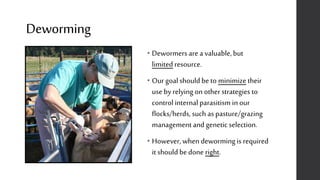
Deworming
• Dewormers are a valuable,but
limited resource.
• Our goalshould be to minimize their
use by relying on other strategies to
control internal parasitism in our
flocks/herds, such as pasture/grazing
management and genetic selection.
• However, when dewormingis required
it should be done right.
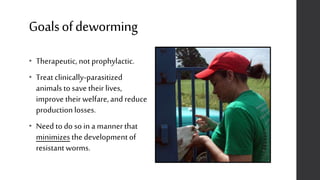
Goalsofdeworming
• Therapeutic, not prophylactic.
• Treat clinically-parasitized
animals to save their lives,
improve their welfare, and reduce
production losses.
• Need to do so in a manner that
minimizes thedevelopmentof
resistantworms.
Dewormers 101
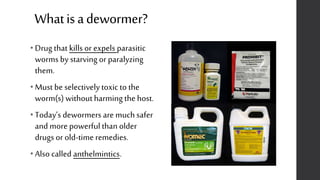
Whatisadewormer?
• Drug that kills or expels parasitic
worms by starving or paralyzing
them.
• Must be selectively toxic to the
worm(s) without harming the host.
• Today’s dewormers are muchsafer
and more powerful than older
drugs or old-time remedies.
• Also called anthelmintics.
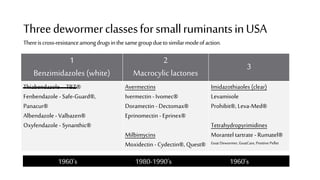
ThreedewormerclassesforsmallruminantsinUSA
Thereiscross-resistanceamongdrugsinthesamegroupduetosimilarmodeofaction.
1
Benzimidazoles (white)
2
Macrocylic lactones
3
Thiabendazole – TBZ®
Fenbendazole - Safe-Guard®,
Panacur®
Albendazole - Valbazen®
Oxyfendazole - Synanthic®
Avermectins
Ivermectin - Ivomec®
Doramectin - Dectomax®
Eprinomectin - Eprinex®
Milbimycins
Moxidectin - Cydectin®, Quest®
Imidazothiaoles (clear)
Levamisole
Prohibit®, Leva-Med®
Tetrahydropyrimidines
Morantel tartrate - Rumatel®
Goat Dewormer, GoatCare, Positive Pellet
1960’s 1980-1990’s 1960’s
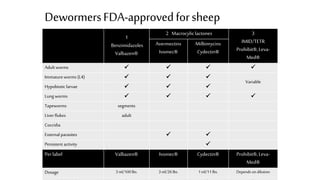
DewormersFDA-approvedforsheep
1
Benzimidazoles
Valbazen®
2 Macrocyliclactones 3
IMID/TETR
Prohibit®,Leva-
Med®
Avermectins
Ivomec®
Milbimycins
Cydectin®
Adult worms    
Immatureworms (L4)   
Variable
Hypobiotic larvae   
Lung worms    
Tapeworms segments
Liver flukes adult
Coccidia
External parasites  
Persistent activity 
Perlabel Valbazen® Ivomec® Cydectin® Prohibit®,Leva-
Med®
Dosage 3 ml/100 lbs. 3 ml/26 lbs. 1 ml/11 lbs. Depends on dilution
1 Benzimidazoles 3 IMID/TETR
Safe-Guard® Valbazen® Moranteltartrate
Adult worms   
Immatureworms (L4)  
Hypobiotic larvae  
Lungworms  
Tapeworms not labeled 
Liver flukes adult
Coccidia
External parasites
Per label Safe-Guard® Valbazen® Morantel tartrate
Dosage per 50lbs. 1.2 ml 2 ml Depends on product
Meat withdrawal 6 days 7 days 30days
Milk withdrawal NA NA 0 days
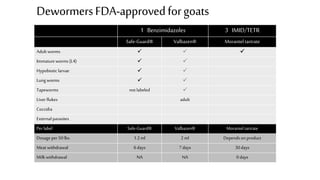
DewormersFDA-approvedforgoats
1 Benzimidazoles 2 Macrocyliclactones 3 IMID/TETR
Safe-Guard® Valbazen® Ivomec® Cydectin® Prohibit®,Leva-Med®
Adult worms     
Immatureworms (L4)    
Variable
Hypobiotic larvae    
Lung worms     
Tape worms segments segments
Adult liver flukes adults
Coccidia
External parasites  
Persistent activity 
PerACSRPC(wormx.info) Safe-Guard® Valbazen® Ivomec® Cydectin® Prohibit®,Leva-Med®
Dosage per 50lbs. 2.3 ml 4 ml 12ml 9 ml Depends on dilution
Meat withdrawal 16days 9 days 14days 17days 4 days
Milk withdrawal 4days 7days 9days 8days 3days
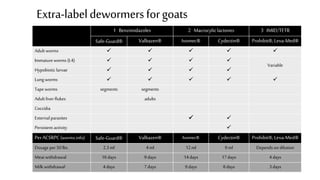
Extra-labeldewormersforgoats
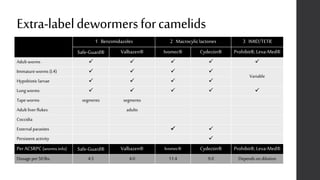
1 Benzimidazoles 2 Macrocyliclactones 3 IMID/TETR
Safe-Guard® Valbazen® Ivomec® Cydectin® Prohibit®,Leva-Med®
Adult worms     
Immatureworms (L4)    
Variable
Hypobiotic larvae    
Lung worms     
Tape worms segments segments
Adult liver flukes adults
Coccidia
External parasites  
Persistent activity 
PerACSRPC(wormx.info) Safe-Guard® Valbazen® Ivomec® Cydectin® Prohibit®,Leva-Med®
Dosage per 50lbs. 4.5 4.0 11.4 9.0 Depends on dilution
Extra-labeldewormersforcamelids
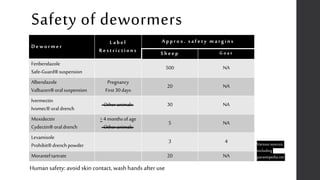
Safety of dewormers
Dew o rmer
Label
Restric tio ns
A ppro x. safety m argins
Sheep G o a t
Fenbendazole
Safe-Guard®suspension
500 NA
Albendazole
Valbazen®oralsuspension
Pregnancy
First 30days
20 NA
Ivermectin
Ivomec® oraldrench
Otheranimals 30 NA
Moxidectin
Cydectin®oraldrench
>4 monthsofage
Otheranimals
5 NA
Levamisole
Prohibit®drench powder
3 4
Moranteltartrate 20 NA
Human safety: avoid skin contact, wash hands after use
Various sources,
including
parasitipedia.net
Environmentalconsiderations
Properdisposal
• Preferablybyuse.
• In a sealedcontainer.
• At approvedlandfillor
byincineration.
• Outofand away from
waterways.
• Whenused correctly,mostofthe dewormers
havea low potentialfor environmental
pollution.
• Macrocycliclactones (endectocides)may
adverselyaffectfishand certainaquatic
species,bedetrimentalto dungbeetles,and
reduceinsectdiversity.
• However,MLs havereducedthe useof much
moretoxicchemicals.
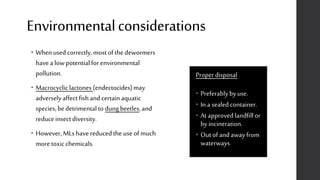
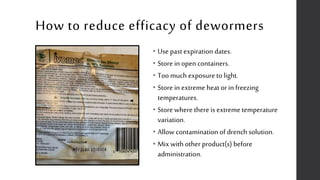
How to reduce efficacy of dewormers
• Use past expiration dates.
• Store in open containers.
• Too much exposure to light.
• Store in extreme heat or in freezing
temperatures.
• Store where there is extreme temperature
variation.
• Allow contamination of drench solution.
• Mix with other product(s) before
administration.
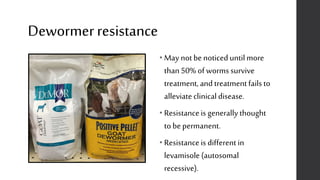
Dewormer resistance
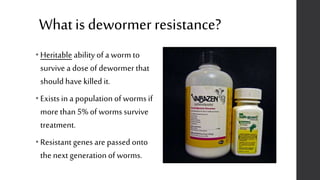
Whatis dewormer resistance?
• Heritable ability of a worm to
survive a dose of dewormer that
should have killed it.
• Exists in a population of worms if
more than 5% of worms survive
treatment.
• Resistant genes are passed onto
the next generation of worms.
Dewormerresistance
• May not be noticed untilmore
than50% of worms survive
treatment, and treatmentfails to
alleviateclinical disease.
• Resistanceis generally thought
to be permanent.
• Resistanceis different in
levamisole (autosomal
recessive).
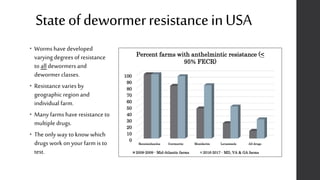
StateofdewormerresistanceinUSA
• Worms have developed
varying degrees of resistance
to all dewormers and
dewormer classes.
• Resistance varies by
geographic region and
individual farm.
• Many farms have resistance to
multiple drugs.
• The only way to know which
drugs work on your farm is to
test.
0
10
20
30
40
50
60
70
80
90
100
Benzimidazoles Ivermectin Moxidectin Levamisole All drugs
Percent farms with anthelmintic resistance (<
95% FECR)
2008-2009 - Mid-Atlantic farms 2016-2017 - MD, VA & GA farms
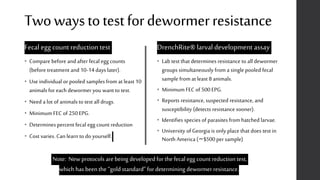
Twowaystotestfordewormerresistance
Fecal egg count reduction test
• Compare before and after fecal egg counts
(before treatment and 10-14 days later).
• Use individual or pooled samples from at least 10
animals for each dewormer you want to test.
• Need a lot of animals to test all drugs.
• Minimum FEC of 250 EPG.
• Determines percent fecal egg count reduction
• Cost varies. Can learn to do yourself.
DrenchRite® larval development assay
• Lab test that determines resistance to all dewormer
groups simultaneously from a single pooled fecal
sample from at least 8 animals.
• Minimum FEC of 500 EPG.
• Reports resistance, suspected resistance, and
susceptibility (detects resistance sooner).
• Identifies species of parasites from hatched larvae.
• University of Georgia is only place that does test in
North America (~$500 per sample)
Note: New protocols arebeing developed forthe fecal egg count reduction test,
which has beenthe “gold standard” for determining dewormer resistance.
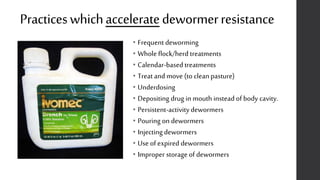
Practiceswhichacceleratedewormerresistance
• Frequent deworming
• Whole flock/herd treatments
• Calendar-based treatments
• Treat and move (to clean pasture)
• Underdosing
• Depositing drug in mouth instead of body cavity.
• Persistent-activitydewormers
• Pouring on dewormers
• Injecting dewormers
• Use of expired dewormers
• Improper storage of dewormers
Proper use of dewormers
Targeted Selective Treatment (TST)
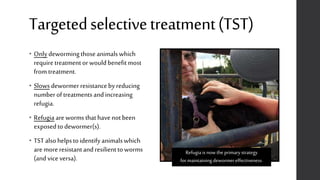
Targetedselectivetreatment(TST)
• Only dewormingthoseanimalswhich
requiretreatmentor wouldbenefitmost
from treatment.
• Slows dewormerresistanceby reducing
numberoftreatments andincreasing
refugia.
• Refugia are worms thathavenotbeen
exposedtodewormer(s).
• TST alsohelpsto identifyanimalswhich
are more resistantandresilientto worms
(and viceversa).
Refugiais nowthe primarystrategy
formaintainingdewormereffectiveness.
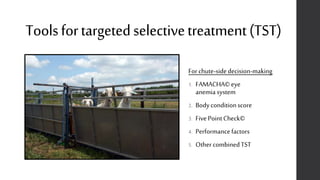
Toolsfortargetedselectivetreatment(TST)
For chute-sidedecision-making
1. FAMACHA©eye
anemia system
2. Bodyconditionscore
3. FivePointCheck©
4. Performancefactors
5. Other combinedTST
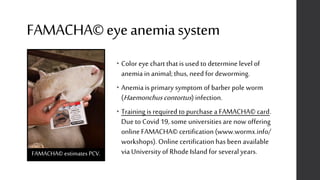
FAMACHA©eyeanemiasystem
• Color eye chart that is used to determine level of
anemia in animal;thus, need for deworming.
• Anemia is primary symptom of barber pole worm
(Haemonchuscontortus) infection.
• Trainingis required to purchase a FAMACHA© card.
Due to Covid 19, some universitiesare now offering
online FAMACHA© certification (www.wormx.info/
workshops). Online certification has been available
via University of Rhode Island for several years.FAMACHA© estimates PCV.
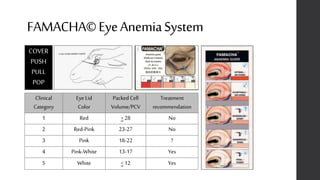
FAMACHA©EyeAnemiaSystem
Clinical
Category
Eye Lid
Color
Packed Cell
Volume/PCV
Treatment
recommendation
1 Red > 28 No
2 Red-Pink 23-27 No
3 Pink 18-22 ?
4 Pink-White 13-17 Yes
5 White < 12 Yes
COVER
PUSH
PULL
POP
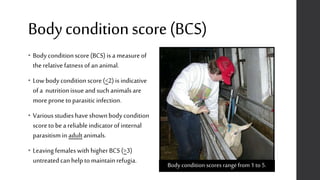
Bodyconditionscore(BCS)
• Bodyconditionscore(BCS) is a measureof
therelativefatnessof ananimal.
• Low bodyconditionscore(<2)is indicative
ofa nutritionissueandsuchanimalsare
moreproneto parasiticinfection.
• Variousstudieshaveshownbodycondition
scoreto bea reliableindicatorofinternal
parasitismin adult animals.
• LeavingfemaleswithhigherBCS (>3)
untreatedcanhelpto maintainrefugia.
Body condition scoresrangefrom 1 to 5.
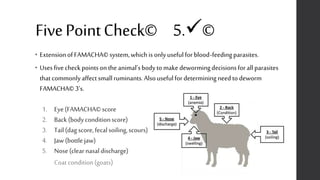
FivePointCheck© 5.©
• ExtensionofFAMACHA©system,whichisonlyusefulfor blood-feedingparasites.
• Usesfivecheck pointsonthe animal’sbodyto make dewormingdecisionsfor all parasites
thatcommonlyaffectsmallruminants.Alsousefulfor determiningneed to deworm
FAMACHA©3’s.
1. Eye(FAMACHA©score
2. Back (bodyconditionscore)
3. Tail(dagscore,fecalsoiling,scours)
4. Jaw (bottlejaw)
5. Nose(clear nasaldischarge)
Coat condition(goats)
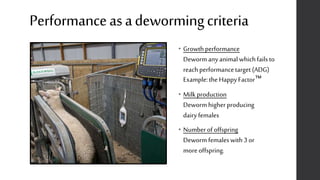
Performanceasadewormingcriteria
• Growthperformance
Deworm anyanimalwhichfailsto
reachperformancetarget (ADG)
Example:theHappyFactor™
• Milk production
Deworm higherproducing
dairyfemales
• Numberof offspring
Deworm femaleswith 3 or
moreoffspring.
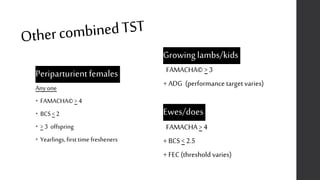
Periparturient females
Any one
• FAMACHA© > 4
• BCS < 2
• > 3 offspring
• Yearlings,firsttime fresheners
Growing lambs/kids
FAMACHA© > 3
+ ADG (performance target varies)
Ewes/does
FAMACHA > 4
+ BCS < 2.5
+ FEC (threshold varies)
Whataboutfecaleggcounts(FEC)?
• Fecal exams are NOT a reliable way to diagnose
parasitic disease in individual animals; it is not their
intended purpose.
• There are no widely-accepted FEC thresholds for
treatment.
• While generally predictive, FEC is not always a good
measure of the worm burden an animal is carrying.
Correlations between FEC and FAMACHA© are not
always high.
• Instead, use FEC to 1) determine efficacy of
dewormers, 2) monitor pasture contamination, and
3) identify more resistant (or susceptible) animals.
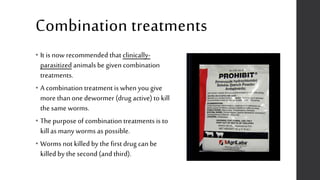
Combination treatments
• It is now recommended that clinically-
parasitized animalsbe given combination
treatments.
• A combination treatment is when you give
more thanone dewormer (drug active) to kill
the same worms.
• The purpose of combination treatments is to
killas many worms as possible.
• Worms not killed by the first drug can be
killed by the second (and third).
Recommendations for combination treatments
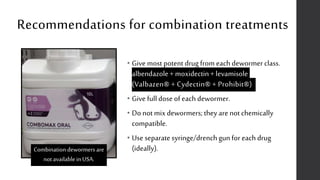
• Give most potent drug from each dewormer class.
albendazole+ moxidectin+ levamisole
(Valbazen® + Cydectin® + Prohibit®)
• Give full dose of each dewormer.
• Do not mix dewormers; they are not chemically
compatible.
• Use separate syringe/drench gun for each drug
(ideally).Combination dewormers are
not available in USA.
Recommendations for combination treatments
• Give dewormers sequentially, one
after theother to get additive effect.
• Observe withdrawal period of
dewormer with longestwithdrawal.
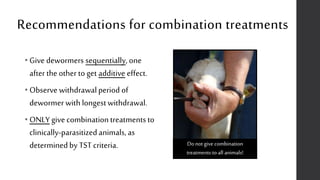
• ONLY give combinationtreatments to
clinically-parasitizedanimals, as
determinedby TST criteria. Do not give combination
treatments to all animals!
Non-drug options for “deworming”
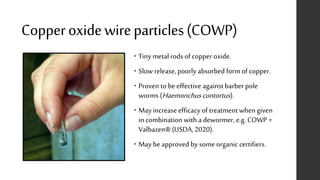
Copperoxidewireparticles(COWP)
• Tiny metal rods of copper oxide.
• Slow release, poorly absorbed form of copper.
• Proven to be effective againstbarber pole
worms (Haemonchuscontortus).
• May increaseefficacy of treatment when given
in combination with a dewormer, e.g. COWP +
Valbazen® (USDA, 2020).
• May be approved by some organic certifiers.
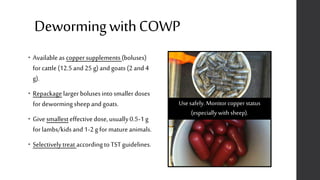
DewormingwithCOWP
• Availableas coppersupplements (boluses)
for cattle(12.5and 25 g) andgoats (2 and 4
g).
• Repackage larger bolusesintosmallerdoses
for dewormingsheepandgoats.
• Give smallesteffectivedose,usually0.5-1g
for lambs/kidsand 1-2 g for matureanimals.
• Selectivelytreat accordingto TSTguidelines.
Usesafely. Monitor copperstatus
(especially with sheep).
Othernon-drugoptionsfordeworming
• Hundreds of “natural” things are said to have
deworming properties.
• With the exception of COWP, none have been proven
to kill worms safely, effectively,and consistently.
• However,if a naturalremedyimproves host immunity
or disrupts the free-livingstage of the worm,it could
reduce the number of animals that need treatedwith
drugs (Examples: sericealespedeza, BioWorma®).
• If you choose to use naturalremedies, be sure to keep
monitoring animals for signs of parasitismand give
them drugs (when necessary) to save their lives.
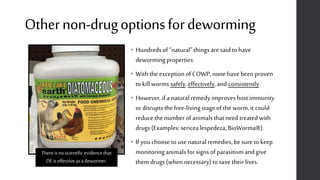
Thereisnoscientific evidence that
DEis effective asadewormer.
Treatment of other parasites
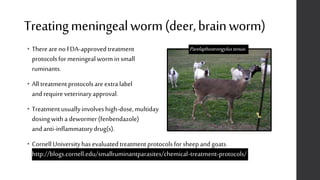
Treatingmeningealworm(deer,brainworm)
• Thereare noFDA-approvedtreatment
protocolsfor meningealworm insmall
ruminants.
• Alltreatmentprotocolsare extra label
andrequireveterinaryapproval.
• Treatmentusuallyinvolveshigh-dose,multiday
dosingwitha dewormer (fenbendazole)
and anti-inflammatorydrug(s).
• CornellUniversityhas evaluatedtreatmentprotocolsfor sheepand goats.
http://blogs.cornell.edu/smallruminantparasites/chemical-treatment-protocols/
Parelaphostrongylustenuis_
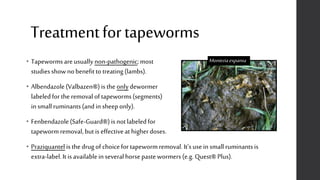
Treatmentfortapeworms
• Tapewormsare usually non-pathogenic;most
studiesshownobenefitto treating(lambs).
• Albendazole(Valbazen®)is the onlydewormer
labeledfor theremovaloftapeworms(segments)
insmallruminants(and insheeponly).
• Fenbendazole(Safe-Guard®)is notlabeledfor
tapewormremoval,butis effectiveat higherdoses.
• Praziquantel isthe drugof choicefor tapewormremoval. It’susein small ruminantsis
extra-label.It is availableinseveralhorsepastewormers (e.g.Quest®Plus).
Monieziaexpansa_
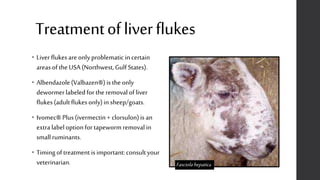
Treatmentofliverflukes
• Liver flukesare onlyproblematicincertain
areas of theUSA (Northwest,GulfStates).
• Albendazole(Valbazen®)is theonly
dewormerlabeledfor theremovalofliver
flukes(adultflukesonly)insheep/goats.
• Ivomec®Plus(ivermectin+ clorsulon)is an
extra labeloptionfor tapewormremovalin
smallruminants.
• Timingoftreatmentis important:consultyour
veterinarian. Fasciolahepatica_
Extra label drug use
ExtralabeldruguseintheUSA
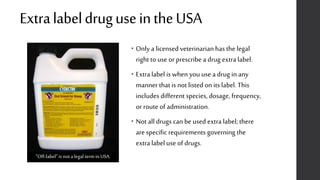
• Only a licensed veterinarian has the legal
right to use or prescribe a drug extra label.
• Extralabel is when you use a drug in any
manner that is not listed on its label. This
includes different species, dosage, frequency,
or route of administration.
• Not all drugs can be used extra label; there
are specific requirements governing the
extra label use of drugs.
“Off-label”is notalegal termin USA.
ExtralabeldruguseintheUSA
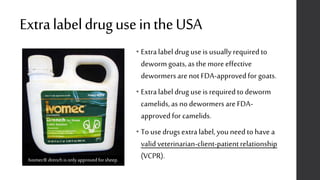
• Extralabeldrug use is usually required to
dewormgoats,as the moreeffective
dewormersare not FDA-approvedfor goats.
• Extralabeldrug use is required to deworm
camelids,as no dewormersare FDA-
approved for camelids.
• To use drugs extralabel, you need to have a
valid veterinarian-client-patientrelationship
(VCPR).Ivomec® drenchis onlyapprovedforsheep.
SUSAN SCHOENIAN
Sheep & Goat Specialist
University of Maryland Extension
sschoen@umd.edu | wormx.info | sheepandgoat.com
Thank you. Questions?

Deworming right

  • 1.
    Dewormingright SUSAN SCHOENIAN Sheep &Goat Specialist University of Maryland Extension sschoen@umd.edu | wormx.info | sheepandgoat.com
  • 2.
    Deworming • Dewormers area valuable,but limited resource. • Our goalshould be to minimize their use by relying on other strategies to control internal parasitism in our flocks/herds, such as pasture/grazing management and genetic selection. • However, when dewormingis required it should be done right.
  • 3.
    Goalsofdeworming • Therapeutic, notprophylactic. • Treat clinically-parasitized animals to save their lives, improve their welfare, and reduce production losses. • Need to do so in a manner that minimizes thedevelopmentof resistantworms.
  • 4.
  • 5.
    Whatisadewormer? • Drug thatkills or expels parasitic worms by starving or paralyzing them. • Must be selectively toxic to the worm(s) without harming the host. • Today’s dewormers are muchsafer and more powerful than older drugs or old-time remedies. • Also called anthelmintics.
  • 6.
    ThreedewormerclassesforsmallruminantsinUSA Thereiscross-resistanceamongdrugsinthesamegroupduetosimilarmodeofaction. 1 Benzimidazoles (white) 2 Macrocylic lactones 3 Thiabendazole– TBZ® Fenbendazole - Safe-Guard®, Panacur® Albendazole - Valbazen® Oxyfendazole - Synanthic® Avermectins Ivermectin - Ivomec® Doramectin - Dectomax® Eprinomectin - Eprinex® Milbimycins Moxidectin - Cydectin®, Quest® Imidazothiaoles (clear) Levamisole Prohibit®, Leva-Med® Tetrahydropyrimidines Morantel tartrate - Rumatel® Goat Dewormer, GoatCare, Positive Pellet 1960’s 1980-1990’s 1960’s
  • 7.
    DewormersFDA-approvedforsheep 1 Benzimidazoles Valbazen® 2 Macrocyliclactones 3 IMID/TETR Prohibit®,Leva- Med® Avermectins Ivomec® Milbimycins Cydectin® Adultworms     Immatureworms (L4)    Variable Hypobiotic larvae    Lung worms     Tapeworms segments Liver flukes adult Coccidia External parasites   Persistent activity  Perlabel Valbazen® Ivomec® Cydectin® Prohibit®,Leva- Med® Dosage 3 ml/100 lbs. 3 ml/26 lbs. 1 ml/11 lbs. Depends on dilution
  • 8.
    1 Benzimidazoles 3IMID/TETR Safe-Guard® Valbazen® Moranteltartrate Adult worms    Immatureworms (L4)   Hypobiotic larvae   Lungworms   Tapeworms not labeled  Liver flukes adult Coccidia External parasites Per label Safe-Guard® Valbazen® Morantel tartrate Dosage per 50lbs. 1.2 ml 2 ml Depends on product Meat withdrawal 6 days 7 days 30days Milk withdrawal NA NA 0 days DewormersFDA-approvedforgoats
  • 9.
    1 Benzimidazoles 2Macrocyliclactones 3 IMID/TETR Safe-Guard® Valbazen® Ivomec® Cydectin® Prohibit®,Leva-Med® Adult worms      Immatureworms (L4)     Variable Hypobiotic larvae     Lung worms      Tape worms segments segments Adult liver flukes adults Coccidia External parasites   Persistent activity  PerACSRPC(wormx.info) Safe-Guard® Valbazen® Ivomec® Cydectin® Prohibit®,Leva-Med® Dosage per 50lbs. 2.3 ml 4 ml 12ml 9 ml Depends on dilution Meat withdrawal 16days 9 days 14days 17days 4 days Milk withdrawal 4days 7days 9days 8days 3days Extra-labeldewormersforgoats
  • 10.
    1 Benzimidazoles 2Macrocyliclactones 3 IMID/TETR Safe-Guard® Valbazen® Ivomec® Cydectin® Prohibit®,Leva-Med® Adult worms      Immatureworms (L4)     Variable Hypobiotic larvae     Lung worms      Tape worms segments segments Adult liver flukes adults Coccidia External parasites   Persistent activity  PerACSRPC(wormx.info) Safe-Guard® Valbazen® Ivomec® Cydectin® Prohibit®,Leva-Med® Dosage per 50lbs. 4.5 4.0 11.4 9.0 Depends on dilution Extra-labeldewormersforcamelids
  • 11.
    Safety of dewormers Dewo rmer Label Restric tio ns A ppro x. safety m argins Sheep G o a t Fenbendazole Safe-Guard®suspension 500 NA Albendazole Valbazen®oralsuspension Pregnancy First 30days 20 NA Ivermectin Ivomec® oraldrench Otheranimals 30 NA Moxidectin Cydectin®oraldrench >4 monthsofage Otheranimals 5 NA Levamisole Prohibit®drench powder 3 4 Moranteltartrate 20 NA Human safety: avoid skin contact, wash hands after use Various sources, including parasitipedia.net
  • 12.
    Environmentalconsiderations Properdisposal • Preferablybyuse. • Ina sealedcontainer. • At approvedlandfillor byincineration. • Outofand away from waterways. • Whenused correctly,mostofthe dewormers havea low potentialfor environmental pollution. • Macrocycliclactones (endectocides)may adverselyaffectfishand certainaquatic species,bedetrimentalto dungbeetles,and reduceinsectdiversity. • However,MLs havereducedthe useof much moretoxicchemicals.
  • 13.
    How to reduceefficacy of dewormers • Use past expiration dates. • Store in open containers. • Too much exposure to light. • Store in extreme heat or in freezing temperatures. • Store where there is extreme temperature variation. • Allow contamination of drench solution. • Mix with other product(s) before administration.
  • 14.
  • 15.
    Whatis dewormer resistance? •Heritable ability of a worm to survive a dose of dewormer that should have killed it. • Exists in a population of worms if more than 5% of worms survive treatment. • Resistant genes are passed onto the next generation of worms.
  • 16.
    Dewormerresistance • May notbe noticed untilmore than50% of worms survive treatment, and treatmentfails to alleviateclinical disease. • Resistanceis generally thought to be permanent. • Resistanceis different in levamisole (autosomal recessive).
  • 17.
    StateofdewormerresistanceinUSA • Worms havedeveloped varying degrees of resistance to all dewormers and dewormer classes. • Resistance varies by geographic region and individual farm. • Many farms have resistance to multiple drugs. • The only way to know which drugs work on your farm is to test. 0 10 20 30 40 50 60 70 80 90 100 Benzimidazoles Ivermectin Moxidectin Levamisole All drugs Percent farms with anthelmintic resistance (< 95% FECR) 2008-2009 - Mid-Atlantic farms 2016-2017 - MD, VA & GA farms
  • 18.
    Twowaystotestfordewormerresistance Fecal egg countreduction test • Compare before and after fecal egg counts (before treatment and 10-14 days later). • Use individual or pooled samples from at least 10 animals for each dewormer you want to test. • Need a lot of animals to test all drugs. • Minimum FEC of 250 EPG. • Determines percent fecal egg count reduction • Cost varies. Can learn to do yourself. DrenchRite® larval development assay • Lab test that determines resistance to all dewormer groups simultaneously from a single pooled fecal sample from at least 8 animals. • Minimum FEC of 500 EPG. • Reports resistance, suspected resistance, and susceptibility (detects resistance sooner). • Identifies species of parasites from hatched larvae. • University of Georgia is only place that does test in North America (~$500 per sample) Note: New protocols arebeing developed forthe fecal egg count reduction test, which has beenthe “gold standard” for determining dewormer resistance.
  • 19.
    Practiceswhichacceleratedewormerresistance • Frequent deworming •Whole flock/herd treatments • Calendar-based treatments • Treat and move (to clean pasture) • Underdosing • Depositing drug in mouth instead of body cavity. • Persistent-activitydewormers • Pouring on dewormers • Injecting dewormers • Use of expired dewormers • Improper storage of dewormers
  • 20.
    Proper use ofdewormers
  • 22.
  • 23.
    Targetedselectivetreatment(TST) • Only dewormingthoseanimalswhich requiretreatmentorwouldbenefitmost from treatment. • Slows dewormerresistanceby reducing numberoftreatments andincreasing refugia. • Refugia are worms thathavenotbeen exposedtodewormer(s). • TST alsohelpsto identifyanimalswhich are more resistantandresilientto worms (and viceversa). Refugiais nowthe primarystrategy formaintainingdewormereffectiveness.
  • 24.
    Toolsfortargetedselectivetreatment(TST) For chute-sidedecision-making 1. FAMACHA©eye anemiasystem 2. Bodyconditionscore 3. FivePointCheck© 4. Performancefactors 5. Other combinedTST
  • 25.
    FAMACHA©eyeanemiasystem • Color eyechart that is used to determine level of anemia in animal;thus, need for deworming. • Anemia is primary symptom of barber pole worm (Haemonchuscontortus) infection. • Trainingis required to purchase a FAMACHA© card. Due to Covid 19, some universitiesare now offering online FAMACHA© certification (www.wormx.info/ workshops). Online certification has been available via University of Rhode Island for several years.FAMACHA© estimates PCV.
  • 26.
    FAMACHA©EyeAnemiaSystem Clinical Category Eye Lid Color Packed Cell Volume/PCV Treatment recommendation 1Red > 28 No 2 Red-Pink 23-27 No 3 Pink 18-22 ? 4 Pink-White 13-17 Yes 5 White < 12 Yes COVER PUSH PULL POP
  • 27.
    Bodyconditionscore(BCS) • Bodyconditionscore(BCS) isa measureof therelativefatnessof ananimal. • Low bodyconditionscore(<2)is indicative ofa nutritionissueandsuchanimalsare moreproneto parasiticinfection. • Variousstudieshaveshownbodycondition scoreto bea reliableindicatorofinternal parasitismin adult animals. • LeavingfemaleswithhigherBCS (>3) untreatedcanhelpto maintainrefugia. Body condition scoresrangefrom 1 to 5.
  • 28.
    FivePointCheck© 5.© • ExtensionofFAMACHA©system,whichisonlyusefulforblood-feedingparasites. • Usesfivecheck pointsonthe animal’sbodyto make dewormingdecisionsfor all parasites thatcommonlyaffectsmallruminants.Alsousefulfor determiningneed to deworm FAMACHA©3’s. 1. Eye(FAMACHA©score 2. Back (bodyconditionscore) 3. Tail(dagscore,fecalsoiling,scours) 4. Jaw (bottlejaw) 5. Nose(clear nasaldischarge) Coat condition(goats)
  • 29.
    Performanceasadewormingcriteria • Growthperformance Deworm anyanimalwhichfailsto reachperformancetarget(ADG) Example:theHappyFactor™ • Milk production Deworm higherproducing dairyfemales • Numberof offspring Deworm femaleswith 3 or moreoffspring.
  • 30.
    Periparturient females Any one •FAMACHA© > 4 • BCS < 2 • > 3 offspring • Yearlings,firsttime fresheners Growing lambs/kids FAMACHA© > 3 + ADG (performance target varies) Ewes/does FAMACHA > 4 + BCS < 2.5 + FEC (threshold varies)
  • 31.
    Whataboutfecaleggcounts(FEC)? • Fecal examsare NOT a reliable way to diagnose parasitic disease in individual animals; it is not their intended purpose. • There are no widely-accepted FEC thresholds for treatment. • While generally predictive, FEC is not always a good measure of the worm burden an animal is carrying. Correlations between FEC and FAMACHA© are not always high. • Instead, use FEC to 1) determine efficacy of dewormers, 2) monitor pasture contamination, and 3) identify more resistant (or susceptible) animals.
  • 32.
  • 33.
    Combination treatments • Itis now recommended that clinically- parasitized animalsbe given combination treatments. • A combination treatment is when you give more thanone dewormer (drug active) to kill the same worms. • The purpose of combination treatments is to killas many worms as possible. • Worms not killed by the first drug can be killed by the second (and third).
  • 34.
    Recommendations for combinationtreatments • Give most potent drug from each dewormer class. albendazole+ moxidectin+ levamisole (Valbazen® + Cydectin® + Prohibit®) • Give full dose of each dewormer. • Do not mix dewormers; they are not chemically compatible. • Use separate syringe/drench gun for each drug (ideally).Combination dewormers are not available in USA.
  • 35.
    Recommendations for combinationtreatments • Give dewormers sequentially, one after theother to get additive effect. • Observe withdrawal period of dewormer with longestwithdrawal. • ONLY give combinationtreatments to clinically-parasitizedanimals, as determinedby TST criteria. Do not give combination treatments to all animals!
  • 36.
    Non-drug options for“deworming”
  • 37.
    Copperoxidewireparticles(COWP) • Tiny metalrods of copper oxide. • Slow release, poorly absorbed form of copper. • Proven to be effective againstbarber pole worms (Haemonchuscontortus). • May increaseefficacy of treatment when given in combination with a dewormer, e.g. COWP + Valbazen® (USDA, 2020). • May be approved by some organic certifiers.
  • 38.
    DewormingwithCOWP • Availableas coppersupplements(boluses) for cattle(12.5and 25 g) andgoats (2 and 4 g). • Repackage larger bolusesintosmallerdoses for dewormingsheepandgoats. • Give smallesteffectivedose,usually0.5-1g for lambs/kidsand 1-2 g for matureanimals. • Selectivelytreat accordingto TSTguidelines. Usesafely. Monitor copperstatus (especially with sheep).
  • 39.
    Othernon-drugoptionsfordeworming • Hundreds of“natural” things are said to have deworming properties. • With the exception of COWP, none have been proven to kill worms safely, effectively,and consistently. • However,if a naturalremedyimproves host immunity or disrupts the free-livingstage of the worm,it could reduce the number of animals that need treatedwith drugs (Examples: sericealespedeza, BioWorma®). • If you choose to use naturalremedies, be sure to keep monitoring animals for signs of parasitismand give them drugs (when necessary) to save their lives. Thereisnoscientific evidence that DEis effective asadewormer.
  • 40.
  • 41.
    Treatingmeningealworm(deer,brainworm) • Thereare noFDA-approvedtreatment protocolsformeningealworm insmall ruminants. • Alltreatmentprotocolsare extra label andrequireveterinaryapproval. • Treatmentusuallyinvolveshigh-dose,multiday dosingwitha dewormer (fenbendazole) and anti-inflammatorydrug(s). • CornellUniversityhas evaluatedtreatmentprotocolsfor sheepand goats. http://blogs.cornell.edu/smallruminantparasites/chemical-treatment-protocols/ Parelaphostrongylustenuis_
  • 42.
    Treatmentfortapeworms • Tapewormsare usuallynon-pathogenic;most studiesshownobenefitto treating(lambs). • Albendazole(Valbazen®)is the onlydewormer labeledfor theremovaloftapeworms(segments) insmallruminants(and insheeponly). • Fenbendazole(Safe-Guard®)is notlabeledfor tapewormremoval,butis effectiveat higherdoses. • Praziquantel isthe drugof choicefor tapewormremoval. It’susein small ruminantsis extra-label.It is availableinseveralhorsepastewormers (e.g.Quest®Plus). Monieziaexpansa_
  • 43.
    Treatmentofliverflukes • Liver flukesareonlyproblematicincertain areas of theUSA (Northwest,GulfStates). • Albendazole(Valbazen®)is theonly dewormerlabeledfor theremovalofliver flukes(adultflukesonly)insheep/goats. • Ivomec®Plus(ivermectin+ clorsulon)is an extra labeloptionfor tapewormremovalin smallruminants. • Timingoftreatmentis important:consultyour veterinarian. Fasciolahepatica_
  • 44.
  • 45.
    ExtralabeldruguseintheUSA • Only alicensed veterinarian has the legal right to use or prescribe a drug extra label. • Extralabel is when you use a drug in any manner that is not listed on its label. This includes different species, dosage, frequency, or route of administration. • Not all drugs can be used extra label; there are specific requirements governing the extra label use of drugs. “Off-label”is notalegal termin USA.
  • 46.
    ExtralabeldruguseintheUSA • Extralabeldrug useis usually required to dewormgoats,as the moreeffective dewormersare not FDA-approvedfor goats. • Extralabeldrug use is required to deworm camelids,as no dewormersare FDA- approved for camelids. • To use drugs extralabel, you need to have a valid veterinarian-client-patientrelationship (VCPR).Ivomec® drenchis onlyapprovedforsheep.
  • 47.
    SUSAN SCHOENIAN Sheep &Goat Specialist University of Maryland Extension sschoen@umd.edu | wormx.info | sheepandgoat.com Thank you. Questions?