WELCOME
DECISION MAKING
INTRODUCTION
Choose always the way that seems the best,
however rough it may be. Custom will soon render it
easy and agreeable. -Pythagoras
DEFINITION
Decision making can be regarded as the mental
processes (cognitive process) resulting in the
selection of a course of action among several
alternatives.
STAGES OF DECISION MAKING
Developed by B. Aubrey Fisher, there are four stages that should be involved in all
group decision making
Orientation stage- This phase is where members meet for the first
time and start to get to know each other.
Conflict stage- Once group members become familiar with each
other, disputes, little fights and arguments occur. Group members
eventually work it out.
Emergence stage- The group begins to clear up ambigiuity in
opinions is talked about.
Reinforcement stage- Members finally make a decision, while
justifying themselves that it was the right decision.
PRINCIPLES OF DECISION
MAKING
1.Purpose-Driven
2.Inclusive, Not Exclusive
3.Educational
4.Voluntary
5.Self-Designed
6.Flexible
7.Egalitarian
8. Respectful
9.Accountable
10.Time Limited
11. Achievable
STEPS IN DECISION MAKING
1. Establishing
goal and
objectives
2. Making the
diagnosis
3. Analyzing
the problem
4. Searching
alternative
solution
5. Selecting the
best possible
solution
6. Putting the
decision into
effect
7. Following
up the decision
MODELS OF DECISION MAKING
1. The 9 step decision making model
2. Information Processing Model
3. Wheeler’s Model
4. Nursing Process
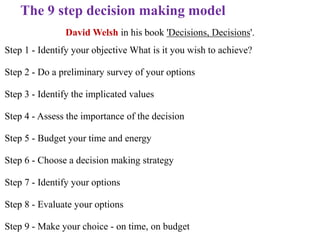
The 9 step decision making model
David Welsh in his book 'Decisions, Decisions'.
Step 1 - Identify your objective What is it you wish to achieve?
Step 2 - Do a preliminary survey of your options
Step 3 - Identify the implicated values
Step 4 - Assess the importance of the decision
Step 5 - Budget your time and energy
Step 6 - Choose a decision making strategy
Step 7 - Identify your options
Step 8 - Evaluate your options
Step 9 - Make your choice - on time, on budget
INFORMATION PROCESSING MODEL
Thompson, 1999
This model consists of two components:
Short-term
memory Long-term
memory
Short-term memory contains the stimuli information necessary to
“unlock” factual.
Experimental knowledge that is stored in the long-term memory
The clinician uses a four-stage process to make decisions in this theory:
1. Gather clinical patient data.
2. Generate hypotheses or predictions about the issue.
3. Interpret the data and confirm or refute the hypotheses.
4. Weigh the pros and cons of each decision alternative.
WHEELER’S MODEL
Wheeler (2000) suggests that having choices and
knowing the context in which choices are made are the most
important elements of proactive decision making. Being
proactive allows the anticipation of an event and allows one to
generate actions before the event.
NURSING PROCESS
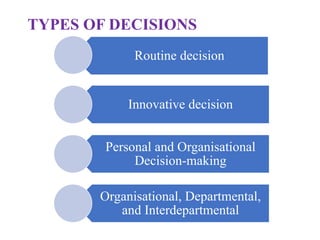
TYPES OF DECISIONS
Routine decision
Innovative decision
Personal and Organisational
Decision-making
Organisational, Departmental,
and Interdepartmental
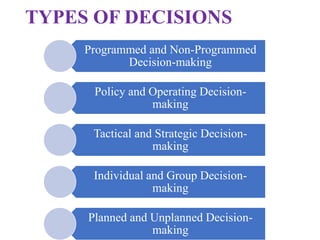
TYPES OF DECISIONS
Programmed and Non-Programmed
Decision-making
Policy and Operating Decision-
making
Tactical and Strategic Decision-
making
Individual and Group Decision-
making
Planned and Unplanned Decision-
making
Innovative decisions are
made when the situation
or problem is unusual
and the rules and
guidelines do not clearly
define or dictate a
course of action
Routine decisions can
be used to respond to
frequently occurring,
common, and
reasonably well-
defined issues
ORGANISATIONAL,
DEPARTMENTAL, AND
INTERDEPARTMENTAL
DECISION-MAKING
Organisational decisions affect the entire organisation;
departmental decisions concern specific departments;
interdepartmental decisions involve collaboration between
multiple departments for integrated solutions.
PROGRAMMED AND NON-
PROGRAMMED DECISION-
MAKING
Programmed decisions follow established routines or
guidelines, while non-programmed decisions are unique and
require custom approaches for novel situations.
POLICY AND OPERATING
DECISION-MAKING
Policy decisions set the general course of action while
operating decisions guide daily activities to achieve policy
objectives.
TACTICALAND STRATEGIC
DECISION-MAKING
Tactical decisions focus on short- to medium-term
goals within specific areas, while strategic decisions
encompass long-term planning and shape the organisation’s
overall direction.
ROUTINE AND BASIC
DECISION-MAKING
Routine decisions involve repetitive tasks and follow
established protocols, whereas basic decisions deal with
common situations but require some analysis or judgment
INDIVIDUAL AND GROUP
DECISION-MAKING
One person makes individual decisions, while group
decisions involve collective input and consensus-building
among team members.
PLANNED AND UNPLANNED
DECISION-MAKING
Planned decisions are part of a predetermined
process or strategy, whereas unplanned decisions
arise unexpectedly in response to unforeseen
circumstances.
TOOLS FOR MAKING DECISION:
1. Traditional model is a seven step process:
2. Managerial model
1. Set the
objectives
2. Search for
alternatives
3. Evaluate
alternatives 4. Choose an
alternative
5. Implement
6. Follow
up
7. Control the
outcomes
SPECIFIC DECISION-MAKING
TOOLS
1. Pros & Cons
2. SWOT
Analysis
3. 2X2 Matrix
1. Pros and Cons
A simple strategy is to make a list with one side labeled
“Pro (or Advantages)” and the other side “Con (or
Disadvantages).”
2. SWOT Analysis
Once the problem has been identified, the SWOT analysis can
be extremely useful for decision making.
S – Strengths
O – Opportunities
W – Weaknesses
T – Threats
3. 2X2 Matrix
Similar to the SWOT approach is the use of a 2X2
matrix. The 2X2 matrix is a relatively simple way to visualize
issues or concerns. It conveys the choices available in
relationship to a goal. According to Lowy and Hood (2004),
the x and y axes are used to clarify issues; a complicated
situation can be reframed to allow everyone to understand all
aspects of the issue.
TECHNIQUES OF DECISION MAKING
A.
Judgmental
technique
B.
Operational
research
technique
C. Delphi
technique
D. Decision
tree
A. Judgemental technique:
This is the oldest technique of decision making and is
subjective in nature. As it is based on past experiences or
intuition about future, it is frequently used for making
routine decisions. It is cheap and can be quickly done. But it is
hazardous as there is chance of taking a wrong decision. So
this technique is rarely used in large capital comminments.
B. Operational research technique:
It is the analysis of decision problem using scientific method to provide
manager the need quantitative information in making decision. Steps of
operational research are:
 Construction of a mathematical model that pin points the important
factors in the situation.
Definition of criteria to be used for comparing the relative merits of
various possible courses of action
Procuring empirical estimates of the numerical parameters in the model
that specify the particular situation to which it is applied.
Carrying out through the mathematical process of finding and series of
action which will give optimum solution
C. Delphi technique:
The Delphi method is a systematic, interactive forecasting
method which relies on a panel of experts. The experts answer
questionnaires in two or more rounds. After each round, a
facilitator provides an anonymous summary of the experts’
forecasts from the previous round as well as the reasons they
provided for their judgments.
D. Decision trees:
A decision tree is a graphic method that can help the
supervisor in visualizing the alternative available, outcomes,
risks and information for a specific needs for a specific
problem over a period of time. It helps her to see the possible
directions that action may take from each decision point and to
evaluate the consequences of a series of decisions.
THEORIES OF DECISION MAKING
1. Marginal theory
This theory stress on profit maximization. this theory
focused on increases profit from the decision. It related to
health care cost and patient outcome
2. Psychological theory
The trust of this theory is on the maximization of
customer satisfaction (patient). The manager acts as a
administrative man rather than economic man
CONT…
3. Mathematic theory
This theory is based on the use of models. This is also known as
operational research theory. The techniques generally used include linear
programming. Theory of probability stimulation models etc
4. Classical decision theory
Views the decision maker as acting world of complete certain
Classical decision making faces a clearly defined problem. Knows all
possible action alternative and their consequences
Choose the optimum alternative
CONT…
5. Behavioural decision theory
Accepts a world with bounded rationality and views the decision maker as
acting only in terms of what he/she perceive about a given situation
The behaviour decision maker faces a problem that is not clearly defined .
has limited knowledge of possible action alternatives and their consequences
6. Statistical decision theory
Several statistical tools and methods are available to organize evidence,
evaluate risks, and aid in decision making. The risks of Type I and type II errors
can be quantified (estimated probability, cost, expected value, etc.) and rational
decision making is improved
STRATEGIC DECISION-
MAKING STYLES
1. Psychological
2.Cognitive
3. Normative
STRATEGIC DECISION-MAKING
STYLES
1. Psychological
This style considers emotional and intuitive factors in decision-making.
Managers use their instincts, emotions, and personal experiences to make choices.
While it can lead to innovative solutions, it might also introduce bias.
2. Cognitive
The cognitive style emphasises rational and logical thinking. Managers analyse
data, facts, and evidence to arrive at decisions. It promotes objective choices but
might overlook qualitative aspects.
3. Normative
The normative style follows established norms, rules, and procedures.
Decisions are made based on accepted standards and practices, ensuring consistency
and conformity.
FACTORS AFFECTING THE DECISION-
MAKING PROCESS
FACTORS
Experience
and
knowledge
Creative
thinking
Self-Concept
Interpersonal
Conflict
Inadequate
Staffing
SOME COMMON MISTAKES THAT DECISION
MAKERS SHOULD BE AWARE OF INCLUDE:
 Only hearing and seeing what we want. Each individual has their own unique set of
preferences or biases which blinker them to certain information. The best way to deal
with this problem is to identify your preferences and biases whilst attempting to be
open to the information around you.
 Placing too great a reliance on the information you receive from others. Often we
rely on certain individuals to provide support and guidance. This may be a suitable
course of action in many cases.
 Ignoring your intuition. On many occasions we are actually aware at a subconscious
level of the correct course of action. Unfortunately, we often tend to ignore our
intuition.
DIFFICULTIES IN DECISION-
MAKING PROCESS
Incomplete Information
Uncertainty and Risk
Cognitive Biases
Time Constraints
Complexity
Resistance to Change
Group Dynamics
Conflicting Interests
Ethical Dilemmas
DIFFICULTIES IN DECISION-
MAKING PROCESS
• Incomplete Information: Insufficient data can hinder analysis and lead to flawed
decisions.
• Uncertainty and Risk: Unpredictable outcomes make confident choices challenging.
• Cognitive Biases: Biases cloud judgment, leading to flawed decisions.
• Complexity: Intricate factors and options complicate decision-making.
• Time Constraints: Limited timeframes force rushed decisions.
• Conflicting Interests: Diverse stakeholder interests hinder consensus.
• Group Dynamics: Conflicts and conformity pressures affect group decisions.
• Resistance to Change: Change introduces resistance to decisions.
• Ethical Dilemmas: Moral considerations complicate choices.
DECENTRALIZATION
INTRODUCTION
Decentralization is the division of activities by forming
departments. In nursing service, departmentalization aims on
attaining a better quality of patient care through benefits
derived from specialist nurses. Departmentalization aims to
provide better arrangements, control of facilities, equipments
and materials required to perform the necessary service.
DEFINITION
Decentralization is the dispersion or delegation of
responsibilities and the authority to lower levels of an
organization. Institution makes use of both centralization &
decentralization. Top management needs a positive attitude
towards decentralization and they need competent personal to
whom they can delegate authority.
BASIC PRINCIPLES
• To relieve the burden of work on the chief executive.
• To develop the managerial faculties.
• To motivate the lower level of workers.
• To take quick and appropriate decision at the level
which it is really required with a view of exploiting the
opportunity available and
• To reduce the communication work and fill the gap in
communication, if any.
DECENTRALIZED
STRUCTURE
The decentralized structure is flat in nature and organizational
power is spread out throughout the structure. These are few
layers in the reporting structure, and managers have a broad
span of control. Communication patterns are simplified and
problems tend to be addressed with ease and efficiency at the
level at which they occur. Employees have autonomy and
increased job satisfaction within this type of structure.
ADVANTAGES OF
DECENTRALIZATION
Advantages:
The advantages of decentralization are as follows:
1. Relieves top manager from burden of managing.
2. Encourages subordinates to undertake responsibility.
3. More freedom to managers.
4. Increases motivation of subordinates.
5. Enhances competition among various departments/units.
6. Helps setting up of profit centres.
7. Promotes development of general managers.
8. Prepares mangers for rapid change in the organization.
LIMITATIONS
The limitations of decentralization are as follows:
1. Maintenance of uniform policy throughout organization becomes
difficult.
2. Increases complexity of coordination.
3. May lead to loss of control by superior level managers.
4. May be limited by inadequate control techniques.
5. May be constrained by inadequate planning.
6. Limited by inadequate training.
7. Limited by inadequate number of qualified personnel at lower level.
8. It may be limited by external factors like; government regulations,
taxation policy of government, etc.
THANKYOU

decision making and decentralization.pptx

  • 1.
  • 2.
  • 3.
    INTRODUCTION Choose always theway that seems the best, however rough it may be. Custom will soon render it easy and agreeable. -Pythagoras
  • 4.
    DEFINITION Decision making canbe regarded as the mental processes (cognitive process) resulting in the selection of a course of action among several alternatives.
  • 5.
    STAGES OF DECISIONMAKING Developed by B. Aubrey Fisher, there are four stages that should be involved in all group decision making Orientation stage- This phase is where members meet for the first time and start to get to know each other. Conflict stage- Once group members become familiar with each other, disputes, little fights and arguments occur. Group members eventually work it out. Emergence stage- The group begins to clear up ambigiuity in opinions is talked about. Reinforcement stage- Members finally make a decision, while justifying themselves that it was the right decision.
  • 6.
    PRINCIPLES OF DECISION MAKING 1.Purpose-Driven 2.Inclusive,Not Exclusive 3.Educational 4.Voluntary 5.Self-Designed 6.Flexible 7.Egalitarian 8. Respectful 9.Accountable 10.Time Limited 11. Achievable
  • 7.
    STEPS IN DECISIONMAKING 1. Establishing goal and objectives 2. Making the diagnosis 3. Analyzing the problem 4. Searching alternative solution 5. Selecting the best possible solution 6. Putting the decision into effect 7. Following up the decision
  • 8.
    MODELS OF DECISIONMAKING 1. The 9 step decision making model 2. Information Processing Model 3. Wheeler’s Model 4. Nursing Process
  • 9.
    The 9 stepdecision making model David Welsh in his book 'Decisions, Decisions'. Step 1 - Identify your objective What is it you wish to achieve? Step 2 - Do a preliminary survey of your options Step 3 - Identify the implicated values Step 4 - Assess the importance of the decision Step 5 - Budget your time and energy Step 6 - Choose a decision making strategy Step 7 - Identify your options Step 8 - Evaluate your options Step 9 - Make your choice - on time, on budget
  • 10.
    INFORMATION PROCESSING MODEL Thompson,1999 This model consists of two components: Short-term memory Long-term memory
  • 11.
    Short-term memory containsthe stimuli information necessary to “unlock” factual. Experimental knowledge that is stored in the long-term memory The clinician uses a four-stage process to make decisions in this theory: 1. Gather clinical patient data. 2. Generate hypotheses or predictions about the issue. 3. Interpret the data and confirm or refute the hypotheses. 4. Weigh the pros and cons of each decision alternative.
  • 12.
    WHEELER’S MODEL Wheeler (2000)suggests that having choices and knowing the context in which choices are made are the most important elements of proactive decision making. Being proactive allows the anticipation of an event and allows one to generate actions before the event.
  • 13.
  • 14.
    TYPES OF DECISIONS Routinedecision Innovative decision Personal and Organisational Decision-making Organisational, Departmental, and Interdepartmental
  • 15.
    TYPES OF DECISIONS Programmedand Non-Programmed Decision-making Policy and Operating Decision- making Tactical and Strategic Decision- making Individual and Group Decision- making Planned and Unplanned Decision- making
  • 16.
    Innovative decisions are madewhen the situation or problem is unusual and the rules and guidelines do not clearly define or dictate a course of action Routine decisions can be used to respond to frequently occurring, common, and reasonably well- defined issues
  • 17.
    ORGANISATIONAL, DEPARTMENTAL, AND INTERDEPARTMENTAL DECISION-MAKING Organisational decisionsaffect the entire organisation; departmental decisions concern specific departments; interdepartmental decisions involve collaboration between multiple departments for integrated solutions.
  • 18.
    PROGRAMMED AND NON- PROGRAMMEDDECISION- MAKING Programmed decisions follow established routines or guidelines, while non-programmed decisions are unique and require custom approaches for novel situations.
  • 19.
    POLICY AND OPERATING DECISION-MAKING Policydecisions set the general course of action while operating decisions guide daily activities to achieve policy objectives.
  • 20.
    TACTICALAND STRATEGIC DECISION-MAKING Tactical decisionsfocus on short- to medium-term goals within specific areas, while strategic decisions encompass long-term planning and shape the organisation’s overall direction.
  • 21.
    ROUTINE AND BASIC DECISION-MAKING Routinedecisions involve repetitive tasks and follow established protocols, whereas basic decisions deal with common situations but require some analysis or judgment
  • 22.
    INDIVIDUAL AND GROUP DECISION-MAKING Oneperson makes individual decisions, while group decisions involve collective input and consensus-building among team members.
  • 23.
    PLANNED AND UNPLANNED DECISION-MAKING Planneddecisions are part of a predetermined process or strategy, whereas unplanned decisions arise unexpectedly in response to unforeseen circumstances.
  • 24.
    TOOLS FOR MAKINGDECISION: 1. Traditional model is a seven step process:
  • 25.
    2. Managerial model 1.Set the objectives 2. Search for alternatives 3. Evaluate alternatives 4. Choose an alternative 5. Implement 6. Follow up 7. Control the outcomes
  • 26.
    SPECIFIC DECISION-MAKING TOOLS 1. Pros& Cons 2. SWOT Analysis 3. 2X2 Matrix
  • 27.
    1. Pros andCons A simple strategy is to make a list with one side labeled “Pro (or Advantages)” and the other side “Con (or Disadvantages).”
  • 28.
    2. SWOT Analysis Oncethe problem has been identified, the SWOT analysis can be extremely useful for decision making. S – Strengths O – Opportunities W – Weaknesses T – Threats
  • 29.
    3. 2X2 Matrix Similarto the SWOT approach is the use of a 2X2 matrix. The 2X2 matrix is a relatively simple way to visualize issues or concerns. It conveys the choices available in relationship to a goal. According to Lowy and Hood (2004), the x and y axes are used to clarify issues; a complicated situation can be reframed to allow everyone to understand all aspects of the issue.
  • 30.
    TECHNIQUES OF DECISIONMAKING A. Judgmental technique B. Operational research technique C. Delphi technique D. Decision tree
  • 31.
    A. Judgemental technique: Thisis the oldest technique of decision making and is subjective in nature. As it is based on past experiences or intuition about future, it is frequently used for making routine decisions. It is cheap and can be quickly done. But it is hazardous as there is chance of taking a wrong decision. So this technique is rarely used in large capital comminments.
  • 32.
    B. Operational researchtechnique: It is the analysis of decision problem using scientific method to provide manager the need quantitative information in making decision. Steps of operational research are:  Construction of a mathematical model that pin points the important factors in the situation. Definition of criteria to be used for comparing the relative merits of various possible courses of action Procuring empirical estimates of the numerical parameters in the model that specify the particular situation to which it is applied. Carrying out through the mathematical process of finding and series of action which will give optimum solution
  • 33.
    C. Delphi technique: TheDelphi method is a systematic, interactive forecasting method which relies on a panel of experts. The experts answer questionnaires in two or more rounds. After each round, a facilitator provides an anonymous summary of the experts’ forecasts from the previous round as well as the reasons they provided for their judgments.
  • 34.
    D. Decision trees: Adecision tree is a graphic method that can help the supervisor in visualizing the alternative available, outcomes, risks and information for a specific needs for a specific problem over a period of time. It helps her to see the possible directions that action may take from each decision point and to evaluate the consequences of a series of decisions.
  • 35.
    THEORIES OF DECISIONMAKING 1. Marginal theory This theory stress on profit maximization. this theory focused on increases profit from the decision. It related to health care cost and patient outcome 2. Psychological theory The trust of this theory is on the maximization of customer satisfaction (patient). The manager acts as a administrative man rather than economic man
  • 36.
    CONT… 3. Mathematic theory Thistheory is based on the use of models. This is also known as operational research theory. The techniques generally used include linear programming. Theory of probability stimulation models etc 4. Classical decision theory Views the decision maker as acting world of complete certain Classical decision making faces a clearly defined problem. Knows all possible action alternative and their consequences Choose the optimum alternative
  • 37.
    CONT… 5. Behavioural decisiontheory Accepts a world with bounded rationality and views the decision maker as acting only in terms of what he/she perceive about a given situation The behaviour decision maker faces a problem that is not clearly defined . has limited knowledge of possible action alternatives and their consequences 6. Statistical decision theory Several statistical tools and methods are available to organize evidence, evaluate risks, and aid in decision making. The risks of Type I and type II errors can be quantified (estimated probability, cost, expected value, etc.) and rational decision making is improved
  • 38.
    STRATEGIC DECISION- MAKING STYLES 1.Psychological 2.Cognitive 3. Normative
  • 39.
    STRATEGIC DECISION-MAKING STYLES 1. Psychological Thisstyle considers emotional and intuitive factors in decision-making. Managers use their instincts, emotions, and personal experiences to make choices. While it can lead to innovative solutions, it might also introduce bias. 2. Cognitive The cognitive style emphasises rational and logical thinking. Managers analyse data, facts, and evidence to arrive at decisions. It promotes objective choices but might overlook qualitative aspects. 3. Normative The normative style follows established norms, rules, and procedures. Decisions are made based on accepted standards and practices, ensuring consistency and conformity.
  • 40.
    FACTORS AFFECTING THEDECISION- MAKING PROCESS FACTORS Experience and knowledge Creative thinking Self-Concept Interpersonal Conflict Inadequate Staffing
  • 41.
    SOME COMMON MISTAKESTHAT DECISION MAKERS SHOULD BE AWARE OF INCLUDE:  Only hearing and seeing what we want. Each individual has their own unique set of preferences or biases which blinker them to certain information. The best way to deal with this problem is to identify your preferences and biases whilst attempting to be open to the information around you.  Placing too great a reliance on the information you receive from others. Often we rely on certain individuals to provide support and guidance. This may be a suitable course of action in many cases.  Ignoring your intuition. On many occasions we are actually aware at a subconscious level of the correct course of action. Unfortunately, we often tend to ignore our intuition.
  • 42.
    DIFFICULTIES IN DECISION- MAKINGPROCESS Incomplete Information Uncertainty and Risk Cognitive Biases Time Constraints Complexity Resistance to Change Group Dynamics Conflicting Interests Ethical Dilemmas
  • 43.
    DIFFICULTIES IN DECISION- MAKINGPROCESS • Incomplete Information: Insufficient data can hinder analysis and lead to flawed decisions. • Uncertainty and Risk: Unpredictable outcomes make confident choices challenging. • Cognitive Biases: Biases cloud judgment, leading to flawed decisions. • Complexity: Intricate factors and options complicate decision-making. • Time Constraints: Limited timeframes force rushed decisions. • Conflicting Interests: Diverse stakeholder interests hinder consensus. • Group Dynamics: Conflicts and conformity pressures affect group decisions. • Resistance to Change: Change introduces resistance to decisions. • Ethical Dilemmas: Moral considerations complicate choices.
  • 44.
  • 45.
    INTRODUCTION Decentralization is thedivision of activities by forming departments. In nursing service, departmentalization aims on attaining a better quality of patient care through benefits derived from specialist nurses. Departmentalization aims to provide better arrangements, control of facilities, equipments and materials required to perform the necessary service.
  • 47.
    DEFINITION Decentralization is thedispersion or delegation of responsibilities and the authority to lower levels of an organization. Institution makes use of both centralization & decentralization. Top management needs a positive attitude towards decentralization and they need competent personal to whom they can delegate authority.
  • 48.
    BASIC PRINCIPLES • Torelieve the burden of work on the chief executive. • To develop the managerial faculties. • To motivate the lower level of workers. • To take quick and appropriate decision at the level which it is really required with a view of exploiting the opportunity available and • To reduce the communication work and fill the gap in communication, if any.
  • 49.
    DECENTRALIZED STRUCTURE The decentralized structureis flat in nature and organizational power is spread out throughout the structure. These are few layers in the reporting structure, and managers have a broad span of control. Communication patterns are simplified and problems tend to be addressed with ease and efficiency at the level at which they occur. Employees have autonomy and increased job satisfaction within this type of structure.
  • 51.
    ADVANTAGES OF DECENTRALIZATION Advantages: The advantagesof decentralization are as follows: 1. Relieves top manager from burden of managing. 2. Encourages subordinates to undertake responsibility. 3. More freedom to managers. 4. Increases motivation of subordinates. 5. Enhances competition among various departments/units. 6. Helps setting up of profit centres. 7. Promotes development of general managers. 8. Prepares mangers for rapid change in the organization.
  • 52.
    LIMITATIONS The limitations ofdecentralization are as follows: 1. Maintenance of uniform policy throughout organization becomes difficult. 2. Increases complexity of coordination. 3. May lead to loss of control by superior level managers. 4. May be limited by inadequate control techniques. 5. May be constrained by inadequate planning. 6. Limited by inadequate training. 7. Limited by inadequate number of qualified personnel at lower level. 8. It may be limited by external factors like; government regulations, taxation policy of government, etc.
  • 53.