Decision making is the process of sufficiently
reducing uncertainty and doubt about
alternatives to allow a reasonable choice to be
made from among them. ...
Decisions whether.
Decision making is the study of identifying
and choosing alternatives based on the values
and preferences of the decision maker.
A decision is the selection of a course of action (or
decision) out of many available alternatives. The
marketing manager may be arrived to a particular
decision by analyzing, evaluating and carefully planning.
The decision making is the basic and fundamental key of
all managerial activities. It is the study of identifying and
choosing best possible choice (or option) based on the
values and preferences of the business organization.
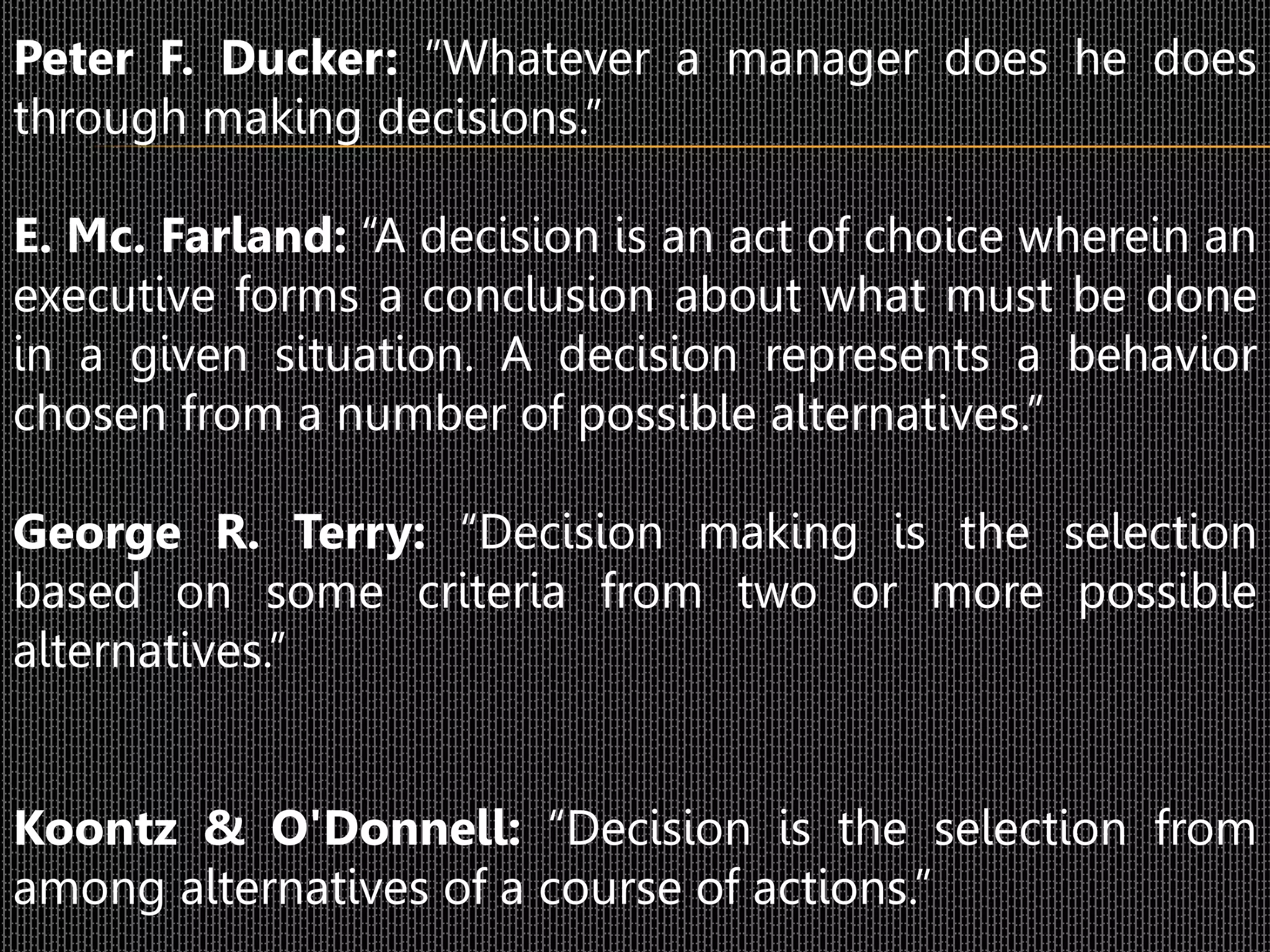
Peter F. Ducker: “Whatever a manager does he does
through making decisions.”
E. Mc. Farland: “A decision is an act of choice wherein an
executive forms a conclusion about what must be done
in a given situation. A decision represents a behavior
chosen from a number of possible alternatives.”
George R. Terry: “Decision making is the selection
based on some criteria from two or more possible
alternatives.”
Koontz & O'Donnell: “Decision is the selection from
among alternatives of a course of actions.”
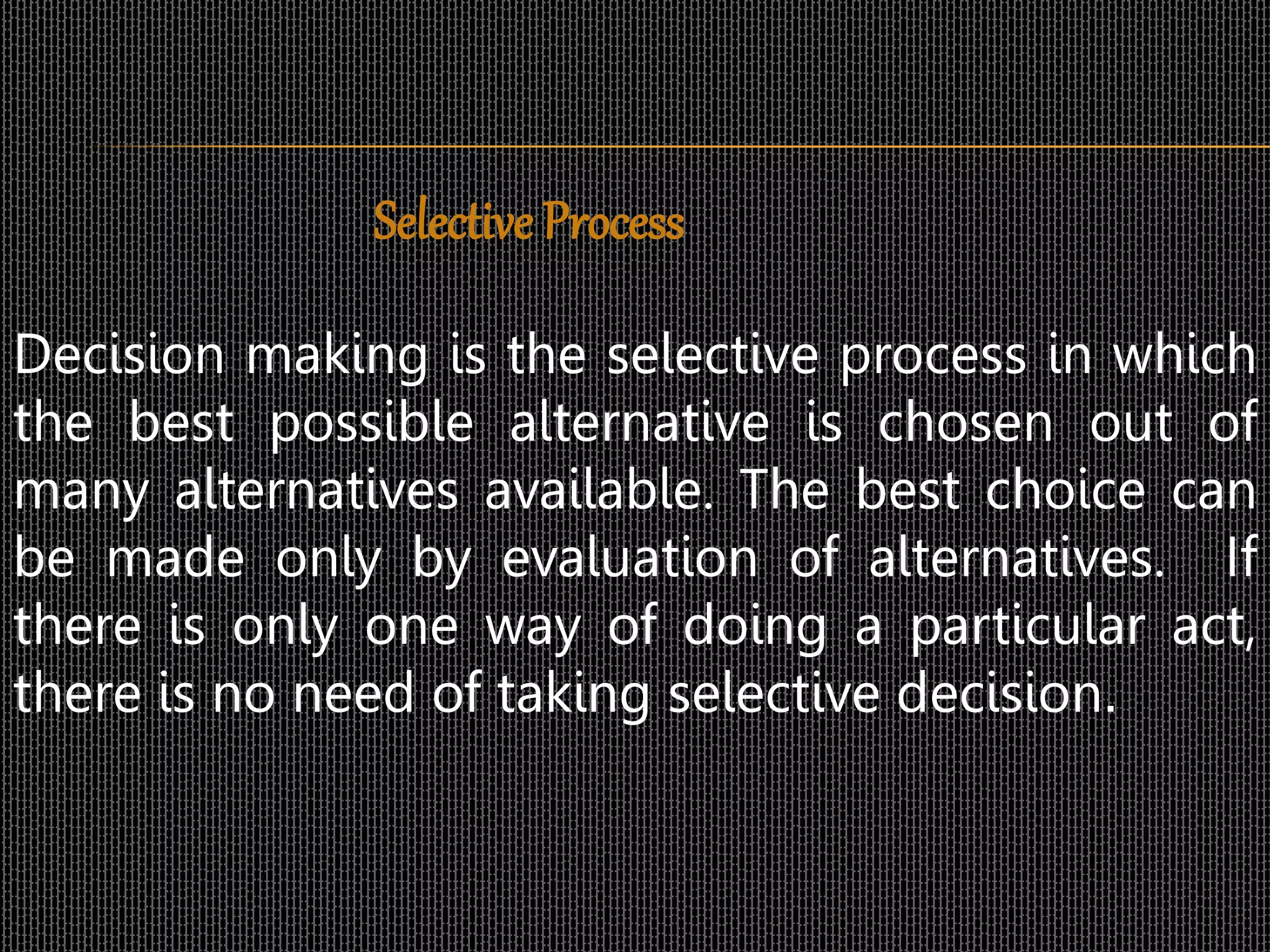
Selective Process
Decision making is the selective process in which
the best possible alternative is chosen out of
many alternatives available. The best choice can
be made only by evaluation of alternatives. If
there is only one way of doing a particular act,
there is no need of taking selective decision.
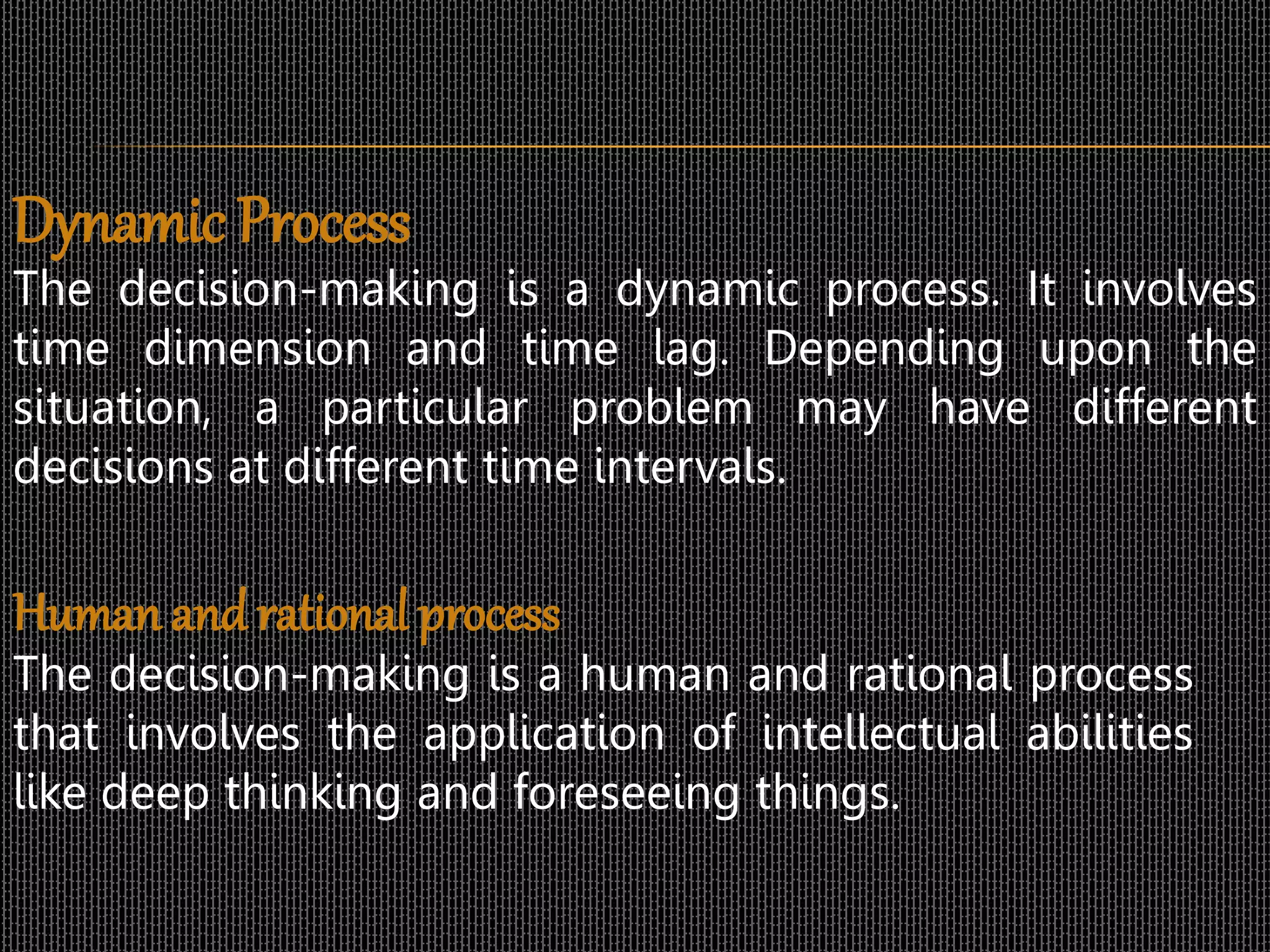
Dynamic Process
The decision-making is a dynamic process. It involves
time dimension and time lag. Depending upon the
situation, a particular problem may have different
decisions at different time intervals.
Human andrational process
The decision-making is a human and rational process
that involves the application of intellectual abilities
like deep thinking and foreseeing things.
Continuous Process
Decision making is a continuous process which
goes on through the life of an organization. It is
a process of taking a decision, implementing it,
following the variations and taking the actions
to remove these variations. In other words, it is
a never ending activity in business
management.
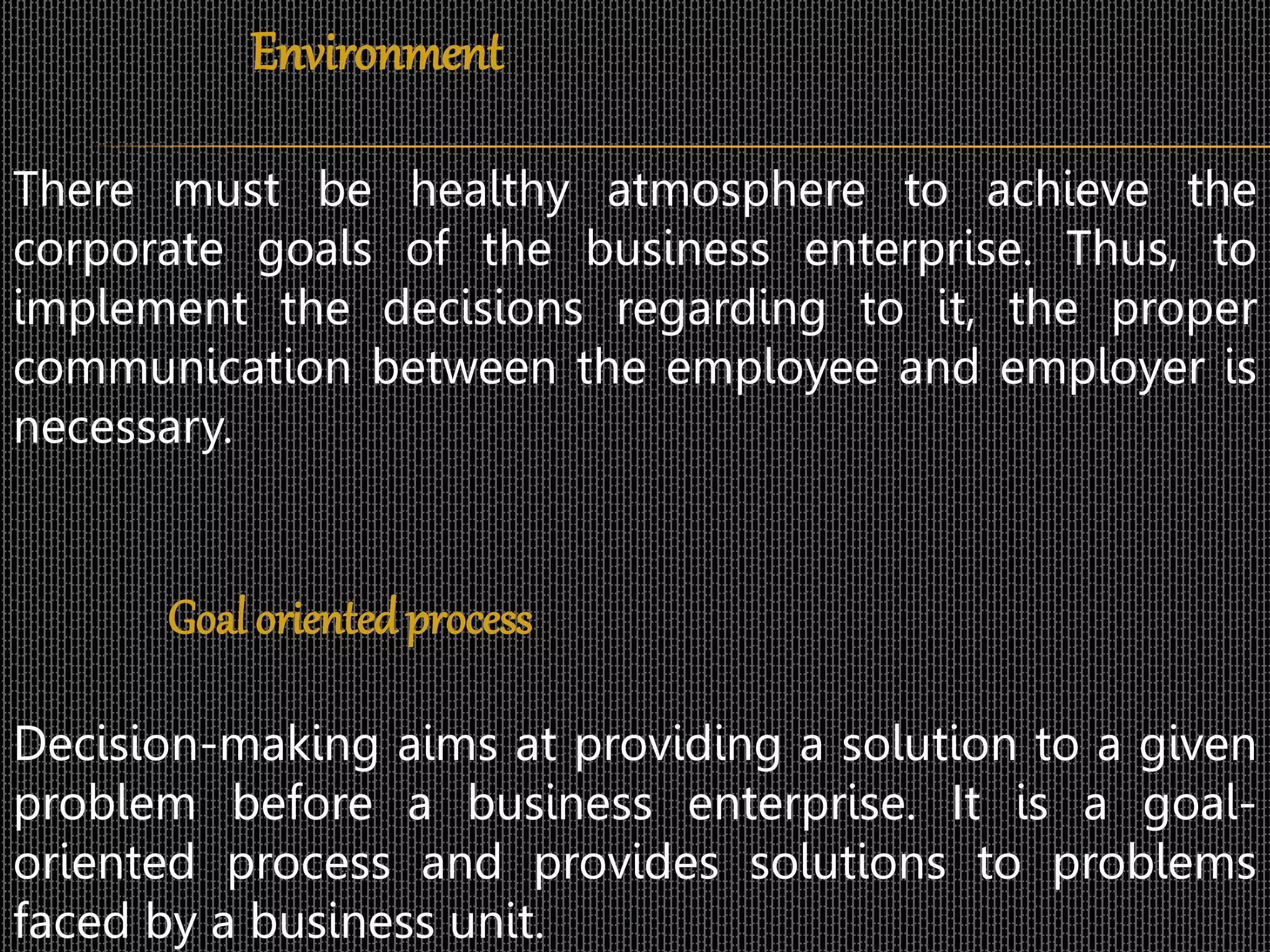
Environment
There must be healthy atmosphere to achieve the
corporate goals of the business enterprise. Thus, to
implement the decisions regarding to it, the proper
communication between the employee and employer is
necessary.
Goal orientedprocess
Decision-making aims at providing a solution to a given
problem before a business enterprise. It is a goal-
oriented process and provides solutions to problems
faced by a business unit.
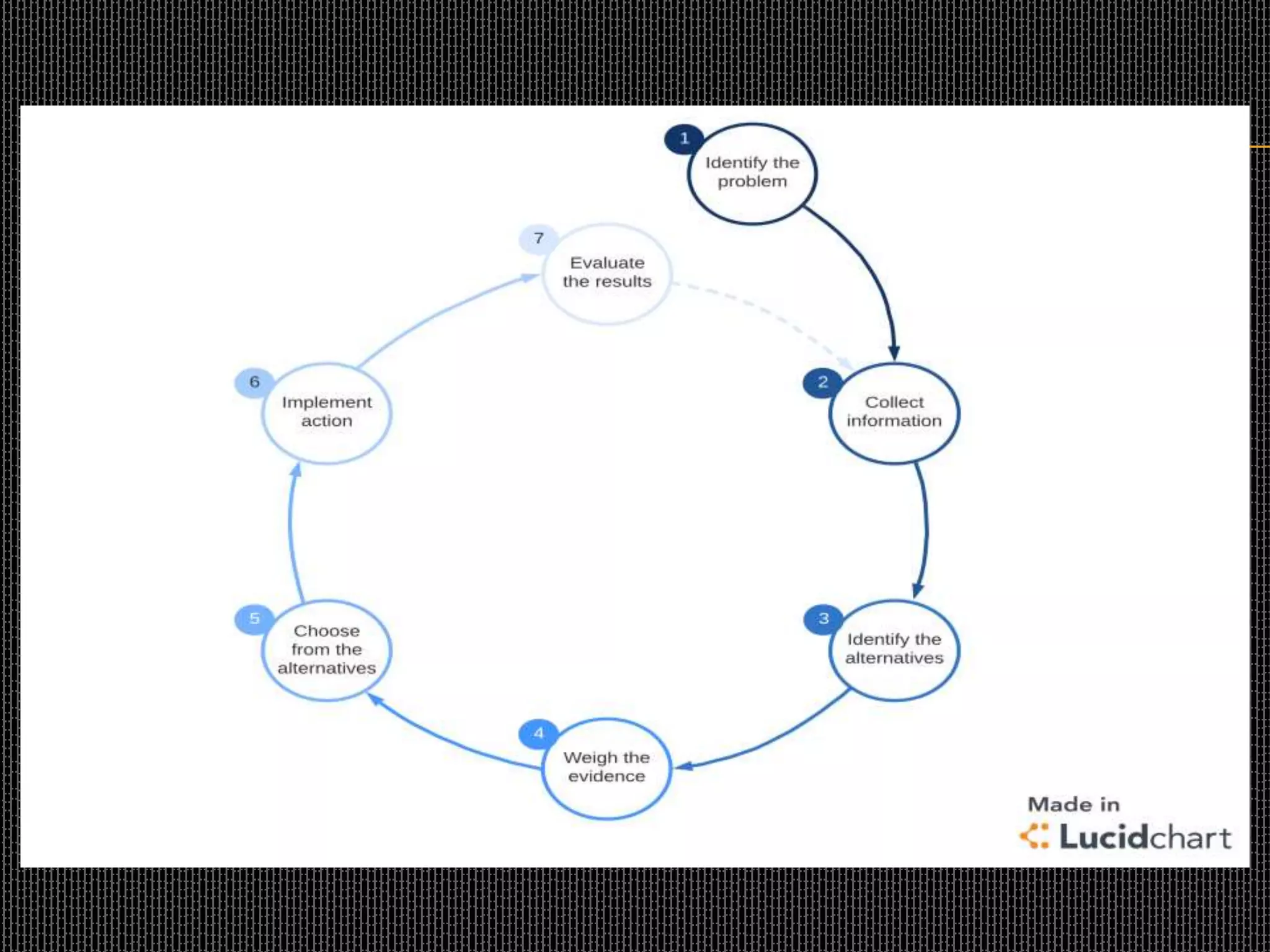
1. Identify the decision
To make a decision, you must first identify the problem
you need to solve or the question you need to answer.
Clearly define your decision. If you misidentify the
problem to solve, or if the problem you’ve chosen is too
broad, you’ll knock the decision train off the track before
it even leaves the station.
If you need to achieve a specific goal from your decision,
make it measurable and timely so you know for certain
that you met the goal at the end of the process.
2 Gather relevant informatiON
Once you have identified your decision, it’s time to
gather the information relevant to that choice. Do an
internal assessment, seeing where your organization
has succeeded and failed in areas related to your
decision. Also, seek information from external sources,
including studies, market research, and, in some cases,
evaluation from paid consultants.
Beware: you can easily become bogged down by too
much information—facts and statistics that seem
applicable to your situation might only complicate the
process.
3. Identify the alternatives
With relevant information now at your fingertips, identify
possible solutions to your problem. There is usually more
than one option to consider when trying to meet a
goal—for example, if your company is trying to gain
more engagement on social media, your alternatives
could include paid social advertisements, a change in
your organic social media strategy, or a combination of
the two.
4. Weigh the evidence
Once you have identified multiple alternatives, weigh the
evidence for or against said alternatives. See what
companies have done in the past to succeed in these
areas, and take a good hard look at your own
organization’s wins and losses. Identify potential pitfalls
for each of your alternatives, and weigh those against
the possible rewards.
5. Choose among alternatives
Here is the part of the decision-making process where
you, you know, make the decision. Hopefully, you’ve
identified and clarified what decision needs to be made,
gathered all relevant information, and developed and
considered the potential paths to take. You are perfectly
prepared to choose.
6. Take action
Once you’ve made your decision, act on it! Develop a
plan to make your decision tangible and
achievable. Develop a project plan related to your
decision, and then set the team loose on their tasks
once the plan is in place.
7. Review your decision
After a predetermined amount of time—which you
defined in step one of the decision-making process—
take an honest look back at your decision. Did you solve
the problem? Did you answer the question? Did you
meet your goals?
If so, take note of what worked for future reference. If
not, learn from your mistakes as you begin the decision-
making process again.
Effective Communication of Decisions:
The communication of decisions to the persons for whom they
have been taken is another administrative problem faced by the
management. The decisions should be communicated in a
language in which they are well understood by the receiver. If a
decision is not conveyed to those who are to implement them
then it will remain on paper and the purpose will not be served.
The management has to cross many barriers in the
communication system so that they are conveyed properly.
Participation in Decision-Making:
The best way of arriving at important decisions is to get
the views of concerned persons before finalizing them.
Different viewpoints will give a wider thought to the
problem and its analysis. The general tendency in
management is to keep decision-making at top level
only. A few persons are given the authority of making
decisions. This type of thinking will create more
problems in implementing them.
The view points of those who are to be directly
influenced by the decisions may not be taken into
consideration. Such decisions suffer from many lacunae.
To avoid such situations management should try to
involve more and more persons in decision-making
process.
Implementation of Decision:
The implementation of decisions is the other difficulty
faced by management. Once a decision is taken then all
efforts should be made honestly to implement it. The
manager and subordinates should help in proper
implementation of decisions. Manager may consult staff
persons or specialists from outside but final decision
will be his own. The responsibility for implementing
decisions will lie on the manager. When a decision goes
wrong then manager is criticized and when it proves
correct then he may not be applauded. So decision
implementation brings a number of problems which
need to be tackled.
1.Programmed and non- programmeddecisions:
Programmed decisions are concerned with the problems of
repetitive nature or routine type matters.
A standard procedure is followed for tackling such problems.
These decisions are taken generally by lower level managers.
Decisions of this type may pertain to e.g. purchase of raw material,
granting leave to an employee and supply of goods and
implements to the employees, etc. Non-programmed decisions
relate to difficult situations for which there is no easy solution.
These matters are very important for the organisation. For
example, opening of a new branch of the organisation or a large
number of employees absenting from the organisation or
introducing new product in the market, etc., are the decisions
which are normally taken at the higher level.
2.Organisational and personal decisions:
When an individual takes decision as an executive in the
official capacity, it is known as organisational decision. If
decision is taken by the executive in the personal
capacity (thereby affecting his personal life), it is known
as personal decision.
Sometimes these decisions may affect functioning of the
organisation also. For example, if an executive leaves the
organisation, it may affect the organisation. The
authority of taking organizational decisions may be
delegated, whereas personal decisions cannot be
delegated.
3.Major and minor decisions:
Another classification of decisions is major
and minor. Decision pertaining to purchase
of new factory premises is a major decision.
Major decisions are taken by top
management. Purchase of office stationery
is a minor decision which can be taken by
office superintendent.
4.Individual and group decisions:
When the decision is taken by a single individual, it is
known as individual decision. Usually routine type
decisions are taken by individuals within the broad
policy framework of the organisation.
Group decisions are taken by group of individuals
constituted in the form of a standing committee.
Generally very important and pertinent matters for the
organisation are referred to this committee. The main
aim in taking group decisions is the involvement of
maximum number of individuals in the process of
decision- making.
DECISION MAKING
DECISION MAKING

DECISION MAKING

  • 2.
    Decision making isthe process of sufficiently reducing uncertainty and doubt about alternatives to allow a reasonable choice to be made from among them. ... Decisions whether. Decision making is the study of identifying and choosing alternatives based on the values and preferences of the decision maker.
  • 4.
    A decision isthe selection of a course of action (or decision) out of many available alternatives. The marketing manager may be arrived to a particular decision by analyzing, evaluating and carefully planning. The decision making is the basic and fundamental key of all managerial activities. It is the study of identifying and choosing best possible choice (or option) based on the values and preferences of the business organization.
  • 5.
    Peter F. Ducker:“Whatever a manager does he does through making decisions.” E. Mc. Farland: “A decision is an act of choice wherein an executive forms a conclusion about what must be done in a given situation. A decision represents a behavior chosen from a number of possible alternatives.” George R. Terry: “Decision making is the selection based on some criteria from two or more possible alternatives.” Koontz & O'Donnell: “Decision is the selection from among alternatives of a course of actions.”
  • 7.
    Selective Process Decision makingis the selective process in which the best possible alternative is chosen out of many alternatives available. The best choice can be made only by evaluation of alternatives. If there is only one way of doing a particular act, there is no need of taking selective decision.
  • 8.
    Dynamic Process The decision-makingis a dynamic process. It involves time dimension and time lag. Depending upon the situation, a particular problem may have different decisions at different time intervals. Human andrational process The decision-making is a human and rational process that involves the application of intellectual abilities like deep thinking and foreseeing things.
  • 9.
    Continuous Process Decision makingis a continuous process which goes on through the life of an organization. It is a process of taking a decision, implementing it, following the variations and taking the actions to remove these variations. In other words, it is a never ending activity in business management.
  • 10.
    Environment There must behealthy atmosphere to achieve the corporate goals of the business enterprise. Thus, to implement the decisions regarding to it, the proper communication between the employee and employer is necessary. Goal orientedprocess Decision-making aims at providing a solution to a given problem before a business enterprise. It is a goal- oriented process and provides solutions to problems faced by a business unit.
  • 13.
    1. Identify thedecision To make a decision, you must first identify the problem you need to solve or the question you need to answer. Clearly define your decision. If you misidentify the problem to solve, or if the problem you’ve chosen is too broad, you’ll knock the decision train off the track before it even leaves the station. If you need to achieve a specific goal from your decision, make it measurable and timely so you know for certain that you met the goal at the end of the process.
  • 14.
    2 Gather relevantinformatiON Once you have identified your decision, it’s time to gather the information relevant to that choice. Do an internal assessment, seeing where your organization has succeeded and failed in areas related to your decision. Also, seek information from external sources, including studies, market research, and, in some cases, evaluation from paid consultants. Beware: you can easily become bogged down by too much information—facts and statistics that seem applicable to your situation might only complicate the process.
  • 15.
    3. Identify thealternatives With relevant information now at your fingertips, identify possible solutions to your problem. There is usually more than one option to consider when trying to meet a goal—for example, if your company is trying to gain more engagement on social media, your alternatives could include paid social advertisements, a change in your organic social media strategy, or a combination of the two.
  • 16.
    4. Weigh theevidence Once you have identified multiple alternatives, weigh the evidence for or against said alternatives. See what companies have done in the past to succeed in these areas, and take a good hard look at your own organization’s wins and losses. Identify potential pitfalls for each of your alternatives, and weigh those against the possible rewards.
  • 17.
    5. Choose amongalternatives Here is the part of the decision-making process where you, you know, make the decision. Hopefully, you’ve identified and clarified what decision needs to be made, gathered all relevant information, and developed and considered the potential paths to take. You are perfectly prepared to choose.
  • 18.
    6. Take action Onceyou’ve made your decision, act on it! Develop a plan to make your decision tangible and achievable. Develop a project plan related to your decision, and then set the team loose on their tasks once the plan is in place.
  • 19.
    7. Review yourdecision After a predetermined amount of time—which you defined in step one of the decision-making process— take an honest look back at your decision. Did you solve the problem? Did you answer the question? Did you meet your goals? If so, take note of what worked for future reference. If not, learn from your mistakes as you begin the decision- making process again.
  • 22.
    Effective Communication ofDecisions: The communication of decisions to the persons for whom they have been taken is another administrative problem faced by the management. The decisions should be communicated in a language in which they are well understood by the receiver. If a decision is not conveyed to those who are to implement them then it will remain on paper and the purpose will not be served. The management has to cross many barriers in the communication system so that they are conveyed properly.
  • 23.
    Participation in Decision-Making: Thebest way of arriving at important decisions is to get the views of concerned persons before finalizing them. Different viewpoints will give a wider thought to the problem and its analysis. The general tendency in management is to keep decision-making at top level only. A few persons are given the authority of making decisions. This type of thinking will create more problems in implementing them. The view points of those who are to be directly influenced by the decisions may not be taken into consideration. Such decisions suffer from many lacunae. To avoid such situations management should try to involve more and more persons in decision-making process.
  • 24.
    Implementation of Decision: Theimplementation of decisions is the other difficulty faced by management. Once a decision is taken then all efforts should be made honestly to implement it. The manager and subordinates should help in proper implementation of decisions. Manager may consult staff persons or specialists from outside but final decision will be his own. The responsibility for implementing decisions will lie on the manager. When a decision goes wrong then manager is criticized and when it proves correct then he may not be applauded. So decision implementation brings a number of problems which need to be tackled.
  • 26.
    1.Programmed and non-programmeddecisions: Programmed decisions are concerned with the problems of repetitive nature or routine type matters. A standard procedure is followed for tackling such problems. These decisions are taken generally by lower level managers. Decisions of this type may pertain to e.g. purchase of raw material, granting leave to an employee and supply of goods and implements to the employees, etc. Non-programmed decisions relate to difficult situations for which there is no easy solution. These matters are very important for the organisation. For example, opening of a new branch of the organisation or a large number of employees absenting from the organisation or introducing new product in the market, etc., are the decisions which are normally taken at the higher level.
  • 27.
    2.Organisational and personaldecisions: When an individual takes decision as an executive in the official capacity, it is known as organisational decision. If decision is taken by the executive in the personal capacity (thereby affecting his personal life), it is known as personal decision. Sometimes these decisions may affect functioning of the organisation also. For example, if an executive leaves the organisation, it may affect the organisation. The authority of taking organizational decisions may be delegated, whereas personal decisions cannot be delegated.
  • 28.
    3.Major and minordecisions: Another classification of decisions is major and minor. Decision pertaining to purchase of new factory premises is a major decision. Major decisions are taken by top management. Purchase of office stationery is a minor decision which can be taken by office superintendent.
  • 29.
    4.Individual and groupdecisions: When the decision is taken by a single individual, it is known as individual decision. Usually routine type decisions are taken by individuals within the broad policy framework of the organisation. Group decisions are taken by group of individuals constituted in the form of a standing committee. Generally very important and pertinent matters for the organisation are referred to this committee. The main aim in taking group decisions is the involvement of maximum number of individuals in the process of decision- making.