An Introduction to
Data Envelopment Analysis
An Introduction to
Data Envelopment Analysis
A Tool for Performance Measurement
R. Ramanathan
Sage Publications
New Delhi l Thousand Oaks l London
Copyright © R. Ramanathan, 2003
All rights reserved. No part of this book may be reproduced or utilized
in any form or by any means, electronic or mechanical, including photo-
copying, recording or by any information storage or retrieval system
without permission in writing from the publisher.
First published in 2003 by
Sage PSage PSage PSage PSage Publications India Pvt Ltdublications India Pvt Ltdublications India Pvt Ltdublications India Pvt Ltdublications India Pvt Ltd
B-42, Panchsheel Enclave
New Delhi 110 017
Sage PSage PSage PSage PSage Publications Incublications Incublications Incublications Incublications Inc Sage PSage PSage PSage PSage Publications Ltdublications Ltdublications Ltdublications Ltdublications Ltd
2455 Teller Road 6 Bonhill Street
Thousand Oaks, California 91320 London EC2A 4PU
Published by Tejeshwar Singh for Sage Publications India Pvt Ltd, type-
set in 10 pt BruceOldStyle BT by Star Compugraphics Private Limited,
New Delhi and printed at Chaman Enterprises, New Delhi.
Library of Congress Cataloging-in-PLibrary of Congress Cataloging-in-PLibrary of Congress Cataloging-in-PLibrary of Congress Cataloging-in-PLibrary of Congress Cataloging-in-Publication Dataublication Dataublication Dataublication Dataublication Data
Ramanathan, R., 1966
An Introduction to data envelopment analysis: A tool for performance
measurement/R. Ramanathan
p. cm.
Includes bibliographical references and index.
1. Industrial productivity—Measurement. 2. Data envelopment
analysis. I. Title.
HD56.25.R36 658.5'15'0151972—dc21 2003 2003011977
ISBN:ISBN:ISBN:ISBN:ISBN: 0–7619–9760–1 (US–Hb) 81–7829–260–2 (India–Hb)
0–7619–9761–X (US–Pb) 81–7829–261–0 (India–Pb)
Sage PSage PSage PSage PSage Production Troduction Troduction Troduction Troduction Team:eam:eam:eam:eam: D. Srilatha, Rajib Chatterjee and Santosh Rawat
I dedicate this book to my parents,
Ramakrishnan and Parvatha Meenakshi
Contents
List of Tables 11
List of Figures 13
Foreword 15
Preface 19
Acknowledgements 21
List of Abbreviations 23
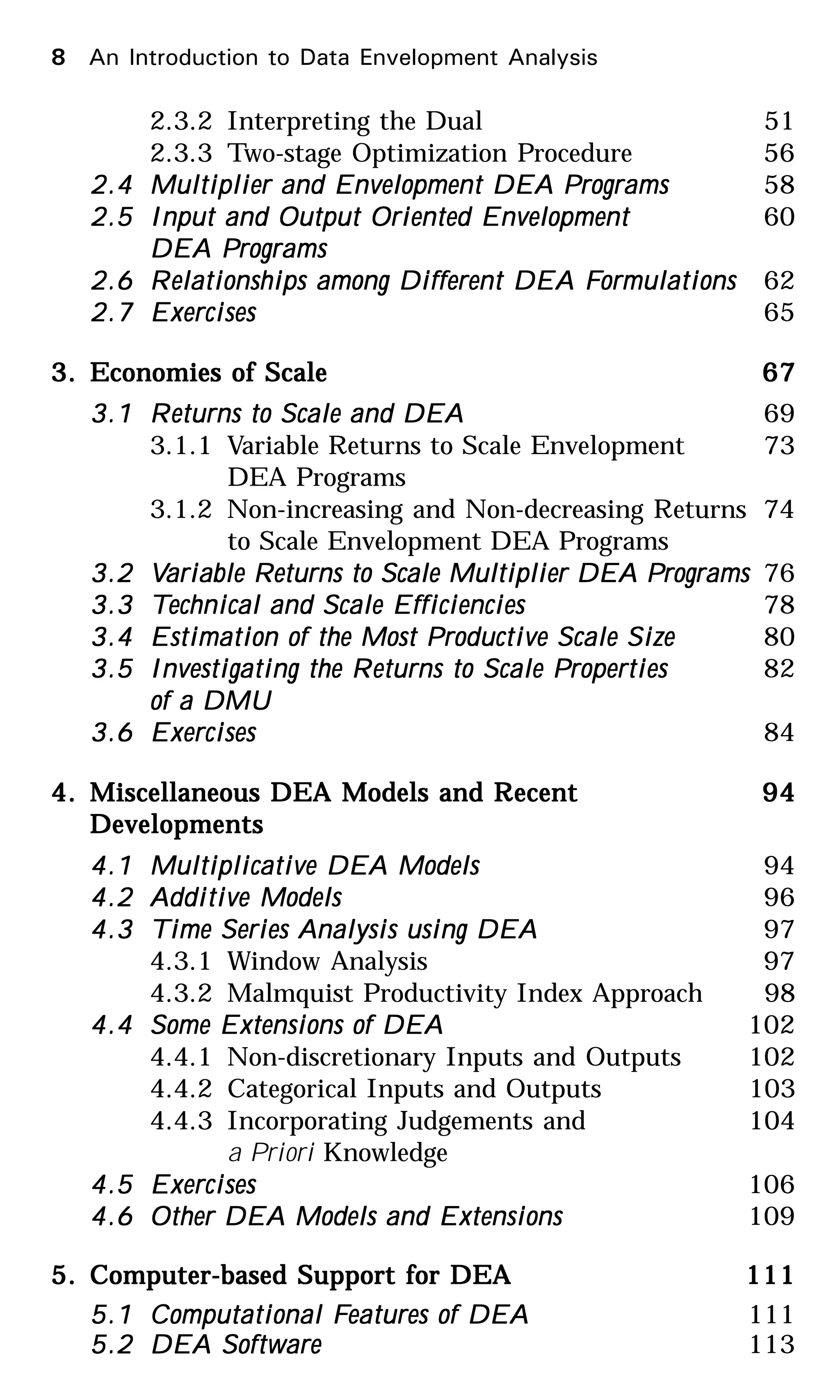
1.1.1.1.1. IntroductionIntroductionIntroductionIntroductionIntroduction 2525252525
1.11.11.11.11.1 Decision-making UnitsDecision-making UnitsDecision-making UnitsDecision-making UnitsDecision-making Units 25
1.21.21.21.21.2 Basic Concepts of Efficiency MeasurementBasic Concepts of Efficiency MeasurementBasic Concepts of Efficiency MeasurementBasic Concepts of Efficiency MeasurementBasic Concepts of Efficiency Measurement 26
1.2.1 Case of Single Input and Single Output 27
1.2.2 Case of Single Output and Two Inputs 30
1.31.31.31.31.3 Graphical Description—FGraphical Description—FGraphical Description—FGraphical Description—FGraphical Description—Frontier Analysisrontier Analysisrontier Analysisrontier Analysisrontier Analysis 31
1.3.1 Estimating Efficiencies of Inefficient Firms 32
1.3.2 Performance Targets and Slacks for 33
Inefficient Firms
1.41.41.41.41.4 Strongly and WStrongly and WStrongly and WStrongly and WStrongly and Weakly Efficient DMUseakly Efficient DMUseakly Efficient DMUseakly Efficient DMUseakly Efficient DMUs 35
1.51.51.51.51.5 ExercisesExercisesExercisesExercisesExercises 35
2.2.2.2.2. Mathematical PMathematical PMathematical PMathematical PMathematical Programming Aspects of DEArogramming Aspects of DEArogramming Aspects of DEArogramming Aspects of DEArogramming Aspects of DEA 3838383838
2.12.12.12.12.1 Mathematical FMathematical FMathematical FMathematical FMathematical Formulationormulationormulationormulationormulation 38
2.1.1 Fractional DEA Programs 40
2.1.2 Output Maximization and Input 42
Minimization DEA Programs
2.1.3 General Form of CCR DEA Models 45
2.22.22.22.22.2 ExercisesExercisesExercisesExercisesExercises 46
2.32.32.32.32.3 Dual DEA ModelsDual DEA ModelsDual DEA ModelsDual DEA ModelsDual DEA Models 48
2.3.1 Comparing Primal and Dual 51
2.3.2 Interpreting the Dual 51
2.3.3 Two-stage Optimization Procedure 56
2.42.42.42.42.4 Multiplier and Envelopment DEA PMultiplier and Envelopment DEA PMultiplier and Envelopment DEA PMultiplier and Envelopment DEA PMultiplier and Envelopment DEA Programsrogramsrogramsrogramsrograms 58
2.52.52.52.52.5 Input and Output Oriented EnvelopmentInput and Output Oriented EnvelopmentInput and Output Oriented EnvelopmentInput and Output Oriented EnvelopmentInput and Output Oriented Envelopment 60
DEA PDEA PDEA PDEA PDEA Programsrogramsrogramsrogramsrograms
2.62.62.62.62.6 RRRRRelationships among Different DEA Felationships among Different DEA Felationships among Different DEA Felationships among Different DEA Felationships among Different DEA Formulationsormulationsormulationsormulationsormulations 62
2.72.72.72.72.7 ExercisesExercisesExercisesExercisesExercises 65
3.3.3.3.3. Economies of ScaleEconomies of ScaleEconomies of ScaleEconomies of ScaleEconomies of Scale 6767676767
3.13.13.13.13.1 RRRRReturns to Scale and DEAeturns to Scale and DEAeturns to Scale and DEAeturns to Scale and DEAeturns to Scale and DEA 69
3.1.1 Variable Returns to Scale Envelopment 73
DEA Programs
3.1.2 Non-increasing and Non-decreasing Returns 74
to Scale Envelopment DEA Programs
3.23.23.23.23.2 VVVVVariable Rariable Rariable Rariable Rariable Returns to Scale Multiplier DEA Peturns to Scale Multiplier DEA Peturns to Scale Multiplier DEA Peturns to Scale Multiplier DEA Peturns to Scale Multiplier DEA Programsrogramsrogramsrogramsrograms 76
3.33.33.33.33.3 TTTTTechnical and Scale Efficienciesechnical and Scale Efficienciesechnical and Scale Efficienciesechnical and Scale Efficienciesechnical and Scale Efficiencies 78
3.43.43.43.43.4 Estimation of the Most PEstimation of the Most PEstimation of the Most PEstimation of the Most PEstimation of the Most Productive Scale Sizeroductive Scale Sizeroductive Scale Sizeroductive Scale Sizeroductive Scale Size 80
3.53.53.53.53.5 Investigating the RInvestigating the RInvestigating the RInvestigating the RInvestigating the Returns to Scale Peturns to Scale Peturns to Scale Peturns to Scale Peturns to Scale Propertiesropertiesropertiesropertiesroperties 82
of a DMUof a DMUof a DMUof a DMUof a DMU
3.63.63.63.63.6 ExercisesExercisesExercisesExercisesExercises 84
4.4.4.4.4. Miscellaneous DEA Models and RMiscellaneous DEA Models and RMiscellaneous DEA Models and RMiscellaneous DEA Models and RMiscellaneous DEA Models and Recentecentecentecentecent 9494949494
DevelopmentsDevelopmentsDevelopmentsDevelopmentsDevelopments
4.14.14.14.14.1 Multiplicative DEA ModelsMultiplicative DEA ModelsMultiplicative DEA ModelsMultiplicative DEA ModelsMultiplicative DEA Models 94
4.24.24.24.24.2 Additive ModelsAdditive ModelsAdditive ModelsAdditive ModelsAdditive Models 96
4.34.34.34.34.3 TTTTTime Series Analysis using DEAime Series Analysis using DEAime Series Analysis using DEAime Series Analysis using DEAime Series Analysis using DEA 97
4.3.1 Window Analysis 97
4.3.2 Malmquist Productivity Index Approach 98
4.44.44.44.44.4 Some Extensions of DEASome Extensions of DEASome Extensions of DEASome Extensions of DEASome Extensions of DEA 102
4.4.1 Non-discretionary Inputs and Outputs 102
4.4.2 Categorical Inputs and Outputs 103
4.4.3 Incorporating Judgements and 104
a Priori Knowledge
4.54.54.54.54.5 ExercisesExercisesExercisesExercisesExercises 106
4.64.64.64.64.6 Other DEA Models and ExtensionsOther DEA Models and ExtensionsOther DEA Models and ExtensionsOther DEA Models and ExtensionsOther DEA Models and Extensions 109
5.5.5.5.5. Computer-based Support for DEAComputer-based Support for DEAComputer-based Support for DEAComputer-based Support for DEAComputer-based Support for DEA 111111111111111
5.15.15.15.15.1 Computational FComputational FComputational FComputational FComputational Features of DEAeatures of DEAeatures of DEAeatures of DEAeatures of DEA 111
5.25.25.25.25.2 DEA SoftwareDEA SoftwareDEA SoftwareDEA SoftwareDEA Software 113
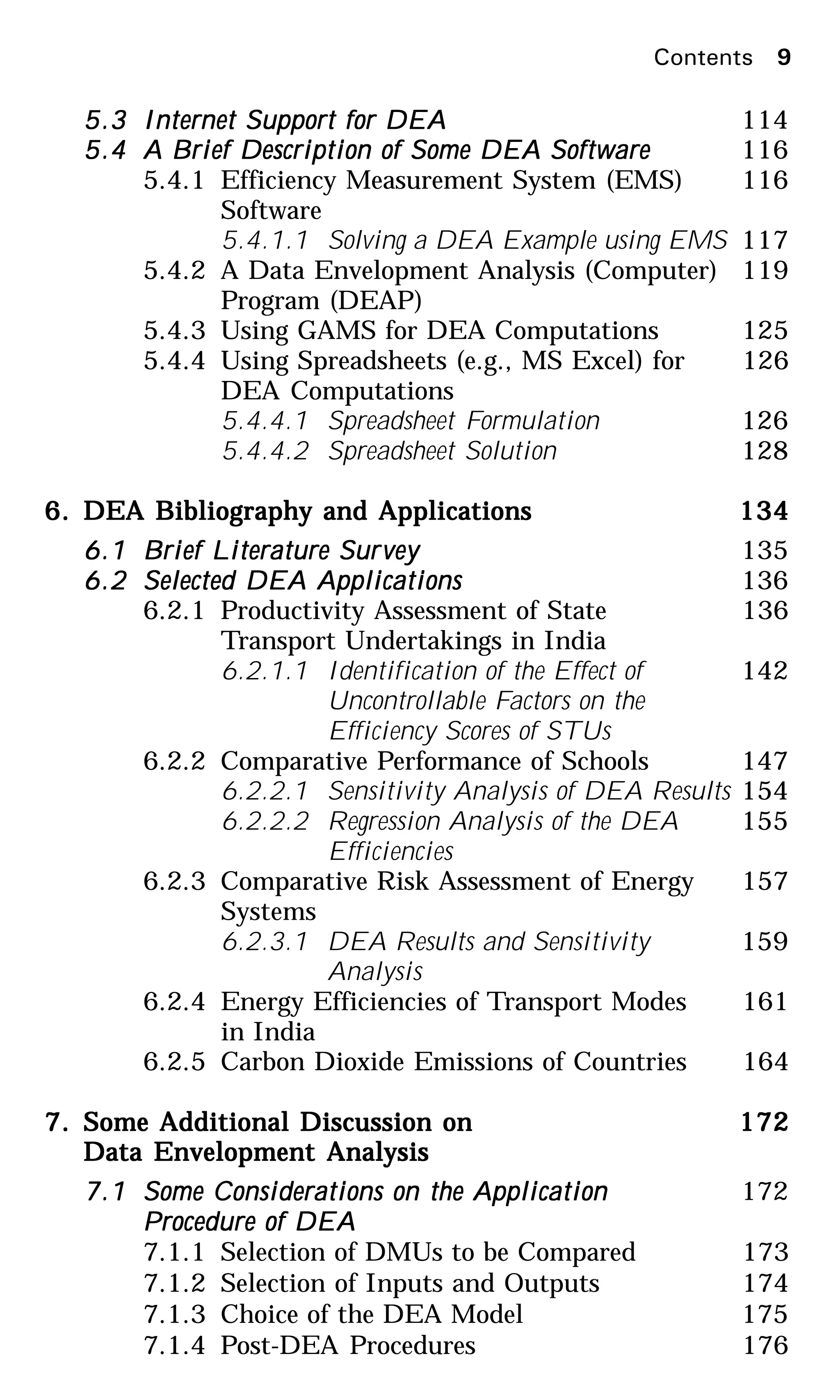
8 An Introduction to Data Envelopment Analysis
5.35.35.35.35.3 Internet Support for DEAInternet Support for DEAInternet Support for DEAInternet Support for DEAInternet Support for DEA 114
5.45.45.45.45.4 A Brief Description of Some DEA SoftwareA Brief Description of Some DEA SoftwareA Brief Description of Some DEA SoftwareA Brief Description of Some DEA SoftwareA Brief Description of Some DEA Software 116
5.4.1 Efficiency Measurement System (EMS) 116
Software
5.4.1.1 Solving a DEA Example using EMS 117
5.4.2 A Data Envelopment Analysis (Computer) 119
Program (DEAP)
5.4.3 Using GAMS for DEA Computations 125
5.4.4 Using Spreadsheets (e.g., MS Excel) for 126
DEA Computations
5.4.4.1 Spreadsheet Formulation 126
5.4.4.2 Spreadsheet Solution 128
6.6.6.6.6. DEA Bibliography and ApplicationsDEA Bibliography and ApplicationsDEA Bibliography and ApplicationsDEA Bibliography and ApplicationsDEA Bibliography and Applications 134134134134134
6.16.16.16.16.1 Brief Literature SurBrief Literature SurBrief Literature SurBrief Literature SurBrief Literature Surveyveyveyveyvey 135
6.26.26.26.26.2 Selected DEA ApplicationsSelected DEA ApplicationsSelected DEA ApplicationsSelected DEA ApplicationsSelected DEA Applications 136
6.2.1 Productivity Assessment of State 136
Transport Undertakings in India
6.2.1.1 Identification of the Effect of 142
Uncontrollable Factors on the
Efficiency Scores of STUs
6.2.2 Comparative Performance of Schools 147
6.2.2.1 Sensitivity Analysis of DEA Results 154
6.2.2.2 Regression Analysis of the DEA 155
Efficiencies
6.2.3 Comparative Risk Assessment of Energy 157
Systems
6.2.3.1 DEA Results and Sensitivity 159
Analysis
6.2.4 Energy Efficiencies of Transport Modes 161
in India
6.2.5 Carbon Dioxide Emissions of Countries 164
7.7.7.7.7. Some Additional Discussion onSome Additional Discussion onSome Additional Discussion onSome Additional Discussion onSome Additional Discussion on 172172172172172
Data Envelopment AnalysisData Envelopment AnalysisData Envelopment AnalysisData Envelopment AnalysisData Envelopment Analysis
7.17.17.17.17.1 Some Considerations on the ApplicationSome Considerations on the ApplicationSome Considerations on the ApplicationSome Considerations on the ApplicationSome Considerations on the Application 172
PPPPProcedure of DEArocedure of DEArocedure of DEArocedure of DEArocedure of DEA
7.1.1 Selection of DMUs to be Compared 173
7.1.2 Selection of Inputs and Outputs 174
7.1.3 Choice of the DEA Model 175
7.1.4 Post-DEA Procedures 176
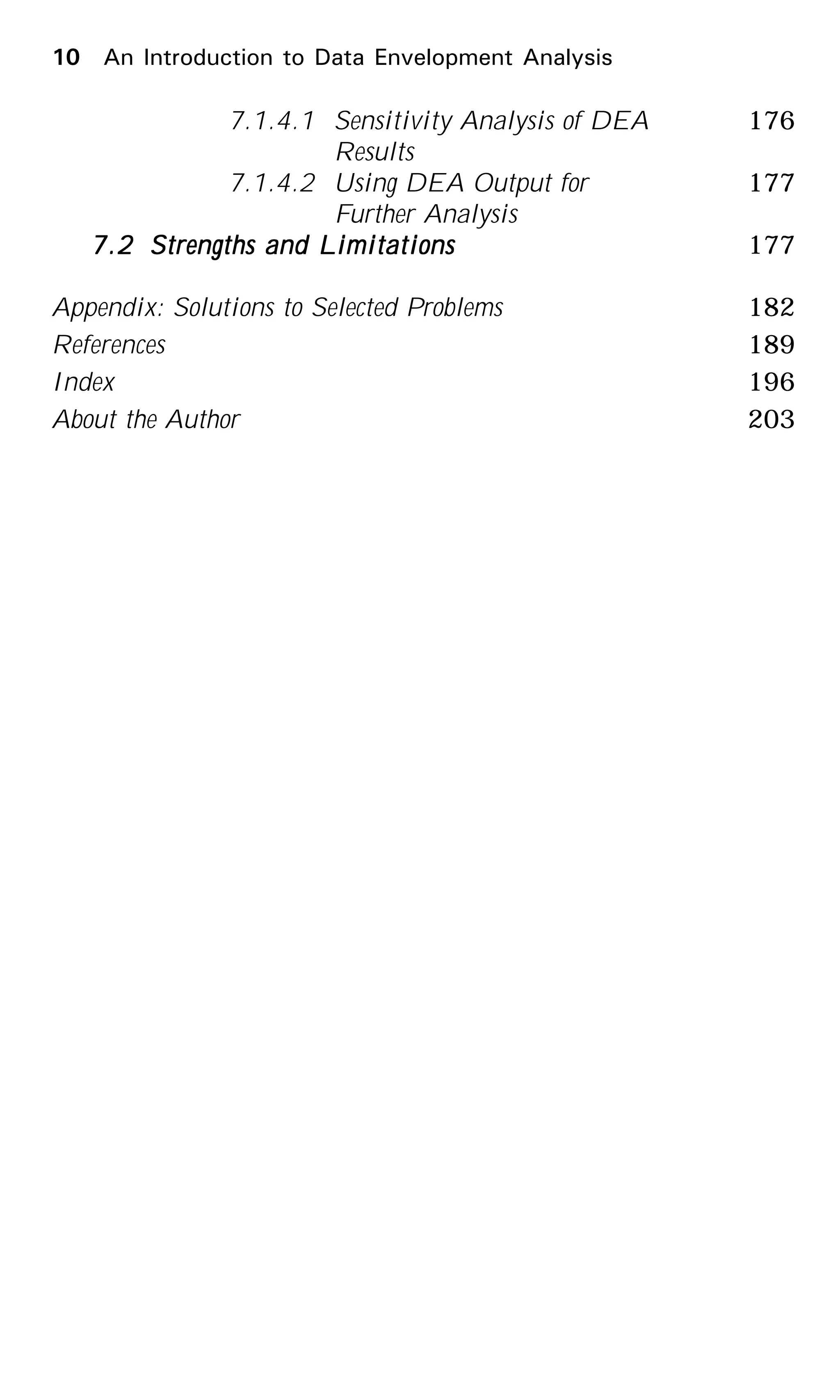
Contents 9
7.1.4.1 Sensitivity Analysis of DEA 176
Results
7.1.4.2 Using DEA Output for 177
Further Analysis
7.27.27.27.27.2 Strengths and LimitationsStrengths and LimitationsStrengths and LimitationsStrengths and LimitationsStrengths and Limitations 177
Appendix: Solutions to Selected Problems 182
References 189
Index 196
About the Author 203
10 An Introduction to Data Envelopment Analysis
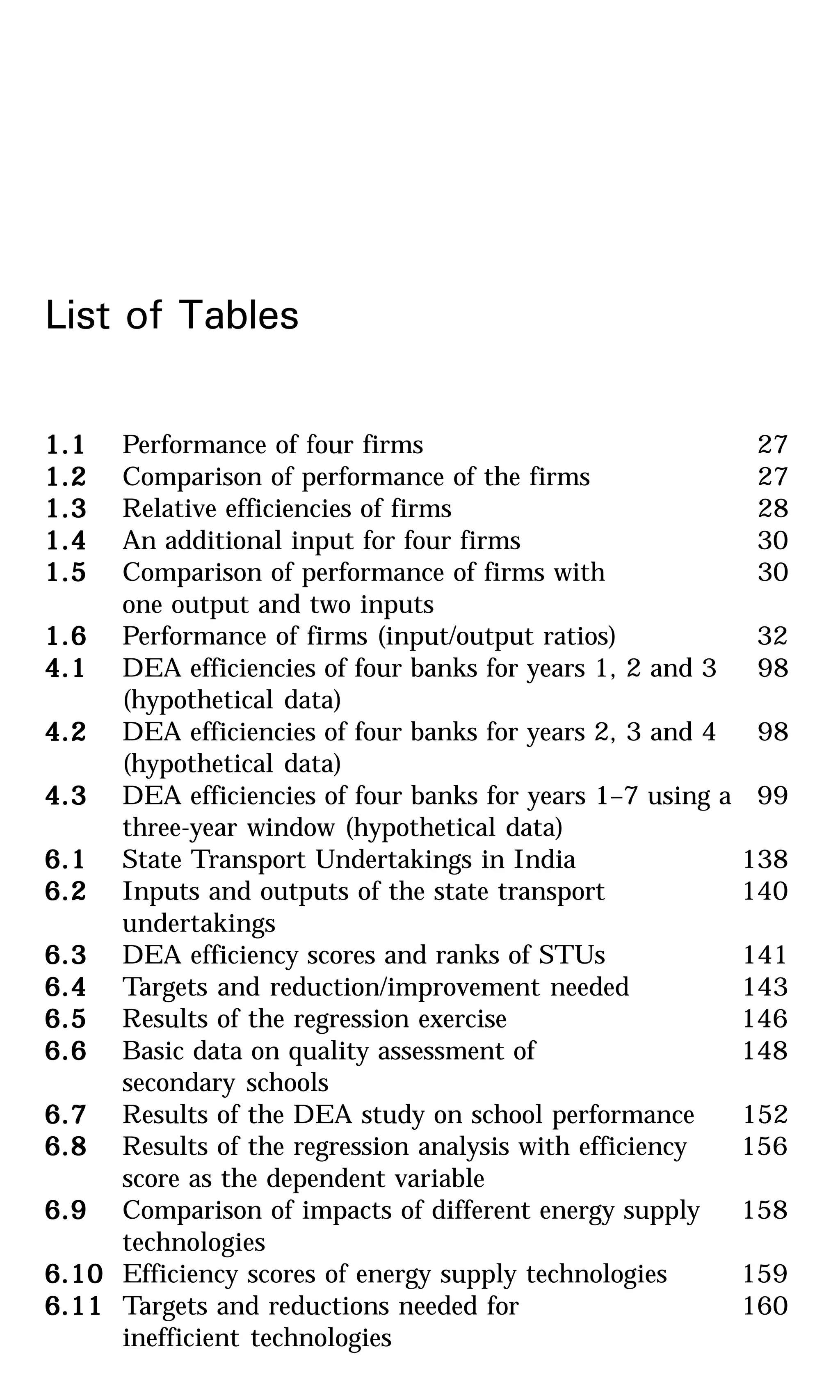
List of Tables
1.11.11.11.11.1 Performance of four firms 27
1.21.21.21.21.2 Comparison of performance of the firms 27
1.31.31.31.31.3 Relative efficiencies of firms 28
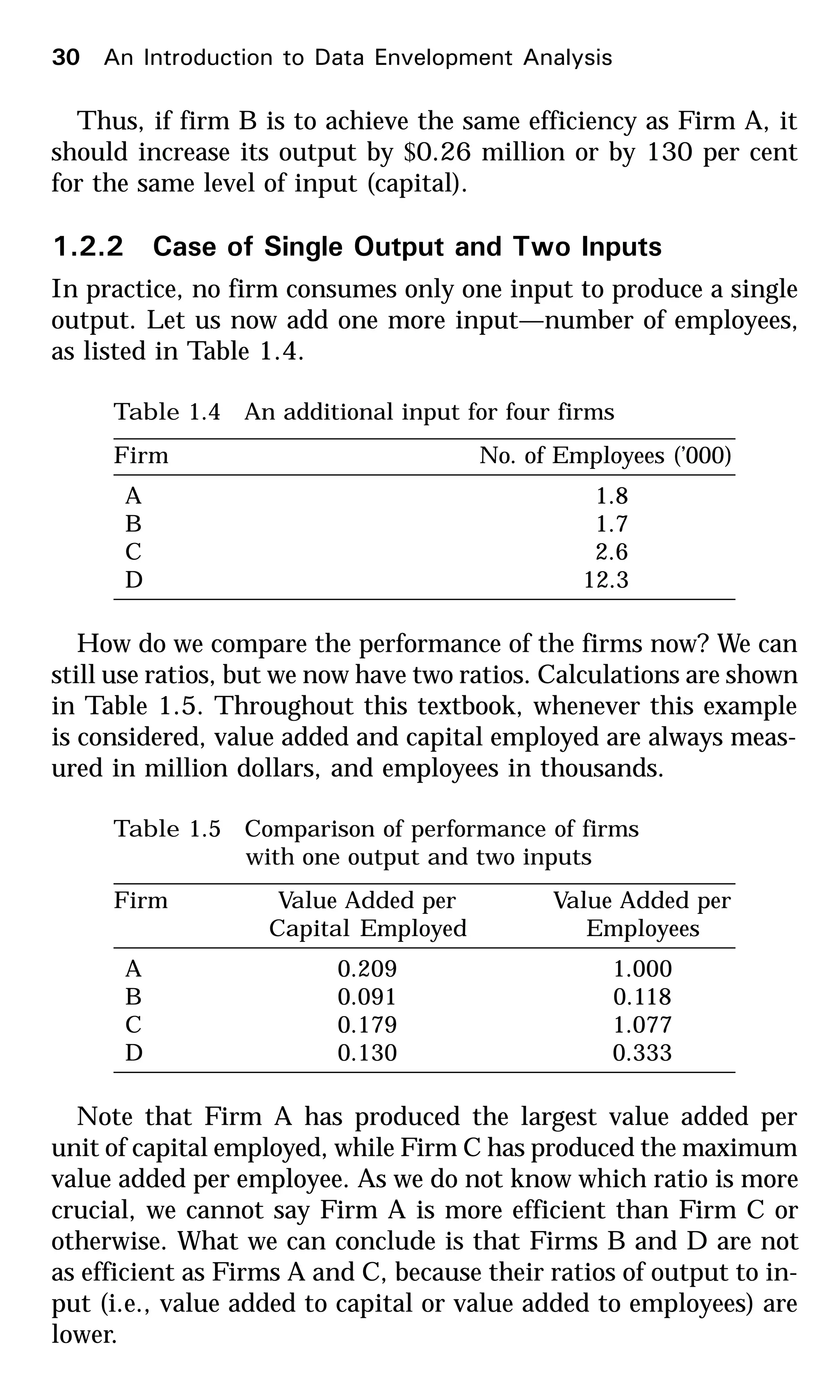
1.41.41.41.41.4 An additional input for four firms 30
1.51.51.51.51.5 Comparison of performance of firms with 30
one output and two inputs
1.61.61.61.61.6 Performance of firms (input/output ratios) 32
4.14.14.14.14.1 DEA efficiencies of four banks for years 1, 2 and 3 98
(hypothetical data)
4.24.24.24.24.2 DEA efficiencies of four banks for years 2, 3 and 4 98
(hypothetical data)
4.34.34.34.34.3 DEA efficiencies of four banks for years 1–7 using a 99
three-year window (hypothetical data)
6.16.16.16.16.1 State Transport Undertakings in India 138
6.26.26.26.26.2 Inputs and outputs of the state transport 140
undertakings
6.36.36.36.36.3 DEA efficiency scores and ranks of STUs 141
6.46.46.46.46.4 Targets and reduction/improvement needed 143
6.56.56.56.56.5 Results of the regression exercise 146
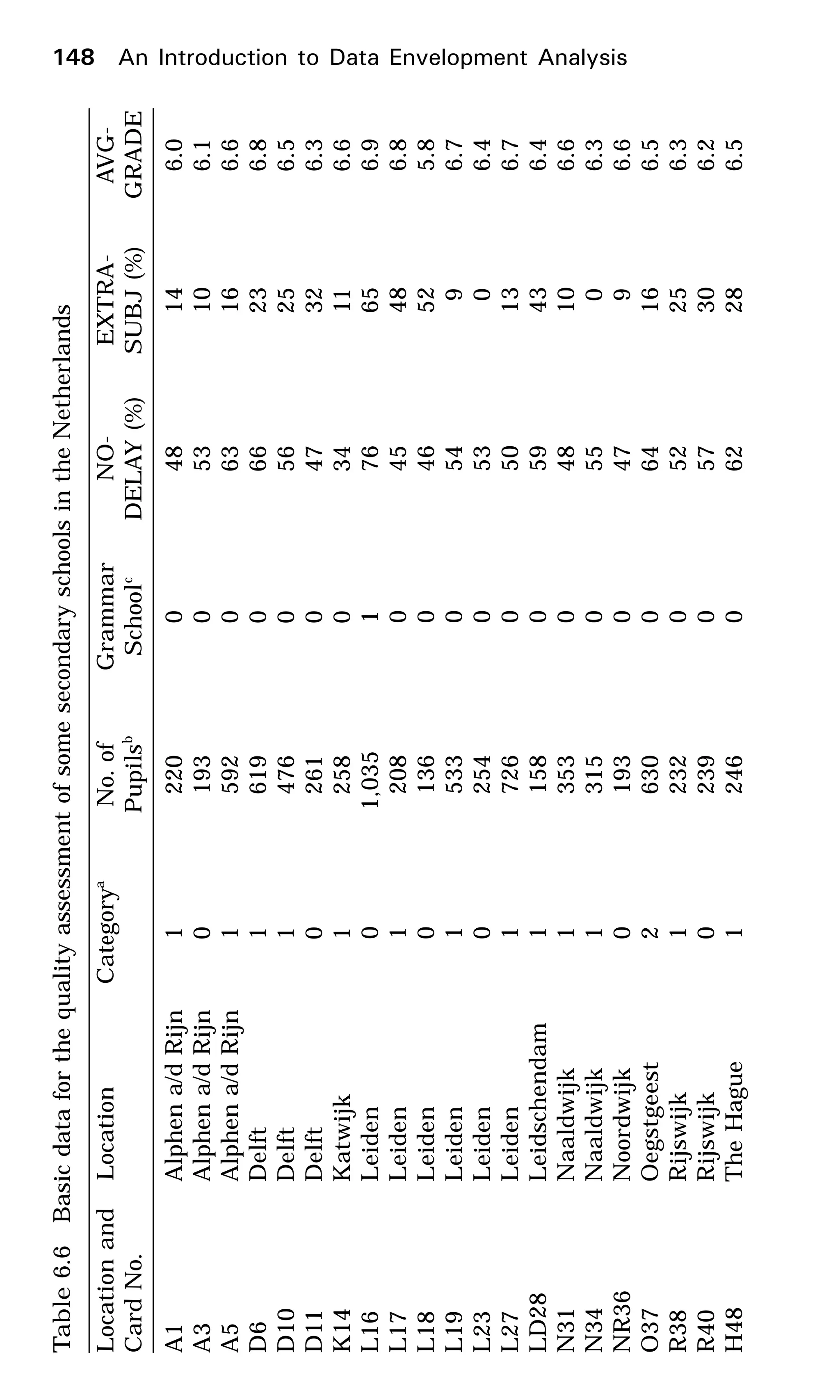
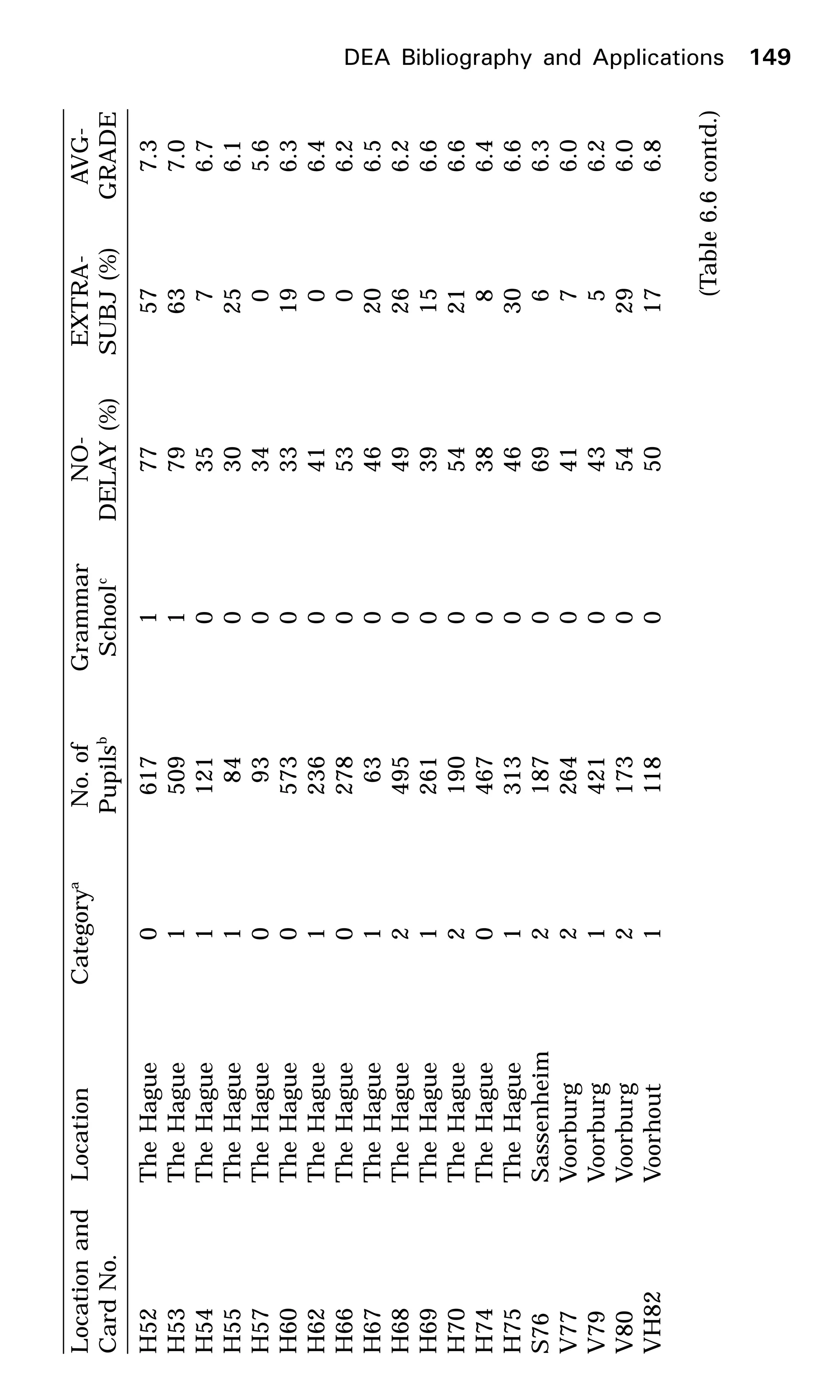
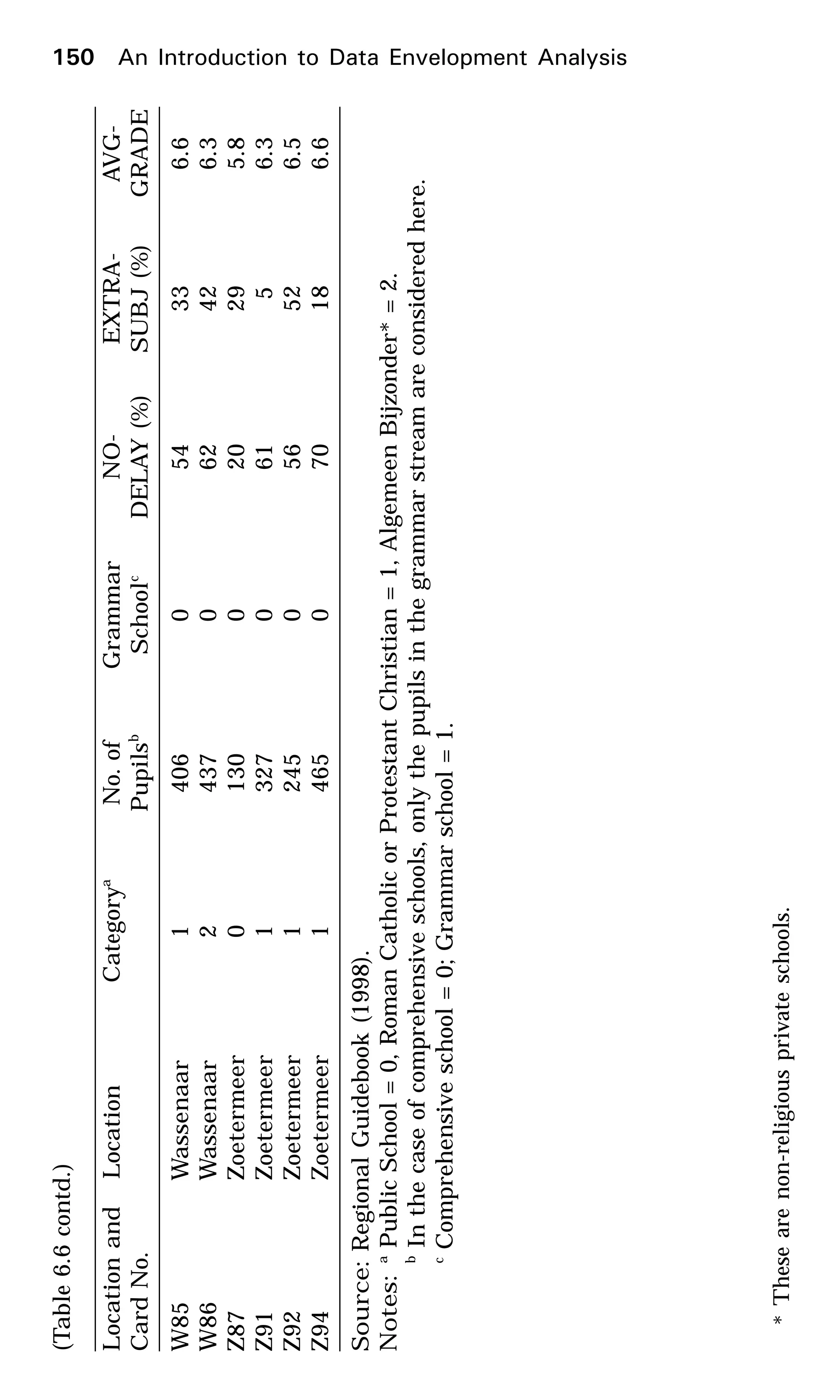
6.66.66.66.66.6 Basic data on quality assessment of 148
secondary schools
6.76.76.76.76.7 Results of the DEA study on school performance 152
6.86.86.86.86.8 Results of the regression analysis with efficiency 156
score as the dependent variable
6.96.96.96.96.9 Comparison of impacts of different energy supply 158
technologies
6.106.106.106.106.10 Efficiency scores of energy supply technologies 159
6.116.116.116.116.11 Targets and reductions needed for 160
inefficient technologies
6.126.126.126.126.12 Physical performance and energy consumption in 162
road and rail transport in India
6.136.136.136.136.13 Trends in energy efficiency of Indian transport 163
6.146.146.146.146.14 Data on carbon dioxide emissions, energy 166
consumption and GDP for 1990
6.156.156.156.156.15 DEA results for 1990 for carbon dioxide emissions 168
12 An Introduction to Data Envelopment Analysis
List of Figures
1.11.11.11.11.1 Frontier analysis in DEA 31
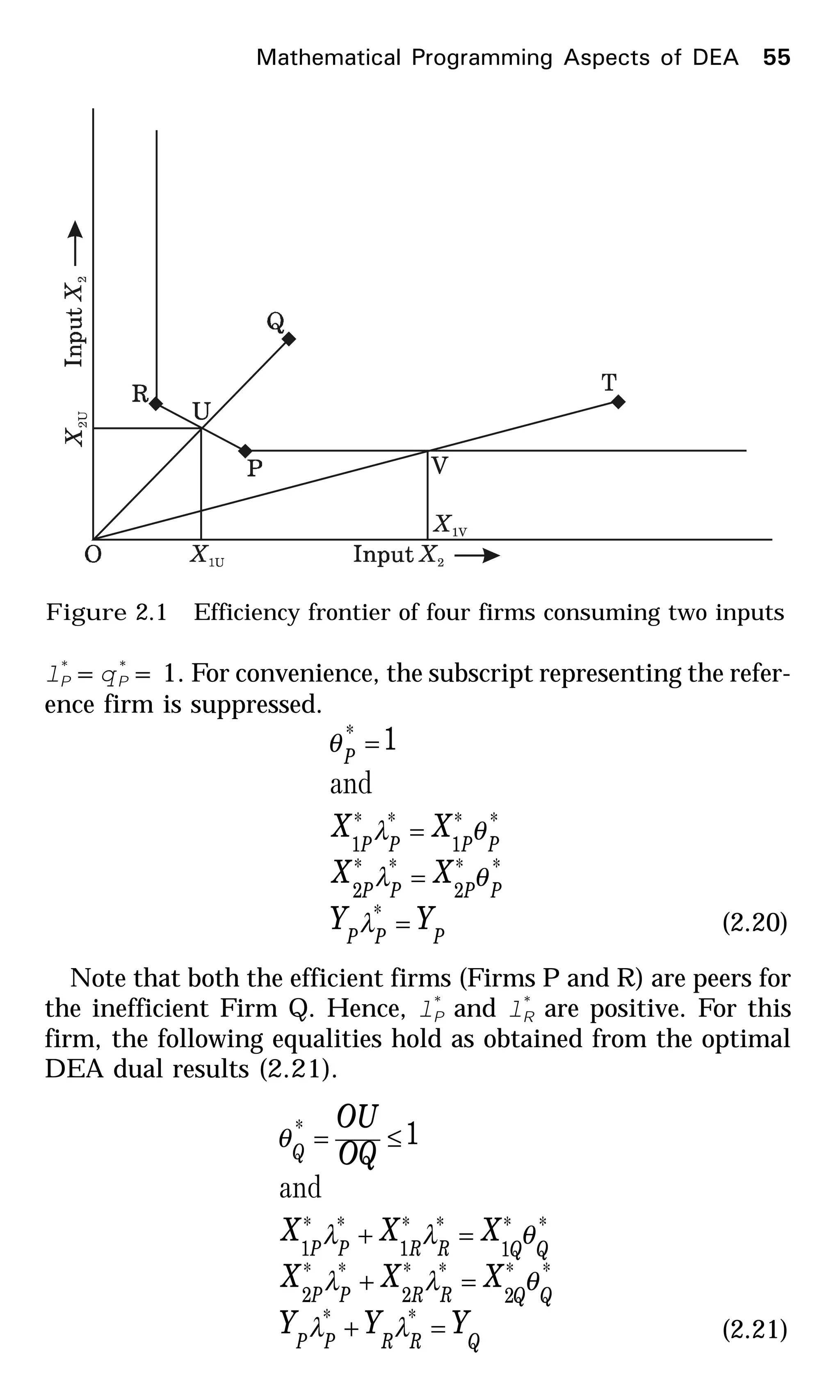
2.12.12.12.12.1 Efficiency frontier of four firms consuming 55
two inputs
2.22.22.22.22.2 Behaviour of input and output oriented 60
envelopment DEA programs
3.13.13.13.13.1 Production functions 68
3.23.23.23.23.2 Scale of operations of Firms A, B, C, and D 70
3.33.33.33.33.3 CRS and VRS frontiers for the Firms A, B, C, and D 72
3.43.43.43.43.4 NIRS DEA frontier 75
3.53.53.53.53.5 NDRS DEA frontier 76
3.63.63.63.63.6 CRS and VRS efficient frontiers for the 79
Firms A, B, C, and D
4.14.14.14.14.1 Malmquist productivity index 100
5.15.15.15.15.1 Output screen from EMS software 118
5.25.25.25.25.2 Spreadsheet for solving the output maximizing 127
multiplier DEA program for Firm A
5.35.35.35.35.3 Solver Parameters dialogue box 129
5.45.45.45.45.4 Add Constraints dialogue box 130
5.55.55.55.55.5 Solver Options dialogue box 131
5.65.65.65.65.6 Solver Results dialogue box 131
5.75.75.75.75.7 Solver solution for the output maximizing 132
multiplier DEA program for Firm A
5.85.85.85.85.8 Spreadsheet for solving the output maximizing 132
multiplier DEA program for Firm B
7.17.17.17.17.1 A graphical representation of DEA analysis 180
of schools in case of two outputs
Foreword
Our society increasingly feels the need to implement transparent
and consistent decision processes. Hence, the citizens are more
and more confronted with evaluation procedures which support
their public and private decisions. The choice of a secondary school
for their children is supported by league tables which record and
assess the performance of the schools in their neighbourhood,
research and education at the universities is subject to elaborate
output-based evaluation procedures, and alternative infrastruc-
tural improvements (alternative motorway and railway trajectories,
alternative airport extensions) are subject to environmental assess-
ment procedures. Public authorities in the European Union are
obliged, whenever they issue a call for tenders, to publish a list of
the relevant criteria ranked in a decreasing order of importance.
With the scores assigned to the alternatives and with proper cri-
terion weights, decisions can be made with due regard to the ob-
jectives of the decision makers and on the basis of state-of-the-art
knowledge of technical, ecological, financial and other experts.
There is a rich variety of methods and techniques for the design
of transparent decision processes. Multi-Criteria Decision Analysis
(MCDA), for instance, can be used to identify a preferred alter-
native, to rank the alternatives in a decreasing order of preference,
or to classify the alternatives into a small number of categories.
Although these techniques clearly explain the rank-order positions
of the alternatives, they do not always indicate how a particular
alternative could reasonably improve its position. This is typically
a strong feature of Data Envelopment Analysis (DEA). In prin-
ciple, DEA is concerned with a number of alternative Decision-
Making Units (DMUs). Each of them is analyzed separately via a
mathematical-programming model which checks whether the
DMU under consideration could improve its performance by de-
creasing its input and increasing its output. The improvement is
pursued until the boundary of the convex hull of the other DMUs
is reached. A DMU which cannot improve its performance is ef-
ficient or non-dominated. Otherwise, it is dominated by a convex
combination of other DMUs. In summary, possible improvements
for a particular DMU are indicated, not in an arbitrary direction,
but on the basis of the performance of the more successful efficient
DMUs.
Data Envelopment Analysis is the major subject of this book.
Dr Ramanathan reviews the theoretical foundations, the algorith-
mic implications, and the computational implementations. There-
after he amply discusses several applications of DEA in the public
sector. Hence, this book is an excellent tool for practitioners who
are interested in the merits and the pitfalls of the technique. It
will prevent naïve applications without deeper reflections on what
the technique actually means for those who are subject to an evalu-
ation by DEA.
Dr Ramanathan spent two long periods in the Faculty of Infor-
mation Technology and Systems of the Delft University of Tech-
nology (September 1995–February 1996 and May–September
1999) where he significantly contributed to my project ‘Multi-
Criteria Decision Analysis and Multi-Objective Optimization’.
He devoted his time and energy to various subjects, in the first
period to the Multiplicative AHP and to Fair Allocation of Re-
sources, in the second period to Data Envelopment Analysis.
Several successful publications appeared later on in the literature.
He has a lot of energy indeed, and his research is an example of
inventiveness, diligence, and accuracy. Moreover, it was a pleasure
to discuss with him the basic assumptions and the objectives of
our efforts to address administrative problems with mathematical
tools. We are operating in the wider fields of Operations Research
and Decision Analysis, where scientists are sometimes heavily
criticized for their quantitative approach of administrative prob-
lems. Nevertheless, we believe that, both, an unbiased collection
and a careful analysis of the relevant data constitute a major con-
tribution to the formulation and the solution of such problems.
It is a real pleasure to congratulate Dr Ramanathan on his
achievements. I expect that many scientists and practitioners will
16 An Introduction to Data Envelopment Analysis
Foreword 17
benefit from his thorough studies and his suggestions for further
research.
FFFFFreerk A. Lreerk A. Lreerk A. Lreerk A. Lreerk A. Lootsmaootsmaootsmaootsmaootsma
Faculty of Information Technology
and Systems
Delft University of Technology
Mekelweg 4
2628 CD Delft
The Netherlands
With great sadness, I have to inform readers that Professor Freerk
A. Lootsma passed away on Friday, 16 May 2003. He contributed
significantly to the field of Multi-Criteria Decision Making and
was a great motivator for researchers like me in his fields of special-
ization. He was a thorough gentleman, and in his untimely passing
I have lost a good friend and mentor.
R. RR. RR. RR. RR. Ramanathanamanathanamanathanamanathanamanathan
Preface
Data Envelopment Analysis (DEA) is a mathematical program-
ming technique that has found a number of practical applications
for measuring the performance of similar units, such as a set of
hospitals, a set of schools, a set of banks, etc. This book has been
developed as an introductory textbook on DEA with some exercises
at the end of many chapters. The book has been developed from
the teaching and research experiences of the author while he was
associated with the Indira Gandhi Institute of Development Re-
search, Mumbai, India, the Delft University of Technology, Delft,
The Netherlands, and the Helsinki University of Technology,
Finland.
Though DEA is essentially a mathematics-oriented subject,
attempt has been made in the book to minimize rigorous mathe-
matical treatment and provide the concepts descriptively. While
the book is meant for a general audience and beginners with min-
imum knowledge on mathematics, a major prerequisite for the
readers of this book is knowledge on linear programming.
The book begins with the basics of efficiency measurement
and frontier analysis. A linear programming formulation is
employed to explain DEA in the next chapter. Various program-
ming aspects of DEA, such as dual formulations, are also described
in this chapter. Chapter 3 provides a treatment of economies of
scale in DEA. Some of the extensions on DEA, namely multipli-
cative models, time series analysis, treatment of non-discretionary
variables, categorical variables, and incorporating judgements in
DEA models have been covered in Chapter 4. For those interested
in knowing more about these extensions, appropriate references
on research articles have been provided in this chapter. Exercises
are included at the end of each chapter. Computational features
of DEA, details on DEA software, and Internet support facilities
have been covered in Chapter 5. Some DEA software available
freely (for academic use) on the Internet have been described and
illustrated. Use of spreadsheets such as MS Excel to solve DEA
programs has been illustrated. A brief literature survey and
references to DEA bibliographies are provided in Chapter 6. To
give a practical flavour to the book, a number of real life perform-
ance measurement studies, especially from the research carried
out by the author and published in reputed international journals,
have been described in this chapter. The applications cover studies
in the Netherlands, India and the world. The practical applications
described in the book have appeared as research articles in Energy
Policy, International Journal of Global Energy Issues, Energy—The
International Journal, OPSEARCH, and Indian Journal of Transport
Management. Other applications reported in the literature have
been used to provide additional exercises. Some practical issues
pertaining to the application of DEA and some research issues
on DEA are discussed in the last chapter. A list of articles referred
in the book is available as a separate reference list. For the benefit
of students, some problems from the exercises have been solved,
and the solutions are provided at the end of the book.
Because of the popularity of Internet and the availability of
several informative Internet sites on DEA, several Internet web
sites have been referred throughout this book. Most the sites have
been accessed in the years 2001 and 2002 (at the latest in April
2002).
It is hoped that this book will be useful for those engaged in
research and applications of operations research and performance
measurement (including those who work in the field of economics).
DEA is likely to be offered as a full course or as part of advanced
quantitative courses in the departments of Business, Management
Science, Quantitative Techniques, Industrial Engineering, Indus-
trial Management or Mathematics of many universities and insti-
tutions. With the growing numbers of basic and advanced courses
on DEA in many universities and institutions across the world,
including the USA, Europe and Asia, it is expected that the book
will have a worldwide audience, including students, researchers
and practising consultants, engaged in operations research and
performance measurement.
20 An Introduction to Data Envelopment Analysis
Acknowledgements
This book is based on my teaching experience and the materials I
prepared for teaching in the Indira Gandhi Institute of Develop-
ment Research (IGIDR), Mumbai, India, and the Helsinki Uni-
versity of Technology, Finland. I would like to acknowledge my
students in both the Institutions who helped me improve the
contents of this book through their helpful suggestions and feed-
back on my courses. I also wish to acknowledge the critical com-
ments and suggestions provided by the reviewers of the book.
My interest in DEA started long ago when I worked with my
research supervisor Professor L.S. Ganesh at the Indian Institute
of Technology, Madras, India, though I could not devote much
attention to this subject at that time. While I carried out some
DEA studies subsequently when I was associated with IGIDR,
the main thrust to my DEA studies happened when I visited the
Delft University of Technology, Delft, The Netherlands. I thank
the Delft University of Technology for offering me the senior re-
search fellowship, and, the late Professor Freerk Lootsma for host-
ing me in his department and for arranging funds to present our
research findings on the application of DEA to Dutch Schools in
a conference in the International Institute of Applied Systems
Analysis, Austria.
My knowledge on DEA further improved during my stay in
Helsinki University of Technology, Finland. I thank the University
for offering me the Visiting Professorship. I thank Professors Ahti
Salo and Raimo Hamalainen of the Helsinki University of Tech-
nology, for their helpful views on DEA. I would like to thank
Professor Pekka Korhonen of the Helsinki School of Economics
and Business Administration for his insight, helpful suggestions
and comments on DEA during our interactions.
I thank my present institution, the Sultan Qaboos University,
for the assistance during the final stages of the preparation of
this book. I thank the members of Sage Publications for the ex-
cellent typesetting and organization of this book.
My wife Usha and children Bharadwaj and Nila played an
absolutely vital role towards the completion of this book. Many a
times they have tolerated my absent-mindedness and created a
warm family atmosphere that drives away the loneliness of scien-
tific research.
22 An Introduction to Data Envelopment Analysis
List of Abbreviations
The following abbreviations pertain to the theory of DEA and
are used in many parts of the book.
DEA Data Envelopment Analysis
DMU Decision-Making Unit
DM Decision-Maker
LP Linear Programming
CCR Charnes, Cooper and Rhodes
BCC Banker, Charnes and Cooper
LHS Left-Hand Side
RHS Right-Hand Side
CAP Capital Employed
VA Value Added
EMP No. of Employees
MPI Malmquist Productivity Index
FDH Free Disposal Hull
MCDM Multi-Criteria Decision-Making
DRS Decreasing Returns to Scale
IRS Increasing Returns to Scale
VRS Variable Returns to Scale
CRS Constant Returns to Scale
NDRS Non-Decreasing Returns to Scale
NIRS Non-Increasing Returns to Scale
MPSS Most Productive Scale Size
DEAP A Data Envelopment Analysis (Computer) Program
EMS Efficiency Measurement System
GAMS General Algebraic Modelling System
The following abbreviations are used only in one chapter/section
of a chapter.
STU State Transport Undertaking
PKM Passenger Kilometres
TKM Tonne-Kilometres
TJ Tera Joules
IS Information System
OECD Organization for Economic Cooperation and
Development
MW MegaWatts
kcal kilocalories
GWh GigaWatt-hour
VBA Visual Basic for Applications
GDP Gross Domestic Product
CRA Comparative Risk Assessment
LLE Loss of Life Expectancy
GLE Gain of Life Expectancy
PV Photovoltaic
CO2 Carbon dioxide
FOSS Fossil Fuel Energy Consumption
NFOSS Non-Fossil Fuel Energy Consumption
24 An Introduction to Data Envelopment Analysis
1
Introduction
Data Envelopment Analysis (DEA) is a methodology based upon
an interesting application of linear programming. It was originally
developed for performance measurement. It has been successfully
employed for assessing the relative performance of a set of firms
that use a variety of identical inputs to produce a variety of iden-
tical outputs. The principles of DEA date back to Farrel (1957).
The recent series of discussions on this topic started with the
article by Charnes et al. (1978). A good introduction to DEA is
available in Norman and Stoker (1991). Cooper et al. (2000)
provide recent and comprehensive material on DEA.
1.1 Decision-making Units
Data Envelopment Analysis is a linear programming-based
technique for measuring the performance efficiency of organiza-
tional units which are termed Decision-Making Units (DMUs).
This technique aims to measure how efficiently a DMU uses the
resources available to generate a set of outputs (Charnes et al.
1978). Decision-making units can include manufacturing units,
departments of big organizations such as universities, schools,
bank branches, hospitals, power plants, police stations, tax offices,
prisons, defence bases, a set of firms or even practising individuals
26 An Introduction to Data Envelopment Analysis
such as medical practitioners. As we shall see later in this book,
DEA has been successfully applied to measure the performance
efficiency of all these kinds of DMUs.
Most of these DMUs are non-profit organizations, where the
measurement of performance efficiency is difficult.1
Note that
the efficiency of commercial organizations can be assessed easily
by their yearly profits, or their stock market indices. However,
such measurable factors are not applicable to non-profit organiza-
tions. The problem is complicated by the fact that the DMUs
consume a variety of identical inputs and produce a variety of
identical outputs. For example, schools can have a variety of in-
puts, which are the same for each school—quality of students,
teachers, grants, etc. They have a variety of identical outputs—
number of students passing the final year, average grade obtained
by the students in their final year, etc.
The performance of DMUs is assessed in DEA using the con-
cept of efficiency or productivity, which is the ratio of total outputs
to total inputs. Efficiencies estimated using DEA are relative,
that is, relative to the best performing DMU (or DMUs if there
is more than one best-performing DMUs). The best-performing
DMU is assigned an efficiency score of unity or 100 per cent, and
the performance of other DMUs vary, between 0 and 100 per
cent relative to this best performance.
1.2 Basic Concepts of Efficiency Measurement
As mentioned earlier, the basic efficiency measure used in DEA
is the ratio of total outputs to total inputs.
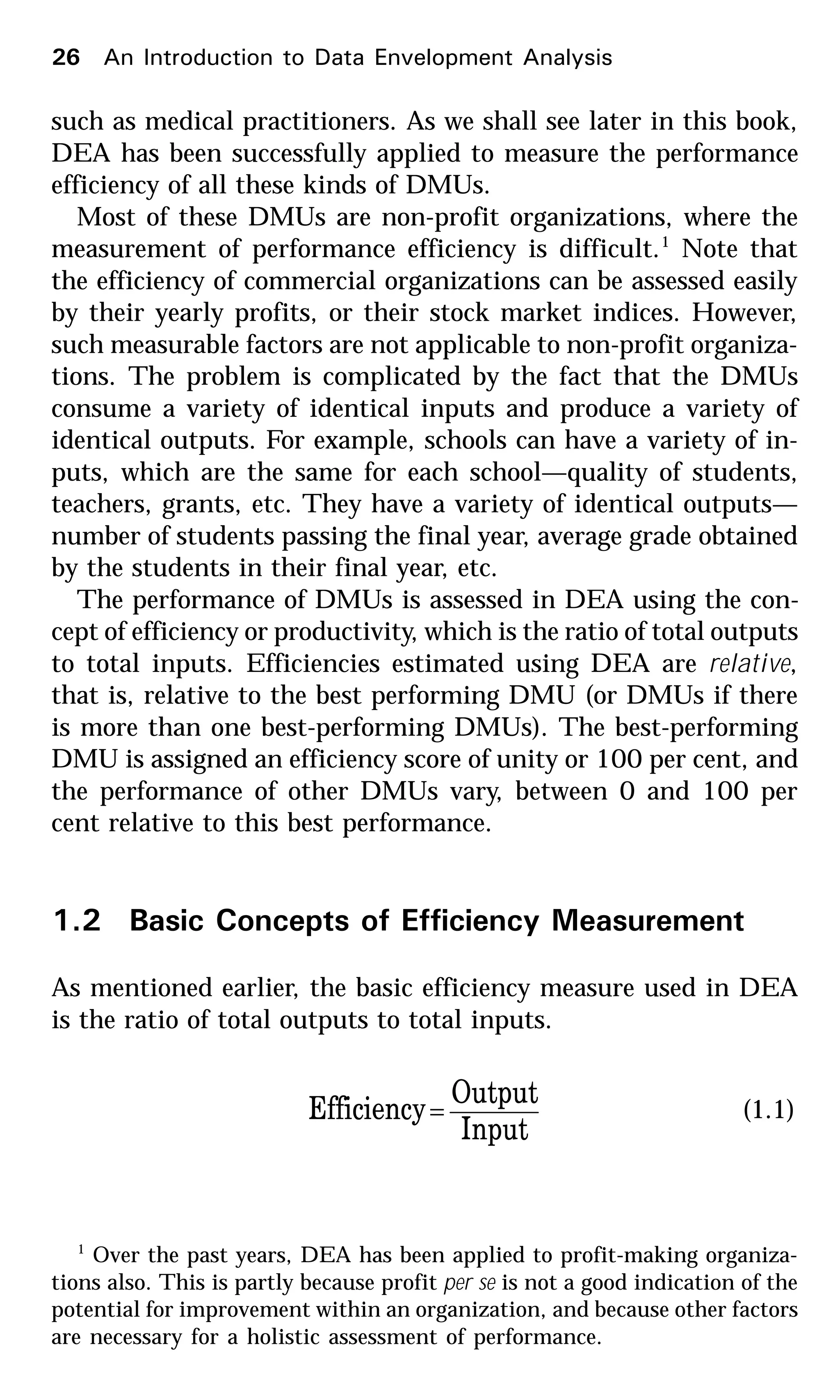
Input
Output
Efficiency= (1.1)
1
Over the past years, DEA has been applied to profit-making organiza-
tions also. This is partly because profit per se is not a good indication of the
potential for improvement within an organization, and because other factors
are necessary for a holistic assessment of performance.
Introduction 27
1.2.1 Case of Single Input and Single Output
Let us consider the performance of four firms on the basis of one
input measure (capital) and one output measure (value added)2
as listed in Table 1.1.
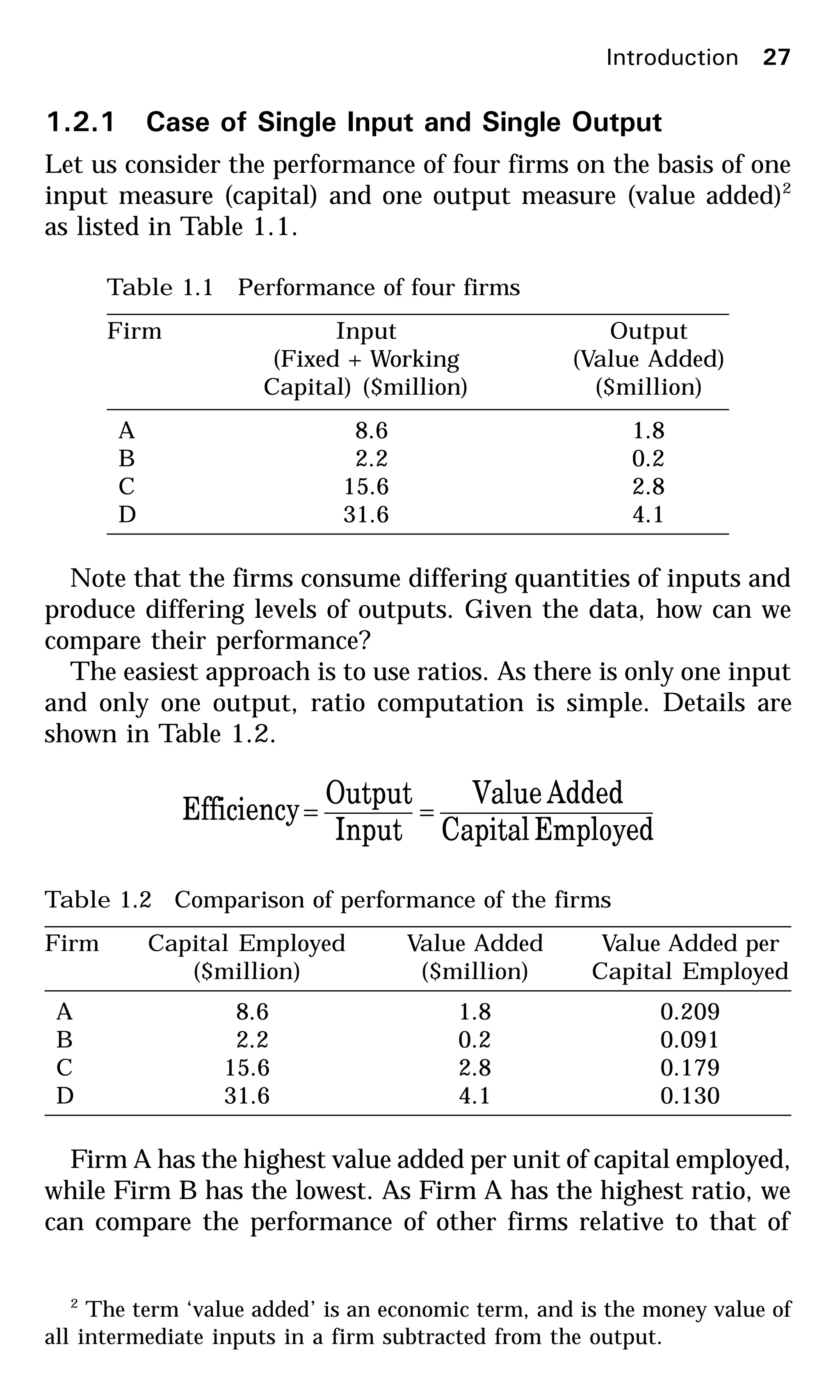
Table 1.1 Performance of four firms
Firm Input Output
(Fixed + Working (Value Added)
Capital) ($million) ($million)
A 8.6 1.8
B 2.2 0.2
C 15.6 2.8
D 31.6 4.1
Note that the firms consume differing quantities of inputs and
produce differing levels of outputs. Given the data, how can we
compare their performance?
The easiest approach is to use ratios. As there is only one input
and only one output, ratio computation is simple. Details are
shown in Table 1.2.
EmployedCapital
AddedValue
Input
Output
Efficiency ==
Table 1.2 Comparison of performance of the firms
Firm Capital Employed Value Added Value Added per
($million) ($million) Capital Employed
A 8.6 1.8 0.209
B 2.2 0.2 0.091
C 15.6 2.8 0.179
D 31.6 4.1 0.130
Firm A has the highest value added per unit of capital employed,
while Firm B has the lowest. As Firm A has the highest ratio, we
can compare the performance of other firms relative to that of
2
The term ‘value added’ is an economic term, and is the money value of
all intermediate inputs in a firm subtracted from the output.
28 An Introduction to Data Envelopment Analysis
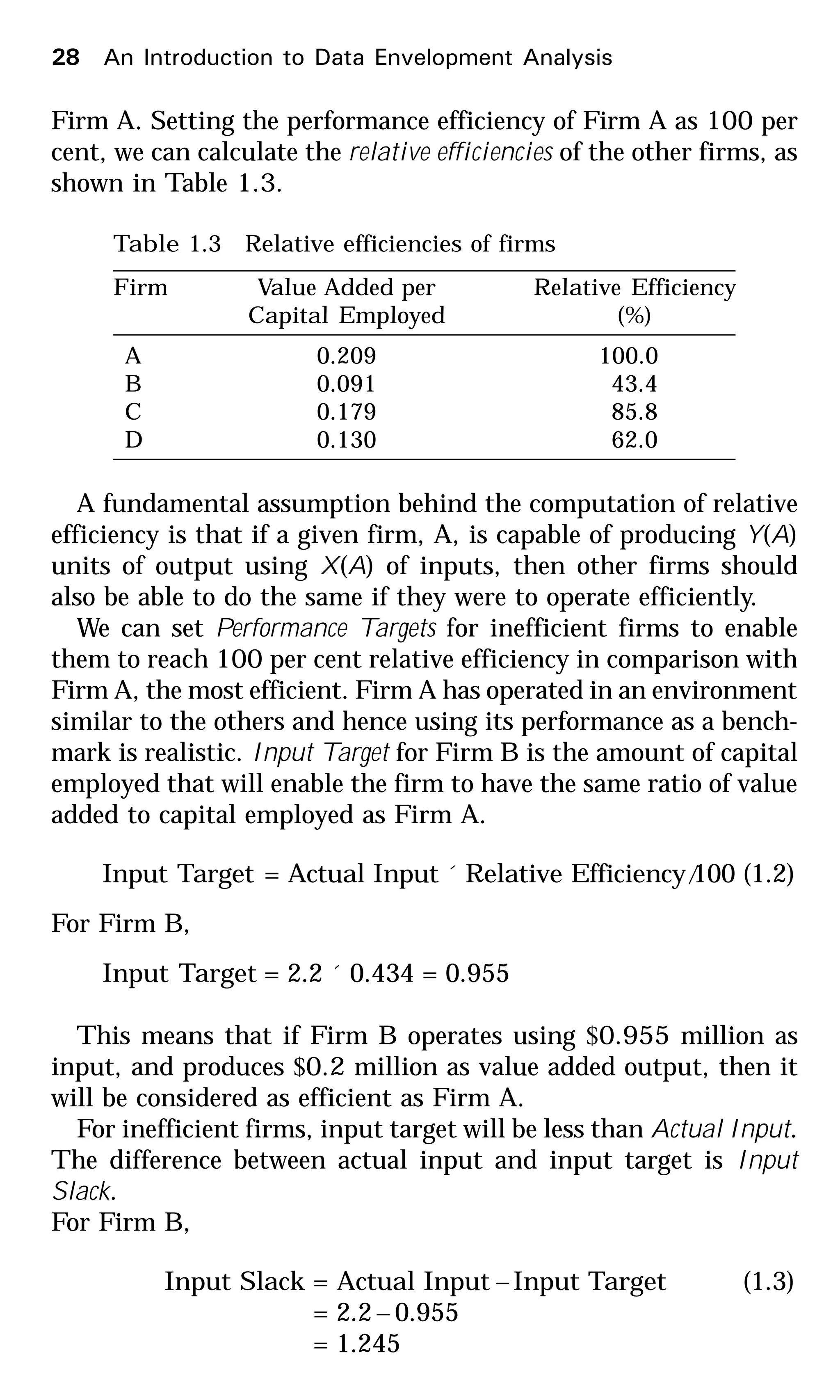
Firm A. Setting the performance efficiency of Firm A as 100 per
cent, we can calculate the relative efficiencies of the other firms, as
shown in Table 1.3.
Table 1.3 Relative efficiencies of firms
Firm Value Added per Relative Efficiency
Capital Employed (%)
A 0.209 100.0
B 0.091 43.4
C 0.179 85.8
D 0.130 62.0
A fundamental assumption behind the computation of relative
efficiency is that if a given firm, A, is capable of producing Y(A)
units of output using X(A) of inputs, then other firms should
also be able to do the same if they were to operate efficiently.
We can set Performance Targets for inefficient firms to enable
them to reach 100 per cent relative efficiency in comparison with
Firm A, the most efficient. Firm A has operated in an environment
similar to the others and hence using its performance as a bench-
mark is realistic. Input Target for Firm B is the amount of capital
employed that will enable the firm to have the same ratio of value
added to capital employed as Firm A.
Input Target = Actual Input ´ Relative Efficiency/100 (1.2)
For Firm B,
Input Target = 2.2 ´ 0.434 = 0.955
This means that if Firm B operates using $0.955 million as
input, and produces $0.2 million as value added output, then it
will be considered as efficient as Firm A.
For inefficient firms, input target will be less than Actual Input.
The difference between actual input and input target is Input
Slack.
For Firm B,
Input Slack = Actual Input –Input Target (1.3)
= 2.2– 0.955
= 1.245
Introduction 29
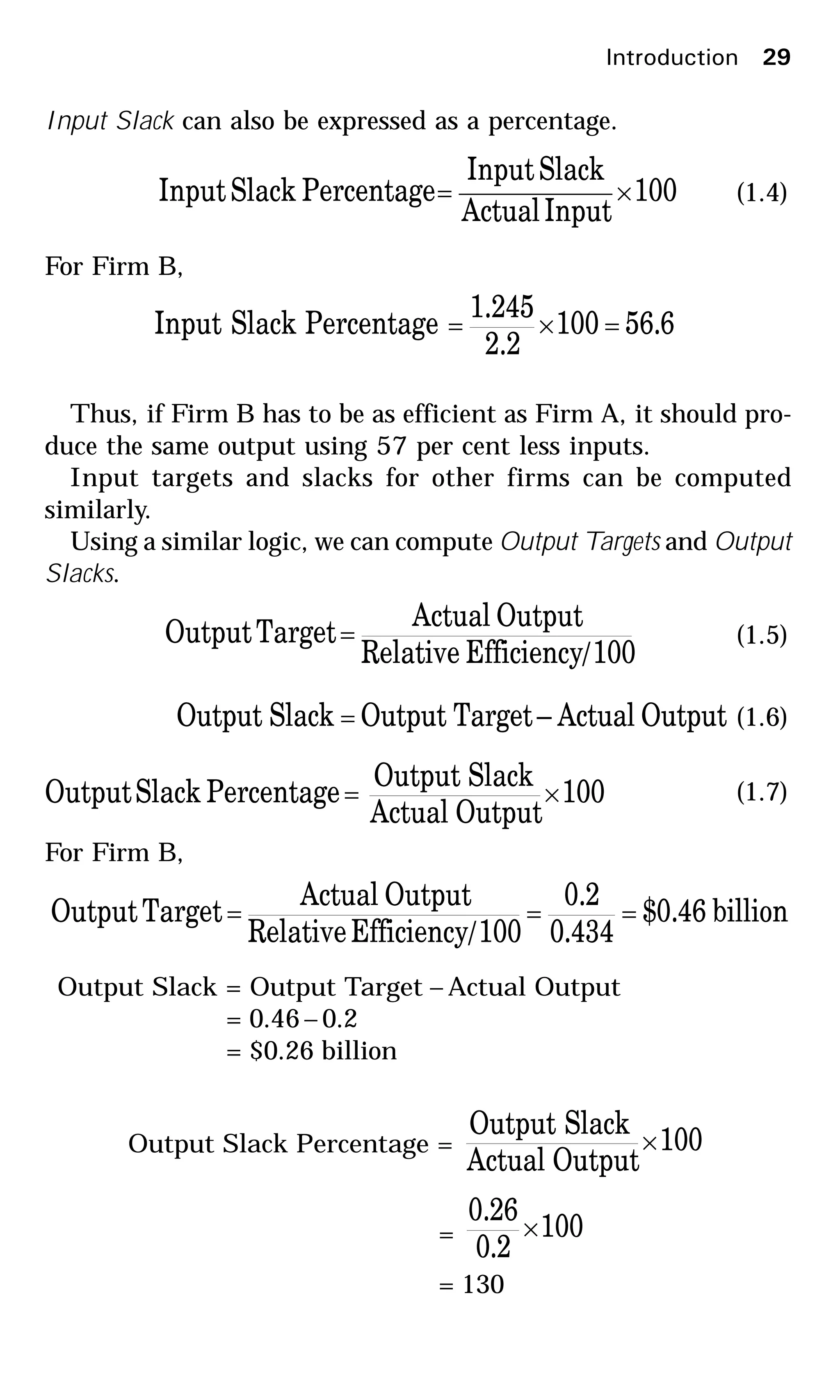
Input Slack can also be expressed as a percentage.
100
InputActual
SlackInput
PercentageSlackInput ×= (1.4)
For Firm B,
6.56100
2.2
1.245
PercentageSlackInput =×=
Thus, if Firm B has to be as efficient as Firm A, it should pro-
duce the same output using 57 per cent less inputs.
Input targets and slacks for other firms can be computed
similarly.
Using a similar logic, we can compute Output Targets and Output
Slacks.
100/EfficiencyRelative
OutputActual
TargetOutput = (1.5)
OutputActual–TargetOutputSlackOutput = (1.6)
100
OutputActual
SlackOutput
PercentageSlackOutput ×= (1.7)
For Firm B,
billion46.0$
434.0
2.0
100/EfficiencyRelative
OutputActual
TargetOutput ===
Output Slack = Output Target – Actual Output
= 0.46– 0.2
= $0.26 billion
Output Slack Percentage = 100
OutputActual
SlackOutput
×
= 100
2.0
26.0
×
= 130
Thus, if firm B is to achieve the same efficiency as Firm A, it
should increase its output by $0.26 million or by 130 per cent
for the same level of input (capital).
1.2.2 Case of Single Output and Two Inputs
In practice, no firm consumes only one input to produce a single
output. Let us now add one more input—number of employees,
as listed in Table 1.4.
Table 1.4 An additional input for four firms
Firm No. of Employees (’000)
A 1.8
B 1.7
C 2.6
D 12.3
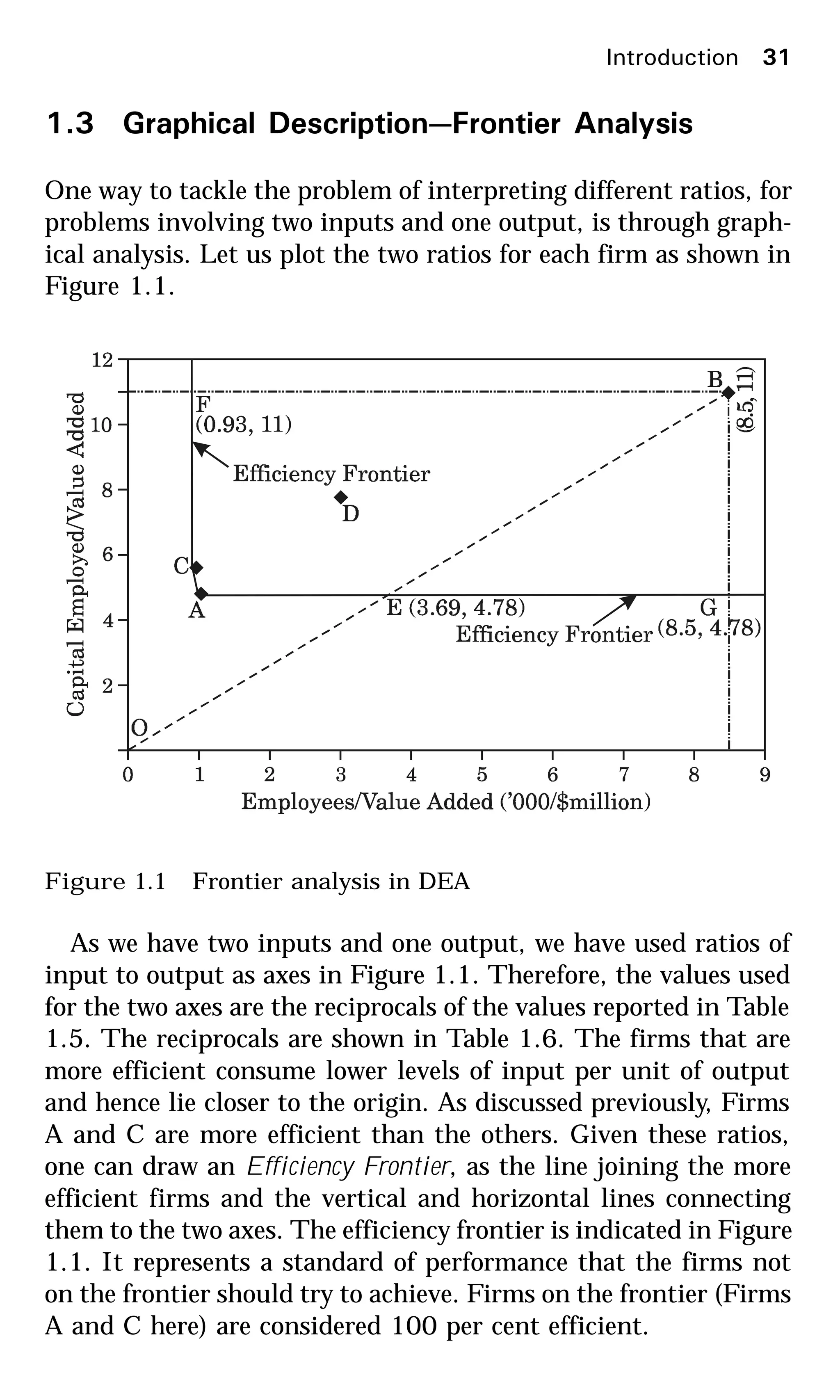
How do we compare the performance of the firms now? We can
still use ratios, but we now have two ratios. Calculations are shown
in Table 1.5. Throughout this textbook, whenever this example
is considered, value added and capital employed are always meas-
ured in million dollars, and employees in thousands.
Table 1.5 Comparison of performance of firms
with one output and two inputs
Firm Value Added per Value Added per
Capital Employed Employees
A 0.209 1.000
B 0.091 0.118
C 0.179 1.077
D 0.130 0.333
Note that Firm A has produced the largest value added per
unit of capital employed, while Firm C has produced the maximum
value added per employee. As we do not know which ratio is more
crucial, we cannot say Firm A is more efficient than Firm C or
otherwise. What we can conclude is that Firms B and D are not
as efficient as Firms A and C, because their ratios of output to in-
put (i.e., value added to capital or value added to employees) are
lower.
30 An Introduction to Data Envelopment Analysis
1.3 Graphical Description—Frontier Analysis
One way to tackle the problem of interpreting different ratios, for
problems involving two inputs and one output, is through graph-
ical analysis. Let us plot the two ratios for each firm as shown in
Figure 1.1.
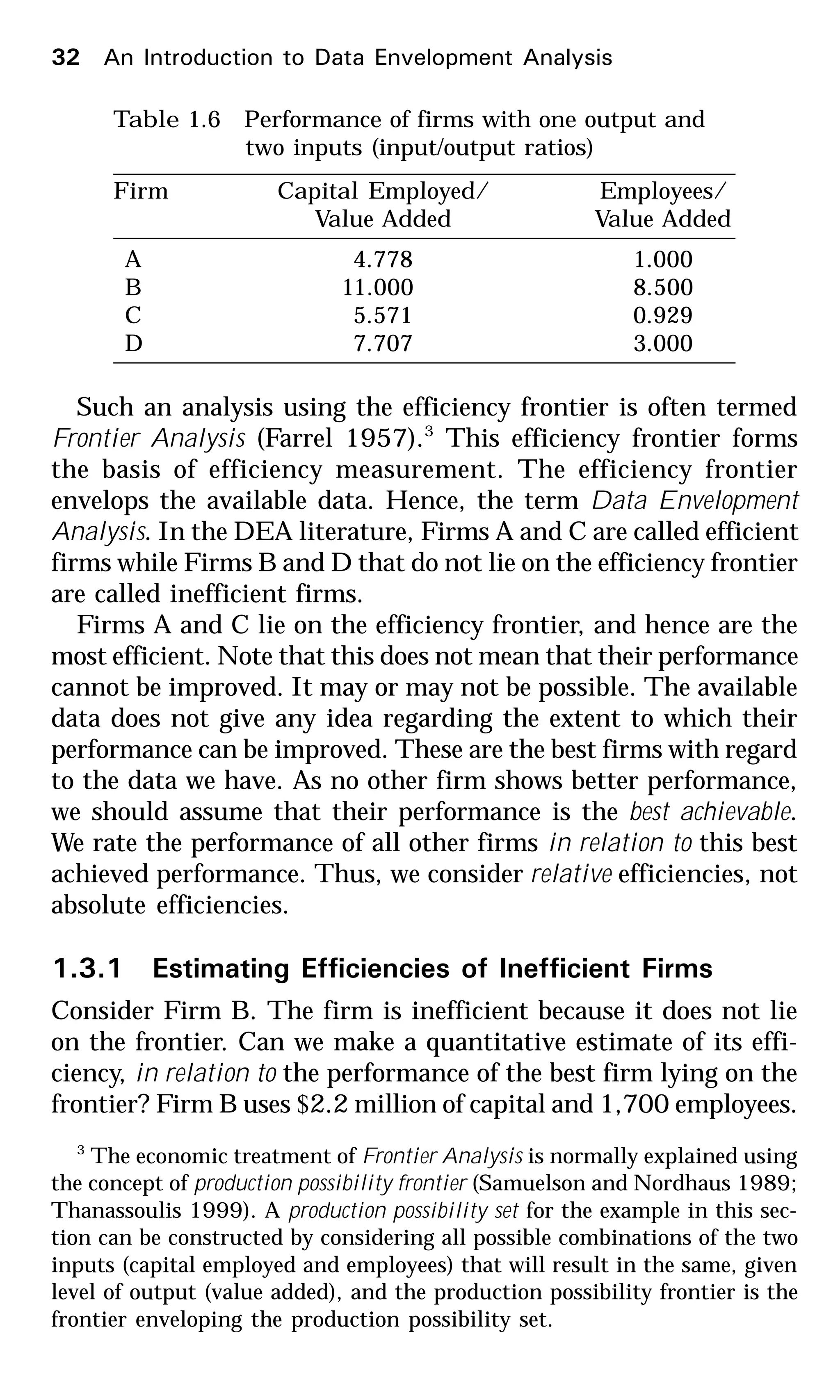
Figure 1.1 Frontier analysis in DEA
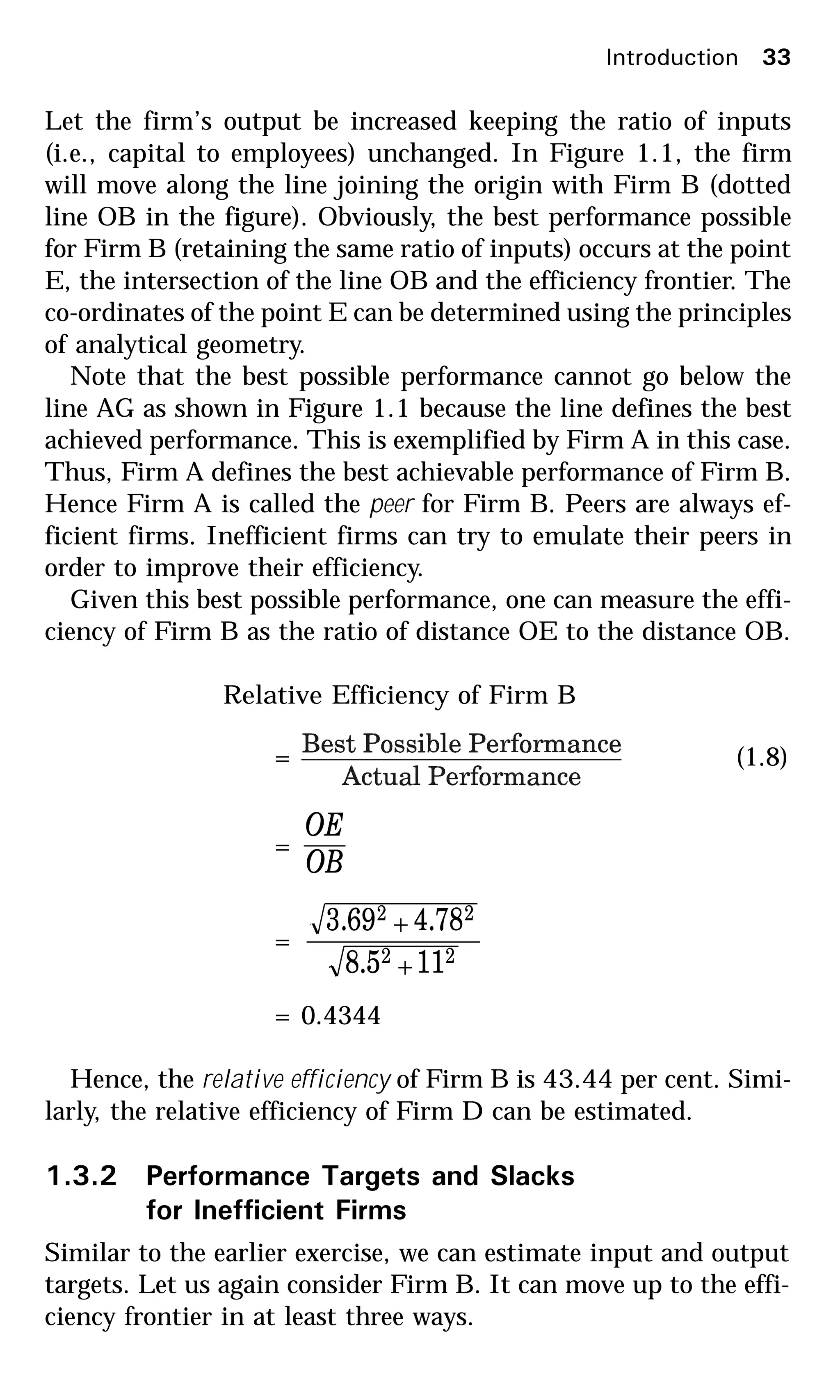
As we have two inputs and one output, we have used ratios of
input to output as axes in Figure 1.1. Therefore, the values used
for the two axes are the reciprocals of the values reported in Table
1.5. The reciprocals are shown in Table 1.6. The firms that are
more efficient consume lower levels of input per unit of output
and hence lie closer to the origin. As discussed previously, Firms
A and C are more efficient than the others. Given these ratios,
one can draw an Efficiency Frontier, as the line joining the more
efficient firms and the vertical and horizontal lines connecting
them to the two axes. The efficiency frontier is indicated in Figure
1.1. It represents a standard of performance that the firms not
on the frontier should try to achieve. Firms on the frontier (Firms
A and C here) are considered 100 per cent efficient.
Introduction 31
Table 1.6 Performance of firms with one output and
two inputs (input/output ratios)
Firm Capital Employed/ Employees/
Value Added Value Added
A 4.778 1.000
B 11.000 8.500
C 5.571 0.929
D 7.707 3.000
Such an analysis using the efficiency frontier is often termed
Frontier Analysis (Farrel 1957).3
This efficiency frontier forms
the basis of efficiency measurement. The efficiency frontier
envelops the available data. Hence, the term Data Envelopment
Analysis. In the DEA literature, Firms A and C are called efficient
firms while Firms B and D that do not lie on the efficiency frontier
are called inefficient firms.
Firms A and C lie on the efficiency frontier, and hence are the
most efficient. Note that this does not mean that their performance
cannot be improved. It may or may not be possible. The available
data does not give any idea regarding the extent to which their
performance can be improved. These are the best firms with regard
to the data we have. As no other firm shows better performance,
we should assume that their performance is the best achievable.
We rate the performance of all other firms in relation to this best
achieved performance. Thus, we consider relative efficiencies, not
absolute efficiencies.
1.3.1 Estimating Efficiencies of Inefficient Firms
Consider Firm B. The firm is inefficient because it does not lie
on the frontier. Can we make a quantitative estimate of its effi-
ciency, in relation to the performance of the best firm lying on the
frontier? Firm B uses $2.2 million of capital and 1,700 employees.
3
The economic treatment of Frontier Analysis is normally explained using
the concept of production possibility frontier (Samuelson and Nordhaus 1989;
Thanassoulis 1999). A production possibility set for the example in this sec-
tion can be constructed by considering all possible combinations of the two
inputs (capital employed and employees) that will result in the same, given
level of output (value added), and the production possibility frontier is the
frontier enveloping the production possibility set.
32 An Introduction to Data Envelopment Analysis
Let the firm’s output be increased keeping the ratio of inputs
(i.e., capital to employees) unchanged. In Figure 1.1, the firm
will move along the line joining the origin with Firm B (dotted
line OB in the figure). Obviously, the best performance possible
for Firm B (retaining the same ratio of inputs) occurs at the point
E, the intersection of the line OB and the efficiency frontier. The
co-ordinates of the point E can be determined using the principles
of analytical geometry.
Note that the best possible performance cannot go below the
line AG as shown in Figure 1.1 because the line defines the best
achieved performance. This is exemplified by Firm A in this case.
Thus, Firm A defines the best achievable performance of Firm B.
Hence Firm A is called the peer for Firm B. Peers are always ef-
ficient firms. Inefficient firms can try to emulate their peers in
order to improve their efficiency.
Given this best possible performance, one can measure the effi-
ciency of Firm B as the ratio of distance OE to the distance OB.
Relative Efficiency of Firm B
= (1.8)
=
OB
OE
=
22
22
115.8
78.469.3
+
+
= 0.4344
Hence, the relative efficiency of Firm B is 43.44 per cent. Simi-
larly, the relative efficiency of Firm D can be estimated.
1.3.2 Performance Targets and Slacks
for Inefficient Firms
Similar to the earlier exercise, we can estimate input and output
targets. Let us again consider Firm B. It can move up to the effi-
ciency frontier in at least three ways.
Introduction 33
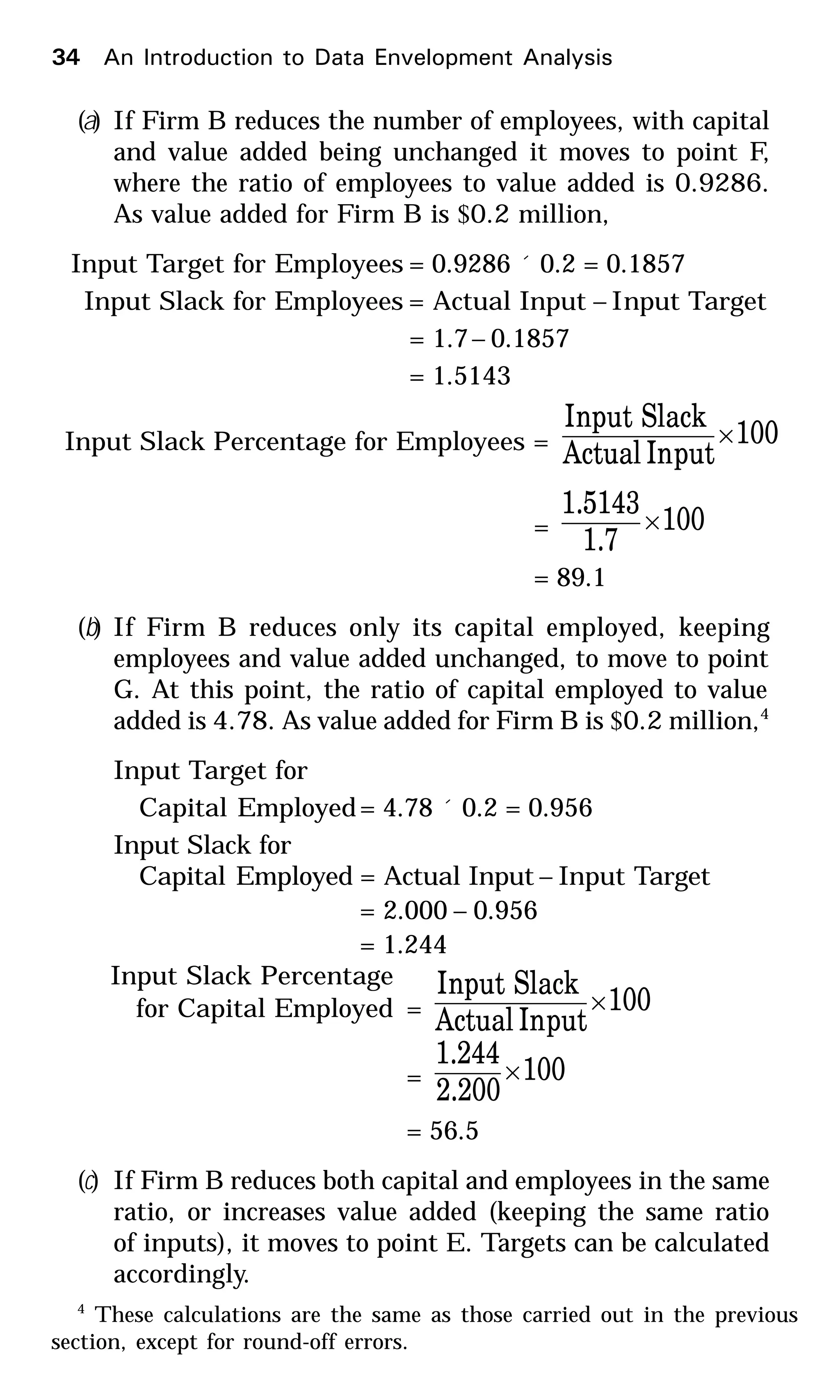
(a) If Firm B reduces the number of employees, with capital
and value added being unchanged it moves to point F,
where the ratio of employees to value added is 0.9286.
As value added for Firm B is $0.2 million,
Input Target for Employees = 0.9286 ´ 0.2 = 0.1857
Input Slack for Employees = Actual Input – Input Target
= 1.7– 0.1857
= 1.5143
Input Slack Percentage for Employees = 100
putInActual
SlacknputI
×
= 100
1.7
1.5143
×
= 89.1
(b) If Firm B reduces only its capital employed, keeping
employees and value added unchanged, to move to point
G. At this point, the ratio of capital employed to value
added is 4.78. As value added for Firm B is $0.2 million,4
Input Target for
Capital Employed= 4.78 ´ 0.2 = 0.956
Input Slack for
Capital Employed = Actual Input – Input Target
= 2.000 – 0.956
= 1.244
Input Slack Percentage
for Capital Employed = 100
putInActual
SlacknputI
×
= 100
2.200
1.244
×
= 56.5
(c) If Firm B reduces both capital and employees in the same
ratio, or increases value added (keeping the same ratio
of inputs), it moves to point E. Targets can be calculated
accordingly.
4
These calculations are the same as those carried out in the previous
section, except for round-off errors.
34 An Introduction to Data Envelopment Analysis
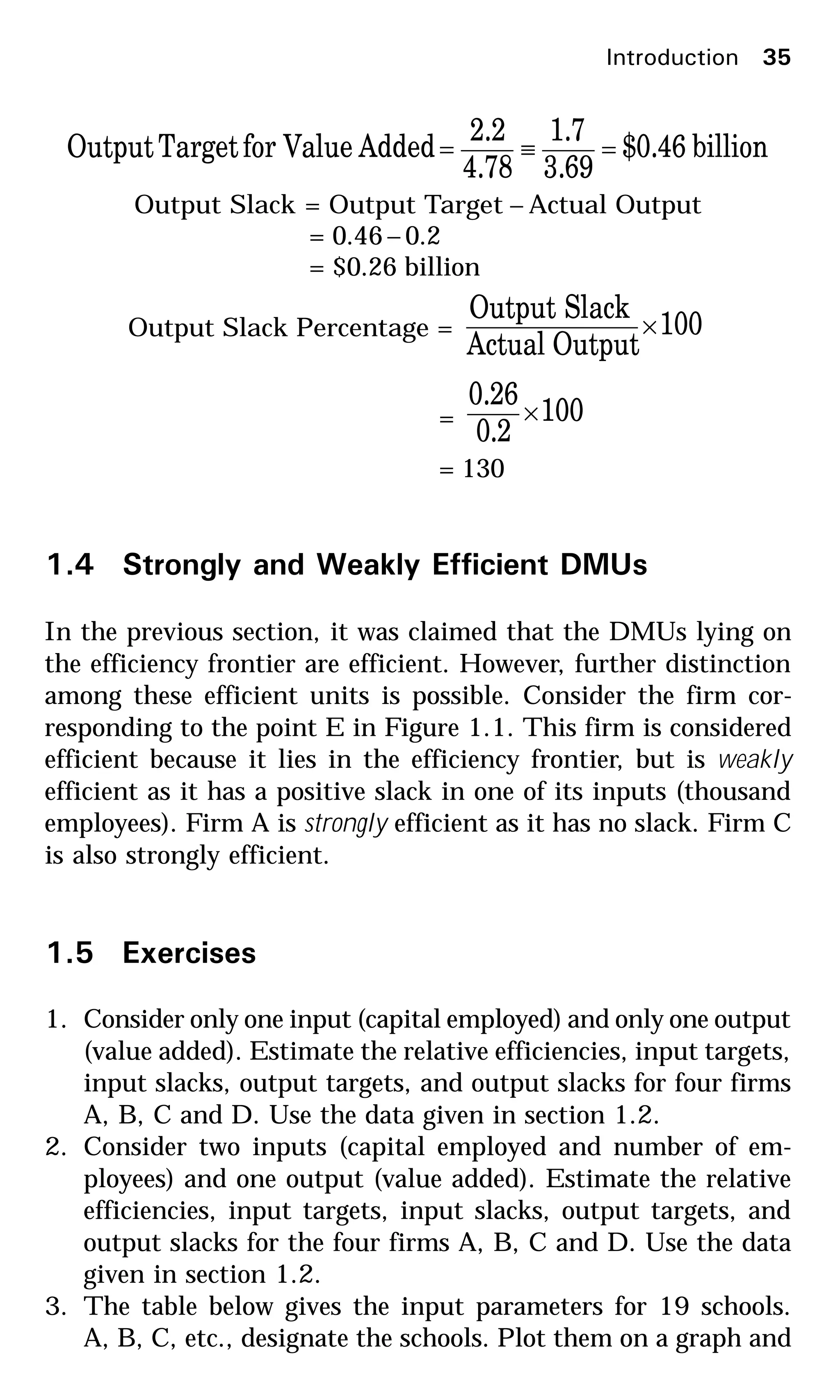
billion46.0$
69.3
7.1
4.78
2.2
AddedValueforTargetOutput =≡=
Output Slack = Output Target – Actual Output
= 0.46– 0.2
= $0.26 billion
Output Slack Percentage = 100
OutputActual
SlackOutput
×
= 100
2.0
26.0
×
= 130
1.4 Strongly and Weakly Efficient DMUs
In the previous section, it was claimed that the DMUs lying on
the efficiency frontier are efficient. However, further distinction
among these efficient units is possible. Consider the firm cor-
responding to the point E in Figure 1.1. This firm is considered
efficient because it lies in the efficiency frontier, but is weakly
efficient as it has a positive slack in one of its inputs (thousand
employees). Firm A is strongly efficient as it has no slack. Firm C
is also strongly efficient.
1.5 Exercises
1. Consider only one input (capital employed) and only one output
(value added). Estimate the relative efficiencies, input targets,
input slacks, output targets, and output slacks for four firms
A, B, C and D. Use the data given in section 1.2.
2. Consider two inputs (capital employed and number of em-
ployees) and one output (value added). Estimate the relative
efficiencies, input targets, input slacks, output targets, and
output slacks for the four firms A, B, C and D. Use the data
given in section 1.2.
3. The table below gives the input parameters for 19 schools.
A, B, C, etc., designate the schools. Plot them on a graph and
Introduction 35
identify the most efficient schools. Draw the efficiency frontier.
Which is the most inefficient school and why? Also, use your
own knowledge in analytical geometry or any other idea to
compute the efficiency of the following schools: B, H, Q, R
and S.
School No. of Non-teaching No. of Teaching
Staff/Proportion of Staff/Proportion of
Students Passing in Students Passing in
the Final School Exam. the Final School Exam.
A 9.443000 252.8089
B 96.45864 202.9064
C 152.2905 175.5855
D 71.88695 150.1708
F 87.27089 144.5602
G 68.9087 139.9097
H 35.56934 121.2792
I 92.76387 100.1946
J 166.9809 94.35873
K 18.09131 93.10026
L 99.06741 91.41724
M 38.35395 90.25016
N 11.41596 83.5886
O 60.25421 79.99854
P 122.7965 74.52081
Q 30.28074 57.25475
R 82.86489 55.91398
S 27.82466 54.57391
T 50.35362 50.12258
4. Some output parameters for hospitals designated as A, B, C,
etc., are tabulated below. Plot them on a graph and identify
the most efficient hospitals. Draw the efficiency frontier. What
is the most inefficient hospital and why? Also, use your own
knowledge in analytical geometry or any other idea to compute
the efficiency of the following hospitals: B, C, H and R.
36 An Introduction to Data Envelopment Analysis
Hospital Average Number of Average Number of
Medical Surgical Intensive Medical Surgical Acute
Care Discharges/Average Discharges/Average
Staffed Beds Staffed Beds
A 0.944307 25.28089
B 9.645874 20.29064
C 15.2290500 17.55855
D 7.188695 15.01708
F 8.727089 14.45602
G 6.890870 13.99097
H 3.556934 12.12792
I 9.276387 10.01946
J 16.6980900 009.435873
K 1.809131 009.310026
L 9.906741 009.141724
M 3.835395 009.025016
N 1.141596 08.35886
O 6.025421 007.999854
P 12.2796500 007.452081
Q 3.028074 005.725475
R 8.286489 005.591398
S 2.782466 005.457391
T 5.035362 005.012258
Introduction 37
2
Mathematical Programming
Aspects of DEA
As discussed in the first chapter, performance evaluation for the
case of two inputs and one output was more complicated than in
the case of single input–output. Graphical analysis was used for
analysing this case. However, graphical models cannot be used if
we consider a greater number of inputs and outputs. Hence, a
general mathematical formulation is needed to handle the case of
multiple inputs and multiple outputs.
Note that the techniques of frontier analysis has been described
by Farrel in 1957, but a mathematical framework to handle fron-
tier analysis could be established only after 20 years. This math-
ematical formulation was provided by Charnes et al. (1978). This
seminal paper provided the fundamentals of the mathematical
aspects of frontier analysis. The authors also coined the term Data
Envelopment Analysis.
2.1 Mathematical Formulation
Let us use x and y to represent inputs and outputs, respectively.
Let the subscripts i and j to represent particular inputs and out-
puts respectively. Thus xi represents the ith input, and yj represent
the jth output of a decision-making unit. Let the total number of
inputs and outputs be represented by I and J respectively, where
I, J > 0.
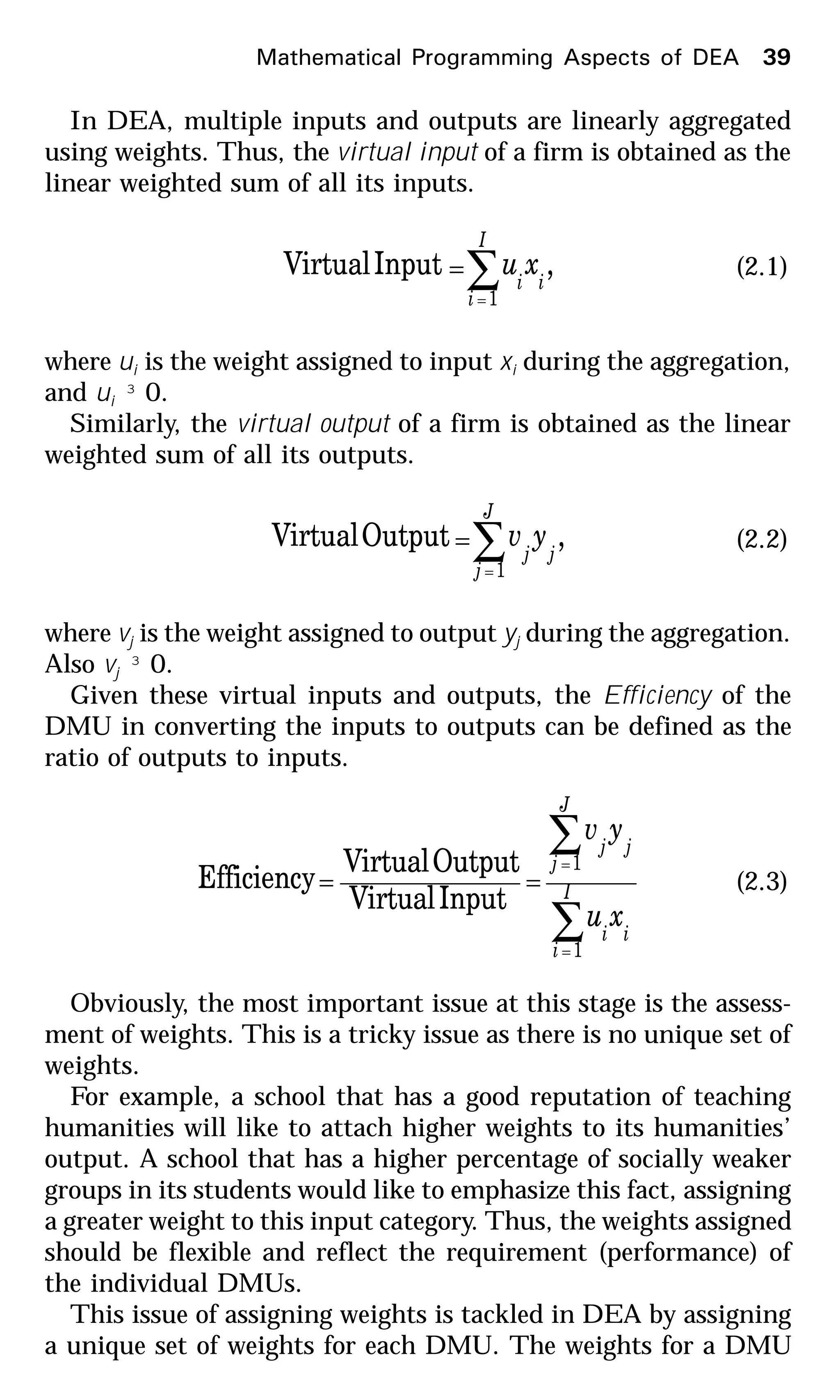
In DEA, multiple inputs and outputs are linearly aggregated
using weights. Thus, the virtual input of a firm is obtained as the
linear weighted sum of all its inputs.
∑=
=
I
i
ii
xu
1
,InputVirtual (2.1)
where ui is the weight assigned to input xi during the aggregation,
and ui ³ 0.
Similarly, the virtual output of a firm is obtained as the linear
weighted sum of all its outputs.
∑=
=
J
j
jj
yv
1
,OutputVirtual (2.2)
where vj is the weight assigned to output yj during the aggregation.
Also vj ³ 0.
Given these virtual inputs and outputs, the Efficiency of the
DMU in converting the inputs to outputs can be defined as the
ratio of outputs to inputs.
∑
∑
=
=
== I
i
ii
J
j
jj
xu
yv
1
1
InputVirtual
OutputVirtual
Efficiency (2.3)
Obviously, the most important issue at this stage is the assess-
ment of weights. This is a tricky issue as there is no unique set of
weights.
For example, a school that has a good reputation of teaching
humanities will like to attach higher weights to its humanities’
output. A school that has a higher percentage of socially weaker
groups in its students would like to emphasize this fact, assigning
a greater weight to this input category. Thus, the weights assigned
should be flexible and reflect the requirement (performance) of
the individual DMUs.
This issue of assigning weights is tackled in DEA by assigning
a unique set of weights for each DMU. The weights for a DMU
Mathematical Programming Aspects of DEA 39
40 An Introduction to Data Envelopment Analysis
are determined, using mathematical programming, as those
weights which will maximize its efficiency subject to the condition
that the efficiencies of other DMUs (calculated using the same
set of weights) is restricted to values between 0 and 1. The DMU
for which the efficiency is maximized is normally termed as the
reference or base DMU or the DMU under the assessment.
2.1.1 Fractional DEA Programs
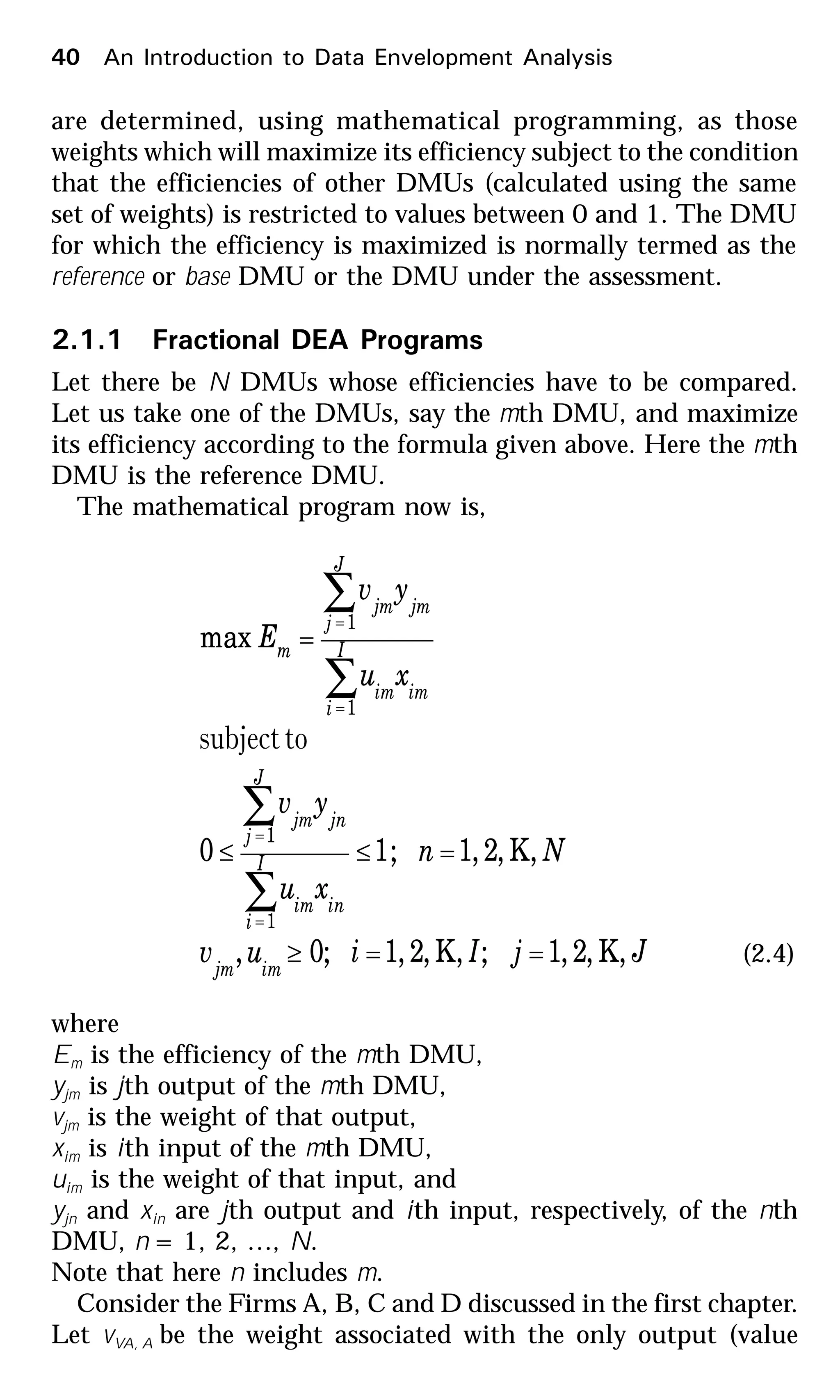
Let there be N DMUs whose efficiencies have to be compared.
Let us take one of the DMUs, say the mth DMU, and maximize
its efficiency according to the formula given above. Here the mth
DMU is the reference DMU.
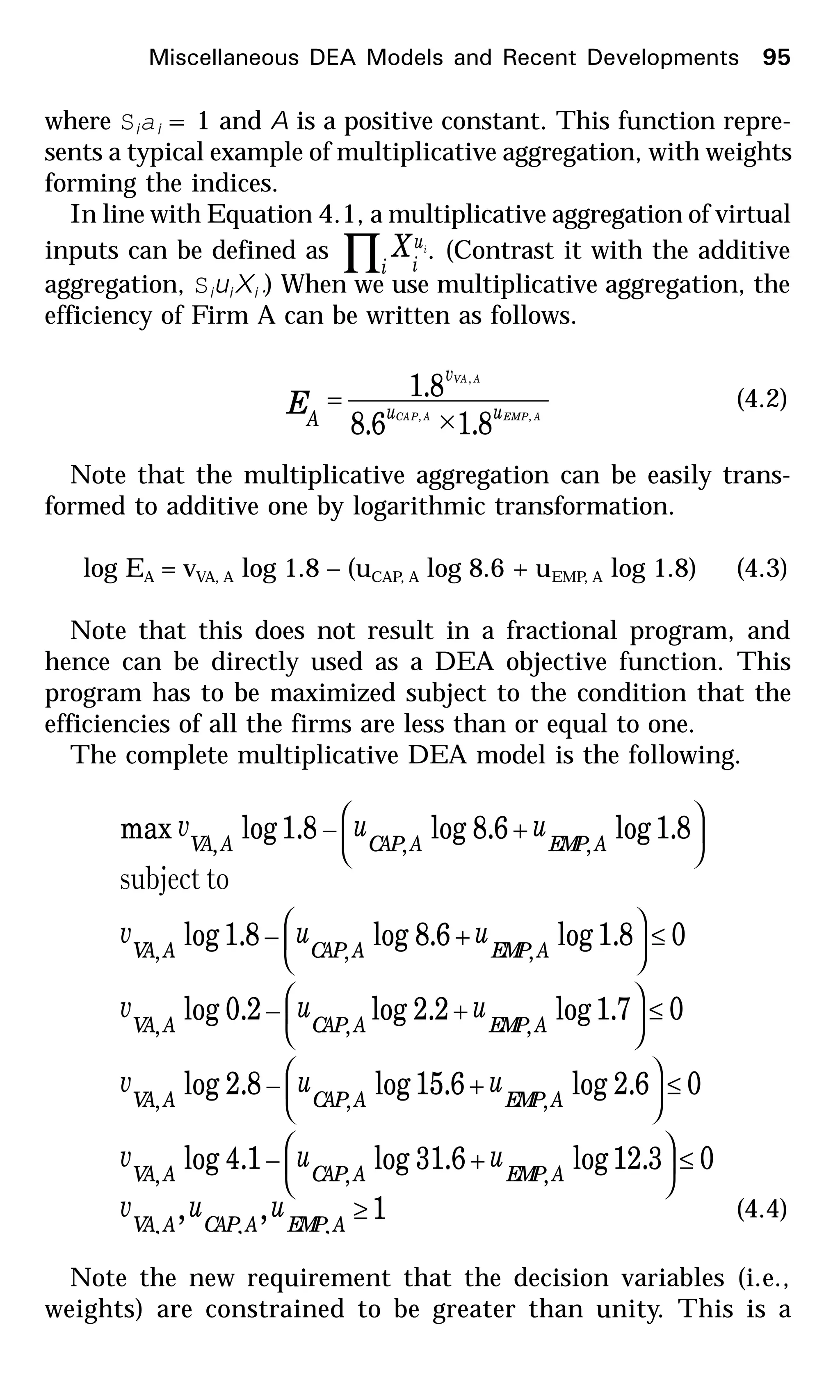
The mathematical program now is,
JjIiuv
Nn
xu
yv
xu
yv
E
imjm
I
i
inim
J
j
jnjm
I
i
imim
J
j
jmjm
m
,K,2,1;,K,2,1;0,
,K,2,1;10
max
1
1
1
1
==≥
=≤≤
=
∑
∑
∑
∑
=
=
=
=
tosubject
(2.4)
where
Em is the efficiency of the mth DMU,
yjm is jth output of the mth DMU,
vjm is the weight of that output,
xim is ith input of the mth DMU,
uim is the weight of that input, and
yjn and xin are jth output and ith input, respectively, of the nth
DMU, n = 1, 2, …, N.
Note that here n includes m.
Consider the Firms A, B, C and D discussed in the first chapter.
Let vVA, A be the weight associated with the only output (value
Mathematical Programming Aspects of DEA 41
added, VA) when Firm A is the reference DMU. The first subscript
denotes the output, while the second subscript denotes the refer-
ence DMU. Using a similar notation, let uCAP, A and uEMP, A represent
the weights of the two inputs, capital employed (CAP) and the
number of employees (EMP), respectively. Thus, in DEA, the ef-
ficiency of Firm A, denoted as EA, is defined as follows.
AEMPACAP
AVA
A uu
v
E
,,
,
8.16.8
8.1
+
= (2.5)
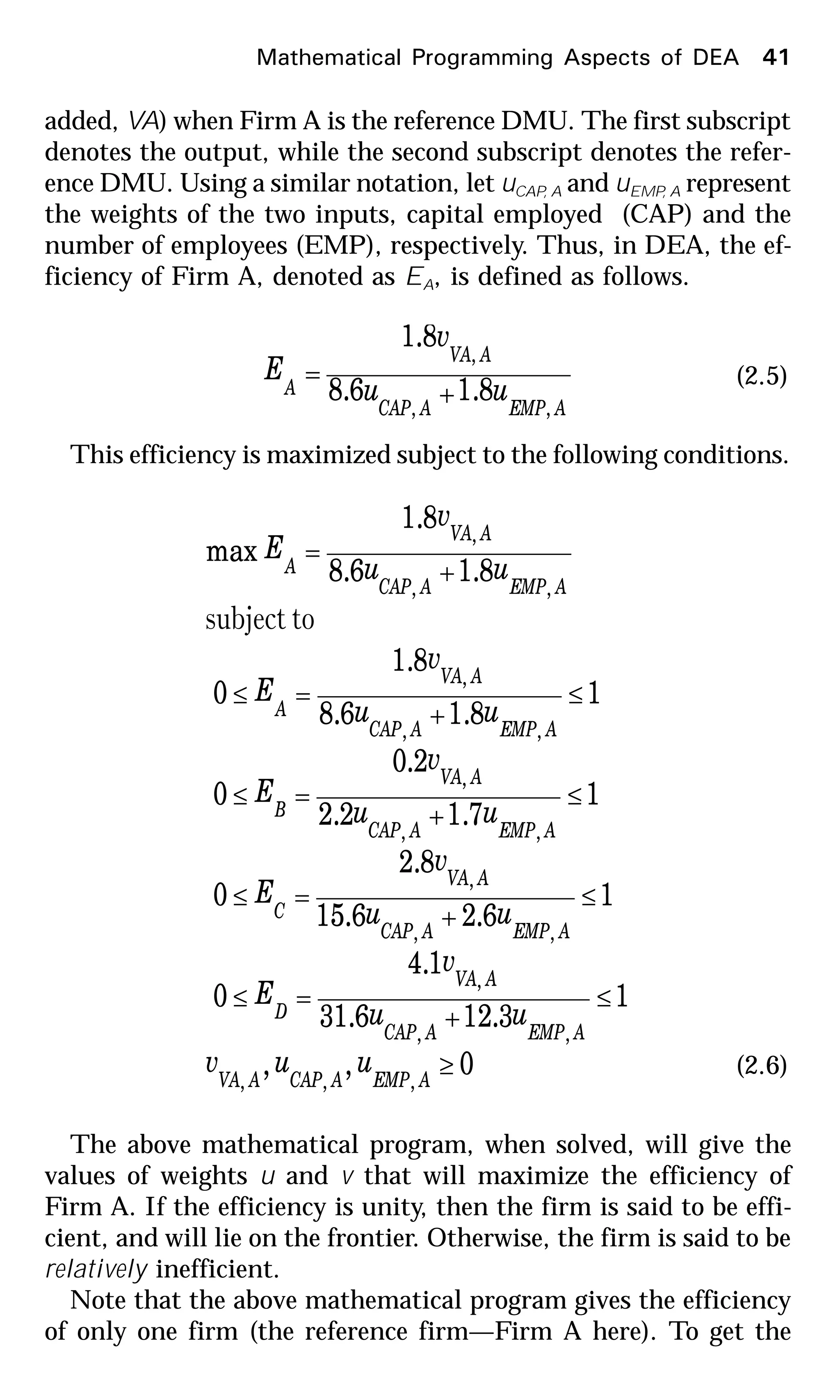
This efficiency is maximized subject to the following conditions.
0,,
1
3.126.31
1.4
0
1
6.26.15
8.2
0
1
7.12.2
2.0
0
1
8.16.8
8.1
0
8.16.8
8.1
max
,,,
,,
,
,,
,
,,
,
,,
,
,,
,
≥
≤
+
=≤
≤
+
=≤
≤
+
=≤
≤
+
=≤
+
=
AEMPACAPAVA
AEMPACAP
AVA
D
AEMPACAP
AVA
C
AEMPACAP
AVA
B
AEMPACAP
AVA
A
AEMPACAP
AVA
A
uuv
uu
v
E
uu
v
E
uu
v
E
uu
v
E
uu
v
E
tosubject
(2.6)
The above mathematical program, when solved, will give the
values of weights u and v that will maximize the efficiency of
Firm A. If the efficiency is unity, then the firm is said to be effi-
cient, and will lie on the frontier. Otherwise, the firm is said to be
relatively inefficient.
Note that the above mathematical program gives the efficiency
of only one firm (the reference firm—Firm A here). To get the
42 An Introduction to Data Envelopment Analysis
efficiency scores of the Firms B, C and D, more such mathematical
programs have to be solved, considering each of them as the refer-
ence firm.
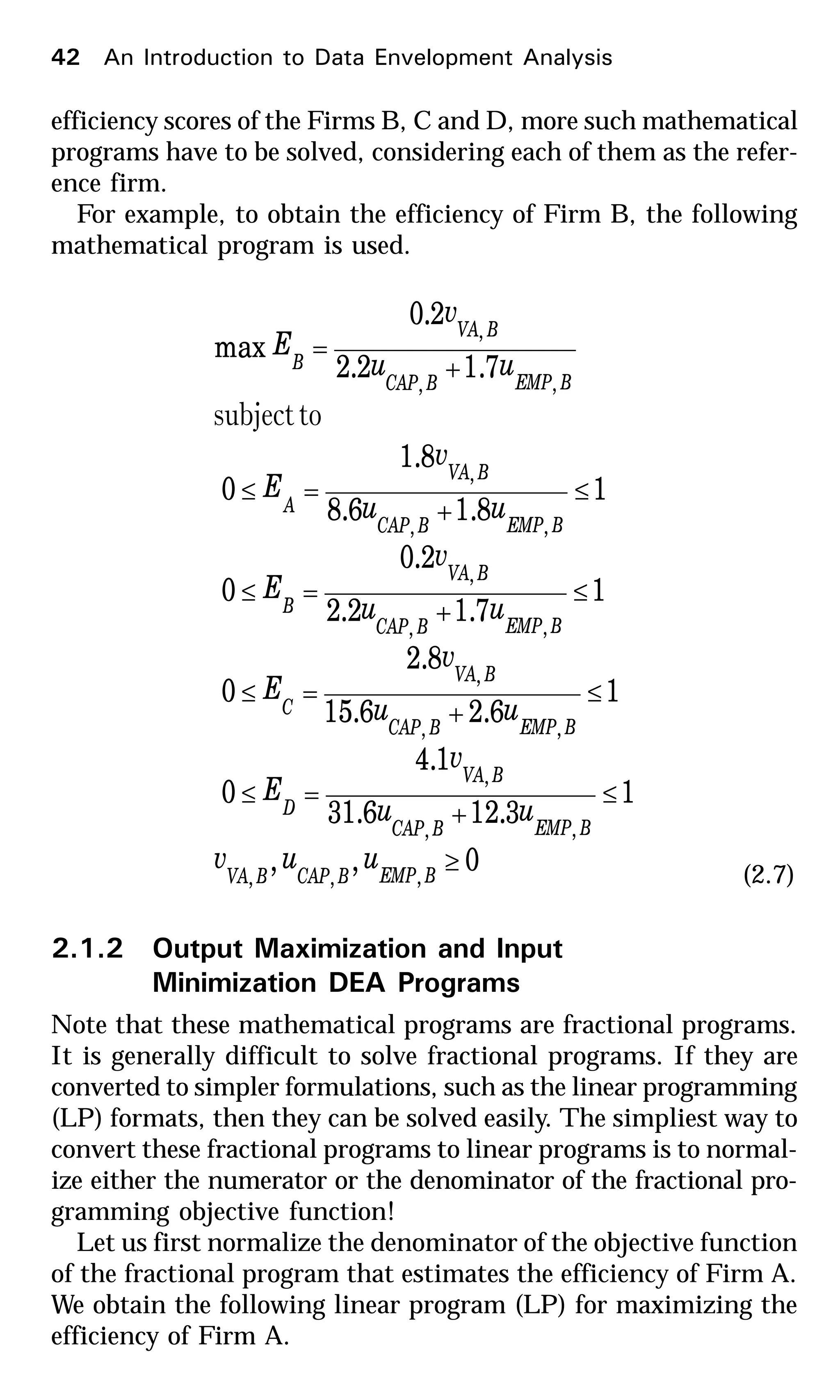
For example, to obtain the efficiency of Firm B, the following
mathematical program is used.
0,,
1
3.126.31
1.4
0
1
6.26.15
8.2
0
1
7.12.2
2.0
0
1
8.16.8
8.1
0
7.12.2
2.0
max
,,,
,,
,
,,
,
,,
,
,,
,
,,
,
≥
≤
+
=≤
≤
+
=≤
≤
+
=≤
≤
+
=≤
+
=
BEMPBCAPBVA
BEMPBCAP
BVA
D
BEMPBCAP
BVA
C
BEMPBCAP
BVA
B
BEMPBCAP
BVA
A
BEMPBCAP
BVA
B
uuv
uu
v
E
uu
v
E
uu
v
E
uu
v
E
uu
v
E
tosubject
(2.7)
2.1.2 Output Maximization and Input
Minimization DEA Programs
Note that these mathematical programs are fractional programs.
It is generally difficult to solve fractional programs. If they are
converted to simpler formulations, such as the linear programming
(LP) formats, then they can be solved easily. The simpliest way to
convert these fractional programs to linear programs is to normal-
ize either the numerator or the denominator of the fractional pro-
gramming objective function!
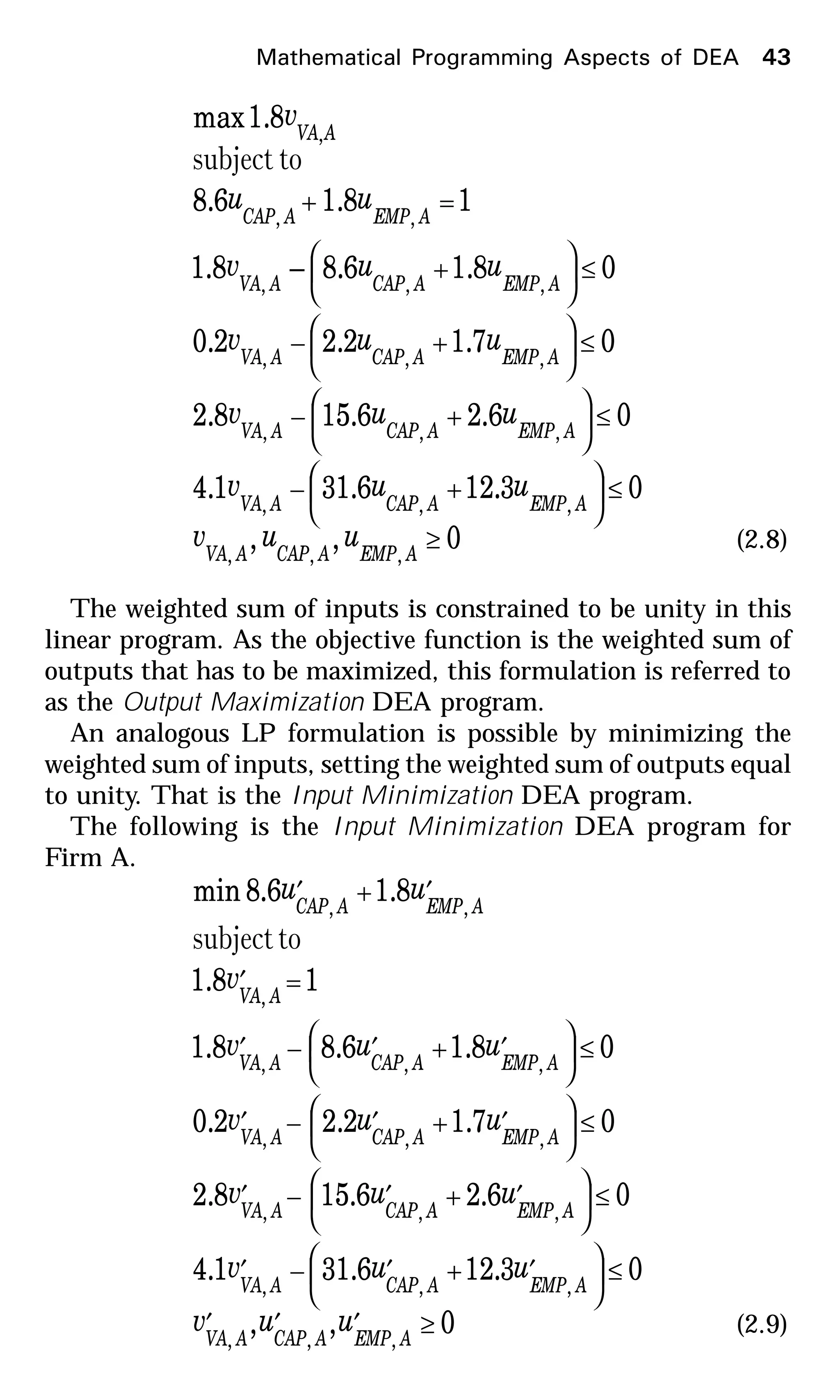
Let us first normalize the denominator of the objective function
of the fractional program that estimates the efficiency of Firm A.
We obtain the following linear program (LP) for maximizing the
efficiency of Firm A.
Mathematical Programming Aspects of DEA 43
0,,
03.126.311.4
06.26.158.2
07.12.22.0
08.16.8–8.1
18.16.8
8.1max
,,,
,,,
,,,
,,,
,,,
,,
,
≥
≤





+−
≤





+−
≤





+−
≤





+
=+
AEMPACAPAVA
AEMPACAPAVA
AEMPACAPAVA
AEMPACAPAVA
AEMPACAPAVA
AEMPACAP
AVA
uuv
uuv
uuv
uuv
uuv
uu
v
tosubject
(2.8)
The weighted sum of inputs is constrained to be unity in this
linear program. As the objective function is the weighted sum of
outputs that has to be maximized, this formulation is referred to
as the Output Maximization DEA program.
An analogous LP formulation is possible by minimizing the
weighted sum of inputs, setting the weighted sum of outputs equal
to unity. That is the Input Minimization DEA program.
The following is the Input Minimization DEA program for
Firm A.
0,,
03.126.311.4
06.26.158.2
07.12.22.0
08.16.88.1
18.1
8.16.8min
,,,
,,,
,,,
,,,
,,,
,
,,
≥′′′
≤




 ′+′−′
≤




 ′+′−′
≤




 ′+′−′
≤




 ′+′−′
=′
′+′
AEMPACAPAVA
AEMPACAPAVA
AEMPACAPAVA
AEMPACAPAVA
AEMPACAPAVA
AVA
AEMPACAP
uuv
uuv
uuv
uuv
uuv
v
uu
tosubject
(2.9)
Because of the nature of the formulations, the optimal objective
function value of the input minimization DEA program for Firm
A will be the reciprocal of the optimal objective function value
(i.e., the value of efficiency) of the output maximization DEA
program for Firm A.
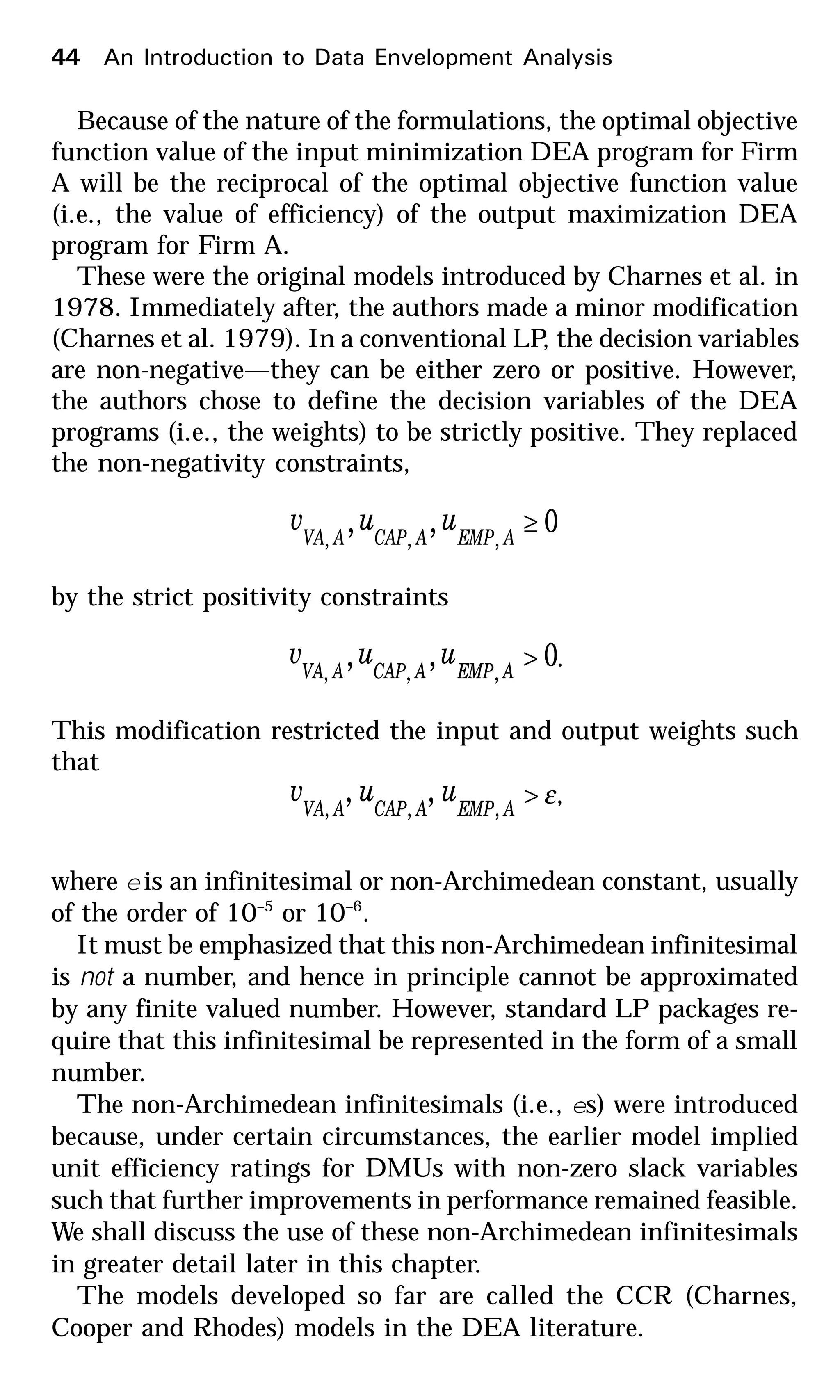
These were the original models introduced by Charnes et al. in
1978. Immediately after, the authors made a minor modification
(Charnes et al. 1979). In a conventional LP, the decision variables
are non-negative—they can be either zero or positive. However,
the authors chose to define the decision variables of the DEA
programs (i.e., the weights) to be strictly positive. They replaced
the non-negativity constraints,
0,, ,,,
≥AEMPACAPAVA
uuv
by the strict positivity constraints
0,, ,,,
>AEMPACAPAVA
uuv .
This modification restricted the input and output weights such
that
ε>AEMPACAPAVA
uuv ,,,
,, ,
where eis an infinitesimal or non-Archimedean constant, usually
of the order of 10–5
or 10–6
.
It must be emphasized that this non-Archimedean infinitesimal
is not a number, and hence in principle cannot be approximated
by any finite valued number. However, standard LP packages re-
quire that this infinitesimal be represented in the form of a small
number.
The non-Archimedean infinitesimals (i.e., es) were introduced
because, under certain circumstances, the earlier model implied
unit efficiency ratings for DMUs with non-zero slack variables
such that further improvements in performance remained feasible.
We shall discuss the use of these non-Archimedean infinitesimals
in greater detail later in this chapter.
The models developed so far are called the CCR (Charnes,
Cooper and Rhodes) models in the DEA literature.
44 An Introduction to Data Envelopment Analysis
2.1.3 General Form of CCR DEA Models1
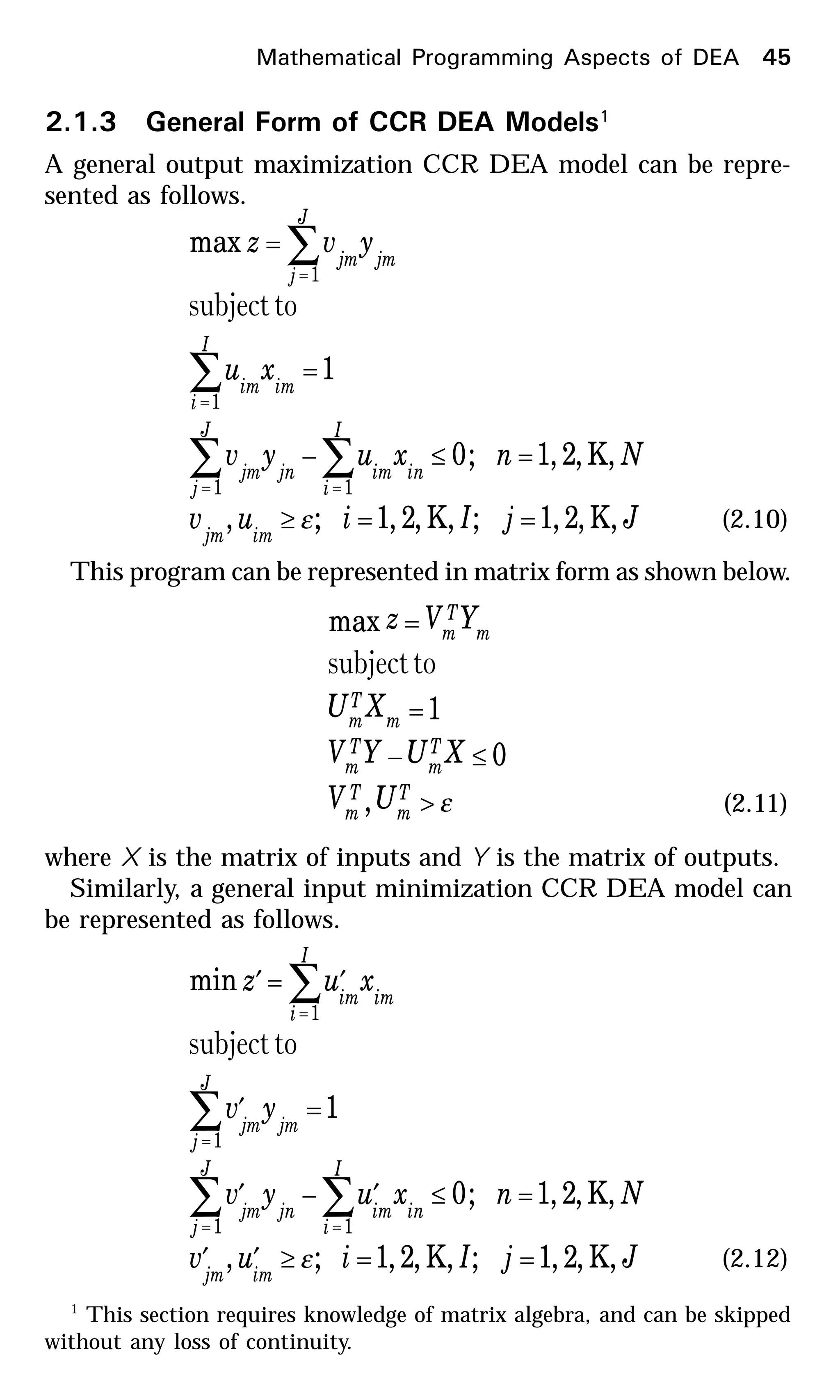
A general output maximization CCR DEA model can be repre-
sented as follows.
JjIiuv
Nnxuyv
xu
yvz
imjm
I
i
inim
J
j
jnjm
I
i
imim
J
j
jmjm
,K,2,1;,K,2,1;,
,K,2,1;0
1
max
11
1
1
==≥
=≤−
=
=
∑∑
∑
∑
==
=
=
ε
tosubject
(2.10)
This program can be represented in matrix form as shown below.
ε>
≤−
=
=
T
m
T
m
T
m
T
m
m
T
m
m
T
m
UV
XUYV
XU
YVz
,
0
1
max
tosubject
(2.11)
where X is the matrix of inputs and Y is the matrix of outputs.
Similarly, a general input minimization CCR DEA model can
be represented as follows.
JjIiuv
Nnxuyv
yv
xuz
imjm
I
i
inim
J
j
jnjm
J
j
jmjm
I
i
imim
,K,2,1;,K,2,1;,
,K,2,1;0
1
min
11
1
1
==≥′′
=≤′−′
=′
′=′
∑∑
∑
∑
==
=
=
ε
tosubject
(2.12)
1
This section requires knowledge of matrix algebra, and can be skipped
without any loss of continuity.
Mathematical Programming Aspects of DEA 45
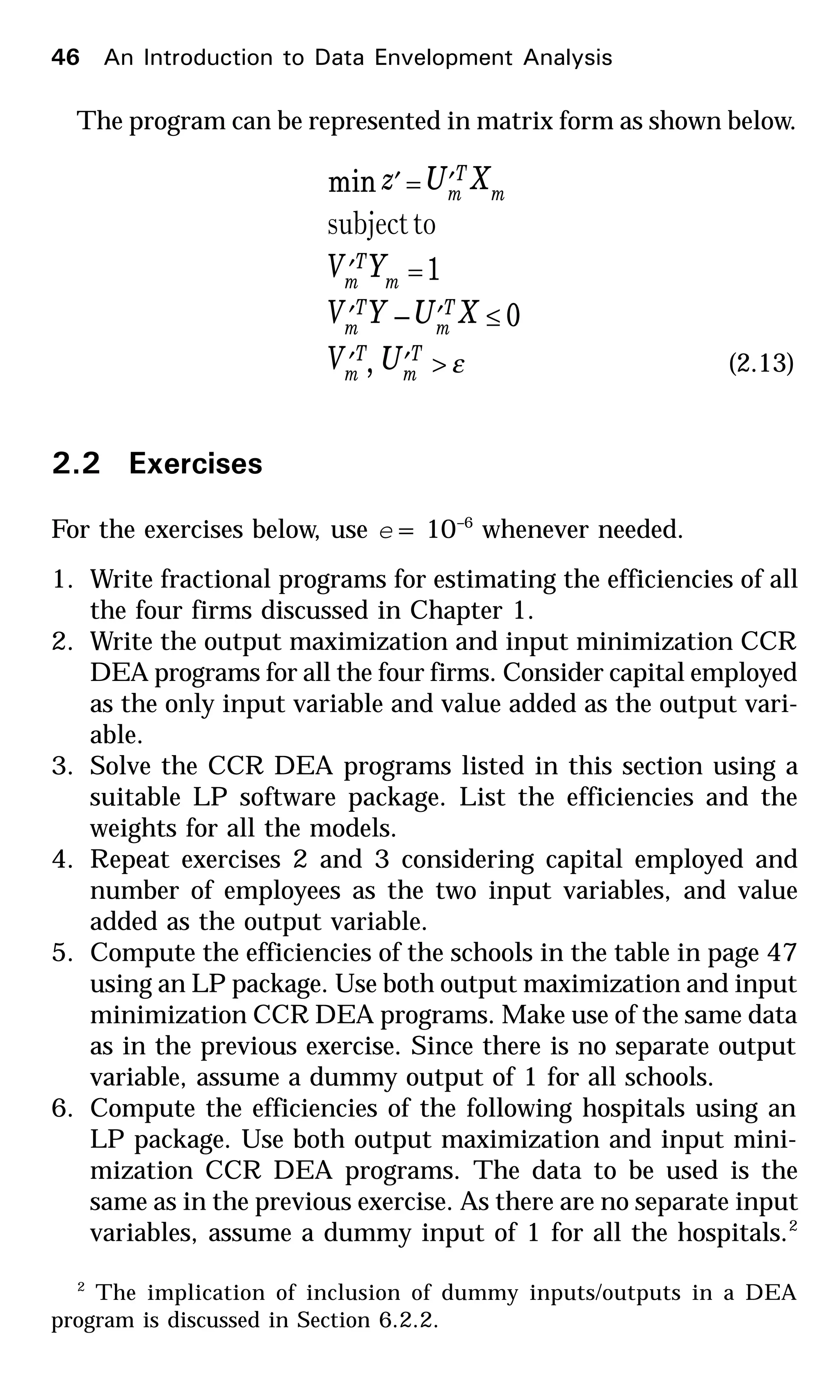
The program can be represented in matrix form as shown below.
ε>′′
≤′′
=′
′=′
T
m
T
m
T
m
T
m
m
T
m
m
T
m
UV
XUYV
YV
XUz
,
0–
1
min
tosubject
(2.13)
2.2 Exercises
For the exercises below, use e = 10–6
whenever needed.
1. Write fractional programs for estimating the efficiencies of all
the four firms discussed in Chapter 1.
2. Write the output maximization and input minimization CCR
DEA programs for all the four firms. Consider capital employed
as the only input variable and value added as the output vari-
able.
3. Solve the CCR DEA programs listed in this section using a
suitable LP software package. List the efficiencies and the
weights for all the models.
4. Repeat exercises 2 and 3 considering capital employed and
number of employees as the two input variables, and value
added as the output variable.
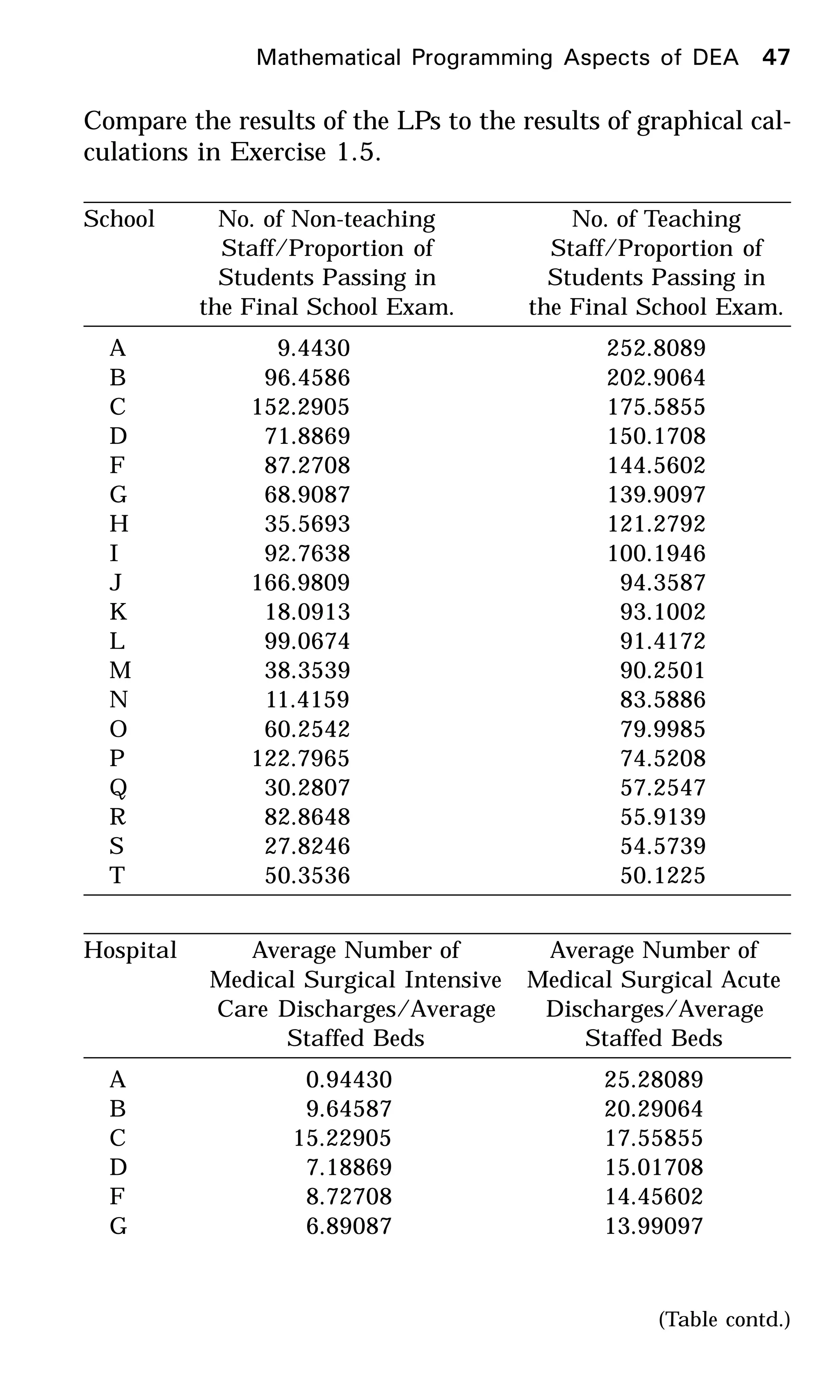
5. Compute the efficiencies of the schools in the table in page 47
using an LP package. Use both output maximization and input
minimization CCR DEA programs. Make use of the same data
as in the previous exercise. Since there is no separate output
variable, assume a dummy output of 1 for all schools.
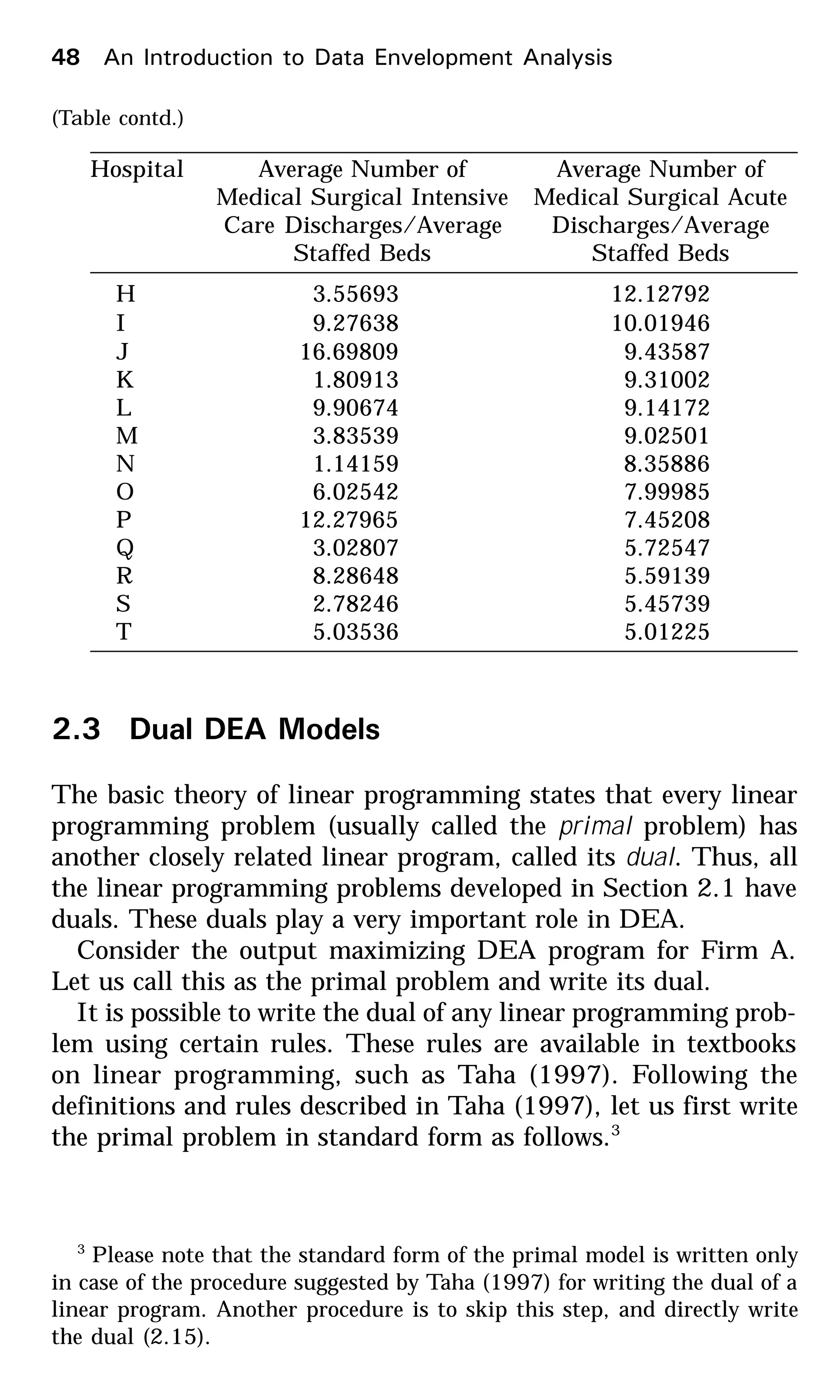
6. Compute the efficiencies of the following hospitals using an
LP package. Use both output maximization and input mini-
mization CCR DEA programs. The data to be used is the
same as in the previous exercise. As there are no separate input
variables, assume a dummy input of 1 for all the hospitals.2
2
The implication of inclusion of dummy inputs/outputs in a DEA
program is discussed in Section 6.2.2.
46 An Introduction to Data Envelopment Analysis
Compare the results of the LPs to the results of graphical cal-
culations in Exercise 1.5.
School No. of Non-teaching No. of Teaching
Staff/Proportion of Staff/Proportion of
Students Passing in Students Passing in
the Final School Exam. the Final School Exam.
A 9.443067 252.8089
B 96.4586400 202.9064
C 152.29050000 175.5855
D 71.8869500 150.1708
F 87.2708900 144.5602
G 68.9087000 139.9097
H 35.5693400 121.2792
I 92.7638700 100.1946
J 166.98090000 0094.35873
K 18.0913100 0093.10026
L 99.0674100 0091.41724
M 38.3539500 0090.25016
N 11.4159600 083.5886
O 60.2542100 0079.99854
P 122.79650000 0074.52081
Q 30.2807400 0057.25475
R 82.8648900 0055.91398
S 27.8246600 0054.57391
T 50.3536200 0050.12258
Hospital Average Number of Average Number of
Medical Surgical Intensive Medical Surgical Acute
Care Discharges/Average Discharges/Average
Staffed Beds Staffed Beds
A 0.944307 25.28089
B 9.645874 20.29064
C 15.2290500 17.55855
D 7.188695 15.01708
F 8.727089 14.45602
G 6.890870 13.99097
Mathematical Programming Aspects of DEA 47
(Table contd.)
H 3.556934 12.12792
I 9.276387 10.01946
J 16.6980900 009.435873
K 1.809131 009.310026
L 9.906741 009.141724
M 3.835395 009.025016
N 1.141596 08.35886
O 6.025421 007.999854
P 12.2796500 007.452081
Q 3.028074 005.725475
R 8.286489 005.591398
S 2.782466 005.457391
T 5.035362 005.012258
2.3 Dual DEA Models
The basic theory of linear programming states that every linear
programming problem (usually called the primal problem) has
another closely related linear program, called its dual. Thus, all
the linear programming problems developed in Section 2.1 have
duals. These duals play a very important role in DEA.
Consider the output maximizing DEA program for Firm A.
Let us call this as the primal problem and write its dual.
It is possible to write the dual of any linear programming prob-
lem using certain rules. These rules are available in textbooks
on linear programming, such as Taha (1997). Following the
definitions and rules described in Taha (1997), let us first write
the primal problem in standard form as follows.3
3
Please note that the standard form of the primal model is written only
in case of the procedure suggested by Taha (1997) for writing the dual of a
linear program. Another procedure is to skip this step, and directly write
the dual (2.15).
48 An Introduction to Data Envelopment Analysis
(Table contd.)
Hospital Average Number of Average Number of
Medical Surgical Intensive Medical Surgical Acute
Care Discharges/Average Discharges/Average
Staffed Beds Staffed Beds
4
Please note that the above standard form of the primal is written only
in case of the procedure suggested by Taha (1997) for writing the dual of a
linear program. Another procedure is to skip this step.
0,,,,,,
03.126.311.4
06.26.158.2
07.12.22.0
08.16.88.1
18.16.8
8.1max
,,,
,,,
,,,
,,,
,,,
,,
,
≥
=+





+−
=+





+−
=+





+−
=+





+−
=+
DCBAAEMPACAPAVA
DAEMPACAPAVA
CAEMPACAPAVA
BAEMPACAPAVA
AAEMPACAPAVA
AEMPACAP
AVA
ppppuuv
puuv
puuv
puuv
puuv
uu
v
tosubject
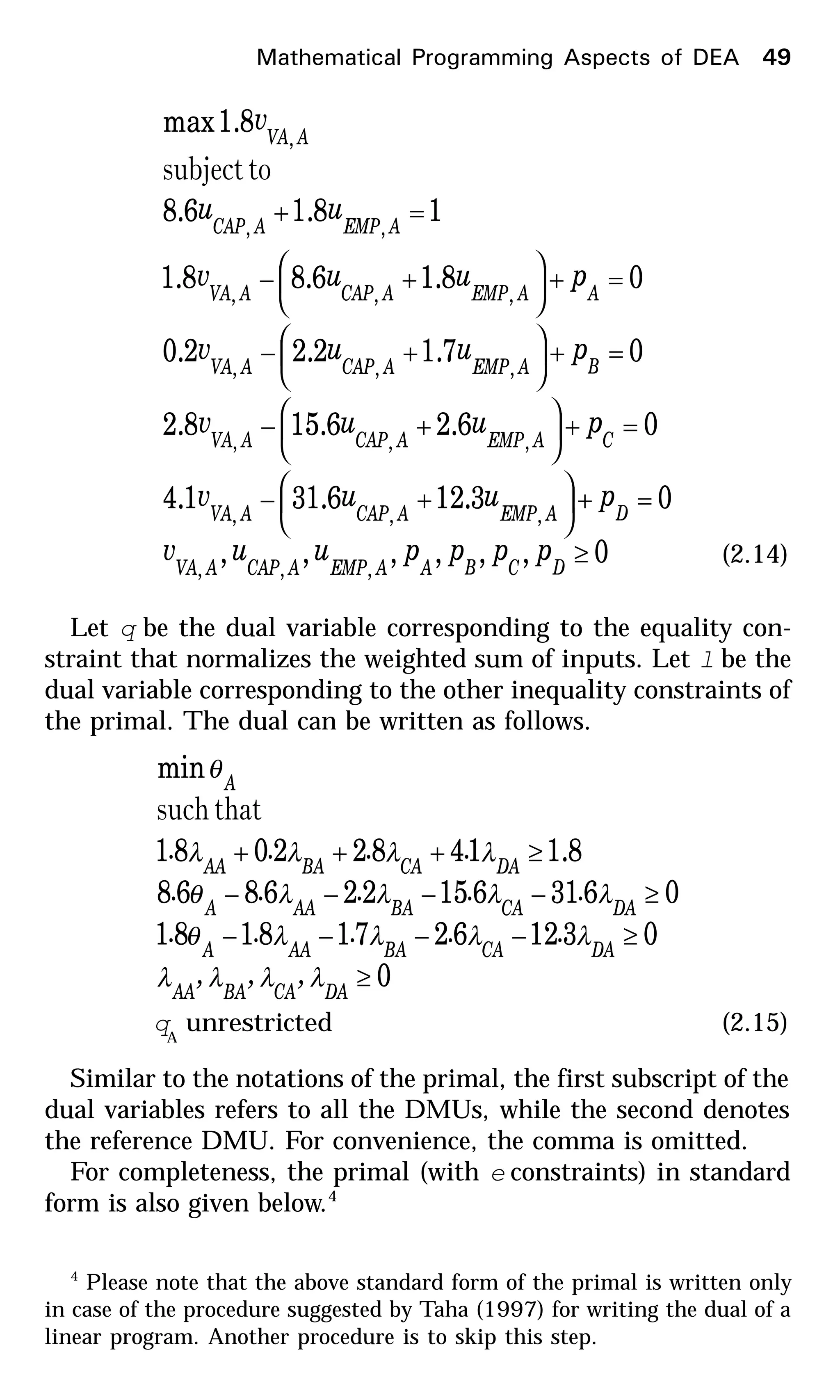
(2.14)
Let q be the dual variable corresponding to the equality con-
straint that normalizes the weighted sum of inputs. Let l be the
dual variable corresponding to the other inequality constraints of
the primal. The dual can be written as follows.
0
031262718181
0631615226868
8.114822081
min
≥
≥−−−−
≥−−−−
≥+++
DACABAAA
DACABAAAA
DACABAAAA
DACABAAA
A
,,,
.....
.....
....
λλλλ
λλλλθ
λλλλθ
λλλλ
θ
thatsuch
qA
unrestricted (2.15)
Similar to the notations of the primal, the first subscript of the
dual variables refers to all the DMUs, while the second denotes
the reference DMU. For convenience, the comma is omitted.
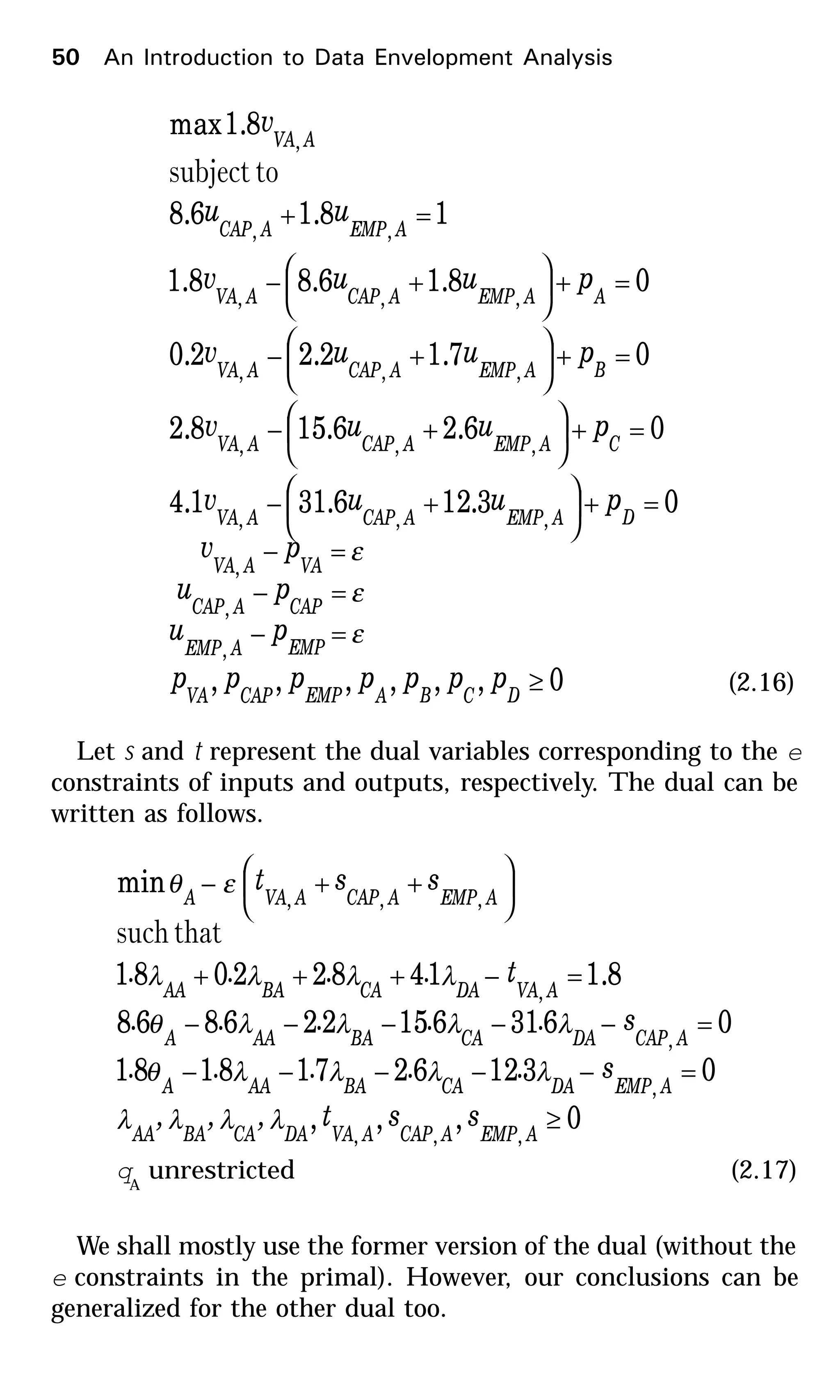
For completeness, the primal (with e constraints) in standard
form is also given below.4
Mathematical Programming Aspects of DEA 49
0,,,,,,
03.126.311.4
06.26.158.2
07.12.22.0
08.16.88.1
18.16.8
8.1max
,
,
,
,,,
,,,
,,,
,,,
,,
,
≥
=−
=−
=−
=+





+−
=+





+−
=+





+−
=+





+−
=+
DCBAEMPCAPVA
EMPAEMP
CAPACAP
VAAVA
DAEMPACAPAVA
CAEMPACAPAVA
BAEMPACAPAVA
AAEMPACAPAVA
AEMPACAP
AVA
ppppppp
pu
pu
pv
puuv
puuv
puuv
puuv
uu
v
ε
ε
ε
tosubject
(2.16)
Let s and t represent the dual variables corresponding to the e
constraints of inputs and outputs, respectively. The dual can be
written as follows.
0,,,
031262718181
0631615226868
8.114822081
min
,,,
,
,
,
,,,
AEMPACAPAVADACABAAA
AEMPDACABAAAA
ACAPDACABAAAA
AVADACABAAA
AEMPACAPAVAA
sst,,,
s.....
s.....
t....
sst
λλλλ
λλλλθ
λλλλθ
λλλλ
εθ
≥
=−−−−−
=−−−−−
=−+++






++−
thatsuch
qA
unrestricted (2.17)
We shall mostly use the former version of the dual (without the
e constraints in the primal). However, our conclusions can be
generalized for the other dual too.
50 An Introduction to Data Envelopment Analysis
2.3.1 Comparing Primal and Dual
Using the basic theory of linear programming, the following ob-
servations can be made.
(a) As the optimal values of primal and dual objective func-
tions are equal, qA represents the efficiency of Firm A.
(b) The number of constraints of the primal depends upon
the number of DMUs, while the number of constraints of
the dual depends upon the number of inputs and outputs.
(c) The computational efficiency of LP codes depends to a
greater extent upon the number of constraints than on
the number of variables. In a typical DEA exercise, about
5 inputs and 5 outputs are considered, while the number
of units being compared is much larger (of the order of
hundreds or even thousands). Hence, the dual formu-
lation is computationally more efficient than the primal.
2.3.2 Interpreting the Dual
Though we have derived the dual mathematically, rather than in-
tuitively, from the primal, we can interpret the dual (2.15) intui-
tively. First of all, let us observe that while the primal provided
optimal weights to inputs and outputs, the dual provides weights
to the DMUs (l).
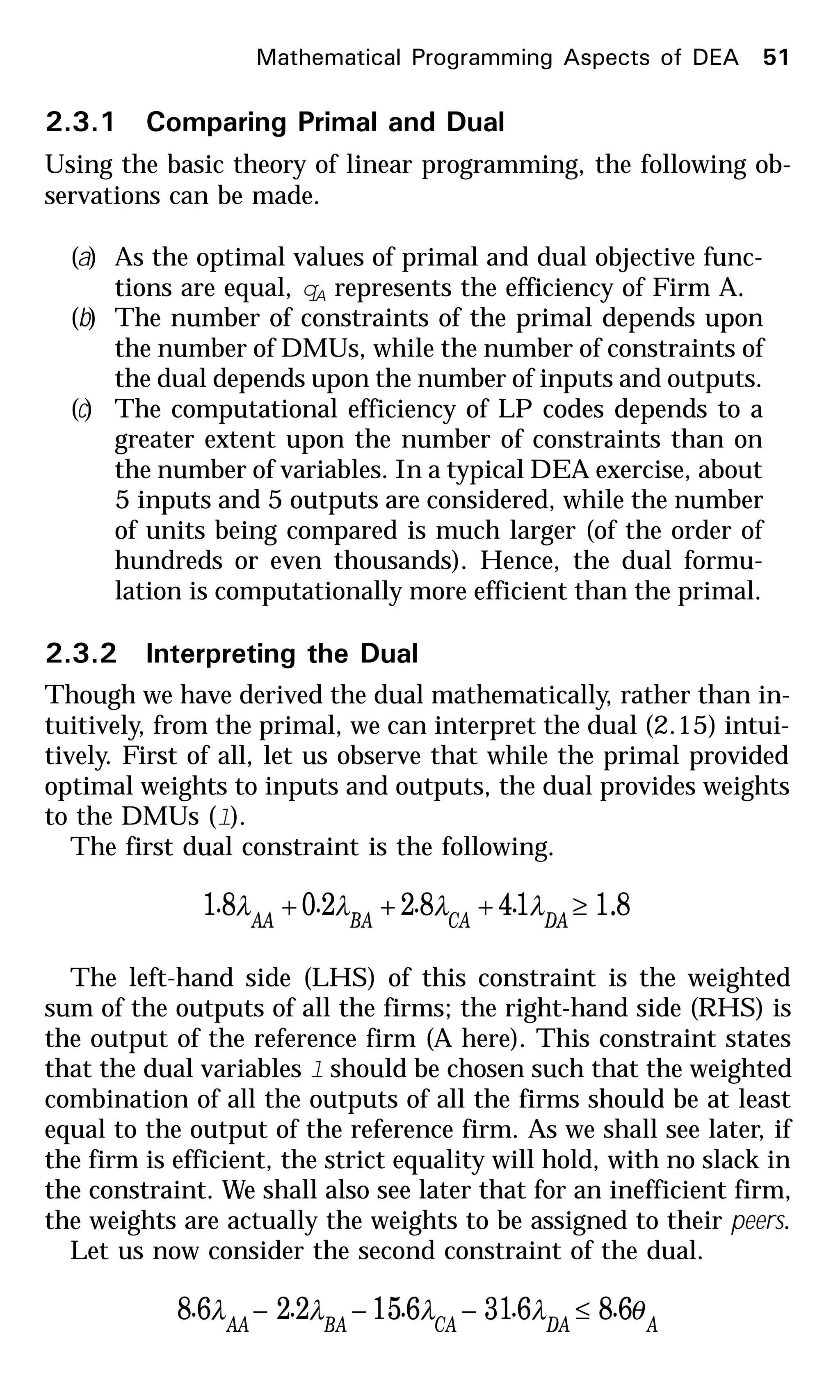
The first dual constraint is the following.
8.114822081 ≥+++ DACABAAA
.... λλλλ
The left-hand side (LHS) of this constraint is the weighted
sum of the outputs of all the firms; the right-hand side (RHS) is
the output of the reference firm (A here). This constraint states
that the dual variables l should be chosen such that the weighted
combination of all the outputs of all the firms should be at least
equal to the output of the reference firm. As we shall see later, if
the firm is efficient, the strict equality will hold, with no slack in
the constraint. We shall also see later that for an inefficient firm,
the weights are actually the weights to be assigned to their peers.
Let us now consider the second constraint of the dual.
ADACABAAA
..... θλλλλ 686316152268 ≤−−−
Mathematical Programming Aspects of DEA 51
This constraint corresponds to the capital input. It says that
the weighted combination of the capital inputs of all the firms
cannot be more than the capital input for the reference firm multi-
plied by its efficiency. This can be proved using the complementary
slackness conditions of linear programming (see Taha 1997) that,
at optimality, for an efficient firm, q*
is unity; the variable q*
refers to optimal values. The constraint becomes strict equality
with zero slacks (Cooper et al. 2000).
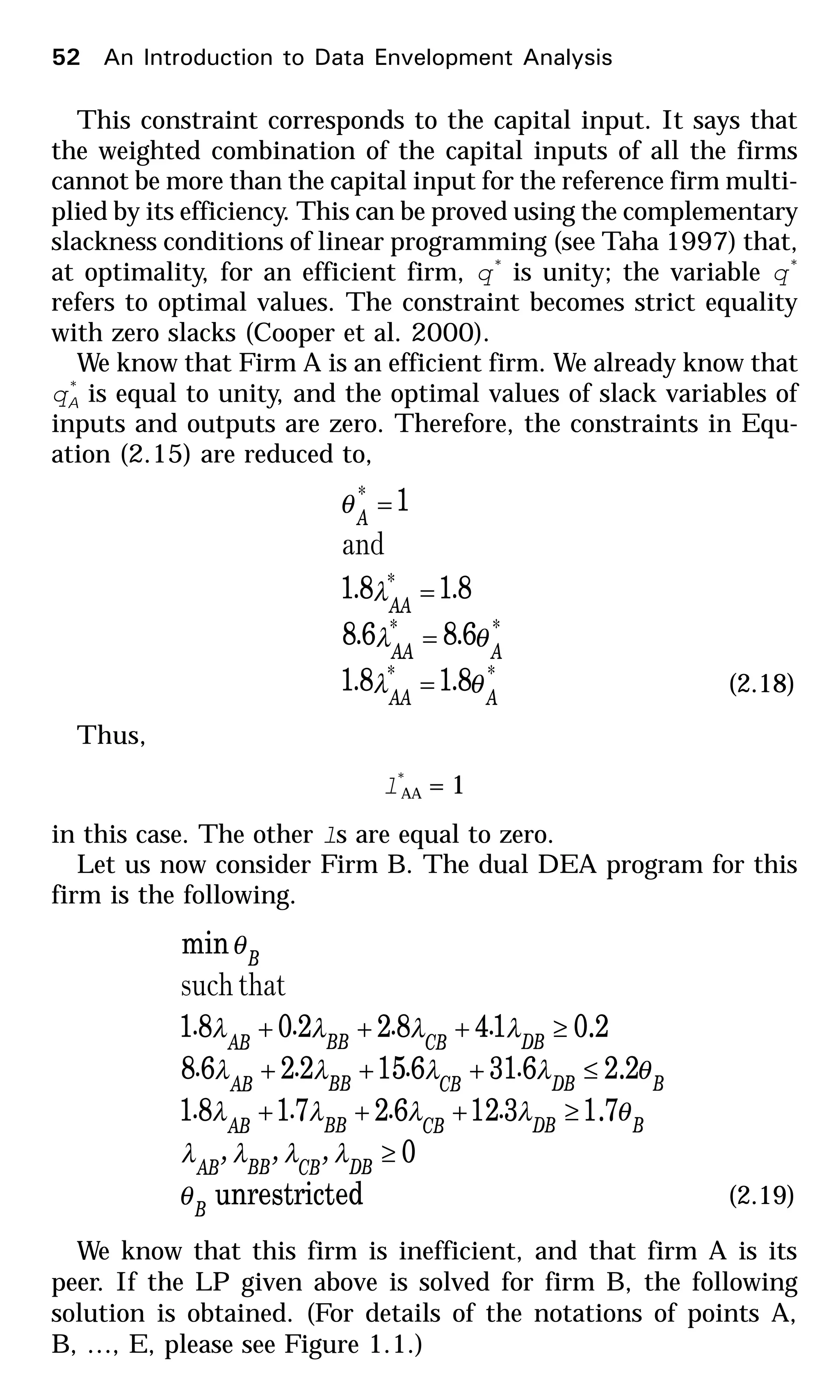
We know that Firm A is an efficient firm. We already know that
q*
A is equal to unity, and the optimal values of slack variables of
inputs and outputs are zero. Therefore, the constraints in Equ-
ation (2.15) are reduced to,
**
**
*
*
8181
6868
8181
1
AAA
AAA
AA
A
..
..
..
θλ
θλ
λ
θ
=
=
=
=
and
(2.18)
Thus,
l*
AA = 1
in this case. The other ls are equal to zero.
Let us now consider Firm B. The dual DEA program for this
firm is the following.
edunrestrict
0
7.1312627181
2.26316152268
2.014822081
min
B
DBCBBBAB
BDBCBBBAB
BDBCBBBAB
DBCBBBAB
B
,,,
....
....
....
θ
λλλλ
θλλλλ
θλλλλ
λλλλ
θ
≥
≥+++
≤+++
≥+++
thatsuch
(2.19)
We know that this firm is inefficient, and that firm A is its
peer. If the LP given above is solved for firm B, the following
solution is obtained. (For details of the notations of points A,
B, …, E, please see Figure 1.1.)
52 An Introduction to Data Envelopment Analysis
**
**
*
*
7.18.1
2.26.8
2.08.1
434.0
OB
OE
BAB
BAB
AB
B
θλ
θλ
λ
θ
<
=
=
==
and
Note that
l*
AB =
9
1
8.1
2.0
=
is positive in this case as Firm A is the only peer for Firm B.
Other ls are zero in value. The value of qB
can also be obtained
from the above equalities.
Thus, mathematically, peers for an inefficient DMU can be
identified by solving the dual DEA program. Peers are those effi-
cient DMUs that have positive ls in the optimal solution of the
dual DEA program.
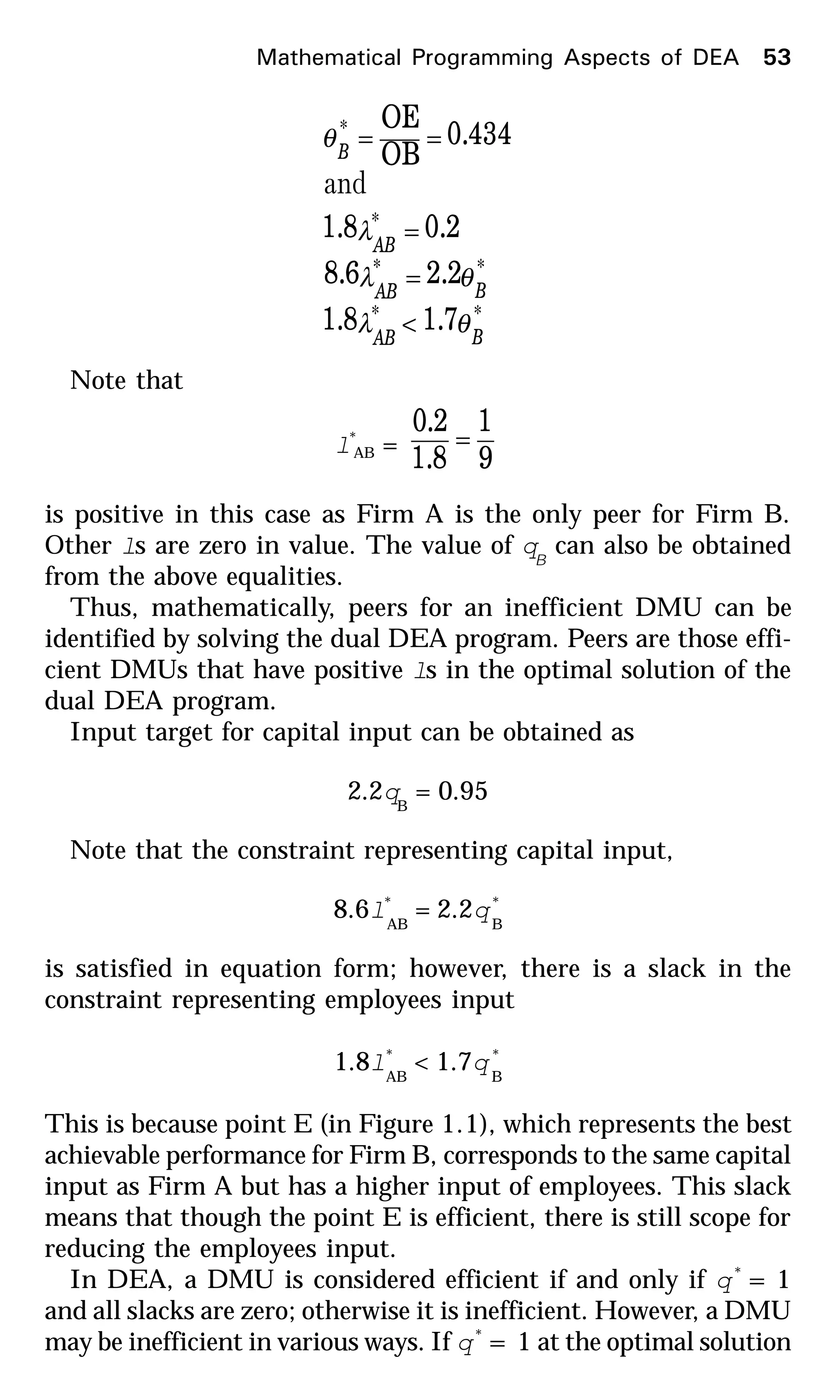
Input target for capital input can be obtained as
2.2qB
= 0.95
Note that the constraint representing capital input,
8.6l*
AB
= 2.2q*
B
is satisfied in equation form; however, there is a slack in the
constraint representing employees input
1.8l*
AB
< 1.7q *
B
This is because point E (in Figure 1.1), which represents the best
achievable performance for Firm B, corresponds to the same capital
input as Firm A but has a higher input of employees. This slack
means that though the point E is efficient, there is still scope for
reducing the employees input.
In DEA, a DMU is considered efficient if and only if q*
= 1
and all slacks are zero; otherwise it is inefficient. However, a DMU
may be inefficient in various ways. If q*
= 1 at the optimal solution
Mathematical Programming Aspects of DEA 53
but some of the slack variables do not equal zero, then there exists
a combination of other units which does not dominate the current
output vector of the reference DMU, but uses less resources. As
discussed in Chapter 1, these DMUs may be termed weakly effi-
cient. Thus, the firm represented by point E in Figure 1.1 is
weakly efficient, while Firms A and B are strongly efficient firms.
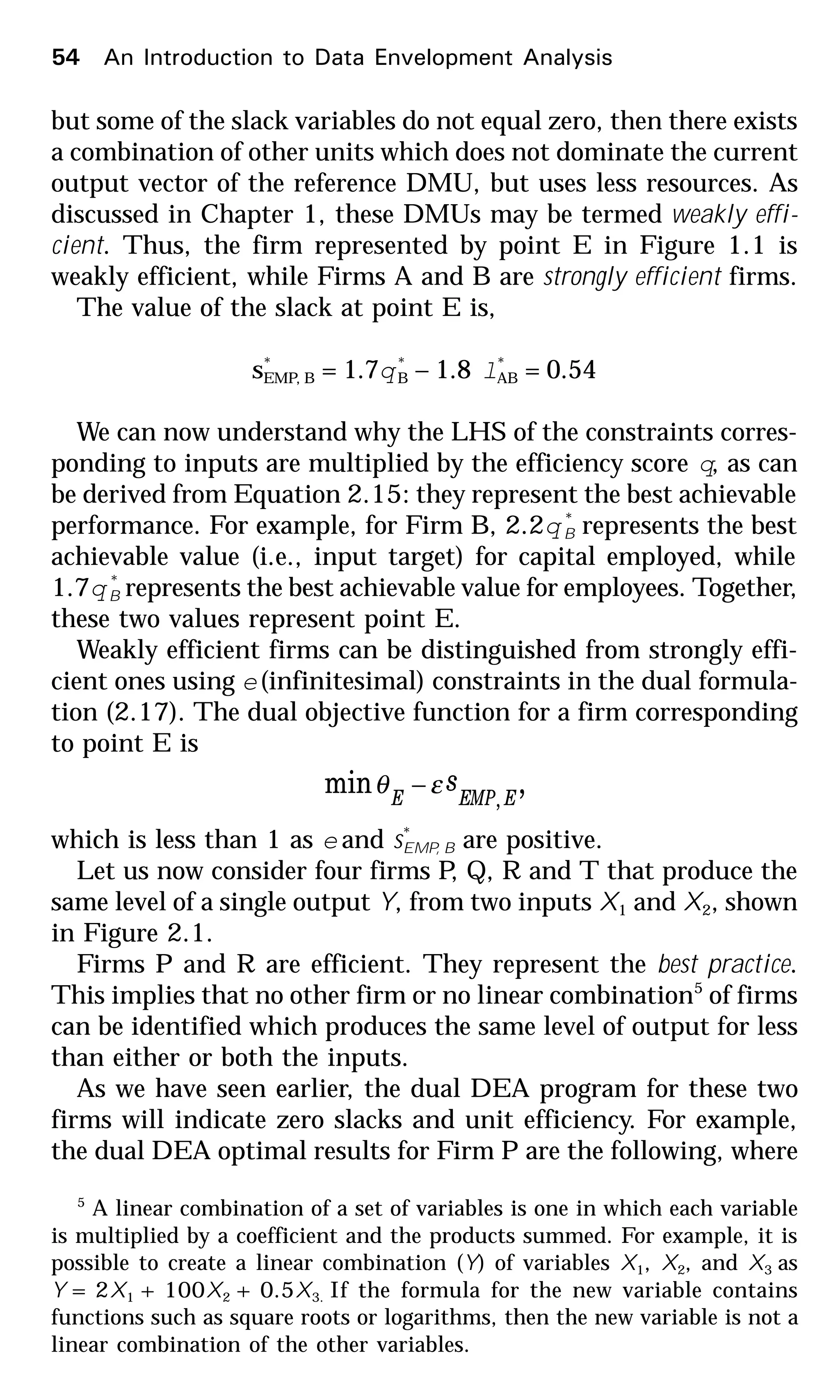
The value of the slack at point E is,
s*
EMP, B = 1.7q*
B – 1.8 l*
AB = 0.54
We can now understand why the LHS of the constraints corres-
ponding to inputs are multiplied by the efficiency score q, as can
be derived from Equation 2.15: they represent the best achievable
performance. For example, for Firm B, 2.2q *
B represents the best
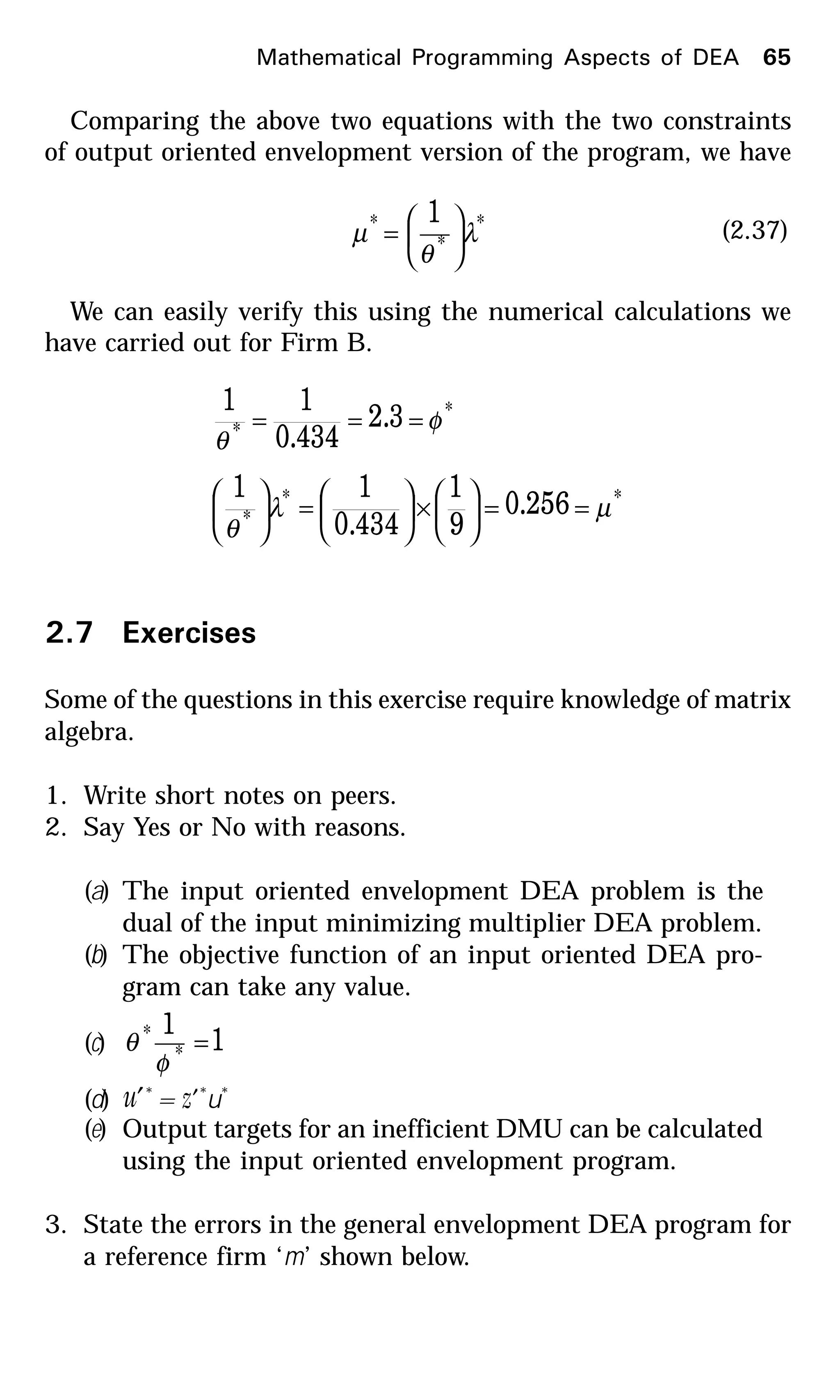
achievable value (i.e., input target) for capital employed, while
1.7q *
B represents the best achievable value for employees. Together,
these two values represent point E.
Weakly efficient firms can be distinguished from strongly effi-
cient ones using e(infinitesimal) constraints in the dual formula-
tion (2.17). The dual objective function for a firm corresponding
to point E is
,min , EEMPE
sεθ −
which is less than 1 as e and s*
EMP, B are positive.
Let us now consider four firms P, Q, R and T that produce the
same level of a single output Y, from two inputs X1 and X2, shown
in Figure 2.1.
Firms P and R are efficient. They represent the best practice.
This implies that no other firm or no linear combination5
of firms
can be identified which produces the same level of output for less
than either or both the inputs.
As we have seen earlier, the dual DEA program for these two
firms will indicate zero slacks and unit efficiency. For example,
the dual DEA optimal results for Firm P are the following, where
5
A linear combination of a set of variables is one in which each variable
is multiplied by a coefficient and the products summed. For example, it is
possible to create a linear combination (Y) of variables X1, X2, and X3 as
Y = 2X1 + 100X2 + 0.5X3. If the formula for the new variable contains
functions such as square roots or logarithms, then the new variable is not a
linear combination of the other variables.
54 An Introduction to Data Envelopment Analysis
l*
P =q *
P = 1. For convenience, the subscript representing the refer-
ence firm is suppressed.
PPP
PPPP
PPPP
P
YY
XX
XX
=
=
=
=
*
**
2
**
2
**
1
**
1
* 1
λ
θλ
θλ
θ
and
(2.20)
Note that both the efficient firms (Firms P and R) are peers for
the inefficient Firm Q. Hence, l*
P and l*
R are positive. For this
firm, the following equalities hold as obtained from the optimal
DEA dual results (2.21).
QRRPP
QQRRPP
QQRRPP
Q
YYY
XXX
XXX
OQ
OU
=+
=+
=+
≤=
**
**
2
**
2
**
2
**
1
**
1
**
1
* 1
λλ
θλλ
θλλ
θ
and
(2.21)
Figure 2.1 Efficiency frontier of four firms consuming two inputs
Mathematical Programming Aspects of DEA 55
Note that RHSs of the above equations represent the best achiev-
able target performance (corresponding to point U) for Firm B.
Also, (X *
1Qq*
Q = X *
1U; X *
2Qq*
Q = X *
2U), the hypothetical firm U is
actually a linear combination of the best practice firms P and R,
where the weights for the linear combination are the ls obtained
from the dual DEA program.
For completeness, the dual DEA program corresponding to
input minimizing multiplier model for Firm A is given below.
edunrestrict
0
8.1312627181
6.86316152268
8.114822081
min
A
DACABAAA
DACABAAA
DACABAAA
ADACABAAA
A
,,,
....
....
....
φ
µµµµ
µµµµ
µµµµ
φµµµµ
φ
≥
≥−−−
≤−−−
≥+++
thatsuch
(2.22)
Before closing this section, it is important to compare the op-
timal values of the objective functions qA and fA. Note that qA is
the dual objective function for Firm A corresponding to the output
maximizing primal, and fA is the dual objective function for Firm
A corresponding to the input minimizing primal. At the optimal
solution, the optimal objective function values of the primal and
the dual are equal. Hence, by comparing the optimal objective
function values of the output maximizing and the input minimiz-
ing primals, it is clear that the optimal value of qA is the reciprocal
of the optimal value of fA.
2.3.3 Two-stage Optimization Procedure
We have seen in Section 2.3 that the use of infinitesimals (e) will
distinguish weakly efficient DMUs from strongly efficient ones.
As discussed in that section, the dual formulation (with e con-
straints) to obtain the efficiency of Firm A is the following (Equ-
ation 2.17, Section 2.3).
56 An Introduction to Data Envelopment Analysis
edunrestrict
0,,,
031262718181
0631615226868
8.114822081
min
,,,
,
,
,
,,,
A
AEMPACAPAVADACABAAA
AEMPDACABAAAA
ACAPDACABAAAA
AVADACABAAA
AEMPACAPAVAA
sst,,,
s.....
s.....
t....
sst
θ
λλλλ
λλλλθ
λλλλθ
λλλλ
εθ
≥
=−−−−−
=−−−−−
=−+++






++−
thatsuch
However, the numeric values for infinitesimals (e’s) in actual
computations should be chosen to be much smaller than other
input and output values so that they will not affect optimization.
This is often troublesome.6
A two-stage optimization procedure
(Ali and Seiford 1993; Joro et al. 1998) has been suggested to
avoid using the infinitesimals (e) in DEA computations.
The two-stage optimization procedure corresponding to the dual
formulation (Equation 2.23) for Firm A can be written as follows.
edunrestrict
0,,,
031262718181
0631615226868
8.114822081
,minlex
,,,
,
,
,
,,,
A
AEMPACAPAVADACABAAA
AEMPDACABAAAA
ACAPDACABAAAA
AVADACABAAA
AEMPACAPAVAA
sst,,,
s.....
s.....
t....
sst
θ
λλλλ
λλλλθ
λλλλθ
λλλλ
θ
≥
=−−−−−
=−−−−−
=−+++












++
thatsuch
(2.23)
Here ‘lex min’ means that the objective function q is mini-
mized first (Stage 1); if the solution is not unique, the second
objective function is minimized lexicographically, subject to the
additional constraint, that q ³ q*
(where q*
is the optimal value
of q) (Stage 2). In case the optimal solution of the first objective
function is unique, the second optimization is not needed.
6
See Chapter 5 for further discussion on the computational features of
DEA.
Mathematical Programming Aspects of DEA 57
The optimization models for Stages 1 and 2 are given below.
Stage 1Stage 1Stage 1Stage 1Stage 1
edunrestrict
0,,,
031262718181
0631615226868
8.114822081
min
,,,
,
,
,
A
AEMPACAPAVADACABAAA
AEMPDACABAAAA
ACAPDACABAAAA
AVADACABAAA
A
sst,,,
s.....
s.....
t....
θ
λλλλ
λλλλθ
λλλλθ
λλλλ
θ
≥
=−−−−−
=−−−−−
=−+++
thatsuch
(2.24)
Note that this Stage 1 model is the same as the DEA model
with no e constraints.
Stage 2Stage 2Stage 2Stage 2Stage 2
edunrestrict
0,,,
031262718181
0631615226868
8.114822081
min
,,,
*
,
,
,
,,,
A
AEMPACAPAVADACABAAA
A
AEMPDACABAAAA
ACAPDACABAAAA
AVADACABAAA
AEMPACAPAVA
sst,,,
s.....
s.....
t....
sst
θ
λλλλ
θθ
λλλλθ
λλλλθ
λλλλ
≥
≥
=−−−−−
=−−−−−
=−+++






++
thatsuch
(2.25)
where q*
is the optimal value of qA in stage 1.
2.4 Multiplier and Envelopment DEA Programs
We know that the dual of a dual is primal. Hence, the terms
primal DEA program and dual DEA program are relative. New
terms are being increasingly used to represent DEA formulations.
58 An Introduction to Data Envelopment Analysis
The DEA programs involving weights of inputs and outputs
(u and v) are called Multiplier DEA Programs. Those involving
weights of firms (q and l) are called Envelopment DEA Programs.
Output maximizing and input minimizing multiplier versions
of DEA programs have been discussed in Section 2.1. A general
envelopment DEA program corresponding to the output maximizing
multiplier model can be written as follows.
(free)edunrestrict
,K,2,1;0
,K,2,1;
,K,2,1;
min
1
1
m
n
imm
N
n
nin
jm
N
n
njn
m
Nn
Iixx
Jjyy
θ
λ
θλ
λ
θ
=≥
=≤
=≥
∑
∑
=
=
thatsuch
(2.26)
This model can also be succinctly represented using matrix
notation as follows.
free;0
min
,
m
m
m
m
XX
YY
θλ
θλ
λ
θ
λθ
≥
≤
≥
thatsuch
(2.27)
Similarly, the envelopment DEA program corresponding to the
input minimizing multiplier model is given below in its general
matrix form.
free;0
max
,
m
m
mm
m
XX
YY
φµ
µ
φµ
φ
µφ
≥
≤
≥
thatsuch
(2.28)
Mathematical Programming Aspects of DEA 59
2.5 Input and Output Oriented Envelopment
DEA Programs
Let us study the two envelopment versions, one involving q and
the other involving f. The version involving q aims to produce
the observed outputs with minimum inputs. That is why inputs
are multiplied by efficiency, according to its constraint rules. Be-
cause of this characteristic, this version is often referred to as an
input oriented envelopment DEA program. The other version in-
volving f is referred to as an output oriented envelopment DEA
program as it aims to maximize output production, subject to
the given resource level.
Note that the dual of the output maximizing multiplier program
is the input oriented envelopment program. Similarly, the dual
of the input minimizing multiplier program is the output oriented
envelopment program.
Let us examine the behaviour of the input and output oriented
envelopment DEA programs more closely, using data regarding
the Firms A, B, C, and D. For simplicity, let us consider only one
input (capital employed) and only one output (value added).
When the values are plotted in a graph (see Figure 2.2), we
observe that Firm A has the maximum output (value added) for a
given input (capital). Hence, Firm A is the most efficient, and
acts as a peer for all other (inefficient) firms. If we can draw a line
Figure 2.2 Behaviour of input and output oriented envelopment
DEA programs
60 An Introduction to Data Envelopment Analysis
joining the origin to A, all other firms are found to the left of this
line.
The input oriented envelopment program used to estimate the
efficiency of Firm B is the following.
0
2.26316152268
2.014822081
min
≥
≤+++
≥+++
DBCBBBAB
BDBCBBBAB
DBCBBBAB
B
,,,
....
....
λλλλ
θλλλλ
λλλλ
θ
capital)(for
added)valuefor(
thatsuch
qB unrestricted (2.29)
Consider its solution. Since Firm A is its peer, zero weights are
assigned to Firms C and D (i.e., no other firm influences the per-
formance of Firm B). Hence,
434.0
2.2
6.8
9
1
8.1
2.0
00
*
*
*
****
=
×
=
==
===≠
AB
B
AB
DBCBBBAB
λ
θ
λ
λλλλ and
Given q*
B
, the best achievable capital input for Firm B is
2.2 ´ 0.434 = 0.96.
The point is shown by B1 in Figure 2.2. Thus, the constraint on
capital input gives the target for capital input. Therefore, the
input oriented envelopment DEA program projects the Firm B
from right to left, as shown by the arrows in Figure 2.2.
Let us study the behaviour of the output oriented envelopment
program for the Firm B.
0
2.01.482208.1
2.2631615226.8
max
≥
≤+++
≤+++
DBCBBBAB
BDBCBBBAB
DBCBBBAB
B
,,,
..
...
µµµµ
φµµµµ
µµµµ
φ
added)value(for
capital)(for
thatsuch
fB unrestricted (2.30)
Mathematical Programming Aspects of DEA 61
7
This section requires knowledge of matrix algebra, and can be skipped
without any loss of continuity.
As before, we have the following results.
30.2
2.0
8.1
256.0
6.8
2.2
00
*
*
*
****
=
×
=
==
===≠
AB
B
AB
DBCBBBAB
µ
φ
µ
µµµµ and
The best achievable performance, using the constraint on out-
put, is 0.2 ´f*
B = 0.46. This corresponds to the point B0 in Fig-
ure 2.2. Thus, the output oriented envelopment DEA program
projects the Firm B from bottom to top.
The projections can be seen more clearly for the Firm D. The
calculations corresponding to this firm are left as an exercise for
students.
Further information on this topic can be obtained from Seiford
and Thrall (1990).
2.6 Relationships among Different
DEA Formulations7
So far, we have studied four different DEA programs.
(a) Output maximizing multiplier program
(b) Input minimizing multiplier program
(c) Input oriented envelopment program, and
(d) Output oriented envelopment program.
The general matrix representations of the four programs are
given below.
62 An Introduction to Data Envelopment Analysis
Multiplier Versions Envelopment Versions
Output Maximizing Input Oriented
( )ε≥≥
≤−
=
=
T
m
T
m
T
m
T
m
T
m
T
m
m
T
m
m
T
mVU
UVUV
XUYV
XU
YVz
,or0,
0
1
thatsuch
max,
free;0
thatsuch
min,
m
mm
m
m
XX
YY
θλ
θλ
λ
θ
λθ
≥
≤
≥
Input Minimizing Output Oriented
( )ε≥′′≥′′
≤′−′
=′
′=′
′′
T
m
T
m
T
m
T
m
T
m
T
m
m
T
m
m
T
mVU
UVUV
XUYV
YV
XUz
,or0,
0
1
thatsuch
min,
free;0
thatsuch
max
,
m
m
mm
m
XX
YY
φµ
µ
φµ
φ
µφ
≥
≤
≥
Using the theory of duality, we can make certain observations
regarding the relationships among the optimal values of these
programs. See Seiford and Thrall (1990) for rigorous treatments
and proofs of the relationships. In the next few paragraphs, we
present the relationships in a more qualitative manner.
It has been explained at the beginning of this chapter (Sec-
tion 2.1) that
.
1
*
*
z
z
′
=
This is because z and z′ represent the denominator and numerator
of the equation defining efficiency.
Consider the first constraint of the output maximizing multi-
plier version of the program. Divide both sides of this equation
by z*
. Note that 0 £ z*
£ 1, because efficiency is restricted to be
between zero and unity in the corresponding multiplier model.
Also, assume that z*
£ 0. We will not use the asterisk in further
discussions, but deal only with optimal values.
Mathematical Programming Aspects of DEA 63
zX
z
U
z
X
z
U
zz
XU
XU
m
T
m
m
T
m
m
T
m
m
T
m
′=







⇒
=







⇒
=⇒
=
1
1
1
(2.31)
Comparing the last equation with the objective function of the
input minimizing multiplier version, we get,
*
*
* 1
U
z
U 





=′ (2.32)
Using a similar argument, we can show
*
*
* 1
V
z
V 





=′′ (2.33)
Let (q*
, l*
) and (f*
, m*
) be the optimal solutions for the input
oriented and output oriented DEA envelopment programs respec-
tively (with the subscript representing the reference firm m sup-
pressed). From analogies with their multiplier versions, we have
*
* 1
θ
φ = (2.34)
Divide the two constraints of the input oriented envelopment
version of the program by q*
m. Note that 0 £ q*
m £ 1 by definition.
Further, assume that q*
m ¹ 0. As before, though asterisks are not
used below, let us deal with optimal values only. We have,
mm
mm
m
m
YY
YY
φ
θ
λ
θθ
λ
≥







⇒≥ (2.35)
m
m
m
m
m
m
XXXX ≤







⇒≤







θ
λ
θ
θ
θ
λ
(2.36)
64 An Introduction to Data Envelopment Analysis
Comparing the above two equations with the two constraints
of output oriented envelopment version of the program, we have
*
*
* 1
λ
θ
µ 





= (2.37)
We can easily verify this using the numerical calculations we
have carried out for Firm B.
*
*
3.2
434.0
11
φ
θ
===
**
*
256.0
9
1
434.0
11
µλ
θ
==





×





=





2.7 Exercises
Some of the questions in this exercise require knowledge of matrix
algebra.
1. Write short notes on peers.
2. Say Yes or No with reasons.
(a) The input oriented envelopment DEA problem is the
dual of the input minimizing multiplier DEA problem.
(b) The objective function of an input oriented DEA pro-
gram can take any value.
(c) 1
1
*
* =
φ
θ
(d) u′*
= z′*
u*
(e) Output targets for an inefficient DMU can be calculated
using the input oriented envelopment program.
3. State the errors in the general envelopment DEA program for
a reference firm ‘m’ shown below.
Mathematical Programming Aspects of DEA 65
0,
min
≥
≤
≤
γω
γ
ωγ
ω
m
m
XX
YY m
thatsuch
4. Interpret the input constraints in an input oriented envelop-
ment DEA program.
5. Compare and contrast the envelopment and multiplier DEA
programs.
6. Explain input and output targets and slacks in DEA using a
graph for the case of two outputs and one input.
7. Write the input minimizing multiplier DEA program using
the following data.
A B C D E
Input I 1 2.5 2 6 10
Output O 5 12.50 11 40 80
Estimate the efficiency of the Firm B for the above data (using
hand calculations). Identify its peer in case B is an inefficient
firm. Using your results, calculate the optimal objective function
value and other parameters for the output oriented DEA program
for the same firm.
66 An Introduction to Data Envelopment Analysis
3
Economies of Scale
In economics, the concept of production function specifies the output
in an industry for all combinations of inputs. A production func-
tion can be depicted on a two-dimensional graph as shown in Fig-
ure 3.1. To facilitate depiction on a two-dimensional graph, let
us aggregate inputs and outputs, i.e., assume that all the inputs
are aggregated into one input, and all outputs are aggregated into
one output.
Suppose that a firm consumes inputs amounting to X1, and
produces Y1 amounts of output. In automated operations, it is
possible to consume a certain amount of inputs, and produce
more than a proportional amount of output. For example, consider
a manufacturer producing shock absorbers. If only a few shock
absorbers need to be produced, he may prefer to do so manually.
But, if he needs to produce a large amount of shock absorbers, he
may prefer automate his process. Hence he will be able to produce
a larger amount of output in proportion to the inputs. Therefore,
he can consume a larger input X2, and can produce the output Y2,
which is more than a proportional increase in output, i.e.,
1
2
1
2
X
X
Y
Y
> . (3.1)
This concept is termed Economy of Scale. Actually, the manu-
facturer is operating under Increasing Returns to Scale as his returns
(profits) will increase if he increases his production.
68 An Introduction to Data Envelopment Analysis
One can define Increasing Returns to Scale (IRS) as a property
of a production function such that changing all inputs by the
same proportion changes the output by a greater extent than the
proportional value.
However, beyond a limit, IRS does not hold. If the manufacturer
needs to produce billions of shock absorbers, he might find it dif-
ficult to produce that amount because of storage problems and
limits on the supply of raw materials. In this case, he is said to be
operating under Decreasing Returns to Scale (DRS).
Combining the two extremes (IRS and DRS) would necessitate
Variable Returns to Scale (VRS). This property signifies that in a
production process, the operations will follow IRS or DRS (or
CRS—see discussion below) for different ranges of output. The
same concept can be extended to areas other than production
processes, such as schools, banks, hospitals, and other categories
of DMUs.
Figure 3.1 Production functions
Economies of Scale 69
Note that the IRS changes to DRS at a particular level of produc-
tion, represented by (X2, Y2) in Figure 3.1. At this point a DMU
is said to be operating at its Most Productive Scale Size (MPSS),
because it enjoys the maximum possible economy of scale.
Another variant of economies of scale is Constant Returns to
Scale (CRS). This property signifies that the manufacturer is able
to scale the inputs and outputs linearly without increasing or
decreasing efficiency. In such a case, he is able to obtain of output
1
Y′ by consuming X1 of input, Y2 by consuming X2 and, 3
Y′ by con-
suming X3. This is a significant assumption because may be valid
over limited ranges. Hence, if the CRS assumption is employed
for a particular case, its use must be justified showing evidences
for the existence of CRS.
3.1 Returns to Scale and DEA
It is important to note that the DEA models discussed so far as-
sume that the operations follow constant returns to scale. This
represented one of the most limiting factors for the applicability
of DEA, at least in the early years. DEA has not received wide-
spread attention for the analysis of production processes because
of this limitation. Many economists viewed this assumption as
over-restrictive and preferred alternative statistical procedures in
spite of the advantages offered by DEA.
Modifications on DEA to handle VRS categories were first de-
scribed in 1984, when Banker et al. (1984) came up with a simple
yet remarkable modification to the CCR DEA models in order to
handle variable returns to scale. This modification was suggested
by comparing some previous studies on production functions. We
will not report the previous studies, and hence will not provide
rigorous proofs of the modification, but we shall certainly study
the effect of modification intuitively. Those interested in rigorous
proof should consult Banker et al. (ibid.).
Before discussing returns to scale properties in the context of
DEA, let us complete estimating the parameters (q and l) for
the Firms C and D (for the case of one input—capital employed,
CAP and one output—value added, VA). Students are advised to
check these computations.
70 An Introduction to Data Envelopment Analysis
for Firm C,
l*
AC = 1.56 and q*
C = 0.86
for Firm D,
l*
AD = 2.28 and q*
D = 0.62
Also, as previously calculated,
for Firm A,
l*
AA = 1 and q*
A = 1
for Firm B,
l*
AB = 1/9 and q*
B = 0.434.
Observe that,
l*
AA = 1; l*
AB < 1; l*
AC > 1 and l*
AD > 1.
We can identify a relationship between the values of l and the
scales of operation of the firms. The performances of the four
Firms A, B, C, and D are plotted in Figure 3.2. Note that the
scale of operation of Firm B is smaller, and that of Firms C and D
is larger, as compared to the efficient Firm A. Accordingly, the
weights of lA for these firms differ. The target for Firm B is scaled
Figure 3.2 Scale of operations of Firms A, B, C, and D
Economies of Scale 71
down as depicted by the relation l*
AB < 1, while the targets for
Firms C and D are scaled up as depicted by the relationships
l*
AC > 1 and l*
AD > 1.
It has already been shown in previous chapter that, when only
capital employed is considered as input and value added as output,
Firm A displays the highest ratio of input to output. Hence, Firm
A is the most efficient and is considered to be operating at the
most productive scale size. Firms operating at lower scale sizes
(such as Firm B) are said to be operating under IRS because they
can achieve greater economies of scale if they increase their volume
of operation. Note that as observed earlier,
l*
AB < 1.
Firms operating at higher scales sizes (such as Firms C and D)
are said to be operating under DRS. Again, as observed earlier,
note that
l*
AC > 1 and l*
AD > 1
and also l*
AA = 1.
In other words, a useful test of returns to scale properties of
DMUs can be obtained by observing the corresponding values
of l*
.
(a) If l*
bp < 1 Þ Increasing Returns to Scale, IRS
(b) If l*
bp > 1 Þ Decreasing Returns to Scale, DRS
where bp denotes the best practice DMU. Note that l*
bp = 1 for the
best practice DMU.
We have considered one input (capital employed, CAP) and only
one output (value added, VA). But, in practice, we may need to
consider a greater number of inputs and outputs. In such cases,
the foregoing conditions will be modified as follows (Ganley and
Cubbin 1992).
DRSScale,toReturnsDecreasing1
IRSScale,toReturnsIncreasing1
1
1
⇒>
⇒<
∑
∑
=
=
N
n
n
N
n
n
λ
λ
Note that, for efficient firms,
1
1
=∑=
N
n
nλ .
Note also that some firms that are not efficient in the models
considered so far may become efficient if we assume variable re-
turns to scale relaxing the assumption of CRS.
Rating firms as efficient/inefficient depends upon the con-
straints imposed on a CCA DEA program. Suppose we force the
condition 1
1
=∑=
N
n
nλ in the CCR DEA program. The introduction
of this additional constraint ensures that firms operating at
different scales are recognized as efficient. Therefore, the envelop-
ment is formed by the multiple convex linear combinations of
best practice (incorporating VRS). The constraint 1
1
=∑=
N
n
nλ is
termed the convexity constraint in the mathematics literature.
The VRS frontier for the four firms is shown in Figure 3.3.
Figure 3.3 CRS and VRS frontiers for the Firms A, B, C, and D
72 An Introduction to Data Envelopment Analysis
3.1.1 Variable Returns to Scale Envelopment
DEA Programs
Thus, the DEA envelopment program for considering variable
returns to scale is the following.
free;0
)runit vectoaiswhere,1(or,1
min
1
,
m
T
N
n
n
m
m
m
ee
XX
YY
θλ
λλ
θλ
λ
θ
λθ
≥
==
≤
≥
∑=
thatsuch
(3.2)
As mentioned earlier, this modification was first suggested
by Banker et al. (1984). Hence, the foregoing DEA model is
termed the BCC (Banker, Charnes and Cooper) model. In general,
DEA programs incorporating the additional convexity constraint
to take into account variable returns to scale are called BCC DEA
models or VRS DEA models. In contrast, CCR DEA models are
also called CRS DEA models.
According to Figure 3.3, all the four firms have been recognized
as efficient. They were considered inefficient by the CCR program
because of their differences in scale sizes.
Consider another Firm E using CAP = 7.5 to produce VA = 1.
It will certainly be designated as inefficient because Firms B and
A operate more efficiently, though they are smaller and larger in
size, respectively, as compared to E. The VRS efficiency of Firm
E is 0.72, with
l*
AE = 0.5 = l*
BE.
Note that the input oriented as well as output oriented envelop-
ment models will project E on to the Facet AB.
Consider another Firm F. As can be observed from Figure 3.3,
it is inefficient, but it is projected onto different facets depending
upon which orientation model is used. The input oriented model
Economies of Scale 73
projects Firm F on the Facet AB on to point G, while the output
oriented model projects it at the Facet AC on to point H. Of
course, without the convexity constraint
1
1
=∑=
N
n
nλ ,
the CCR envelopment models will project the firm onto the points
M and L respectively.
3.1.2 Non-increasing and Non-decreasing Returns to
Scale Envelopment DEA Programs
We now know that appending the constraint 1
1
=∑=
N
n
nλ has the
effect of introducing VRS into the model. Not appending such a
constraint has the effect of introducing CRS.
What is the effect of introducing the constraints, 1
1
≤∑=
N
n
nλ or
1
1
≥∑=
N
n
nλ ?
Suppose, we add the constraint 1
1
≤∑=
N
n
nλ . Firm B, which is at
IRS, will be chosen as efficient only if 1
1
=∑=
N
n
nλ is forced. But,
1
1
≤∑=
N
n
nλ does not force this. Without any convexity constraint,
Firm B has the constraint 1
1
<∑=
N
n
nλ . This requirement is allowed
by the condition 1
1
≤∑=
N
n
nλ . Hence, Firm B will not be considered
efficient.
In contrast, for Firms C and D, 1
1
>∑=
N
n
nλ , which is not allowed
by the condition 1
1
≤∑=
N
n
nλ . Hence, the condition 1
1
=∑=
N
n
nλ is
forced, in their case. Accordingly, they will be considered efficient
by the model.
74 An Introduction to Data Envelopment Analysis
Thus, adding the constraint, 1
1
≤∑=
N
n
nλ , has the effect of forcing
CRS up to Firm A, and VRS beyond it. Firm B, which is operating
under IRS, will be considered inefficient, while Firms C and D,
which are operating under DRS, will be considered efficient. Thus
the resulting model will be said to be capturing Non-Increasing
Returns to Scale (NIRS). The NIRS frontier is shown in Fig-
ure 3.4.
Figure 3.4 NIRS DEA frontier
Using a similar argument, we can prove that the condition
1
1
≥∑=
N
n
nλ will capture Non-Decreasing Returns to Scale (NDRS).
If this constraint is introduced, Firm B will be considered efficient,
while Firms C and D will be considered inefficient. The NDRS
frontier is shown in Figure 3.5.
Economies of Scale 75
Figure 3.5 NDRS DEA frontier
3.2 Variable Returns to Scale Multiplier DEA Programs
What is the effect of introducing the constraint 1
1
=∑=
N
n
nλ on the
dual of the envelopment program (i.e., the multiplier program)?
Let us write the multiplier DEA program now.
Let us consider the VRS envelopment program for Firm B (the
BCC model).
edunrestrict
0
1
7.1312627181
2.26316152268
2.014822081
min
B
DBCBBBAB
DBCBBBAB
BDBCBBBAB
BDBCBBBAB
DBCBBBAB
B
,,,
....
....
....
θ
λλλλ
λλλλ
θλλλλ
θλλλλ
λλλλ
θ
≥
=+++
≤+++
≤+++
≥+++
thatsuch
(3.3)
76 An Introduction to Data Envelopment Analysis
Let v0B be the dual variable corresponding to the convexity con-
straint (the subscript B refers to the reference DMU). The dual
is shown below.
free
0,,
03.126.311.4
06.26.158.2
07.12.22.0
08.16.88.1
17.12.2
2.0max
0
,,,
0,,,
0,,,
0,,,
0,,,
,,
0,
B
BEMPBCAPBVA
BBEMPBCAPBVA
BBEMPBCAPBVA
BBEMPBCAPBVA
BBEMPBCAPBVA
BEMPBCAP
BBVA
v
uuv
vuuv
vuuv
vuuv
vuuv
uu
vv
≥
≤+





+−
≤+





+−
≤+





+−
≤+





+−
=+
+
tosubject
(3.4)
Thus, the addition of the convexity constraint in the envelop-
ment program results in the introduction of another variable,
v0B, in the corresponding multiplier program. Note that v0B is a
free variable in the above formulation. Can we interpret the new
variable intuitively?
Suppose that the convexity constraint 1
1
=∑=
N
n
nλ in the envelop-
ment program is modified to 1
1
≥∑=
N
n
nλ . How does the dual change?
Verify that the multiplier program is the same as shown pre-
viously, except that v0B is not a free variable now, but that v0B ³ 0.
We know that the constraint 1
1
≥∑=
N
n
nλ leads to NDRS. Hence,
we can deduce that, if the optimal value of v0 is positive, then the
DMU is characterized by NDRS.
By a similar logic, we can deduce that if v0B £ 0, then the firm
is characterized by NIRS.
Note that the CCR model did not have the variable v0B. Hence,
we can say that v0B = 0 for CRS.
Economies of Scale 77
As a summary,
for VRSfreeis
NIRS0
CRS0
NDRS0
0
0
0
0
v
v
v
v
⇒≤
⇒=
⇒≥
Combining the above, we have,
DRS0
CRS0
IRS0
*
0
*
0
*
0
⇒<
⇒=
⇒>
v
v
v
Thus, if the optimal value of v0 is positive, we can conclude
that the DMU is operating under IRS.
3.3 Technical and Scale Efficiencies
Given the fact that firms are assigned different efficiencies in
case of CRS and VRS assumptions, i.e., using CCR models and
BCC models, we can distinguish two different kinds of efficien-
cies—Technical and Scale Efficiencies.
The CCR model (without the convexity constraint) estimates
the gross efficiency of a DMU. This efficiency comprises technical
efficiency and scale efficiency. Technical efficiency describes the
efficiency in converting inputs to outputs, while scale efficiency
recognizes that economy of scale cannot be attained at all scales
of production, and that there is one most productive scale size, where
the scale efficiency is maximum at 100 per cent.
The BCC model takes into account the variation of efficiency
with respect to the scale of operation, and hence measures pure
Technical Efficiency.
The CRS and VRS frontiers for the four Firms A, B, C and D
are shown in Figure 3.6. Note that while only Firm A is assigned
100 per cent efficiency in the case of the CRS assumption, all the
firms are considered 100 per cent efficient in case of the VRS
assumption. This indicates that the inefficiencies assigned to
Firms B, C, and D in case of the CRS assumption are purely due
to their scales of operation.
78 An Introduction to Data Envelopment Analysis
Figure 3.6 CRS and VRS efficient frontiers for the Firms A, B, C
and D
Consider another Firm E, with value added (VA) of $2.2 million
and capital employed (CAP) of $14 million, as shown in Fig-
ure 3.6. Obviously, Firm E is inefficient in case of both CRS and
VRS assumptions. It is considered inefficient in case of the CRS
assumption because its ratio of VA to CAP is 0.1571, which is
smaller than the corresponding ratio for Firm A. It is considered
inefficient in case of the VRS assumption because Firms A and C
operate at lower and higher scales, respectively, compared to E
and have higher VA/CAP ratios. The application of the DEA
models show that the CRS efficiency of Firm E is 75.08 per cent
while its VRS efficiency is 81.43 per cent.
The VRS efficiency (solved using the BCC model) is given by
the following.
(VRS efficiency of E) = (Pure Technical Efficiency) = HF/HE
The CRS efficiency (solved using the CCR model) is given by
the following.
Economies of Scale 79
(CRS efficiency of E) = (Technical and Scale Efficiency) = HG/HE
In other words, scale efficiency of a DMU can be computed as
the ratio of its CRS efficiency to its VRS efficiency. Hence, Scale
Efficiency of Firm E, caused purely by the fact that E does not
operate at the most productive scale size, is given by HG/HF.
Note that,
Technical and Scale Efficiency (CCR efficiency)
= HG/HE
= (HG/HF) ´ (HF/HE)
= Scale Efficiency ´ Technical (VRS) Efficiency (3.5)
Thus, the scale efficiency of Firm E can be obtained as the
ratio of its CRS efficiency to its VRS efficiency, which is (75.08/
81.43), or 92.2 per cent.
The CRS efficiency of a firm is always less than or equal to the
pure technical (VRS) efficiency.
CRS efficiency £ VRS efficiency
The equality holds when the scale efficiency is unity, or when
the DMU is operating at the Most Productive Scale Size (MPSS).
Thus, other things being equal, the VRS technique gives the
highest efficiency score, while the CRS technique gives the lowest
score.
3.4 Estimation of the Most Productive Scale Size
We have discussed in Section 3.3 that CCR efficiency accounts
for scale inefficiency also. That is, CCR efficiency takes into
account the fact that DMUs operate at scales that are not their
Most Productive Scale Size (MPSS). In such a case, if a DMU does
not operate at its MPSS, what is its MPSS? That is, if the present
scale of operation of a DMU does not lead to 100 per cent scale
efficiency, then what is the scale size it should operate at, to achieve
100 per cent scale efficiency?
The identification of MPSS is easy in case of single input/single
output. For example, Firm B is not an efficient one under the
80 An Introduction to Data Envelopment Analysis
CRS assumption, but the MPSS for the firm is given by the size
of the efficient Firm A. However, it is not as easy to identify
MPSS when dealing with multiple inputs and outputs. Note that,
for more than one input and output, there will be more than one
DMU that is CCR efficient. Further, it is not easy to check which
of the CCR-efficient DMUs will form the MPSS for a given ineffi-
cient firm.
Mathematically, the information about MPSS for a CRS-
inefficient firm is contained in the weights of its peers (l). Let us
study the following relationships.
MPSS of VA for Firm B =
∑=
N
n
n
1
BFirmforVA
λ
= *
0.2
AB
λ
=
( )9/1
0.2
= 1.8
= VA for Firm A
MPSS of CAP for Firm B =
∑=
× N
n
n
B
1
* BFirmforPAC
λ
θ
= *
2.20.434
AB
λ
×
=
( )9/1
0.9548
= 8.6
= CAP for Firm A
The same logic can be extended for cases involving greater num-
bers of inputs and outputs. Banker (1984) has proved that MPSS
for a given inefficient firm can be obtained using the following
relationship.
Economies of Scale 81
















=





∑∑ ==
N
n
nm
jm
N
n
nm
im
m
MPSS
mj
MPSS
mi
YX
YX
1
*
1
*
*
,,
,,
λλ
θ (3.6)
where q*
m and l*
nm are obtained for the reference firm m using the
CCR input oriented envelopment DEA model. Note that q*
m and
∑=
N
n
*
nm
1
λ both equal unity for a CCR-efficient firm (which operates
at its MPSS).
Similarly, if the output oriented CCR model is used, then MPSS
for a given inefficient DMU can be obtained as follows.
















=





∑∑ ==
N
n
nm
jm
mN
n
nm
imMPSS
mj
MPSS
mi
YX
YX
1
*
*
1
*
,,
,,
µ
φ
µ
(3.7)
3.5 Investigating the Returns to
Scale Properties of a DMU
The discussion so far in this chapter provides two different
methods for investigating the nature of a DMUs returns to scale.
The first one, detailed in Section 3.1, uses the sum of the optimal
values of all the ls when the CCR envelopment version is solved,
considering the DMU in question as the reference DMU. Thus,
if 1
1
* =∑=
N
n
nλ , then the reference DMU is expected to exhibit
CRS,
if 1
1
* >∑=
N
n
nλ , then the reference DMU is expected to exhibit
IRS,
82 An Introduction to Data Envelopment Analysis
and if 1
1
* >∑=
N
n
nλ , then the reference DMU is expected to exhibit
DRS.
The second method, discussed in Section 3.2, uses the value of
v0 when the VRS multiplier version is solved, considering the
DMU in question as the reference DMU.
If v*
0 = 0, then the reference DMU is expected to exhibit CRS,
if v*
0 > 0, then the reference DMU is expected to exhibit IRS,
and if v*
0 < 0, then the reference DMU is expected to exhibit
DRS.
However, these tests may fail when the DEA models have alter-
nate optima. Interested students should refer to Seiford and Zhu
(1999) for further details.
The third method, usually called the scale efficiency method
(Fare et al. 1985), is robust against multiple optima (Seiford and
Zhu 1999). In this method, three different DEA models are solved,
considering the DMU whose returns to scale is to be assessed as
the reference DMU.
(a) The first model is the CCR DEA model. For example,
the input oriented envelopment CCR DEA model does
not have any convexity constraint involving ∑=
N
n 1
λ. Let
the optimal objective function value be denoted as p.
(b) The second model is the BCC DEA model. For example,
the input oriented envelopment BCC DEA model has the
additional constraint, 1
1
=∑=
N
n
λ . Let the optimal objective
function value be denoted as q. We have seen earlier that
the ratio p/q is the scale efficiency of the reference DMU.
If the scale efficiency is 1, i.e., if p = q, then the reference
DMU exhibits CRS.
(c) Otherwise, if p ¹ q, a third model, the NIRS DEA model,
needs to be solved. For example, the input oriented envel-
opment NIRS DEA model has the additional constraint,
Economies of Scale 83
1
1
≤∑=
N
n
λ , as compared to the basic CCR DEA model. Let
the optimal objective function value be denoted as r. If
q > r, then the reference DMU exhibits IRS, and if q = r,
then the reference DMU exhibits DRS (Fare and Grosskopf
1985; Seiford and Zhu 1999).
Let us use the scale efficiency method to assess the returns to
scale properties for Firms B and D.
For Firm B,
p = 0.434,
q = 1.000 and
r = 0.434.
Since p ¹ q, we conclude that Firm B does not exhibit CRS.
Further, since q > r, Firm B exhibits IRS.
For Firm D,
p = 0.620,
q = 1.000 and
r = 1.000.
Since p ¹ q, we conclude that Firm D does not exhibit CRS. Fur-
ther, since q = r, Firm D exhibits DRS.
3.6 Exercises
1. Write all the eight DEA programs for estimating efficiencies
of the four Firms A, B, C and D.
(a) Envelopment: input oriented and output oriented
(b) Multiplier: output maximizing and input minimizing
(c) Returns to scale: constant and variable
84 An Introduction to Data Envelopment Analysis
Solve the programs using an LP software. Tabulate the re-
sults. You may use the results of the previous exercises wherever
needed.
2. Solve the problems of the previous question using a DEA soft-
ware. (See Chapter 5 on a discussion on available DEA soft-
ware.) Compare the results.
3. A VRS-efficient firm will operate at its MPSS. Comment.
4. Say Yes or No with reasons.
(a) The introduction of the constraint ål £ 1 to the CRS
envelopment version will force the DEA program to
assume Non-Increasing Returns to Scale.
(b) The figure below represents firms evaluated using the
NDRS assumption.
(c) The figure in the next page represents firms evaluated
using the constraint ål ³ 1.
(d) Decreasing returns to scale in an output maximizing
DEA multipler program is forced by introducing the
variable v0 in the objective function only such that
v0 < 0.
(e) For a firm, VRS efficiency £ CRS efficiency.
Economies of Scale 85
5. Consider the figure shown below involving six firms, M, N, P,
Q, R and A. Say Yes or No with reasons.
(a) Firms N and P are the only two efficient firms.
(b) Firm A is inefficient.
(c) An input oriented CRS DEA program for Firm A will
project this firm on to the point D.
86 An Introduction to Data Envelopment Analysis
(d) M operates at its MPSS.
(e) Firm P is 100 per cent scale efficient.
( f ) If one introduces the constraint ål ³ 1 to the CCR
envelopment model, Firm M will be considered effi-
cient.
(g) Write the ratios for the CRS, VRS and scale efficiencies
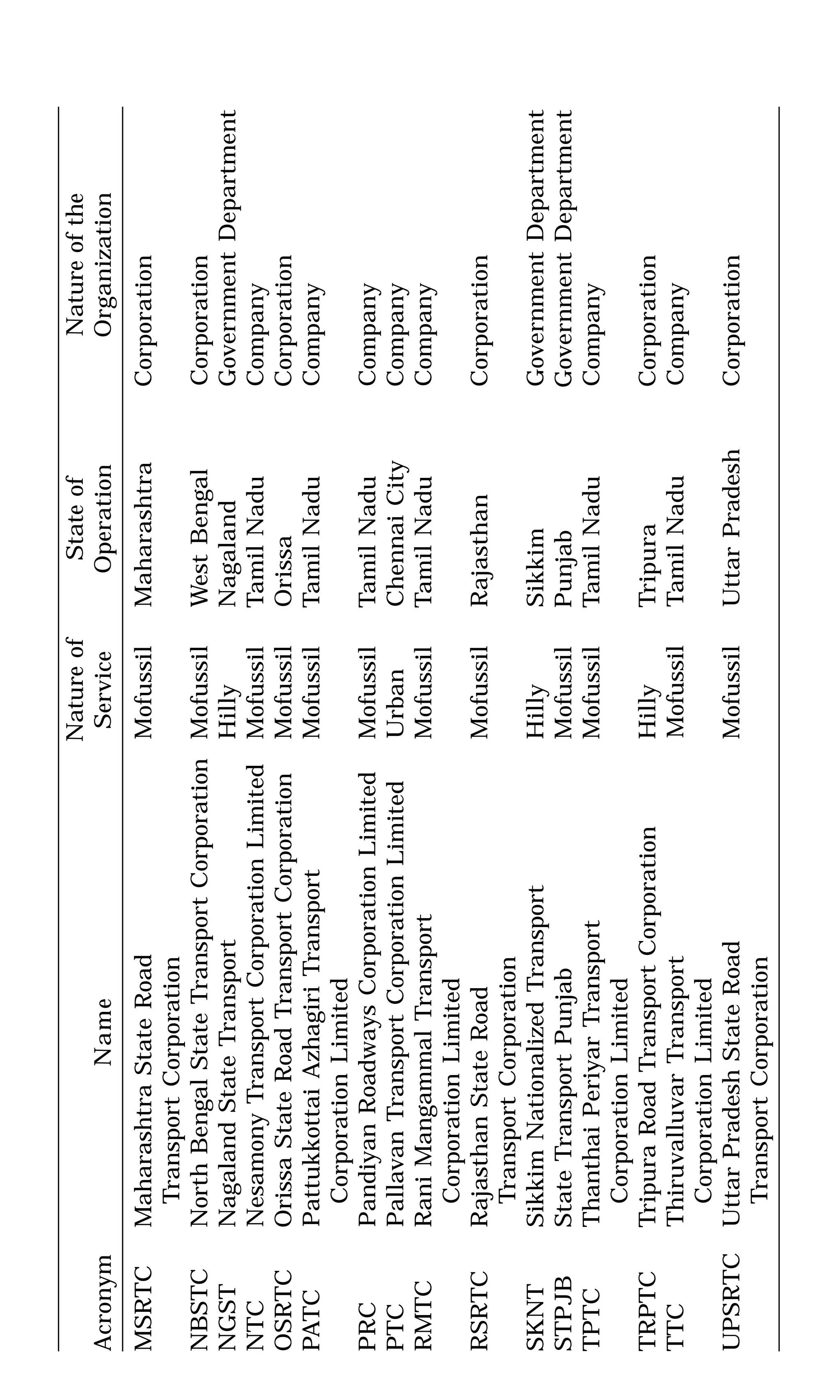
of Firm A.
The following questions have been included as practice prob-
lems for demonstrating the variety of applications of DEA.
Several applications of DEA have been described in Chap-
ter 6, each for of which the data and the DEA results have
been presented. Students should consider them also as practice
problems. In addition, several data sets for practicing DEA
are available on the Internet. See Chapter 5 for more details.
6. The data, choice of inputs and choice of output in this exercise
are based on the article, Sueyoshi and Goto (2001). The fol-
lowing data represents, for the year 1993, three inputs (the
amount of total fossil fuel generation capacity in Mega Watts
(MW); the amount of total fuel consumption in 109
kilocalories
(kcal); and the number of total employees in fossil fuel plants)
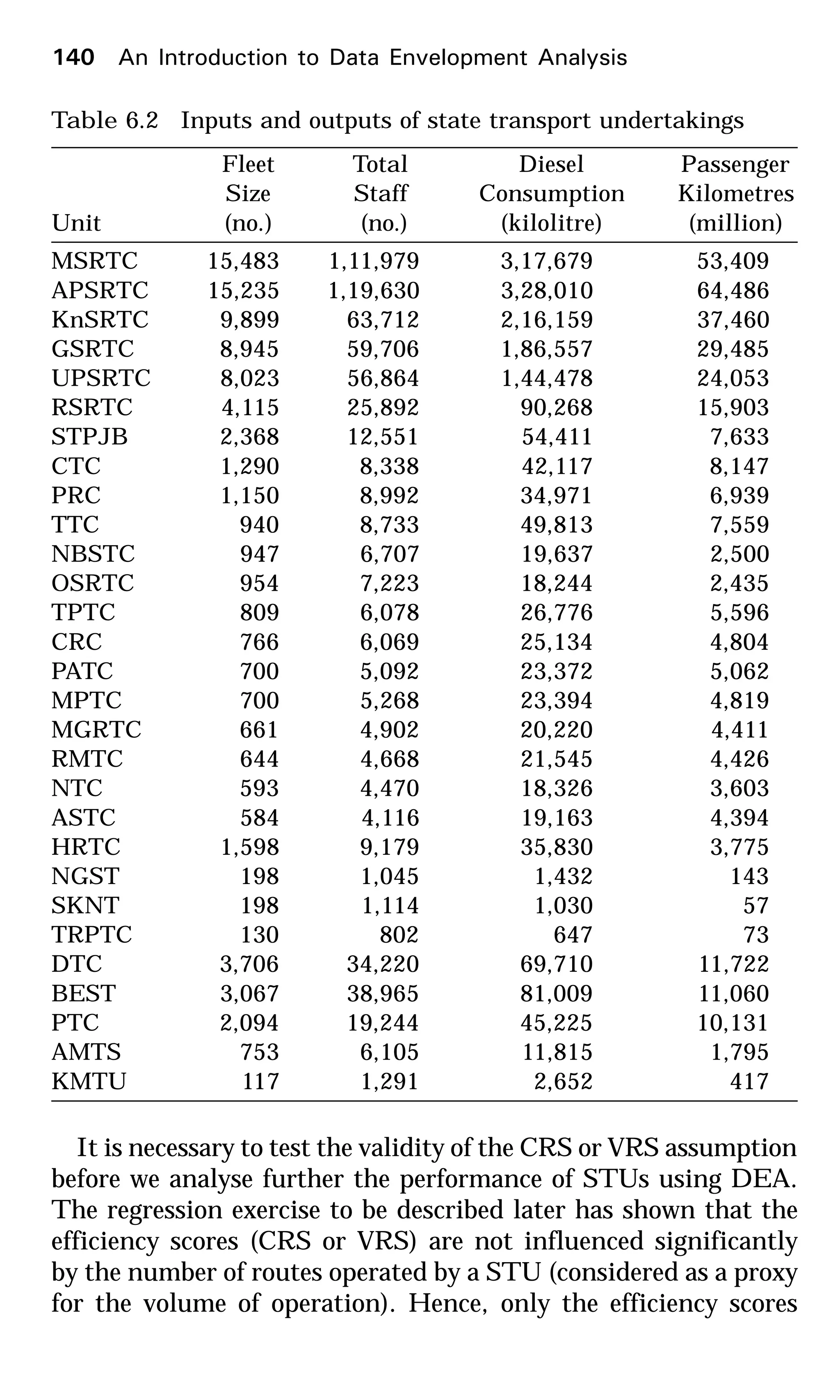
and one output (the amount of total generation in Giga Watt-
hour [GWh]) pertaining to electric power generation companies
in Japan.
Write all the eight DEA programs (Envelopment: input
oriented and output oriented, Multiplier: output maximizing
and input minimizing, and Returns to scale: constant and
variable) for estimating the efficiency of the power generation
company located in Hokkaido.
Solve the programs using an LP software. Tabulate the re-
sults. Is the Hokkaido power generation company efficient?
If not, which power generation companies would you recom-
mend the Hokkaido company consider emulating to improve
the efficiency of its operation? What are the CRS, VRS and
scale efficiencies of this company? What is its most productive
scale size?
Which are the efficient power generation companies in this
data set? For each of them, prepare a table showing the ineffi-
cient companies for whom the efficient company is a peer.
Economies of Scale 87
7. The performance of some selected international airlines is given
in the following table. Operating costs, nonflight assets and
nonpassenger revenue are measured in appropriate money units
(US$).
Write all the eight DEA programs (Envelopment: input
oriented and output oriented, Multiplier: output maximizing
and input minimizing, and Returns to scale: constant and
variable) for estimating the efficiency of Airline 4.
Solve these programs using an LP software. Tabulate the
results. Is Airline 4 efficient? If not, which airlines would
you recommend that Airline 4 consider emulating to improve
the efficiency of its operation? What are the CRS, VRS and
A data set of Japanese electric power generation companies
Name Generation Fuel Number Total
(DMU) Capacity Consumption of Generation
(MW) (109
kcal) Employees (GWh)
Chubu 18,075 1,53,335 2,472 69,300
Chugoku 6,406 56,194 1,176 25,717
Dengen-kaihatsu 4,655 65,728 825 30,071
Fukui 250 754 59 326
Fukuyama 699 9,704 187 4,339
Hokkaido 3,060 28,850 659 13,120
Hokuriku 2,662 17,127 664 7,648
Jyouban 1,625 15,758 206 6,940
Kansai 18,581 1,14,707 3,132 50,846
Kashima 1,400 12,380 141 5,407
Kimitsu 950 12,745 177 5,533
Kyushu 9,321 57,229 1,480 27,448
Mizushima 543 6,946 106 3,107
Okinawa 1,290 8,134 477 4,018
Ooita 500 7,837 85 3,351
Sakai 150 1,530 63 594
Sakata 700 9,468 86 4,229
Shikoku 3,171 29,611 554 13,113
Sumitomo 463 2,456 97 990
Tobata 781 10,446 104 4,488
Tohoku 7,868 73,705 107 34,228
Tokya 29,254 2,80,478 3,751 1,27,538
Tomakomai 250 1,817 55 790
Toyama 500 6,192 84 2,703
Wakayama 306 4,541 112 1,921
88 An Introduction to Data Envelopment Analysis
scale efficiencies of this airline? What is its most productive
scale size?
Which airlines are efficient according to this data set? For
each, prepare a table showing the inefficient airlines for which
the efficient airline is a peer.
8. The data, choice of inputs and choice of output in this exercise
are based on the article, Shafer and Byrd (2000). The efficiency
of organizational investments in information technology firms
need to be studied. The three inputs related to investments in
IT exercise are: information system (IS) budget as a percentage
of sales, an organization’s total processor value as a percentage
of sales, and the percentage of the IS budget allocated to train-
ing. Because of a wide range of companies (in terms of sales,
profits, number of employees, and industry) all three inputs
were normalized to facilitate comparisons. Specifically, IS
budget and an organization’s total processor value were taken
as a percentage of sales to normalize the differences in company
size. Similarly, training expenditures were taken as a percentage
of the total IS budget. Normalized measures are used to repre-
sent two outputs. Data on inputs and outputs for 36 of the
209 companies considered in the article are shown in the table
below.
A data set for selected international airlines
Inputs Outputs
Airline Available Operating Non- Revenue Non-
(DMU) ton km Cost flight Passenger passenger
Assets (km) Revenue
1 10,884 6,730 3,934 26,677 7,688
2 4,603 3,457 2,360 22,112 969
3 12,097 6,779 6,474 52,363 2,001
4 6,587 3,341 3,581 26,504 1,297
5 5,723 3,239 2,003 26,677 697
6 24,099 9,560 6,267 1,24,055 1,266
7 22,793 9,874 4,145 1,22,528 1,404
8 19,080 8,032 3,272 95,011 572
9 5,654 1,878 1,916 19,277 972
10 12,559 8,098 3,310 41,925 3,398
11 5,728 2,481 2,254 27,754 982
12 4,715 1,792 2,485 31,332 543
13 13,565 7,499 3,213 64,734 1,563
14 5,183 1,880 783 23,604 513
15 5,895 4,225 4,557 33,081 539
Economies of Scale 89
A data set for information technology firms
Company IS Processer Training Five Year Five Year
Name Budget Value as Budget as Compound Compound
as Percent- Percent- Percent- Annual Annual
age of age of age of Revenue Income
Revenues Revenues IS Budget Growth Growth
Ahawmut 5.69 0.46 0.93 29.4 135.6
Natl. Corp.
AMR Corp. 6.70 0.70 0.57 26.3 114.1
Arvin 1.70 0.78 3.47 28.7 108.6
Industries Inc.
Bank of Boston 3.28 0.72 1.89 42.0 135.7
Corp.
Bankers Trust 5.80 1.02 1.45 32.5 123.2
New York
Barnett Banks 3.17 0.88 2.67 28.6 94.6
Inc.
Chase Manhattan 3.92 0.65 1.67 25.9 118.8
Corp.
Chrysler Corp. 0.55 0.32 5.00 32.8 149.5
Comerica Inc. 2.61 1.22 2.67 41.5 124.7
Continental 2.48 0.51 1.45 11.8 95.0
Bank Corp.
Corestates 4.11 1.07 1.17 32.3 103.9
Financial Corp.
Dana Corp. 2.24 0.51 3.10 25.9 91.0
Delta Air Lines 2.01 0.73 2.00 25.9 105.5
Inc.
E-Systems Inc. 0.82 1.12 3.67 38.8 131.5
Eaton Corp. 2.60 0.62 2.50 27.4 86.3
First of America 2.75 0.82 2.47 34.1 99.1
Bank Corp.
First Union Corp. 3.36 0.48 0.97 42.6 115.1
Ford Motor Co. 1.66 0.51 4.00 30.2 103.4
Gencorp Inc. 2.15 0.91 3.80 25.5 33.2
General Dynam- 4.92 2.03 1.33 1.0 97.8
ics Corp.
General Motors 2.57 0.84 3.45 29.1 100.7
Corp.
KeyCorp 3.52 0.89 1.17 45.7 113.3
Lockheed Corp. 3.44 2.69 3.67 33.1 347.1
Martin Marietta 5.06 1.44 1.33 38.9 76.1
Corp.
90 An Introduction to Data Envelopment Analysis
McDonnell 4.38 1.63 2.83 25.7 143.4
Douglas Corp.
Mellon Bank Corp.7.05 2.21 1.33 28.0 109.4
Meridian Ban- 2.63 0.57 1.70 32.2 103.8
corp Inc.
Paccar Inc. 2.00 1.11 3.33 27.2 100.9
Raytheon Co. 1.84 0.48 2.30 33.3 128.4
Republic New 0.82 0.43 0.67 27.7 178.8
York Corp.
Sequa 0.98 0.77 2.33 28.7 89.9
Southwest 2.29 0.59 2.33 43.7 118.1
Airlines Co.
Suntrust Banks 3.22 0.93 2.33 26.2 90.3
The Boeing Co. 5.30 2.84 1.85 34.1 93.6
UAL 2.96 0.42 1.19 25.0 111.9
US Air Group Inc.1.57 0.39 1.93 18.7 82.7
Write all the eight DEA programs (Envelopment: input
oriented and output oriented, Multiplier: output maximizing
and input minimizing, and Returns to scale: constant and
variable) for estimating the efficiency of Bank of Boston.
Solve these programs using an LP software. Tabulate the
results. Is Bank of Boston efficient? If not, which company/
companies would you recommend Bank of Boston consider
emulating to improve the efficiency of its operation?
Which of these companies are efficient? For each of the effi-
cient companies, prepare a table showing the inefficient com-
panies for whom the efficient company is a peer.
9. In this exercise, DEA is applied to assess the performance of
some banks. Three inputs (number of employees, capital, and
deposits), and two outputs (loans and investments) are used
for the purpose. Capital is measured by the book value of fixed
assets and premises, and deposits are measured by the sum of
long-term and saving deposits. Similarly, loans include loans
to individuals, real estate loans, and commercial and indus-
trial loans. Investments are measured using the value of all
Economies of Scale 91
Company IS Processer Training Five Year Five Year
Name Budget Value as Budget as Compound Compound
as Percent- Percent- Percent- Annual Annual
age of age of age of Revenue Income
Revenues Revenues IS Budget Growth Growth
securities, other than those held in a bank’s trading accounts.
This data is shown below. Capital, deposits, loans and invest-
ments are measured in appropriate money units (US$).
Write all the eight DEA programs (Envelopment: input
oriented and output oriented, Multiplier: output maximizing
and input minimizing, and Returns to scale: constant and
variable) for estimating the efficiency of Bank 2. Is this an
efficient bank? If not, which bank/banks it should consider
emulating to improve the efficiency of its operation?
Which are the efficient banks? For each of the efficient banks,
prepare a table showing the inefficient banks for which the
efficient bank is a peer.
10. The management of the Sun Restaurant company wants to
analyze the efficiency of the operations of its seven fast-food
restaurants. For the study of efficiency, the management has
chosen the following inputs and outputs: number of employees
(input), monthly expenses (input), monthly profit (output),
and market share in percentage (output). Data for the input
and output measures is shown below. Expenses and profits
are measured in appropriate money units (US$).
Branch Number of Monthly Monthly Market
Employees Expenses Profit Share
1 25 2,000 7,500 45
2 200 18,000 79,500 53
3 45 3,000 8,400 25
4 10 800 4,600 10
5 29 2,300 6,000 5
6 12 1,000 3,000 45
7 89 8,000 40,550 67
Bank Loans Investments Employees Capital Deposits
1 945.326 233.366 520 91.087 3,457.951
2 85.545 20.343 43 8.287 299.820
3 1,200.333 323.973 643 109.863 4,203.085
4 12.534 4.752 21 0.996 40.653
5 43.984 8.874 19 3.984 198.353
6 249.876 40.983 112 19.469 892.073
7 546.987 98.730 286 25.084 1,417.933
8 325.651 75.926 215 20.651 999.984
9 1,513.832 387.341 680 121.792 4,802.963
92 An Introduction to Data Envelopment Analysis
Write all the eight DEA programs (Envelopment: input
oriented and output oriented, Multiplier: output maximizing
and input minimizing, and Returns to scale: constant and
variable) for estimating efficiency of Branch 5.
Solve these programs using an LP software. Tabulate the
results. Is Branch 5 efficient? If not, which company/com-
panies would you recommend the branch consider emulating
to improve the efficiency of its operation?
Which are the efficient branches in this data set? For each
of the efficient branches, prepare a table showing the inefficient
branches for which the efficient branch is a peer.
Economies of Scale 93
4
Miscellaneous DEA Models and
Recent Developments
The DEA model studied so far can be termed as the basic DEA
models. Several variations of the basic models have been proposed
in the DEA literature over the years. A brief outline of some of
these models and recent developments is provided in this chapter.
Those interested in knowing more about the models discussed
here should refer to the references provided at appropriate places.
4.1 Multiplicative DEA Models
In the DEA models we have seen so far, the inputs and outputs of
a DMU are aggregated additively. An alternative method of
multiplicative aggregation is possible. Using this mode of aggre-
gation, multiplicative DEA models have been constructed. The
method of multiplicative aggregation makes sense, especially for
manufacturing firms, because of the domination of the Cobb-
Douglas production functions.
The Cobb-Douglas function is a popular form for production
functions. With arguments X = (X1, ..., Xn), the function is ex-
pressed as
( ) ∏=
i
i
iXAXF α
(4.1)
where Siai = 1 and A is a positive constant. This function repre-
sents a typical example of multiplicative aggregation, with weights
forming the indices.
In line with Equation 4.1, a multiplicative aggregation of virtual
inputs can be defined as ∏i
u
i
iX . (Contrast it with the additive
aggregation, SiuiXi.) When we use multiplicative aggregation, the
efficiency of Firm A can be written as follows.
AEMPACAP
AVA
uu
v
A
E ,,
,
8.16.8
8.1
×
= (4.2)
Note that the multiplicative aggregation can be easily trans-
formed to additive one by logarithmic transformation.
log EA = vVA, A log 1.8 – (uCAP, A log 8.6 + uEMP, A log 1.8) (4.3)
Note that this does not result in a fractional program, and
hence can be directly used as a DEA objective function. This
program has to be maximized subject to the condition that the
efficiencies of all the firms are less than or equal to one.
The complete multiplicative DEA model is the following.
1,,
03.12log6.31log1.4log
06.2log6.15log8.2log
07.1log2.2log2.0log
08.1log6.8log8.1log
8.1log6.8log8.1logmax
,,,
,,,
,,,
,,,
,,,
,,,
≥
≤





+−
≤





+−
≤





+−
≤





+−






+−
AEMPACAPAVA
AEMPACAPAVA
AEMPACAPAVA
AEMPACAPAVA
AEMPACAPAVA
AEMPACAPAVA
uuv
uuv
uuv
uuv
uuv
uuv
tosubject
(4.4)
Note the new requirement that the decision variables (i.e.,
weights) are constrained to be greater than unity. This is a
Miscellaneous DEA Models and Recent Developments 95
96 An Introduction to Data Envelopment Analysis
requirement of the original model developed in Charnes et al.
(1982; 1983). Note that, otherwise, we cannot write its dual!
Note also that the dual will not include the variable q, but will
incluide only the slack variables of the dual constraints.
For the sake of completeness, the dual form of the multiplicative
DEA model is given here.
)5.4(0,,
0
8.1log312log62log71log81log
6.8log631log615log22log68log
8.1log14log82log20log81log
–––min
,,,
,
,
,
,,,
≥
≥
=+−−−
=+−−−
=−+++
AEMPACAPAVA
DACABAAA
AEMPDACABAAA
ACAPDACABAAA
AVADACABAAA
AEMPACAPAVA
sst
,,,
s....
s....
t....
sst
λλλλ
λλλλ
λλλλ
λλλλ
thatsuch
4.2 Additive Models
Note that there is a slight difference in the formulation of the
multiplicative models from the models discussed in Chapters 2
and 3. Unlike those models, the multiplicative models are not
formulated fractional programs, and hence no normalization
constraint is needed. Similar to the multiplicative model, it is
easy to write an additive DEA model also. The additive version
was published in Charnes et al. (1985b).
The general BCC version of the additive multiplier and
envelopment versions can be written as follows.
Multiplier version
free;1,
0
max
0
0
0,, 0
m
T
m
T
m
m
T
m
T
m
mm
T
mm
T
mvvu
vUV
vXUYV
vXUYVz
≥
≤+−
+−=
thatsuch
(4.6)
Miscellaneous DEA Models and Recent Developments 97
Envelopment version
0,,
1
min
,,
≥
=
=+
=−
−−
st
e
XsX
YtY
st
T
m
m
ts
λ
λ
λ
λ
λ
thatsuch
(4.7)
4.3 Time Series Analysis using DEA
So far, we have compared the performance of a number of DMUs
that operate at a particular point in time. This kind of analysis is
normally referred to as a cross-sectional analysis. In contrast,
one can think of comparing performance of DMUs over time.
This type of analysis is generally referred to as a time series analysis.
In practice, DMUs are observed over multiple time periods;
the variations of efficiency of DMUs over time can help in making
important conclusions.
There are at least two ways of using DEA in a time series mode:
Window Analysis and Malmquist Productivity Index.
4.3.1 Window Analysis
This mode is a moving average pattern of analysis, and is described
in Charnes et al. (1985a). A DMU in each period is treated as if
it is a different DMU. The performance of a DMU is compared
with its performance in other periods, in addition to comparing
it with the performance of other DMUs in the same period.
Let us consider the performance of four banks, A, B, C, and D,
over a seven-year time period. Then, we select a three-year ‘Win-
dow’ (the analog of ‘moving average’ in traditional time series
econometric analysis).
We analyze the firms for the first three years. In total, we will
have 4 ´ 3 = 12 DMUs since Bank A in Year 1 is treated as a dif-
ferent DMU as compared to Bank A in Year 2. The DEA results
may be presented in Table 4.1.
98 An Introduction to Data Envelopment Analysis
Table 4.1 DEA efficiencies of four banks for
years 1, 2 and 3 (hypothetical data)
Bank Year 1 Year 2 Year 3
A 0.981 0.973 0.981
B 1.000 0.997 0.991
C 0.937 0.913 0.952
D 1.000 1.000 0.998
Thus Bank B in Year 1, Bank D in Years 1 and 2 are the most
efficient ones in this three-year window.
Then the window is shifted by one year, and DEA analysis is
performed for the four banks for the Years 2, 3 and 4. We again
have 12 DMUs. Their efficiencies are shown in Table 4.2.
Table 4.2 DEA efficiencies of four banks for
years 2, 3 and 4 (hypothetical data)
Bank Year 2 Year 3 Year 4
A 0.967 0.964 0.946
B 1.000 0.991 1.000
C 0.918 0.956 0.943
D 1.000 0.991 1.000
Similar analysis is performed for other windows, and the results
are arranged in Table 4.3.
This window-type presentation facilitates an easy comparison
of the performance of a bank over time as well as a comparison
with its competitors at a particular point in time.
4.3.2 Malmquist Productivity Index Approach
Another method of time series analysis in DEA is to use the results
of DEA in conjunction with the Malmquist Productivity Index
(MPI) (see Fare et al. 1995). Note that this index number approach
of analyzing performance variations over time was in existence
much before DEA was proposed.
The output based Malmquist Productivity Index is defined as
follows (Malmquist 1953).
2
1
1
11111
111
),(
),(
),(
),(
),,,(








×= +
+++++
+++
ttt
ttt
ttt
ttt
ttttt
yxD
yxD
yxD
yxD
yxyxM (4.8)
Miscellaneous DEA Models and Recent Developments 99
where Dt
is a distance function measuring the efficiency of con-
version of inputs xt
to outputs yt
during the period t.
Note that if there is a technological change during the period
(t + 1), then,
Dt + 1
(xt
, yt
) = Efficiency of conversion of input at period t
to output at period t
¹ Dt
(xt
, yt
) (4.9)
MPI is a geometric average of the effect of technology change.
It can be written as,
21
1111
11111
111
),(
),(
),(
),(
),(
),(),,,( 





×= ++++
+++++
+++
ttt
ttt
ttt
ttt
ttt
ttt
ttttt
yxD
yxD
yxD
yxD
yxD
yxDyxyxM
or
M = E ´ T (4.10)
Table 4.3 DEA efficiencies of four banks for years 1–7
using a three-year window (hypothetical data)
Year 1 2 3 4 5 6 7
A 0.981 0.973 0.981
0.967 0.964 0.946
0.991 0.973 0.981
0.967 0.888 1.000
0.756 1.000 0.993
B 1.000 0.997 0.991
1.000 0.991 1.000
0.948 0.796 0.848
0.856 0.888 0.728
0.869 0.809 0.967
C 0.937 0.913 0.952
0.918 0.956 0.943
1.000 0.867 0.800
0.856 0.743 1.000
0.856 0.938 0.725
D 1.000 1.000 0.998
1.000 0.991 1.000
0.874 0.767 1.000
0.793 0.896 0.847
0.971 0.744 1.000
where E = Technical efficiency change, and
T = Technology change.
Consider Figure 4.1. St + 1
is the frontier at (t + 1). If there is a
technical progress, St + 1
will shift upwards from St
. M represents
achievement (xt + 1
, yt + 1
) at time (t + 1), while N represents the
achievement at time t.
Figure 4.1 Malmquist productivity index
Note that DEA efficiency can be considered as a distance meas-
ure because it reflects the efficiency of conversion of inputs to
outputs. Hence,
( ) outputsandinputsusingefficiencyDEA, 11111 +++++
= ttttt yxyxD
=
OA
OB
100 An Introduction to Data Envelopment Analysis
Similarly,
( )
OE
OF
yxD ttt =,
Hence,
( )
( )
( )
( )OEOF
OAOB
yxD
yxD
E
ttt
ttt
/
/
,
,
changeefficiencyTechnical
111
=
=
=
+++
(4.11)
If E > 1, then there is an increase in the technical efficiency of
converting inputs to outputs.
What does ( )[ ]ttt yxD , ( )[ ]ttt yxD ,1+
in Equation 4.10 mean?
Because of a technical change, the same input xt
can produce a
higher output when used during the period (t+1). Input xt
can
produce only OE as its best ouput in time t, but can produce a
higher output OC in time (t+1). Hence, the ratio (OC/OE)
represents a measure of technology change. If this ratio is greater
than unity, then there is proof of technological improvement.
( )
( )
OC
OFyxD
OE
OF
yxD
ttt
ttt
=
=
+
,
,
1
HHence,
( )
( ) OE
OC
yxD
yxD
ttt
ttt
=+
,
,
1
For technological progress, this ratio should be greater than
unity. Similarly,
( )
( )
1
,
,
111
11
>=
+++
++
OD
OA
yxD
yxD
ttt
ttt
for technological progress.
Miscellaneous DEA Models and Recent Developments 101
Thus,
( )
( )
( )
( )
2
1
2
1
1111
11
,
,
,
,
changeTechnology






×=






×=
=
++++
++
OE
OC
OD
OA
yxD
yxD
yxD
yxD
T
ttt
ttt
ttt
ttt
(4.12)
represents the average technological change, measured as the geo-
metric mean of the foregoing two ratios.
4.4 Some Extensions of DEA
When the basic DEA models are applied in practical problems,
several issues are encountered. Therefore, the DEA models often
have to be modified to extend their applicability to these problems.
Some of these extensions reported in the literature are discussed
here.
4.4.1 Non-discretionary Inputs and Outputs
The basic DEA models we have discussed so far assume that all
inputs and outputs are discretionary, i.e., all of them are under
the control of the management of the DMU, and can be varied at
its discretion. Thus the failure of a DMU to produce maximal
output levels with minimal input consumption results in decreased
efficiency score. However, in practice, there may be circumstances
when some of the inputs or outputs are beyond the control of the
management of a DMU. For example, a school situated in a back-
ward area will have a greater enrolment of socially weaker students.
A manager of agricultural farms cannot alter soil characteristics.
There are at least two ways to approach this issue in DEA.
The first method introduces non-discretionary characteristics
within the DEA framework. It is done by recognizing that there
cannot be a best achievable performance for non-discretionary in-
puts or outputs. In the DEA framework, the envelopment version
has the flexibility to handle this situation.
102 An Introduction to Data Envelopment Analysis
Let ID be the set of discretionary inputs, where ID Î I and let
IND =I – ID. The input oriented envelopment problem now
becomes,
(4.13)free
0
)(;
)(;
,K,2,1;
min
1
1
1
m
n
Dim
N
n
nin
Dimm
N
n
nin
jm
N
n
njn
m
Iixx
Iixx
Jjyy
θ
λ
λ
θλ
λ
θ
≥
←∉≤
←∈≤
=≥
∑
∑
∑
=
=
=
inputsarydiscretion-nonfor
inputsarydiscretionforonly
thatsuch
Obviously, the above model will consider only non-discretionary
inputs. To consider non-discretionary outputs, one has to use the
output oriented envelopment version.
There is another way of handling non-discretionary inputs,
which has been used by many DEA researchers. This method
draws from published literature on Total Factor Productivity (Caves
et al. 1982). It combines DEA and regression. Non-discretionary
variables are handled outside the DEA framework.
In this method, the efficiencies of DMUs are obtained without
considering the non-discretionary variables. Then, the resulting
DEA efficiencies are regressed using the non-discretionary vari-
ables as the independent variables. This process filters the effects
of non-discretionary variables on the efficiency ratings. If needed,
the residuals of regression may be used as the final efficiency
scores of the DMUs. An example of this approach is described in
Section 6.2 in the context of the application of DEA to transport
undertakings and schools.
4.4.2 Categorical Inputs and Outputs
We have so far considered all inputs and outputs to be continuous
variables. However, practical applications do involve categorical
or ordinal variables.
Miscellaneous DEA Models and Recent Developments 103
As an example, some DMUs can perform well simply by virtue
of their location. If the locations could be characterized as good,
medium or poor, it may not be correct to compare the performance
of DMUs located in a good location with those located in a poor
location. Decision-making units having similar location character-
istics should be compared, and caution must be exercised in com-
paring DMUs that have different location characteristics.
Similarly, some DMUs may have a particular capability unlike
others. For example, some hotels may have a drive-in facility. It
may not be meaningful to compare the performance of these DMUs
with those who do not have this facility.
This issue is tackled by comparing only those DMUs having a
particular capability. Suppose that only a subset NA of the DMUs
has a particular capability, where NA Î N. Then the envelopment
DEA program can be modified as follows (Banker and Morey
1986; Charnes et al. 1994).
free
0
,K,2,1;
,K,2,1;
min
m
n
imm
Nn
nin
jm
Nn
njn
m
Iixx
Jjyy
A
A
θ
λ
θλ
λ
θ
≥
=≤
=≥
∑
∑
∈
∈
thatsuch
(4.14)
This DEA model compares only those DMUs that possess simi-
lar characteristics. Hence, the resulting efficiency scores provide
a more accurate measurement of performance.
4.4.3 Incorporating Judgements and a Priori
Knowledge
A DEA program is a mathematical program, which yields effi-
ciency ratings when supplied with input–output data. However,
DEA can provide results that are unacceptable on the basis of
some other criteria or inputs. Some specific situations are:
104 An Introduction to Data Envelopment Analysis
(a) The DEA analysis ignores information that cannot be
directly incorporated into the model or that contradicts
expert opinion.
(b) The management of a DMU have some a priori information
regarding the weights to be given to different inputs and
outputs. More generally, they may have a range for the
weights.
(c) DEA may sometimes fail to discriminate among DMUs,
especially for a small sample size. Hence, all may be rated
efficient (e.g., Firms A, B, C and D under VRS assump-
tion in Chapter 1).
These requirements are normally addressed by imposing add-
itional constraints in the DEA program. These constraints may
restrict the weights of inputs and outputs, weights of DMUs, or
impose other constraints that are meaningful for the problem.
For instance, from a set of hundreds of DMUs, one may like
to compare only those which consume (or produce) more than a
certain quantity of input (or output) for a specific situation. This
can be done simply by introducing another constraint in the model.
As an example, Dyson and Thanassoulis (1988) have imposed
upper and lower bounds on the weights.
The method of ‘assurance region’ (Thompson et al. 1986) has
been developed by restricting the relative magnitude of the weights
for special items. For example, the ratio of weights for the two in-
puts (capital employed and number of employees) may be restricted
by providing this additional constraint to the output maximizing
multiplier version:
lowerbound £ uCAP, A/uEMP, A £ upperbound
(here Firm A is the reference firm).
The method of ‘cone-ratio envelopment’ described as cone-ratio
DEA model in Charnes et al. (1989) and polyhedral cone-ratio
DEA model in Charnes et al. (1990) uses more general framework
to specify weight restrictions. Weight restrictions are incorporated
using the form {Cw ³ 0} where w is a column matrix of the weights
(uCAP, A, uEMP, A, etc.) and C is a matrix where weight restrictions
are specified. It is possible to write the weight restriction
Miscellaneous DEA Models and Recent Developments 105
constraints of the assurance region in the form {Cw ³ 0}. Thus,
the cone-ratio envelopment method is more general compared to
the assurance region method. More complicated cone-ratio formu-
lations are also available in the literature. It has been proved that
the cone-ratio DEA model can be transformed to a form similar
to the CCR DEA model using suitable transformations, and hence
can be solved with the existing DEA software without any need
for modifying computer codes. Interested readers should refer to
Charnes et al. (1989; 1990) and Brockett et al. (1997).
4.5 Exercises
1. The following table gives two outputs and two inputs used for
measuring the relative efficiency of some highway maintenance
patrols. All the patrols are approximately similar in size. Each
patrol is responsible for a fixed number of lane-kilometres of
highway, as well as the activities associated with that portion
of the network.
(a) Identify efficient patrols, and the most productive scale
size for each of the inefficient patrols.
(b) The management of the DMUs feels that the weight
of the available Average Traffic Served should not be
less than half, but cannot be more than 20 per cent, of
the weight assigned to the variable Area Served Factor.
Estimate the relative efficiency of the patrols after im-
posing these restrictions.
Outputs Inputs
Area Served Average Traffic Maintenance Capital
Factor Served Expenditure Expenditure
PATROL 1 0.5 8.0 930 600
PATROL 2 3.5 62.0 256 600
PATROL 3 1.0 75.0 990 600
PATROL 4 2.3 62.0 76 2,000
PATROL 5 4.5 48.0 20 700
PATROL 6 0.8 40.0 20 4,000
PATROL 7 3.4 3.3 35 900
PATROL 8 0.8 12.0 10 2,400
106 An Introduction to Data Envelopment Analysis
2. The following table summarizes the performance of selected
State Transport Undertakings (STUs) in India. Fleet size is a
representative of the capital input, total number of staff is a
representative of the labour input, and diesel consumption
represents a dominant material input. Passenger kilometres,
a composite measure of the passenger carried and the average
distance travelled by passengers, is considered as the single
measure of output.1
Fleet Total Diesel Passenger
Size Staff Consumption Kilometres
Unit (no.) (no.) (kilolitres) (millions)
STU1 15,483 1,11,979 3,17,679 53,409
STU2 15,235 1,19,630 3,28,010 64,486
STU3 9,899 63,712 2,16,159 37,460
STU4 8,945 59,706 1,86,557 29,485
STU5 8,023 56,864 1,44,478 24,053
STU6 4,115 25,892 90,268 15,903
STU7 2,368 12,551 54,411 7,633
STU8 1,290 8,338 42,117 8,147
STU9 1,150 8,992 34,971 6,939
STU10 940 8,733 49,813 7,559
STU11 947 6,707 19,637 2,500
STU12 954 7,223 18,244 2,435
STU13 809 6,078 26,776 5,596
STU14 766 6,069 25,134 4,804
STU15 700 5,092 23,372 5,062
STU16 700 5,268 23,394 4,819
STU17 661 4,902 20,220 4,411
STU18 644 4,668 21,545 4,426
STU19 593 4,470 18,326 3,603
STU20 584 4,116 19,163 4,394
STU21 1,598 9,179 35,830 3,775
STU22 198 1,045 1,432 143
STU23 198 1,114 1,030 57
STU24 130 802 647 73
STU25 3,706 34,220 69,710 11,722
STU26 3,067 38,965 81,009 11,060
STU27 2,094 19,244 45,225 10,131
STU28 753 6,105 11,815 1,795
STU29 117 1,291 2,652 417
1
This application is partly described in Section 6.2.
Miscellaneous DEA Models and Recent Developments 107
Perform data envelopment analysis to identify efficient and
inefficient STUs.
Note that STUs 21 to 24 operate on a hilly terrain, while
STUs 25 to 29 operate exclusively in urban areas. The remain-
ing operate mostly long distance, inter-city bus services. There
is reason to believe that STUs operating on a hilly terrain are
at a disadvantage compared to others. Also, STUs operating
in urban areas have a special advantage over others as they
have better capacity utilization. How can you incorporate these
differences into the DEA analysis?
STUs 1, 4, 10, 16, 24, and 25 are Government-owned, while
the remaining STUs operated independently as private corpor-
ations. How will you test the hypothesis that private corpor-
ations generally perform better than Government departments?
3. The following table provides data regarding physical perform-
ance and energy consumption in road and rail transport. PKM
refers to Passenger Kilometres, a composite measure of the
number of passengers and the distance travelled by passengers,
while TKM refers to Tonne-Kilometres, which is a measure of
total tonnage of materials and the distance transported. These
are the output measures, while energy consumption is a domin-
ant material input.2
Railways Roadways
Energy PKM TKM Energy PKM TKM
Year (TJ) (billion) (billion) (TJ) (billion) (billion)
1 2,76,547 209 159 4,42,590 353 98
2 2,88,503 221 174 4,59,360 377 103
3 2,84,951 227 178 4,98,588 408 106
4 2,75,747 223 178 5,30,511 448 116
5 2,59,278 227 182 5,73,339 486 124
6 2,54,974 241 206 6,27,644 850 193
7 2,33,496 257 223 6,83,686 893 210
8 2,23,517 269 231 7,55,410 980 238
9 2,07,529 264 230 8,29,482 905 275
10 1,25,367 296 257 11,45,102 1,500 350
2
This application is partly described in Section 6.2.
108 An Introduction to Data Envelopment Analysis
The DEA efficiencies provide an idea of the energy efficiency
of the two modes of transport over time. Perform window analysis
with a three-year window, and make useful conclusions.
4.6 Other DEA Models and Extensions3
The literature on DEA is continuously evolving and contains
many more extensions, including the free disposal hull (FDH)
(Tulkens 1993), generalized DEA (Nakayama et al. 2000), value
efficiency analysis (Halme et al. 1999), etc. The FDH model is
quite similar to the BCC model, except that the multipliers (l)
are restricted to binary (zero and one) variables.
Research studies on the incorporation of preference information
in DEA (e.g., the value efficiency analysis suggested in Halme
et al. 1999) have largely explored the relationship between DEA
and the larger field of Multi-Criteria Decision-Making (MCDM).4
Though DEA was originally developed as a tool for performance
measurement, over the last few years the linkages between the
fields of DEA and MCDM have been explored (Stewart 1996;
Agrell and Tind 1998; Belton and Stewart 1999). Data envelop-
ment analysis is now widely accepted as a tool for multi-criteria
decision-making. Stewart (1996) has compared and contrasted
the traditional goals of DEA and MCDM. The goal of DEA is to
determine the productive efficiency of a system or DMU by com-
paring how well the DMUs convert inputs into outputs, while
the goal of MCDM is to rank and select from a set of alternatives
that have conflicting criteria. Incorporating preference informa-
tion in a DEA analysis extends it naturally towards MCDM.
This issue has been discussed for a long time in DEA literature
(Golany 1988; Thanassoulis and Dyson 1992; Zhu 1996; Halme
et al. 1999). Golany (1988) and Thanassoulis and Dyson (1992),
among others, have developed target setting models. Golany
3
This section is meant for advanced readers, and can be skipped without
any loss of continuity.
4
A multi-criteria decision-making problem is characterized by the need to
choose one or a few criteria from among a number of alternatives, and the
choice is made on the basis of two or more criteria or attributes (Dyer et al.
1992).
Miscellaneous DEA Models and Recent Developments 109
(1988) has allowed the decision maker (DM) to select the preferred
set of output levels, given the input levels of a DMU. Thanassoulis
and Dyson (1992) have estimated alternative input/output target
levels to render relatively inefficient DMUs efficient. Another
approach to incorporate preference information in DEA is to re-
strict the flexibility of weights (e.g., Charnes et al. 1989). Gener-
ally speaking, weight restrictions result in the reduction of the
number of efficient DMUs. Zhu (1996) proposed a model that
calculates efficiency scores incorporating data regarding the DM’s
preference. In the value efficiency analysis proposed in Halme et
al. (1999), the DMs’ preferences are incorporated in DEA by expli-
citly locating his/her most preferred input–output vector on the
efficient frontier. This results in the DM’s Most Preferred Solution.
The approach uses a pseudo-concave value function to estimate a
hyperplane for comparing the utility of observations.
The field of DEA is developing very rapidly with new topics
being added regularly. While most of the important issues are
covered in the previous sections of this chapter and in the previous
chapters, other topics will not be covered in this book. Interested
readers are advised to refer to the articles cited in this chapter
and elsewhere in this book. More bibliographic information on
DEA is provided in Chapter 6.
110 An Introduction to Data Envelopment Analysis
5
Computer-based Support for DEA
In this computer era, it is important that any management science
technique has adequate software support so that potential users
are encouraged to use it. Software harnesses the computing power
of PCs for use in practical decision-making situations. It can also
expedite the implementation of a method. Potential users can
access the software more easily if it is accessible from Web site on
the Internet, and, if it is available as a freeware, downloaded.
5.1 Computational Features of DEA
Data envelopment analysis is based on linear programming. There-
fore, any software package available for solving linear programming
can in principle be used for solving DEA applications. However,
there are some significant characteristics of DEA that cannot be
handled satisfactorily by standard LP packages, thus necessitating
specialized software. These characteristics include the following.
(a) DEA applications typically involve solving separate linear
programming problems for each of the DMUs involved.
If there are N DMUs, one has to invoke the LP package
N times, each time modifying the objective function and
other parameters. This is tedious and time-consuming.
(b) Multiplier DEA versions involve normalizing constraints.
For example, the output maximizing multiplier problem
112 An Introduction to Data Envelopment Analysis
requires the following constraint that normalizes the
weighted sum of inputs.
UT
m Xm = 1
Obviously, the weights ui are inversely proportional to the
magnitude of inputs: if Xi is large, then the corresponding
ui have to be necessarily small. It is possible that if the
value of inputs is sufficiently large, the resulting small
values of weights can confound the testing of optimality
in the LP algorithm.
(c) The optimal solution of a DEA model often involves many
more zero values than encountered in regular linear pro-
gramming models. For example, when an envelopment
DEA model is solved for an efficient DMU, only the vari-
able q and its corresponding l are positive, while all other
values are equal to zero in the optimal solution. Given
this situation, readers familiar with linear programming
will realize that DEA models can lead to degeneracy. In
linear programming, a basis corresponding to a feasible
solution is said to be degenerate when at least one of the
basic variables has a value of zero. When a DEA model is
solved using an ordinary LP package, the basic solutions
of many iterations can contain many zero basic variables,
and therefore will be degenerate basic solutions. The main
theoretical implication of degeneracy is the phenomenon
of cycling—the simplex procedure would repeat the same
sequence of iterations, never improving the objective value
and never terminating the computations. Thus it is neces-
sary to incorporate methods for eliminating cycling, result-
ing in the reduction of computational speed.
(d) As noted in Chapter 2, the use of non-Archimedean in-
finitesimals can create computational difficulties when
solved using an LP software. Though the non-Archimedean
infinitesimals are not numbers, standard LP packages do
require that the infinitesimals be represented in the form
of small numbers. The numeric values for non-Archimedean
infinitesimals in actual computations should be chosen
Computer-based Support for DEA 113
to be much smaller than other input and output values
so that optimization is not affected. However, it is normally
not possible to know the values of inputs and outputs in
commercial software that will be used for a variety of appli-
cations. Therefore, solution methodologies that do not
require explicit specification of the values of infinitesimals
are required for use with DEA software. A two-phase opti-
mization procedure, discussed in Chapter 2, can be used
to avoid assigning numerical values to non-Archimedean
infinitesimals (see Ali and Seiford 1993).
More information about the computational aspects of DEA is
available in Ali (1994).
5.2 DEA Software
The DEA methodology can be programmed using various high-
level programming languages to generate their software. Software
implementation for DEA is available from several developers
including universities and private companies. Examples include
the University of Warwick and Banxia Software Ltd., UK. Simi-
larly, the latter has developed Frontier Analyst. Demonstration
versions of the above software are available from their respective
developers. Other software for DEA include BYU-DEA developed
at Brigham Young University, Utah, USA; IDEAS developed by
1 Consulting, Massachusetts, USA; and, PIONEER developed
at the Southern Methodist University, Dallas, USA. More informa-
tion on many of these software is available in Charnes et al. (1994).
Other free DEA software include Efficiency Measurement System
(EMS) developed at the University of Dortmund, Germany, and
A Data Envelopment Analysis (Computer) Program (DEAP) de-
veloped at the Centre for Efficiency and Productivity Analysis,
University of New England, Australia. Note that the DEA software
listed above are available free only for academic purposes.
The latest survey of decision analysis software (Maxwell 2000)
published in ORMS Today includes a description of software such
as Frontier Analyst.
114 An Introduction to Data Envelopment Analysis
5.3 Internet Support for DEA1
As mentioned earlier, Internet support for software including DEA
software will augment their capabilities. Internet support provides
avenues for faster communication between users and developers,
incorporation of feedback from users, and quick updating of new
versions of DEA software.
Developers of most of the DEA software mentioned in Section
5.2 provide elaborate Internet support to their clients through
Web sites. Support includes providing information, and making
demonstration versions of the software available. The following
are the Internet sites for some of the DEA software.
(a) Frontier Analyst software, Banxia Software Ltd., Glasgow,
Scotland (http://www.banxia.com).
(b) Warwick-DEA software, University of Warwick, UK
(http:// www.warwick.ac.uk/~bsrlu/).
(c) The EMS software, University of Dortmund, Germany
(http://www.wiso.uni-dortmund.de/lsfg/or/scheel/ems/).
(d) The DEAP software, Centre for Efficiency and Produc-
tivity Analysis, University of New England, Australia
(http://www.uq.edu.au/~uqtcoell/deap.htm).
(e) The DEA-Solver-PRO software developed by SAITECH,
Inc., New Jersey, USA (http://www.saitech-inc.com/security/
dea.htm). This software is bundled with a recent book on
DEA (Cooper et al. 2000).
(f ) OnFront software developed by Economic Measurement
and Quality AB, Box 2134, S-220 02 Lund, Sweden
(http://www.emq.se/software.html).
(g) The DEAFrontier software, bundled with Zhu (2002), is
an Add-In for Microsoft Excel for performing DEA com-
putations (http://www.deafrontier.com).
Charnes et al. (1994) provide the e-mail addresses of
developers of some other DEA software. In addition, the
softwares surveyed at the ORMS Today are available at
the Internet site: http://www.lionhrtpub.com/software-
surveys.shtml. Herrero and Pascoe (2002) provide a
1
I thank Mr Jukka Pattero of the Helsinki University of Technology for
his help in compiling some of the Internet facilities for DEA.
Computer-based Support for DEA 115
comparative analysis of many different DEA software.
Many of the DEA software are also listed at the Internet
site http://www.deazone.com/software/index.htm.
Note that Internet support need not be limited to DEA
software. Internet provides several other support facilities
for DEA. They include the following features.
(h) A Web-based DEA interface is available at the University
of Mannheim, Germany (http://heliodor.bwl.uni-man-
nheim.de/webdea.html). The interface enables users of DEA
to enter data for their DEA computations online, processes
their data immediately, and provides DEA efficiencies and
other relevant results.
(i) A number of Internet sites provide DEA tutorials. Ex-
amples include, among others, http://www.emp.pdx.edu/dea/
homedea.html (Portland State University, Oregon, USA),
http://www.warwick.ac.uk/~bsrlu/dea/deat/deat1.htm
(University of Warwick, UK), http://www.ms. ic.ac.uk/jeb/
or/dea.html (Imperial College, London, UK), and, http://
members.tripod.com/moezh/DEAtutorial/DEAtutorial.html
(York University, Canada).
(j) Most of these Internet sites provide some bibliographical
information on DEA and also links to other DEA sites.
The Web site of the author of this book (www.geocities.
com/r_ramnath) also provides information on DEA. A de-
tailed DEA bibliography is available at the University of
Warwick, UK (refer item b).
(k) Other interesting Internet sites for DEA include the
Web site of the Productivity Analysis Research Network
(PARN) in SDU-Odense University, Denmark (http://
www.busieco.ou.dk/parn/), and the EURO Working Group
on Data Envelopment Analysis and Performance Measure-
ment (Euro-DEAPM) (http://www.deazone.com/euro-
deapm/).
A collection of data sets for testing and practising DEA problems
are available in many Internet sites. These include the DEA data-
set repository (http://www.etm.pdx.edu/dea/dataset/Default.htm)
maintained by the Portland State University, USA, and the
University of Auckland, New Zealand, the OR-Library (http://
mscmga.ms.ic.ac.uk/jeb/orlib/deainfo.html), and the data set
maintained at the site http://www.deazone.com/datasets/FILE1/
index.asp.
5.4 A Brief Description of Some DEA Software
In this section, a brief description of some free DEA software
available on the Internet will be provided. The information has
been obtained from the documentation available at the corres-
ponding Internet sites. More details can be obtained from these
sites. It is worth mentioning again that these software are available
free only for academic purposes.
5.4.1 Efficiency Measurement System (EMS)
Software
Efficiency Measurement System (EMS) (Version 1.3) is a software
developed at the University of Dortmund, Germany, for Windows
9x/NT, for performing DEA computations. EMS is free of charge
for academic users. It can be downloaded from: http://www.wiso.
uni-dortmund.de/lsfg/or/scheel/ems/. The latest news about EMS,
downloads and bug fixes can also be found at this page. Enquiries
regarding the software can be sent to the developer at H.Scheel
@wiso.uni-dortmund.de.
EMS uses LP Solver DLL BPMPD 2.11 by Csaba zesM ′′ aros
for the computation of the scores (http://www.netlib.org). It is an
interior point solver.
There is theoretically no limitation on the number of DMUs,
inputs and outputs in EMS. The size of the analysis is limited
by the memory of the computer in which the computations are
performed. The developer of the software claims to have solved
problems with over 5,000 DMUs and about 40 inputs and outputs
successfully.
EMS accepts data in MS Excel 97 (and earlier versions) or in
text format. Guidelines for using Excel files are listed below.
(a) The input–output data should be collected in one work-
sheet, ‘Data’.
(b) Input names are specified by including the string ‘{I}’ at
the end of the names.
116 An Introduction to Data Envelopment Analysis
(c) Output names are specified by including the string ‘{O}’
at the end of the names.
(d) The first row should contain names of inputs, followed
by names of outputs.
(e) The first column of the worksheet should contain the
DMU names.
(f )The worksheet should not contain formulae.
The following guidelines should be used for text files.
(a) If text files are used, the name of the text file should be
mentioned in a separate file named Schema.ini. This file
is normally available with the EMS software and may be
modified whenever necessary.
(b) In a text file, columns are separated by tabs.
(c) The first column contains the DMU names.
(d) As with Excel files, the input names contain the string
‘{I}’, while the output names contain the string ‘{O}’.
Non-discretionary inputs and outputs can also be specified in
EMS. This is done by including the string ‘{IN}’ instead of ‘{I}’
for inputs and by including ‘{ON}’ instead of ‘{O}’ for outputs.
Weight restrictions (see Chapter 4) can be specified using a
separate Excel or text file. The EMS software can also perform
Window analysis and Malmquist index-based analysis. For more
details, the reader is referred to the documentation available at
the EMS home page specified earlier.
5.4.1.1 Solving a DEA example using EMS: Use of EMS for
computing DEA efficiencies will be explained in this section using
the example of the four DMUs A, B, C and D discussed in Chap-
ter 1. Recall that there were the two inputs (CAP and EMP) and
one output (VA) for the four firms.
Step 1—Data input: If a text file is used for inputting data,
the following should be its contents. The symbol ® indicates a
tab.
DMU ® CAP {I} ® VA {O}
A ® 8.6 ® 1.8 ® 1.8
B ® 2.2 ® 1.7 ® 0.2
Computer-based Support for DEA 117
C ® 15.6 ® 2.6 ® 2.8
D ® 31.6 ® 12.3 ® 4.1
Step 2—Making the calculations: EMS software can be started
by clicking the appropriate icon. Input and output data can be
loaded by pressing Ctrl+O or invoking the File menu, and then
clicking ‘Load data’. Once the data are loaded, efficiencies can be
calculated by pressing Ctrl+M or be invoking the DEA menu
and the clicking ‘Run Model’.
Step 3—Viewing results: The output created by the EMS soft-
ware when the input data is specified as the text file as in Step 1
is shown in Figure 5.1.
The window caption describes which model was computed. In
this case, the window caption above is Data.txt_CRS_RAD_IN,
which specifies that the input data file is Data.txt, and that the
computations have been carried out assuming constant returns
to scale, radial distance, and input orientation.
Step 4—Interpreting the results: The result table contains the
following:
Figure 5.1 Output screen from EMS software
118 An Introduction to Data Envelopment Analysis
(a) DMU name
(b) DEA efficiency score. For example, the above output shows
that the efficiency of DMU A and C are 100 per cent
while those of DMUs B and D are 43.43 per cent and 62
per cent respectively. Please recall that these were the same
efficiencies calculated in Chapter 1.
(c) Weights (shadow prices) {W} or virtual inputs/outputs
{V} as selected in Menu DEA ® Format.
(d) Benchmarks:
(i) For inefficient DMU: the reference DMUs with corres-
ponding intensities (the ‘lambdas’) in brackets.
(ii) For efficient DMU: the number of inefficient DMUs
which have chosen the DMU as Benchmark.
(e) Slacks {S} or factors {F}. Depending of the chosen dis-
tance, for radial and additive measures, the slacks are dis-
played.
5.4.2 A Data Envelopment Analysis (Computer)
Program (DEAP)
Another DEA software, A Data Envelopment Analysis (Computer)
Program (DEAP) (Version 2.1) has been developed by Professor
Tim Coelli of the Centre for Efficiency and Productivity Analysis,
University of New England, Australia.2
Detailed instructions on how to use the DEAP software are
available in a user guide (Coelli 1996), available when the software
is downloaded. The documentation is a working paper (96/08) of
the Centre for Efficiency and Productivity Analysis, Australia,
and can also be downloaded separately.
Like the EMS software, theoretically there is no limitation on
the number of DMUs, inputs and outputs in DEAP. The size of
the DEA analysis is limited by the memory of computer on which
the computations are performed. The DEAP software can consider
a variety of DEA models. Three principal options are:
Computer-based Support for DEA 119
2
As on May 2003, the Centre for Efficiency and Productivity Analysis
has moved to the University of Queensland at http://www.uq.edu.au/economics/
cepa/deap.htm. Professor Coelli can be contacted at t.coelli@economics.uq.
edu.au.
(a) Standard CRS and VRS DEA models as discussed in
Chapters 2 and 3.
(b) The extension of the above models to account for cost
and allocative efficiencies. This information can be ob-
tained from Fare et al. (1994).
(c) Application of Malmquist productivity index approach
for time series analysis, as discussed in Chapter 4.
All methods are available as either input or output orientation
models. The output from the program includes, where applicable,
technical, scale, allocative and cost efficiency estimates; residual
slacks; peers; and other indices.
DEAP is a DOS based computer program, but can be easily
run from Windows operating systems. The program involves a
simple batch file system where the user creates a data file (usually
with the extension .DTA) and a small file containing instructions
(with the extension .INS). The DEAP software reads the data,
follows the instructions in the instruction file and produces the
output of its analysis in an output file (with the extension .OUT).
All these files (data, instruction and output) are simple text files,
and must be stored in the same directory where the executable
file of the software, DEAP.EXE, is stored.
In addition to the above files, the execution of DEAP Version 2
(on an IBM PC) involves the use of another file, DEAP.000. This
file is supplied when the software is downloaded. According to
the software’s documentation (Coelli 1996), this file contains
only the value of a variable used to test inequalities with zero.
Data must be listed by observation with one row for each firm.
There must be a column for each output and each input, with all
outputs listed first followed by inputs (from left to right across
the file). As an example, let us consider the four DMUs A, B, C
and D discussed in Chapter 1. Their DEA efficiencies need to be
calculated, using a single output (VA) and two inputs (CAP and
EMP). This involves the following steps.
Step 1: Create a data file listing the input and output values
for the four firms. Its contents are shown below. Note that there
are four rows, one each for DMUs A, B, C and D, and that output
values are listed first followed by the two inputs.
120 An Introduction to Data Envelopment Analysis
1.8 8.6 1.8
0.2 2.2 1.7
2.8 15.6 2.6
4.1 31.6 12.3
The data file can be longer and more complicated depending
on the nature of analysis. For example, the DEAP software can
calculate cost efficiencies and Malmquist indices for time series
analysis, and data must be entered in proper format. Please consult
the software documentation for further information.
Step 2: Create an instruction file giving further details of the
computation. The instruction file contains nine lines and provide
necessary information on the names of data and output files, num-
ber of firms, number of time periods, number of inputs and out-
puts, input or output, orientation, CRS or VRS, etc. For example,
the instruction file for calculating CRS efficiencies of the four
DMUs should contain the following. The information is self ex-
planatory, and the reader should consult the software documen-
tation for further information.
DEAbook.dta DATA FILE NAME
DEAbook.out OUTPUT FILE NAME
4 NUMBER OF FIRMS
1 NUMBER OF TIME PERIODS
1 NUMBER OF OUTPUTS
2 NUMBER OF INPUTS
0 0 = INPUT AND 1 = OUTPUT ORIENTATED
0 0 = CRS AND 1 = VRS
0 0 = DEA(MULTI-STAGE), 1 = COST-DEA,
2 = MALMQUIST-DEA, 3 = DEA(1-STAGE),
4 = DEA(2-STAGE)
Step 3: Now calculate the DEA efficiencies. As mentioned ear-
lier, DEA calculations can be performed by invoking the executable
file DEAP.EXE. Once invoked, the software will prompt for the
name of instruction file. The name of the instruction file should
then be supplied on the screen (along with the .INS extension).
DEAP will then take some time to make the DEA computations,
and will create the output file (with the name as specified in the
instruction file). The output file for the computation of DEA
efficiencies of the four firms is shown below. The output is self
explanatory.
Computer-based Support for DEA 121
Output file from DEAP
Results from DEAP Version 2.1
Instruction file = DEAbook.ins
Data file = DEAbook.dta
Input orientated DEA
Scale assumption: CRS
Slacks calculated using multi-stage method
EFFICIENCY SUMMARY:
firm te
1 1.000
2 0.434
3 1.000
4 0.620
mean 0.764
SUMMARY OF OUTPUT SLACKS:
firm output: 1
1 0.000
2 0.000
3 0.000
4 0.000
mean 0.000
SUMMARY OF INPUT SLACKS:
firm input: 1 2
1 0.000 0.000
2 0.000 0.538
3 0.000 0.000
4 0.000 3.525
mean 0.000 1.016
SUMMARY OF PEERS:
firm peers:
1 1
2 1
3 3
4 1
122 An Introduction to Data Envelopment Analysis
SUMMARY OF PEER WEIGHTS:
(in same order as above)
firm peer weights:
1 1.000
2 0.111
3 1.000
4 2.278
PEER COUNT SUMMARY:
(i.e., no. times each firm is a peer for another)
firm peer count:
1 2
2 0
3 0
4 0
SUMMARY OF OUTPUT TARGETS:
firm output: 1
1 1.800
2 0.200
3 2.800
4 4.100
SUMMARY OF INPUT TARGETS:
firm input: 1 2
1 8.600 1.800
2 0.956 0.200
3 15.600 2.600
4 19.589 4.100
FIRM BY FIRM RESULTS:
Results for firm: 1
Technical efficiency = 1.000
PROJECTION SUMMARY:
variable original radial slack projected
value movement movement value
output 1 1.800 0.000 0.000 1.800
input 1 8.600 0.000 0.000 8.600
input 2 1.800 0.000 0.000 1.800
Computer-based Support for DEA 123
LISTING OF PEERS:
peer lambda weight
1 1.000
Results for firm: 2
Technical efficiency = 0.434
PROJECTION SUMMARY:
variable original radial slack projected
value movement movement value
output 1 0.200 0.000 0.000 0.200
input 1 2.200 –1.244 0.000 0.956
input 2 1.700 –0.962 –0.538 0.200
LISTING OF PEERS:
peer lambda weight
1 0.111
Results for firm: 3
Technical efficiency = 1.000
PROJECTION SUMMARY:
variable original radial slack projected
value movement movement value
output 1 2.800 0.000 0.000 2.800
input 1 15.600 0.000 0.000 15.600
input 2 2.600 0.000 0.000 2.600
LISTING OF PEERS:
peer lambda weight
3 1.000
Results for firm: 4
Technical efficiency = 0.620
PROJECTION SUMMARY:
variable original radial slack projected
value movement movement value
output 1 4.100 0.000 0.000 4.100
input 1 31.600 –12.011 0.000 19.589
input 2 12.300 –4.675 –3.525 4.100
124 An Introduction to Data Envelopment Analysis
LISTING OF PEERS:
peer lambda weight
1 2.278
5.4.3 Using GAMS for DEA Computations
General Algebraic Modelling System (GAMS) is a high-level model-
ling system for mathematical programming problems. GAMS
modelling language has been used in a variety of linear, non-linear,
and mixed-integer programming models, general equilibrium
models, and network models. It has a syntax similar to that of a
high-level computer programming language. The GAMS system
is especially useful for large, complex problems. GAMS is available
for use on systems ranging from personal computers to supercom-
puters. GAMS allows the user to concentrate on modelling the
problem by making the setup simple. It is used in conjunction
with a solver. Further information on GAMS can be obtained at
www.gams.com.
As the DEA technique is based on linear programming, it can
be implemented on GAMS. But, GAMS, in its original form, has
not been designed for the repeated LP computations needed for
DEA. However, latest versions of GAMS provide the flexibility to
include DEA-type computations. For example, DEA computations
can be performed by invoking a new interface, GAMS/DEA inter-
face, in a GAMS program. Please see the GAMS Web site for fur-
ther details.
Some of the DEA studies reported in the literature have been
carried out using GAMS. Olesen and Petersen (1996) have pro-
vided GAMS programming code for DEA. Based on this, Walden
and Kirkley (2000) have developed several GAMS programs for
modelling production efficiency and fishing capacity in an applica-
tion of DEA in marine fisheries. The study by Productivity Com-
mission (1999) has used DEA for assessing the performance of
Australian Railways. A copy of the GAMS programming code
employed for the study is available at http://www.pc.gov.au/inquiry/
rail/finalreport/supplement/gamscode.doc.
Computer-based Support for DEA 125
5.4.4 Using Spreadsheets (e.g., MS Excel) for DEA
Computations
Over the last several years, the computational capabilities of
spreadsheet packages have been growing rapidly. Many commercial
versions of spreadsheet software provide special tools for per-
forming many statistical analysis, optimization and simulation
tasks. For example, Microsoft’s spreadsheet package Microsoft
Excel can perform many complex computations using special add-
ins such as Solver and Data Analysis. More complex computations
can be performed using the macro features of spreadsheet packages.
For Excel, the macro programming language, Visual Basic for
Applications (VBA) can be used.
The flexibility and computational superiority offered by spread-
sheet packages can be exploited advantageously to perform DEA
computations. It is necessary to enter all the input and output
data required for a DEA study. We have seen that the DEA score
of a particular DMU can be obtained using linear programming.
This can be easily solved in Excel by calling the Solver add-in.
Textbooks on operations research (e.g., Anderson et al. 2000)
provide further help in using Microsoft Excel for solving linear
programming problems. In this section, the use of Excel for solving
an output maximizing multiplier DEA program for computing
efficiency of Firm A (see Chapter 2) will be illustrated. Please
note that the description is limited to illustrating the use of Solver
for solving a DEA program. For a complete description of the op-
tions available in Excel Solver, the reader should consult its user
manual.
In order to enable Excel or any other spreadsheet program to
solve a DEA problem, it is important to provide all the data—the
decision variables, the objective function, the left-hand sides of
the constraints, and the right-hand sides of the constraints.
5.4.4.1 Spreadsheet formulation: Follow these steps to solve
any problem using spreadsheets.
Step 1: Enter the basic data as a separate part, usually at the
top of the spreadsheet or as a separate worksheet in a workbook.
In the example given below, the basic input–output data for the
DEA program is entered at the top of the spreadsheet, from the
rows 4 to 8 (from Cell A4 to Cell D8). Captions are provided in
126 An Introduction to Data Envelopment Analysis
Row 4, and each of the other rows corresponds to the data of
Firms A, B, C and D, respectively. For example, Cell B5 represents
the capital employed for Firm A, Cell C5 represents the number
of employees for Firm A and Cell D5 represents the value added
for Firm A. The spreadsheet formulation for the output maximiz-
ing multiplier DEA program for computing the efficiency of Firm
A is shown in Figure 5.2.
Figure 5.2 Spreadsheet (with formulae) for solving the output
maximizing multiplier DEA program for Firm A
Step 2: Specify cell locations for all the decision variables.
The decision variables used in the example are the weights of
inputs (capital employed, CAP and number of employees, EMP)
and output (value added, VA). Cell B13 is reserved for the weight
of CAP, Cell C13 for the weight of EMP, and Cell D13 for the
weight of VA. These cells are highlighted in Figure 5.2. Note
that no values are selected initially for these cells. Excel’s Solver,
when invoked, computes the optimal values of these weights that
optimize the objective function.
Step 3: Select a cell and enter the formula for computing the
value of the objective function.
Computer-based Support for DEA 127
The objective function of this example is the product of the
weight of VA and the value of VA for Firm A. This formula is
entered in Cell B15. Note that, for the sake of explanation, the
spreadsheet shows the formula descriptively. Actually, in a spread-
sheet, when a formula is entered, only the result of the computa-
tion is shown in the cell; the formula cannot be seen. In Excel,
formulae should start either with a + sign or = sign; otherwise,
Excel does not recognize the formula and considers whatever is
typed to be a set of text information.
Step 4: Select a cell and enter the formula for computing the
left-hand side of each constraint.
The first constraint is the normalizing constraint that equates
the weighted sum of inputs to unity. This formula is entered
using a special function of Excel called SUMPRODUCT. The
formula,
+ SUMPRODUCT (B5:C5, B13:C13)
is equivalent to
+ (B5 * B13) + (C5 * C13).
Step 5: Select a cell and enter the formula for computing the
right-hand side of each constraint.
This step is necessary if, in a linear program, the right-hand
side of constraints have to be computed using some formulae.
However, for the DEA programs, this step is normally not neces-
sary as the right-hand sides of the constraints are either 1 (for
normalizing constraint) or 0 (for other constraints). They can be
directly entered in Excel’s Solver PSolver PSolver PSolver PSolver Parametersarametersarametersarametersarameters box, and will be
described shortly.
5.4.4.2 Spreadsheet solution: Once the spreadsheet formula-
tion is complete, the optimal solution can be obtained by accessing
Excel’s Solver add-in. Excel Solver is a general optimization tool,
and is not specifically designed for DEA computations. The
following steps are necessary to solve the DEA problem presented
in Figure 5.2.
128 An Introduction to Data Envelopment Analysis
Step 1: Select the TTTTToolsoolsoolsoolsools pull-down menu.
Step 2: Select the SolverSolverSolverSolverSolver option. (If the SolverSolverSolverSolverSolver option is not
available, the Solver Add-in has to be loaded by invoking the TTTTToolsoolsoolsoolsools
menu and choosing the Add-Ins…Add-Ins…Add-Ins…Add-Ins…Add-Ins… option. This is a one-time
procedure and need not be carried out every time Solver is invoked.)
The Solver PSolver PSolver PSolver PSolver Parametersarametersarametersarametersarameters dialogue box appears as shown in Fig-
ure 5.3.
Figure 5.3 Solver Parameters dialogue box
Step 3: Complete the entries as shown in Figure 5.3 in the SolverSolverSolverSolverSolver
PPPPParametersarametersarametersarametersarameters dialogue box. The target cell is the cell that has the
formula of the objective function (Cell B15, in this example). As
the problem requires the maximization of this objective function,
the radio button maxmaxmaxmaxmax has to be chosen. The decision variable
cells (Cells B13 to D13, specified in Excel as B13:C13) have to
entered in the By Changing CellsBy Changing CellsBy Changing CellsBy Changing CellsBy Changing Cells box.
Constraints should be specified by clicking the AddAddAddAddAdd button.
This will bring the Add ConstraintAdd ConstraintAdd ConstraintAdd ConstraintAdd Constraint dialogue box, shown in Fig-
ure 5.4.
The first constraint can be specified as shown in Figure 5.4.
The formula for the left-hand side of this constraint has already
been entered in Cell B18; hence this cell reference has to be speci-
fied below the Cell RCell RCell RCell RCell Referenceeferenceeferenceeferenceeference box. As this is an equality constraint,
the equality symbol has to be chosen in the next box. The right-
hand side of this constraint is 1; hence this number is entered in
Computer-based Support for DEA 129
the ConstraintConstraintConstraintConstraintConstraint box. Clicking the OKOKOKOKOK button will enter this con-
straint in the Solver PSolver PSolver PSolver PSolver Parametersarametersarametersarametersarameters dialogue box. The Solver PSolver PSolver PSolver PSolver Para-ara-ara-ara-ara-
metersmetersmetersmetersmeters dialogue box reappears.
The remaining constraints have a similar structure: their right-
hand sides have similar formulae and have been entered in Cells
B19 to B22; all of them are less-than-or-equal-to constraints;
and their right-hand sides are zero. All of them can be entered in
the Add ConstraintAdd ConstraintAdd ConstraintAdd ConstraintAdd Constraint dialogue box. The Cell RCell RCell RCell RCell Referenceeferenceeferenceeferenceeference should be
B19:B22, the symbol £ should be chosen in the next box, while
the value 0 should be entered in ConstraintConstraintConstraintConstraintConstraint box. Note that the
constraints can also be entered one at a time.
Step 4: When the Solver PSolver PSolver PSolver PSolver Parametersarametersarametersarametersarameters dialogue box reappears,
click the OptionsOptionsOptionsOptionsOptions button. This will bring up the Solver OptionsSolver OptionsSolver OptionsSolver OptionsSolver Options
dialogue box shown in Figure 5.5. Select the radio buttons corres-
ponding to Assume Linear ModelAssume Linear ModelAssume Linear ModelAssume Linear ModelAssume Linear Model and Assume Non-NegativeAssume Non-NegativeAssume Non-NegativeAssume Non-NegativeAssume Non-Negative
as shown in the figure. This action specifies non-negativity con-
straints. Normally, these are the only two data to be provided in
this dialogue box, but, if necessary, other data (say, precision)
may also be changed.
Step 5: When the Solver PSolver PSolver PSolver PSolver Parametersarametersarametersarametersarameters dialogue box reappears,
click the SolveSolveSolveSolveSolve button. This will bring up the Solver RSolver RSolver RSolver RSolver Resultsesultsesultsesultsesults
dialogue box, shown in Figure 5.6. If all the previous data has
been entered correctly, the Solver program would have found a
solution. Click the radio button for KKKKKeep Solver Solutioneep Solver Solutioneep Solver Solutioneep Solver Solutioneep Solver Solution, and
click OKOKOKOKOK to produce the optimal solution output. This output is
shown in Figure 5.7.
According to the optimal solution, the optimal objective function
value, available in Cell B15, is equal to 1 signifying that Firm A
is an efficient one. For inefficient firms, this optimal objective
Figure 5.4 Add Constraints dialogue box
130 An Introduction to Data Envelopment Analysis
Figure 5.5 Solver Options dialogue box
Figure 5.6 Solver Results dialogue box
function value will be less than 1. The optimal weights of the in-
puts and outputs can be obtained from the Decision Variables
Cells (B13 to D13).
Note that the above procedure solves the DEA program for
Firm A and hence calculates DEA efficiency for Firm A only. To
Computer-based Support for DEA 131
Figure 5.7 Solver solution for the output maximizing multiplier
DEA program for Firm A
Figure 5.8 Spreadsheet (with formulae) for solving the output
maximizing multiplier DEA program for Firm B
132 An Introduction to Data Envelopment Analysis
get the efficiency score for any other firm, say Firm B, this pro-
cedure has to be repeated using a new objective function and
normalization constraint. The spreadsheet (with formulae) for
computing the efficiency of Firm B is shown in Figure 5.8.
In order to get the DEA efficiency score for all DMUs, Excel
Solver should be used to solve the DEA linear programming prob-
lem repeatedly for each DMU. This means that the objective func-
tion and the normalization constraint have to be modified for
each DEA computation. This can be tedious, especially when the
number of DMUs are of the order of a few hundreds. This process
can be automated using a macro. Since VBA can be used to control
Solver, macros can be written using VBA. Macro programming is
beyond the scope of this book. Proudlove (2000) has provided
one such VBA macro for repeatedly solving LP programs for DEA
computations. Others who have used spreadsheets for performing
DEA computations include Jablonský (1999) and Premachandra
et al. (1998). The DEAFrontier software bundled with Zhu
(2002), is based on an Excel Add-in for DEA computations.
Computer-based Support for DEA 133
6
DEA Bibliography and Applications
Data Envelopment Analysis (DEA) is an actively growing field of
operations research and performance measurement. Since 1978,
when the first paper on DEA was published, over 1,000 articles,
books and dissertations have appeared. The original CCR and
BCC formulations of DEA have been extended to include more com-
plications involving categorical variables, discretionary and non-
discretionary variables, incorporating value judgements, weight
restrictions, Malmquist productivity indices, technical change in
DEA, and many other topics. Some of extension have been dis-
cussed in the earlier chapters of this book. The application fields
of DEA are also diverse: from education (schools and universities)
to banks, health care (hospitals, clinics), prisons, agricultural pro-
duction, banking, transportation, courts, and to many others.
Hence, the bibliography of DEA is a constantly growing one.
Seiford (1994, 1996) presented one of the recent bibliographies
on DEA. The bibliography includes more than 472 published
articles and dissertations related to DEA, covering the period
1978–92. Professor Seiford maintains a Web site on DEA at the
Internet site, http://www.ecs.umass.edu/mie/dea/ as on May 2001,
where a comprehensive DEA bibliography is also available. Pro-
fessor Tim Anderson, Portland State University, USA, is main-
taining a DEA bibliography at the Internet site, http://www.emp.
pdx.edu/dea/deabib.html. A very comprehensive DEA bibliography
is maintained at the University of Warwick by Professor Emrouz-
nejad (1995–2001). This bibliography is available on the Internet
at the site, http://www.deazone.com/. Abstracts of many of the
articles mentioned in the bibliography are also available in the
Web site. The bibliography is available in printed form on request.
Many of the Web sites mentioned in the previous chapters also
provided some bibliographic information on DEA. There are
several other bibliographies on the Internet, which can be accessed
via the links available from the sites mentioned above.
6.1 Brief Literature Survey
In this section, a brief review of the applications of DEA is provided.
This review is by no means comprehensive, but is intended to
provide references to selected publications in the application areas
mentioned in the following paragraphs.
Seiford and Thrall (1990), Charnes et al. (1994) and Seiford
(1996) have provided detailed accounts of the important develop-
ments in the history of DEA. Golany and Roll (1989) have given
broad guidelines for describing the applications of DEA.
The application areas of DEA include assessing social and eco-
nomic performances of countries and cities of the world, produc-
tivity assessment in the public sector, and evaluation of school
performance. Golany and Thore (1997) have compared different
nations in terms of their overall socio-economic performance using
DEA. They used the ratio of real domestic investment to real
GDP, ratio of real government consumption expenditure to real
GDP, and the ratio of government expenditure on education to
nominal GDP as inputs. The growth rate of per capita GDP, one
minus infant mortality rate, enrolment ratio for secondary educa-
tion, and ratio of nominal social insurance and welfare payments
to nominal GDP were considered as outputs.
DEA has found a number of applications for productivity assess-
ment, especially in the public sector. Ganley and Cubbin (1992)
have described the applications of DEA to schools and prisons.
Yeh (1996) has reported an application of DEA to banks. An ap-
plication to the health sector is available in Bates et al. (1996).
Fare et al. (1996) have described an application of DEA in the
environmental performance evaluation for the case of fossil-fuel-
fired electric utilities. DEA has also been applied to the transport
DEA Bibliography and Applications 135
136 An Introduction to Data Envelopment Analysis
sector, for example, to measure transportation productivity by
Good and Rhodes (1990) for airlines, and by Oum and Yu (1991)
for railways. Adolphson et al. (1989) have used DEA for railroad
property valuation. Hjalmarsson and Odeck (1996) have evaluated
the efficiency of trucks in road construction and road maintenance.
Nozick et al. (1998) have used DEA to evaluate travel demand
measures and programs.
There is a vast volume of literature on DEA applications to
school performance evaluation. Perhaps the oldest application was
made in USA (Bessent and Bessent 1980) for evaluating the
performance of 55 schools in an urban school district with 60,000
pupils. Subsequently, the same group (Bessent et al. 1982; 1984)
conducted more studies in the American context. Ray (1991) has
applied DEA to estimate relative efficiencies in the public school
district of Connecticut. He has further analysed the effect of several
socio-economic factors using regression. DEA has been applied
to schools in UK (Smith and Mayston 1987) and Denmark (Olesen
and Petersen 1995).
A complete list of all articles referred to in this book is available
at the end of this book.
6.2 Selected DEA Applications
From the time the DEA technique was proposed more than two
decades ago, the methodology has been used for numerous trad-
itional as well as novel applications. Several reviews of DEA have
been published regularly in journals and books. It is not the inten-
tion here to present an exhaustive overview of all the applications
of DEA. In the sub-sections below, the use of DEA for some trad-
itional and novel applications, mainly from the articles published
by the author, are described in detail. For most of the studies pre-
sented below, the software package from the University of Warwick
(Windows version 1.03) has been used for carrying out the DEA
computations.
6.2.1 Productivity Assessment of State Transport
Undertakings in India
A straightforward application of DEA to assess the productiv-
ity of 29 State Transport Undertakings (STUs) during the year
DEA Bibliography and Applications 137
1993–94 is presented by Ramanathan (1999). The data used for
productivity assessment has been obtained from the information
published regularly by the Association of State Road Transport
Undertakings (e.g., CIRT 1995). The public bus operators con-
sidered in this study are listed in Table 6.1, along with geograph-
ical information.
Three inputs have been considered as most important in produc-
ing the output. They include fleet size, representative of the capital
input; total number of staff, representative of the labour input;
and diesel consumption, a dominant material input. Table 6.2
lists the inputs.
Two demand-side measures (passengers carried and passenger
kilometres effected) and two supply-side measures (seat kilometres
and vehicle seat hours) of output, at the least, can be identified
from a study of the literature. The supply side output measures
may be considered alternatively as intermediate outputs because
not all of them may be used for service. Hence, demand-oriented
output measures are considered for the analysis here. More speci-
fically, being a composite measure of the numbers of passengers
carried and the average lead travelled by passengers, passenger
kilometres has been chosen as a single measure of output for the
bus operators. Details are listed in Table 6.2.
The DEA analysis has been carried out using both CRS and
VRS assumptions. The efficiency scores of the STUs are shown
in Table 6.3 along with their ranks.
Table 6.3 shows that there is a high degree of correlation between
the efficiencies under CRS and VRS assumptions. The correlation
coefficient is 0.83. As expected, the VRS scores are higher than
the CRS scores. The average efficiency score under CRS assump-
tion is about 75 per cent. Fourteen STUs have a score lower than
this average. The average efficiency score under VRS assumption
is about 84 per cent, with 10 STUs placed below this average
figure.
A striking observation in the efficiency ratings based on CRS
assumption is that the STUs operated as companies have received
the highest ratings. However, though companies topped the list
in terms of the VRS efficiency score, their domination is not so
perfect. This might mean that STUs that are not operated as
companies did not receive higher CRS efficiency scores because
they did not operate at their most productive scale size.
Table6.1StateTransportUndertakingsinIndia
NatureofStateofNatureofthe
AcronymNameServiceOperationOrganization
AMTSAhmedabadMunicipalTransportServiceUrbanAhmedabadCityMunicipalUndertaking
APSRTCAndhraPradeshStateRoadMofussilAndhraPradeshCorporation
TransportCorporation
ASTCAnnaiSatyaTransportMofussilTamilNaduCompany
CorporationLimited
BESTBombayElectricSupply&UrbanMumbaiCityMunicipalUndertaking
TransportUndertaking
CRCCholanRoadwaysCorporationLimitedMofussilTamilNaduCompany
CTCCheranTransportCorporationLimitedMofussilTamilNaduCompany
DTCDelhiTransportCorporationUrbanDelhiCorporation
GSRTCGujaratStateRoadTransportCorporationMofussilGujaratCorporation
HRTCHimachalRoadTransportCorporationHillyHimachalPradeshCorporation
KMTUKohlapurMunicipalTransportUrbanKohlapurCityMunicipalUndertaking
Undertaking
KnSRTCKarnatakaStateRoadMofussilKarnatakaCorporation
TransportCorporation
MGRTCPuratchiThalaivarMGRMofussilTamilNaduCompany
TransportCorporationLimited
MPTCMarudhuPandiyarTransportMofussilTamilNaduCompany
CorporationLimited
NatureofStateofNatureofthe
AcronymNameServiceOperationOrganization
MSRTCMaharashtraStateRoadMofussilMaharashtraCorporation
TransportCorporation
NBSTCNorthBengalStateTransportCorporationMofussilWestBengalCorporation
NGSTNagalandStateTransportHillyNagalandGovernmentDepartment
NTCNesamonyTransportCorporationLimitedMofussilTamilNaduCompany
OSRTCOrissaStateRoadTransportCorporationMofussilOrissaCorporation
PATCPattukkottaiAzhagiriTransportMofussilTamilNaduCompany
CorporationLimited
PRCPandiyanRoadwaysCorporationLimitedMofussilTamilNaduCompany
PTCPallavanTransportCorporationLimitedUrbanChennaiCityCompany
RMTCRaniMangammalTransportMofussilTamilNaduCompany
CorporationLimited
RSRTCRajasthanStateRoadMofussilRajasthanCorporation
TransportCorporation
SKNTSikkimNationalizedTransportHillySikkimGovernmentDepartment
STPJBStateTransportPunjabMofussilPunjabGovernmentDepartment
TPTCThanthaiPeriyarTransportMofussilTamilNaduCompany
CorporationLimited
TRPTCTripuraRoadTransportCorporationHillyTripuraCorporation
TTCThiruvalluvarTransportMofussilTamilNaduCompany
CorporationLimited
UPSRTCUttarPradeshStateRoadMofussilUttarPradeshCorporation
TransportCorporation
Table 6.2 Inputs and outputs of state transport undertakings
Fleet Total Diesel Passenger
Size Staff Consumption Kilometres
Unit (no.) (no.) (kilolitre) (million)
MSRTC 15,483 1,11,979 3,17,679 53,409
APSRTC 15,235 1,19,630 3,28,010 64,486
KnSRTC 9,899 63,712 2,16,159 37,460
GSRTC 8,945 59,706 1,86,557 29,485
UPSRTC 8,023 56,864 1,44,478 24,053
RSRTC 4,115 25,892 90,268 15,903
STPJB 2,368 12,551 54,411 7,633
CTC 1,290 8,338 42,117 8,147
PRC 1,150 8,992 34,971 6,939
TTC 940 8,733 49,813 7,559
NBSTC 947 6,707 19,637 2,500
OSRTC 954 7,223 18,244 2,435
TPTC 809 6,078 26,776 5,596
CRC 766 6,069 25,134 4,804
PATC 700 5,092 23,372 5,062
MPTC 700 5,268 23,394 4,819
MGRTC 661 4,902 20,220 4,411
RMTC 644 4,668 21,545 4,426
NTC 593 4,470 18,326 3,603
ASTC 584 4,116 19,163 4,394
HRTC 1,598 9,179 35,830 3,775
NGST 198 1,045 1,432 143
SKNT 198 1,114 1,030 57
TRPTC 130 802 647 73
DTC 3,706 34,220 69,710 11,722
BEST 3,067 38,965 81,009 11,060
PTC 2,094 19,244 45,225 10,131
AMTS 753 6,105 11,815 1,795
KMTU 117 1,291 2,652 417
It is necessary to test the validity of the CRS or VRS assumption
before we analyse further the performance of STUs using DEA.
The regression exercise to be described later has shown that the
efficiency scores (CRS or VRS) are not influenced significantly
by the number of routes operated by a STU (considered as a proxy
for the volume of operation). Hence, only the efficiency scores
140 An Introduction to Data Envelopment Analysis
under the CRS assumption have been considered in the DEA an-
alysis hereafter.
This DEA analysis also provides important information about
the sources of inefficiencies of those STUs that do not have unit
efficiencies. Obviously, the sources are identified by comparing
the inefficient STU with the efficient ones (performance targets).
The targets as well as the reduction or improvement required in
Table 6.3 DEA efficiency scores and ranks of STUs under
constant returns to scale (CRS) assumption and
under variable returns to scale (VRS) assumption
Unit CRS Rank VRS Rank
AMTS 66.26 21 67.00 24
APSRTC 85.73 11 100.00 1
ASTC 100.00 1 100.00 1
BEST 59.54 23 71.52 23
CRC 83.35 13 89.38 16
CTC 91.52 7 100.00 1
DTC 73.33 16 79.01 21
GSRTC 68.92 19 85.08 19
HRTC 45.94 27 50.69 28
KMTU 68.54 20 100.00 1
KnSRTC 75.57 15 100.00 1
MGRTC 95.12 5 95.32 12
MPTC 91.31 8 95.17 13
MSRTC 73.32 17 87.86 17
NBSTC 55.53 25 55.58 27
NGST 43.45 28 55.66 26
NTC 85.73 11 85.80 18
OSRTC 58.20 24 58.25 25
PATC 95.93 4 100.00 1
PRC 86.53 10 97.08 11
PTC 97.69 3 100.00 1
RMTC 91.14 9 93.13 14
RSRTC 76.83 14 92.69 15
SKNT 24.13 29 35.06 29
STPJB 61.18 22 73.83 22
TPTC 91.84 6 99.46 10
TRPTC 49.30 26 100.00 1
TTC 100.00 1 100.00 1
UPSRTC 72.60 18 82.35 20
DEA Bibliography and Applications 141
the performance of STUs to achieve the targets are listed Table 6.4.
In the case of inputs, the target specifies the amount the STU in
question ought to have consumed if it were to be rated efficient.
Obviously, an inefficient STU would have consumed more inputs
than the target. The extent of reduction needed is also listed in
the table. Similarly, in the case of outputs, the target specifies
the amount required to be achieved if the STU is to be rated effi-
cient; the extent of improvement needed is also listed for each
STU.
Both ASTC and TTC have been rated as efficient under the
CRS assumption. Hence, their targets coincide with the actual
achievements, and the extent of reduction of inputs or improve-
ment in their output is 0. In the case of other STUs, the targets
are different from their actual performances. For example, the
fleet size of AMTS has to be reduced from its present size of 743
to about 360 (that is by about 52 per cent) in order for it to qual-
ify as an efficient STU. The STU with the lowest ranking, namely
SKNT, requires significant reductions (more than 80 per cent) in
fleet size or staff, or a very significant (more than 300 per cent)
improvement in output to be rated efficient. Note that most STUs
are using their fuel efficiently. But, Table 6.4 shows that many of
the inefficient STUs have excess capacities in terms of fleet size
and staff. Of the two factors, overstaffing is more pronounced,
which is a general characteristic of public sector organizations.
An improved level of fleet utilization is necessary for the STUs
to be more efficient. This points to the need for efficient manage-
ment of available non-human resources. If the STUs achieve higher
output (passenger kilometres) using the same amount of input,
their efficiency score would improve. The extent of improvement
needed in the output of each STU is available in Table 6.4.
The inefficient STUs would do well if they utilize their human
capital properly through better human resource management. This
can be achieved through proper co-ordination, and motivation of
the employees for better performance.
6.2.1.1 Identification of the effect of uncontrollable factors
on the efficiency scores of STUs: The efficiency scores obtained
using the DEA model described so far should be more appro-
priately termed gross efficiency scores because they include the
effects of certain variations in the inputs and outputs which are
142 An Introduction to Data Envelopment Analysis
Table6.4Targets(inoriginalunitsmentionedinTable6.2)andreduction/improvementneeded(percent)
UnitFleetSizeNo.ofStaffFuelConsumptionPassengerKilometres
TargetReductionTargetReductionTargetReductionTargetImprovement
AMTS36052.182,53858.4311,8150.0027,09450.91
APSRTC9,99634.3970,45441.113,28,0100.007,52,16216.64
ASTC5840.004,1160.0019,1630.0043,9420.00
BEST2,46919.5017,40055.3481,0090.001,85,76167.96
CRC7660.005,39911.0525,1340.0057,63519.98
CTC1,1838.298,3380.0038,8197.8389,0169.26
DTC2,12542.6714,97356.2469,7100.001,59,85236.37
GSRTC5,68636.4440,07132.891,86,5570.004,27,79645.09
HRTC1,09231.677,69616.1635,8300.0082,162117.68
KMTU8130.9457055.882,6520.006,08145.89
KNSRTC6,58833.4546,42927.132,16,1590.004,95,67632.32
MGRTC6166.784,34311.4020,2200.0046,3675.13
MPTC7000.004,9815.4523,3940.0052,7799.52
MSRTC9,68237.4768,23539.063,17,6790.007,28,47136.40
NBSTC59936.804,21837.1119,6370.0045,03180.09
NGST4477.9830870.561,4320.003,284130.13
NTC5595.823,93611.9418,3260.0042,02416.64
OSRTC55641.723,91945.7518,2440.0041,83571.82
PATC7000.004,9782.2323,3720.0052,7744.25
PRC1,0667.327,51216.4634,9710.0080,19215.56
PTC1,37834.189,71449.5245,2250.001,03,7062.37
(Table6.4contd.)
DEA Bibliography and Applications 143
(Table6.4contd.)
UnitFleetSizeNo.ofStaffFuelConsumptionPassengerKilometres
TargetReductionTargetReductionTargetReductionTargetImprovement
RMTC6440.004,5851.7821,5450.0048,5639.72
RSRTC2,75133.1519,38925.1290,2680.002,06,99530.16
SKNT3184.1422180.131,0300.002,363314.49
STPJB1,65829.9711,6876.8854,4110.001,24,77063.45
TPTC8090.005,7275.7726,7760.0060,9318.88
TRPTC2084.8513982.676470.001,484102.82
TTC9400.008,7330.0049,8130.0075,5890.00
UPSRTC4,40345.1231,03345.431,44,4780.003,31,30337.74
144 An Introduction to Data Envelopment Analysis
beyond the control of individual STUs. For example, an STU
with an older fleet will not be able to perform as well as the firms
with younger fleets. Similarly, if an STU operates its bus services
in hilly terrain, it is likely to consume more input for a given
output. If the factors beyond managerial control are not con-
sidered, any inference regarding the efficiency of STUs is likely
to be misleading.
As discussed in Chapter 4, DEA studies in the literature have
recognized this problem, and have used different approaches to
overcome it. For example, Majumdar (1997) has employed regres-
sion analysis to study the effect of several factors on the efficiency
scores obtained for the telecommunication industry in USA. Ray
(1991) has used a similar approach while comparing the efficiency
of some schools in USA. Yeh (1996) has employed the Principal
Factor Analysis approach in his application of DEA for bank per-
formance evaluation. Hence, a regression-based approach is em-
ployed here to study the effect on the DEA scores of those factors
which are beyond managerial control but are likely to affect the
performance of STUs.
Several factors, including as the following, have been considered
for the regression analysis.
(a) Number of routes operated by an STU. This variable is a
proxy for the volume of operation of an STU.
(b) Age of fleet (denoted as AGE). STUs with older fleets are
likely to be less efficient compared to those with relatively
younger fleets.
(c) Share of urban operations expressed as a percentage
(CITY). Some STUs operate exclusively in urban areas,
some operate exclusively in rural areas, while others oper-
ate in both the areas. Urban services are likely to be more
efficient because of higher capacity utilization.
(d) The nature of the terrain. The STUs operating on a hilly
terrain are likely to incur more expenditure, especially
for fuel, than those operating on a plain terrain. A dummy
variable, denoted as HILL, is used to represent hill
services.
(e) The average number of passenger per bus per day (PASS-
DENSITY). This is likely to indicate the capacity utiliza-
tion of a bus.
DEA Bibliography and Applications 145
In addition to the above factors, several others, including deficit
per passenger, ratio of labour to other inputs, average lead, etc.,
have also been used in the regression exercise. However, their in-
clusion did not yield satisfactory results.
The first striking result emerging from the regression exer-
cise is the low statistical significance associated with the variable
representing the number of routes. The same result has also been
obtained with regard to the efficiency scores under the VRS as-
sumption. This supports the view that the efficiency scores are
not affected by the volume of operation. All the other variables
listed above yielded good results. Different combinations of these
variables along with linear and logarithmic functional forms have
been employed to generate four regression models. The results
are given in Table 6.5.
Table 6.5 Results of the regression exercise with the efficiency
score (under CRS assumption) as the dependent
variable
Regressor Linear Logarithmic
Model 1 Model 2 Model 3 Model 4
CONSTANT 97.221* 88.677* 5.002* 4.216*
(17.886) (14.851) (42.620) (15.387)
AGE –4.538* –3.831* –0.422* –0.383*
(–4.152) (–4.064) (–5.752) (–4.419)
HILL –26.724* –23.914* –0.415* –0.349**
(–3.860) (–3.449) (–5.036) (–2.763)
CITY 0.175** – 0.028* –
(2.443) – (4.747) –
PASSDENSITY – 0.014* – 0.117*
– (2.921) – (2.865)
R2
adjusted 0.680 0.705 0.839 0.770
Notes: t-values are shown in parentheses. Symbols *, ** indicate
that the corresponding coefficients are significant at 1 per
cent and 5 per cent levels.
Note that AGE and HILL have been found to be highly signifi-
cant in all the models consistently. They have the expected negative
values, which signifies that the efficiency score would decrease
if the average age of fleet of a STU increases or if the STU oper-
ates on a hilly terrain. The vairable CITY has positive values,
146 An Introduction to Data Envelopment Analysis
indicating an increase in efficiency for urban operations. Similarly,
the variable PASSDENSITY also has the expected positive values.
6.2.2 Comparative Performance of Schools
Another simple application of DEA that evaluates the performance
of some schools in the Netherlands has been described by Lootsma
and Ramanathan (1999) and Ramanathan (2001a).
The Ministry of Education, the Netherlands, has recently intro-
duced an assessment of secondary schools in the country on the
basis of the performance of the pupils (Regional Guidebook 1998).
The leading criteria for the assessment of a school in the current
year are the following.
l The percentage of pupils who successfully proceeded with-
out delay, from the start of the third schoolyear until the
final diploma at the end of the sixth year, NO-DELAY;
l the percentage of pupils who were successfully examined
in more than the prescribed minimum of seven subjects,
EXTRA-SUBJ; and
l the average grade obtained by the pupils in the subjects
which were centrally examined, i.e, nationwide, per subject
on the same day, and with identical exercises, AVG-
GRADE.
The results of the assessment, summarized on so-called quality
cards, are available on request. The quality cards, one per school,
are bundled into regional guidebooks so that each school is in-
formed about the performance of the neighbouring schools.
The basic data compiled from the Regional Guidebook (1998)
on grammar schools and the grammar streams of comprehensive
schools, totalling 46, in the region containing The Hague, Leiden,
Delft and Zoetermeer is given in Table 6.6. Data regarding the
performance of these schools based on the three outputs (criteria)
is presented in the table. One can differentiate two kinds of inputs
for these schools—discretionary and non-discretionary. Discre-
tionary inputs are normally under the control of the school man-
agement; they include the number of teachers, pupil–teacher ratio,
total cost, and cost per pupil. It is believed that these inputs are
approximately the same in the Netherlands. However, the non-
discretionary inputs (i.e., inputs which are beyond the control of
DEA Bibliography and Applications 147
Table6.6BasicdataforthequalityassessmentofsomesecondaryschoolsintheNetherlands
LocationandLocationCategorya
No.ofGrammarNO-EXTRA-AVG-
CardNo.Pupilsb
Schoolc
DELAY(%)SUBJ(%)GRADE
A1Alphena/dRijn1220048146.0
A3Alphena/dRijn0193053106.1
A5Alphena/dRijn1592063166.6
D6Delft1619066236.8
D10Delft1476056256.5
D11Delft0261047326.3
K14Katwijk1258034116.6
L16Leiden01,035176656.9
L17Leiden1208045486.8
L18Leiden0136046525.8
L19Leiden153305496.7
L23Leiden025405306.4
L27Leiden1726050136.7
LD28Leidschendam1158059436.4
N31Naaldwijk1353048106.6
N34Naaldwijk131505506.3
NR36Noordwijk019304796.6
O37Oegstgeest2630064166.5
R38Rijswijk1232052256.3
R40Rijswijk0239057306.2
H48TheHague1246062286.5
148 An Introduction to Data Envelopment Analysis
LocationandLocationCategorya
No.ofGrammarNO-EXTRA-AVG-
CardNo.Pupilsb
Schoolc
DELAY(%)SUBJ(%)GRADE
H52TheHague0617177577.3
H53TheHague1509179637.0
H54TheHague112103576.7
H55TheHague184030256.1
H57TheHague09303405.6
H60TheHague0573033196.3
H62TheHague123604106.4
H66TheHague027805306.2
H67TheHague163046206.5
H68TheHague2495049266.2
H69TheHague1261039156.6
H70TheHague2190054216.6
H74TheHague046703886.4
H75TheHague1313046306.6
S76Sassenheim218706966.3
V77Voorburg226404176.0
V79Voorburg142104356.2
V80Voorburg2173054296.0
VH82Voorhout1118050176.8
(Table6.6contd.)
DEA Bibliography and Applications 149
(Table6.6contd.)
LocationandLocationCategorya
No.ofGrammarNO-EXTRA-AVG-
CardNo.Pupilsb
Schoolc
DELAY(%)SUBJ(%)GRADE
W85Wassenaar1406054336.6
W86Wassenaar2437062426.3
Z87Zoetermeer0130020295.8
Z91Zoetermeer132706156.3
Z92Zoetermeer1245056526.5
Z94Zoetermeer1465070186.6
Source:RegionalGuidebook(1998).
Notes:a
PublicSchool=0,RomanCatholicorProtestantChristian=1,AlgemeenBijzonder*=2.
b
Inthecaseofcomprehensiveschools,onlythepupilsinthegrammarstreamareconsideredhere.
c
Comprehensiveschool=0;Grammarschool=1.
*Thesearenon-religiousprivateschools.
150 An Introduction to Data Envelopment Analysis
the school management) for different schools can vary and are
important. These inputs include the category of schools (Roman
Catholic, Protestant Christian, public school, etc.); whether the
school is an exclusive grammar school or a comprehensive school;
and the location of schools in the city of The Hague. In the DEA
analysis below, we do not consider these non-discretionary inputs
for the calculation of performance assessment measures (i.e., effi-
ciency scores). However, they are considered in the study of their
influence on the efficiency scores using regression analysis. This
is similar to the approach used in the previous application.
The performances of these 46 schools were analyzed using DEA.
As mentioned earlier, we considered that the cost per pupil to be
approximately the same in the Netherlands, and hence used as
imput a dummy variable which has the same value for all the
schools.1
DEA analysis has been carried out using the software
package from the University of Warwick (Windows version 1.03).
The performance efficiencies of the schools and other relevant
1
In fact, the simplifying assumption of dummy identical inputs to all
schools in the CCR model converts it effectively into the corresponding
BCC version (Lovell and Pastor 1999). This makes the model to be insen-
sitive to assumptions on returns to scale. To illustrate this, let us consider
the output-oriented envelopment DEA model. The model is,
free;0
--
--
--
max
46
1
46
1
46
1
46
1
mn
m
n
nn
mmnn
n
mmnn
n
mmn
n
n
m
INPUTINPUT
GRADEAVGGRADEAVG
SUBJEXTRASUBJEXTRA
DELAYNODELAYNO
φλ
λ
φλ
φλ
φλ
φ
≥
≤
≥
≥
≥
∑
∑
∑
∑
=
=
=
=
As all inputs are the same, the last constraint becomes 1
46
1
≤∑=n
nλ which is a
restriction for NIRS. Further, Lovell and Pastor (ibid.) have proved that at
the optimal solution the strict equality holds, i.e.,
46
1
∑=n
nλ =1 making the
model coincide with its corresponding BCC version.
DEA Bibliography and Applications 151
results are presented in Table 6.7. The results were insensitive to
assumptions on returns to scale.
Table 6.7 Results of the DEA study on school performance evaluation
School Efficiency NO-DELAY EXTRA-SUBJ AVG-GRADE
(%) Target % to Target % to Target % to
Gain Gain Gain
A1 82.19 63.3 32 46.8 234 6.0 0
A3 83.56 64.3 21 47.6 376 6.1 0
A5 90.41 69.6 10 51.5 222 6.6 0
D6 93.15 71.7 9 53.1 131 6.8 0
D10 89.04 68.6 23 50.8 103 6.5 0
D11 86.30 66.5 41 49.2 54 6.3 0
K14 90.41 69.6 105 51.5 368 6.6 0
L16 100.00 76.0 0 65.0 0 6.9 0
L17 93.15 71.7 59 53.1 11 6.8 0
L18 82.76 65.3 42 52.0 0 5.8 0
L19 91.78 70.7 31 52.3 481 6.7 0
L23 87.67 67.5 27 50.0 – 6.4 0
L27 91.78 70.7 41 52.3 302 6.7 0
LD28 87.67 67.5 14 50.0 16 6.4 0
N31 90.41 69.6 45 51.5 415 6.6 0
N34 86.30 66.5 21 49.2 – 6.3 0
NR36 90.41 69.6 48 51.5 472 6.6 0
O37 89.04 68.6 7 50.8 218 6.5 0
R38 86.30 66.5 28 49.2 97 6.3 0
R40 84.93 65.4 15 48.4 61 6.2 0
H48 89.04 68.6 11 50.8 81 6.5 0
H52 100.00 77.0 0 57.0 0 7.3 0
H53 100.00 79.0 0 63.0 0 7.0 0
H54 91.78 70.7 102 52.3 647 6.7 0
H55 83.56 64.3 114 47.6 90 6.1 0
H57 76.71 59.1 74 43.7 – 5.6 0
H60 86.30 66.5 102 49.2 159 6.3 0
H62 87.67 67.5 65 50.0 – 6.4 0
H66 84.93 65.4 23 48.4 – 6.2 0
H67 89.04 68.6 49 50.8 154 6.5 0
H68 84.93 65.4 33 48.4 86 6.2 0
H69 90.41 69.6 78 51.5 243 6.6 0
H70 90.41 69.6 29 51.5 145 6.6 0
H74 87.67 67.5 78 50.0 525 6.4 0
H75 90.41 69.6 51 51.5 72 6.6 0
S76 88.33 69.0 0 53.3 788 6.3 0
152 An Introduction to Data Envelopment Analysis
V77 82.19 63.3 54 46.8 569 6.0 0
V79 84.93 65.4 52 48.4 868 6.2 0
V80 82.19 63.3 17 46.8 61 6.0 0
VH82 93.15 71.7 43 53.1 212 6.8 0
W85 90.41 69.6 29 51.5 56 6.6 0
W86 86.30 66.5 7 49.2 17 6.3 0
Z87 79.45 61.2 206 45.3 56 5.8 0
Z91 86.30 66.5 9 49.2 884 6.3 0
Z92 89.66 69.3 24 52.0 0 6.5 0
Z94 90.72 70.0 0 52.2 190 6.6 0
Three schools, L16, H52 and H53 have achieved 100 per cent
efficiency. Note that these are the three schools which registered
best performances in terms of the variables, EXTRA-SUBJ, AVG-
GRADE and NO-DELAY, respectively. Note also that all these
are exclusive grammar schools, and the only three grammar schools
to be considered in the analysis. These three schools seem to be
far more efficient than others, as the next best school (VH82) is
only 93 per cent efficient (relative to the performance of these
three best schools). The average efficiency achieved is about 88.34
per cent. Customarily, the average efficiency is calculated excluding
the most efficient performance; this average is about 87.53 per
cent. There is no significant variation between the two averages,
mainly because the number of the most efficient schools is very
small (3 out of 46). Note that the proportion of efficient units
reported in many DEA studies is much higher. For example, the
numbers of efficient units were 31 out of 55(Bessent and Bessent
1980); 49 out of 207 (Chalos and Cherian 1995); and 92 out
of 182 banks (Golany and Storbeck 1999) in some of the DEA
studies. The relatively low number of efficient units in the present
study may be due to the absence of any input variable.
The average efficiency of schools was the highest for the schools
located in Leiden (91 per cent), while Voorburg recorded the lowest
average efficiency (83 per cent). Though Voorhout registered
higher efficiency, it had only one school.
Table 6.7 also gives additional information regarding the
source of inefficiencies. It lists the improvements possible in the
DEA Bibliography and Applications 153
School Efficiency NO-DELAY EXTRA-SUBJ AVG-GRADE
(%) Target % to Target % to Target % to
Gain Gain Gain
performance of inefficient schools so that they can be as efficient
as their peers. For example, the table specifies that the target for
the school A1 as regards the NO-DELAY criterion is 63 per cent.
This means that the school A1 can become the most efficient if
the percentage of pupils passing without delay is increased from
its present level of 48 per cent to 63 per cent. The target (63) re-
presents an increase of 32 per cent over the actual achievement.
The target for this school under the EXTRA-SUBJ criterion is
47 per cent, which means that it can become the best-performing
school if it can increase the percentage of pupils passing in extra
subjects from the present 14 per cent to 47 per cent. Note that
there is no slack in terms of the criterion AVG-GRADE for any of
the schools, meaning that all the schools performed equally well
in terms of average grade.
6.2.2.1 Sensitivity analysis of DEA results: As discussed earlier,
a key feature of DEA is that the efficient frontier is formed by
the best-performing units (schools here). This is in contrast to
techniques such as regression analysis, which seek to average out
stochastic error terms. This feature can be a source of a problem
in DEA, because there is no direct way of assessing whether a
school’s deviation from the frontier is statistically significant or
not. Hence, it is expected that the robustness of the DEA results
be tested using some form of sensitivity analysis.
According to the DEA technique, it is possible for a school to
become efficient if it achieves exceptionally better results in terms
of one output but performs below average in terms of other out-
puts. An easy way to test these kind of efficient units is by identify-
ing the peers for inefficient units. If the unit is genuinely efficient,
it is expected that there are some inefficient units in its vicinity,
so that it is considered a peer for these inefficient units. How-
ever, if the unit is not a peer for any inefficient unit, then its best
performance is questionable. Other evidence for establishing the
superiority of its performance is necessary. Thus, the analysis of
peers is an important sensitivity information for the results of
DEA analysis. Such peer analysis has been carried out for the
present study. The analysis provided peculiar results. Of the three
best schools, H53 formed a peer for 44 inefficient schools, confirm-
ing it as an efficient school. H52 formed a peer for three ineffi-
cient schools, but L16 did not form a peer for any inefficient school.
154 An Introduction to Data Envelopment Analysis
However, from Table 6.7, we find that L16 has not registered an
extraordinarily large performance in terms of an output and un-
usually low in terms of other outputs to make it an unusual school.
An alternative way of testing the robustness of the DEA results
is by conducting the analysis by omitting an input or output and
then studying the results. We carried out such analysis, and the
results indicated no dramatic changes in the efficiency pattern.
For example, when the variable NO-DELAY is removed from the
output list, the resulting efficiency pattern showed that H53,
which has registered the best performance based on this output,
lost its status of 100 per cent efficiency; but the efficiency patterns
of other schools did not vary significantly.
Finally, noting that all the three best schools are exclusively
grammar schools, we carried out an additional DEA analysis ex-
cluding these three. The purpose of this analysis was two-fold.
One was to assess the sensitivity of the DEA results for this change;
and more importantly to find the best-performing schools among
the grammar streams of the comprehensive schools. The results
of this analysis show that, of the 43 schools considered, seven
schools were ranked the best. The best schools in this case are
located in Delft (1), Leiden (2), Voorhout (1), Wassenaar (1) and
Zoetermeer (2). No school in The Hague has been considered the
best in this case.
6.2.2.2 Regression analysis of the DEA efficiencies: As men-
tioned earlier, a regression analysis is attempted to find out the
effects of non-discretionary inputs on the DEA efficiencies.
Specifically, the objectives of the regression exercise were to check
whether the impact of the non-discretionary inputs on the effi-
ciency scores were significant, and if so, to understand the nature
and extent of their influence on the efficiencies. We considered
the following inputs for the purpose of analysis.
(a) The category of the schools. We classified the schools as
public schools (denoted as PUBLIC), Roman Catholic and/
or Protestant Christian (RKPC) schools and Algemeen
Bijzonder (ALGE) schools.
(b) Size of the schools (expressed in terms of the number of
pupils; refers only to pupils of the grammar stream in the
case of comprehensive schools) (denoted as PUPILS).
DEA Bibliography and Applications 155
(c) Location of schools within the city of The Hague (denoted
as THE HAGUE).
(d) Specialization of schools (exclusively grammar schools or
grammar streams of comprehensive schools) (denoted as
GRAMMAR). We have already established that special-
ization has a very significant impact on efficiency as all
the three best schools are exclusively grammar schools.
We have included this variable in the regression analysis
for the sake of completeness.
We ran ordinary least squares regression separately for each
input, with efficiency score as the dependent variable, using the
model,
EFF = (a * VARIABLE) + INTERCEPT
where EFF is the efficiency score and VARIABLE refers to inpts
such as RKPC, THE HAGUE, etc. as specified above. The results
are summarized in Table 6.8.
Table 6.8 Results of the regression analysis with efficiency score
as the dependent variable
VARIABLE PUPILS GRAMMAR RKPC PUBLIC ALGE THE
HAGUE
INTERCEPT 83.94a
87.53a
86.70a
88.88a
88.73 88.09a
(72)b
(156) (84) (107) (116)a
(101)
Coefficient ‘a’ 0.013a
12.47a
2.90c
–1.91d
–2.53d
0.76d
(4.38) (5.7) (2.1) (1.2) (1.3) (0.5)
Multiple 0.304 0.42 0.09 0.03 0.037 0.006
R-squared
F-statistic 19.22 32.08 4.45 1.49 1.676 0.253
p-value 0.0001 0 0.04 0.23 0.202 0.620
Notes: a
Significant at 1 per cent confidence level.
b
Figures within the parentheses indicate the t-statistics.
c
Significant at 5 per cent confidence level.
d
Insignificant.
The results indicate that efficiency is greatly influenced by the
size of the school (measured in terms of the number of pupils in
156 An Introduction to Data Envelopment Analysis
the grammar stream), and that larger schools tend to be more
efficient.
As expected, the variable GRAMMAR is also highly significant.
Its coefficient can be loosely interpreted to mean that there is an
additional 12 per cent efficiency for exclusive grammar schools.
Similarly, Roman Catholic and/or Protestant Christian schools
seem to have a significant positive influence on the efficiency
score. However, other categories do not seem to have a significant
influence, though the direction of this insignificant influence
seems to be negative.
Finally, the presence of schools in the city of The Hague does
not have any significant influence on their efficiency. However,
the direction of influence seems to be positive.
Further comments on DEA using this application are provided
in Chapter 7.
6.2.3 Comparative Risk Assessment of
Energy Systems
A novel use of DEA to assess selected energy technologies has
been presented by Ramanathan (2001b).
Comparative Risk Assessment (CRA) is the balancing of the
benefit-cost-risk estimates of all the alternatives for accomplishing
the same end purpose (Starr and Whipple 1991). Risk is generally
defined as the potential exposure to a loss created by a hazard. A
hazard is a situation (physical or societal) which, if encountered,
could initiate a range of undesirable consequences. Risk assessment
is the process of obtaining quantitative estimate of a risk (prob-
ability and consequences). For ease of comparison, CRA techniques
generally rely on converting the risks to a single quantitative meas-
ure, though opposition does exist to such an approach (Hansson
1989).
A number of studies in the area of CRA are available in the
literature (e.g., Rasmussen 1981; Nathwani et al. 1992; see also
Ramanathan 2001b for further references). In this section, we
discuss the study by Nathwani et al. (1992). The choice is guided
by the strong quantitative approach to CRA adopted in the study,
and presentation of the comparative numerical data for eight im-
portant energy technologies.
According to the authors (ibid.), for discussion of world energy
policy, the risks associated with various ways of developing energy
DEA Bibliography and Applications 157
supply technologies must be expressed in forms comparable with
each other and with the safety benefits indirecty associated with
wealth creation in general, and energy use in particular. This has
been done by reducing all risks and safety benefits to the common
measures of loss or gain of life expectancy (LLE or GLE). The
study has considered LLE or GLE which would result if 20 per
cent of the total energy supply of a population in the high-income
category (with Canada as a typical representative) of the total
world population were obtained from the technology considered.
In addition, the expected land use and carbon dioxide (CO2) emis-
sions resulting from the use of technologies have also been esti-
mated. Their estimates of the risk and benefit parameters and
other variables associated with different energy supply technologies
are given in Table 6.9. For example, according to Nathwani et al.
(1992), if the solar photovoltaic option is used to supply 20 per
cent of the total energy supply to the high-income category of the
world population, it will result in a level of risk equivalent to
LLE of one day, require 630 km2
of land, and release 600 tonnes
of CO2 per GW per year. Note that though solar photovoltaic (PV)
energy does not result in net carbon emission while in operation,
it does result in carbon dioxide emission in the life-cycle context
as the production of the materials needed for solar photovoltaic
power plant will result in CO2 emissions.
Table 6.9 Comparison of impact of different energy supply
technologies
Technology Loss Gain Land CO2 Emissions
Supplying of Life of Life Use (tonnes) per
20% of Expectancy Expectancy (km2
) GW per Year
Total Demand (days) (days)
(LLE) (GLE) (LAND) (CO2)
Solar photovoltaic 1.0 62 630 600
Biomass 3.5 62 25,600 600
Windmills 1.0 62 9,900 600
Hydroelectric 2.3 62 7,600 2,000
Oil 4.5 62 20 7,00,000
Natural gas 0.8 62 20 4,00,000
Coal 8.4 62 35 9,00,000
Nuclear 0.8 62 10 2,400
Source: Nathwani et al. (1992).
158 An Introduction to Data Envelopment Analysis
DEA has been used to quantitatively assess the comparative
risks of the technologies provided in Table 6.9. Of the four vari-
ables used to assess the positive and negative impacts associated
with the eight energy supply technologies, LAND is the input,
while LLE, GLE and CO2 are the outputs. Further, as LLE and
CO2 are not the desired outputs, we associate a negative sign
with their values. Wherever a range is specified in the original
study, we have considered the average values.
6.2.3.1 DEA results and sensitivity analysis: First, a straight-
forward application of DEA to the data given in Table 6.9 is at-
tempted. The relative efficiency scores are given in Table 6.10.
Table 6.10 Efficiency scores of energy supply
technologies
Technology Score (%)
Hydroelectric 1.94
Biomass 2.46
Windmills 6.36
Coal 28.57
Natural gas 50.00
Oil 50.00
Nuclear 100.00
Solar photovoltaic 100.00
It is important to note that the efficiency ratings shown are
only relative, with regard to the best technology considered. The
most efficient technologies is assigned an efficiency score of 100
per cent, while the ratings of others represent their relative rank-
ing, with regard to the best technology.
Note that nuclear and solar photovoltaic energies are rated to
be the most efficient technologies. These are followed by natural
gas and oil, which are rated as only half as efficient. The main
risk associated with nuclear technology is radioactivity. The
original study had considered this risk in their calculation of LLE.
However, we have found that the relative efficiency for nuclear
energy is 100 per cent even if its LLE is increased. This means
that in spite of radioactivity problems, nuclear technologies are
rated well for the technologies and variables considered in this
study. Once the value is changed from 0.8 to 1.0, the only change
DEA Bibliography and Applications 159
observed was that the efficiency score of natural gas increased
from 50 to 100.
Table 6.10 highlights the major problems associated with renew-
able technologies. They require a very large land area, thus reduc-
ing their efficiency score. On further analysis, it has been found
that if the land required for hydroelectric power generation is
reduced to about 148 km2
, it becomes 100 per cent relatively ef-
ficient. This means that smaller scale hydroelectric plants may
be preferable. Hydroelectric technology can become relatively the
most efficient if the risks associated it improves so that its LLE
increases by about 65 per cent. The results of similar sensitivity
analysis pertaining to other technologies for other characteristics
are given in Table 6.11. For example, technologies based on natural
gas can achieve the best relative efficiency if the land used by
them is reduced by 50 per cent or their carbon emissions reduced
by more than 99.7 per cent.
Table 6.11 Targets and reduction (percentage) needed for inefficient
technologies to reach 100 per cent relative efficiency
Unit Land Reduction LLE Reduction CO2 Reduction
Hydroelectric 147.8 98.06 0.8 65.22 2,000 0.00
Biomass 630.0 97.54 1.0 71.43 600 0.00
Windmills 630.0 93.64 1.0 0.00 600 0.00
Coal 10.0 71.43 0.8 90.48 2,400 99.73
Natural gas 10.0 50.00 0.8 0.00 2,400 99.40
Oil 10.0 50.00 0.8 82.22 2,400 99.66
Further sensitivity analysis is attempted to obtain more insights
into comparative risk analysis. The original data pertains to the
beginning of the 1990s. The threat of global warming is considered
more real and acute at present than at the beginning of this decade.
Hence, it will be informative to consider the sensitivity of the ef-
ficiency ratings for variations in CO2 emissions. To assess this,
CO2 emission is excluded from the criterion set; efficiency scores
were obtained without this variable. The results showed that,
hydroelectric energy, which had higher a CO2 emission as compared
to biomass and windmills, has improved its ranking and moved
ahead of them.
We have been witnessing a general reduction in the preference
for nuclear technology by many developed countries in the past
160 An Introduction to Data Envelopment Analysis
two decades. Hence, we excluded this option from the set of tech-
nologies. The resulting efficiency ratings showed that natural gas
and oil technologies are rated the best, along with solar photo-
voltaic technology. Similarly, when solar photovoltaic technology
is excluded, windmills are rated as the best relatively efficient
technology, along with nuclear technology.
6.2.4 Energy Efficiencies of Transport Modes in India
The two equally prominent forms of transport—transport of pas-
sengers and transport of freight—are measured by composite units,
Passenger Kilometres (PKM) and Tonne-Kilometres (TKM) re-
spectively. Both forms of transport require several inputs, such
as infrastructure, labour and energy. It is difficult to disaggregate
the consumption of these inputs in terms of their use for passenger
or freight transport. It can be easily recognized at this stage that
DEA provides a natural way of comparing performance efficiencies
in such situations.
In this application, one of the most important input as regards
transport, namely energy, is considered. The efficiencies of energy
utilization by the different transport modes have been assessed
using DEA. Normally, the energy consumption figures for trans-
port do not clearly distinguish whether the energy is spent for
passenger or freight transport. This is because the same locomotive
or vehicle can be used for carrying either passengers or materials,
and it may not be possible to disaggregate the total energy con-
sumption in terms of exclusive use for passenger or freight trans-
port. Though it is possible to estimate the energy efficiencies of
both forms of transport by apportioning energy consumption on
the basis of some norms, the accuracy of these estimates depends
upon the norms. Instead, the assessment of ‘true’ efficiency is
possible if a holistic methodology, which considers both passenger
and freight performance, is used. DEA provides such a holistic
methodology, and has been used here to estimate the relative energy
efficiencies of transport in India and trace the pattern of change
in these efficiencies over the years.
The trends in energy consumption and physical performance
of rail and road transport in India are presented in Table 6.12.
Railways have registered negative growth in energy consumption,
while registering positive growth in physical performance. The
DEA Bibliography and Applications 161
reason is the shift from the fuel-inefficient coal traction to more
efficient diesel and electric traction. Similar, straightforward com-
putation of the efficiency of road transport is not possible as suf-
ficient data is not available.
Table 6.12 Physical performance and energy consumption in road
and rail transport in India
Year Railways Roadways
Energy PKM TKM Energy PKM TKM
(TJ) (billion) (billion) (TJ) (billion) (billion)
1980–81 2,76,547 209 159 4,42,590 353 98
1981–82 2,88,503 221 174 4,59,360 377 103
1982–83 2,84,951 227 178 4,98,588 408 106
1983–84 2,75,747 223 178 5,30,511 448 116
1984–85 2,59,278 227 182 5,73,339 486 124
1985–86 2,54,974 241 206 6,27,644 850 193
1986–87 2,33,496 257 223 6,83,686 893 210
1987–88 2,23,517 269 231 7,55,410 980 238
1988–89 2,07,529 264 230 8,29,482 905 275
1989–90 1,96,795 281 237 9,16,163 NA NA
1990–91 1,83,191 296 243 9,39,671 NA NA
1991–92 1,74,779 315 257 10,06,974 NA NA
1992–93 1,51,194 300 258 10,76,886 NA NA
1993–94 1,25,367 296 257 11,45,102 1,500 350
CARG†
–5.49 2.52 3.49 7.03 10.89 9.52
1980–94 (%)
Sources: Various issues of monthly abstracts of statistics and eco-
nomic surveys published by the Government of India, and
various documents published by the Centre for Monitoring
Indian Economy, Mumbai.
Note: †
Cumulative Annual Rate of Growth.
Table 6.12 shows that the growth of energy consumption by
road transport (7 per cent per year during 1980–94) is less than
the growth of PKM performance (11 per cent) and TKM (9.5 per
cent), indicating roughly an increase in energy efficiency. A similar
observation shows an increase in energy efficiency in rail transport
as well. However, it is not possible to compare the improvement
in the efficiencies of the two modes because of the different levels
of changes in energy consumption and performance. Also, such a
simplistic analysis cannot provide a numerical assessment of the
162 An Introduction to Data Envelopment Analysis
patterns of efficiency changes over time. However DEA can help
to track the progress of energy efficiency of the two major transport
modes, which is presented in Ramanathan (2000).
Table 6.13 shows the efficiency scores when both rail and road
transport are considered. Results of only the CRS assumption
are shown here, because this assumption seems to be more ap-
propriate for road transport. Road transport has registered much
larger performance than rail transport in terms of both PKM and
TKM. The results show the performance of rail transport in the
year 1993–94 to be the relative best in terms of energy efficiency.
DEA Bibliography and Applications 163
Table 6.13 Trend in energy efficiency of Indian trans-
port (rail and road)
Efficiency Slack (%)
Year (%) Energy PKM TKM
Rail
1980–81 36.83 63.17 0.00 14.09
1981–82 37.33 62.67 0.00 10.23
1982–83 38.82 61.18 0.00 10.67
1983–84 39.41 60.59 0.00 8.76
1984–85 42.66 57.34 0.00 8.24
1985–86 46.06 53.94 0.00 1.55
1986–87 53.63 46.37 0.00 0.04
1987–88 58.64 41.36 0.00 1.08
1988–89 62.22 37.78 0.38 0.00
1989–90 69.53 30.47 0.00 2.87
1990–91 78.63 21.37 0.00 5.73
1991–92 87.71 12.29 0.00 6.31
1992–93 96.72 3.28 0.00 0.93
1993–94 100.00 0.00 0.00 0.00
Road
1980–81 38.86 61.14 0.00 212.65
1981–82 39.99 60.01 0.00 217.67
1982–83 39.87 60.13 0.00 234.06
1983–84 41.15 58.85 0.00 235.26
1984–85 41.30 58.70 0.00 240.16
1985–86 65.99 34.01 0.00 282.28
1986–87 63.65 36.35 0.00 269.10
1987–88 63.21 36.79 0.00 257.39
1988–89 53.16 46.84 0.00 185.64
1993–94 63.39 36.61 0.00 272.00
The energy efficiency of rail transport in the year 1980–81 was
only 37 per cent of its efficiency in 1993–94, while the energy
efficiency of road in 1993–94 was only 63 per cent as compared
to the relative best efficiency. The results of the sensitivity analysis,
shown in the same table, show that to be as energy efficient as in
1993–94, in 1980–81 the railways ought to have reduced its
consumption by 63 per cent for the same levels of PKM and
TKM performance; or it could have increased its TKM perform-
ance by 14 per cent. Note that, to achieve the relative best effi-
ciency, road transport in 1993–94 should have consumed about
36 per cent less energy, or it should have almost tripled its freight
performance.
6.2.5 Carbon Dioxide Emissions of Countries
The anticipated catastrophic problems due to the greenhouse effect
have created a lot of interest in understanding the patterns of
energy consumption and carbon dioxide (CO2) emissions in the
world. Reducing the continued emissions of CO2 and distributing
the reduction among the countries (called burden sharing) are
the principal foci of national and international negotiations for
the past few years. Carbon dioxide emissions are driven by a multi-
tude of factors, the most prominent being energy consumption
from fossil fuels, the level of economic activity, and population.
Patterns in the level of energy consumption, economic activity
and CO2 emissions of a country have been analyzed using suitable
indicators. Various studies have reported several interesting
indicators. For example, Goldemberg (1996) has suggested the
use of energy intensity (the ratio of primary energy consumption
to GDP) to analyze the energy consumption trends across countries.
Grubler and Nakicenovic (1994) has estimated CO2 emissions
per capita, per unit area and per unit GDP for several countries
and regions of the world. This information has been used for ana-
lyzing the strategies of individual countries in a multi-criteria
setting (Ramanathan 1998). Ringuis et al. (1998) have used indi-
cators such as CO2 emissions per GDP, GDP per capita, and CO2
emission per capita to identify the effect of burden sharing on
different OECD countries using multi-criteira analysis. In general,
most of the indicators can be termed as partial indicators, as they
164 An Introduction to Data Envelopment Analysis
indicate CO2 emissions as a function of only one parameter (such
as population in per capita CO2 emissions, GDP in carbon inten-
sity, or energy consumption in Carbonization Index). A holistic
view is possible if one arrives at an index comprizing all the relevant
indicators—population, energy consumption, economic activity
and CO2 emissions. The DEA technique has been used to provide
such a holistic evaluation of different countries by Ramanathan
(2002). The discussion below is based on this paper.
Four indicators are used for the analysis here: CO2 emissions
per capita (denoted as CO2 hereafter), fossil fuel energy consump-
tion (FOSS), gross domestic product per capita (GDP), and non-
fossil fuel energy consumption (NFOSS). FOSS is the sum of
primary consumption of coal, oil and gas, while NFOSS is the
sum of primary consumption of electricity and primary con-
sumption of non-conventional energy sources. Note that we prefer
countries that emit the least CO2, have the least FOSS consump-
tion, the largest GDP, and the largest NFOSS consumption. Of
the four, CO2 and FOSS are minimization indicators in the sense
that countries that register the lowest values in these indicators
are preferred over other countries. Hence, these indicators are
considered as the input-side parameters of the DEA program, as
they have characteristics of the inputs in DEA terminology. Simi-
larly, the indicators NFOSS and GDP are considered as output-
side parameters of the DEA program.
The data for the analysis, given in Table 6.14, have been ob-
tained from the ENERDATA database (NRD-Link 3.01). Coun-
tries for which consistent data were not available were excluded
from our data set. Totally, 64 countries have been considered in
the analysis. DEA analysis has been performed using the software
package from the University of Warwick (Windows version 1.03).
Constant returns to scale has been assumed. This means that a
change in GDP and NFOSS results in a proportional change in
CO2 and FOSS.
The resulting efficiency scores of different countries are indi-
cated in Table 6.15.
Table 6.15 shows that only six countries have been considered
efficient for the year 1990. They are India, Luxembourg, Norway,
Sudan, Switzerland and Tanzania. Nigeria, Mozambique, Myan-
mar, Sweden and Bangladesh are the next five ranked countries.
DEA Bibliography and Applications 165
Table 6.14 Data on carbon dioxide emissions, energy consumption
and gross domestic product for the year 1990
Unit Per capita Fossil Fuel Non-fossil Gross Domestic
Carbon Energy Con- Fuel Energy Product per
dioxide sumption per Consumption capita
Emissions capita per capita (Thousands of
(Tons) (Tons of Oil (Tons of Oil US$ at 1987
Equivalent) Equivalent) Price and
Exchange Rate)
Albania 1.8895 0.6401 0.1906 0.6403
Algeria 2.5010 0.9839 0.0180 2.6239
Argentina 3.0540 1.1736 0.1705 3.1499
Australia 15.3783 4.7954 0.3035 13.0697
Austria 7.4902 2.6214 0.7018 17.2012
Bangladesh 0.1487 0.0575 0.1529 0.1792
Belgium 11.5296 3.7261 1.1316 15.8955
Bolivia 0.8310 0.3074 0.1303 0.7367
Brazil 1.4886 0.4798 0.4090 1.9515
Bulgaria 9.3078 2.6596 0.5431 3.1762
Canada 15.0580 5.6410 1.9049 15.8964
Chile 2.5359 0.8553 0.2630 1.9227
China 1.9176 0.5644 0.1863 0.2846
Colombia 1.6745 0.5575 0.2435 1.2091
Czech 14.8731 4.1728 0.3227 3.6801
Republic
Denmark 10.4967 3.2072 0.3379 20.5414
Egypt 1.5705 0.5826 0.0362 0.8997
Finland 10.8210 3.5657 2.2189 19.5693
France 6.8756 2.3844 1.6277 17.4846
Ghana 0.1743 0.0611 0.2910 0.3894
Greece 7.1030 2.0541 0.0665 5.9877
Hungary 6.9628 2.2505 0.4744 2.4565
India 0.7276 0.2060 0.2163 0.3744
Indonesia 0.8412 0.3009 0.2391 0.5368
Iran 3.2511 1.3077 0.0224 2.7682
Ireland 8.8132 2.8772 0.0176 10.8042
Israel 7.3123 2.4936 –0.0078 9.0967
Italy 7.0852 2.5405 0.1666 14.5952
Japan 8.6288 3.0008 0.5554 22.9283
Luxembourg 32.0342 8.3269 0.9660 22.5011
Malaysia 3.4500 1.2891 0.1376 2.3010
Mexico 3.5278 1.3149 0.1742 1.8700
Morocco 0.8539 0.2836 0.0179 0.9156
166 An Introduction to Data Envelopment Analysis
Mozambique 0.1180 0.0341 0.4827 0.1153
Myanmar 0.0969 0.0357 0.2277 0.2404
Netherlands 10.9916 4.3472 0.1402 16.2826
New Zealand 7.5807 2.7543 1.3571 10.7824
Nigeria 0.3756 0.1450 0.5921 0.3106
Norway 6.9364 2.7199 2.3702 21.9751
Pakistan 0.5949 0.2067 0.1807 0.3503
Papua New 0.6847 0.2206 0.3861 0.8025
Guinea
Peru 0.9899 0.3190 0.2348 0.2539
Philippines 0.7190 0.2139 0.2407 0.6165
Poland 9.3088 2.5371 0.0573 1.5589
Romania 7.1289 2.5463 0.1016 1.4524
Singapore 12.4420 4.9383 0.0000 10.1968
Slovak 10.4399 3.2411 0.7403 3.6217
Republic
South Africa 9.8531 2.3417 0.3755 2.5582
South Korea 5.4394 1.8030 0.3529 4.1316
Spain 5.6529 1.8332 0.5069 8.6178
Sudan 0.1763 0.0525 0.3648 0.6841
Sweden 6.2086 2.1297 3.4304 20.0141
Switzerland 6.4052 2.3116 1.4200 28.1136
Syria 2.5553 1.0438 0.0403 1.0397
Taiwan 5.9267 1.8801 0.4682 6.1777
Tanzania 0.0825 0.0293 0.4624 0.1525
Thailand 1.7360 0.5276 0.2746 1.2911
Tunisia 1.5222 0.5674 0.1275 1.3089
Turkey 2.4512 0.7389 0.1640 1.7348
United 9.9122 3.3592 0.3343 12.8990
Kingdom
United 19.2082 6.6786 1.0399 19.6549
States
Venezuela 3.8000 1.9105 0.1905 2.5370
Vietnam 0.3083 0.0848 0.2924 0.6102
Zaire 0.1189 0.0371 0.2799 0.1896
Source: ENERDATA database (NRD-Link 3.01).
DEA Bibliography and Applications 167
Unit Per capita Fossil Fuel Non-fossil Gross Domestic
Carbon Energy Con- Fuel Energy Product per
dioxide sumption per Consumption capita
Emissions capita per capita (Thousands of
(Tons) (Tons of Oil (Tons of Oil US$ at 1987
Equivalent) Equivalent) Price and
Exchange Rate)
Table 6.15 DEA results for the year 1990 for comparing carbon
dioxide emissions of different countries
Country DEA DEA Peer(s) % Reduction % Increase
Scores Rank CO2 FOSS NFOSS GDP
Albania 15.51 51 Luxembourg, 84.2 84.5 0.0 0.0
Norway,
Tanzania
Algeria 23.90 40 Switzerland 76.0 94.1 97.6 0.0
Argentina 23.98 39 Switzerland, 76.7 94.2 0.0 0.0
Sudan
Australia 19.39 44 Switzerland, 80.5 91.1 0.0 0.0
Sudan
Austria 52.37 21 Switzerland 48.0 53.1 7.6 0.0
Bangladesh 70.08 11 India, Sudan, 50.0 29.9 0.0 0.0
Tanzania
Belgium 31.60 31 Switzerland, 68.7 74.7 0.0 0.0
Sudan
Bolivia 21.73 41 Norway, 75.0 78.3 0.0 0.0
Switzerland,
Tanzania
Brazil 43.32 25 India, Sudan, 60.0 56.7 0.0 0.0
Tanzania
Bulgaria 8.39 58 Norway, 91.4 91.6 0.0 0.0
Switzerland,
Tanzania
Canada 25.00 36 Switzerland, 74.8 91.2 0.0 0.0
Sudan
Chile 17.56 49 Switzerland, 84.0 87.9 0.0 0.0
Sudan
China 43.77 24 India 57.9 68.6 0.0 33.3
Colombia 17.88 48 Switzerland, 82.4 92.1 0.0 0.0
Sudan
Czech 5.68 62 Switzerland, 94.6 94.8 0.0 0.0
Republic Sudan
Denmark 64.43 14 Luxembourg, 35.2 35.6 268.6 0.0
Switzerland
Egypt 13.37 54 Switzerland, 87.5 97.8 0.0 0.0
Sudan
Finland 58.24 18 Luxembourg, 41.7 41.8 0.0 0.0
Norway,
Tanzania
France 61.60 16 Switzerland, 39.1 86.2 0.0 0.0
Sudan
168 An Introduction to Data Envelopment Analysis
Ghana 60.74 17 Switzerland, 50.0 39.3 0.0 0.0
Sudan,
Tanzania
Greece 19.24 46 Switzerland 80.3 84.2 200.3 0.0
Hungary 8.23 59 Switzerland, 91.4 92.4 0.0 0.0
Sudan
India 100.00 1 India 0.0 0.0 0.0 0.0
Indonesia 33.29 30 India, Sudan, 62.5 66.7 0.0 0.0
Tanzania
Iran 19.46 43 Switzerland, 81.8 97.8 0.0 0.0
Sudan
Ireland 51.91 22 Luxembourg, 47.7 48.1 4911.7 0.0
Switzerland
Israel 40.59 26 Luxembourg, 58.9 59.4 –7958.3a
0.0
Switzerland
Italy 47.14 23 Switzerland, 53.5 94.1 0.0 0.0
Sudan
Japan 62.65 15 Switzerland, 37.2 94.9 0.0 0.0
Sudan
Luxembourg 100.00 1 Luxembourg 0.0 0.0 0.0 0.0
Malaysia 15.34 53 Switzerland, 85.7 93.7 0.0 0.0
Sudan
Mexico 13.23 55 Switzerland, 85.7 97.7 0.0 0.0
Sudan
Morocco 24.72 37 Switzerland, 77.8 92.4 0.0 0.0
Sudan
Mozambique 90.78 8 Luxembourg, 0.0 9.2 0.0 0.0
Tanzania
Myanmar 89.05 9 India, Sudan, 0.0 11.0 0.0 0.0
Tanzania
Netherlands 33.78 29 Switzerland, 66.4 86.2 163.4 0.0
Luxembourg
New Zealand 57.52 19 Norway, 42.1 42.5 0.0 0.0
Tanzania
Nigeria 93.87 7 India, Tanzania 0.0 6.1 0.0 100.0
Norway 100.00 1 Norway 0.0 0.0 0.0 0.0
Pakistan 26.17 35 India, Sudan, 66.7 73.8 0.0 0.0
Tanzania
Papua New 53.08 20 Luxembourg, 42.9 46.9 0.0 0.0
Guinea Norway,
Tanzania
(Table 6.15 contd.)
DEA Bibliography and Applications 169
Country DEA DEA Peer(s) % Reduction % Increase
Scores Rank CO2 FOSS NFOSS GDP
Peru 7.51 60 Switzerland, 90.0 92.5 0.0 0.0
Sudan,
Tanzania
Philippines 26.63 34 India, Sudan, 71.4 73.4 0.0 0.0
Tanzania
Poland 3.87 64 Switzerland, 95.7 98.9 0.0 0.0
Sudan
Romania 4.71 63 Switzerland, 95.8 98.3 0.0 0.0
Sudan
Singapore 36.46 27 Luxembourg, 63.7 63.5 –b
0.0
Switzerland
Slovak 11.71 56 Luxembourg, 88.5 88.3 0.0 0.0
Norway,
Tanzania
South Africa 6.28 61 Switzerland, 93.9 96.7 0.0 0.0
Sudan
South Korea 18.05 47 Switzerland, 81.5 95.2 0.0 0.0
Sudan
Spain 35.66 28 Switzerland, 64.9 90.9 0.0 0.0
Sudan
Sudan 100.00 1 Sudan 0.0 0.0 0.0 0.0
Sweden 74.54 10 Switzerland, 25.8 26.5 0.0 0.0
Sudan
Switzerland 100.00 1 Switzerland 0.0 0.0 0.0 0.0
Syria 9.28 57 Switzerland, 92.3 95.3 0.0 0.0
Sudan
Taiwan 24.13 38 Switzerland, 76.3 89.0 0.0 0.0
Sudan
Tanzania 100.00 1 Tanzania 0.0 0.0 0.0 0.0
Thailand 19.39 44 Switzerland, 82.4 92.3 0.0 0.0
Sudan
Tunisia 19.77 42 Switzerland, 80.0 83.1 0.0 0.0
Sudan
Turkey 17.13 50 Switzerland, 84.0 95.5 0.0 0.0
Sudan
UK 30.12 32 Switzerland, 69.7 95.5 0.0 0.0
Sudan
USA 27.18 33 India, Sudan 72.9 97.5 0.0 0.0
(Table 6.15 contd.)
170 An Introduction to Data Envelopment Analysis
Country DEA DEA Peer(s) % Reduction % Increase
Scores Rank CO2 FOSS NFOSS GDP
Central European countries such as Poland, Romania, Czech Re-
public and Hungary, along with South Africa and Peru, are con-
sidered the least efficient according to the DEA analysis.
Table 6.15 also gives information about peer(s) for countries
considered inefficient. For example, Austria’s peer is Switzerland,
meaning that the former can try to emulate the latter in order to
register the values of indicators that will be considered best in
the DEA study. Note that, in general, peers belong to the same
group (OECD/developing country, etc.) as the countries for which
they are peers. While Switzerland is chosen as a peer for most of
the developed countries, Sudan and Tanzania are considered as
peers for most of the developing countries. India is considered as
a peer for most developing countries of Asia. Further columns in
the table provide the reduction/increase in the values of specific
indicators that would make inefficient countries to be deemed
efficient by the DEA. For example, if Austria is to be considered
efficient, it should register about 48 per cent reduction in its per
capita CO2 emissions (keeping the values of all other indicators
constant). Alternatively, it will be considered efficient if it registers
about 53 per cent reduction in fossil fuel energy consumption,
or about 7.6 per cent increase in its non-fossil fuel energy con-
sumption.
DEA Bibliography and Applications 171
Country DEA DEA Peer(s) % Reduction % Increase
Scores Rank CO2 FOSS NFOSS GDP
Venezuela 15.46 52 Switzerland, 84.2 95.4 0.0 0.0
Sudan
Vietnam 66.85 13 India, Sudan, 33.3 33.1 0.0 0.0
Tanzania
Zaire 69.14 12 India, Sudan, 0.0 30.9 0.0 0.0
Tanzania
Notes: a
This value is negative as the primary consumption of elec-
tricity for this country is negative.
b
This value requires division by zero, as the original value of
NFOSS is zero.
7
Some Additional Discussion on
Data Envelopment Analysis
The past chapters have presented the basic and advanced features
of DEA. The emphasis in those chapters has been on the computa-
tional and software aspects of the technique. While these aspects
are important in any DEA application, other behavioural and
usage aspects are also equally important. They will be discussed
in this concluding chapter of the book. Then, a brief discussion
of the strengths and limitations will be provided.
7.1 Some Considerations on the
Application Procedure of DEA
While the routine computations of DEA can be performed using
general LP software or specialized DEA software, there are several
non-computational aspects that are important in the application
procedure of DEA. These aspects relate to the choice of DMUs
for a given DEA application, selection of inputs and outputs,
choice of a particular DEA model (e.g., CRS, VRS, etc.) for a
given application, and choice of an appropriate sensitivity analysis
procedure. These are briefly discussed in this section. A good dis-
cussion of the application procedure for DEA is available in Golany
and Roll (1989). The discussion in this section is based on this
article and other more recent articles (e.g., Dyson et al. 2001).
7.1.1 Selection of DMUs to be Compared
Two factors influence the selection of DMUs for a study. They
are—homogeneity, and the number of DMUs.
(a) The DMUs must be homogenous units. They should per-
form the same tasks, and should have similar objectives.
The inputs and outputs characterizing the performance
of DMUs should be identical, except for differences in
intensity or magnitude. For example, DEA efficiencies
will not be appropriate when the performance of univer-
sities and secondary schools are compared because their
inputs and outputs would be very different.
(b) The number of DMUs to be compared depends upon the
objectives of the DEA study, and on the number of homo-
geneous units whose performance in practice has to be
compared. However, some considerations have been speci-
fied in this selection of the number of DMUs for a DEA
study.
(i) If the number of DMUs is high, then the probability
of capturing high performance units that determine
the efficiency frontier will also be high. A large number
of DMUs will also enable a sharper identification of
typical relations between inputs and outputs. In gen-
eral, as the number of DMUs increases, more inputs
and outputs can be incorporated in a DEA analysis.
However, the DEA analyst should be cautious not to
increase the number of units unnecessarily. The most
important consideration in the selection of the number
of DMUs should be the homogeneity of the DMUs.
One should not relax this and include heterogeneous
units which are not comparable with the rest just for
the sake of increasing the number of DMUs.
(ii) The relation between the number of DMUs and the
number of input and output is sometimes specified
some rules of thumb.
t The number of DMUs is expected to be larger than
the product of number of inputs and outputs (Darrat
et al. 2002; Avkiran 2001) in order to discriminate
Some Additional Discussion on Data Envelopment Analysis 173
174 An Introduction to Data Envelopment Analysis
effectively between efficient and inefficient DMUs.
However, there are many examples in the literature
where DEA has been used with small sample sizes.
t The sample size should be at least 2 or 3 times
larger than the sum of the number of inputs and
outputs.
7.1.2 Selection of Inputs and Outputs
A main difficulty in any application of DEA is in the selection of
inputs and outputs. The criteria of selection of these inputs and
outputs are quite subjective. There is no specific rule in deter-
mining the procedure for selection of inputs and outputs. However,
some guidelines may be suggested, and are discussed below.
A DEA study should start with an exhaustive, initial list of
inputs and outputs that are considered relevant for the study. At
this stage, all the inputs and outputs that have a bearing on the
performance of the DMUs to be analyzed should be listed. Screen-
ing procedures, which may be quantitative (e.g., statistical) or
qualitative (simply judgemental, using expert advice or using
methods such as the Analytic Hierarchy Process [Saaty 1980]),
may be used to pick up the most important inputs and outputs
and, therefore reducing the total number to a reasonable level.
For the purpose of this filtering, questions such as the following
may help:
(a) Is the input or output related to one or more of the objec-
tives of the DEA study?
(b) Does the input or output identify the characteristics of
the DMUs that are not captured by other inputs or out-
puts?
Normally, inputs are defined as resources utilized by the DMUs
or conditions affecting the performance of DMUs, while outputs
are the benefits generated as a result of the operation of the DMUs.
However, sometimes it may become difficult to classify a particular
factor as input or output, especially when the factor can be inter-
preted either as input or as output. In such cases, one way of
classifying the factor to check whether DMUs recording higher
performance in terms of that factor is considered more efficient
Some Additional Discussion on Data Envelopment Analysis 175
or not. If yes, the factor is normally classified as an output. Other-
wise, it is classified as an input.
In any study, it is important to focus on specifying inputs and
outputs correctly. For a meaningful study, it is important to restrict
the total number of inputs and outputs to reasonable levels. Some
rules of thumb specified above can help to determine the appro-
priate number of inputs and outputs. Usually, as the number of
inputs and outputs increases, there will be more number of DMUs
that will get an efficiency rating of 1, as they become too specialized
to be evaluated with respect to other units. In other words, as
mentioned earlier, it is possible for DMUs to concentrate on a
few inputs and/or outputs and score highest efficiency ratings,
leading to large number of DMUs with unit efficiency ratings. In
any study, it is important to focus on correctly specifying inputs
and outputs.
7.1.3 Choice of the DEA Model
A variety of DEA models have been presented in the preceding
chapters: input maximizing or output minimizing, multiplier or
envelopment, constant or variable returns to scale, etc. As we
have seen in Chapter 2, the outputs of many of these models are
related. However, some considerations may be useful in choosing
an appropriate DEA model.
In applications that involve inflexible inputs (not fully under
control), output-based formulation would be more appropriate.
However, in applications where outputs are decided by the goals
of the management rather than by extracting the best possible
performance of the DMUs, input-based DEA formulation may
be more appropriate. Multiplier versions are used when inputs
and outputs are emphasized in an application, while envelop-
ment versions are used when the relations among the DMUs are
emphasized.
The choice of constant or variable returns to scale depends on
the specific application. When the performances of DMUs are
not normally expected to depend on the scale of operation (e.g.,
comparisons of performance of several large monopolies), con-
stant returns to scale (CRS) seem appropriate. In most of other
cases, variable returns to scale (VRS) may be a more appropriate
assumption.
176 An Introduction to Data Envelopment Analysis
7.1.4 Post-DEA Procedures
A DEA study normally provides information about efficiencies of
DMUs, slacks, and peers, among others. It is important to verify
the robustness of these results using sensitivity analysis. In some
cases, these DEA outputs are sufficient for making relevant con-
clusions; other cases may need further analysis of DEA output.
The latter studies will be discussed in this section.
7.1.4.1 Sensitivity analysis of DEA results: DEA is an extreme
point technique because the efficiency frontier is formed by the
actual performance of best-performing DMUs. A direct conse-
quence of this aspect is that errors in measurement can affect
DEA results significantly. DEA efficiencies are very sensitive to
even small errors. Furthermore, since DEA is a non-parametric
technique, statistical hypothesis tests are difficult. For example,
it may not be possible to estimate the confidence with which DEA
efficiencies are computed (in the sense of confidence as used in
the field of statistics). Hence, as with any modelling technique,
the outputs generated by DEA should be viewed with caution,
and should be used only after conducting appropriate sensitivity
analysis. Some such procedures for DEA have been described in
the literature (e.g., Smith and Mayston 1987). Some of the sen-
sitivity analysis procedures have been detailed in Chapter 6, fol-
lowing the discussions of DEA applications.
It is possible for a DMU to obtain a value of utility by simply
improving its performance in terms of only one particular output
ignoring others. The DMU will be considered efficient even though
it has not improved its performance in terms of all the outputs.
However, such an unusual DMU will not be a peer for many in-
efficient units. Thus, if a DMU is initially identified as efficient
by DEA, a supplementary sensitivity analysis should be conducted
by checking the number of inefficient DMUs for which it is a
peer. If the number is high, then the DMU is genuinely efficient;
the efficiency of a DMU with only a few peers should always be
viewed with caution.
Another way of checking the sensitivity of DEA efficiency of a
DMU is to verify whether the efficiency score of a DMU is affected
appreciably if only one input or output is omitted from the DEA
analysis. An efficient DMU that is ranked inefficient due to the
omission of just one input or one output should be viewed with
Some Additional Discussion on Data Envelopment Analysis 177
caution. A similar sensitivity analysis should be conducted by
leaving out an efficient DMU from the analysis.
7.1.4.2 Using DEA output for further analysis: There are situ-
ations where further analysis of DEA efficiencies will be needed.
Several DEA studies reported in the literature have used additional
methodologies such regression analysis, principal factor analysis,
and the Malmquist productivity index approach to analyze DEA
output further. Some of the examples reported in Chapter 6 have
used regression analysis of DEA efficiencies to filter the effect of
uncontrollable factors. Principal Factor Analysis has been em-
ployed in conjunction with DEA scores by Yeh (1996). The Malm-
quist productivity index approach (see Chapter 4) allows DEA
efficiencies to be used for time series analysis.
7.2 Strengths and Limitations
Data envelopment analysis is a powerful technique for performance
measurement. This is illustrated by the large and growing number
of its applications in various fields, some of which have been re-
ported in this book. These applications provide evidences of the
strengths of DEA, some of which are discussed below.
(a) The main strength of DEA is its objectivity, i.e., DEA
provides efficiency ratings based on numerical data, and
not by using subjective opinions of people. DEA is certain-
ly a very valuable evaluation tool that makes the maximum
possible objective use of the available data. The results of
DEA are useful if one accepts the principle of frontier
analysis.
(b) DEA can handle multiple input and multiple outputs,
and they can be measured in very different units. For ex-
ample, in the example presented in Chapter 1, one input
(capital employed) was measured in money units, while
the other unit (number of employees) was measured in
number units.
(c) Unlike statistical methods of performance analysis, DEA
is non-parametric in the sense that it does not require an
assumption of a functional form relating inputs to out-
puts.
However, DEA does have certain limitations, which have been
discussed in the literature. These are:
(a) Application of DEA requires solving a separate linear
program for each DMU. Hence, the application of DEA
to problems that have many DMUs can be computationally
intensive. However, this is not a very serious problem,
considering the computational power of present-day com-
puters, and the number of DMUs that are considered in
normal DEA problems.
(b) Since DEA is an extreme point technique, errors in meas-
urement can cause significant problems. DEA efficiencies
are very sensitive to even small errors, making sensitivity
analysis an important component of post-DEA procedure.
This aspect has already been discussed earlier in this
chapter.
(c) Since DEA is a non-parametric technique, statistical hypo-
thesis tests are difficult. This issue has also been discussed
earlier.
(d) As efficiency scores in DEA are obtained after running a
number of LP problems, it is not easy to explain intuitively
the process of DEA for the case of more than two inputs
and outputs to a non-technical audience. A general audi-
ence, which will normally not have a background in linear
programming, may not consider DEA transparent. In gen-
eral, the management of the organizations, for which a
DEA study will be carried out, may find it difficult to
comprehend its results. They sometimes prefer simpler
applications, if possible. However, it is possible to explain
the process of DEA (and linear programming) in simpler
terms, which could help win their support.
Some further important limitations of DEA are sum-
marized below, especially from the point of view of the
performance evaluation of schools, presented in Chap-
ter 6 (Section 6.2.2).
(e) DEA has been designed to compute efficiency scores only
when one or more inputs and one or more outputs are
178 An Introduction to Data Envelopment Analysis
used for the analysis. It would be better if the methodology
has the flexibility to allow for one or more or even nil out-
puts or inputs for performance evaluation. Note that in
the performance evaluation of schools, it was felt that the
inputs are almost uniform across schools in the Nether-
lands. Hence, it was assumed that there was no need to
use any input measure. However, it was not possible to
directly proceed with a DEA analysis, without any input.
Though this problem was overcome by introducing one
dummy input variable that has the same value for all the
schools, it indicated a possible limitation of the method-
ology.
( f ) A second problem with DEA is the way in which effi-
ciencies are calculated. The values of weights of inputs
and outputs are chosen (by the methodology) as the op-
timal value of a linear program for each DMU. They are
not considered physically significant in the DEA litera-
ture. Thus a DEA analysis of schools provided 46 different
sets of these weights, but they were not used further.
Though some restrictions on weights may be introduced
in the form of additional constraints (see Section 4.4.3),
the management does not have a direct control on their
values even if it wishes to associate measures of importance
to minimizing any one or more of inputs or maximizing
any one or more of outputs. Clearly, it would be better if
the choice of weights lies with the management. This will
increase the flexibility of the methodology, and will make
the methodology more intuitive for the management.
(g) Sometimes, the DEA analysis may lead to unexpected re-
sults. This can be explained using a simplified graphical
(frontier) analysis of the data of the schools.1
Figure 7.1
shows the performance 46 schools when only two outputs
(NO-DELAY and EXTRA-SUBJ) are used for perform-
ance evaluation. Obviously, the schools with higher effi-
ciency are represented by points as far away from origin
as possible. The schools L16 and H53 are recognized as
the most efficient units by the DEA analysis, and the so-
called efficiency frontier is formed by these two schools
1
See Chapter 1 for a detailed description of graphical (frontier) analysis.
Some Additional Discussion on Data Envelopment Analysis 179
Figure 7.1 A graphical representation of DEA analysis of some
schools for the two-output case. The outputs considered
are NO-DELAY and EXTRA-SUBJ. Percentage figures
within brackets are the DEA efficiencies
and the x- and y-axes. The schools lying within this fron-
tier are less efficient. Take the case of two schools L18
and Z92. Both have the same performance in terms of
the criterion EXTRA-SUBJ, while Z92 has done better
in terms of the criterion NO-DELAY. In such a case, one
would consider Z92 to be more efficient than L18. How-
ever, the DEA efficiency scores are the same for both, as
the ratio of achieved performance and the best performance
is the same for both (i.e., the ratios OA/OB and OC/OD
are equal). In fact, DEA analysis will rank any school
which attains 65 per cent in EXTRA-SUBJ criterion to
be 100 per cent efficient, though its performance in terms
of NO-DELAY is low (say just 45 per cent at the point P).
Similarly, compare the schools L19 and W85. Both have
the same performance in terms of NO-DELAY, though
W85 is far superior in terms of EXTRA-SUBJ (33 per
cent compared to L19’s only 9 per cent). However, DEA
analysis provides equal efficiency for both. Obviously, such
a DEA analysis will not be acceptable to schools such as
Z92 and W85.
180 An Introduction to Data Envelopment Analysis
(h) As mentioned above, it is possible for any school to at-
tain best efficiency by single-handedly improving its per-
formance in one score and not attaining much in terms of
other outputs (for example, the point P in Figure 7.1).
This aspect may send wrong signals to schools (or DMUs),
which, in their interests to record 100 per cent efficiency,
may concentrate on improving their performance in terms
of only a few outputs and may not be interested in their
overall improvement. Of course, as discussed earlier in
this chapter, it is possible to identify such schools/DMUs
using post-DEA sensitivity analysis. For example, schools/
DMUs which concentrate on improving their performance
in terms of only a few outputs can be identified by finding
the number of inefficient DMUs for which the DMU is a
peer.
Some Additional Discussion on Data Envelopment Analysis 181
Appendix: Solutions to
Selected Problems
Exercise 1.5
Problem 3
The figure is given below. Schools A, N, S and T are the most efficient
schools. Efficiency of School H is given by OU/OH. Similarly, efficiencies
for other schools can be estimated.
Problem 4
The figure below shows that A, C and J are the most efficient hospitals.
Efficiency of Hospital R is given by OR/OV. Similarly, efficiencies of
other hospitals can be estimated.
Exercise 2.2
Problem 5
The following are the efficiencies of the schools.
School Efficiency (%)
A 100.00
B 27.79
C 29.21
D 37.43
F 37.13
G 39.65
H 56.35
I 50.68
J 53.12
K 82.96
L 54.83
M 65.65
N 100.00
O 65.36
P 67.26
Q 94.99
R 89.64
S 100.00
T 100.00
Appendix 183
184 An Introduction to Data Envelopment Analysis
Problem 6
The following are the efficiencies of the hospitals.
Hospital Efficiency (%)
A 100.00
B 98.89
C 100.00
D 73.29
F 74.34
G 68.69
H 54.48
I 60.25
J 100.00
K 39.89
L 62.81
M 43.03
N 34.80
O 43.65
P 74.04
Q 28.55
R 50.52
S 26.99
T 32.28
Exercise 2.7
Problem 7
The following is the input minimizing multiplier program for Firm B.
0,
01080
0640
0211
05.212
05
112
5.2min
,,
,,
,,
,,
,,
,,
,
,
≥′′
≤′−′
≤′−′
≤′−′
≤′−′
≤′−′
=′
′
BInpBOut
BInpBOut
BInpBOut
BInpBOut
BInpBOut
BInpBOut
BOut
BInp
uv
uv
uv
uv
uv
uv
v
u
tosubject
Appendix 185
Efficiency for Firm B is 60 per cent. Firm E is its peer.
Exercise 3.6
Problem 4
(a) Yes
(b) Yes
(c) No
(d) Yes
(e) No
Problem 5
(a) No. They are efficient only under CRS. M, Q and R are also
efficient under VRS.
(b) Yes
(c) No. Project to C. An input-oriented CRS DEA program for
Firm A will project it on to the point C.
(d) No
(e) Yes
(f ) Yes, it will be NDRS
(g) For Firm A,
CRS efficiency = FC/FA
VRS efficiency = FB/FA, and
Scale efficiency = FC/FB,
where F is the projection of A on the Y-axis.
Problem 6
The following table provides the efficiency values of the power generation
companies under assumptions of Constant (CRS) and Variable Returns
to Scale (VRS).
UNIT CRS VRS
CHUBU 95.88 98.20
CHUGOKU 97.04 97.75
DENGEN-KAIHATSU 100.00 100.00
FUKUI 87.53 100.00
FUKUYAMA 97.63 100.00
HOKKAIDO 96.77 97.02
186 An Introduction to Data Envelopment Analysis
HOKURIKU 92.10 92.17
JYOUBAN 94.40 95.12
KANSAI 92.31 95.39
KASHIMA 93.16 94.21
KIMITSU 94.61 96.02
KYUSHU 100.00 100.00
MIZUSHIMA 97.19 100.00
OKINAWA 100.00 100.00
OOITA 100.00 100.00
SAKAI 82.81 100.00
SAKATA 100.00 100.00
SHIKOKU 94.40 94.50
SUMITOMO 83.01 87.63
TOBATA 95.06 95.87
TOHOKU 100.00 100.00
TOKYA 97.39 100.00
TOMAKOMAI 90.64 100.00
TOYAMA 94.79 98.15
WAKAYAMA 95.52 100.00
Problem 7
The following table provides the efficiency values of the airlines under
the assumptions of Constant (CRS) and Variable Returns to Scale (VRS).
Airline CRS VRS
1 100.00 100.00
2 84.39 100.00
3 73.73 83.71
4 72.64 79.62
5 82.56 87.36
6 94.75 100.00
7 100.00 100.00
8 97.66 98.10
9 84.64 100.00
10 80.40 81.53
11 87.33 90.76
12 100.00 100.00
13 90.91 91.49
14 100.00 100.00
15 84.45 85.86
UNIT CRS VRS
Appendix 187
Problem 8
The following table provides the efficiency values of the companies under
the assumptions of Constant (CRS) and Variable Returns to Scale (VRS).
Company Name CRS VRS
Ahawmut Natl. Corp. 85.24 93.63
AMR Corp. 100.00 100.00
Arvin Industries Inc. 49.96 51.46
Bank of Boston Corp. 73.51 96.17
Bankers Trust New York 51.43 51.77
Barnett Banks Inc. 42.66 47.25
Chase Manhattan Corp. 52.27 64.31
Chrysler Corp. 100.00 100.00
Comerica Inc. 50.61 79.53
Continental Bank Corp. 44.30 81.16
Corestates Financial Corp. 63.20 64.15
Dana Corp. 57.59 75.44
Delta Air Lines Inc. 49.61 57.02
E-Systems Inc. 100.00 100.00
Eaton Corp. 54.15 65.24
First of America Bank Corp. 55.45 56.66
First Union Corp. 100.00 100.00
Ford Motor Co. 67.36 73.07
Gencorp Inc. 38.01 44.23
General Dynamics Corp. 27.55 48.38
General Motors Corp. 45.17 48.29
KeyCorp 90.01 100.00
Lockheed Corp. 45.93 100.00
Martin Marietta Corp. 66.46 66.76
McDonnell Douglas Corp. 23.04 26.24
Mellon Bank Corp. 47.84 48.58
Meridian Bancorp Inc. 70.08 75.34
Paccar Inc. 37.27 39.04
Raytheon Co. 84.51 86.01
Republic New York Corp. 100.00 100.00
Sequa 74.51 76.58
Southwest Airlines Co. 92.62 100.00
Suntrust Banks 38.03 45.04
The Boeing Co. 42.64 42.95
UAL 76.85 98.73
US Air Group Inc. 58.42 100.00
Problem 9
CRS and VRS efficiencies of the banks are given in the table below.
Bank CRS VRS
1 84.7 84.76
2 89.91 100.00
3 94.29 95.51
4 100.00 100.00
5 100.00 100.00
6 100.00 100.00
7 100.00 100.00
8 97.84 100.00
9 100.00 100.00
Problem 10
The following table provides the efficiency values of the restaurant bran-
ches under the assumptions of Constant (CRS) and Variable Returns to
Scale (VRS).
Branch CRS VRS
1 83.05 90.12
2 86.41 100.00
3 51.49 56.18
4 100.00 100.00
5 45.37 46.97
6 100.00 100.00
7 99.05 100.00
188 An Introduction to Data Envelopment Analysis
References
Adolphson, D.L., Cornia, G.C. and Walters, L.C. (1989), Railroad property
valuation using data envelopment analysis, Interfaces, 19 (3),
18–26.
Agrell, Per J. and Tind, Jørgen (1998), Extensions of DEA-MCDM Liaison,
Working Paper 3/1998, Department of Operations Research, Univer-
sity of Copenhagen, Denmark.
Ali, Agha Iqbal (1994), Computational aspects of DEA, In: Charnes, A.,
Cooper, W.W., Lewin, A.Y. and Seiford, L.M. (Eds.), Data Envelopment
Analysis: Theory, Methodology, and Application, Kluwer Academic Pub-
lishers, Massachusetts, USA, 63–88.
Ali, Agha Iqbal and Seiford, L.M. (1993), Computational accuracy and
infinitesimals in Data Envelopment Analysis, INFOR, 31 (4), 290–
97.
Anderson, D.R., Sweeney, D.J. and Williams, T.A. (2000), An Introduction
to Management Science: Quantitative Approaches to Decision Making,
9th edition, South Western Publishing, Cincinatti, USA.
Avkiran, Necmi K. (2001), Investigating technical and scale efficiencies of
Australian Universities through data envelopment analysis, Socio-
Economic Planning Sciences, 35, 57–80.
Banker, R.D. (1984), Estimating most productive scale size using data
envelopment analysis. European Journal of Operational Research, 17,
35–44.
Banker, R.D., Charnes, A. and Cooper, W.W. (1984), Some models for esti-
mating technical and scale efficiencies in Data Envelopment Analysis,
Management Science, 30 (9), 1078–92.
Banker, R.D. and Morey, R.C. (1986), Efficiency analysis for exogenously
fixed inputs and outputs, Operations Research, 34 (4), 513–21.
Bates, J.M., Baines, D.B. and Whynes, D.K. (1996), Measuring the effi-
ciency of prescribing by general practitioners, Journal of the Operational
Research Society, 47, 1443–51.
Belton, V. and Stewart, T.J. (1999), DEA and MCDA: Competing or Com-
plementary Approaches? In: Meskens, N. and Roubens, M. (Eds.),
Advances in Decision Analysis, Kluwer Academic Publishers, 87–104.
190 An Introduction to Data Envelopment Analysis
Bessent, Authella M. and Bessent, Wailand E. (1980), Determining the
comparative efficiency of schools through data envelopment analysis,
Educational Administration Quarterly, 16 (2), 57–75.
Bessent, A.M., Bessent, W., Elam, J. and Long, D. (1984), Educational
Productivity council employs management science methods to improve
educational quality, Interfaces, 14 (6), 1–8.
Bessent, A.M., Bessent, W., Kennington, J. and Reagan, B. (1982), An ap-
plication of mathematical programming to assess productivity in the
Houston Independent School District, Management Science, 28, 1355–
67.
Brockett, P.L., Charnes, A., Cooper, W.W., Huang, Z.M. and Sun, D.B.
(1997), Data transformations in DEA cone ratio envelopment ap-
proaches for monitoring bank performances, European Journal of
Operational Research, 98, 250–68.
Caves, D.W., Christensen, L.R. and Diewert, W.E. (1982), Multilateral
comparisons of output, input and productivity using index numbers,
Economic Journal, 92, 73–86.
Chalos, P. and Cherian, J. (1995), An application of data envelopment an-
alysis to public sector performance measurement and accountability,
Journal of Accounting and Public Policy, 14, 143–60.
Charnes, A., Cooper, W.W. and Rhodes, E. (1978), Measuring the efficiency
of decision making units, European Journal of Operations Research, 2,
429–44.
——— (1979), Short communication: measuring the efficiency of decision
making units, European Journal of Operational Research, 3, 339–339.
Charnes, A., Clark, Charles T., Cooper, W.W. and Boaz, Golany (1985a), A
developmental study of data envelopment analysis in measuring the
efficiency of maintenance units in the U.S. Air Forces, In: Russell,
G. and Robert Thrall, G. (Eds.), Annals of Operations Research, 2 (1),
95–11.
Charnes, A., Cooper, W.W., Golany, B., Seiford, L. and Stutz, J. (1985b),
Foundations of data envelopment analysis for Pareto-Koopmans effi-
cient empirical production functions, Journal of Econometrics, 30
(1/2), 91–107.
Charnes, A., Cooper, W.W., Huang, Z.M. and Sun, D.B. (1990), Polyhedral
cone ratio DEA models with an illustrative application to large com-
mercial banks, Journal of Econometrics, 46, 73–91.
Charnes, A., Cooper, W.W., Seiford, L. and Stutz, L. (1982), A multiplicative
model for efficiency analysis, Socio-Economic Planning Sciences, 16,
223–24.
——— (1983), Invariant multiplicative efficiency and piecewise Cobb-
Douglas envelopments, Operations Research Letters, 2 (3), 101–3.
Charnes, A., Cooper, W.W., Wei, Q.L. and Huang, Z.M. (1989), Cone ratio
data envelopment analysis and multi-objective programming, Inter-
national Journal of Systems Science, 20, 1099–1118.
References 191
Charnes, Abraham, Cooper, William W. and Lewin, Arie Y. (1994), Data
envelopment analysis: Theory, methodology and applications, Kluwer,
Boston.
Coelli, T. (1996), A Guide to DEAP Version 2.1: A Data Envelopment Analysis
(Computer) Program, CEPA Working Paper 96/08, Centre for Efficiency
and Productivity Analysis, University of New England, Australia.
Cooper, William W., Seiford, Lawrence M. and Tone, Kaoru (2000), Data
Envelopment Analysis: A Comprehensive Text with Models, Applications,
References and DEA-Solver Software, Kluwer Academic Publishers,
Boston, USA.
CIRT (1995), Performance Statistics of State Transport Undertakings—
1993–94, Central Institute of Road Transport, Pune, India.
Darrat, Ali F., Can Topuz and Tarik Yousef (2002), Assessing Cost and
Technical Efficiency of Banks in Kuwait, Paper presented to the ERF’s
8th Annual Conference in Cairo, ERF, Cairo, Egypt (http://www.erf.
org.eg/html/Finance_8th/Assessingcost-Darrat&Yousef.pdf).
Dyer, James S., Fishburn, Peter C., Steuer, Ralph E., Wallenius, Jyrki and
Zionts, Stanley (1992), Multiple criteria decision making, multi-
attribute utility theory: the next ten years, Management Science, 38
(5), 645–54.
Dyson, R.G., Allen, R., Camanho, A.S., Podinovski, V.V., Sarrico, C.S.
and Shale, E.A. (2001), Pitfalls and protocols in DEA, European
Journal of Operational Research, 132, 245–59.
Dyson, R.G. and Thanassoulis, E. (1988), Reducing weight flexibility in
data envelopment analysis, Journal of the Operational Research Society,
39 (6), 563–76.
Emrouznejad, A. (1995–2001), Ali Emrouznejad’s DEA HomePage,
Warwick Business School, Coventry, UK (www.deazone.com).
Fare, R. and Grosskopf, S. (1985), A nonparametric approach to scale effi-
ciency, Scandinavian Journal of Economics, 87, 594–604.
Fare, R, Grosskopf, S. and Lee, W.F. (1995), Productivity in Taiwanese
manufacturing-industries, Applied Economics, 27, 259–65.
Fare, R., Grosskopf, S. and Lovell, C.A.K. (1985), The Measurement of
Efficiency of Production, Kluwer Nijhoff, Boston, USA.
——— (1994), Production Frontiers, Cambridge University Press.
Fare, R., Grosskopf, S. and Tyteca, D. (1996), An activity analysis model
of the environmental performance of firms—application to fossil-fuel-
fired electric utilities, Ecological Economics, 18, 161–75.
Farrel, M.J. (1957), The measurement of productive efficiency, Journal of
Royal Statistical Society (A), 120, 253–81.
Ganley, J.A. and Cubbin, J.S. (1992), Public Sector Efficiency Measurement:
Applications of Data Envelopment Analysis, North-Holland,
Amsterdam.
Golany, B. (1988), An interactive MOLP procedure for the extension of
DEA to effectiveness analysis, Journal of the Operational Research
Society, 39, 725–34.
192 An Introduction to Data Envelopment Analysis
Golany, B. and Roll, Y. (1989), An application procedure for DEA, Omega,
17 (3), 237–50
Golany, B. and Storbeck, J.E. (1999), A data envelopment analysis of the
operational efficiency of bank branches, Interfaces, 29 (3), 14–26.
Golany, Boaz and Thore, Sten (1997), The economic and social performance
of nations: efficiency and returns to scale, Socio-Economic Planning
Sciences, 31 (3), 191–204.
Goldemberg, J. (1996), A note on the energy intensity of developing coun-
tries, Energy Policy, 24 (8), 759–61.
Good, D. and Rhodes, E. (1990), Productive efficiency, technological change,
and the competitiveness of U.S. airlines in the Pacific Rim, Paper pre-
sented at the Transportation Research Forum, Long Beach, California.
Grubler, Arnulf and Nakicenovic, Nebojsa (1994), International Burden
Sharing in Greenhouse Gas Reduction, RP-94-9, International Institute
for Applied Systems Analysis, Laxenburg, Austria.
Halme, M., Joro, T., Korhonen, P., Salo, S. and Wallenius, J. (1999), A
value efficiency approach to incorporating preference information in
Data Envelopment Analysis, Management Science, 45, 103–15.
Hansson, S.O. (1989), Dimensions of risk, Risk Analysis, 9 (1), 107–13.
Herrero, Inés and Pascoe, Sean (2002), Estimation of technical efficiency:
a review of some of the stochastic frontier and DEA software, Computer
in Higher Education and Economics Review (CHEER), 15 (1), Uni-
versity of Bristol, UK (http://www.economics.ltsn.ac.uk/cheer/ch15_1/
dea.htm).
Hjalmarsson, Lennart and Odeck, James (1996), Efficiency of trucks in
road construction and maintenance: An evaluation with data envelop-
ment analysis, Computers and Operation Research, 23 (4), 393–404.
Jablonský, J. (1999). A spreadsheet based support for data envelopment
analysis, In: Plesinger, J. (Ed.), Proceedings of the 17th International
Conference on Mathematical Methods in Economics. Jindrichuv Hradec,
Republic of Czechoslovakia, 133–38.
Joro, T., Korhonen, P. and Wallenius, J. (1998), Structural comparison of
data envelopment analysis and multiple objective linear programming,
Management Science, 40, 962–70.
Lootsma, Freerk A. and Ramanathan, R. (1999), Some experiences on as-
sessment of schools in the Netherlands: a comparison between DEA
and MCDA, Paper presented at the Seventh IIASA/DAS Workshop
on ‘The Future of Decision Analysis and Support’, International
Institute for Applied Systems Analysis (IIASA), Laxenburg, Austria,
6–7 September 1999.
Lovell, Knox, C.A. and Pastor, Jesús T. (1999), Radial DEA models without
inputs or without outputs, European Journal of Operational Research,
118, 46–51.
Majumdar, Sumit K. (1997), Modularity and productivity: Assessing the
impact of digital technology in the U.S. telecommunications industry,
Technological Forecasting and Social Change, 56, 61–75.
References 193
Malmquist, S. (1953), Index numbers and indifference surfaces, Trabajos
de Estatistica, 4, 209–42.
Maxwell, Daniel T. (2000), Decision analysis: aiding insight V—fifth
biennial survey, ORMS Today, 27 (5), 29–35 (http://www.lionhrtpub.
com/software-surveys.shtml).
Nakayama, Hirotaka, Tetsuzo Tanino and Yeboon Yun (2000), Generalized
data envelopment analysis and its applications, In: Shi, Yong and
Milan, Zeleny (Eds.), New Frontiers of Decision Making for the Informa-
tion Technology Era, World Scientific Publishing Co. Pte. Ltd., Singa-
pore, 227–48.
Nathwani, J.S., Siddall, E. and Lind, N.C. (1992), Energy for 300 Years:
Benefits and Risks, Institute for Risk Research, University of Waterloo,
Waterloo, Ontario, Canada.
Norman, M. and Stoker, B. (1991), Data Envelopment Analysis: The
Assessment of Performance, John Wiley & Sons, Chichester, UK.
Nozick, L.K., Borderas, H. and Meyburg, A.H. (1998), Evaluation of travel
demand measures and programs: A Data Envelopment Analysis
approach, Transportation Research A, 32 (5), 331–43.
Olesen, O.B. and Petersen, N.C. (1995), Incorporating quality into data
envelopment analysis: A stochasic dominance approach, International
Journal of Production Economics, 39, 117–35.
——— (1996), A presentation of GAMS for DEA, Computers and Operations
Research, 23 (4), 323–39.
Oum, T.H. and Yu, C. (1991), Economic efficiency of passenger railway systems
and implications on public policy, Working Paper 91-TRA-013, Faculty
of Commerce and Business Administration, The University of British
Columbia, Vancouver, Canada.
Premachandra, I., Powell, J.G. and Shi, J. (1998), Measuring the rela-
tive efficiency of fund management strategies in New Zealand using
a spreadsheet-based stochastic data envelopment analysis model,
Omega, 26 (2), 319–31.
Productivity Commission (1999), An Assessment of the Performance of Aus-
tralian Railways, 1990 to 1998, Supplement to Inquiry Report Pro-
gress in Rail Reform, AusInfo, Canberra, November.
Proudlove, Nathan (2000), Using Excel for Data Envelopment Analysis,
Working Paper No. 2007, Manchester School of Management, Man-
chester, UK.
Ramanathan, R. (1998), A Multi-Criteria Methodology to the Global Nego-
tiations on Climate Change, IEEE Transactions on Systems, Man and
Cybernetics—Part C: Applications and Reviews, 28 (4), November, 541–
48.
——— (1999), Using Data Envelopment Analysis for assessing the produc-
tivity of the State Transport Undertakings, Indian Journal of Transport
Management, 23 (5), 301–12.
——— (2000), A holistic approach to compare energy efficiencies of different
transport modes, Energy Policy, 28 (11), 743–47.
194 An Introduction to Data Envelopment Analysis
Ramanathan, R. (2001a), A Data Envelopment Analysis of Comparative
Performance of Schools in the Netherlands, OPSEARCH—The Indian
Journal of Operational Research, 38 (2), 160–82.
——— (2001b), Comparative Risk Assessment of Energy Supply Tech-
nologies: A Data Envelopment Analysis Approach, Energy—The Inter-
national Journal, 26, 197–203.
——— (2002), Combining Indicators of energy consumption and CO2
emis-
sions: A cross-country comparison, The International Journal of Global
Energy Issues, 17 (3), 214–22.
Rasmussen (1981), The application of probabilistic risk assessment tech-
niques to energy technologies, Annual Review of Energy, 6, 123–38.
Ray, Subash C. (1991), Resource-use efficiency in public schools: A study
of Connecticut data, Management Science, 37 (12), 1620–28.
Regional Guidebook (1998), Regional Guidebook with Quality Cards of
Secondary Schools. Region 8—The Hague, Leiden, Delft, Zoetermeer (in
Dutch) Sdu Service Centre, The Hague, The Netherlands.
Ringuis, L., Torvanger, A. and Holtsmark, B. (1998), Can multi-criteria
rules fairly distribute climate burdens? OECD results from three
burden sharing rules, Energy Policy, 26 (10), 777–93.
Saaty, Thomas L. (1980), The Analytic Hierarchy Process, McGraw-Hill,
New York.
Samuelson, Paul A. and Nordhaus, Willian D. (1989), Economics, Thirteenth
Edition, McGraw-Hill, New York.
Seiford, Lawrence M. (1994), A DEA bibliography (1978–1992), In:
Charnes et al. (Eds.), 437–69.
——— (1996), Data envelopment analysis: The evolution of the state of
the art (1978–1995), The Journal of Productivity Analysis, 7, 99–
137.
Seiford, Lawrence M. and Thrall, Robert M. (1990), Recent developments
in DEA: The mathematical programming approach to frontier an-
alysis, Journal of Econometrics, 46, 7–38.
Seiford, Lawrence M. and Zhu, Joe (1999), An investigation of returns to
scale in data envelopment analysis, Omega, The International Journal
of Management Science, 27, 1–11.
Shafer, Scott M. and Byrd, Terry A. (2000), A framework for measuring
the efficiency of organizational investments in information technology
using data envelopment analysis, Omega, 28, 125–41.
Smith, Peter and Mayston, David (1987), Measuring efficiency in the public
sector, Omega—International Journal of Management Science, 15 (3),
181–89.
Starr, Chauncey and Whipple, Chris (1991), The strategic defence initiative
and nuclear proliferation from a risk analysis perspective, In: Shubik,
Martin (Ed.), Risk, Organizations, and Society, Kluwer Academic Pub-
lishers, Boston, 49–61.
Stewart, T.J. (1992), A critical survey on the status of multiple criteria
decision making theory and practice, Omega, 20 (5/6), 569–86.
Stewart, T.J. (1996), Relationships between data envelopment analysis and
multicriteria decision analysis, Journal of the Operational Research
Society, 47 (5), 654–65.
Sueyoshi, Toshiyuki and Goto, Mika (2001), Slack-adjusted DEA for time
series analysis: Performance measurement of Japanese electric power
generation industry in 1984–1993, European Journal of Operational
Research, 133, 232–59.
Taha, H.A. (1997), Operations Research—An Introduction, Prentice-Hall Inc.,
New Jersey, USA.
Thanassoulis, Emmanuel (1999), Data Envelopment Analysis and Its Use
in Banking, Interfaces, 29 (3), 1–13.
Thanassoulis, E. and Dyson, R.G. (1992), Estimating preferred target
input-output levels using data envelopment analysis, European Journal
of Operational Research, 56, 80–97.
Thompson, R.G., Singleton Jr., F.D., Thrall, R.M. and Smith, B.A. (1986),
Comparative site evaluations for locating a high-energy physics lab
in Texas, Interfaces, 16, 35–49.
Tulkens, H. (1993), On FDH efficiency: some methodological issues and
applications to retain banking, courts and urban transit, Journal of
Productivity Analysis, 4, 183–210.
Walden, John B. and Kirkley, James E. (2000), Measuring Technical Efficiency
and Capacity in Fisheries by Data Envelopment Analysis Using the
General Algebraic Modeling System (GAMS): A Workbook, NOAA
Technical Memorandum NMFS-NE-160, National Oceanic and At-
mospheric Administration, US Department of Commerce, Massa-
chusetts, USA (http://www.nefsc.nmfs.gov/nefsc/publications/tm/tm160/
tm160.htm).
Yeh, Q. (1996), The application of data envelopment analysis in conjunction
with financial ratios for bank performance evaluation, Journal of the
Operational Research Society, 47, 980–88.
Zhu, J. (1996), Data envelopment analysis with preference structure, Journal
of the Operational Research Society, 47, 136–50.
Zhu, Joe (2002), Quantitative Models for Performance Evaluation and
Benchmarking: DEA with spreadsheets and Excel Solver, Kluwer
Academic Publishers, Boston.
References 195
Index
Adolphson, D.L., 136
aggregation,
additive, 95
multiplicative, 95
Agrell, Per J., 109
Ali, Agha Iqbal, 57, 113
analysis,
frontier, 31, 38
graphical, 30, 38
principal factor, 177
principal factor, approach, 145
regression, 145, 177
regression, of the DEA effi-
ciencies, 155
sensitivity, of DEA results,
154, 176
sensitivity, procedures, 176
techniques of frontier, 38
time series, 97
time series using DEA, 97
value efficiency, 109
window, 97
Analytic Hierarchy Process, 174
Anderson, Tim, 134
Association of State Road Trans-
port Undertakings, 137
assumption, average-efficiency
score under CRS, 137
assurance region method, 106
Australian Railways, 125
Avkiran, Necmi K., 173
Banker, R.D., 69, 73, 81, 104
Bates, J.M., 135
Belton, V., 109
best practice, 54
Bessent, Authella M., 136, 153
Brockett, P.L., 106
Byrd, Terry A., 89
Caves, D.W., 103
Centre for Efficiency and Produc-
tivity Analysis, 119
Chalos, P., 153
Charnes, A., 25, 38, 44, 96, 97,
104, 105, 106, 110, 114, 135
Cobb-Douglas production func-
tions, 94
Coelli, Tim, 119
Comparative Risk Assessment
(CRA), 157
of Energy Systems, 157
Constant Returns to Scale (CRS),
69, 175
convexity constraint, 72, 74, 77,
83
Cooper, W.W., 25, 52
CRS assumption, 78, 81
Cubbins, J.S., 71, 135
Darrat, Ali F., 173
Data Envelopment Analysis
(DEA), 25, 31, 38, 109, 110,
111, 134, 177
Data Envelopment Analysis (Com-
puter) Program (DEAP), 113,
119
data,
input–output, 104
on carbon dioxide emissions,
166
DEA,
analysis, 105, 151, 165, 171,
173, 176
applications, 136
computational aspects of, 113
computational features of, 111
computer-based support for,
111
dual, models, 48
dual, program, 58
envelopment program, 73
Non-Decreasing Returns to
Scale, 74
Non-Increasing Returns to
Scale, 74
Variable Returns to Scale, 73
fractional, programs, 40
framework, 102
generalized, model, 109
Internet support for, 114
model, 69, 73, 96, 104
multiplier programs, 59
multiplier versions, 111
objective function, 95
principles of, 25
relationships among different,
formulations, 62
results and sensitivity analysis,
159
technique, 165
Decision-Making Units (DMUs),
25, 26, 39, 40, 104, 105
Decreasing Returns to Scale
(DRS), 68
DMU,
base, 40
best practice, 71
best-performing, 26
management of a, 105
reference, 40, 41
strongly efficient, 35, 54
weakly efficient, 35, 54, 56
dual,
formulation, 56, 57
interpreting the, 51
of the envelopment program, 76
of the output, maximizing
multiplier program, 60
optimal DEA results, 55
solving the, DEA program, 53
duality, theory of, 63
Dyson, R.G., 105, 109, 110, 172
Economies of Scale, 67, 71
Efficiency Measurement System
(EMS), 113, 116–19
efficiency,
average, score, 137
basic concepts of, measurement,
26
basic, measure, 26
CCR, 80
computation of relative, 28
computation of the, of road
transport, 162
CRS, 79, 80
CRS scores, 137
DEA, 100
frontier, 30, 31
measurement, 32
measurement of performance,
26
of commercial organizations,
26
of conversion of input to out-
put, 99
performance, of organizational
units, 25
productive, of a system, 109
pure technical, 79
relative, 26, 28, 32
score(s), 54, 178
Scale, 78, 80
Technical, and Scale, 80
Technical, 78
Technical, change, 101
Index 197
variation of, 78
VRS, 79, 80
VRS, score, 137
Emrouznejad, A., 134
energy,
efficiencies of transport modes
in India, 161
efficiency, of rail transport, 164
efficiency, of road transport, 163
patterns of, consumption, 162,
164
envelopment,
behaviour of the output ori-
ented, program, 61
CCR input oriented, DEA
model, 82
CCR, models, 74
cone-ratio, method, 105, 106
DEA program, 59
input oriented program, 62–65
output oriented program, 60–
65
VRS, program, 76
Fare, R., 83, 84, 98, 120, 135
Farrel, M.J., 25, 31, 38
frontier, NIRS, 75
function, distance, 99
Ganley, J.A., 71, 135
General Algebraic Modelling Sys-
tem (GAMS), 125
Golany, B., 109, 135, 172
Grosskopf, S., 84
Halme, M., 109, 110
Herrero, Inés, 114
Hjalmarsson, Lennart, 136
IDEAS, 113
Increasing Returns to Scale (IRS),
68, 67
Inefficient Firms, Efficiencies of,
32
input,
and output oriented envelop-
ment DEA programs, 60
and output oriented envelop-
ment program, 60, 73
capital, 52, 61
categorical, and outputs, 103
constraint on capital, 61
dual of the, minimizing multi-
plier program, 60
minimal, consumption, 102
minimization, 42
minimization DEA program,
43
minimizing, 59
minimizing multiplier pro-
gram, 62
minimizing multiplier version,
64
non-discretionary, and outputs,
102
oriented envelopment BCC
DEA model, 83
oriented envelopment CCR
DEA model, 83
oriented envelopment DEA pro-
gram, 60, 64
oriented envelopment NIRS
DEA model, 83
oriented envelopment program,
60, 61
oriented envelopment version of
the program, 64
oriented model, 73
slack, 28, 34
slack, percentage, 29, 34
target for capital input, 53
target, 28, 34
virtual, 39
Joro, T., 57
linear programming, 25
basic theory of, 48, 51
198 An Introduction to Data Envelopment Analysis
complementary slackness condi-
tions of, 52
computational efficiency, 51
Lootsma, Freerk A., 147
Majumdar, Sumit K., 145
Malmquist productivity index, 97,
134
approach, 98, 120, 177
output based, 98
Maxwell, Daniel T., 113
Mayston, David, 136
method,
assurance region 105–6
Ministry of Education, the Nether-
lands, 147
model,
additive DEA, 96
application of the DEA, 79
basic DEA, 102
BCC, 79, 78, 109
BCC DEA, 73, 83
CCR, 77, 78
CCR DEA, 45, 72, 73, 83, 106
choice of the DEA, 174
cone-ratio DEA, 106
envelopment DEA, 112
Free Disposal Hull (FDH), 109
formulation of the multipli-
cative, 96
input minimization CCR DEA,
45
input minimizing multiplier,
56, 59
modification to the CCR DEA,
69
multiplicative DEA, 94, 95
multiplier, 63
NIRS DEA, 83
optimal solution of a DEA, 112
output maximization CCR
DEA, 45
output oriented, 74
polyhedral cone-ratio, 105
Morey, R.C., 104
Most Preferred Solution, 110
Most Productive Scale Size
(MPSS), 69, 80
estimation of the, 80
information about, 81
Multi-Criteria Decision-Making
(MCDM), 109
multiplier,
BCC version of the additive,
version, 96
program, 77
Nakayama, Hirotaka, 109
Nakicenovic, Nebojsa, 164
Nathwani, J.S., 157
non-Archimedean,
constant, 44
infinitesimals, 44, 113
numeric values of, infinitesi-
mals, 112
use of, in infinitesimals, 112
Non-Decreasing Returns to Scale
(NDRS), 75
Non-Increasing Returns to Scale
(NIRS), 75
Nozick, L.K., 136
Odeck, James, 136
Olesen, O.B., 136
optimal objective function value,
83, 84
optimization, two-stage, pro-
cedure, 56, 57
output,
constraint on, 62
demand-oriented, measures,
137
maximal, levels, 102
Maximization DEA program,
43
maximizing, 59
maximizing DEA program, 48
maximizing multiplier model,
59
Index 199
maximizing multiplier problem,
111
maximizing multiplier pro-
gram, 62, 63
slack, 29
slack percentage, 29, 35
virtual, 39
Pascoe, Sean, 114
peer, 32, 51, 55, 60, 81, 120, 154,
171, 176
for an inefficient DMU, 53
performance,
comparison of , of the firms, 26
evaluation, 38
measurement, 25
target, 28, 56
targets and slacks for inefficient
firms, 32
Petersen, N.C., 136
PIONEER, 113
primal DEA program, 58
primal, 48, 49
comparing, and dual, 51
optimal values of and dual
objective functions, 51
standard form, 48, 49
with constraints, 49
procedure, post-DEA, 176
production,
function, 67
productivity,
assessment, 135
total, factor, 103
Pseudo-concave value function, 110
rail and road transport, in India,
161
Ramanathan, R., 137, 147, 155,
164, 165
Rasmussen, 157
returns to scale, 84
properties of a DMU, 71, 82
Rhodes, E., 136
Ringuis, L., 164
Roll, Y., 172
Saaty, Thomas L., 174
scale efficiency, 78, 80
method, 83
of a DMU, 80
Seiford, L.M., 57, 62, 63, 83, 84,
113, 134, 135
Shafer, Scott M., 89
Smith, Peter, 136
software,
DEA, 113
DEA Frontier, 114
DEAP, 114
DEA-Solver-PRO, 114
Efficiency Measurement Sys-
tem (EMS), 114, 116
Frontier Analyst, 114
OnFront, 114
Warwick-DEA, 114
Starr, Chauncey 157
State Transport Undertakings,
in India, 138
inputs and outputs of, 140
productivity assessment of, in
India, 136
Stewart, T.J., 109
strongly efficient firms, 54
Taha, H.A., 48, 52
Thanassoulis, Emmanuel, 105,
109
Thompson, R.G., 105
Thore, Sten, 135
Thrall, R.M., 62, 63, 135
Tind, Jorgen, 109
Tulkens, H., 109
University,
of Auckland, 115
of Dortmund, 113
Portland State, 115
200 An Introduction to Data Envelopment Analysis
Variable Returns to Scale (VRS),
68, 73, 174
Multiplier DEA Programs, 76
VRS,
assumption, 79
DEA models, 73
multiplier version, 83
Whipple, Chris, 157
Yeh, Q., 145
Yu, C., 136
Zhu, J., 84, 109, 110, 114
Index 201
About the Author
R. Ramanathan is Assistant Professor, Operations Management
and Business Statistics, at the College of Commerce and Eco-
nomics, Sultan Qaboos University, Sultanate of Oman. Courses
he has taught include basic and advanced topics in optimization
theory, data envelopment analysis, management science, business
statistics, simulation, energy and environmental economics, and
energy and transport economics.
His research interests include operations management and
economic and policy analysis of issues in education and the infra-
structure sectors of energy and transport. This has involved the
use of modelling techniques such as optimization, decision an-
alysis, data envelopment analysis, and the analytic hierarchy
process.
His works include a chapter on urban transport in India Devel-
opment Report, 1999, published by Oxford University Press and
a chapter on multi-criteria analysis of energy in the Encyclopedia
of Energy to be published by Academic Press (Elsevier Science).
He has authored a book on Indian transport and jointly authored
a book on India-specific issues of climate change. Both books are
likely to be published in 2003. His research papers have been
published in leading journals in the field of operations research,
energy, transport, environmental management, planning and
accountancy.
The author has participated in international conferences on
operational research, multi-criteria decision analysis, decision sup-
port systems, and environment and ecology, such as the triennial
conference of the International Federation of Operational Research
Societies (IFORS), (Vancouver, Canada, 1996) and the European
Operational Research Conference (Rotterdam, the Netherlands,
2001).

An introduction to dea

  • 2.
    An Introduction to DataEnvelopment Analysis
  • 4.
    An Introduction to DataEnvelopment Analysis A Tool for Performance Measurement R. Ramanathan Sage Publications New Delhi l Thousand Oaks l London
  • 5.
    Copyright © R.Ramanathan, 2003 All rights reserved. No part of this book may be reproduced or utilized in any form or by any means, electronic or mechanical, including photo- copying, recording or by any information storage or retrieval system without permission in writing from the publisher. First published in 2003 by Sage PSage PSage PSage PSage Publications India Pvt Ltdublications India Pvt Ltdublications India Pvt Ltdublications India Pvt Ltdublications India Pvt Ltd B-42, Panchsheel Enclave New Delhi 110 017 Sage PSage PSage PSage PSage Publications Incublications Incublications Incublications Incublications Inc Sage PSage PSage PSage PSage Publications Ltdublications Ltdublications Ltdublications Ltdublications Ltd 2455 Teller Road 6 Bonhill Street Thousand Oaks, California 91320 London EC2A 4PU Published by Tejeshwar Singh for Sage Publications India Pvt Ltd, type- set in 10 pt BruceOldStyle BT by Star Compugraphics Private Limited, New Delhi and printed at Chaman Enterprises, New Delhi. Library of Congress Cataloging-in-PLibrary of Congress Cataloging-in-PLibrary of Congress Cataloging-in-PLibrary of Congress Cataloging-in-PLibrary of Congress Cataloging-in-Publication Dataublication Dataublication Dataublication Dataublication Data Ramanathan, R., 1966 An Introduction to data envelopment analysis: A tool for performance measurement/R. Ramanathan p. cm. Includes bibliographical references and index. 1. Industrial productivity—Measurement. 2. Data envelopment analysis. I. Title. HD56.25.R36 658.5'15'0151972—dc21 2003 2003011977 ISBN:ISBN:ISBN:ISBN:ISBN: 0–7619–9760–1 (US–Hb) 81–7829–260–2 (India–Hb) 0–7619–9761–X (US–Pb) 81–7829–261–0 (India–Pb) Sage PSage PSage PSage PSage Production Troduction Troduction Troduction Troduction Team:eam:eam:eam:eam: D. Srilatha, Rajib Chatterjee and Santosh Rawat
  • 6.
    I dedicate thisbook to my parents, Ramakrishnan and Parvatha Meenakshi
  • 8.
    Contents List of Tables11 List of Figures 13 Foreword 15 Preface 19 Acknowledgements 21 List of Abbreviations 23 1.1.1.1.1. IntroductionIntroductionIntroductionIntroductionIntroduction 2525252525 1.11.11.11.11.1 Decision-making UnitsDecision-making UnitsDecision-making UnitsDecision-making UnitsDecision-making Units 25 1.21.21.21.21.2 Basic Concepts of Efficiency MeasurementBasic Concepts of Efficiency MeasurementBasic Concepts of Efficiency MeasurementBasic Concepts of Efficiency MeasurementBasic Concepts of Efficiency Measurement 26 1.2.1 Case of Single Input and Single Output 27 1.2.2 Case of Single Output and Two Inputs 30 1.31.31.31.31.3 Graphical Description—FGraphical Description—FGraphical Description—FGraphical Description—FGraphical Description—Frontier Analysisrontier Analysisrontier Analysisrontier Analysisrontier Analysis 31 1.3.1 Estimating Efficiencies of Inefficient Firms 32 1.3.2 Performance Targets and Slacks for 33 Inefficient Firms 1.41.41.41.41.4 Strongly and WStrongly and WStrongly and WStrongly and WStrongly and Weakly Efficient DMUseakly Efficient DMUseakly Efficient DMUseakly Efficient DMUseakly Efficient DMUs 35 1.51.51.51.51.5 ExercisesExercisesExercisesExercisesExercises 35 2.2.2.2.2. Mathematical PMathematical PMathematical PMathematical PMathematical Programming Aspects of DEArogramming Aspects of DEArogramming Aspects of DEArogramming Aspects of DEArogramming Aspects of DEA 3838383838 2.12.12.12.12.1 Mathematical FMathematical FMathematical FMathematical FMathematical Formulationormulationormulationormulationormulation 38 2.1.1 Fractional DEA Programs 40 2.1.2 Output Maximization and Input 42 Minimization DEA Programs 2.1.3 General Form of CCR DEA Models 45 2.22.22.22.22.2 ExercisesExercisesExercisesExercisesExercises 46 2.32.32.32.32.3 Dual DEA ModelsDual DEA ModelsDual DEA ModelsDual DEA ModelsDual DEA Models 48 2.3.1 Comparing Primal and Dual 51
  • 9.
    2.3.2 Interpreting theDual 51 2.3.3 Two-stage Optimization Procedure 56 2.42.42.42.42.4 Multiplier and Envelopment DEA PMultiplier and Envelopment DEA PMultiplier and Envelopment DEA PMultiplier and Envelopment DEA PMultiplier and Envelopment DEA Programsrogramsrogramsrogramsrograms 58 2.52.52.52.52.5 Input and Output Oriented EnvelopmentInput and Output Oriented EnvelopmentInput and Output Oriented EnvelopmentInput and Output Oriented EnvelopmentInput and Output Oriented Envelopment 60 DEA PDEA PDEA PDEA PDEA Programsrogramsrogramsrogramsrograms 2.62.62.62.62.6 RRRRRelationships among Different DEA Felationships among Different DEA Felationships among Different DEA Felationships among Different DEA Felationships among Different DEA Formulationsormulationsormulationsormulationsormulations 62 2.72.72.72.72.7 ExercisesExercisesExercisesExercisesExercises 65 3.3.3.3.3. Economies of ScaleEconomies of ScaleEconomies of ScaleEconomies of ScaleEconomies of Scale 6767676767 3.13.13.13.13.1 RRRRReturns to Scale and DEAeturns to Scale and DEAeturns to Scale and DEAeturns to Scale and DEAeturns to Scale and DEA 69 3.1.1 Variable Returns to Scale Envelopment 73 DEA Programs 3.1.2 Non-increasing and Non-decreasing Returns 74 to Scale Envelopment DEA Programs 3.23.23.23.23.2 VVVVVariable Rariable Rariable Rariable Rariable Returns to Scale Multiplier DEA Peturns to Scale Multiplier DEA Peturns to Scale Multiplier DEA Peturns to Scale Multiplier DEA Peturns to Scale Multiplier DEA Programsrogramsrogramsrogramsrograms 76 3.33.33.33.33.3 TTTTTechnical and Scale Efficienciesechnical and Scale Efficienciesechnical and Scale Efficienciesechnical and Scale Efficienciesechnical and Scale Efficiencies 78 3.43.43.43.43.4 Estimation of the Most PEstimation of the Most PEstimation of the Most PEstimation of the Most PEstimation of the Most Productive Scale Sizeroductive Scale Sizeroductive Scale Sizeroductive Scale Sizeroductive Scale Size 80 3.53.53.53.53.5 Investigating the RInvestigating the RInvestigating the RInvestigating the RInvestigating the Returns to Scale Peturns to Scale Peturns to Scale Peturns to Scale Peturns to Scale Propertiesropertiesropertiesropertiesroperties 82 of a DMUof a DMUof a DMUof a DMUof a DMU 3.63.63.63.63.6 ExercisesExercisesExercisesExercisesExercises 84 4.4.4.4.4. Miscellaneous DEA Models and RMiscellaneous DEA Models and RMiscellaneous DEA Models and RMiscellaneous DEA Models and RMiscellaneous DEA Models and Recentecentecentecentecent 9494949494 DevelopmentsDevelopmentsDevelopmentsDevelopmentsDevelopments 4.14.14.14.14.1 Multiplicative DEA ModelsMultiplicative DEA ModelsMultiplicative DEA ModelsMultiplicative DEA ModelsMultiplicative DEA Models 94 4.24.24.24.24.2 Additive ModelsAdditive ModelsAdditive ModelsAdditive ModelsAdditive Models 96 4.34.34.34.34.3 TTTTTime Series Analysis using DEAime Series Analysis using DEAime Series Analysis using DEAime Series Analysis using DEAime Series Analysis using DEA 97 4.3.1 Window Analysis 97 4.3.2 Malmquist Productivity Index Approach 98 4.44.44.44.44.4 Some Extensions of DEASome Extensions of DEASome Extensions of DEASome Extensions of DEASome Extensions of DEA 102 4.4.1 Non-discretionary Inputs and Outputs 102 4.4.2 Categorical Inputs and Outputs 103 4.4.3 Incorporating Judgements and 104 a Priori Knowledge 4.54.54.54.54.5 ExercisesExercisesExercisesExercisesExercises 106 4.64.64.64.64.6 Other DEA Models and ExtensionsOther DEA Models and ExtensionsOther DEA Models and ExtensionsOther DEA Models and ExtensionsOther DEA Models and Extensions 109 5.5.5.5.5. Computer-based Support for DEAComputer-based Support for DEAComputer-based Support for DEAComputer-based Support for DEAComputer-based Support for DEA 111111111111111 5.15.15.15.15.1 Computational FComputational FComputational FComputational FComputational Features of DEAeatures of DEAeatures of DEAeatures of DEAeatures of DEA 111 5.25.25.25.25.2 DEA SoftwareDEA SoftwareDEA SoftwareDEA SoftwareDEA Software 113 8 An Introduction to Data Envelopment Analysis
  • 10.
    5.35.35.35.35.3 Internet Supportfor DEAInternet Support for DEAInternet Support for DEAInternet Support for DEAInternet Support for DEA 114 5.45.45.45.45.4 A Brief Description of Some DEA SoftwareA Brief Description of Some DEA SoftwareA Brief Description of Some DEA SoftwareA Brief Description of Some DEA SoftwareA Brief Description of Some DEA Software 116 5.4.1 Efficiency Measurement System (EMS) 116 Software 5.4.1.1 Solving a DEA Example using EMS 117 5.4.2 A Data Envelopment Analysis (Computer) 119 Program (DEAP) 5.4.3 Using GAMS for DEA Computations 125 5.4.4 Using Spreadsheets (e.g., MS Excel) for 126 DEA Computations 5.4.4.1 Spreadsheet Formulation 126 5.4.4.2 Spreadsheet Solution 128 6.6.6.6.6. DEA Bibliography and ApplicationsDEA Bibliography and ApplicationsDEA Bibliography and ApplicationsDEA Bibliography and ApplicationsDEA Bibliography and Applications 134134134134134 6.16.16.16.16.1 Brief Literature SurBrief Literature SurBrief Literature SurBrief Literature SurBrief Literature Surveyveyveyveyvey 135 6.26.26.26.26.2 Selected DEA ApplicationsSelected DEA ApplicationsSelected DEA ApplicationsSelected DEA ApplicationsSelected DEA Applications 136 6.2.1 Productivity Assessment of State 136 Transport Undertakings in India 6.2.1.1 Identification of the Effect of 142 Uncontrollable Factors on the Efficiency Scores of STUs 6.2.2 Comparative Performance of Schools 147 6.2.2.1 Sensitivity Analysis of DEA Results 154 6.2.2.2 Regression Analysis of the DEA 155 Efficiencies 6.2.3 Comparative Risk Assessment of Energy 157 Systems 6.2.3.1 DEA Results and Sensitivity 159 Analysis 6.2.4 Energy Efficiencies of Transport Modes 161 in India 6.2.5 Carbon Dioxide Emissions of Countries 164 7.7.7.7.7. Some Additional Discussion onSome Additional Discussion onSome Additional Discussion onSome Additional Discussion onSome Additional Discussion on 172172172172172 Data Envelopment AnalysisData Envelopment AnalysisData Envelopment AnalysisData Envelopment AnalysisData Envelopment Analysis 7.17.17.17.17.1 Some Considerations on the ApplicationSome Considerations on the ApplicationSome Considerations on the ApplicationSome Considerations on the ApplicationSome Considerations on the Application 172 PPPPProcedure of DEArocedure of DEArocedure of DEArocedure of DEArocedure of DEA 7.1.1 Selection of DMUs to be Compared 173 7.1.2 Selection of Inputs and Outputs 174 7.1.3 Choice of the DEA Model 175 7.1.4 Post-DEA Procedures 176 Contents 9
  • 11.
    7.1.4.1 Sensitivity Analysisof DEA 176 Results 7.1.4.2 Using DEA Output for 177 Further Analysis 7.27.27.27.27.2 Strengths and LimitationsStrengths and LimitationsStrengths and LimitationsStrengths and LimitationsStrengths and Limitations 177 Appendix: Solutions to Selected Problems 182 References 189 Index 196 About the Author 203 10 An Introduction to Data Envelopment Analysis
  • 12.
    List of Tables 1.11.11.11.11.1Performance of four firms 27 1.21.21.21.21.2 Comparison of performance of the firms 27 1.31.31.31.31.3 Relative efficiencies of firms 28 1.41.41.41.41.4 An additional input for four firms 30 1.51.51.51.51.5 Comparison of performance of firms with 30 one output and two inputs 1.61.61.61.61.6 Performance of firms (input/output ratios) 32 4.14.14.14.14.1 DEA efficiencies of four banks for years 1, 2 and 3 98 (hypothetical data) 4.24.24.24.24.2 DEA efficiencies of four banks for years 2, 3 and 4 98 (hypothetical data) 4.34.34.34.34.3 DEA efficiencies of four banks for years 1–7 using a 99 three-year window (hypothetical data) 6.16.16.16.16.1 State Transport Undertakings in India 138 6.26.26.26.26.2 Inputs and outputs of the state transport 140 undertakings 6.36.36.36.36.3 DEA efficiency scores and ranks of STUs 141 6.46.46.46.46.4 Targets and reduction/improvement needed 143 6.56.56.56.56.5 Results of the regression exercise 146 6.66.66.66.66.6 Basic data on quality assessment of 148 secondary schools 6.76.76.76.76.7 Results of the DEA study on school performance 152 6.86.86.86.86.8 Results of the regression analysis with efficiency 156 score as the dependent variable 6.96.96.96.96.9 Comparison of impacts of different energy supply 158 technologies 6.106.106.106.106.10 Efficiency scores of energy supply technologies 159 6.116.116.116.116.11 Targets and reductions needed for 160 inefficient technologies
  • 13.
    6.126.126.126.126.12 Physical performanceand energy consumption in 162 road and rail transport in India 6.136.136.136.136.13 Trends in energy efficiency of Indian transport 163 6.146.146.146.146.14 Data on carbon dioxide emissions, energy 166 consumption and GDP for 1990 6.156.156.156.156.15 DEA results for 1990 for carbon dioxide emissions 168 12 An Introduction to Data Envelopment Analysis
  • 14.
    List of Figures 1.11.11.11.11.1Frontier analysis in DEA 31 2.12.12.12.12.1 Efficiency frontier of four firms consuming 55 two inputs 2.22.22.22.22.2 Behaviour of input and output oriented 60 envelopment DEA programs 3.13.13.13.13.1 Production functions 68 3.23.23.23.23.2 Scale of operations of Firms A, B, C, and D 70 3.33.33.33.33.3 CRS and VRS frontiers for the Firms A, B, C, and D 72 3.43.43.43.43.4 NIRS DEA frontier 75 3.53.53.53.53.5 NDRS DEA frontier 76 3.63.63.63.63.6 CRS and VRS efficient frontiers for the 79 Firms A, B, C, and D 4.14.14.14.14.1 Malmquist productivity index 100 5.15.15.15.15.1 Output screen from EMS software 118 5.25.25.25.25.2 Spreadsheet for solving the output maximizing 127 multiplier DEA program for Firm A 5.35.35.35.35.3 Solver Parameters dialogue box 129 5.45.45.45.45.4 Add Constraints dialogue box 130 5.55.55.55.55.5 Solver Options dialogue box 131 5.65.65.65.65.6 Solver Results dialogue box 131 5.75.75.75.75.7 Solver solution for the output maximizing 132 multiplier DEA program for Firm A 5.85.85.85.85.8 Spreadsheet for solving the output maximizing 132 multiplier DEA program for Firm B 7.17.17.17.17.1 A graphical representation of DEA analysis 180 of schools in case of two outputs
  • 16.
    Foreword Our society increasinglyfeels the need to implement transparent and consistent decision processes. Hence, the citizens are more and more confronted with evaluation procedures which support their public and private decisions. The choice of a secondary school for their children is supported by league tables which record and assess the performance of the schools in their neighbourhood, research and education at the universities is subject to elaborate output-based evaluation procedures, and alternative infrastruc- tural improvements (alternative motorway and railway trajectories, alternative airport extensions) are subject to environmental assess- ment procedures. Public authorities in the European Union are obliged, whenever they issue a call for tenders, to publish a list of the relevant criteria ranked in a decreasing order of importance. With the scores assigned to the alternatives and with proper cri- terion weights, decisions can be made with due regard to the ob- jectives of the decision makers and on the basis of state-of-the-art knowledge of technical, ecological, financial and other experts. There is a rich variety of methods and techniques for the design of transparent decision processes. Multi-Criteria Decision Analysis (MCDA), for instance, can be used to identify a preferred alter- native, to rank the alternatives in a decreasing order of preference, or to classify the alternatives into a small number of categories. Although these techniques clearly explain the rank-order positions of the alternatives, they do not always indicate how a particular alternative could reasonably improve its position. This is typically a strong feature of Data Envelopment Analysis (DEA). In prin- ciple, DEA is concerned with a number of alternative Decision- Making Units (DMUs). Each of them is analyzed separately via a
  • 17.
    mathematical-programming model whichchecks whether the DMU under consideration could improve its performance by de- creasing its input and increasing its output. The improvement is pursued until the boundary of the convex hull of the other DMUs is reached. A DMU which cannot improve its performance is ef- ficient or non-dominated. Otherwise, it is dominated by a convex combination of other DMUs. In summary, possible improvements for a particular DMU are indicated, not in an arbitrary direction, but on the basis of the performance of the more successful efficient DMUs. Data Envelopment Analysis is the major subject of this book. Dr Ramanathan reviews the theoretical foundations, the algorith- mic implications, and the computational implementations. There- after he amply discusses several applications of DEA in the public sector. Hence, this book is an excellent tool for practitioners who are interested in the merits and the pitfalls of the technique. It will prevent naïve applications without deeper reflections on what the technique actually means for those who are subject to an evalu- ation by DEA. Dr Ramanathan spent two long periods in the Faculty of Infor- mation Technology and Systems of the Delft University of Tech- nology (September 1995–February 1996 and May–September 1999) where he significantly contributed to my project ‘Multi- Criteria Decision Analysis and Multi-Objective Optimization’. He devoted his time and energy to various subjects, in the first period to the Multiplicative AHP and to Fair Allocation of Re- sources, in the second period to Data Envelopment Analysis. Several successful publications appeared later on in the literature. He has a lot of energy indeed, and his research is an example of inventiveness, diligence, and accuracy. Moreover, it was a pleasure to discuss with him the basic assumptions and the objectives of our efforts to address administrative problems with mathematical tools. We are operating in the wider fields of Operations Research and Decision Analysis, where scientists are sometimes heavily criticized for their quantitative approach of administrative prob- lems. Nevertheless, we believe that, both, an unbiased collection and a careful analysis of the relevant data constitute a major con- tribution to the formulation and the solution of such problems. It is a real pleasure to congratulate Dr Ramanathan on his achievements. I expect that many scientists and practitioners will 16 An Introduction to Data Envelopment Analysis
  • 18.
    Foreword 17 benefit fromhis thorough studies and his suggestions for further research. FFFFFreerk A. Lreerk A. Lreerk A. Lreerk A. Lreerk A. Lootsmaootsmaootsmaootsmaootsma Faculty of Information Technology and Systems Delft University of Technology Mekelweg 4 2628 CD Delft The Netherlands With great sadness, I have to inform readers that Professor Freerk A. Lootsma passed away on Friday, 16 May 2003. He contributed significantly to the field of Multi-Criteria Decision Making and was a great motivator for researchers like me in his fields of special- ization. He was a thorough gentleman, and in his untimely passing I have lost a good friend and mentor. R. RR. RR. RR. RR. Ramanathanamanathanamanathanamanathanamanathan
  • 20.
    Preface Data Envelopment Analysis(DEA) is a mathematical program- ming technique that has found a number of practical applications for measuring the performance of similar units, such as a set of hospitals, a set of schools, a set of banks, etc. This book has been developed as an introductory textbook on DEA with some exercises at the end of many chapters. The book has been developed from the teaching and research experiences of the author while he was associated with the Indira Gandhi Institute of Development Re- search, Mumbai, India, the Delft University of Technology, Delft, The Netherlands, and the Helsinki University of Technology, Finland. Though DEA is essentially a mathematics-oriented subject, attempt has been made in the book to minimize rigorous mathe- matical treatment and provide the concepts descriptively. While the book is meant for a general audience and beginners with min- imum knowledge on mathematics, a major prerequisite for the readers of this book is knowledge on linear programming. The book begins with the basics of efficiency measurement and frontier analysis. A linear programming formulation is employed to explain DEA in the next chapter. Various program- ming aspects of DEA, such as dual formulations, are also described in this chapter. Chapter 3 provides a treatment of economies of scale in DEA. Some of the extensions on DEA, namely multipli- cative models, time series analysis, treatment of non-discretionary variables, categorical variables, and incorporating judgements in DEA models have been covered in Chapter 4. For those interested in knowing more about these extensions, appropriate references on research articles have been provided in this chapter. Exercises are included at the end of each chapter. Computational features
  • 21.
    of DEA, detailson DEA software, and Internet support facilities have been covered in Chapter 5. Some DEA software available freely (for academic use) on the Internet have been described and illustrated. Use of spreadsheets such as MS Excel to solve DEA programs has been illustrated. A brief literature survey and references to DEA bibliographies are provided in Chapter 6. To give a practical flavour to the book, a number of real life perform- ance measurement studies, especially from the research carried out by the author and published in reputed international journals, have been described in this chapter. The applications cover studies in the Netherlands, India and the world. The practical applications described in the book have appeared as research articles in Energy Policy, International Journal of Global Energy Issues, Energy—The International Journal, OPSEARCH, and Indian Journal of Transport Management. Other applications reported in the literature have been used to provide additional exercises. Some practical issues pertaining to the application of DEA and some research issues on DEA are discussed in the last chapter. A list of articles referred in the book is available as a separate reference list. For the benefit of students, some problems from the exercises have been solved, and the solutions are provided at the end of the book. Because of the popularity of Internet and the availability of several informative Internet sites on DEA, several Internet web sites have been referred throughout this book. Most the sites have been accessed in the years 2001 and 2002 (at the latest in April 2002). It is hoped that this book will be useful for those engaged in research and applications of operations research and performance measurement (including those who work in the field of economics). DEA is likely to be offered as a full course or as part of advanced quantitative courses in the departments of Business, Management Science, Quantitative Techniques, Industrial Engineering, Indus- trial Management or Mathematics of many universities and insti- tutions. With the growing numbers of basic and advanced courses on DEA in many universities and institutions across the world, including the USA, Europe and Asia, it is expected that the book will have a worldwide audience, including students, researchers and practising consultants, engaged in operations research and performance measurement. 20 An Introduction to Data Envelopment Analysis
  • 22.
    Acknowledgements This book isbased on my teaching experience and the materials I prepared for teaching in the Indira Gandhi Institute of Develop- ment Research (IGIDR), Mumbai, India, and the Helsinki Uni- versity of Technology, Finland. I would like to acknowledge my students in both the Institutions who helped me improve the contents of this book through their helpful suggestions and feed- back on my courses. I also wish to acknowledge the critical com- ments and suggestions provided by the reviewers of the book. My interest in DEA started long ago when I worked with my research supervisor Professor L.S. Ganesh at the Indian Institute of Technology, Madras, India, though I could not devote much attention to this subject at that time. While I carried out some DEA studies subsequently when I was associated with IGIDR, the main thrust to my DEA studies happened when I visited the Delft University of Technology, Delft, The Netherlands. I thank the Delft University of Technology for offering me the senior re- search fellowship, and, the late Professor Freerk Lootsma for host- ing me in his department and for arranging funds to present our research findings on the application of DEA to Dutch Schools in a conference in the International Institute of Applied Systems Analysis, Austria. My knowledge on DEA further improved during my stay in Helsinki University of Technology, Finland. I thank the University for offering me the Visiting Professorship. I thank Professors Ahti Salo and Raimo Hamalainen of the Helsinki University of Tech- nology, for their helpful views on DEA. I would like to thank Professor Pekka Korhonen of the Helsinki School of Economics and Business Administration for his insight, helpful suggestions and comments on DEA during our interactions.
  • 23.
    I thank mypresent institution, the Sultan Qaboos University, for the assistance during the final stages of the preparation of this book. I thank the members of Sage Publications for the ex- cellent typesetting and organization of this book. My wife Usha and children Bharadwaj and Nila played an absolutely vital role towards the completion of this book. Many a times they have tolerated my absent-mindedness and created a warm family atmosphere that drives away the loneliness of scien- tific research. 22 An Introduction to Data Envelopment Analysis
  • 24.
    List of Abbreviations Thefollowing abbreviations pertain to the theory of DEA and are used in many parts of the book. DEA Data Envelopment Analysis DMU Decision-Making Unit DM Decision-Maker LP Linear Programming CCR Charnes, Cooper and Rhodes BCC Banker, Charnes and Cooper LHS Left-Hand Side RHS Right-Hand Side CAP Capital Employed VA Value Added EMP No. of Employees MPI Malmquist Productivity Index FDH Free Disposal Hull MCDM Multi-Criteria Decision-Making DRS Decreasing Returns to Scale IRS Increasing Returns to Scale VRS Variable Returns to Scale CRS Constant Returns to Scale NDRS Non-Decreasing Returns to Scale NIRS Non-Increasing Returns to Scale MPSS Most Productive Scale Size DEAP A Data Envelopment Analysis (Computer) Program EMS Efficiency Measurement System GAMS General Algebraic Modelling System The following abbreviations are used only in one chapter/section of a chapter.
  • 25.
    STU State TransportUndertaking PKM Passenger Kilometres TKM Tonne-Kilometres TJ Tera Joules IS Information System OECD Organization for Economic Cooperation and Development MW MegaWatts kcal kilocalories GWh GigaWatt-hour VBA Visual Basic for Applications GDP Gross Domestic Product CRA Comparative Risk Assessment LLE Loss of Life Expectancy GLE Gain of Life Expectancy PV Photovoltaic CO2 Carbon dioxide FOSS Fossil Fuel Energy Consumption NFOSS Non-Fossil Fuel Energy Consumption 24 An Introduction to Data Envelopment Analysis
  • 26.
    1 Introduction Data Envelopment Analysis(DEA) is a methodology based upon an interesting application of linear programming. It was originally developed for performance measurement. It has been successfully employed for assessing the relative performance of a set of firms that use a variety of identical inputs to produce a variety of iden- tical outputs. The principles of DEA date back to Farrel (1957). The recent series of discussions on this topic started with the article by Charnes et al. (1978). A good introduction to DEA is available in Norman and Stoker (1991). Cooper et al. (2000) provide recent and comprehensive material on DEA. 1.1 Decision-making Units Data Envelopment Analysis is a linear programming-based technique for measuring the performance efficiency of organiza- tional units which are termed Decision-Making Units (DMUs). This technique aims to measure how efficiently a DMU uses the resources available to generate a set of outputs (Charnes et al. 1978). Decision-making units can include manufacturing units, departments of big organizations such as universities, schools, bank branches, hospitals, power plants, police stations, tax offices, prisons, defence bases, a set of firms or even practising individuals
  • 27.
    26 An Introductionto Data Envelopment Analysis such as medical practitioners. As we shall see later in this book, DEA has been successfully applied to measure the performance efficiency of all these kinds of DMUs. Most of these DMUs are non-profit organizations, where the measurement of performance efficiency is difficult.1 Note that the efficiency of commercial organizations can be assessed easily by their yearly profits, or their stock market indices. However, such measurable factors are not applicable to non-profit organiza- tions. The problem is complicated by the fact that the DMUs consume a variety of identical inputs and produce a variety of identical outputs. For example, schools can have a variety of in- puts, which are the same for each school—quality of students, teachers, grants, etc. They have a variety of identical outputs— number of students passing the final year, average grade obtained by the students in their final year, etc. The performance of DMUs is assessed in DEA using the con- cept of efficiency or productivity, which is the ratio of total outputs to total inputs. Efficiencies estimated using DEA are relative, that is, relative to the best performing DMU (or DMUs if there is more than one best-performing DMUs). The best-performing DMU is assigned an efficiency score of unity or 100 per cent, and the performance of other DMUs vary, between 0 and 100 per cent relative to this best performance. 1.2 Basic Concepts of Efficiency Measurement As mentioned earlier, the basic efficiency measure used in DEA is the ratio of total outputs to total inputs. Input Output Efficiency= (1.1) 1 Over the past years, DEA has been applied to profit-making organiza- tions also. This is partly because profit per se is not a good indication of the potential for improvement within an organization, and because other factors are necessary for a holistic assessment of performance.
  • 28.
    Introduction 27 1.2.1 Caseof Single Input and Single Output Let us consider the performance of four firms on the basis of one input measure (capital) and one output measure (value added)2 as listed in Table 1.1. Table 1.1 Performance of four firms Firm Input Output (Fixed + Working (Value Added) Capital) ($million) ($million) A 8.6 1.8 B 2.2 0.2 C 15.6 2.8 D 31.6 4.1 Note that the firms consume differing quantities of inputs and produce differing levels of outputs. Given the data, how can we compare their performance? The easiest approach is to use ratios. As there is only one input and only one output, ratio computation is simple. Details are shown in Table 1.2. EmployedCapital AddedValue Input Output Efficiency == Table 1.2 Comparison of performance of the firms Firm Capital Employed Value Added Value Added per ($million) ($million) Capital Employed A 8.6 1.8 0.209 B 2.2 0.2 0.091 C 15.6 2.8 0.179 D 31.6 4.1 0.130 Firm A has the highest value added per unit of capital employed, while Firm B has the lowest. As Firm A has the highest ratio, we can compare the performance of other firms relative to that of 2 The term ‘value added’ is an economic term, and is the money value of all intermediate inputs in a firm subtracted from the output.
  • 29.
    28 An Introductionto Data Envelopment Analysis Firm A. Setting the performance efficiency of Firm A as 100 per cent, we can calculate the relative efficiencies of the other firms, as shown in Table 1.3. Table 1.3 Relative efficiencies of firms Firm Value Added per Relative Efficiency Capital Employed (%) A 0.209 100.0 B 0.091 43.4 C 0.179 85.8 D 0.130 62.0 A fundamental assumption behind the computation of relative efficiency is that if a given firm, A, is capable of producing Y(A) units of output using X(A) of inputs, then other firms should also be able to do the same if they were to operate efficiently. We can set Performance Targets for inefficient firms to enable them to reach 100 per cent relative efficiency in comparison with Firm A, the most efficient. Firm A has operated in an environment similar to the others and hence using its performance as a bench- mark is realistic. Input Target for Firm B is the amount of capital employed that will enable the firm to have the same ratio of value added to capital employed as Firm A. Input Target = Actual Input ´ Relative Efficiency/100 (1.2) For Firm B, Input Target = 2.2 ´ 0.434 = 0.955 This means that if Firm B operates using $0.955 million as input, and produces $0.2 million as value added output, then it will be considered as efficient as Firm A. For inefficient firms, input target will be less than Actual Input. The difference between actual input and input target is Input Slack. For Firm B, Input Slack = Actual Input –Input Target (1.3) = 2.2– 0.955 = 1.245
  • 30.
    Introduction 29 Input Slackcan also be expressed as a percentage. 100 InputActual SlackInput PercentageSlackInput ×= (1.4) For Firm B, 6.56100 2.2 1.245 PercentageSlackInput =×= Thus, if Firm B has to be as efficient as Firm A, it should pro- duce the same output using 57 per cent less inputs. Input targets and slacks for other firms can be computed similarly. Using a similar logic, we can compute Output Targets and Output Slacks. 100/EfficiencyRelative OutputActual TargetOutput = (1.5) OutputActual–TargetOutputSlackOutput = (1.6) 100 OutputActual SlackOutput PercentageSlackOutput ×= (1.7) For Firm B, billion46.0$ 434.0 2.0 100/EfficiencyRelative OutputActual TargetOutput === Output Slack = Output Target – Actual Output = 0.46– 0.2 = $0.26 billion Output Slack Percentage = 100 OutputActual SlackOutput × = 100 2.0 26.0 × = 130
  • 31.
    Thus, if firmB is to achieve the same efficiency as Firm A, it should increase its output by $0.26 million or by 130 per cent for the same level of input (capital). 1.2.2 Case of Single Output and Two Inputs In practice, no firm consumes only one input to produce a single output. Let us now add one more input—number of employees, as listed in Table 1.4. Table 1.4 An additional input for four firms Firm No. of Employees (’000) A 1.8 B 1.7 C 2.6 D 12.3 How do we compare the performance of the firms now? We can still use ratios, but we now have two ratios. Calculations are shown in Table 1.5. Throughout this textbook, whenever this example is considered, value added and capital employed are always meas- ured in million dollars, and employees in thousands. Table 1.5 Comparison of performance of firms with one output and two inputs Firm Value Added per Value Added per Capital Employed Employees A 0.209 1.000 B 0.091 0.118 C 0.179 1.077 D 0.130 0.333 Note that Firm A has produced the largest value added per unit of capital employed, while Firm C has produced the maximum value added per employee. As we do not know which ratio is more crucial, we cannot say Firm A is more efficient than Firm C or otherwise. What we can conclude is that Firms B and D are not as efficient as Firms A and C, because their ratios of output to in- put (i.e., value added to capital or value added to employees) are lower. 30 An Introduction to Data Envelopment Analysis
  • 32.
    1.3 Graphical Description—FrontierAnalysis One way to tackle the problem of interpreting different ratios, for problems involving two inputs and one output, is through graph- ical analysis. Let us plot the two ratios for each firm as shown in Figure 1.1. Figure 1.1 Frontier analysis in DEA As we have two inputs and one output, we have used ratios of input to output as axes in Figure 1.1. Therefore, the values used for the two axes are the reciprocals of the values reported in Table 1.5. The reciprocals are shown in Table 1.6. The firms that are more efficient consume lower levels of input per unit of output and hence lie closer to the origin. As discussed previously, Firms A and C are more efficient than the others. Given these ratios, one can draw an Efficiency Frontier, as the line joining the more efficient firms and the vertical and horizontal lines connecting them to the two axes. The efficiency frontier is indicated in Figure 1.1. It represents a standard of performance that the firms not on the frontier should try to achieve. Firms on the frontier (Firms A and C here) are considered 100 per cent efficient. Introduction 31
  • 33.
    Table 1.6 Performanceof firms with one output and two inputs (input/output ratios) Firm Capital Employed/ Employees/ Value Added Value Added A 4.778 1.000 B 11.000 8.500 C 5.571 0.929 D 7.707 3.000 Such an analysis using the efficiency frontier is often termed Frontier Analysis (Farrel 1957).3 This efficiency frontier forms the basis of efficiency measurement. The efficiency frontier envelops the available data. Hence, the term Data Envelopment Analysis. In the DEA literature, Firms A and C are called efficient firms while Firms B and D that do not lie on the efficiency frontier are called inefficient firms. Firms A and C lie on the efficiency frontier, and hence are the most efficient. Note that this does not mean that their performance cannot be improved. It may or may not be possible. The available data does not give any idea regarding the extent to which their performance can be improved. These are the best firms with regard to the data we have. As no other firm shows better performance, we should assume that their performance is the best achievable. We rate the performance of all other firms in relation to this best achieved performance. Thus, we consider relative efficiencies, not absolute efficiencies. 1.3.1 Estimating Efficiencies of Inefficient Firms Consider Firm B. The firm is inefficient because it does not lie on the frontier. Can we make a quantitative estimate of its effi- ciency, in relation to the performance of the best firm lying on the frontier? Firm B uses $2.2 million of capital and 1,700 employees. 3 The economic treatment of Frontier Analysis is normally explained using the concept of production possibility frontier (Samuelson and Nordhaus 1989; Thanassoulis 1999). A production possibility set for the example in this sec- tion can be constructed by considering all possible combinations of the two inputs (capital employed and employees) that will result in the same, given level of output (value added), and the production possibility frontier is the frontier enveloping the production possibility set. 32 An Introduction to Data Envelopment Analysis
  • 34.
    Let the firm’soutput be increased keeping the ratio of inputs (i.e., capital to employees) unchanged. In Figure 1.1, the firm will move along the line joining the origin with Firm B (dotted line OB in the figure). Obviously, the best performance possible for Firm B (retaining the same ratio of inputs) occurs at the point E, the intersection of the line OB and the efficiency frontier. The co-ordinates of the point E can be determined using the principles of analytical geometry. Note that the best possible performance cannot go below the line AG as shown in Figure 1.1 because the line defines the best achieved performance. This is exemplified by Firm A in this case. Thus, Firm A defines the best achievable performance of Firm B. Hence Firm A is called the peer for Firm B. Peers are always ef- ficient firms. Inefficient firms can try to emulate their peers in order to improve their efficiency. Given this best possible performance, one can measure the effi- ciency of Firm B as the ratio of distance OE to the distance OB. Relative Efficiency of Firm B = (1.8) = OB OE = 22 22 115.8 78.469.3 + + = 0.4344 Hence, the relative efficiency of Firm B is 43.44 per cent. Simi- larly, the relative efficiency of Firm D can be estimated. 1.3.2 Performance Targets and Slacks for Inefficient Firms Similar to the earlier exercise, we can estimate input and output targets. Let us again consider Firm B. It can move up to the effi- ciency frontier in at least three ways. Introduction 33
  • 35.
    (a) If FirmB reduces the number of employees, with capital and value added being unchanged it moves to point F, where the ratio of employees to value added is 0.9286. As value added for Firm B is $0.2 million, Input Target for Employees = 0.9286 ´ 0.2 = 0.1857 Input Slack for Employees = Actual Input – Input Target = 1.7– 0.1857 = 1.5143 Input Slack Percentage for Employees = 100 putInActual SlacknputI × = 100 1.7 1.5143 × = 89.1 (b) If Firm B reduces only its capital employed, keeping employees and value added unchanged, to move to point G. At this point, the ratio of capital employed to value added is 4.78. As value added for Firm B is $0.2 million,4 Input Target for Capital Employed= 4.78 ´ 0.2 = 0.956 Input Slack for Capital Employed = Actual Input – Input Target = 2.000 – 0.956 = 1.244 Input Slack Percentage for Capital Employed = 100 putInActual SlacknputI × = 100 2.200 1.244 × = 56.5 (c) If Firm B reduces both capital and employees in the same ratio, or increases value added (keeping the same ratio of inputs), it moves to point E. Targets can be calculated accordingly. 4 These calculations are the same as those carried out in the previous section, except for round-off errors. 34 An Introduction to Data Envelopment Analysis
  • 36.
    billion46.0$ 69.3 7.1 4.78 2.2 AddedValueforTargetOutput =≡= Output Slack= Output Target – Actual Output = 0.46– 0.2 = $0.26 billion Output Slack Percentage = 100 OutputActual SlackOutput × = 100 2.0 26.0 × = 130 1.4 Strongly and Weakly Efficient DMUs In the previous section, it was claimed that the DMUs lying on the efficiency frontier are efficient. However, further distinction among these efficient units is possible. Consider the firm cor- responding to the point E in Figure 1.1. This firm is considered efficient because it lies in the efficiency frontier, but is weakly efficient as it has a positive slack in one of its inputs (thousand employees). Firm A is strongly efficient as it has no slack. Firm C is also strongly efficient. 1.5 Exercises 1. Consider only one input (capital employed) and only one output (value added). Estimate the relative efficiencies, input targets, input slacks, output targets, and output slacks for four firms A, B, C and D. Use the data given in section 1.2. 2. Consider two inputs (capital employed and number of em- ployees) and one output (value added). Estimate the relative efficiencies, input targets, input slacks, output targets, and output slacks for the four firms A, B, C and D. Use the data given in section 1.2. 3. The table below gives the input parameters for 19 schools. A, B, C, etc., designate the schools. Plot them on a graph and Introduction 35
  • 37.
    identify the mostefficient schools. Draw the efficiency frontier. Which is the most inefficient school and why? Also, use your own knowledge in analytical geometry or any other idea to compute the efficiency of the following schools: B, H, Q, R and S. School No. of Non-teaching No. of Teaching Staff/Proportion of Staff/Proportion of Students Passing in Students Passing in the Final School Exam. the Final School Exam. A 9.443000 252.8089 B 96.45864 202.9064 C 152.2905 175.5855 D 71.88695 150.1708 F 87.27089 144.5602 G 68.9087 139.9097 H 35.56934 121.2792 I 92.76387 100.1946 J 166.9809 94.35873 K 18.09131 93.10026 L 99.06741 91.41724 M 38.35395 90.25016 N 11.41596 83.5886 O 60.25421 79.99854 P 122.7965 74.52081 Q 30.28074 57.25475 R 82.86489 55.91398 S 27.82466 54.57391 T 50.35362 50.12258 4. Some output parameters for hospitals designated as A, B, C, etc., are tabulated below. Plot them on a graph and identify the most efficient hospitals. Draw the efficiency frontier. What is the most inefficient hospital and why? Also, use your own knowledge in analytical geometry or any other idea to compute the efficiency of the following hospitals: B, C, H and R. 36 An Introduction to Data Envelopment Analysis
  • 38.
    Hospital Average Numberof Average Number of Medical Surgical Intensive Medical Surgical Acute Care Discharges/Average Discharges/Average Staffed Beds Staffed Beds A 0.944307 25.28089 B 9.645874 20.29064 C 15.2290500 17.55855 D 7.188695 15.01708 F 8.727089 14.45602 G 6.890870 13.99097 H 3.556934 12.12792 I 9.276387 10.01946 J 16.6980900 009.435873 K 1.809131 009.310026 L 9.906741 009.141724 M 3.835395 009.025016 N 1.141596 08.35886 O 6.025421 007.999854 P 12.2796500 007.452081 Q 3.028074 005.725475 R 8.286489 005.591398 S 2.782466 005.457391 T 5.035362 005.012258 Introduction 37
  • 39.
    2 Mathematical Programming Aspects ofDEA As discussed in the first chapter, performance evaluation for the case of two inputs and one output was more complicated than in the case of single input–output. Graphical analysis was used for analysing this case. However, graphical models cannot be used if we consider a greater number of inputs and outputs. Hence, a general mathematical formulation is needed to handle the case of multiple inputs and multiple outputs. Note that the techniques of frontier analysis has been described by Farrel in 1957, but a mathematical framework to handle fron- tier analysis could be established only after 20 years. This math- ematical formulation was provided by Charnes et al. (1978). This seminal paper provided the fundamentals of the mathematical aspects of frontier analysis. The authors also coined the term Data Envelopment Analysis. 2.1 Mathematical Formulation Let us use x and y to represent inputs and outputs, respectively. Let the subscripts i and j to represent particular inputs and out- puts respectively. Thus xi represents the ith input, and yj represent the jth output of a decision-making unit. Let the total number of inputs and outputs be represented by I and J respectively, where I, J > 0.
  • 40.
    In DEA, multipleinputs and outputs are linearly aggregated using weights. Thus, the virtual input of a firm is obtained as the linear weighted sum of all its inputs. ∑= = I i ii xu 1 ,InputVirtual (2.1) where ui is the weight assigned to input xi during the aggregation, and ui ³ 0. Similarly, the virtual output of a firm is obtained as the linear weighted sum of all its outputs. ∑= = J j jj yv 1 ,OutputVirtual (2.2) where vj is the weight assigned to output yj during the aggregation. Also vj ³ 0. Given these virtual inputs and outputs, the Efficiency of the DMU in converting the inputs to outputs can be defined as the ratio of outputs to inputs. ∑ ∑ = = == I i ii J j jj xu yv 1 1 InputVirtual OutputVirtual Efficiency (2.3) Obviously, the most important issue at this stage is the assess- ment of weights. This is a tricky issue as there is no unique set of weights. For example, a school that has a good reputation of teaching humanities will like to attach higher weights to its humanities’ output. A school that has a higher percentage of socially weaker groups in its students would like to emphasize this fact, assigning a greater weight to this input category. Thus, the weights assigned should be flexible and reflect the requirement (performance) of the individual DMUs. This issue of assigning weights is tackled in DEA by assigning a unique set of weights for each DMU. The weights for a DMU Mathematical Programming Aspects of DEA 39
  • 41.
    40 An Introductionto Data Envelopment Analysis are determined, using mathematical programming, as those weights which will maximize its efficiency subject to the condition that the efficiencies of other DMUs (calculated using the same set of weights) is restricted to values between 0 and 1. The DMU for which the efficiency is maximized is normally termed as the reference or base DMU or the DMU under the assessment. 2.1.1 Fractional DEA Programs Let there be N DMUs whose efficiencies have to be compared. Let us take one of the DMUs, say the mth DMU, and maximize its efficiency according to the formula given above. Here the mth DMU is the reference DMU. The mathematical program now is, JjIiuv Nn xu yv xu yv E imjm I i inim J j jnjm I i imim J j jmjm m ,K,2,1;,K,2,1;0, ,K,2,1;10 max 1 1 1 1 ==≥ =≤≤ = ∑ ∑ ∑ ∑ = = = = tosubject (2.4) where Em is the efficiency of the mth DMU, yjm is jth output of the mth DMU, vjm is the weight of that output, xim is ith input of the mth DMU, uim is the weight of that input, and yjn and xin are jth output and ith input, respectively, of the nth DMU, n = 1, 2, …, N. Note that here n includes m. Consider the Firms A, B, C and D discussed in the first chapter. Let vVA, A be the weight associated with the only output (value
  • 42.
    Mathematical Programming Aspectsof DEA 41 added, VA) when Firm A is the reference DMU. The first subscript denotes the output, while the second subscript denotes the refer- ence DMU. Using a similar notation, let uCAP, A and uEMP, A represent the weights of the two inputs, capital employed (CAP) and the number of employees (EMP), respectively. Thus, in DEA, the ef- ficiency of Firm A, denoted as EA, is defined as follows. AEMPACAP AVA A uu v E ,, , 8.16.8 8.1 + = (2.5) This efficiency is maximized subject to the following conditions. 0,, 1 3.126.31 1.4 0 1 6.26.15 8.2 0 1 7.12.2 2.0 0 1 8.16.8 8.1 0 8.16.8 8.1 max ,,, ,, , ,, , ,, , ,, , ,, , ≥ ≤ + =≤ ≤ + =≤ ≤ + =≤ ≤ + =≤ + = AEMPACAPAVA AEMPACAP AVA D AEMPACAP AVA C AEMPACAP AVA B AEMPACAP AVA A AEMPACAP AVA A uuv uu v E uu v E uu v E uu v E uu v E tosubject (2.6) The above mathematical program, when solved, will give the values of weights u and v that will maximize the efficiency of Firm A. If the efficiency is unity, then the firm is said to be effi- cient, and will lie on the frontier. Otherwise, the firm is said to be relatively inefficient. Note that the above mathematical program gives the efficiency of only one firm (the reference firm—Firm A here). To get the
  • 43.
    42 An Introductionto Data Envelopment Analysis efficiency scores of the Firms B, C and D, more such mathematical programs have to be solved, considering each of them as the refer- ence firm. For example, to obtain the efficiency of Firm B, the following mathematical program is used. 0,, 1 3.126.31 1.4 0 1 6.26.15 8.2 0 1 7.12.2 2.0 0 1 8.16.8 8.1 0 7.12.2 2.0 max ,,, ,, , ,, , ,, , ,, , ,, , ≥ ≤ + =≤ ≤ + =≤ ≤ + =≤ ≤ + =≤ + = BEMPBCAPBVA BEMPBCAP BVA D BEMPBCAP BVA C BEMPBCAP BVA B BEMPBCAP BVA A BEMPBCAP BVA B uuv uu v E uu v E uu v E uu v E uu v E tosubject (2.7) 2.1.2 Output Maximization and Input Minimization DEA Programs Note that these mathematical programs are fractional programs. It is generally difficult to solve fractional programs. If they are converted to simpler formulations, such as the linear programming (LP) formats, then they can be solved easily. The simpliest way to convert these fractional programs to linear programs is to normal- ize either the numerator or the denominator of the fractional pro- gramming objective function! Let us first normalize the denominator of the objective function of the fractional program that estimates the efficiency of Firm A. We obtain the following linear program (LP) for maximizing the efficiency of Firm A.
  • 44.
    Mathematical Programming Aspectsof DEA 43 0,, 03.126.311.4 06.26.158.2 07.12.22.0 08.16.8–8.1 18.16.8 8.1max ,,, ,,, ,,, ,,, ,,, ,, , ≥ ≤      +− ≤      +− ≤      +− ≤      + =+ AEMPACAPAVA AEMPACAPAVA AEMPACAPAVA AEMPACAPAVA AEMPACAPAVA AEMPACAP AVA uuv uuv uuv uuv uuv uu v tosubject (2.8) The weighted sum of inputs is constrained to be unity in this linear program. As the objective function is the weighted sum of outputs that has to be maximized, this formulation is referred to as the Output Maximization DEA program. An analogous LP formulation is possible by minimizing the weighted sum of inputs, setting the weighted sum of outputs equal to unity. That is the Input Minimization DEA program. The following is the Input Minimization DEA program for Firm A. 0,, 03.126.311.4 06.26.158.2 07.12.22.0 08.16.88.1 18.1 8.16.8min ,,, ,,, ,,, ,,, ,,, , ,, ≥′′′ ≤      ′+′−′ ≤      ′+′−′ ≤      ′+′−′ ≤      ′+′−′ =′ ′+′ AEMPACAPAVA AEMPACAPAVA AEMPACAPAVA AEMPACAPAVA AEMPACAPAVA AVA AEMPACAP uuv uuv uuv uuv uuv v uu tosubject (2.9)
  • 45.
    Because of thenature of the formulations, the optimal objective function value of the input minimization DEA program for Firm A will be the reciprocal of the optimal objective function value (i.e., the value of efficiency) of the output maximization DEA program for Firm A. These were the original models introduced by Charnes et al. in 1978. Immediately after, the authors made a minor modification (Charnes et al. 1979). In a conventional LP, the decision variables are non-negative—they can be either zero or positive. However, the authors chose to define the decision variables of the DEA programs (i.e., the weights) to be strictly positive. They replaced the non-negativity constraints, 0,, ,,, ≥AEMPACAPAVA uuv by the strict positivity constraints 0,, ,,, >AEMPACAPAVA uuv . This modification restricted the input and output weights such that ε>AEMPACAPAVA uuv ,,, ,, , where eis an infinitesimal or non-Archimedean constant, usually of the order of 10–5 or 10–6 . It must be emphasized that this non-Archimedean infinitesimal is not a number, and hence in principle cannot be approximated by any finite valued number. However, standard LP packages re- quire that this infinitesimal be represented in the form of a small number. The non-Archimedean infinitesimals (i.e., es) were introduced because, under certain circumstances, the earlier model implied unit efficiency ratings for DMUs with non-zero slack variables such that further improvements in performance remained feasible. We shall discuss the use of these non-Archimedean infinitesimals in greater detail later in this chapter. The models developed so far are called the CCR (Charnes, Cooper and Rhodes) models in the DEA literature. 44 An Introduction to Data Envelopment Analysis
  • 46.
    2.1.3 General Formof CCR DEA Models1 A general output maximization CCR DEA model can be repre- sented as follows. JjIiuv Nnxuyv xu yvz imjm I i inim J j jnjm I i imim J j jmjm ,K,2,1;,K,2,1;, ,K,2,1;0 1 max 11 1 1 ==≥ =≤− = = ∑∑ ∑ ∑ == = = ε tosubject (2.10) This program can be represented in matrix form as shown below. ε> ≤− = = T m T m T m T m m T m m T m UV XUYV XU YVz , 0 1 max tosubject (2.11) where X is the matrix of inputs and Y is the matrix of outputs. Similarly, a general input minimization CCR DEA model can be represented as follows. JjIiuv Nnxuyv yv xuz imjm I i inim J j jnjm J j jmjm I i imim ,K,2,1;,K,2,1;, ,K,2,1;0 1 min 11 1 1 ==≥′′ =≤′−′ =′ ′=′ ∑∑ ∑ ∑ == = = ε tosubject (2.12) 1 This section requires knowledge of matrix algebra, and can be skipped without any loss of continuity. Mathematical Programming Aspects of DEA 45
  • 47.
    The program canbe represented in matrix form as shown below. ε>′′ ≤′′ =′ ′=′ T m T m T m T m m T m m T m UV XUYV YV XUz , 0– 1 min tosubject (2.13) 2.2 Exercises For the exercises below, use e = 10–6 whenever needed. 1. Write fractional programs for estimating the efficiencies of all the four firms discussed in Chapter 1. 2. Write the output maximization and input minimization CCR DEA programs for all the four firms. Consider capital employed as the only input variable and value added as the output vari- able. 3. Solve the CCR DEA programs listed in this section using a suitable LP software package. List the efficiencies and the weights for all the models. 4. Repeat exercises 2 and 3 considering capital employed and number of employees as the two input variables, and value added as the output variable. 5. Compute the efficiencies of the schools in the table in page 47 using an LP package. Use both output maximization and input minimization CCR DEA programs. Make use of the same data as in the previous exercise. Since there is no separate output variable, assume a dummy output of 1 for all schools. 6. Compute the efficiencies of the following hospitals using an LP package. Use both output maximization and input mini- mization CCR DEA programs. The data to be used is the same as in the previous exercise. As there are no separate input variables, assume a dummy input of 1 for all the hospitals.2 2 The implication of inclusion of dummy inputs/outputs in a DEA program is discussed in Section 6.2.2. 46 An Introduction to Data Envelopment Analysis
  • 48.
    Compare the resultsof the LPs to the results of graphical cal- culations in Exercise 1.5. School No. of Non-teaching No. of Teaching Staff/Proportion of Staff/Proportion of Students Passing in Students Passing in the Final School Exam. the Final School Exam. A 9.443067 252.8089 B 96.4586400 202.9064 C 152.29050000 175.5855 D 71.8869500 150.1708 F 87.2708900 144.5602 G 68.9087000 139.9097 H 35.5693400 121.2792 I 92.7638700 100.1946 J 166.98090000 0094.35873 K 18.0913100 0093.10026 L 99.0674100 0091.41724 M 38.3539500 0090.25016 N 11.4159600 083.5886 O 60.2542100 0079.99854 P 122.79650000 0074.52081 Q 30.2807400 0057.25475 R 82.8648900 0055.91398 S 27.8246600 0054.57391 T 50.3536200 0050.12258 Hospital Average Number of Average Number of Medical Surgical Intensive Medical Surgical Acute Care Discharges/Average Discharges/Average Staffed Beds Staffed Beds A 0.944307 25.28089 B 9.645874 20.29064 C 15.2290500 17.55855 D 7.188695 15.01708 F 8.727089 14.45602 G 6.890870 13.99097 Mathematical Programming Aspects of DEA 47 (Table contd.)
  • 49.
    H 3.556934 12.12792 I9.276387 10.01946 J 16.6980900 009.435873 K 1.809131 009.310026 L 9.906741 009.141724 M 3.835395 009.025016 N 1.141596 08.35886 O 6.025421 007.999854 P 12.2796500 007.452081 Q 3.028074 005.725475 R 8.286489 005.591398 S 2.782466 005.457391 T 5.035362 005.012258 2.3 Dual DEA Models The basic theory of linear programming states that every linear programming problem (usually called the primal problem) has another closely related linear program, called its dual. Thus, all the linear programming problems developed in Section 2.1 have duals. These duals play a very important role in DEA. Consider the output maximizing DEA program for Firm A. Let us call this as the primal problem and write its dual. It is possible to write the dual of any linear programming prob- lem using certain rules. These rules are available in textbooks on linear programming, such as Taha (1997). Following the definitions and rules described in Taha (1997), let us first write the primal problem in standard form as follows.3 3 Please note that the standard form of the primal model is written only in case of the procedure suggested by Taha (1997) for writing the dual of a linear program. Another procedure is to skip this step, and directly write the dual (2.15). 48 An Introduction to Data Envelopment Analysis (Table contd.) Hospital Average Number of Average Number of Medical Surgical Intensive Medical Surgical Acute Care Discharges/Average Discharges/Average Staffed Beds Staffed Beds
  • 50.
    4 Please note thatthe above standard form of the primal is written only in case of the procedure suggested by Taha (1997) for writing the dual of a linear program. Another procedure is to skip this step. 0,,,,,, 03.126.311.4 06.26.158.2 07.12.22.0 08.16.88.1 18.16.8 8.1max ,,, ,,, ,,, ,,, ,,, ,, , ≥ =+      +− =+      +− =+      +− =+      +− =+ DCBAAEMPACAPAVA DAEMPACAPAVA CAEMPACAPAVA BAEMPACAPAVA AAEMPACAPAVA AEMPACAP AVA ppppuuv puuv puuv puuv puuv uu v tosubject (2.14) Let q be the dual variable corresponding to the equality con- straint that normalizes the weighted sum of inputs. Let l be the dual variable corresponding to the other inequality constraints of the primal. The dual can be written as follows. 0 031262718181 0631615226868 8.114822081 min ≥ ≥−−−− ≥−−−− ≥+++ DACABAAA DACABAAAA DACABAAAA DACABAAA A ,,, ..... ..... .... λλλλ λλλλθ λλλλθ λλλλ θ thatsuch qA unrestricted (2.15) Similar to the notations of the primal, the first subscript of the dual variables refers to all the DMUs, while the second denotes the reference DMU. For convenience, the comma is omitted. For completeness, the primal (with e constraints) in standard form is also given below.4 Mathematical Programming Aspects of DEA 49
  • 51.
    0,,,,,, 03.126.311.4 06.26.158.2 07.12.22.0 08.16.88.1 18.16.8 8.1max , , , ,,, ,,, ,,, ,,, ,, , ≥ =− =− =− =+      +− =+      +− =+      +− =+      +− =+ DCBAEMPCAPVA EMPAEMP CAPACAP VAAVA DAEMPACAPAVA CAEMPACAPAVA BAEMPACAPAVA AAEMPACAPAVA AEMPACAP AVA ppppppp pu pu pv puuv puuv puuv puuv uu v ε ε ε tosubject (2.16) Let s andt represent the dual variables corresponding to the e constraints of inputs and outputs, respectively. The dual can be written as follows. 0,,, 031262718181 0631615226868 8.114822081 min ,,, , , , ,,, AEMPACAPAVADACABAAA AEMPDACABAAAA ACAPDACABAAAA AVADACABAAA AEMPACAPAVAA sst,,, s..... s..... t.... sst λλλλ λλλλθ λλλλθ λλλλ εθ ≥ =−−−−− =−−−−− =−+++       ++− thatsuch qA unrestricted (2.17) We shall mostly use the former version of the dual (without the e constraints in the primal). However, our conclusions can be generalized for the other dual too. 50 An Introduction to Data Envelopment Analysis
  • 52.
    2.3.1 Comparing Primaland Dual Using the basic theory of linear programming, the following ob- servations can be made. (a) As the optimal values of primal and dual objective func- tions are equal, qA represents the efficiency of Firm A. (b) The number of constraints of the primal depends upon the number of DMUs, while the number of constraints of the dual depends upon the number of inputs and outputs. (c) The computational efficiency of LP codes depends to a greater extent upon the number of constraints than on the number of variables. In a typical DEA exercise, about 5 inputs and 5 outputs are considered, while the number of units being compared is much larger (of the order of hundreds or even thousands). Hence, the dual formu- lation is computationally more efficient than the primal. 2.3.2 Interpreting the Dual Though we have derived the dual mathematically, rather than in- tuitively, from the primal, we can interpret the dual (2.15) intui- tively. First of all, let us observe that while the primal provided optimal weights to inputs and outputs, the dual provides weights to the DMUs (l). The first dual constraint is the following. 8.114822081 ≥+++ DACABAAA .... λλλλ The left-hand side (LHS) of this constraint is the weighted sum of the outputs of all the firms; the right-hand side (RHS) is the output of the reference firm (A here). This constraint states that the dual variables l should be chosen such that the weighted combination of all the outputs of all the firms should be at least equal to the output of the reference firm. As we shall see later, if the firm is efficient, the strict equality will hold, with no slack in the constraint. We shall also see later that for an inefficient firm, the weights are actually the weights to be assigned to their peers. Let us now consider the second constraint of the dual. ADACABAAA ..... θλλλλ 686316152268 ≤−−− Mathematical Programming Aspects of DEA 51
  • 53.
    This constraint correspondsto the capital input. It says that the weighted combination of the capital inputs of all the firms cannot be more than the capital input for the reference firm multi- plied by its efficiency. This can be proved using the complementary slackness conditions of linear programming (see Taha 1997) that, at optimality, for an efficient firm, q* is unity; the variable q* refers to optimal values. The constraint becomes strict equality with zero slacks (Cooper et al. 2000). We know that Firm A is an efficient firm. We already know that q* A is equal to unity, and the optimal values of slack variables of inputs and outputs are zero. Therefore, the constraints in Equ- ation (2.15) are reduced to, ** ** * * 8181 6868 8181 1 AAA AAA AA A .. .. .. θλ θλ λ θ = = = = and (2.18) Thus, l* AA = 1 in this case. The other ls are equal to zero. Let us now consider Firm B. The dual DEA program for this firm is the following. edunrestrict 0 7.1312627181 2.26316152268 2.014822081 min B DBCBBBAB BDBCBBBAB BDBCBBBAB DBCBBBAB B ,,, .... .... .... θ λλλλ θλλλλ θλλλλ λλλλ θ ≥ ≥+++ ≤+++ ≥+++ thatsuch (2.19) We know that this firm is inefficient, and that firm A is its peer. If the LP given above is solved for firm B, the following solution is obtained. (For details of the notations of points A, B, …, E, please see Figure 1.1.) 52 An Introduction to Data Envelopment Analysis
  • 54.
    ** ** * * 7.18.1 2.26.8 2.08.1 434.0 OB OE BAB BAB AB B θλ θλ λ θ < = = == and Note that l* AB = 9 1 8.1 2.0 = ispositive in this case as Firm A is the only peer for Firm B. Other ls are zero in value. The value of qB can also be obtained from the above equalities. Thus, mathematically, peers for an inefficient DMU can be identified by solving the dual DEA program. Peers are those effi- cient DMUs that have positive ls in the optimal solution of the dual DEA program. Input target for capital input can be obtained as 2.2qB = 0.95 Note that the constraint representing capital input, 8.6l* AB = 2.2q* B is satisfied in equation form; however, there is a slack in the constraint representing employees input 1.8l* AB < 1.7q * B This is because point E (in Figure 1.1), which represents the best achievable performance for Firm B, corresponds to the same capital input as Firm A but has a higher input of employees. This slack means that though the point E is efficient, there is still scope for reducing the employees input. In DEA, a DMU is considered efficient if and only if q* = 1 and all slacks are zero; otherwise it is inefficient. However, a DMU may be inefficient in various ways. If q* = 1 at the optimal solution Mathematical Programming Aspects of DEA 53
  • 55.
    but some ofthe slack variables do not equal zero, then there exists a combination of other units which does not dominate the current output vector of the reference DMU, but uses less resources. As discussed in Chapter 1, these DMUs may be termed weakly effi- cient. Thus, the firm represented by point E in Figure 1.1 is weakly efficient, while Firms A and B are strongly efficient firms. The value of the slack at point E is, s* EMP, B = 1.7q* B – 1.8 l* AB = 0.54 We can now understand why the LHS of the constraints corres- ponding to inputs are multiplied by the efficiency score q, as can be derived from Equation 2.15: they represent the best achievable performance. For example, for Firm B, 2.2q * B represents the best achievable value (i.e., input target) for capital employed, while 1.7q * B represents the best achievable value for employees. Together, these two values represent point E. Weakly efficient firms can be distinguished from strongly effi- cient ones using e(infinitesimal) constraints in the dual formula- tion (2.17). The dual objective function for a firm corresponding to point E is ,min , EEMPE sεθ − which is less than 1 as e and s* EMP, B are positive. Let us now consider four firms P, Q, R and T that produce the same level of a single output Y, from two inputs X1 and X2, shown in Figure 2.1. Firms P and R are efficient. They represent the best practice. This implies that no other firm or no linear combination5 of firms can be identified which produces the same level of output for less than either or both the inputs. As we have seen earlier, the dual DEA program for these two firms will indicate zero slacks and unit efficiency. For example, the dual DEA optimal results for Firm P are the following, where 5 A linear combination of a set of variables is one in which each variable is multiplied by a coefficient and the products summed. For example, it is possible to create a linear combination (Y) of variables X1, X2, and X3 as Y = 2X1 + 100X2 + 0.5X3. If the formula for the new variable contains functions such as square roots or logarithms, then the new variable is not a linear combination of the other variables. 54 An Introduction to Data Envelopment Analysis
  • 56.
    l* P =q * P= 1. For convenience, the subscript representing the refer- ence firm is suppressed. PPP PPPP PPPP P YY XX XX = = = = * ** 2 ** 2 ** 1 ** 1 * 1 λ θλ θλ θ and (2.20) Note that both the efficient firms (Firms P and R) are peers for the inefficient Firm Q. Hence, l* P and l* R are positive. For this firm, the following equalities hold as obtained from the optimal DEA dual results (2.21). QRRPP QQRRPP QQRRPP Q YYY XXX XXX OQ OU =+ =+ =+ ≤= ** ** 2 ** 2 ** 2 ** 1 ** 1 ** 1 * 1 λλ θλλ θλλ θ and (2.21) Figure 2.1 Efficiency frontier of four firms consuming two inputs Mathematical Programming Aspects of DEA 55
  • 57.
    Note that RHSsof the above equations represent the best achiev- able target performance (corresponding to point U) for Firm B. Also, (X * 1Qq* Q = X * 1U; X * 2Qq* Q = X * 2U), the hypothetical firm U is actually a linear combination of the best practice firms P and R, where the weights for the linear combination are the ls obtained from the dual DEA program. For completeness, the dual DEA program corresponding to input minimizing multiplier model for Firm A is given below. edunrestrict 0 8.1312627181 6.86316152268 8.114822081 min A DACABAAA DACABAAA DACABAAA ADACABAAA A ,,, .... .... .... φ µµµµ µµµµ µµµµ φµµµµ φ ≥ ≥−−− ≤−−− ≥+++ thatsuch (2.22) Before closing this section, it is important to compare the op- timal values of the objective functions qA and fA. Note that qA is the dual objective function for Firm A corresponding to the output maximizing primal, and fA is the dual objective function for Firm A corresponding to the input minimizing primal. At the optimal solution, the optimal objective function values of the primal and the dual are equal. Hence, by comparing the optimal objective function values of the output maximizing and the input minimiz- ing primals, it is clear that the optimal value of qA is the reciprocal of the optimal value of fA. 2.3.3 Two-stage Optimization Procedure We have seen in Section 2.3 that the use of infinitesimals (e) will distinguish weakly efficient DMUs from strongly efficient ones. As discussed in that section, the dual formulation (with e con- straints) to obtain the efficiency of Firm A is the following (Equ- ation 2.17, Section 2.3). 56 An Introduction to Data Envelopment Analysis
  • 58.
    edunrestrict 0,,, 031262718181 0631615226868 8.114822081 min ,,, , , , ,,, A AEMPACAPAVADACABAAA AEMPDACABAAAA ACAPDACABAAAA AVADACABAAA AEMPACAPAVAA sst,,, s..... s..... t.... sst θ λλλλ λλλλθ λλλλθ λλλλ εθ ≥ =−−−−− =−−−−− =−+++       ++− thatsuch However, the numericvalues for infinitesimals (e’s) in actual computations should be chosen to be much smaller than other input and output values so that they will not affect optimization. This is often troublesome.6 A two-stage optimization procedure (Ali and Seiford 1993; Joro et al. 1998) has been suggested to avoid using the infinitesimals (e) in DEA computations. The two-stage optimization procedure corresponding to the dual formulation (Equation 2.23) for Firm A can be written as follows. edunrestrict 0,,, 031262718181 0631615226868 8.114822081 ,minlex ,,, , , , ,,, A AEMPACAPAVADACABAAA AEMPDACABAAAA ACAPDACABAAAA AVADACABAAA AEMPACAPAVAA sst,,, s..... s..... t.... sst θ λλλλ λλλλθ λλλλθ λλλλ θ ≥ =−−−−− =−−−−− =−+++             ++ thatsuch (2.23) Here ‘lex min’ means that the objective function q is mini- mized first (Stage 1); if the solution is not unique, the second objective function is minimized lexicographically, subject to the additional constraint, that q ³ q* (where q* is the optimal value of q) (Stage 2). In case the optimal solution of the first objective function is unique, the second optimization is not needed. 6 See Chapter 5 for further discussion on the computational features of DEA. Mathematical Programming Aspects of DEA 57
  • 59.
    The optimization modelsfor Stages 1 and 2 are given below. Stage 1Stage 1Stage 1Stage 1Stage 1 edunrestrict 0,,, 031262718181 0631615226868 8.114822081 min ,,, , , , A AEMPACAPAVADACABAAA AEMPDACABAAAA ACAPDACABAAAA AVADACABAAA A sst,,, s..... s..... t.... θ λλλλ λλλλθ λλλλθ λλλλ θ ≥ =−−−−− =−−−−− =−+++ thatsuch (2.24) Note that this Stage 1 model is the same as the DEA model with no e constraints. Stage 2Stage 2Stage 2Stage 2Stage 2 edunrestrict 0,,, 031262718181 0631615226868 8.114822081 min ,,, * , , , ,,, A AEMPACAPAVADACABAAA A AEMPDACABAAAA ACAPDACABAAAA AVADACABAAA AEMPACAPAVA sst,,, s..... s..... t.... sst θ λλλλ θθ λλλλθ λλλλθ λλλλ ≥ ≥ =−−−−− =−−−−− =−+++       ++ thatsuch (2.25) where q* is the optimal value of qA in stage 1. 2.4 Multiplier and Envelopment DEA Programs We know that the dual of a dual is primal. Hence, the terms primal DEA program and dual DEA program are relative. New terms are being increasingly used to represent DEA formulations. 58 An Introduction to Data Envelopment Analysis
  • 60.
    The DEA programsinvolving weights of inputs and outputs (u and v) are called Multiplier DEA Programs. Those involving weights of firms (q and l) are called Envelopment DEA Programs. Output maximizing and input minimizing multiplier versions of DEA programs have been discussed in Section 2.1. A general envelopment DEA program corresponding to the output maximizing multiplier model can be written as follows. (free)edunrestrict ,K,2,1;0 ,K,2,1; ,K,2,1; min 1 1 m n imm N n nin jm N n njn m Nn Iixx Jjyy θ λ θλ λ θ =≥ =≤ =≥ ∑ ∑ = = thatsuch (2.26) This model can also be succinctly represented using matrix notation as follows. free;0 min , m m m m XX YY θλ θλ λ θ λθ ≥ ≤ ≥ thatsuch (2.27) Similarly, the envelopment DEA program corresponding to the input minimizing multiplier model is given below in its general matrix form. free;0 max , m m mm m XX YY φµ µ φµ φ µφ ≥ ≤ ≥ thatsuch (2.28) Mathematical Programming Aspects of DEA 59
  • 61.
    2.5 Input andOutput Oriented Envelopment DEA Programs Let us study the two envelopment versions, one involving q and the other involving f. The version involving q aims to produce the observed outputs with minimum inputs. That is why inputs are multiplied by efficiency, according to its constraint rules. Be- cause of this characteristic, this version is often referred to as an input oriented envelopment DEA program. The other version in- volving f is referred to as an output oriented envelopment DEA program as it aims to maximize output production, subject to the given resource level. Note that the dual of the output maximizing multiplier program is the input oriented envelopment program. Similarly, the dual of the input minimizing multiplier program is the output oriented envelopment program. Let us examine the behaviour of the input and output oriented envelopment DEA programs more closely, using data regarding the Firms A, B, C, and D. For simplicity, let us consider only one input (capital employed) and only one output (value added). When the values are plotted in a graph (see Figure 2.2), we observe that Firm A has the maximum output (value added) for a given input (capital). Hence, Firm A is the most efficient, and acts as a peer for all other (inefficient) firms. If we can draw a line Figure 2.2 Behaviour of input and output oriented envelopment DEA programs 60 An Introduction to Data Envelopment Analysis
  • 62.
    joining the originto A, all other firms are found to the left of this line. The input oriented envelopment program used to estimate the efficiency of Firm B is the following. 0 2.26316152268 2.014822081 min ≥ ≤+++ ≥+++ DBCBBBAB BDBCBBBAB DBCBBBAB B ,,, .... .... λλλλ θλλλλ λλλλ θ capital)(for added)valuefor( thatsuch qB unrestricted (2.29) Consider its solution. Since Firm A is its peer, zero weights are assigned to Firms C and D (i.e., no other firm influences the per- formance of Firm B). Hence, 434.0 2.2 6.8 9 1 8.1 2.0 00 * * * **** = × = == ===≠ AB B AB DBCBBBAB λ θ λ λλλλ and Given q* B , the best achievable capital input for Firm B is 2.2 ´ 0.434 = 0.96. The point is shown by B1 in Figure 2.2. Thus, the constraint on capital input gives the target for capital input. Therefore, the input oriented envelopment DEA program projects the Firm B from right to left, as shown by the arrows in Figure 2.2. Let us study the behaviour of the output oriented envelopment program for the Firm B. 0 2.01.482208.1 2.2631615226.8 max ≥ ≤+++ ≤+++ DBCBBBAB BDBCBBBAB DBCBBBAB B ,,, .. ... µµµµ φµµµµ µµµµ φ added)value(for capital)(for thatsuch fB unrestricted (2.30) Mathematical Programming Aspects of DEA 61
  • 63.
    7 This section requiresknowledge of matrix algebra, and can be skipped without any loss of continuity. As before, we have the following results. 30.2 2.0 8.1 256.0 6.8 2.2 00 * * * **** = × = == ===≠ AB B AB DBCBBBAB µ φ µ µµµµ and The best achievable performance, using the constraint on out- put, is 0.2 ´f* B = 0.46. This corresponds to the point B0 in Fig- ure 2.2. Thus, the output oriented envelopment DEA program projects the Firm B from bottom to top. The projections can be seen more clearly for the Firm D. The calculations corresponding to this firm are left as an exercise for students. Further information on this topic can be obtained from Seiford and Thrall (1990). 2.6 Relationships among Different DEA Formulations7 So far, we have studied four different DEA programs. (a) Output maximizing multiplier program (b) Input minimizing multiplier program (c) Input oriented envelopment program, and (d) Output oriented envelopment program. The general matrix representations of the four programs are given below. 62 An Introduction to Data Envelopment Analysis
  • 64.
    Multiplier Versions EnvelopmentVersions Output Maximizing Input Oriented ( )ε≥≥ ≤− = = T m T m T m T m T m T m m T m m T mVU UVUV XUYV XU YVz ,or0, 0 1 thatsuch max, free;0 thatsuch min, m mm m m XX YY θλ θλ λ θ λθ ≥ ≤ ≥ Input Minimizing Output Oriented ( )ε≥′′≥′′ ≤′−′ =′ ′=′ ′′ T m T m T m T m T m T m m T m m T mVU UVUV XUYV YV XUz ,or0, 0 1 thatsuch min, free;0 thatsuch max , m m mm m XX YY φµ µ φµ φ µφ ≥ ≤ ≥ Using the theory of duality, we can make certain observations regarding the relationships among the optimal values of these programs. See Seiford and Thrall (1990) for rigorous treatments and proofs of the relationships. In the next few paragraphs, we present the relationships in a more qualitative manner. It has been explained at the beginning of this chapter (Sec- tion 2.1) that . 1 * * z z ′ = This is because z and z′ represent the denominator and numerator of the equation defining efficiency. Consider the first constraint of the output maximizing multi- plier version of the program. Divide both sides of this equation by z* . Note that 0 £ z* £ 1, because efficiency is restricted to be between zero and unity in the corresponding multiplier model. Also, assume that z* £ 0. We will not use the asterisk in further discussions, but deal only with optimal values. Mathematical Programming Aspects of DEA 63
  • 65.
    zX z U z X z U zz XU XU m T m m T m m T m m T m ′=        ⇒ =        ⇒ =⇒ = 1 1 1 (2.31) Comparing the lastequation with the objective function of the input minimizing multiplier version, we get, * * * 1 U z U       =′ (2.32) Using a similar argument, we can show * * * 1 V z V       =′′ (2.33) Let (q* , l* ) and (f* , m* ) be the optimal solutions for the input oriented and output oriented DEA envelopment programs respec- tively (with the subscript representing the reference firm m sup- pressed). From analogies with their multiplier versions, we have * * 1 θ φ = (2.34) Divide the two constraints of the input oriented envelopment version of the program by q* m. Note that 0 £ q* m £ 1 by definition. Further, assume that q* m ¹ 0. As before, though asterisks are not used below, let us deal with optimal values only. We have, mm mm m m YY YY φ θ λ θθ λ ≥        ⇒≥ (2.35) m m m m m m XXXX ≤        ⇒≤        θ λ θ θ θ λ (2.36) 64 An Introduction to Data Envelopment Analysis
  • 66.
    Comparing the abovetwo equations with the two constraints of output oriented envelopment version of the program, we have * * * 1 λ θ µ       = (2.37) We can easily verify this using the numerical calculations we have carried out for Firm B. * * 3.2 434.0 11 φ θ === ** * 256.0 9 1 434.0 11 µλ θ ==      ×      =      2.7 Exercises Some of the questions in this exercise require knowledge of matrix algebra. 1. Write short notes on peers. 2. Say Yes or No with reasons. (a) The input oriented envelopment DEA problem is the dual of the input minimizing multiplier DEA problem. (b) The objective function of an input oriented DEA pro- gram can take any value. (c) 1 1 * * = φ θ (d) u′* = z′* u* (e) Output targets for an inefficient DMU can be calculated using the input oriented envelopment program. 3. State the errors in the general envelopment DEA program for a reference firm ‘m’ shown below. Mathematical Programming Aspects of DEA 65
  • 67.
    0, min ≥ ≤ ≤ γω γ ωγ ω m m XX YY m thatsuch 4. Interpretthe input constraints in an input oriented envelop- ment DEA program. 5. Compare and contrast the envelopment and multiplier DEA programs. 6. Explain input and output targets and slacks in DEA using a graph for the case of two outputs and one input. 7. Write the input minimizing multiplier DEA program using the following data. A B C D E Input I 1 2.5 2 6 10 Output O 5 12.50 11 40 80 Estimate the efficiency of the Firm B for the above data (using hand calculations). Identify its peer in case B is an inefficient firm. Using your results, calculate the optimal objective function value and other parameters for the output oriented DEA program for the same firm. 66 An Introduction to Data Envelopment Analysis
  • 68.
    3 Economies of Scale Ineconomics, the concept of production function specifies the output in an industry for all combinations of inputs. A production func- tion can be depicted on a two-dimensional graph as shown in Fig- ure 3.1. To facilitate depiction on a two-dimensional graph, let us aggregate inputs and outputs, i.e., assume that all the inputs are aggregated into one input, and all outputs are aggregated into one output. Suppose that a firm consumes inputs amounting to X1, and produces Y1 amounts of output. In automated operations, it is possible to consume a certain amount of inputs, and produce more than a proportional amount of output. For example, consider a manufacturer producing shock absorbers. If only a few shock absorbers need to be produced, he may prefer to do so manually. But, if he needs to produce a large amount of shock absorbers, he may prefer automate his process. Hence he will be able to produce a larger amount of output in proportion to the inputs. Therefore, he can consume a larger input X2, and can produce the output Y2, which is more than a proportional increase in output, i.e., 1 2 1 2 X X Y Y > . (3.1) This concept is termed Economy of Scale. Actually, the manu- facturer is operating under Increasing Returns to Scale as his returns (profits) will increase if he increases his production.
  • 69.
    68 An Introductionto Data Envelopment Analysis One can define Increasing Returns to Scale (IRS) as a property of a production function such that changing all inputs by the same proportion changes the output by a greater extent than the proportional value. However, beyond a limit, IRS does not hold. If the manufacturer needs to produce billions of shock absorbers, he might find it dif- ficult to produce that amount because of storage problems and limits on the supply of raw materials. In this case, he is said to be operating under Decreasing Returns to Scale (DRS). Combining the two extremes (IRS and DRS) would necessitate Variable Returns to Scale (VRS). This property signifies that in a production process, the operations will follow IRS or DRS (or CRS—see discussion below) for different ranges of output. The same concept can be extended to areas other than production processes, such as schools, banks, hospitals, and other categories of DMUs. Figure 3.1 Production functions
  • 70.
    Economies of Scale69 Note that the IRS changes to DRS at a particular level of produc- tion, represented by (X2, Y2) in Figure 3.1. At this point a DMU is said to be operating at its Most Productive Scale Size (MPSS), because it enjoys the maximum possible economy of scale. Another variant of economies of scale is Constant Returns to Scale (CRS). This property signifies that the manufacturer is able to scale the inputs and outputs linearly without increasing or decreasing efficiency. In such a case, he is able to obtain of output 1 Y′ by consuming X1 of input, Y2 by consuming X2 and, 3 Y′ by con- suming X3. This is a significant assumption because may be valid over limited ranges. Hence, if the CRS assumption is employed for a particular case, its use must be justified showing evidences for the existence of CRS. 3.1 Returns to Scale and DEA It is important to note that the DEA models discussed so far as- sume that the operations follow constant returns to scale. This represented one of the most limiting factors for the applicability of DEA, at least in the early years. DEA has not received wide- spread attention for the analysis of production processes because of this limitation. Many economists viewed this assumption as over-restrictive and preferred alternative statistical procedures in spite of the advantages offered by DEA. Modifications on DEA to handle VRS categories were first de- scribed in 1984, when Banker et al. (1984) came up with a simple yet remarkable modification to the CCR DEA models in order to handle variable returns to scale. This modification was suggested by comparing some previous studies on production functions. We will not report the previous studies, and hence will not provide rigorous proofs of the modification, but we shall certainly study the effect of modification intuitively. Those interested in rigorous proof should consult Banker et al. (ibid.). Before discussing returns to scale properties in the context of DEA, let us complete estimating the parameters (q and l) for the Firms C and D (for the case of one input—capital employed, CAP and one output—value added, VA). Students are advised to check these computations.
  • 71.
    70 An Introductionto Data Envelopment Analysis for Firm C, l* AC = 1.56 and q* C = 0.86 for Firm D, l* AD = 2.28 and q* D = 0.62 Also, as previously calculated, for Firm A, l* AA = 1 and q* A = 1 for Firm B, l* AB = 1/9 and q* B = 0.434. Observe that, l* AA = 1; l* AB < 1; l* AC > 1 and l* AD > 1. We can identify a relationship between the values of l and the scales of operation of the firms. The performances of the four Firms A, B, C, and D are plotted in Figure 3.2. Note that the scale of operation of Firm B is smaller, and that of Firms C and D is larger, as compared to the efficient Firm A. Accordingly, the weights of lA for these firms differ. The target for Firm B is scaled Figure 3.2 Scale of operations of Firms A, B, C, and D
  • 72.
    Economies of Scale71 down as depicted by the relation l* AB < 1, while the targets for Firms C and D are scaled up as depicted by the relationships l* AC > 1 and l* AD > 1. It has already been shown in previous chapter that, when only capital employed is considered as input and value added as output, Firm A displays the highest ratio of input to output. Hence, Firm A is the most efficient and is considered to be operating at the most productive scale size. Firms operating at lower scale sizes (such as Firm B) are said to be operating under IRS because they can achieve greater economies of scale if they increase their volume of operation. Note that as observed earlier, l* AB < 1. Firms operating at higher scales sizes (such as Firms C and D) are said to be operating under DRS. Again, as observed earlier, note that l* AC > 1 and l* AD > 1 and also l* AA = 1. In other words, a useful test of returns to scale properties of DMUs can be obtained by observing the corresponding values of l* . (a) If l* bp < 1 Þ Increasing Returns to Scale, IRS (b) If l* bp > 1 Þ Decreasing Returns to Scale, DRS where bp denotes the best practice DMU. Note that l* bp = 1 for the best practice DMU. We have considered one input (capital employed, CAP) and only one output (value added, VA). But, in practice, we may need to consider a greater number of inputs and outputs. In such cases, the foregoing conditions will be modified as follows (Ganley and Cubbin 1992). DRSScale,toReturnsDecreasing1 IRSScale,toReturnsIncreasing1 1 1 ⇒> ⇒< ∑ ∑ = = N n n N n n λ λ
  • 73.
    Note that, forefficient firms, 1 1 =∑= N n nλ . Note also that some firms that are not efficient in the models considered so far may become efficient if we assume variable re- turns to scale relaxing the assumption of CRS. Rating firms as efficient/inefficient depends upon the con- straints imposed on a CCA DEA program. Suppose we force the condition 1 1 =∑= N n nλ in the CCR DEA program. The introduction of this additional constraint ensures that firms operating at different scales are recognized as efficient. Therefore, the envelop- ment is formed by the multiple convex linear combinations of best practice (incorporating VRS). The constraint 1 1 =∑= N n nλ is termed the convexity constraint in the mathematics literature. The VRS frontier for the four firms is shown in Figure 3.3. Figure 3.3 CRS and VRS frontiers for the Firms A, B, C, and D 72 An Introduction to Data Envelopment Analysis
  • 74.
    3.1.1 Variable Returnsto Scale Envelopment DEA Programs Thus, the DEA envelopment program for considering variable returns to scale is the following. free;0 )runit vectoaiswhere,1(or,1 min 1 , m T N n n m m m ee XX YY θλ λλ θλ λ θ λθ ≥ == ≤ ≥ ∑= thatsuch (3.2) As mentioned earlier, this modification was first suggested by Banker et al. (1984). Hence, the foregoing DEA model is termed the BCC (Banker, Charnes and Cooper) model. In general, DEA programs incorporating the additional convexity constraint to take into account variable returns to scale are called BCC DEA models or VRS DEA models. In contrast, CCR DEA models are also called CRS DEA models. According to Figure 3.3, all the four firms have been recognized as efficient. They were considered inefficient by the CCR program because of their differences in scale sizes. Consider another Firm E using CAP = 7.5 to produce VA = 1. It will certainly be designated as inefficient because Firms B and A operate more efficiently, though they are smaller and larger in size, respectively, as compared to E. The VRS efficiency of Firm E is 0.72, with l* AE = 0.5 = l* BE. Note that the input oriented as well as output oriented envelop- ment models will project E on to the Facet AB. Consider another Firm F. As can be observed from Figure 3.3, it is inefficient, but it is projected onto different facets depending upon which orientation model is used. The input oriented model Economies of Scale 73
  • 75.
    projects Firm Fon the Facet AB on to point G, while the output oriented model projects it at the Facet AC on to point H. Of course, without the convexity constraint 1 1 =∑= N n nλ , the CCR envelopment models will project the firm onto the points M and L respectively. 3.1.2 Non-increasing and Non-decreasing Returns to Scale Envelopment DEA Programs We now know that appending the constraint 1 1 =∑= N n nλ has the effect of introducing VRS into the model. Not appending such a constraint has the effect of introducing CRS. What is the effect of introducing the constraints, 1 1 ≤∑= N n nλ or 1 1 ≥∑= N n nλ ? Suppose, we add the constraint 1 1 ≤∑= N n nλ . Firm B, which is at IRS, will be chosen as efficient only if 1 1 =∑= N n nλ is forced. But, 1 1 ≤∑= N n nλ does not force this. Without any convexity constraint, Firm B has the constraint 1 1 <∑= N n nλ . This requirement is allowed by the condition 1 1 ≤∑= N n nλ . Hence, Firm B will not be considered efficient. In contrast, for Firms C and D, 1 1 >∑= N n nλ , which is not allowed by the condition 1 1 ≤∑= N n nλ . Hence, the condition 1 1 =∑= N n nλ is forced, in their case. Accordingly, they will be considered efficient by the model. 74 An Introduction to Data Envelopment Analysis
  • 76.
    Thus, adding theconstraint, 1 1 ≤∑= N n nλ , has the effect of forcing CRS up to Firm A, and VRS beyond it. Firm B, which is operating under IRS, will be considered inefficient, while Firms C and D, which are operating under DRS, will be considered efficient. Thus the resulting model will be said to be capturing Non-Increasing Returns to Scale (NIRS). The NIRS frontier is shown in Fig- ure 3.4. Figure 3.4 NIRS DEA frontier Using a similar argument, we can prove that the condition 1 1 ≥∑= N n nλ will capture Non-Decreasing Returns to Scale (NDRS). If this constraint is introduced, Firm B will be considered efficient, while Firms C and D will be considered inefficient. The NDRS frontier is shown in Figure 3.5. Economies of Scale 75
  • 77.
    Figure 3.5 NDRSDEA frontier 3.2 Variable Returns to Scale Multiplier DEA Programs What is the effect of introducing the constraint 1 1 =∑= N n nλ on the dual of the envelopment program (i.e., the multiplier program)? Let us write the multiplier DEA program now. Let us consider the VRS envelopment program for Firm B (the BCC model). edunrestrict 0 1 7.1312627181 2.26316152268 2.014822081 min B DBCBBBAB DBCBBBAB BDBCBBBAB BDBCBBBAB DBCBBBAB B ,,, .... .... .... θ λλλλ λλλλ θλλλλ θλλλλ λλλλ θ ≥ =+++ ≤+++ ≤+++ ≥+++ thatsuch (3.3) 76 An Introduction to Data Envelopment Analysis
  • 78.
    Let v0B bethe dual variable corresponding to the convexity con- straint (the subscript B refers to the reference DMU). The dual is shown below. free 0,, 03.126.311.4 06.26.158.2 07.12.22.0 08.16.88.1 17.12.2 2.0max 0 ,,, 0,,, 0,,, 0,,, 0,,, ,, 0, B BEMPBCAPBVA BBEMPBCAPBVA BBEMPBCAPBVA BBEMPBCAPBVA BBEMPBCAPBVA BEMPBCAP BBVA v uuv vuuv vuuv vuuv vuuv uu vv ≥ ≤+      +− ≤+      +− ≤+      +− ≤+      +− =+ + tosubject (3.4) Thus, the addition of the convexity constraint in the envelop- ment program results in the introduction of another variable, v0B, in the corresponding multiplier program. Note that v0B is a free variable in the above formulation. Can we interpret the new variable intuitively? Suppose that the convexity constraint 1 1 =∑= N n nλ in the envelop- ment program is modified to 1 1 ≥∑= N n nλ . How does the dual change? Verify that the multiplier program is the same as shown pre- viously, except that v0B is not a free variable now, but that v0B ³ 0. We know that the constraint 1 1 ≥∑= N n nλ leads to NDRS. Hence, we can deduce that, if the optimal value of v0 is positive, then the DMU is characterized by NDRS. By a similar logic, we can deduce that if v0B £ 0, then the firm is characterized by NIRS. Note that the CCR model did not have the variable v0B. Hence, we can say that v0B = 0 for CRS. Economies of Scale 77
  • 79.
    As a summary, forVRSfreeis NIRS0 CRS0 NDRS0 0 0 0 0 v v v v ⇒≤ ⇒= ⇒≥ Combining the above, we have, DRS0 CRS0 IRS0 * 0 * 0 * 0 ⇒< ⇒= ⇒> v v v Thus, if the optimal value of v0 is positive, we can conclude that the DMU is operating under IRS. 3.3 Technical and Scale Efficiencies Given the fact that firms are assigned different efficiencies in case of CRS and VRS assumptions, i.e., using CCR models and BCC models, we can distinguish two different kinds of efficien- cies—Technical and Scale Efficiencies. The CCR model (without the convexity constraint) estimates the gross efficiency of a DMU. This efficiency comprises technical efficiency and scale efficiency. Technical efficiency describes the efficiency in converting inputs to outputs, while scale efficiency recognizes that economy of scale cannot be attained at all scales of production, and that there is one most productive scale size, where the scale efficiency is maximum at 100 per cent. The BCC model takes into account the variation of efficiency with respect to the scale of operation, and hence measures pure Technical Efficiency. The CRS and VRS frontiers for the four Firms A, B, C and D are shown in Figure 3.6. Note that while only Firm A is assigned 100 per cent efficiency in the case of the CRS assumption, all the firms are considered 100 per cent efficient in case of the VRS assumption. This indicates that the inefficiencies assigned to Firms B, C, and D in case of the CRS assumption are purely due to their scales of operation. 78 An Introduction to Data Envelopment Analysis
  • 80.
    Figure 3.6 CRSand VRS efficient frontiers for the Firms A, B, C and D Consider another Firm E, with value added (VA) of $2.2 million and capital employed (CAP) of $14 million, as shown in Fig- ure 3.6. Obviously, Firm E is inefficient in case of both CRS and VRS assumptions. It is considered inefficient in case of the CRS assumption because its ratio of VA to CAP is 0.1571, which is smaller than the corresponding ratio for Firm A. It is considered inefficient in case of the VRS assumption because Firms A and C operate at lower and higher scales, respectively, compared to E and have higher VA/CAP ratios. The application of the DEA models show that the CRS efficiency of Firm E is 75.08 per cent while its VRS efficiency is 81.43 per cent. The VRS efficiency (solved using the BCC model) is given by the following. (VRS efficiency of E) = (Pure Technical Efficiency) = HF/HE The CRS efficiency (solved using the CCR model) is given by the following. Economies of Scale 79
  • 81.
    (CRS efficiency ofE) = (Technical and Scale Efficiency) = HG/HE In other words, scale efficiency of a DMU can be computed as the ratio of its CRS efficiency to its VRS efficiency. Hence, Scale Efficiency of Firm E, caused purely by the fact that E does not operate at the most productive scale size, is given by HG/HF. Note that, Technical and Scale Efficiency (CCR efficiency) = HG/HE = (HG/HF) ´ (HF/HE) = Scale Efficiency ´ Technical (VRS) Efficiency (3.5) Thus, the scale efficiency of Firm E can be obtained as the ratio of its CRS efficiency to its VRS efficiency, which is (75.08/ 81.43), or 92.2 per cent. The CRS efficiency of a firm is always less than or equal to the pure technical (VRS) efficiency. CRS efficiency £ VRS efficiency The equality holds when the scale efficiency is unity, or when the DMU is operating at the Most Productive Scale Size (MPSS). Thus, other things being equal, the VRS technique gives the highest efficiency score, while the CRS technique gives the lowest score. 3.4 Estimation of the Most Productive Scale Size We have discussed in Section 3.3 that CCR efficiency accounts for scale inefficiency also. That is, CCR efficiency takes into account the fact that DMUs operate at scales that are not their Most Productive Scale Size (MPSS). In such a case, if a DMU does not operate at its MPSS, what is its MPSS? That is, if the present scale of operation of a DMU does not lead to 100 per cent scale efficiency, then what is the scale size it should operate at, to achieve 100 per cent scale efficiency? The identification of MPSS is easy in case of single input/single output. For example, Firm B is not an efficient one under the 80 An Introduction to Data Envelopment Analysis
  • 82.
    CRS assumption, butthe MPSS for the firm is given by the size of the efficient Firm A. However, it is not as easy to identify MPSS when dealing with multiple inputs and outputs. Note that, for more than one input and output, there will be more than one DMU that is CCR efficient. Further, it is not easy to check which of the CCR-efficient DMUs will form the MPSS for a given ineffi- cient firm. Mathematically, the information about MPSS for a CRS- inefficient firm is contained in the weights of its peers (l). Let us study the following relationships. MPSS of VA for Firm B = ∑= N n n 1 BFirmforVA λ = * 0.2 AB λ = ( )9/1 0.2 = 1.8 = VA for Firm A MPSS of CAP for Firm B = ∑= × N n n B 1 * BFirmforPAC λ θ = * 2.20.434 AB λ × = ( )9/1 0.9548 = 8.6 = CAP for Firm A The same logic can be extended for cases involving greater num- bers of inputs and outputs. Banker (1984) has proved that MPSS for a given inefficient firm can be obtained using the following relationship. Economies of Scale 81
  • 83.
                    =      ∑∑ == N n nm jm N n nm im m MPSS mj MPSS mi YX YX 1 * 1 * * ,, ,, λλ θ (3.6) whereq* m and l* nm are obtained for the reference firm m using the CCR input oriented envelopment DEA model. Note that q* m and ∑= N n * nm 1 λ both equal unity for a CCR-efficient firm (which operates at its MPSS). Similarly, if the output oriented CCR model is used, then MPSS for a given inefficient DMU can be obtained as follows.                 =      ∑∑ == N n nm jm mN n nm imMPSS mj MPSS mi YX YX 1 * * 1 * ,, ,, µ φ µ (3.7) 3.5 Investigating the Returns to Scale Properties of a DMU The discussion so far in this chapter provides two different methods for investigating the nature of a DMUs returns to scale. The first one, detailed in Section 3.1, uses the sum of the optimal values of all the ls when the CCR envelopment version is solved, considering the DMU in question as the reference DMU. Thus, if 1 1 * =∑= N n nλ , then the reference DMU is expected to exhibit CRS, if 1 1 * >∑= N n nλ , then the reference DMU is expected to exhibit IRS, 82 An Introduction to Data Envelopment Analysis
  • 84.
    and if 1 1 *>∑= N n nλ , then the reference DMU is expected to exhibit DRS. The second method, discussed in Section 3.2, uses the value of v0 when the VRS multiplier version is solved, considering the DMU in question as the reference DMU. If v* 0 = 0, then the reference DMU is expected to exhibit CRS, if v* 0 > 0, then the reference DMU is expected to exhibit IRS, and if v* 0 < 0, then the reference DMU is expected to exhibit DRS. However, these tests may fail when the DEA models have alter- nate optima. Interested students should refer to Seiford and Zhu (1999) for further details. The third method, usually called the scale efficiency method (Fare et al. 1985), is robust against multiple optima (Seiford and Zhu 1999). In this method, three different DEA models are solved, considering the DMU whose returns to scale is to be assessed as the reference DMU. (a) The first model is the CCR DEA model. For example, the input oriented envelopment CCR DEA model does not have any convexity constraint involving ∑= N n 1 λ. Let the optimal objective function value be denoted as p. (b) The second model is the BCC DEA model. For example, the input oriented envelopment BCC DEA model has the additional constraint, 1 1 =∑= N n λ . Let the optimal objective function value be denoted as q. We have seen earlier that the ratio p/q is the scale efficiency of the reference DMU. If the scale efficiency is 1, i.e., if p = q, then the reference DMU exhibits CRS. (c) Otherwise, if p ¹ q, a third model, the NIRS DEA model, needs to be solved. For example, the input oriented envel- opment NIRS DEA model has the additional constraint, Economies of Scale 83
  • 85.
    1 1 ≤∑= N n λ , ascompared to the basic CCR DEA model. Let the optimal objective function value be denoted as r. If q > r, then the reference DMU exhibits IRS, and if q = r, then the reference DMU exhibits DRS (Fare and Grosskopf 1985; Seiford and Zhu 1999). Let us use the scale efficiency method to assess the returns to scale properties for Firms B and D. For Firm B, p = 0.434, q = 1.000 and r = 0.434. Since p ¹ q, we conclude that Firm B does not exhibit CRS. Further, since q > r, Firm B exhibits IRS. For Firm D, p = 0.620, q = 1.000 and r = 1.000. Since p ¹ q, we conclude that Firm D does not exhibit CRS. Fur- ther, since q = r, Firm D exhibits DRS. 3.6 Exercises 1. Write all the eight DEA programs for estimating efficiencies of the four Firms A, B, C and D. (a) Envelopment: input oriented and output oriented (b) Multiplier: output maximizing and input minimizing (c) Returns to scale: constant and variable 84 An Introduction to Data Envelopment Analysis
  • 86.
    Solve the programsusing an LP software. Tabulate the re- sults. You may use the results of the previous exercises wherever needed. 2. Solve the problems of the previous question using a DEA soft- ware. (See Chapter 5 on a discussion on available DEA soft- ware.) Compare the results. 3. A VRS-efficient firm will operate at its MPSS. Comment. 4. Say Yes or No with reasons. (a) The introduction of the constraint ål £ 1 to the CRS envelopment version will force the DEA program to assume Non-Increasing Returns to Scale. (b) The figure below represents firms evaluated using the NDRS assumption. (c) The figure in the next page represents firms evaluated using the constraint ål ³ 1. (d) Decreasing returns to scale in an output maximizing DEA multipler program is forced by introducing the variable v0 in the objective function only such that v0 < 0. (e) For a firm, VRS efficiency £ CRS efficiency. Economies of Scale 85
  • 87.
    5. Consider thefigure shown below involving six firms, M, N, P, Q, R and A. Say Yes or No with reasons. (a) Firms N and P are the only two efficient firms. (b) Firm A is inefficient. (c) An input oriented CRS DEA program for Firm A will project this firm on to the point D. 86 An Introduction to Data Envelopment Analysis
  • 88.
    (d) M operatesat its MPSS. (e) Firm P is 100 per cent scale efficient. ( f ) If one introduces the constraint ål ³ 1 to the CCR envelopment model, Firm M will be considered effi- cient. (g) Write the ratios for the CRS, VRS and scale efficiencies of Firm A. The following questions have been included as practice prob- lems for demonstrating the variety of applications of DEA. Several applications of DEA have been described in Chap- ter 6, each for of which the data and the DEA results have been presented. Students should consider them also as practice problems. In addition, several data sets for practicing DEA are available on the Internet. See Chapter 5 for more details. 6. The data, choice of inputs and choice of output in this exercise are based on the article, Sueyoshi and Goto (2001). The fol- lowing data represents, for the year 1993, three inputs (the amount of total fossil fuel generation capacity in Mega Watts (MW); the amount of total fuel consumption in 109 kilocalories (kcal); and the number of total employees in fossil fuel plants) and one output (the amount of total generation in Giga Watt- hour [GWh]) pertaining to electric power generation companies in Japan. Write all the eight DEA programs (Envelopment: input oriented and output oriented, Multiplier: output maximizing and input minimizing, and Returns to scale: constant and variable) for estimating the efficiency of the power generation company located in Hokkaido. Solve the programs using an LP software. Tabulate the re- sults. Is the Hokkaido power generation company efficient? If not, which power generation companies would you recom- mend the Hokkaido company consider emulating to improve the efficiency of its operation? What are the CRS, VRS and scale efficiencies of this company? What is its most productive scale size? Which are the efficient power generation companies in this data set? For each of them, prepare a table showing the ineffi- cient companies for whom the efficient company is a peer. Economies of Scale 87
  • 89.
    7. The performanceof some selected international airlines is given in the following table. Operating costs, nonflight assets and nonpassenger revenue are measured in appropriate money units (US$). Write all the eight DEA programs (Envelopment: input oriented and output oriented, Multiplier: output maximizing and input minimizing, and Returns to scale: constant and variable) for estimating the efficiency of Airline 4. Solve these programs using an LP software. Tabulate the results. Is Airline 4 efficient? If not, which airlines would you recommend that Airline 4 consider emulating to improve the efficiency of its operation? What are the CRS, VRS and A data set of Japanese electric power generation companies Name Generation Fuel Number Total (DMU) Capacity Consumption of Generation (MW) (109 kcal) Employees (GWh) Chubu 18,075 1,53,335 2,472 69,300 Chugoku 6,406 56,194 1,176 25,717 Dengen-kaihatsu 4,655 65,728 825 30,071 Fukui 250 754 59 326 Fukuyama 699 9,704 187 4,339 Hokkaido 3,060 28,850 659 13,120 Hokuriku 2,662 17,127 664 7,648 Jyouban 1,625 15,758 206 6,940 Kansai 18,581 1,14,707 3,132 50,846 Kashima 1,400 12,380 141 5,407 Kimitsu 950 12,745 177 5,533 Kyushu 9,321 57,229 1,480 27,448 Mizushima 543 6,946 106 3,107 Okinawa 1,290 8,134 477 4,018 Ooita 500 7,837 85 3,351 Sakai 150 1,530 63 594 Sakata 700 9,468 86 4,229 Shikoku 3,171 29,611 554 13,113 Sumitomo 463 2,456 97 990 Tobata 781 10,446 104 4,488 Tohoku 7,868 73,705 107 34,228 Tokya 29,254 2,80,478 3,751 1,27,538 Tomakomai 250 1,817 55 790 Toyama 500 6,192 84 2,703 Wakayama 306 4,541 112 1,921 88 An Introduction to Data Envelopment Analysis
  • 90.
    scale efficiencies ofthis airline? What is its most productive scale size? Which airlines are efficient according to this data set? For each, prepare a table showing the inefficient airlines for which the efficient airline is a peer. 8. The data, choice of inputs and choice of output in this exercise are based on the article, Shafer and Byrd (2000). The efficiency of organizational investments in information technology firms need to be studied. The three inputs related to investments in IT exercise are: information system (IS) budget as a percentage of sales, an organization’s total processor value as a percentage of sales, and the percentage of the IS budget allocated to train- ing. Because of a wide range of companies (in terms of sales, profits, number of employees, and industry) all three inputs were normalized to facilitate comparisons. Specifically, IS budget and an organization’s total processor value were taken as a percentage of sales to normalize the differences in company size. Similarly, training expenditures were taken as a percentage of the total IS budget. Normalized measures are used to repre- sent two outputs. Data on inputs and outputs for 36 of the 209 companies considered in the article are shown in the table below. A data set for selected international airlines Inputs Outputs Airline Available Operating Non- Revenue Non- (DMU) ton km Cost flight Passenger passenger Assets (km) Revenue 1 10,884 6,730 3,934 26,677 7,688 2 4,603 3,457 2,360 22,112 969 3 12,097 6,779 6,474 52,363 2,001 4 6,587 3,341 3,581 26,504 1,297 5 5,723 3,239 2,003 26,677 697 6 24,099 9,560 6,267 1,24,055 1,266 7 22,793 9,874 4,145 1,22,528 1,404 8 19,080 8,032 3,272 95,011 572 9 5,654 1,878 1,916 19,277 972 10 12,559 8,098 3,310 41,925 3,398 11 5,728 2,481 2,254 27,754 982 12 4,715 1,792 2,485 31,332 543 13 13,565 7,499 3,213 64,734 1,563 14 5,183 1,880 783 23,604 513 15 5,895 4,225 4,557 33,081 539 Economies of Scale 89
  • 91.
    A data setfor information technology firms Company IS Processer Training Five Year Five Year Name Budget Value as Budget as Compound Compound as Percent- Percent- Percent- Annual Annual age of age of age of Revenue Income Revenues Revenues IS Budget Growth Growth Ahawmut 5.69 0.46 0.93 29.4 135.6 Natl. Corp. AMR Corp. 6.70 0.70 0.57 26.3 114.1 Arvin 1.70 0.78 3.47 28.7 108.6 Industries Inc. Bank of Boston 3.28 0.72 1.89 42.0 135.7 Corp. Bankers Trust 5.80 1.02 1.45 32.5 123.2 New York Barnett Banks 3.17 0.88 2.67 28.6 94.6 Inc. Chase Manhattan 3.92 0.65 1.67 25.9 118.8 Corp. Chrysler Corp. 0.55 0.32 5.00 32.8 149.5 Comerica Inc. 2.61 1.22 2.67 41.5 124.7 Continental 2.48 0.51 1.45 11.8 95.0 Bank Corp. Corestates 4.11 1.07 1.17 32.3 103.9 Financial Corp. Dana Corp. 2.24 0.51 3.10 25.9 91.0 Delta Air Lines 2.01 0.73 2.00 25.9 105.5 Inc. E-Systems Inc. 0.82 1.12 3.67 38.8 131.5 Eaton Corp. 2.60 0.62 2.50 27.4 86.3 First of America 2.75 0.82 2.47 34.1 99.1 Bank Corp. First Union Corp. 3.36 0.48 0.97 42.6 115.1 Ford Motor Co. 1.66 0.51 4.00 30.2 103.4 Gencorp Inc. 2.15 0.91 3.80 25.5 33.2 General Dynam- 4.92 2.03 1.33 1.0 97.8 ics Corp. General Motors 2.57 0.84 3.45 29.1 100.7 Corp. KeyCorp 3.52 0.89 1.17 45.7 113.3 Lockheed Corp. 3.44 2.69 3.67 33.1 347.1 Martin Marietta 5.06 1.44 1.33 38.9 76.1 Corp. 90 An Introduction to Data Envelopment Analysis
  • 92.
    McDonnell 4.38 1.632.83 25.7 143.4 Douglas Corp. Mellon Bank Corp.7.05 2.21 1.33 28.0 109.4 Meridian Ban- 2.63 0.57 1.70 32.2 103.8 corp Inc. Paccar Inc. 2.00 1.11 3.33 27.2 100.9 Raytheon Co. 1.84 0.48 2.30 33.3 128.4 Republic New 0.82 0.43 0.67 27.7 178.8 York Corp. Sequa 0.98 0.77 2.33 28.7 89.9 Southwest 2.29 0.59 2.33 43.7 118.1 Airlines Co. Suntrust Banks 3.22 0.93 2.33 26.2 90.3 The Boeing Co. 5.30 2.84 1.85 34.1 93.6 UAL 2.96 0.42 1.19 25.0 111.9 US Air Group Inc.1.57 0.39 1.93 18.7 82.7 Write all the eight DEA programs (Envelopment: input oriented and output oriented, Multiplier: output maximizing and input minimizing, and Returns to scale: constant and variable) for estimating the efficiency of Bank of Boston. Solve these programs using an LP software. Tabulate the results. Is Bank of Boston efficient? If not, which company/ companies would you recommend Bank of Boston consider emulating to improve the efficiency of its operation? Which of these companies are efficient? For each of the effi- cient companies, prepare a table showing the inefficient com- panies for whom the efficient company is a peer. 9. In this exercise, DEA is applied to assess the performance of some banks. Three inputs (number of employees, capital, and deposits), and two outputs (loans and investments) are used for the purpose. Capital is measured by the book value of fixed assets and premises, and deposits are measured by the sum of long-term and saving deposits. Similarly, loans include loans to individuals, real estate loans, and commercial and indus- trial loans. Investments are measured using the value of all Economies of Scale 91 Company IS Processer Training Five Year Five Year Name Budget Value as Budget as Compound Compound as Percent- Percent- Percent- Annual Annual age of age of age of Revenue Income Revenues Revenues IS Budget Growth Growth
  • 93.
    securities, other thanthose held in a bank’s trading accounts. This data is shown below. Capital, deposits, loans and invest- ments are measured in appropriate money units (US$). Write all the eight DEA programs (Envelopment: input oriented and output oriented, Multiplier: output maximizing and input minimizing, and Returns to scale: constant and variable) for estimating the efficiency of Bank 2. Is this an efficient bank? If not, which bank/banks it should consider emulating to improve the efficiency of its operation? Which are the efficient banks? For each of the efficient banks, prepare a table showing the inefficient banks for which the efficient bank is a peer. 10. The management of the Sun Restaurant company wants to analyze the efficiency of the operations of its seven fast-food restaurants. For the study of efficiency, the management has chosen the following inputs and outputs: number of employees (input), monthly expenses (input), monthly profit (output), and market share in percentage (output). Data for the input and output measures is shown below. Expenses and profits are measured in appropriate money units (US$). Branch Number of Monthly Monthly Market Employees Expenses Profit Share 1 25 2,000 7,500 45 2 200 18,000 79,500 53 3 45 3,000 8,400 25 4 10 800 4,600 10 5 29 2,300 6,000 5 6 12 1,000 3,000 45 7 89 8,000 40,550 67 Bank Loans Investments Employees Capital Deposits 1 945.326 233.366 520 91.087 3,457.951 2 85.545 20.343 43 8.287 299.820 3 1,200.333 323.973 643 109.863 4,203.085 4 12.534 4.752 21 0.996 40.653 5 43.984 8.874 19 3.984 198.353 6 249.876 40.983 112 19.469 892.073 7 546.987 98.730 286 25.084 1,417.933 8 325.651 75.926 215 20.651 999.984 9 1,513.832 387.341 680 121.792 4,802.963 92 An Introduction to Data Envelopment Analysis
  • 94.
    Write all theeight DEA programs (Envelopment: input oriented and output oriented, Multiplier: output maximizing and input minimizing, and Returns to scale: constant and variable) for estimating efficiency of Branch 5. Solve these programs using an LP software. Tabulate the results. Is Branch 5 efficient? If not, which company/com- panies would you recommend the branch consider emulating to improve the efficiency of its operation? Which are the efficient branches in this data set? For each of the efficient branches, prepare a table showing the inefficient branches for which the efficient branch is a peer. Economies of Scale 93
  • 95.
    4 Miscellaneous DEA Modelsand Recent Developments The DEA model studied so far can be termed as the basic DEA models. Several variations of the basic models have been proposed in the DEA literature over the years. A brief outline of some of these models and recent developments is provided in this chapter. Those interested in knowing more about the models discussed here should refer to the references provided at appropriate places. 4.1 Multiplicative DEA Models In the DEA models we have seen so far, the inputs and outputs of a DMU are aggregated additively. An alternative method of multiplicative aggregation is possible. Using this mode of aggre- gation, multiplicative DEA models have been constructed. The method of multiplicative aggregation makes sense, especially for manufacturing firms, because of the domination of the Cobb- Douglas production functions. The Cobb-Douglas function is a popular form for production functions. With arguments X = (X1, ..., Xn), the function is ex- pressed as ( ) ∏= i i iXAXF α (4.1)
  • 96.
    where Siai =1 and A is a positive constant. This function repre- sents a typical example of multiplicative aggregation, with weights forming the indices. In line with Equation 4.1, a multiplicative aggregation of virtual inputs can be defined as ∏i u i iX . (Contrast it with the additive aggregation, SiuiXi.) When we use multiplicative aggregation, the efficiency of Firm A can be written as follows. AEMPACAP AVA uu v A E ,, , 8.16.8 8.1 × = (4.2) Note that the multiplicative aggregation can be easily trans- formed to additive one by logarithmic transformation. log EA = vVA, A log 1.8 – (uCAP, A log 8.6 + uEMP, A log 1.8) (4.3) Note that this does not result in a fractional program, and hence can be directly used as a DEA objective function. This program has to be maximized subject to the condition that the efficiencies of all the firms are less than or equal to one. The complete multiplicative DEA model is the following. 1,, 03.12log6.31log1.4log 06.2log6.15log8.2log 07.1log2.2log2.0log 08.1log6.8log8.1log 8.1log6.8log8.1logmax ,,, ,,, ,,, ,,, ,,, ,,, ≥ ≤      +− ≤      +− ≤      +− ≤      +−       +− AEMPACAPAVA AEMPACAPAVA AEMPACAPAVA AEMPACAPAVA AEMPACAPAVA AEMPACAPAVA uuv uuv uuv uuv uuv uuv tosubject (4.4) Note the new requirement that the decision variables (i.e., weights) are constrained to be greater than unity. This is a Miscellaneous DEA Models and Recent Developments 95
  • 97.
    96 An Introductionto Data Envelopment Analysis requirement of the original model developed in Charnes et al. (1982; 1983). Note that, otherwise, we cannot write its dual! Note also that the dual will not include the variable q, but will incluide only the slack variables of the dual constraints. For the sake of completeness, the dual form of the multiplicative DEA model is given here. )5.4(0,, 0 8.1log312log62log71log81log 6.8log631log615log22log68log 8.1log14log82log20log81log –––min ,,, , , , ,,, ≥ ≥ =+−−− =+−−− =−+++ AEMPACAPAVA DACABAAA AEMPDACABAAA ACAPDACABAAA AVADACABAAA AEMPACAPAVA sst ,,, s.... s.... t.... sst λλλλ λλλλ λλλλ λλλλ thatsuch 4.2 Additive Models Note that there is a slight difference in the formulation of the multiplicative models from the models discussed in Chapters 2 and 3. Unlike those models, the multiplicative models are not formulated fractional programs, and hence no normalization constraint is needed. Similar to the multiplicative model, it is easy to write an additive DEA model also. The additive version was published in Charnes et al. (1985b). The general BCC version of the additive multiplier and envelopment versions can be written as follows. Multiplier version free;1, 0 max 0 0 0,, 0 m T m T m m T m T m mm T mm T mvvu vUV vXUYV vXUYVz ≥ ≤+− +−= thatsuch (4.6)
  • 98.
    Miscellaneous DEA Modelsand Recent Developments 97 Envelopment version 0,, 1 min ,, ≥ = =+ =− −− st e XsX YtY st T m m ts λ λ λ λ λ thatsuch (4.7) 4.3 Time Series Analysis using DEA So far, we have compared the performance of a number of DMUs that operate at a particular point in time. This kind of analysis is normally referred to as a cross-sectional analysis. In contrast, one can think of comparing performance of DMUs over time. This type of analysis is generally referred to as a time series analysis. In practice, DMUs are observed over multiple time periods; the variations of efficiency of DMUs over time can help in making important conclusions. There are at least two ways of using DEA in a time series mode: Window Analysis and Malmquist Productivity Index. 4.3.1 Window Analysis This mode is a moving average pattern of analysis, and is described in Charnes et al. (1985a). A DMU in each period is treated as if it is a different DMU. The performance of a DMU is compared with its performance in other periods, in addition to comparing it with the performance of other DMUs in the same period. Let us consider the performance of four banks, A, B, C, and D, over a seven-year time period. Then, we select a three-year ‘Win- dow’ (the analog of ‘moving average’ in traditional time series econometric analysis). We analyze the firms for the first three years. In total, we will have 4 ´ 3 = 12 DMUs since Bank A in Year 1 is treated as a dif- ferent DMU as compared to Bank A in Year 2. The DEA results may be presented in Table 4.1.
  • 99.
    98 An Introductionto Data Envelopment Analysis Table 4.1 DEA efficiencies of four banks for years 1, 2 and 3 (hypothetical data) Bank Year 1 Year 2 Year 3 A 0.981 0.973 0.981 B 1.000 0.997 0.991 C 0.937 0.913 0.952 D 1.000 1.000 0.998 Thus Bank B in Year 1, Bank D in Years 1 and 2 are the most efficient ones in this three-year window. Then the window is shifted by one year, and DEA analysis is performed for the four banks for the Years 2, 3 and 4. We again have 12 DMUs. Their efficiencies are shown in Table 4.2. Table 4.2 DEA efficiencies of four banks for years 2, 3 and 4 (hypothetical data) Bank Year 2 Year 3 Year 4 A 0.967 0.964 0.946 B 1.000 0.991 1.000 C 0.918 0.956 0.943 D 1.000 0.991 1.000 Similar analysis is performed for other windows, and the results are arranged in Table 4.3. This window-type presentation facilitates an easy comparison of the performance of a bank over time as well as a comparison with its competitors at a particular point in time. 4.3.2 Malmquist Productivity Index Approach Another method of time series analysis in DEA is to use the results of DEA in conjunction with the Malmquist Productivity Index (MPI) (see Fare et al. 1995). Note that this index number approach of analyzing performance variations over time was in existence much before DEA was proposed. The output based Malmquist Productivity Index is defined as follows (Malmquist 1953). 2 1 1 11111 111 ),( ),( ),( ),( ),,,(         ×= + +++++ +++ ttt ttt ttt ttt ttttt yxD yxD yxD yxD yxyxM (4.8)
  • 100.
    Miscellaneous DEA Modelsand Recent Developments 99 where Dt is a distance function measuring the efficiency of con- version of inputs xt to outputs yt during the period t. Note that if there is a technological change during the period (t + 1), then, Dt + 1 (xt , yt ) = Efficiency of conversion of input at period t to output at period t ¹ Dt (xt , yt ) (4.9) MPI is a geometric average of the effect of technology change. It can be written as, 21 1111 11111 111 ),( ),( ),( ),( ),( ),(),,,(       ×= ++++ +++++ +++ ttt ttt ttt ttt ttt ttt ttttt yxD yxD yxD yxD yxD yxDyxyxM or M = E ´ T (4.10) Table 4.3 DEA efficiencies of four banks for years 1–7 using a three-year window (hypothetical data) Year 1 2 3 4 5 6 7 A 0.981 0.973 0.981 0.967 0.964 0.946 0.991 0.973 0.981 0.967 0.888 1.000 0.756 1.000 0.993 B 1.000 0.997 0.991 1.000 0.991 1.000 0.948 0.796 0.848 0.856 0.888 0.728 0.869 0.809 0.967 C 0.937 0.913 0.952 0.918 0.956 0.943 1.000 0.867 0.800 0.856 0.743 1.000 0.856 0.938 0.725 D 1.000 1.000 0.998 1.000 0.991 1.000 0.874 0.767 1.000 0.793 0.896 0.847 0.971 0.744 1.000
  • 101.
    where E =Technical efficiency change, and T = Technology change. Consider Figure 4.1. St + 1 is the frontier at (t + 1). If there is a technical progress, St + 1 will shift upwards from St . M represents achievement (xt + 1 , yt + 1 ) at time (t + 1), while N represents the achievement at time t. Figure 4.1 Malmquist productivity index Note that DEA efficiency can be considered as a distance meas- ure because it reflects the efficiency of conversion of inputs to outputs. Hence, ( ) outputsandinputsusingefficiencyDEA, 11111 +++++ = ttttt yxyxD = OA OB 100 An Introduction to Data Envelopment Analysis
  • 102.
    Similarly, ( ) OE OF yxD ttt=, Hence, ( ) ( ) ( ) ( )OEOF OAOB yxD yxD E ttt ttt / / , , changeefficiencyTechnical 111 = = = +++ (4.11) If E > 1, then there is an increase in the technical efficiency of converting inputs to outputs. What does ( )[ ]ttt yxD , ( )[ ]ttt yxD ,1+ in Equation 4.10 mean? Because of a technical change, the same input xt can produce a higher output when used during the period (t+1). Input xt can produce only OE as its best ouput in time t, but can produce a higher output OC in time (t+1). Hence, the ratio (OC/OE) represents a measure of technology change. If this ratio is greater than unity, then there is proof of technological improvement. ( ) ( ) OC OFyxD OE OF yxD ttt ttt = = + , , 1 HHence, ( ) ( ) OE OC yxD yxD ttt ttt =+ , , 1 For technological progress, this ratio should be greater than unity. Similarly, ( ) ( ) 1 , , 111 11 >= +++ ++ OD OA yxD yxD ttt ttt for technological progress. Miscellaneous DEA Models and Recent Developments 101
  • 103.
    Thus, ( ) ( ) () ( ) 2 1 2 1 1111 11 , , , , changeTechnology       ×=       ×= = ++++ ++ OE OC OD OA yxD yxD yxD yxD T ttt ttt ttt ttt (4.12) represents the average technological change, measured as the geo- metric mean of the foregoing two ratios. 4.4 Some Extensions of DEA When the basic DEA models are applied in practical problems, several issues are encountered. Therefore, the DEA models often have to be modified to extend their applicability to these problems. Some of these extensions reported in the literature are discussed here. 4.4.1 Non-discretionary Inputs and Outputs The basic DEA models we have discussed so far assume that all inputs and outputs are discretionary, i.e., all of them are under the control of the management of the DMU, and can be varied at its discretion. Thus the failure of a DMU to produce maximal output levels with minimal input consumption results in decreased efficiency score. However, in practice, there may be circumstances when some of the inputs or outputs are beyond the control of the management of a DMU. For example, a school situated in a back- ward area will have a greater enrolment of socially weaker students. A manager of agricultural farms cannot alter soil characteristics. There are at least two ways to approach this issue in DEA. The first method introduces non-discretionary characteristics within the DEA framework. It is done by recognizing that there cannot be a best achievable performance for non-discretionary in- puts or outputs. In the DEA framework, the envelopment version has the flexibility to handle this situation. 102 An Introduction to Data Envelopment Analysis
  • 104.
    Let ID bethe set of discretionary inputs, where ID Î I and let IND =I – ID. The input oriented envelopment problem now becomes, (4.13)free 0 )(; )(; ,K,2,1; min 1 1 1 m n Dim N n nin Dimm N n nin jm N n njn m Iixx Iixx Jjyy θ λ λ θλ λ θ ≥ ←∉≤ ←∈≤ =≥ ∑ ∑ ∑ = = = inputsarydiscretion-nonfor inputsarydiscretionforonly thatsuch Obviously, the above model will consider only non-discretionary inputs. To consider non-discretionary outputs, one has to use the output oriented envelopment version. There is another way of handling non-discretionary inputs, which has been used by many DEA researchers. This method draws from published literature on Total Factor Productivity (Caves et al. 1982). It combines DEA and regression. Non-discretionary variables are handled outside the DEA framework. In this method, the efficiencies of DMUs are obtained without considering the non-discretionary variables. Then, the resulting DEA efficiencies are regressed using the non-discretionary vari- ables as the independent variables. This process filters the effects of non-discretionary variables on the efficiency ratings. If needed, the residuals of regression may be used as the final efficiency scores of the DMUs. An example of this approach is described in Section 6.2 in the context of the application of DEA to transport undertakings and schools. 4.4.2 Categorical Inputs and Outputs We have so far considered all inputs and outputs to be continuous variables. However, practical applications do involve categorical or ordinal variables. Miscellaneous DEA Models and Recent Developments 103
  • 105.
    As an example,some DMUs can perform well simply by virtue of their location. If the locations could be characterized as good, medium or poor, it may not be correct to compare the performance of DMUs located in a good location with those located in a poor location. Decision-making units having similar location character- istics should be compared, and caution must be exercised in com- paring DMUs that have different location characteristics. Similarly, some DMUs may have a particular capability unlike others. For example, some hotels may have a drive-in facility. It may not be meaningful to compare the performance of these DMUs with those who do not have this facility. This issue is tackled by comparing only those DMUs having a particular capability. Suppose that only a subset NA of the DMUs has a particular capability, where NA Î N. Then the envelopment DEA program can be modified as follows (Banker and Morey 1986; Charnes et al. 1994). free 0 ,K,2,1; ,K,2,1; min m n imm Nn nin jm Nn njn m Iixx Jjyy A A θ λ θλ λ θ ≥ =≤ =≥ ∑ ∑ ∈ ∈ thatsuch (4.14) This DEA model compares only those DMUs that possess simi- lar characteristics. Hence, the resulting efficiency scores provide a more accurate measurement of performance. 4.4.3 Incorporating Judgements and a Priori Knowledge A DEA program is a mathematical program, which yields effi- ciency ratings when supplied with input–output data. However, DEA can provide results that are unacceptable on the basis of some other criteria or inputs. Some specific situations are: 104 An Introduction to Data Envelopment Analysis
  • 106.
    (a) The DEAanalysis ignores information that cannot be directly incorporated into the model or that contradicts expert opinion. (b) The management of a DMU have some a priori information regarding the weights to be given to different inputs and outputs. More generally, they may have a range for the weights. (c) DEA may sometimes fail to discriminate among DMUs, especially for a small sample size. Hence, all may be rated efficient (e.g., Firms A, B, C and D under VRS assump- tion in Chapter 1). These requirements are normally addressed by imposing add- itional constraints in the DEA program. These constraints may restrict the weights of inputs and outputs, weights of DMUs, or impose other constraints that are meaningful for the problem. For instance, from a set of hundreds of DMUs, one may like to compare only those which consume (or produce) more than a certain quantity of input (or output) for a specific situation. This can be done simply by introducing another constraint in the model. As an example, Dyson and Thanassoulis (1988) have imposed upper and lower bounds on the weights. The method of ‘assurance region’ (Thompson et al. 1986) has been developed by restricting the relative magnitude of the weights for special items. For example, the ratio of weights for the two in- puts (capital employed and number of employees) may be restricted by providing this additional constraint to the output maximizing multiplier version: lowerbound £ uCAP, A/uEMP, A £ upperbound (here Firm A is the reference firm). The method of ‘cone-ratio envelopment’ described as cone-ratio DEA model in Charnes et al. (1989) and polyhedral cone-ratio DEA model in Charnes et al. (1990) uses more general framework to specify weight restrictions. Weight restrictions are incorporated using the form {Cw ³ 0} where w is a column matrix of the weights (uCAP, A, uEMP, A, etc.) and C is a matrix where weight restrictions are specified. It is possible to write the weight restriction Miscellaneous DEA Models and Recent Developments 105
  • 107.
    constraints of theassurance region in the form {Cw ³ 0}. Thus, the cone-ratio envelopment method is more general compared to the assurance region method. More complicated cone-ratio formu- lations are also available in the literature. It has been proved that the cone-ratio DEA model can be transformed to a form similar to the CCR DEA model using suitable transformations, and hence can be solved with the existing DEA software without any need for modifying computer codes. Interested readers should refer to Charnes et al. (1989; 1990) and Brockett et al. (1997). 4.5 Exercises 1. The following table gives two outputs and two inputs used for measuring the relative efficiency of some highway maintenance patrols. All the patrols are approximately similar in size. Each patrol is responsible for a fixed number of lane-kilometres of highway, as well as the activities associated with that portion of the network. (a) Identify efficient patrols, and the most productive scale size for each of the inefficient patrols. (b) The management of the DMUs feels that the weight of the available Average Traffic Served should not be less than half, but cannot be more than 20 per cent, of the weight assigned to the variable Area Served Factor. Estimate the relative efficiency of the patrols after im- posing these restrictions. Outputs Inputs Area Served Average Traffic Maintenance Capital Factor Served Expenditure Expenditure PATROL 1 0.5 8.0 930 600 PATROL 2 3.5 62.0 256 600 PATROL 3 1.0 75.0 990 600 PATROL 4 2.3 62.0 76 2,000 PATROL 5 4.5 48.0 20 700 PATROL 6 0.8 40.0 20 4,000 PATROL 7 3.4 3.3 35 900 PATROL 8 0.8 12.0 10 2,400 106 An Introduction to Data Envelopment Analysis
  • 108.
    2. The followingtable summarizes the performance of selected State Transport Undertakings (STUs) in India. Fleet size is a representative of the capital input, total number of staff is a representative of the labour input, and diesel consumption represents a dominant material input. Passenger kilometres, a composite measure of the passenger carried and the average distance travelled by passengers, is considered as the single measure of output.1 Fleet Total Diesel Passenger Size Staff Consumption Kilometres Unit (no.) (no.) (kilolitres) (millions) STU1 15,483 1,11,979 3,17,679 53,409 STU2 15,235 1,19,630 3,28,010 64,486 STU3 9,899 63,712 2,16,159 37,460 STU4 8,945 59,706 1,86,557 29,485 STU5 8,023 56,864 1,44,478 24,053 STU6 4,115 25,892 90,268 15,903 STU7 2,368 12,551 54,411 7,633 STU8 1,290 8,338 42,117 8,147 STU9 1,150 8,992 34,971 6,939 STU10 940 8,733 49,813 7,559 STU11 947 6,707 19,637 2,500 STU12 954 7,223 18,244 2,435 STU13 809 6,078 26,776 5,596 STU14 766 6,069 25,134 4,804 STU15 700 5,092 23,372 5,062 STU16 700 5,268 23,394 4,819 STU17 661 4,902 20,220 4,411 STU18 644 4,668 21,545 4,426 STU19 593 4,470 18,326 3,603 STU20 584 4,116 19,163 4,394 STU21 1,598 9,179 35,830 3,775 STU22 198 1,045 1,432 143 STU23 198 1,114 1,030 57 STU24 130 802 647 73 STU25 3,706 34,220 69,710 11,722 STU26 3,067 38,965 81,009 11,060 STU27 2,094 19,244 45,225 10,131 STU28 753 6,105 11,815 1,795 STU29 117 1,291 2,652 417 1 This application is partly described in Section 6.2. Miscellaneous DEA Models and Recent Developments 107
  • 109.
    Perform data envelopmentanalysis to identify efficient and inefficient STUs. Note that STUs 21 to 24 operate on a hilly terrain, while STUs 25 to 29 operate exclusively in urban areas. The remain- ing operate mostly long distance, inter-city bus services. There is reason to believe that STUs operating on a hilly terrain are at a disadvantage compared to others. Also, STUs operating in urban areas have a special advantage over others as they have better capacity utilization. How can you incorporate these differences into the DEA analysis? STUs 1, 4, 10, 16, 24, and 25 are Government-owned, while the remaining STUs operated independently as private corpor- ations. How will you test the hypothesis that private corpor- ations generally perform better than Government departments? 3. The following table provides data regarding physical perform- ance and energy consumption in road and rail transport. PKM refers to Passenger Kilometres, a composite measure of the number of passengers and the distance travelled by passengers, while TKM refers to Tonne-Kilometres, which is a measure of total tonnage of materials and the distance transported. These are the output measures, while energy consumption is a domin- ant material input.2 Railways Roadways Energy PKM TKM Energy PKM TKM Year (TJ) (billion) (billion) (TJ) (billion) (billion) 1 2,76,547 209 159 4,42,590 353 98 2 2,88,503 221 174 4,59,360 377 103 3 2,84,951 227 178 4,98,588 408 106 4 2,75,747 223 178 5,30,511 448 116 5 2,59,278 227 182 5,73,339 486 124 6 2,54,974 241 206 6,27,644 850 193 7 2,33,496 257 223 6,83,686 893 210 8 2,23,517 269 231 7,55,410 980 238 9 2,07,529 264 230 8,29,482 905 275 10 1,25,367 296 257 11,45,102 1,500 350 2 This application is partly described in Section 6.2. 108 An Introduction to Data Envelopment Analysis
  • 110.
    The DEA efficienciesprovide an idea of the energy efficiency of the two modes of transport over time. Perform window analysis with a three-year window, and make useful conclusions. 4.6 Other DEA Models and Extensions3 The literature on DEA is continuously evolving and contains many more extensions, including the free disposal hull (FDH) (Tulkens 1993), generalized DEA (Nakayama et al. 2000), value efficiency analysis (Halme et al. 1999), etc. The FDH model is quite similar to the BCC model, except that the multipliers (l) are restricted to binary (zero and one) variables. Research studies on the incorporation of preference information in DEA (e.g., the value efficiency analysis suggested in Halme et al. 1999) have largely explored the relationship between DEA and the larger field of Multi-Criteria Decision-Making (MCDM).4 Though DEA was originally developed as a tool for performance measurement, over the last few years the linkages between the fields of DEA and MCDM have been explored (Stewart 1996; Agrell and Tind 1998; Belton and Stewart 1999). Data envelop- ment analysis is now widely accepted as a tool for multi-criteria decision-making. Stewart (1996) has compared and contrasted the traditional goals of DEA and MCDM. The goal of DEA is to determine the productive efficiency of a system or DMU by com- paring how well the DMUs convert inputs into outputs, while the goal of MCDM is to rank and select from a set of alternatives that have conflicting criteria. Incorporating preference informa- tion in a DEA analysis extends it naturally towards MCDM. This issue has been discussed for a long time in DEA literature (Golany 1988; Thanassoulis and Dyson 1992; Zhu 1996; Halme et al. 1999). Golany (1988) and Thanassoulis and Dyson (1992), among others, have developed target setting models. Golany 3 This section is meant for advanced readers, and can be skipped without any loss of continuity. 4 A multi-criteria decision-making problem is characterized by the need to choose one or a few criteria from among a number of alternatives, and the choice is made on the basis of two or more criteria or attributes (Dyer et al. 1992). Miscellaneous DEA Models and Recent Developments 109
  • 111.
    (1988) has allowedthe decision maker (DM) to select the preferred set of output levels, given the input levels of a DMU. Thanassoulis and Dyson (1992) have estimated alternative input/output target levels to render relatively inefficient DMUs efficient. Another approach to incorporate preference information in DEA is to re- strict the flexibility of weights (e.g., Charnes et al. 1989). Gener- ally speaking, weight restrictions result in the reduction of the number of efficient DMUs. Zhu (1996) proposed a model that calculates efficiency scores incorporating data regarding the DM’s preference. In the value efficiency analysis proposed in Halme et al. (1999), the DMs’ preferences are incorporated in DEA by expli- citly locating his/her most preferred input–output vector on the efficient frontier. This results in the DM’s Most Preferred Solution. The approach uses a pseudo-concave value function to estimate a hyperplane for comparing the utility of observations. The field of DEA is developing very rapidly with new topics being added regularly. While most of the important issues are covered in the previous sections of this chapter and in the previous chapters, other topics will not be covered in this book. Interested readers are advised to refer to the articles cited in this chapter and elsewhere in this book. More bibliographic information on DEA is provided in Chapter 6. 110 An Introduction to Data Envelopment Analysis
  • 112.
    5 Computer-based Support forDEA In this computer era, it is important that any management science technique has adequate software support so that potential users are encouraged to use it. Software harnesses the computing power of PCs for use in practical decision-making situations. It can also expedite the implementation of a method. Potential users can access the software more easily if it is accessible from Web site on the Internet, and, if it is available as a freeware, downloaded. 5.1 Computational Features of DEA Data envelopment analysis is based on linear programming. There- fore, any software package available for solving linear programming can in principle be used for solving DEA applications. However, there are some significant characteristics of DEA that cannot be handled satisfactorily by standard LP packages, thus necessitating specialized software. These characteristics include the following. (a) DEA applications typically involve solving separate linear programming problems for each of the DMUs involved. If there are N DMUs, one has to invoke the LP package N times, each time modifying the objective function and other parameters. This is tedious and time-consuming. (b) Multiplier DEA versions involve normalizing constraints. For example, the output maximizing multiplier problem
  • 113.
    112 An Introductionto Data Envelopment Analysis requires the following constraint that normalizes the weighted sum of inputs. UT m Xm = 1 Obviously, the weights ui are inversely proportional to the magnitude of inputs: if Xi is large, then the corresponding ui have to be necessarily small. It is possible that if the value of inputs is sufficiently large, the resulting small values of weights can confound the testing of optimality in the LP algorithm. (c) The optimal solution of a DEA model often involves many more zero values than encountered in regular linear pro- gramming models. For example, when an envelopment DEA model is solved for an efficient DMU, only the vari- able q and its corresponding l are positive, while all other values are equal to zero in the optimal solution. Given this situation, readers familiar with linear programming will realize that DEA models can lead to degeneracy. In linear programming, a basis corresponding to a feasible solution is said to be degenerate when at least one of the basic variables has a value of zero. When a DEA model is solved using an ordinary LP package, the basic solutions of many iterations can contain many zero basic variables, and therefore will be degenerate basic solutions. The main theoretical implication of degeneracy is the phenomenon of cycling—the simplex procedure would repeat the same sequence of iterations, never improving the objective value and never terminating the computations. Thus it is neces- sary to incorporate methods for eliminating cycling, result- ing in the reduction of computational speed. (d) As noted in Chapter 2, the use of non-Archimedean in- finitesimals can create computational difficulties when solved using an LP software. Though the non-Archimedean infinitesimals are not numbers, standard LP packages do require that the infinitesimals be represented in the form of small numbers. The numeric values for non-Archimedean infinitesimals in actual computations should be chosen
  • 114.
    Computer-based Support forDEA 113 to be much smaller than other input and output values so that optimization is not affected. However, it is normally not possible to know the values of inputs and outputs in commercial software that will be used for a variety of appli- cations. Therefore, solution methodologies that do not require explicit specification of the values of infinitesimals are required for use with DEA software. A two-phase opti- mization procedure, discussed in Chapter 2, can be used to avoid assigning numerical values to non-Archimedean infinitesimals (see Ali and Seiford 1993). More information about the computational aspects of DEA is available in Ali (1994). 5.2 DEA Software The DEA methodology can be programmed using various high- level programming languages to generate their software. Software implementation for DEA is available from several developers including universities and private companies. Examples include the University of Warwick and Banxia Software Ltd., UK. Simi- larly, the latter has developed Frontier Analyst. Demonstration versions of the above software are available from their respective developers. Other software for DEA include BYU-DEA developed at Brigham Young University, Utah, USA; IDEAS developed by 1 Consulting, Massachusetts, USA; and, PIONEER developed at the Southern Methodist University, Dallas, USA. More informa- tion on many of these software is available in Charnes et al. (1994). Other free DEA software include Efficiency Measurement System (EMS) developed at the University of Dortmund, Germany, and A Data Envelopment Analysis (Computer) Program (DEAP) de- veloped at the Centre for Efficiency and Productivity Analysis, University of New England, Australia. Note that the DEA software listed above are available free only for academic purposes. The latest survey of decision analysis software (Maxwell 2000) published in ORMS Today includes a description of software such as Frontier Analyst.
  • 115.
    114 An Introductionto Data Envelopment Analysis 5.3 Internet Support for DEA1 As mentioned earlier, Internet support for software including DEA software will augment their capabilities. Internet support provides avenues for faster communication between users and developers, incorporation of feedback from users, and quick updating of new versions of DEA software. Developers of most of the DEA software mentioned in Section 5.2 provide elaborate Internet support to their clients through Web sites. Support includes providing information, and making demonstration versions of the software available. The following are the Internet sites for some of the DEA software. (a) Frontier Analyst software, Banxia Software Ltd., Glasgow, Scotland (http://www.banxia.com). (b) Warwick-DEA software, University of Warwick, UK (http:// www.warwick.ac.uk/~bsrlu/). (c) The EMS software, University of Dortmund, Germany (http://www.wiso.uni-dortmund.de/lsfg/or/scheel/ems/). (d) The DEAP software, Centre for Efficiency and Produc- tivity Analysis, University of New England, Australia (http://www.uq.edu.au/~uqtcoell/deap.htm). (e) The DEA-Solver-PRO software developed by SAITECH, Inc., New Jersey, USA (http://www.saitech-inc.com/security/ dea.htm). This software is bundled with a recent book on DEA (Cooper et al. 2000). (f ) OnFront software developed by Economic Measurement and Quality AB, Box 2134, S-220 02 Lund, Sweden (http://www.emq.se/software.html). (g) The DEAFrontier software, bundled with Zhu (2002), is an Add-In for Microsoft Excel for performing DEA com- putations (http://www.deafrontier.com). Charnes et al. (1994) provide the e-mail addresses of developers of some other DEA software. In addition, the softwares surveyed at the ORMS Today are available at the Internet site: http://www.lionhrtpub.com/software- surveys.shtml. Herrero and Pascoe (2002) provide a 1 I thank Mr Jukka Pattero of the Helsinki University of Technology for his help in compiling some of the Internet facilities for DEA.
  • 116.
    Computer-based Support forDEA 115 comparative analysis of many different DEA software. Many of the DEA software are also listed at the Internet site http://www.deazone.com/software/index.htm. Note that Internet support need not be limited to DEA software. Internet provides several other support facilities for DEA. They include the following features. (h) A Web-based DEA interface is available at the University of Mannheim, Germany (http://heliodor.bwl.uni-man- nheim.de/webdea.html). The interface enables users of DEA to enter data for their DEA computations online, processes their data immediately, and provides DEA efficiencies and other relevant results. (i) A number of Internet sites provide DEA tutorials. Ex- amples include, among others, http://www.emp.pdx.edu/dea/ homedea.html (Portland State University, Oregon, USA), http://www.warwick.ac.uk/~bsrlu/dea/deat/deat1.htm (University of Warwick, UK), http://www.ms. ic.ac.uk/jeb/ or/dea.html (Imperial College, London, UK), and, http:// members.tripod.com/moezh/DEAtutorial/DEAtutorial.html (York University, Canada). (j) Most of these Internet sites provide some bibliographical information on DEA and also links to other DEA sites. The Web site of the author of this book (www.geocities. com/r_ramnath) also provides information on DEA. A de- tailed DEA bibliography is available at the University of Warwick, UK (refer item b). (k) Other interesting Internet sites for DEA include the Web site of the Productivity Analysis Research Network (PARN) in SDU-Odense University, Denmark (http:// www.busieco.ou.dk/parn/), and the EURO Working Group on Data Envelopment Analysis and Performance Measure- ment (Euro-DEAPM) (http://www.deazone.com/euro- deapm/). A collection of data sets for testing and practising DEA problems are available in many Internet sites. These include the DEA data- set repository (http://www.etm.pdx.edu/dea/dataset/Default.htm) maintained by the Portland State University, USA, and the University of Auckland, New Zealand, the OR-Library (http:// mscmga.ms.ic.ac.uk/jeb/orlib/deainfo.html), and the data set
  • 117.
    maintained at thesite http://www.deazone.com/datasets/FILE1/ index.asp. 5.4 A Brief Description of Some DEA Software In this section, a brief description of some free DEA software available on the Internet will be provided. The information has been obtained from the documentation available at the corres- ponding Internet sites. More details can be obtained from these sites. It is worth mentioning again that these software are available free only for academic purposes. 5.4.1 Efficiency Measurement System (EMS) Software Efficiency Measurement System (EMS) (Version 1.3) is a software developed at the University of Dortmund, Germany, for Windows 9x/NT, for performing DEA computations. EMS is free of charge for academic users. It can be downloaded from: http://www.wiso. uni-dortmund.de/lsfg/or/scheel/ems/. The latest news about EMS, downloads and bug fixes can also be found at this page. Enquiries regarding the software can be sent to the developer at H.Scheel @wiso.uni-dortmund.de. EMS uses LP Solver DLL BPMPD 2.11 by Csaba zesM ′′ aros for the computation of the scores (http://www.netlib.org). It is an interior point solver. There is theoretically no limitation on the number of DMUs, inputs and outputs in EMS. The size of the analysis is limited by the memory of the computer in which the computations are performed. The developer of the software claims to have solved problems with over 5,000 DMUs and about 40 inputs and outputs successfully. EMS accepts data in MS Excel 97 (and earlier versions) or in text format. Guidelines for using Excel files are listed below. (a) The input–output data should be collected in one work- sheet, ‘Data’. (b) Input names are specified by including the string ‘{I}’ at the end of the names. 116 An Introduction to Data Envelopment Analysis
  • 118.
    (c) Output namesare specified by including the string ‘{O}’ at the end of the names. (d) The first row should contain names of inputs, followed by names of outputs. (e) The first column of the worksheet should contain the DMU names. (f )The worksheet should not contain formulae. The following guidelines should be used for text files. (a) If text files are used, the name of the text file should be mentioned in a separate file named Schema.ini. This file is normally available with the EMS software and may be modified whenever necessary. (b) In a text file, columns are separated by tabs. (c) The first column contains the DMU names. (d) As with Excel files, the input names contain the string ‘{I}’, while the output names contain the string ‘{O}’. Non-discretionary inputs and outputs can also be specified in EMS. This is done by including the string ‘{IN}’ instead of ‘{I}’ for inputs and by including ‘{ON}’ instead of ‘{O}’ for outputs. Weight restrictions (see Chapter 4) can be specified using a separate Excel or text file. The EMS software can also perform Window analysis and Malmquist index-based analysis. For more details, the reader is referred to the documentation available at the EMS home page specified earlier. 5.4.1.1 Solving a DEA example using EMS: Use of EMS for computing DEA efficiencies will be explained in this section using the example of the four DMUs A, B, C and D discussed in Chap- ter 1. Recall that there were the two inputs (CAP and EMP) and one output (VA) for the four firms. Step 1—Data input: If a text file is used for inputting data, the following should be its contents. The symbol ® indicates a tab. DMU ® CAP {I} ® VA {O} A ® 8.6 ® 1.8 ® 1.8 B ® 2.2 ® 1.7 ® 0.2 Computer-based Support for DEA 117
  • 119.
    C ® 15.6® 2.6 ® 2.8 D ® 31.6 ® 12.3 ® 4.1 Step 2—Making the calculations: EMS software can be started by clicking the appropriate icon. Input and output data can be loaded by pressing Ctrl+O or invoking the File menu, and then clicking ‘Load data’. Once the data are loaded, efficiencies can be calculated by pressing Ctrl+M or be invoking the DEA menu and the clicking ‘Run Model’. Step 3—Viewing results: The output created by the EMS soft- ware when the input data is specified as the text file as in Step 1 is shown in Figure 5.1. The window caption describes which model was computed. In this case, the window caption above is Data.txt_CRS_RAD_IN, which specifies that the input data file is Data.txt, and that the computations have been carried out assuming constant returns to scale, radial distance, and input orientation. Step 4—Interpreting the results: The result table contains the following: Figure 5.1 Output screen from EMS software 118 An Introduction to Data Envelopment Analysis
  • 120.
    (a) DMU name (b)DEA efficiency score. For example, the above output shows that the efficiency of DMU A and C are 100 per cent while those of DMUs B and D are 43.43 per cent and 62 per cent respectively. Please recall that these were the same efficiencies calculated in Chapter 1. (c) Weights (shadow prices) {W} or virtual inputs/outputs {V} as selected in Menu DEA ® Format. (d) Benchmarks: (i) For inefficient DMU: the reference DMUs with corres- ponding intensities (the ‘lambdas’) in brackets. (ii) For efficient DMU: the number of inefficient DMUs which have chosen the DMU as Benchmark. (e) Slacks {S} or factors {F}. Depending of the chosen dis- tance, for radial and additive measures, the slacks are dis- played. 5.4.2 A Data Envelopment Analysis (Computer) Program (DEAP) Another DEA software, A Data Envelopment Analysis (Computer) Program (DEAP) (Version 2.1) has been developed by Professor Tim Coelli of the Centre for Efficiency and Productivity Analysis, University of New England, Australia.2 Detailed instructions on how to use the DEAP software are available in a user guide (Coelli 1996), available when the software is downloaded. The documentation is a working paper (96/08) of the Centre for Efficiency and Productivity Analysis, Australia, and can also be downloaded separately. Like the EMS software, theoretically there is no limitation on the number of DMUs, inputs and outputs in DEAP. The size of the DEA analysis is limited by the memory of computer on which the computations are performed. The DEAP software can consider a variety of DEA models. Three principal options are: Computer-based Support for DEA 119 2 As on May 2003, the Centre for Efficiency and Productivity Analysis has moved to the University of Queensland at http://www.uq.edu.au/economics/ cepa/deap.htm. Professor Coelli can be contacted at t.coelli@economics.uq. edu.au.
  • 121.
    (a) Standard CRSand VRS DEA models as discussed in Chapters 2 and 3. (b) The extension of the above models to account for cost and allocative efficiencies. This information can be ob- tained from Fare et al. (1994). (c) Application of Malmquist productivity index approach for time series analysis, as discussed in Chapter 4. All methods are available as either input or output orientation models. The output from the program includes, where applicable, technical, scale, allocative and cost efficiency estimates; residual slacks; peers; and other indices. DEAP is a DOS based computer program, but can be easily run from Windows operating systems. The program involves a simple batch file system where the user creates a data file (usually with the extension .DTA) and a small file containing instructions (with the extension .INS). The DEAP software reads the data, follows the instructions in the instruction file and produces the output of its analysis in an output file (with the extension .OUT). All these files (data, instruction and output) are simple text files, and must be stored in the same directory where the executable file of the software, DEAP.EXE, is stored. In addition to the above files, the execution of DEAP Version 2 (on an IBM PC) involves the use of another file, DEAP.000. This file is supplied when the software is downloaded. According to the software’s documentation (Coelli 1996), this file contains only the value of a variable used to test inequalities with zero. Data must be listed by observation with one row for each firm. There must be a column for each output and each input, with all outputs listed first followed by inputs (from left to right across the file). As an example, let us consider the four DMUs A, B, C and D discussed in Chapter 1. Their DEA efficiencies need to be calculated, using a single output (VA) and two inputs (CAP and EMP). This involves the following steps. Step 1: Create a data file listing the input and output values for the four firms. Its contents are shown below. Note that there are four rows, one each for DMUs A, B, C and D, and that output values are listed first followed by the two inputs. 120 An Introduction to Data Envelopment Analysis
  • 122.
    1.8 8.6 1.8 0.22.2 1.7 2.8 15.6 2.6 4.1 31.6 12.3 The data file can be longer and more complicated depending on the nature of analysis. For example, the DEAP software can calculate cost efficiencies and Malmquist indices for time series analysis, and data must be entered in proper format. Please consult the software documentation for further information. Step 2: Create an instruction file giving further details of the computation. The instruction file contains nine lines and provide necessary information on the names of data and output files, num- ber of firms, number of time periods, number of inputs and out- puts, input or output, orientation, CRS or VRS, etc. For example, the instruction file for calculating CRS efficiencies of the four DMUs should contain the following. The information is self ex- planatory, and the reader should consult the software documen- tation for further information. DEAbook.dta DATA FILE NAME DEAbook.out OUTPUT FILE NAME 4 NUMBER OF FIRMS 1 NUMBER OF TIME PERIODS 1 NUMBER OF OUTPUTS 2 NUMBER OF INPUTS 0 0 = INPUT AND 1 = OUTPUT ORIENTATED 0 0 = CRS AND 1 = VRS 0 0 = DEA(MULTI-STAGE), 1 = COST-DEA, 2 = MALMQUIST-DEA, 3 = DEA(1-STAGE), 4 = DEA(2-STAGE) Step 3: Now calculate the DEA efficiencies. As mentioned ear- lier, DEA calculations can be performed by invoking the executable file DEAP.EXE. Once invoked, the software will prompt for the name of instruction file. The name of the instruction file should then be supplied on the screen (along with the .INS extension). DEAP will then take some time to make the DEA computations, and will create the output file (with the name as specified in the instruction file). The output file for the computation of DEA efficiencies of the four firms is shown below. The output is self explanatory. Computer-based Support for DEA 121
  • 123.
    Output file fromDEAP Results from DEAP Version 2.1 Instruction file = DEAbook.ins Data file = DEAbook.dta Input orientated DEA Scale assumption: CRS Slacks calculated using multi-stage method EFFICIENCY SUMMARY: firm te 1 1.000 2 0.434 3 1.000 4 0.620 mean 0.764 SUMMARY OF OUTPUT SLACKS: firm output: 1 1 0.000 2 0.000 3 0.000 4 0.000 mean 0.000 SUMMARY OF INPUT SLACKS: firm input: 1 2 1 0.000 0.000 2 0.000 0.538 3 0.000 0.000 4 0.000 3.525 mean 0.000 1.016 SUMMARY OF PEERS: firm peers: 1 1 2 1 3 3 4 1 122 An Introduction to Data Envelopment Analysis
  • 124.
    SUMMARY OF PEERWEIGHTS: (in same order as above) firm peer weights: 1 1.000 2 0.111 3 1.000 4 2.278 PEER COUNT SUMMARY: (i.e., no. times each firm is a peer for another) firm peer count: 1 2 2 0 3 0 4 0 SUMMARY OF OUTPUT TARGETS: firm output: 1 1 1.800 2 0.200 3 2.800 4 4.100 SUMMARY OF INPUT TARGETS: firm input: 1 2 1 8.600 1.800 2 0.956 0.200 3 15.600 2.600 4 19.589 4.100 FIRM BY FIRM RESULTS: Results for firm: 1 Technical efficiency = 1.000 PROJECTION SUMMARY: variable original radial slack projected value movement movement value output 1 1.800 0.000 0.000 1.800 input 1 8.600 0.000 0.000 8.600 input 2 1.800 0.000 0.000 1.800 Computer-based Support for DEA 123
  • 125.
    LISTING OF PEERS: peerlambda weight 1 1.000 Results for firm: 2 Technical efficiency = 0.434 PROJECTION SUMMARY: variable original radial slack projected value movement movement value output 1 0.200 0.000 0.000 0.200 input 1 2.200 –1.244 0.000 0.956 input 2 1.700 –0.962 –0.538 0.200 LISTING OF PEERS: peer lambda weight 1 0.111 Results for firm: 3 Technical efficiency = 1.000 PROJECTION SUMMARY: variable original radial slack projected value movement movement value output 1 2.800 0.000 0.000 2.800 input 1 15.600 0.000 0.000 15.600 input 2 2.600 0.000 0.000 2.600 LISTING OF PEERS: peer lambda weight 3 1.000 Results for firm: 4 Technical efficiency = 0.620 PROJECTION SUMMARY: variable original radial slack projected value movement movement value output 1 4.100 0.000 0.000 4.100 input 1 31.600 –12.011 0.000 19.589 input 2 12.300 –4.675 –3.525 4.100 124 An Introduction to Data Envelopment Analysis
  • 126.
    LISTING OF PEERS: peerlambda weight 1 2.278 5.4.3 Using GAMS for DEA Computations General Algebraic Modelling System (GAMS) is a high-level model- ling system for mathematical programming problems. GAMS modelling language has been used in a variety of linear, non-linear, and mixed-integer programming models, general equilibrium models, and network models. It has a syntax similar to that of a high-level computer programming language. The GAMS system is especially useful for large, complex problems. GAMS is available for use on systems ranging from personal computers to supercom- puters. GAMS allows the user to concentrate on modelling the problem by making the setup simple. It is used in conjunction with a solver. Further information on GAMS can be obtained at www.gams.com. As the DEA technique is based on linear programming, it can be implemented on GAMS. But, GAMS, in its original form, has not been designed for the repeated LP computations needed for DEA. However, latest versions of GAMS provide the flexibility to include DEA-type computations. For example, DEA computations can be performed by invoking a new interface, GAMS/DEA inter- face, in a GAMS program. Please see the GAMS Web site for fur- ther details. Some of the DEA studies reported in the literature have been carried out using GAMS. Olesen and Petersen (1996) have pro- vided GAMS programming code for DEA. Based on this, Walden and Kirkley (2000) have developed several GAMS programs for modelling production efficiency and fishing capacity in an applica- tion of DEA in marine fisheries. The study by Productivity Com- mission (1999) has used DEA for assessing the performance of Australian Railways. A copy of the GAMS programming code employed for the study is available at http://www.pc.gov.au/inquiry/ rail/finalreport/supplement/gamscode.doc. Computer-based Support for DEA 125
  • 127.
    5.4.4 Using Spreadsheets(e.g., MS Excel) for DEA Computations Over the last several years, the computational capabilities of spreadsheet packages have been growing rapidly. Many commercial versions of spreadsheet software provide special tools for per- forming many statistical analysis, optimization and simulation tasks. For example, Microsoft’s spreadsheet package Microsoft Excel can perform many complex computations using special add- ins such as Solver and Data Analysis. More complex computations can be performed using the macro features of spreadsheet packages. For Excel, the macro programming language, Visual Basic for Applications (VBA) can be used. The flexibility and computational superiority offered by spread- sheet packages can be exploited advantageously to perform DEA computations. It is necessary to enter all the input and output data required for a DEA study. We have seen that the DEA score of a particular DMU can be obtained using linear programming. This can be easily solved in Excel by calling the Solver add-in. Textbooks on operations research (e.g., Anderson et al. 2000) provide further help in using Microsoft Excel for solving linear programming problems. In this section, the use of Excel for solving an output maximizing multiplier DEA program for computing efficiency of Firm A (see Chapter 2) will be illustrated. Please note that the description is limited to illustrating the use of Solver for solving a DEA program. For a complete description of the op- tions available in Excel Solver, the reader should consult its user manual. In order to enable Excel or any other spreadsheet program to solve a DEA problem, it is important to provide all the data—the decision variables, the objective function, the left-hand sides of the constraints, and the right-hand sides of the constraints. 5.4.4.1 Spreadsheet formulation: Follow these steps to solve any problem using spreadsheets. Step 1: Enter the basic data as a separate part, usually at the top of the spreadsheet or as a separate worksheet in a workbook. In the example given below, the basic input–output data for the DEA program is entered at the top of the spreadsheet, from the rows 4 to 8 (from Cell A4 to Cell D8). Captions are provided in 126 An Introduction to Data Envelopment Analysis
  • 128.
    Row 4, andeach of the other rows corresponds to the data of Firms A, B, C and D, respectively. For example, Cell B5 represents the capital employed for Firm A, Cell C5 represents the number of employees for Firm A and Cell D5 represents the value added for Firm A. The spreadsheet formulation for the output maximiz- ing multiplier DEA program for computing the efficiency of Firm A is shown in Figure 5.2. Figure 5.2 Spreadsheet (with formulae) for solving the output maximizing multiplier DEA program for Firm A Step 2: Specify cell locations for all the decision variables. The decision variables used in the example are the weights of inputs (capital employed, CAP and number of employees, EMP) and output (value added, VA). Cell B13 is reserved for the weight of CAP, Cell C13 for the weight of EMP, and Cell D13 for the weight of VA. These cells are highlighted in Figure 5.2. Note that no values are selected initially for these cells. Excel’s Solver, when invoked, computes the optimal values of these weights that optimize the objective function. Step 3: Select a cell and enter the formula for computing the value of the objective function. Computer-based Support for DEA 127
  • 129.
    The objective functionof this example is the product of the weight of VA and the value of VA for Firm A. This formula is entered in Cell B15. Note that, for the sake of explanation, the spreadsheet shows the formula descriptively. Actually, in a spread- sheet, when a formula is entered, only the result of the computa- tion is shown in the cell; the formula cannot be seen. In Excel, formulae should start either with a + sign or = sign; otherwise, Excel does not recognize the formula and considers whatever is typed to be a set of text information. Step 4: Select a cell and enter the formula for computing the left-hand side of each constraint. The first constraint is the normalizing constraint that equates the weighted sum of inputs to unity. This formula is entered using a special function of Excel called SUMPRODUCT. The formula, + SUMPRODUCT (B5:C5, B13:C13) is equivalent to + (B5 * B13) + (C5 * C13). Step 5: Select a cell and enter the formula for computing the right-hand side of each constraint. This step is necessary if, in a linear program, the right-hand side of constraints have to be computed using some formulae. However, for the DEA programs, this step is normally not neces- sary as the right-hand sides of the constraints are either 1 (for normalizing constraint) or 0 (for other constraints). They can be directly entered in Excel’s Solver PSolver PSolver PSolver PSolver Parametersarametersarametersarametersarameters box, and will be described shortly. 5.4.4.2 Spreadsheet solution: Once the spreadsheet formula- tion is complete, the optimal solution can be obtained by accessing Excel’s Solver add-in. Excel Solver is a general optimization tool, and is not specifically designed for DEA computations. The following steps are necessary to solve the DEA problem presented in Figure 5.2. 128 An Introduction to Data Envelopment Analysis
  • 130.
    Step 1: Selectthe TTTTToolsoolsoolsoolsools pull-down menu. Step 2: Select the SolverSolverSolverSolverSolver option. (If the SolverSolverSolverSolverSolver option is not available, the Solver Add-in has to be loaded by invoking the TTTTToolsoolsoolsoolsools menu and choosing the Add-Ins…Add-Ins…Add-Ins…Add-Ins…Add-Ins… option. This is a one-time procedure and need not be carried out every time Solver is invoked.) The Solver PSolver PSolver PSolver PSolver Parametersarametersarametersarametersarameters dialogue box appears as shown in Fig- ure 5.3. Figure 5.3 Solver Parameters dialogue box Step 3: Complete the entries as shown in Figure 5.3 in the SolverSolverSolverSolverSolver PPPPParametersarametersarametersarametersarameters dialogue box. The target cell is the cell that has the formula of the objective function (Cell B15, in this example). As the problem requires the maximization of this objective function, the radio button maxmaxmaxmaxmax has to be chosen. The decision variable cells (Cells B13 to D13, specified in Excel as B13:C13) have to entered in the By Changing CellsBy Changing CellsBy Changing CellsBy Changing CellsBy Changing Cells box. Constraints should be specified by clicking the AddAddAddAddAdd button. This will bring the Add ConstraintAdd ConstraintAdd ConstraintAdd ConstraintAdd Constraint dialogue box, shown in Fig- ure 5.4. The first constraint can be specified as shown in Figure 5.4. The formula for the left-hand side of this constraint has already been entered in Cell B18; hence this cell reference has to be speci- fied below the Cell RCell RCell RCell RCell Referenceeferenceeferenceeferenceeference box. As this is an equality constraint, the equality symbol has to be chosen in the next box. The right- hand side of this constraint is 1; hence this number is entered in Computer-based Support for DEA 129
  • 131.
    the ConstraintConstraintConstraintConstraintConstraint box.Clicking the OKOKOKOKOK button will enter this con- straint in the Solver PSolver PSolver PSolver PSolver Parametersarametersarametersarametersarameters dialogue box. The Solver PSolver PSolver PSolver PSolver Para-ara-ara-ara-ara- metersmetersmetersmetersmeters dialogue box reappears. The remaining constraints have a similar structure: their right- hand sides have similar formulae and have been entered in Cells B19 to B22; all of them are less-than-or-equal-to constraints; and their right-hand sides are zero. All of them can be entered in the Add ConstraintAdd ConstraintAdd ConstraintAdd ConstraintAdd Constraint dialogue box. The Cell RCell RCell RCell RCell Referenceeferenceeferenceeferenceeference should be B19:B22, the symbol £ should be chosen in the next box, while the value 0 should be entered in ConstraintConstraintConstraintConstraintConstraint box. Note that the constraints can also be entered one at a time. Step 4: When the Solver PSolver PSolver PSolver PSolver Parametersarametersarametersarametersarameters dialogue box reappears, click the OptionsOptionsOptionsOptionsOptions button. This will bring up the Solver OptionsSolver OptionsSolver OptionsSolver OptionsSolver Options dialogue box shown in Figure 5.5. Select the radio buttons corres- ponding to Assume Linear ModelAssume Linear ModelAssume Linear ModelAssume Linear ModelAssume Linear Model and Assume Non-NegativeAssume Non-NegativeAssume Non-NegativeAssume Non-NegativeAssume Non-Negative as shown in the figure. This action specifies non-negativity con- straints. Normally, these are the only two data to be provided in this dialogue box, but, if necessary, other data (say, precision) may also be changed. Step 5: When the Solver PSolver PSolver PSolver PSolver Parametersarametersarametersarametersarameters dialogue box reappears, click the SolveSolveSolveSolveSolve button. This will bring up the Solver RSolver RSolver RSolver RSolver Resultsesultsesultsesultsesults dialogue box, shown in Figure 5.6. If all the previous data has been entered correctly, the Solver program would have found a solution. Click the radio button for KKKKKeep Solver Solutioneep Solver Solutioneep Solver Solutioneep Solver Solutioneep Solver Solution, and click OKOKOKOKOK to produce the optimal solution output. This output is shown in Figure 5.7. According to the optimal solution, the optimal objective function value, available in Cell B15, is equal to 1 signifying that Firm A is an efficient one. For inefficient firms, this optimal objective Figure 5.4 Add Constraints dialogue box 130 An Introduction to Data Envelopment Analysis
  • 132.
    Figure 5.5 SolverOptions dialogue box Figure 5.6 Solver Results dialogue box function value will be less than 1. The optimal weights of the in- puts and outputs can be obtained from the Decision Variables Cells (B13 to D13). Note that the above procedure solves the DEA program for Firm A and hence calculates DEA efficiency for Firm A only. To Computer-based Support for DEA 131
  • 133.
    Figure 5.7 Solversolution for the output maximizing multiplier DEA program for Firm A Figure 5.8 Spreadsheet (with formulae) for solving the output maximizing multiplier DEA program for Firm B 132 An Introduction to Data Envelopment Analysis
  • 134.
    get the efficiencyscore for any other firm, say Firm B, this pro- cedure has to be repeated using a new objective function and normalization constraint. The spreadsheet (with formulae) for computing the efficiency of Firm B is shown in Figure 5.8. In order to get the DEA efficiency score for all DMUs, Excel Solver should be used to solve the DEA linear programming prob- lem repeatedly for each DMU. This means that the objective func- tion and the normalization constraint have to be modified for each DEA computation. This can be tedious, especially when the number of DMUs are of the order of a few hundreds. This process can be automated using a macro. Since VBA can be used to control Solver, macros can be written using VBA. Macro programming is beyond the scope of this book. Proudlove (2000) has provided one such VBA macro for repeatedly solving LP programs for DEA computations. Others who have used spreadsheets for performing DEA computations include Jablonský (1999) and Premachandra et al. (1998). The DEAFrontier software bundled with Zhu (2002), is based on an Excel Add-in for DEA computations. Computer-based Support for DEA 133
  • 135.
    6 DEA Bibliography andApplications Data Envelopment Analysis (DEA) is an actively growing field of operations research and performance measurement. Since 1978, when the first paper on DEA was published, over 1,000 articles, books and dissertations have appeared. The original CCR and BCC formulations of DEA have been extended to include more com- plications involving categorical variables, discretionary and non- discretionary variables, incorporating value judgements, weight restrictions, Malmquist productivity indices, technical change in DEA, and many other topics. Some of extension have been dis- cussed in the earlier chapters of this book. The application fields of DEA are also diverse: from education (schools and universities) to banks, health care (hospitals, clinics), prisons, agricultural pro- duction, banking, transportation, courts, and to many others. Hence, the bibliography of DEA is a constantly growing one. Seiford (1994, 1996) presented one of the recent bibliographies on DEA. The bibliography includes more than 472 published articles and dissertations related to DEA, covering the period 1978–92. Professor Seiford maintains a Web site on DEA at the Internet site, http://www.ecs.umass.edu/mie/dea/ as on May 2001, where a comprehensive DEA bibliography is also available. Pro- fessor Tim Anderson, Portland State University, USA, is main- taining a DEA bibliography at the Internet site, http://www.emp. pdx.edu/dea/deabib.html. A very comprehensive DEA bibliography is maintained at the University of Warwick by Professor Emrouz- nejad (1995–2001). This bibliography is available on the Internet
  • 136.
    at the site,http://www.deazone.com/. Abstracts of many of the articles mentioned in the bibliography are also available in the Web site. The bibliography is available in printed form on request. Many of the Web sites mentioned in the previous chapters also provided some bibliographic information on DEA. There are several other bibliographies on the Internet, which can be accessed via the links available from the sites mentioned above. 6.1 Brief Literature Survey In this section, a brief review of the applications of DEA is provided. This review is by no means comprehensive, but is intended to provide references to selected publications in the application areas mentioned in the following paragraphs. Seiford and Thrall (1990), Charnes et al. (1994) and Seiford (1996) have provided detailed accounts of the important develop- ments in the history of DEA. Golany and Roll (1989) have given broad guidelines for describing the applications of DEA. The application areas of DEA include assessing social and eco- nomic performances of countries and cities of the world, produc- tivity assessment in the public sector, and evaluation of school performance. Golany and Thore (1997) have compared different nations in terms of their overall socio-economic performance using DEA. They used the ratio of real domestic investment to real GDP, ratio of real government consumption expenditure to real GDP, and the ratio of government expenditure on education to nominal GDP as inputs. The growth rate of per capita GDP, one minus infant mortality rate, enrolment ratio for secondary educa- tion, and ratio of nominal social insurance and welfare payments to nominal GDP were considered as outputs. DEA has found a number of applications for productivity assess- ment, especially in the public sector. Ganley and Cubbin (1992) have described the applications of DEA to schools and prisons. Yeh (1996) has reported an application of DEA to banks. An ap- plication to the health sector is available in Bates et al. (1996). Fare et al. (1996) have described an application of DEA in the environmental performance evaluation for the case of fossil-fuel- fired electric utilities. DEA has also been applied to the transport DEA Bibliography and Applications 135
  • 137.
    136 An Introductionto Data Envelopment Analysis sector, for example, to measure transportation productivity by Good and Rhodes (1990) for airlines, and by Oum and Yu (1991) for railways. Adolphson et al. (1989) have used DEA for railroad property valuation. Hjalmarsson and Odeck (1996) have evaluated the efficiency of trucks in road construction and road maintenance. Nozick et al. (1998) have used DEA to evaluate travel demand measures and programs. There is a vast volume of literature on DEA applications to school performance evaluation. Perhaps the oldest application was made in USA (Bessent and Bessent 1980) for evaluating the performance of 55 schools in an urban school district with 60,000 pupils. Subsequently, the same group (Bessent et al. 1982; 1984) conducted more studies in the American context. Ray (1991) has applied DEA to estimate relative efficiencies in the public school district of Connecticut. He has further analysed the effect of several socio-economic factors using regression. DEA has been applied to schools in UK (Smith and Mayston 1987) and Denmark (Olesen and Petersen 1995). A complete list of all articles referred to in this book is available at the end of this book. 6.2 Selected DEA Applications From the time the DEA technique was proposed more than two decades ago, the methodology has been used for numerous trad- itional as well as novel applications. Several reviews of DEA have been published regularly in journals and books. It is not the inten- tion here to present an exhaustive overview of all the applications of DEA. In the sub-sections below, the use of DEA for some trad- itional and novel applications, mainly from the articles published by the author, are described in detail. For most of the studies pre- sented below, the software package from the University of Warwick (Windows version 1.03) has been used for carrying out the DEA computations. 6.2.1 Productivity Assessment of State Transport Undertakings in India A straightforward application of DEA to assess the productiv- ity of 29 State Transport Undertakings (STUs) during the year
  • 138.
    DEA Bibliography andApplications 137 1993–94 is presented by Ramanathan (1999). The data used for productivity assessment has been obtained from the information published regularly by the Association of State Road Transport Undertakings (e.g., CIRT 1995). The public bus operators con- sidered in this study are listed in Table 6.1, along with geograph- ical information. Three inputs have been considered as most important in produc- ing the output. They include fleet size, representative of the capital input; total number of staff, representative of the labour input; and diesel consumption, a dominant material input. Table 6.2 lists the inputs. Two demand-side measures (passengers carried and passenger kilometres effected) and two supply-side measures (seat kilometres and vehicle seat hours) of output, at the least, can be identified from a study of the literature. The supply side output measures may be considered alternatively as intermediate outputs because not all of them may be used for service. Hence, demand-oriented output measures are considered for the analysis here. More speci- fically, being a composite measure of the numbers of passengers carried and the average lead travelled by passengers, passenger kilometres has been chosen as a single measure of output for the bus operators. Details are listed in Table 6.2. The DEA analysis has been carried out using both CRS and VRS assumptions. The efficiency scores of the STUs are shown in Table 6.3 along with their ranks. Table 6.3 shows that there is a high degree of correlation between the efficiencies under CRS and VRS assumptions. The correlation coefficient is 0.83. As expected, the VRS scores are higher than the CRS scores. The average efficiency score under CRS assump- tion is about 75 per cent. Fourteen STUs have a score lower than this average. The average efficiency score under VRS assumption is about 84 per cent, with 10 STUs placed below this average figure. A striking observation in the efficiency ratings based on CRS assumption is that the STUs operated as companies have received the highest ratings. However, though companies topped the list in terms of the VRS efficiency score, their domination is not so perfect. This might mean that STUs that are not operated as companies did not receive higher CRS efficiency scores because they did not operate at their most productive scale size.
  • 139.
    Table6.1StateTransportUndertakingsinIndia NatureofStateofNatureofthe AcronymNameServiceOperationOrganization AMTSAhmedabadMunicipalTransportServiceUrbanAhmedabadCityMunicipalUndertaking APSRTCAndhraPradeshStateRoadMofussilAndhraPradeshCorporation TransportCorporation ASTCAnnaiSatyaTransportMofussilTamilNaduCompany CorporationLimited BESTBombayElectricSupply&UrbanMumbaiCityMunicipalUndertaking TransportUndertaking CRCCholanRoadwaysCorporationLimitedMofussilTamilNaduCompany CTCCheranTransportCorporationLimitedMofussilTamilNaduCompany DTCDelhiTransportCorporationUrbanDelhiCorporation GSRTCGujaratStateRoadTransportCorporationMofussilGujaratCorporation HRTCHimachalRoadTransportCorporationHillyHimachalPradeshCorporation KMTUKohlapurMunicipalTransportUrbanKohlapurCityMunicipalUndertaking Undertaking KnSRTCKarnatakaStateRoadMofussilKarnatakaCorporation TransportCorporation MGRTCPuratchiThalaivarMGRMofussilTamilNaduCompany TransportCorporationLimited MPTCMarudhuPandiyarTransportMofussilTamilNaduCompany CorporationLimited
  • 140.
    NatureofStateofNatureofthe AcronymNameServiceOperationOrganization MSRTCMaharashtraStateRoadMofussilMaharashtraCorporation TransportCorporation NBSTCNorthBengalStateTransportCorporationMofussilWestBengalCorporation NGSTNagalandStateTransportHillyNagalandGovernmentDepartment NTCNesamonyTransportCorporationLimitedMofussilTamilNaduCompany OSRTCOrissaStateRoadTransportCorporationMofussilOrissaCorporation PATCPattukkottaiAzhagiriTransportMofussilTamilNaduCompany CorporationLimited PRCPandiyanRoadwaysCorporationLimitedMofussilTamilNaduCompany PTCPallavanTransportCorporationLimitedUrbanChennaiCityCompany RMTCRaniMangammalTransportMofussilTamilNaduCompany CorporationLimited RSRTCRajasthanStateRoadMofussilRajasthanCorporation TransportCorporation SKNTSikkimNationalizedTransportHillySikkimGovernmentDepartment STPJBStateTransportPunjabMofussilPunjabGovernmentDepartment TPTCThanthaiPeriyarTransportMofussilTamilNaduCompany CorporationLimited TRPTCTripuraRoadTransportCorporationHillyTripuraCorporation TTCThiruvalluvarTransportMofussilTamilNaduCompany CorporationLimited UPSRTCUttarPradeshStateRoadMofussilUttarPradeshCorporation TransportCorporation
  • 141.
    Table 6.2 Inputsand outputs of state transport undertakings Fleet Total Diesel Passenger Size Staff Consumption Kilometres Unit (no.) (no.) (kilolitre) (million) MSRTC 15,483 1,11,979 3,17,679 53,409 APSRTC 15,235 1,19,630 3,28,010 64,486 KnSRTC 9,899 63,712 2,16,159 37,460 GSRTC 8,945 59,706 1,86,557 29,485 UPSRTC 8,023 56,864 1,44,478 24,053 RSRTC 4,115 25,892 90,268 15,903 STPJB 2,368 12,551 54,411 7,633 CTC 1,290 8,338 42,117 8,147 PRC 1,150 8,992 34,971 6,939 TTC 940 8,733 49,813 7,559 NBSTC 947 6,707 19,637 2,500 OSRTC 954 7,223 18,244 2,435 TPTC 809 6,078 26,776 5,596 CRC 766 6,069 25,134 4,804 PATC 700 5,092 23,372 5,062 MPTC 700 5,268 23,394 4,819 MGRTC 661 4,902 20,220 4,411 RMTC 644 4,668 21,545 4,426 NTC 593 4,470 18,326 3,603 ASTC 584 4,116 19,163 4,394 HRTC 1,598 9,179 35,830 3,775 NGST 198 1,045 1,432 143 SKNT 198 1,114 1,030 57 TRPTC 130 802 647 73 DTC 3,706 34,220 69,710 11,722 BEST 3,067 38,965 81,009 11,060 PTC 2,094 19,244 45,225 10,131 AMTS 753 6,105 11,815 1,795 KMTU 117 1,291 2,652 417 It is necessary to test the validity of the CRS or VRS assumption before we analyse further the performance of STUs using DEA. The regression exercise to be described later has shown that the efficiency scores (CRS or VRS) are not influenced significantly by the number of routes operated by a STU (considered as a proxy for the volume of operation). Hence, only the efficiency scores 140 An Introduction to Data Envelopment Analysis
  • 142.
    under the CRSassumption have been considered in the DEA an- alysis hereafter. This DEA analysis also provides important information about the sources of inefficiencies of those STUs that do not have unit efficiencies. Obviously, the sources are identified by comparing the inefficient STU with the efficient ones (performance targets). The targets as well as the reduction or improvement required in Table 6.3 DEA efficiency scores and ranks of STUs under constant returns to scale (CRS) assumption and under variable returns to scale (VRS) assumption Unit CRS Rank VRS Rank AMTS 66.26 21 67.00 24 APSRTC 85.73 11 100.00 1 ASTC 100.00 1 100.00 1 BEST 59.54 23 71.52 23 CRC 83.35 13 89.38 16 CTC 91.52 7 100.00 1 DTC 73.33 16 79.01 21 GSRTC 68.92 19 85.08 19 HRTC 45.94 27 50.69 28 KMTU 68.54 20 100.00 1 KnSRTC 75.57 15 100.00 1 MGRTC 95.12 5 95.32 12 MPTC 91.31 8 95.17 13 MSRTC 73.32 17 87.86 17 NBSTC 55.53 25 55.58 27 NGST 43.45 28 55.66 26 NTC 85.73 11 85.80 18 OSRTC 58.20 24 58.25 25 PATC 95.93 4 100.00 1 PRC 86.53 10 97.08 11 PTC 97.69 3 100.00 1 RMTC 91.14 9 93.13 14 RSRTC 76.83 14 92.69 15 SKNT 24.13 29 35.06 29 STPJB 61.18 22 73.83 22 TPTC 91.84 6 99.46 10 TRPTC 49.30 26 100.00 1 TTC 100.00 1 100.00 1 UPSRTC 72.60 18 82.35 20 DEA Bibliography and Applications 141
  • 143.
    the performance ofSTUs to achieve the targets are listed Table 6.4. In the case of inputs, the target specifies the amount the STU in question ought to have consumed if it were to be rated efficient. Obviously, an inefficient STU would have consumed more inputs than the target. The extent of reduction needed is also listed in the table. Similarly, in the case of outputs, the target specifies the amount required to be achieved if the STU is to be rated effi- cient; the extent of improvement needed is also listed for each STU. Both ASTC and TTC have been rated as efficient under the CRS assumption. Hence, their targets coincide with the actual achievements, and the extent of reduction of inputs or improve- ment in their output is 0. In the case of other STUs, the targets are different from their actual performances. For example, the fleet size of AMTS has to be reduced from its present size of 743 to about 360 (that is by about 52 per cent) in order for it to qual- ify as an efficient STU. The STU with the lowest ranking, namely SKNT, requires significant reductions (more than 80 per cent) in fleet size or staff, or a very significant (more than 300 per cent) improvement in output to be rated efficient. Note that most STUs are using their fuel efficiently. But, Table 6.4 shows that many of the inefficient STUs have excess capacities in terms of fleet size and staff. Of the two factors, overstaffing is more pronounced, which is a general characteristic of public sector organizations. An improved level of fleet utilization is necessary for the STUs to be more efficient. This points to the need for efficient manage- ment of available non-human resources. If the STUs achieve higher output (passenger kilometres) using the same amount of input, their efficiency score would improve. The extent of improvement needed in the output of each STU is available in Table 6.4. The inefficient STUs would do well if they utilize their human capital properly through better human resource management. This can be achieved through proper co-ordination, and motivation of the employees for better performance. 6.2.1.1 Identification of the effect of uncontrollable factors on the efficiency scores of STUs: The efficiency scores obtained using the DEA model described so far should be more appro- priately termed gross efficiency scores because they include the effects of certain variations in the inputs and outputs which are 142 An Introduction to Data Envelopment Analysis
  • 144.
    Table6.4Targets(inoriginalunitsmentionedinTable6.2)andreduction/improvementneeded(percent) UnitFleetSizeNo.ofStaffFuelConsumptionPassengerKilometres TargetReductionTargetReductionTargetReductionTargetImprovement AMTS36052.182,53858.4311,8150.0027,09450.91 APSRTC9,99634.3970,45441.113,28,0100.007,52,16216.64 ASTC5840.004,1160.0019,1630.0043,9420.00 BEST2,46919.5017,40055.3481,0090.001,85,76167.96 CRC7660.005,39911.0525,1340.0057,63519.98 CTC1,1838.298,3380.0038,8197.8389,0169.26 DTC2,12542.6714,97356.2469,7100.001,59,85236.37 GSRTC5,68636.4440,07132.891,86,5570.004,27,79645.09 HRTC1,09231.677,69616.1635,8300.0082,162117.68 KMTU8130.9457055.882,6520.006,08145.89 KNSRTC6,58833.4546,42927.132,16,1590.004,95,67632.32 MGRTC6166.784,34311.4020,2200.0046,3675.13 MPTC7000.004,9815.4523,3940.0052,7799.52 MSRTC9,68237.4768,23539.063,17,6790.007,28,47136.40 NBSTC59936.804,21837.1119,6370.0045,03180.09 NGST4477.9830870.561,4320.003,284130.13 NTC5595.823,93611.9418,3260.0042,02416.64 OSRTC55641.723,91945.7518,2440.0041,83571.82 PATC7000.004,9782.2323,3720.0052,7744.25 PRC1,0667.327,51216.4634,9710.0080,19215.56 PTC1,37834.189,71449.5245,2250.001,03,7062.37 (Table6.4contd.) DEA Bibliography andApplications 143
  • 145.
  • 146.
    beyond the controlof individual STUs. For example, an STU with an older fleet will not be able to perform as well as the firms with younger fleets. Similarly, if an STU operates its bus services in hilly terrain, it is likely to consume more input for a given output. If the factors beyond managerial control are not con- sidered, any inference regarding the efficiency of STUs is likely to be misleading. As discussed in Chapter 4, DEA studies in the literature have recognized this problem, and have used different approaches to overcome it. For example, Majumdar (1997) has employed regres- sion analysis to study the effect of several factors on the efficiency scores obtained for the telecommunication industry in USA. Ray (1991) has used a similar approach while comparing the efficiency of some schools in USA. Yeh (1996) has employed the Principal Factor Analysis approach in his application of DEA for bank per- formance evaluation. Hence, a regression-based approach is em- ployed here to study the effect on the DEA scores of those factors which are beyond managerial control but are likely to affect the performance of STUs. Several factors, including as the following, have been considered for the regression analysis. (a) Number of routes operated by an STU. This variable is a proxy for the volume of operation of an STU. (b) Age of fleet (denoted as AGE). STUs with older fleets are likely to be less efficient compared to those with relatively younger fleets. (c) Share of urban operations expressed as a percentage (CITY). Some STUs operate exclusively in urban areas, some operate exclusively in rural areas, while others oper- ate in both the areas. Urban services are likely to be more efficient because of higher capacity utilization. (d) The nature of the terrain. The STUs operating on a hilly terrain are likely to incur more expenditure, especially for fuel, than those operating on a plain terrain. A dummy variable, denoted as HILL, is used to represent hill services. (e) The average number of passenger per bus per day (PASS- DENSITY). This is likely to indicate the capacity utiliza- tion of a bus. DEA Bibliography and Applications 145
  • 147.
    In addition tothe above factors, several others, including deficit per passenger, ratio of labour to other inputs, average lead, etc., have also been used in the regression exercise. However, their in- clusion did not yield satisfactory results. The first striking result emerging from the regression exer- cise is the low statistical significance associated with the variable representing the number of routes. The same result has also been obtained with regard to the efficiency scores under the VRS as- sumption. This supports the view that the efficiency scores are not affected by the volume of operation. All the other variables listed above yielded good results. Different combinations of these variables along with linear and logarithmic functional forms have been employed to generate four regression models. The results are given in Table 6.5. Table 6.5 Results of the regression exercise with the efficiency score (under CRS assumption) as the dependent variable Regressor Linear Logarithmic Model 1 Model 2 Model 3 Model 4 CONSTANT 97.221* 88.677* 5.002* 4.216* (17.886) (14.851) (42.620) (15.387) AGE –4.538* –3.831* –0.422* –0.383* (–4.152) (–4.064) (–5.752) (–4.419) HILL –26.724* –23.914* –0.415* –0.349** (–3.860) (–3.449) (–5.036) (–2.763) CITY 0.175** – 0.028* – (2.443) – (4.747) – PASSDENSITY – 0.014* – 0.117* – (2.921) – (2.865) R2 adjusted 0.680 0.705 0.839 0.770 Notes: t-values are shown in parentheses. Symbols *, ** indicate that the corresponding coefficients are significant at 1 per cent and 5 per cent levels. Note that AGE and HILL have been found to be highly signifi- cant in all the models consistently. They have the expected negative values, which signifies that the efficiency score would decrease if the average age of fleet of a STU increases or if the STU oper- ates on a hilly terrain. The vairable CITY has positive values, 146 An Introduction to Data Envelopment Analysis
  • 148.
    indicating an increasein efficiency for urban operations. Similarly, the variable PASSDENSITY also has the expected positive values. 6.2.2 Comparative Performance of Schools Another simple application of DEA that evaluates the performance of some schools in the Netherlands has been described by Lootsma and Ramanathan (1999) and Ramanathan (2001a). The Ministry of Education, the Netherlands, has recently intro- duced an assessment of secondary schools in the country on the basis of the performance of the pupils (Regional Guidebook 1998). The leading criteria for the assessment of a school in the current year are the following. l The percentage of pupils who successfully proceeded with- out delay, from the start of the third schoolyear until the final diploma at the end of the sixth year, NO-DELAY; l the percentage of pupils who were successfully examined in more than the prescribed minimum of seven subjects, EXTRA-SUBJ; and l the average grade obtained by the pupils in the subjects which were centrally examined, i.e, nationwide, per subject on the same day, and with identical exercises, AVG- GRADE. The results of the assessment, summarized on so-called quality cards, are available on request. The quality cards, one per school, are bundled into regional guidebooks so that each school is in- formed about the performance of the neighbouring schools. The basic data compiled from the Regional Guidebook (1998) on grammar schools and the grammar streams of comprehensive schools, totalling 46, in the region containing The Hague, Leiden, Delft and Zoetermeer is given in Table 6.6. Data regarding the performance of these schools based on the three outputs (criteria) is presented in the table. One can differentiate two kinds of inputs for these schools—discretionary and non-discretionary. Discre- tionary inputs are normally under the control of the school man- agement; they include the number of teachers, pupil–teacher ratio, total cost, and cost per pupil. It is believed that these inputs are approximately the same in the Netherlands. However, the non- discretionary inputs (i.e., inputs which are beyond the control of DEA Bibliography and Applications 147
  • 149.
  • 150.
  • 151.
  • 152.
    the school management)for different schools can vary and are important. These inputs include the category of schools (Roman Catholic, Protestant Christian, public school, etc.); whether the school is an exclusive grammar school or a comprehensive school; and the location of schools in the city of The Hague. In the DEA analysis below, we do not consider these non-discretionary inputs for the calculation of performance assessment measures (i.e., effi- ciency scores). However, they are considered in the study of their influence on the efficiency scores using regression analysis. This is similar to the approach used in the previous application. The performances of these 46 schools were analyzed using DEA. As mentioned earlier, we considered that the cost per pupil to be approximately the same in the Netherlands, and hence used as imput a dummy variable which has the same value for all the schools.1 DEA analysis has been carried out using the software package from the University of Warwick (Windows version 1.03). The performance efficiencies of the schools and other relevant 1 In fact, the simplifying assumption of dummy identical inputs to all schools in the CCR model converts it effectively into the corresponding BCC version (Lovell and Pastor 1999). This makes the model to be insen- sitive to assumptions on returns to scale. To illustrate this, let us consider the output-oriented envelopment DEA model. The model is, free;0 -- -- -- max 46 1 46 1 46 1 46 1 mn m n nn mmnn n mmnn n mmn n n m INPUTINPUT GRADEAVGGRADEAVG SUBJEXTRASUBJEXTRA DELAYNODELAYNO φλ λ φλ φλ φλ φ ≥ ≤ ≥ ≥ ≥ ∑ ∑ ∑ ∑ = = = = As all inputs are the same, the last constraint becomes 1 46 1 ≤∑=n nλ which is a restriction for NIRS. Further, Lovell and Pastor (ibid.) have proved that at the optimal solution the strict equality holds, i.e., 46 1 ∑=n nλ =1 making the model coincide with its corresponding BCC version. DEA Bibliography and Applications 151
  • 153.
    results are presentedin Table 6.7. The results were insensitive to assumptions on returns to scale. Table 6.7 Results of the DEA study on school performance evaluation School Efficiency NO-DELAY EXTRA-SUBJ AVG-GRADE (%) Target % to Target % to Target % to Gain Gain Gain A1 82.19 63.3 32 46.8 234 6.0 0 A3 83.56 64.3 21 47.6 376 6.1 0 A5 90.41 69.6 10 51.5 222 6.6 0 D6 93.15 71.7 9 53.1 131 6.8 0 D10 89.04 68.6 23 50.8 103 6.5 0 D11 86.30 66.5 41 49.2 54 6.3 0 K14 90.41 69.6 105 51.5 368 6.6 0 L16 100.00 76.0 0 65.0 0 6.9 0 L17 93.15 71.7 59 53.1 11 6.8 0 L18 82.76 65.3 42 52.0 0 5.8 0 L19 91.78 70.7 31 52.3 481 6.7 0 L23 87.67 67.5 27 50.0 – 6.4 0 L27 91.78 70.7 41 52.3 302 6.7 0 LD28 87.67 67.5 14 50.0 16 6.4 0 N31 90.41 69.6 45 51.5 415 6.6 0 N34 86.30 66.5 21 49.2 – 6.3 0 NR36 90.41 69.6 48 51.5 472 6.6 0 O37 89.04 68.6 7 50.8 218 6.5 0 R38 86.30 66.5 28 49.2 97 6.3 0 R40 84.93 65.4 15 48.4 61 6.2 0 H48 89.04 68.6 11 50.8 81 6.5 0 H52 100.00 77.0 0 57.0 0 7.3 0 H53 100.00 79.0 0 63.0 0 7.0 0 H54 91.78 70.7 102 52.3 647 6.7 0 H55 83.56 64.3 114 47.6 90 6.1 0 H57 76.71 59.1 74 43.7 – 5.6 0 H60 86.30 66.5 102 49.2 159 6.3 0 H62 87.67 67.5 65 50.0 – 6.4 0 H66 84.93 65.4 23 48.4 – 6.2 0 H67 89.04 68.6 49 50.8 154 6.5 0 H68 84.93 65.4 33 48.4 86 6.2 0 H69 90.41 69.6 78 51.5 243 6.6 0 H70 90.41 69.6 29 51.5 145 6.6 0 H74 87.67 67.5 78 50.0 525 6.4 0 H75 90.41 69.6 51 51.5 72 6.6 0 S76 88.33 69.0 0 53.3 788 6.3 0 152 An Introduction to Data Envelopment Analysis
  • 154.
    V77 82.19 63.354 46.8 569 6.0 0 V79 84.93 65.4 52 48.4 868 6.2 0 V80 82.19 63.3 17 46.8 61 6.0 0 VH82 93.15 71.7 43 53.1 212 6.8 0 W85 90.41 69.6 29 51.5 56 6.6 0 W86 86.30 66.5 7 49.2 17 6.3 0 Z87 79.45 61.2 206 45.3 56 5.8 0 Z91 86.30 66.5 9 49.2 884 6.3 0 Z92 89.66 69.3 24 52.0 0 6.5 0 Z94 90.72 70.0 0 52.2 190 6.6 0 Three schools, L16, H52 and H53 have achieved 100 per cent efficiency. Note that these are the three schools which registered best performances in terms of the variables, EXTRA-SUBJ, AVG- GRADE and NO-DELAY, respectively. Note also that all these are exclusive grammar schools, and the only three grammar schools to be considered in the analysis. These three schools seem to be far more efficient than others, as the next best school (VH82) is only 93 per cent efficient (relative to the performance of these three best schools). The average efficiency achieved is about 88.34 per cent. Customarily, the average efficiency is calculated excluding the most efficient performance; this average is about 87.53 per cent. There is no significant variation between the two averages, mainly because the number of the most efficient schools is very small (3 out of 46). Note that the proportion of efficient units reported in many DEA studies is much higher. For example, the numbers of efficient units were 31 out of 55(Bessent and Bessent 1980); 49 out of 207 (Chalos and Cherian 1995); and 92 out of 182 banks (Golany and Storbeck 1999) in some of the DEA studies. The relatively low number of efficient units in the present study may be due to the absence of any input variable. The average efficiency of schools was the highest for the schools located in Leiden (91 per cent), while Voorburg recorded the lowest average efficiency (83 per cent). Though Voorhout registered higher efficiency, it had only one school. Table 6.7 also gives additional information regarding the source of inefficiencies. It lists the improvements possible in the DEA Bibliography and Applications 153 School Efficiency NO-DELAY EXTRA-SUBJ AVG-GRADE (%) Target % to Target % to Target % to Gain Gain Gain
  • 155.
    performance of inefficientschools so that they can be as efficient as their peers. For example, the table specifies that the target for the school A1 as regards the NO-DELAY criterion is 63 per cent. This means that the school A1 can become the most efficient if the percentage of pupils passing without delay is increased from its present level of 48 per cent to 63 per cent. The target (63) re- presents an increase of 32 per cent over the actual achievement. The target for this school under the EXTRA-SUBJ criterion is 47 per cent, which means that it can become the best-performing school if it can increase the percentage of pupils passing in extra subjects from the present 14 per cent to 47 per cent. Note that there is no slack in terms of the criterion AVG-GRADE for any of the schools, meaning that all the schools performed equally well in terms of average grade. 6.2.2.1 Sensitivity analysis of DEA results: As discussed earlier, a key feature of DEA is that the efficient frontier is formed by the best-performing units (schools here). This is in contrast to techniques such as regression analysis, which seek to average out stochastic error terms. This feature can be a source of a problem in DEA, because there is no direct way of assessing whether a school’s deviation from the frontier is statistically significant or not. Hence, it is expected that the robustness of the DEA results be tested using some form of sensitivity analysis. According to the DEA technique, it is possible for a school to become efficient if it achieves exceptionally better results in terms of one output but performs below average in terms of other out- puts. An easy way to test these kind of efficient units is by identify- ing the peers for inefficient units. If the unit is genuinely efficient, it is expected that there are some inefficient units in its vicinity, so that it is considered a peer for these inefficient units. How- ever, if the unit is not a peer for any inefficient unit, then its best performance is questionable. Other evidence for establishing the superiority of its performance is necessary. Thus, the analysis of peers is an important sensitivity information for the results of DEA analysis. Such peer analysis has been carried out for the present study. The analysis provided peculiar results. Of the three best schools, H53 formed a peer for 44 inefficient schools, confirm- ing it as an efficient school. H52 formed a peer for three ineffi- cient schools, but L16 did not form a peer for any inefficient school. 154 An Introduction to Data Envelopment Analysis
  • 156.
    However, from Table6.7, we find that L16 has not registered an extraordinarily large performance in terms of an output and un- usually low in terms of other outputs to make it an unusual school. An alternative way of testing the robustness of the DEA results is by conducting the analysis by omitting an input or output and then studying the results. We carried out such analysis, and the results indicated no dramatic changes in the efficiency pattern. For example, when the variable NO-DELAY is removed from the output list, the resulting efficiency pattern showed that H53, which has registered the best performance based on this output, lost its status of 100 per cent efficiency; but the efficiency patterns of other schools did not vary significantly. Finally, noting that all the three best schools are exclusively grammar schools, we carried out an additional DEA analysis ex- cluding these three. The purpose of this analysis was two-fold. One was to assess the sensitivity of the DEA results for this change; and more importantly to find the best-performing schools among the grammar streams of the comprehensive schools. The results of this analysis show that, of the 43 schools considered, seven schools were ranked the best. The best schools in this case are located in Delft (1), Leiden (2), Voorhout (1), Wassenaar (1) and Zoetermeer (2). No school in The Hague has been considered the best in this case. 6.2.2.2 Regression analysis of the DEA efficiencies: As men- tioned earlier, a regression analysis is attempted to find out the effects of non-discretionary inputs on the DEA efficiencies. Specifically, the objectives of the regression exercise were to check whether the impact of the non-discretionary inputs on the effi- ciency scores were significant, and if so, to understand the nature and extent of their influence on the efficiencies. We considered the following inputs for the purpose of analysis. (a) The category of the schools. We classified the schools as public schools (denoted as PUBLIC), Roman Catholic and/ or Protestant Christian (RKPC) schools and Algemeen Bijzonder (ALGE) schools. (b) Size of the schools (expressed in terms of the number of pupils; refers only to pupils of the grammar stream in the case of comprehensive schools) (denoted as PUPILS). DEA Bibliography and Applications 155
  • 157.
    (c) Location ofschools within the city of The Hague (denoted as THE HAGUE). (d) Specialization of schools (exclusively grammar schools or grammar streams of comprehensive schools) (denoted as GRAMMAR). We have already established that special- ization has a very significant impact on efficiency as all the three best schools are exclusively grammar schools. We have included this variable in the regression analysis for the sake of completeness. We ran ordinary least squares regression separately for each input, with efficiency score as the dependent variable, using the model, EFF = (a * VARIABLE) + INTERCEPT where EFF is the efficiency score and VARIABLE refers to inpts such as RKPC, THE HAGUE, etc. as specified above. The results are summarized in Table 6.8. Table 6.8 Results of the regression analysis with efficiency score as the dependent variable VARIABLE PUPILS GRAMMAR RKPC PUBLIC ALGE THE HAGUE INTERCEPT 83.94a 87.53a 86.70a 88.88a 88.73 88.09a (72)b (156) (84) (107) (116)a (101) Coefficient ‘a’ 0.013a 12.47a 2.90c –1.91d –2.53d 0.76d (4.38) (5.7) (2.1) (1.2) (1.3) (0.5) Multiple 0.304 0.42 0.09 0.03 0.037 0.006 R-squared F-statistic 19.22 32.08 4.45 1.49 1.676 0.253 p-value 0.0001 0 0.04 0.23 0.202 0.620 Notes: a Significant at 1 per cent confidence level. b Figures within the parentheses indicate the t-statistics. c Significant at 5 per cent confidence level. d Insignificant. The results indicate that efficiency is greatly influenced by the size of the school (measured in terms of the number of pupils in 156 An Introduction to Data Envelopment Analysis
  • 158.
    the grammar stream),and that larger schools tend to be more efficient. As expected, the variable GRAMMAR is also highly significant. Its coefficient can be loosely interpreted to mean that there is an additional 12 per cent efficiency for exclusive grammar schools. Similarly, Roman Catholic and/or Protestant Christian schools seem to have a significant positive influence on the efficiency score. However, other categories do not seem to have a significant influence, though the direction of this insignificant influence seems to be negative. Finally, the presence of schools in the city of The Hague does not have any significant influence on their efficiency. However, the direction of influence seems to be positive. Further comments on DEA using this application are provided in Chapter 7. 6.2.3 Comparative Risk Assessment of Energy Systems A novel use of DEA to assess selected energy technologies has been presented by Ramanathan (2001b). Comparative Risk Assessment (CRA) is the balancing of the benefit-cost-risk estimates of all the alternatives for accomplishing the same end purpose (Starr and Whipple 1991). Risk is generally defined as the potential exposure to a loss created by a hazard. A hazard is a situation (physical or societal) which, if encountered, could initiate a range of undesirable consequences. Risk assessment is the process of obtaining quantitative estimate of a risk (prob- ability and consequences). For ease of comparison, CRA techniques generally rely on converting the risks to a single quantitative meas- ure, though opposition does exist to such an approach (Hansson 1989). A number of studies in the area of CRA are available in the literature (e.g., Rasmussen 1981; Nathwani et al. 1992; see also Ramanathan 2001b for further references). In this section, we discuss the study by Nathwani et al. (1992). The choice is guided by the strong quantitative approach to CRA adopted in the study, and presentation of the comparative numerical data for eight im- portant energy technologies. According to the authors (ibid.), for discussion of world energy policy, the risks associated with various ways of developing energy DEA Bibliography and Applications 157
  • 159.
    supply technologies mustbe expressed in forms comparable with each other and with the safety benefits indirecty associated with wealth creation in general, and energy use in particular. This has been done by reducing all risks and safety benefits to the common measures of loss or gain of life expectancy (LLE or GLE). The study has considered LLE or GLE which would result if 20 per cent of the total energy supply of a population in the high-income category (with Canada as a typical representative) of the total world population were obtained from the technology considered. In addition, the expected land use and carbon dioxide (CO2) emis- sions resulting from the use of technologies have also been esti- mated. Their estimates of the risk and benefit parameters and other variables associated with different energy supply technologies are given in Table 6.9. For example, according to Nathwani et al. (1992), if the solar photovoltaic option is used to supply 20 per cent of the total energy supply to the high-income category of the world population, it will result in a level of risk equivalent to LLE of one day, require 630 km2 of land, and release 600 tonnes of CO2 per GW per year. Note that though solar photovoltaic (PV) energy does not result in net carbon emission while in operation, it does result in carbon dioxide emission in the life-cycle context as the production of the materials needed for solar photovoltaic power plant will result in CO2 emissions. Table 6.9 Comparison of impact of different energy supply technologies Technology Loss Gain Land CO2 Emissions Supplying of Life of Life Use (tonnes) per 20% of Expectancy Expectancy (km2 ) GW per Year Total Demand (days) (days) (LLE) (GLE) (LAND) (CO2) Solar photovoltaic 1.0 62 630 600 Biomass 3.5 62 25,600 600 Windmills 1.0 62 9,900 600 Hydroelectric 2.3 62 7,600 2,000 Oil 4.5 62 20 7,00,000 Natural gas 0.8 62 20 4,00,000 Coal 8.4 62 35 9,00,000 Nuclear 0.8 62 10 2,400 Source: Nathwani et al. (1992). 158 An Introduction to Data Envelopment Analysis
  • 160.
    DEA has beenused to quantitatively assess the comparative risks of the technologies provided in Table 6.9. Of the four vari- ables used to assess the positive and negative impacts associated with the eight energy supply technologies, LAND is the input, while LLE, GLE and CO2 are the outputs. Further, as LLE and CO2 are not the desired outputs, we associate a negative sign with their values. Wherever a range is specified in the original study, we have considered the average values. 6.2.3.1 DEA results and sensitivity analysis: First, a straight- forward application of DEA to the data given in Table 6.9 is at- tempted. The relative efficiency scores are given in Table 6.10. Table 6.10 Efficiency scores of energy supply technologies Technology Score (%) Hydroelectric 1.94 Biomass 2.46 Windmills 6.36 Coal 28.57 Natural gas 50.00 Oil 50.00 Nuclear 100.00 Solar photovoltaic 100.00 It is important to note that the efficiency ratings shown are only relative, with regard to the best technology considered. The most efficient technologies is assigned an efficiency score of 100 per cent, while the ratings of others represent their relative rank- ing, with regard to the best technology. Note that nuclear and solar photovoltaic energies are rated to be the most efficient technologies. These are followed by natural gas and oil, which are rated as only half as efficient. The main risk associated with nuclear technology is radioactivity. The original study had considered this risk in their calculation of LLE. However, we have found that the relative efficiency for nuclear energy is 100 per cent even if its LLE is increased. This means that in spite of radioactivity problems, nuclear technologies are rated well for the technologies and variables considered in this study. Once the value is changed from 0.8 to 1.0, the only change DEA Bibliography and Applications 159
  • 161.
    observed was thatthe efficiency score of natural gas increased from 50 to 100. Table 6.10 highlights the major problems associated with renew- able technologies. They require a very large land area, thus reduc- ing their efficiency score. On further analysis, it has been found that if the land required for hydroelectric power generation is reduced to about 148 km2 , it becomes 100 per cent relatively ef- ficient. This means that smaller scale hydroelectric plants may be preferable. Hydroelectric technology can become relatively the most efficient if the risks associated it improves so that its LLE increases by about 65 per cent. The results of similar sensitivity analysis pertaining to other technologies for other characteristics are given in Table 6.11. For example, technologies based on natural gas can achieve the best relative efficiency if the land used by them is reduced by 50 per cent or their carbon emissions reduced by more than 99.7 per cent. Table 6.11 Targets and reduction (percentage) needed for inefficient technologies to reach 100 per cent relative efficiency Unit Land Reduction LLE Reduction CO2 Reduction Hydroelectric 147.8 98.06 0.8 65.22 2,000 0.00 Biomass 630.0 97.54 1.0 71.43 600 0.00 Windmills 630.0 93.64 1.0 0.00 600 0.00 Coal 10.0 71.43 0.8 90.48 2,400 99.73 Natural gas 10.0 50.00 0.8 0.00 2,400 99.40 Oil 10.0 50.00 0.8 82.22 2,400 99.66 Further sensitivity analysis is attempted to obtain more insights into comparative risk analysis. The original data pertains to the beginning of the 1990s. The threat of global warming is considered more real and acute at present than at the beginning of this decade. Hence, it will be informative to consider the sensitivity of the ef- ficiency ratings for variations in CO2 emissions. To assess this, CO2 emission is excluded from the criterion set; efficiency scores were obtained without this variable. The results showed that, hydroelectric energy, which had higher a CO2 emission as compared to biomass and windmills, has improved its ranking and moved ahead of them. We have been witnessing a general reduction in the preference for nuclear technology by many developed countries in the past 160 An Introduction to Data Envelopment Analysis
  • 162.
    two decades. Hence,we excluded this option from the set of tech- nologies. The resulting efficiency ratings showed that natural gas and oil technologies are rated the best, along with solar photo- voltaic technology. Similarly, when solar photovoltaic technology is excluded, windmills are rated as the best relatively efficient technology, along with nuclear technology. 6.2.4 Energy Efficiencies of Transport Modes in India The two equally prominent forms of transport—transport of pas- sengers and transport of freight—are measured by composite units, Passenger Kilometres (PKM) and Tonne-Kilometres (TKM) re- spectively. Both forms of transport require several inputs, such as infrastructure, labour and energy. It is difficult to disaggregate the consumption of these inputs in terms of their use for passenger or freight transport. It can be easily recognized at this stage that DEA provides a natural way of comparing performance efficiencies in such situations. In this application, one of the most important input as regards transport, namely energy, is considered. The efficiencies of energy utilization by the different transport modes have been assessed using DEA. Normally, the energy consumption figures for trans- port do not clearly distinguish whether the energy is spent for passenger or freight transport. This is because the same locomotive or vehicle can be used for carrying either passengers or materials, and it may not be possible to disaggregate the total energy con- sumption in terms of exclusive use for passenger or freight trans- port. Though it is possible to estimate the energy efficiencies of both forms of transport by apportioning energy consumption on the basis of some norms, the accuracy of these estimates depends upon the norms. Instead, the assessment of ‘true’ efficiency is possible if a holistic methodology, which considers both passenger and freight performance, is used. DEA provides such a holistic methodology, and has been used here to estimate the relative energy efficiencies of transport in India and trace the pattern of change in these efficiencies over the years. The trends in energy consumption and physical performance of rail and road transport in India are presented in Table 6.12. Railways have registered negative growth in energy consumption, while registering positive growth in physical performance. The DEA Bibliography and Applications 161
  • 163.
    reason is theshift from the fuel-inefficient coal traction to more efficient diesel and electric traction. Similar, straightforward com- putation of the efficiency of road transport is not possible as suf- ficient data is not available. Table 6.12 Physical performance and energy consumption in road and rail transport in India Year Railways Roadways Energy PKM TKM Energy PKM TKM (TJ) (billion) (billion) (TJ) (billion) (billion) 1980–81 2,76,547 209 159 4,42,590 353 98 1981–82 2,88,503 221 174 4,59,360 377 103 1982–83 2,84,951 227 178 4,98,588 408 106 1983–84 2,75,747 223 178 5,30,511 448 116 1984–85 2,59,278 227 182 5,73,339 486 124 1985–86 2,54,974 241 206 6,27,644 850 193 1986–87 2,33,496 257 223 6,83,686 893 210 1987–88 2,23,517 269 231 7,55,410 980 238 1988–89 2,07,529 264 230 8,29,482 905 275 1989–90 1,96,795 281 237 9,16,163 NA NA 1990–91 1,83,191 296 243 9,39,671 NA NA 1991–92 1,74,779 315 257 10,06,974 NA NA 1992–93 1,51,194 300 258 10,76,886 NA NA 1993–94 1,25,367 296 257 11,45,102 1,500 350 CARG† –5.49 2.52 3.49 7.03 10.89 9.52 1980–94 (%) Sources: Various issues of monthly abstracts of statistics and eco- nomic surveys published by the Government of India, and various documents published by the Centre for Monitoring Indian Economy, Mumbai. Note: † Cumulative Annual Rate of Growth. Table 6.12 shows that the growth of energy consumption by road transport (7 per cent per year during 1980–94) is less than the growth of PKM performance (11 per cent) and TKM (9.5 per cent), indicating roughly an increase in energy efficiency. A similar observation shows an increase in energy efficiency in rail transport as well. However, it is not possible to compare the improvement in the efficiencies of the two modes because of the different levels of changes in energy consumption and performance. Also, such a simplistic analysis cannot provide a numerical assessment of the 162 An Introduction to Data Envelopment Analysis
  • 164.
    patterns of efficiencychanges over time. However DEA can help to track the progress of energy efficiency of the two major transport modes, which is presented in Ramanathan (2000). Table 6.13 shows the efficiency scores when both rail and road transport are considered. Results of only the CRS assumption are shown here, because this assumption seems to be more ap- propriate for road transport. Road transport has registered much larger performance than rail transport in terms of both PKM and TKM. The results show the performance of rail transport in the year 1993–94 to be the relative best in terms of energy efficiency. DEA Bibliography and Applications 163 Table 6.13 Trend in energy efficiency of Indian trans- port (rail and road) Efficiency Slack (%) Year (%) Energy PKM TKM Rail 1980–81 36.83 63.17 0.00 14.09 1981–82 37.33 62.67 0.00 10.23 1982–83 38.82 61.18 0.00 10.67 1983–84 39.41 60.59 0.00 8.76 1984–85 42.66 57.34 0.00 8.24 1985–86 46.06 53.94 0.00 1.55 1986–87 53.63 46.37 0.00 0.04 1987–88 58.64 41.36 0.00 1.08 1988–89 62.22 37.78 0.38 0.00 1989–90 69.53 30.47 0.00 2.87 1990–91 78.63 21.37 0.00 5.73 1991–92 87.71 12.29 0.00 6.31 1992–93 96.72 3.28 0.00 0.93 1993–94 100.00 0.00 0.00 0.00 Road 1980–81 38.86 61.14 0.00 212.65 1981–82 39.99 60.01 0.00 217.67 1982–83 39.87 60.13 0.00 234.06 1983–84 41.15 58.85 0.00 235.26 1984–85 41.30 58.70 0.00 240.16 1985–86 65.99 34.01 0.00 282.28 1986–87 63.65 36.35 0.00 269.10 1987–88 63.21 36.79 0.00 257.39 1988–89 53.16 46.84 0.00 185.64 1993–94 63.39 36.61 0.00 272.00
  • 165.
    The energy efficiencyof rail transport in the year 1980–81 was only 37 per cent of its efficiency in 1993–94, while the energy efficiency of road in 1993–94 was only 63 per cent as compared to the relative best efficiency. The results of the sensitivity analysis, shown in the same table, show that to be as energy efficient as in 1993–94, in 1980–81 the railways ought to have reduced its consumption by 63 per cent for the same levels of PKM and TKM performance; or it could have increased its TKM perform- ance by 14 per cent. Note that, to achieve the relative best effi- ciency, road transport in 1993–94 should have consumed about 36 per cent less energy, or it should have almost tripled its freight performance. 6.2.5 Carbon Dioxide Emissions of Countries The anticipated catastrophic problems due to the greenhouse effect have created a lot of interest in understanding the patterns of energy consumption and carbon dioxide (CO2) emissions in the world. Reducing the continued emissions of CO2 and distributing the reduction among the countries (called burden sharing) are the principal foci of national and international negotiations for the past few years. Carbon dioxide emissions are driven by a multi- tude of factors, the most prominent being energy consumption from fossil fuels, the level of economic activity, and population. Patterns in the level of energy consumption, economic activity and CO2 emissions of a country have been analyzed using suitable indicators. Various studies have reported several interesting indicators. For example, Goldemberg (1996) has suggested the use of energy intensity (the ratio of primary energy consumption to GDP) to analyze the energy consumption trends across countries. Grubler and Nakicenovic (1994) has estimated CO2 emissions per capita, per unit area and per unit GDP for several countries and regions of the world. This information has been used for ana- lyzing the strategies of individual countries in a multi-criteria setting (Ramanathan 1998). Ringuis et al. (1998) have used indi- cators such as CO2 emissions per GDP, GDP per capita, and CO2 emission per capita to identify the effect of burden sharing on different OECD countries using multi-criteira analysis. In general, most of the indicators can be termed as partial indicators, as they 164 An Introduction to Data Envelopment Analysis
  • 166.
    indicate CO2 emissionsas a function of only one parameter (such as population in per capita CO2 emissions, GDP in carbon inten- sity, or energy consumption in Carbonization Index). A holistic view is possible if one arrives at an index comprizing all the relevant indicators—population, energy consumption, economic activity and CO2 emissions. The DEA technique has been used to provide such a holistic evaluation of different countries by Ramanathan (2002). The discussion below is based on this paper. Four indicators are used for the analysis here: CO2 emissions per capita (denoted as CO2 hereafter), fossil fuel energy consump- tion (FOSS), gross domestic product per capita (GDP), and non- fossil fuel energy consumption (NFOSS). FOSS is the sum of primary consumption of coal, oil and gas, while NFOSS is the sum of primary consumption of electricity and primary con- sumption of non-conventional energy sources. Note that we prefer countries that emit the least CO2, have the least FOSS consump- tion, the largest GDP, and the largest NFOSS consumption. Of the four, CO2 and FOSS are minimization indicators in the sense that countries that register the lowest values in these indicators are preferred over other countries. Hence, these indicators are considered as the input-side parameters of the DEA program, as they have characteristics of the inputs in DEA terminology. Simi- larly, the indicators NFOSS and GDP are considered as output- side parameters of the DEA program. The data for the analysis, given in Table 6.14, have been ob- tained from the ENERDATA database (NRD-Link 3.01). Coun- tries for which consistent data were not available were excluded from our data set. Totally, 64 countries have been considered in the analysis. DEA analysis has been performed using the software package from the University of Warwick (Windows version 1.03). Constant returns to scale has been assumed. This means that a change in GDP and NFOSS results in a proportional change in CO2 and FOSS. The resulting efficiency scores of different countries are indi- cated in Table 6.15. Table 6.15 shows that only six countries have been considered efficient for the year 1990. They are India, Luxembourg, Norway, Sudan, Switzerland and Tanzania. Nigeria, Mozambique, Myan- mar, Sweden and Bangladesh are the next five ranked countries. DEA Bibliography and Applications 165
  • 167.
    Table 6.14 Dataon carbon dioxide emissions, energy consumption and gross domestic product for the year 1990 Unit Per capita Fossil Fuel Non-fossil Gross Domestic Carbon Energy Con- Fuel Energy Product per dioxide sumption per Consumption capita Emissions capita per capita (Thousands of (Tons) (Tons of Oil (Tons of Oil US$ at 1987 Equivalent) Equivalent) Price and Exchange Rate) Albania 1.8895 0.6401 0.1906 0.6403 Algeria 2.5010 0.9839 0.0180 2.6239 Argentina 3.0540 1.1736 0.1705 3.1499 Australia 15.3783 4.7954 0.3035 13.0697 Austria 7.4902 2.6214 0.7018 17.2012 Bangladesh 0.1487 0.0575 0.1529 0.1792 Belgium 11.5296 3.7261 1.1316 15.8955 Bolivia 0.8310 0.3074 0.1303 0.7367 Brazil 1.4886 0.4798 0.4090 1.9515 Bulgaria 9.3078 2.6596 0.5431 3.1762 Canada 15.0580 5.6410 1.9049 15.8964 Chile 2.5359 0.8553 0.2630 1.9227 China 1.9176 0.5644 0.1863 0.2846 Colombia 1.6745 0.5575 0.2435 1.2091 Czech 14.8731 4.1728 0.3227 3.6801 Republic Denmark 10.4967 3.2072 0.3379 20.5414 Egypt 1.5705 0.5826 0.0362 0.8997 Finland 10.8210 3.5657 2.2189 19.5693 France 6.8756 2.3844 1.6277 17.4846 Ghana 0.1743 0.0611 0.2910 0.3894 Greece 7.1030 2.0541 0.0665 5.9877 Hungary 6.9628 2.2505 0.4744 2.4565 India 0.7276 0.2060 0.2163 0.3744 Indonesia 0.8412 0.3009 0.2391 0.5368 Iran 3.2511 1.3077 0.0224 2.7682 Ireland 8.8132 2.8772 0.0176 10.8042 Israel 7.3123 2.4936 –0.0078 9.0967 Italy 7.0852 2.5405 0.1666 14.5952 Japan 8.6288 3.0008 0.5554 22.9283 Luxembourg 32.0342 8.3269 0.9660 22.5011 Malaysia 3.4500 1.2891 0.1376 2.3010 Mexico 3.5278 1.3149 0.1742 1.8700 Morocco 0.8539 0.2836 0.0179 0.9156 166 An Introduction to Data Envelopment Analysis
  • 168.
    Mozambique 0.1180 0.03410.4827 0.1153 Myanmar 0.0969 0.0357 0.2277 0.2404 Netherlands 10.9916 4.3472 0.1402 16.2826 New Zealand 7.5807 2.7543 1.3571 10.7824 Nigeria 0.3756 0.1450 0.5921 0.3106 Norway 6.9364 2.7199 2.3702 21.9751 Pakistan 0.5949 0.2067 0.1807 0.3503 Papua New 0.6847 0.2206 0.3861 0.8025 Guinea Peru 0.9899 0.3190 0.2348 0.2539 Philippines 0.7190 0.2139 0.2407 0.6165 Poland 9.3088 2.5371 0.0573 1.5589 Romania 7.1289 2.5463 0.1016 1.4524 Singapore 12.4420 4.9383 0.0000 10.1968 Slovak 10.4399 3.2411 0.7403 3.6217 Republic South Africa 9.8531 2.3417 0.3755 2.5582 South Korea 5.4394 1.8030 0.3529 4.1316 Spain 5.6529 1.8332 0.5069 8.6178 Sudan 0.1763 0.0525 0.3648 0.6841 Sweden 6.2086 2.1297 3.4304 20.0141 Switzerland 6.4052 2.3116 1.4200 28.1136 Syria 2.5553 1.0438 0.0403 1.0397 Taiwan 5.9267 1.8801 0.4682 6.1777 Tanzania 0.0825 0.0293 0.4624 0.1525 Thailand 1.7360 0.5276 0.2746 1.2911 Tunisia 1.5222 0.5674 0.1275 1.3089 Turkey 2.4512 0.7389 0.1640 1.7348 United 9.9122 3.3592 0.3343 12.8990 Kingdom United 19.2082 6.6786 1.0399 19.6549 States Venezuela 3.8000 1.9105 0.1905 2.5370 Vietnam 0.3083 0.0848 0.2924 0.6102 Zaire 0.1189 0.0371 0.2799 0.1896 Source: ENERDATA database (NRD-Link 3.01). DEA Bibliography and Applications 167 Unit Per capita Fossil Fuel Non-fossil Gross Domestic Carbon Energy Con- Fuel Energy Product per dioxide sumption per Consumption capita Emissions capita per capita (Thousands of (Tons) (Tons of Oil (Tons of Oil US$ at 1987 Equivalent) Equivalent) Price and Exchange Rate)
  • 169.
    Table 6.15 DEAresults for the year 1990 for comparing carbon dioxide emissions of different countries Country DEA DEA Peer(s) % Reduction % Increase Scores Rank CO2 FOSS NFOSS GDP Albania 15.51 51 Luxembourg, 84.2 84.5 0.0 0.0 Norway, Tanzania Algeria 23.90 40 Switzerland 76.0 94.1 97.6 0.0 Argentina 23.98 39 Switzerland, 76.7 94.2 0.0 0.0 Sudan Australia 19.39 44 Switzerland, 80.5 91.1 0.0 0.0 Sudan Austria 52.37 21 Switzerland 48.0 53.1 7.6 0.0 Bangladesh 70.08 11 India, Sudan, 50.0 29.9 0.0 0.0 Tanzania Belgium 31.60 31 Switzerland, 68.7 74.7 0.0 0.0 Sudan Bolivia 21.73 41 Norway, 75.0 78.3 0.0 0.0 Switzerland, Tanzania Brazil 43.32 25 India, Sudan, 60.0 56.7 0.0 0.0 Tanzania Bulgaria 8.39 58 Norway, 91.4 91.6 0.0 0.0 Switzerland, Tanzania Canada 25.00 36 Switzerland, 74.8 91.2 0.0 0.0 Sudan Chile 17.56 49 Switzerland, 84.0 87.9 0.0 0.0 Sudan China 43.77 24 India 57.9 68.6 0.0 33.3 Colombia 17.88 48 Switzerland, 82.4 92.1 0.0 0.0 Sudan Czech 5.68 62 Switzerland, 94.6 94.8 0.0 0.0 Republic Sudan Denmark 64.43 14 Luxembourg, 35.2 35.6 268.6 0.0 Switzerland Egypt 13.37 54 Switzerland, 87.5 97.8 0.0 0.0 Sudan Finland 58.24 18 Luxembourg, 41.7 41.8 0.0 0.0 Norway, Tanzania France 61.60 16 Switzerland, 39.1 86.2 0.0 0.0 Sudan 168 An Introduction to Data Envelopment Analysis
  • 170.
    Ghana 60.74 17Switzerland, 50.0 39.3 0.0 0.0 Sudan, Tanzania Greece 19.24 46 Switzerland 80.3 84.2 200.3 0.0 Hungary 8.23 59 Switzerland, 91.4 92.4 0.0 0.0 Sudan India 100.00 1 India 0.0 0.0 0.0 0.0 Indonesia 33.29 30 India, Sudan, 62.5 66.7 0.0 0.0 Tanzania Iran 19.46 43 Switzerland, 81.8 97.8 0.0 0.0 Sudan Ireland 51.91 22 Luxembourg, 47.7 48.1 4911.7 0.0 Switzerland Israel 40.59 26 Luxembourg, 58.9 59.4 –7958.3a 0.0 Switzerland Italy 47.14 23 Switzerland, 53.5 94.1 0.0 0.0 Sudan Japan 62.65 15 Switzerland, 37.2 94.9 0.0 0.0 Sudan Luxembourg 100.00 1 Luxembourg 0.0 0.0 0.0 0.0 Malaysia 15.34 53 Switzerland, 85.7 93.7 0.0 0.0 Sudan Mexico 13.23 55 Switzerland, 85.7 97.7 0.0 0.0 Sudan Morocco 24.72 37 Switzerland, 77.8 92.4 0.0 0.0 Sudan Mozambique 90.78 8 Luxembourg, 0.0 9.2 0.0 0.0 Tanzania Myanmar 89.05 9 India, Sudan, 0.0 11.0 0.0 0.0 Tanzania Netherlands 33.78 29 Switzerland, 66.4 86.2 163.4 0.0 Luxembourg New Zealand 57.52 19 Norway, 42.1 42.5 0.0 0.0 Tanzania Nigeria 93.87 7 India, Tanzania 0.0 6.1 0.0 100.0 Norway 100.00 1 Norway 0.0 0.0 0.0 0.0 Pakistan 26.17 35 India, Sudan, 66.7 73.8 0.0 0.0 Tanzania Papua New 53.08 20 Luxembourg, 42.9 46.9 0.0 0.0 Guinea Norway, Tanzania (Table 6.15 contd.) DEA Bibliography and Applications 169 Country DEA DEA Peer(s) % Reduction % Increase Scores Rank CO2 FOSS NFOSS GDP
  • 171.
    Peru 7.51 60Switzerland, 90.0 92.5 0.0 0.0 Sudan, Tanzania Philippines 26.63 34 India, Sudan, 71.4 73.4 0.0 0.0 Tanzania Poland 3.87 64 Switzerland, 95.7 98.9 0.0 0.0 Sudan Romania 4.71 63 Switzerland, 95.8 98.3 0.0 0.0 Sudan Singapore 36.46 27 Luxembourg, 63.7 63.5 –b 0.0 Switzerland Slovak 11.71 56 Luxembourg, 88.5 88.3 0.0 0.0 Norway, Tanzania South Africa 6.28 61 Switzerland, 93.9 96.7 0.0 0.0 Sudan South Korea 18.05 47 Switzerland, 81.5 95.2 0.0 0.0 Sudan Spain 35.66 28 Switzerland, 64.9 90.9 0.0 0.0 Sudan Sudan 100.00 1 Sudan 0.0 0.0 0.0 0.0 Sweden 74.54 10 Switzerland, 25.8 26.5 0.0 0.0 Sudan Switzerland 100.00 1 Switzerland 0.0 0.0 0.0 0.0 Syria 9.28 57 Switzerland, 92.3 95.3 0.0 0.0 Sudan Taiwan 24.13 38 Switzerland, 76.3 89.0 0.0 0.0 Sudan Tanzania 100.00 1 Tanzania 0.0 0.0 0.0 0.0 Thailand 19.39 44 Switzerland, 82.4 92.3 0.0 0.0 Sudan Tunisia 19.77 42 Switzerland, 80.0 83.1 0.0 0.0 Sudan Turkey 17.13 50 Switzerland, 84.0 95.5 0.0 0.0 Sudan UK 30.12 32 Switzerland, 69.7 95.5 0.0 0.0 Sudan USA 27.18 33 India, Sudan 72.9 97.5 0.0 0.0 (Table 6.15 contd.) 170 An Introduction to Data Envelopment Analysis Country DEA DEA Peer(s) % Reduction % Increase Scores Rank CO2 FOSS NFOSS GDP
  • 172.
    Central European countriessuch as Poland, Romania, Czech Re- public and Hungary, along with South Africa and Peru, are con- sidered the least efficient according to the DEA analysis. Table 6.15 also gives information about peer(s) for countries considered inefficient. For example, Austria’s peer is Switzerland, meaning that the former can try to emulate the latter in order to register the values of indicators that will be considered best in the DEA study. Note that, in general, peers belong to the same group (OECD/developing country, etc.) as the countries for which they are peers. While Switzerland is chosen as a peer for most of the developed countries, Sudan and Tanzania are considered as peers for most of the developing countries. India is considered as a peer for most developing countries of Asia. Further columns in the table provide the reduction/increase in the values of specific indicators that would make inefficient countries to be deemed efficient by the DEA. For example, if Austria is to be considered efficient, it should register about 48 per cent reduction in its per capita CO2 emissions (keeping the values of all other indicators constant). Alternatively, it will be considered efficient if it registers about 53 per cent reduction in fossil fuel energy consumption, or about 7.6 per cent increase in its non-fossil fuel energy con- sumption. DEA Bibliography and Applications 171 Country DEA DEA Peer(s) % Reduction % Increase Scores Rank CO2 FOSS NFOSS GDP Venezuela 15.46 52 Switzerland, 84.2 95.4 0.0 0.0 Sudan Vietnam 66.85 13 India, Sudan, 33.3 33.1 0.0 0.0 Tanzania Zaire 69.14 12 India, Sudan, 0.0 30.9 0.0 0.0 Tanzania Notes: a This value is negative as the primary consumption of elec- tricity for this country is negative. b This value requires division by zero, as the original value of NFOSS is zero.
  • 173.
    7 Some Additional Discussionon Data Envelopment Analysis The past chapters have presented the basic and advanced features of DEA. The emphasis in those chapters has been on the computa- tional and software aspects of the technique. While these aspects are important in any DEA application, other behavioural and usage aspects are also equally important. They will be discussed in this concluding chapter of the book. Then, a brief discussion of the strengths and limitations will be provided. 7.1 Some Considerations on the Application Procedure of DEA While the routine computations of DEA can be performed using general LP software or specialized DEA software, there are several non-computational aspects that are important in the application procedure of DEA. These aspects relate to the choice of DMUs for a given DEA application, selection of inputs and outputs, choice of a particular DEA model (e.g., CRS, VRS, etc.) for a given application, and choice of an appropriate sensitivity analysis procedure. These are briefly discussed in this section. A good dis- cussion of the application procedure for DEA is available in Golany and Roll (1989). The discussion in this section is based on this article and other more recent articles (e.g., Dyson et al. 2001).
  • 174.
    7.1.1 Selection ofDMUs to be Compared Two factors influence the selection of DMUs for a study. They are—homogeneity, and the number of DMUs. (a) The DMUs must be homogenous units. They should per- form the same tasks, and should have similar objectives. The inputs and outputs characterizing the performance of DMUs should be identical, except for differences in intensity or magnitude. For example, DEA efficiencies will not be appropriate when the performance of univer- sities and secondary schools are compared because their inputs and outputs would be very different. (b) The number of DMUs to be compared depends upon the objectives of the DEA study, and on the number of homo- geneous units whose performance in practice has to be compared. However, some considerations have been speci- fied in this selection of the number of DMUs for a DEA study. (i) If the number of DMUs is high, then the probability of capturing high performance units that determine the efficiency frontier will also be high. A large number of DMUs will also enable a sharper identification of typical relations between inputs and outputs. In gen- eral, as the number of DMUs increases, more inputs and outputs can be incorporated in a DEA analysis. However, the DEA analyst should be cautious not to increase the number of units unnecessarily. The most important consideration in the selection of the number of DMUs should be the homogeneity of the DMUs. One should not relax this and include heterogeneous units which are not comparable with the rest just for the sake of increasing the number of DMUs. (ii) The relation between the number of DMUs and the number of input and output is sometimes specified some rules of thumb. t The number of DMUs is expected to be larger than the product of number of inputs and outputs (Darrat et al. 2002; Avkiran 2001) in order to discriminate Some Additional Discussion on Data Envelopment Analysis 173
  • 175.
    174 An Introductionto Data Envelopment Analysis effectively between efficient and inefficient DMUs. However, there are many examples in the literature where DEA has been used with small sample sizes. t The sample size should be at least 2 or 3 times larger than the sum of the number of inputs and outputs. 7.1.2 Selection of Inputs and Outputs A main difficulty in any application of DEA is in the selection of inputs and outputs. The criteria of selection of these inputs and outputs are quite subjective. There is no specific rule in deter- mining the procedure for selection of inputs and outputs. However, some guidelines may be suggested, and are discussed below. A DEA study should start with an exhaustive, initial list of inputs and outputs that are considered relevant for the study. At this stage, all the inputs and outputs that have a bearing on the performance of the DMUs to be analyzed should be listed. Screen- ing procedures, which may be quantitative (e.g., statistical) or qualitative (simply judgemental, using expert advice or using methods such as the Analytic Hierarchy Process [Saaty 1980]), may be used to pick up the most important inputs and outputs and, therefore reducing the total number to a reasonable level. For the purpose of this filtering, questions such as the following may help: (a) Is the input or output related to one or more of the objec- tives of the DEA study? (b) Does the input or output identify the characteristics of the DMUs that are not captured by other inputs or out- puts? Normally, inputs are defined as resources utilized by the DMUs or conditions affecting the performance of DMUs, while outputs are the benefits generated as a result of the operation of the DMUs. However, sometimes it may become difficult to classify a particular factor as input or output, especially when the factor can be inter- preted either as input or as output. In such cases, one way of classifying the factor to check whether DMUs recording higher performance in terms of that factor is considered more efficient
  • 176.
    Some Additional Discussionon Data Envelopment Analysis 175 or not. If yes, the factor is normally classified as an output. Other- wise, it is classified as an input. In any study, it is important to focus on specifying inputs and outputs correctly. For a meaningful study, it is important to restrict the total number of inputs and outputs to reasonable levels. Some rules of thumb specified above can help to determine the appro- priate number of inputs and outputs. Usually, as the number of inputs and outputs increases, there will be more number of DMUs that will get an efficiency rating of 1, as they become too specialized to be evaluated with respect to other units. In other words, as mentioned earlier, it is possible for DMUs to concentrate on a few inputs and/or outputs and score highest efficiency ratings, leading to large number of DMUs with unit efficiency ratings. In any study, it is important to focus on correctly specifying inputs and outputs. 7.1.3 Choice of the DEA Model A variety of DEA models have been presented in the preceding chapters: input maximizing or output minimizing, multiplier or envelopment, constant or variable returns to scale, etc. As we have seen in Chapter 2, the outputs of many of these models are related. However, some considerations may be useful in choosing an appropriate DEA model. In applications that involve inflexible inputs (not fully under control), output-based formulation would be more appropriate. However, in applications where outputs are decided by the goals of the management rather than by extracting the best possible performance of the DMUs, input-based DEA formulation may be more appropriate. Multiplier versions are used when inputs and outputs are emphasized in an application, while envelop- ment versions are used when the relations among the DMUs are emphasized. The choice of constant or variable returns to scale depends on the specific application. When the performances of DMUs are not normally expected to depend on the scale of operation (e.g., comparisons of performance of several large monopolies), con- stant returns to scale (CRS) seem appropriate. In most of other cases, variable returns to scale (VRS) may be a more appropriate assumption.
  • 177.
    176 An Introductionto Data Envelopment Analysis 7.1.4 Post-DEA Procedures A DEA study normally provides information about efficiencies of DMUs, slacks, and peers, among others. It is important to verify the robustness of these results using sensitivity analysis. In some cases, these DEA outputs are sufficient for making relevant con- clusions; other cases may need further analysis of DEA output. The latter studies will be discussed in this section. 7.1.4.1 Sensitivity analysis of DEA results: DEA is an extreme point technique because the efficiency frontier is formed by the actual performance of best-performing DMUs. A direct conse- quence of this aspect is that errors in measurement can affect DEA results significantly. DEA efficiencies are very sensitive to even small errors. Furthermore, since DEA is a non-parametric technique, statistical hypothesis tests are difficult. For example, it may not be possible to estimate the confidence with which DEA efficiencies are computed (in the sense of confidence as used in the field of statistics). Hence, as with any modelling technique, the outputs generated by DEA should be viewed with caution, and should be used only after conducting appropriate sensitivity analysis. Some such procedures for DEA have been described in the literature (e.g., Smith and Mayston 1987). Some of the sen- sitivity analysis procedures have been detailed in Chapter 6, fol- lowing the discussions of DEA applications. It is possible for a DMU to obtain a value of utility by simply improving its performance in terms of only one particular output ignoring others. The DMU will be considered efficient even though it has not improved its performance in terms of all the outputs. However, such an unusual DMU will not be a peer for many in- efficient units. Thus, if a DMU is initially identified as efficient by DEA, a supplementary sensitivity analysis should be conducted by checking the number of inefficient DMUs for which it is a peer. If the number is high, then the DMU is genuinely efficient; the efficiency of a DMU with only a few peers should always be viewed with caution. Another way of checking the sensitivity of DEA efficiency of a DMU is to verify whether the efficiency score of a DMU is affected appreciably if only one input or output is omitted from the DEA analysis. An efficient DMU that is ranked inefficient due to the omission of just one input or one output should be viewed with
  • 178.
    Some Additional Discussionon Data Envelopment Analysis 177 caution. A similar sensitivity analysis should be conducted by leaving out an efficient DMU from the analysis. 7.1.4.2 Using DEA output for further analysis: There are situ- ations where further analysis of DEA efficiencies will be needed. Several DEA studies reported in the literature have used additional methodologies such regression analysis, principal factor analysis, and the Malmquist productivity index approach to analyze DEA output further. Some of the examples reported in Chapter 6 have used regression analysis of DEA efficiencies to filter the effect of uncontrollable factors. Principal Factor Analysis has been em- ployed in conjunction with DEA scores by Yeh (1996). The Malm- quist productivity index approach (see Chapter 4) allows DEA efficiencies to be used for time series analysis. 7.2 Strengths and Limitations Data envelopment analysis is a powerful technique for performance measurement. This is illustrated by the large and growing number of its applications in various fields, some of which have been re- ported in this book. These applications provide evidences of the strengths of DEA, some of which are discussed below. (a) The main strength of DEA is its objectivity, i.e., DEA provides efficiency ratings based on numerical data, and not by using subjective opinions of people. DEA is certain- ly a very valuable evaluation tool that makes the maximum possible objective use of the available data. The results of DEA are useful if one accepts the principle of frontier analysis. (b) DEA can handle multiple input and multiple outputs, and they can be measured in very different units. For ex- ample, in the example presented in Chapter 1, one input (capital employed) was measured in money units, while the other unit (number of employees) was measured in number units. (c) Unlike statistical methods of performance analysis, DEA is non-parametric in the sense that it does not require an
  • 179.
    assumption of afunctional form relating inputs to out- puts. However, DEA does have certain limitations, which have been discussed in the literature. These are: (a) Application of DEA requires solving a separate linear program for each DMU. Hence, the application of DEA to problems that have many DMUs can be computationally intensive. However, this is not a very serious problem, considering the computational power of present-day com- puters, and the number of DMUs that are considered in normal DEA problems. (b) Since DEA is an extreme point technique, errors in meas- urement can cause significant problems. DEA efficiencies are very sensitive to even small errors, making sensitivity analysis an important component of post-DEA procedure. This aspect has already been discussed earlier in this chapter. (c) Since DEA is a non-parametric technique, statistical hypo- thesis tests are difficult. This issue has also been discussed earlier. (d) As efficiency scores in DEA are obtained after running a number of LP problems, it is not easy to explain intuitively the process of DEA for the case of more than two inputs and outputs to a non-technical audience. A general audi- ence, which will normally not have a background in linear programming, may not consider DEA transparent. In gen- eral, the management of the organizations, for which a DEA study will be carried out, may find it difficult to comprehend its results. They sometimes prefer simpler applications, if possible. However, it is possible to explain the process of DEA (and linear programming) in simpler terms, which could help win their support. Some further important limitations of DEA are sum- marized below, especially from the point of view of the performance evaluation of schools, presented in Chap- ter 6 (Section 6.2.2). (e) DEA has been designed to compute efficiency scores only when one or more inputs and one or more outputs are 178 An Introduction to Data Envelopment Analysis
  • 180.
    used for theanalysis. It would be better if the methodology has the flexibility to allow for one or more or even nil out- puts or inputs for performance evaluation. Note that in the performance evaluation of schools, it was felt that the inputs are almost uniform across schools in the Nether- lands. Hence, it was assumed that there was no need to use any input measure. However, it was not possible to directly proceed with a DEA analysis, without any input. Though this problem was overcome by introducing one dummy input variable that has the same value for all the schools, it indicated a possible limitation of the method- ology. ( f ) A second problem with DEA is the way in which effi- ciencies are calculated. The values of weights of inputs and outputs are chosen (by the methodology) as the op- timal value of a linear program for each DMU. They are not considered physically significant in the DEA litera- ture. Thus a DEA analysis of schools provided 46 different sets of these weights, but they were not used further. Though some restrictions on weights may be introduced in the form of additional constraints (see Section 4.4.3), the management does not have a direct control on their values even if it wishes to associate measures of importance to minimizing any one or more of inputs or maximizing any one or more of outputs. Clearly, it would be better if the choice of weights lies with the management. This will increase the flexibility of the methodology, and will make the methodology more intuitive for the management. (g) Sometimes, the DEA analysis may lead to unexpected re- sults. This can be explained using a simplified graphical (frontier) analysis of the data of the schools.1 Figure 7.1 shows the performance 46 schools when only two outputs (NO-DELAY and EXTRA-SUBJ) are used for perform- ance evaluation. Obviously, the schools with higher effi- ciency are represented by points as far away from origin as possible. The schools L16 and H53 are recognized as the most efficient units by the DEA analysis, and the so- called efficiency frontier is formed by these two schools 1 See Chapter 1 for a detailed description of graphical (frontier) analysis. Some Additional Discussion on Data Envelopment Analysis 179
  • 181.
    Figure 7.1 Agraphical representation of DEA analysis of some schools for the two-output case. The outputs considered are NO-DELAY and EXTRA-SUBJ. Percentage figures within brackets are the DEA efficiencies and the x- and y-axes. The schools lying within this fron- tier are less efficient. Take the case of two schools L18 and Z92. Both have the same performance in terms of the criterion EXTRA-SUBJ, while Z92 has done better in terms of the criterion NO-DELAY. In such a case, one would consider Z92 to be more efficient than L18. How- ever, the DEA efficiency scores are the same for both, as the ratio of achieved performance and the best performance is the same for both (i.e., the ratios OA/OB and OC/OD are equal). In fact, DEA analysis will rank any school which attains 65 per cent in EXTRA-SUBJ criterion to be 100 per cent efficient, though its performance in terms of NO-DELAY is low (say just 45 per cent at the point P). Similarly, compare the schools L19 and W85. Both have the same performance in terms of NO-DELAY, though W85 is far superior in terms of EXTRA-SUBJ (33 per cent compared to L19’s only 9 per cent). However, DEA analysis provides equal efficiency for both. Obviously, such a DEA analysis will not be acceptable to schools such as Z92 and W85. 180 An Introduction to Data Envelopment Analysis
  • 182.
    (h) As mentionedabove, it is possible for any school to at- tain best efficiency by single-handedly improving its per- formance in one score and not attaining much in terms of other outputs (for example, the point P in Figure 7.1). This aspect may send wrong signals to schools (or DMUs), which, in their interests to record 100 per cent efficiency, may concentrate on improving their performance in terms of only a few outputs and may not be interested in their overall improvement. Of course, as discussed earlier in this chapter, it is possible to identify such schools/DMUs using post-DEA sensitivity analysis. For example, schools/ DMUs which concentrate on improving their performance in terms of only a few outputs can be identified by finding the number of inefficient DMUs for which the DMU is a peer. Some Additional Discussion on Data Envelopment Analysis 181
  • 183.
    Appendix: Solutions to SelectedProblems Exercise 1.5 Problem 3 The figure is given below. Schools A, N, S and T are the most efficient schools. Efficiency of School H is given by OU/OH. Similarly, efficiencies for other schools can be estimated. Problem 4 The figure below shows that A, C and J are the most efficient hospitals. Efficiency of Hospital R is given by OR/OV. Similarly, efficiencies of other hospitals can be estimated.
  • 184.
    Exercise 2.2 Problem 5 Thefollowing are the efficiencies of the schools. School Efficiency (%) A 100.00 B 27.79 C 29.21 D 37.43 F 37.13 G 39.65 H 56.35 I 50.68 J 53.12 K 82.96 L 54.83 M 65.65 N 100.00 O 65.36 P 67.26 Q 94.99 R 89.64 S 100.00 T 100.00 Appendix 183
  • 185.
    184 An Introductionto Data Envelopment Analysis Problem 6 The following are the efficiencies of the hospitals. Hospital Efficiency (%) A 100.00 B 98.89 C 100.00 D 73.29 F 74.34 G 68.69 H 54.48 I 60.25 J 100.00 K 39.89 L 62.81 M 43.03 N 34.80 O 43.65 P 74.04 Q 28.55 R 50.52 S 26.99 T 32.28 Exercise 2.7 Problem 7 The following is the input minimizing multiplier program for Firm B. 0, 01080 0640 0211 05.212 05 112 5.2min ,, ,, ,, ,, ,, ,, , , ≥′′ ≤′−′ ≤′−′ ≤′−′ ≤′−′ ≤′−′ =′ ′ BInpBOut BInpBOut BInpBOut BInpBOut BInpBOut BInpBOut BOut BInp uv uv uv uv uv uv v u tosubject
  • 186.
    Appendix 185 Efficiency forFirm B is 60 per cent. Firm E is its peer. Exercise 3.6 Problem 4 (a) Yes (b) Yes (c) No (d) Yes (e) No Problem 5 (a) No. They are efficient only under CRS. M, Q and R are also efficient under VRS. (b) Yes (c) No. Project to C. An input-oriented CRS DEA program for Firm A will project it on to the point C. (d) No (e) Yes (f ) Yes, it will be NDRS (g) For Firm A, CRS efficiency = FC/FA VRS efficiency = FB/FA, and Scale efficiency = FC/FB, where F is the projection of A on the Y-axis. Problem 6 The following table provides the efficiency values of the power generation companies under assumptions of Constant (CRS) and Variable Returns to Scale (VRS). UNIT CRS VRS CHUBU 95.88 98.20 CHUGOKU 97.04 97.75 DENGEN-KAIHATSU 100.00 100.00 FUKUI 87.53 100.00 FUKUYAMA 97.63 100.00 HOKKAIDO 96.77 97.02
  • 187.
    186 An Introductionto Data Envelopment Analysis HOKURIKU 92.10 92.17 JYOUBAN 94.40 95.12 KANSAI 92.31 95.39 KASHIMA 93.16 94.21 KIMITSU 94.61 96.02 KYUSHU 100.00 100.00 MIZUSHIMA 97.19 100.00 OKINAWA 100.00 100.00 OOITA 100.00 100.00 SAKAI 82.81 100.00 SAKATA 100.00 100.00 SHIKOKU 94.40 94.50 SUMITOMO 83.01 87.63 TOBATA 95.06 95.87 TOHOKU 100.00 100.00 TOKYA 97.39 100.00 TOMAKOMAI 90.64 100.00 TOYAMA 94.79 98.15 WAKAYAMA 95.52 100.00 Problem 7 The following table provides the efficiency values of the airlines under the assumptions of Constant (CRS) and Variable Returns to Scale (VRS). Airline CRS VRS 1 100.00 100.00 2 84.39 100.00 3 73.73 83.71 4 72.64 79.62 5 82.56 87.36 6 94.75 100.00 7 100.00 100.00 8 97.66 98.10 9 84.64 100.00 10 80.40 81.53 11 87.33 90.76 12 100.00 100.00 13 90.91 91.49 14 100.00 100.00 15 84.45 85.86 UNIT CRS VRS
  • 188.
    Appendix 187 Problem 8 Thefollowing table provides the efficiency values of the companies under the assumptions of Constant (CRS) and Variable Returns to Scale (VRS). Company Name CRS VRS Ahawmut Natl. Corp. 85.24 93.63 AMR Corp. 100.00 100.00 Arvin Industries Inc. 49.96 51.46 Bank of Boston Corp. 73.51 96.17 Bankers Trust New York 51.43 51.77 Barnett Banks Inc. 42.66 47.25 Chase Manhattan Corp. 52.27 64.31 Chrysler Corp. 100.00 100.00 Comerica Inc. 50.61 79.53 Continental Bank Corp. 44.30 81.16 Corestates Financial Corp. 63.20 64.15 Dana Corp. 57.59 75.44 Delta Air Lines Inc. 49.61 57.02 E-Systems Inc. 100.00 100.00 Eaton Corp. 54.15 65.24 First of America Bank Corp. 55.45 56.66 First Union Corp. 100.00 100.00 Ford Motor Co. 67.36 73.07 Gencorp Inc. 38.01 44.23 General Dynamics Corp. 27.55 48.38 General Motors Corp. 45.17 48.29 KeyCorp 90.01 100.00 Lockheed Corp. 45.93 100.00 Martin Marietta Corp. 66.46 66.76 McDonnell Douglas Corp. 23.04 26.24 Mellon Bank Corp. 47.84 48.58 Meridian Bancorp Inc. 70.08 75.34 Paccar Inc. 37.27 39.04 Raytheon Co. 84.51 86.01 Republic New York Corp. 100.00 100.00 Sequa 74.51 76.58 Southwest Airlines Co. 92.62 100.00 Suntrust Banks 38.03 45.04 The Boeing Co. 42.64 42.95 UAL 76.85 98.73 US Air Group Inc. 58.42 100.00
  • 189.
    Problem 9 CRS andVRS efficiencies of the banks are given in the table below. Bank CRS VRS 1 84.7 84.76 2 89.91 100.00 3 94.29 95.51 4 100.00 100.00 5 100.00 100.00 6 100.00 100.00 7 100.00 100.00 8 97.84 100.00 9 100.00 100.00 Problem 10 The following table provides the efficiency values of the restaurant bran- ches under the assumptions of Constant (CRS) and Variable Returns to Scale (VRS). Branch CRS VRS 1 83.05 90.12 2 86.41 100.00 3 51.49 56.18 4 100.00 100.00 5 45.37 46.97 6 100.00 100.00 7 99.05 100.00 188 An Introduction to Data Envelopment Analysis
  • 190.
    References Adolphson, D.L., Cornia,G.C. and Walters, L.C. (1989), Railroad property valuation using data envelopment analysis, Interfaces, 19 (3), 18–26. Agrell, Per J. and Tind, Jørgen (1998), Extensions of DEA-MCDM Liaison, Working Paper 3/1998, Department of Operations Research, Univer- sity of Copenhagen, Denmark. Ali, Agha Iqbal (1994), Computational aspects of DEA, In: Charnes, A., Cooper, W.W., Lewin, A.Y. and Seiford, L.M. (Eds.), Data Envelopment Analysis: Theory, Methodology, and Application, Kluwer Academic Pub- lishers, Massachusetts, USA, 63–88. Ali, Agha Iqbal and Seiford, L.M. (1993), Computational accuracy and infinitesimals in Data Envelopment Analysis, INFOR, 31 (4), 290– 97. Anderson, D.R., Sweeney, D.J. and Williams, T.A. (2000), An Introduction to Management Science: Quantitative Approaches to Decision Making, 9th edition, South Western Publishing, Cincinatti, USA. Avkiran, Necmi K. (2001), Investigating technical and scale efficiencies of Australian Universities through data envelopment analysis, Socio- Economic Planning Sciences, 35, 57–80. Banker, R.D. (1984), Estimating most productive scale size using data envelopment analysis. European Journal of Operational Research, 17, 35–44. Banker, R.D., Charnes, A. and Cooper, W.W. (1984), Some models for esti- mating technical and scale efficiencies in Data Envelopment Analysis, Management Science, 30 (9), 1078–92. Banker, R.D. and Morey, R.C. (1986), Efficiency analysis for exogenously fixed inputs and outputs, Operations Research, 34 (4), 513–21. Bates, J.M., Baines, D.B. and Whynes, D.K. (1996), Measuring the effi- ciency of prescribing by general practitioners, Journal of the Operational Research Society, 47, 1443–51. Belton, V. and Stewart, T.J. (1999), DEA and MCDA: Competing or Com- plementary Approaches? In: Meskens, N. and Roubens, M. (Eds.), Advances in Decision Analysis, Kluwer Academic Publishers, 87–104.
  • 191.
    190 An Introductionto Data Envelopment Analysis Bessent, Authella M. and Bessent, Wailand E. (1980), Determining the comparative efficiency of schools through data envelopment analysis, Educational Administration Quarterly, 16 (2), 57–75. Bessent, A.M., Bessent, W., Elam, J. and Long, D. (1984), Educational Productivity council employs management science methods to improve educational quality, Interfaces, 14 (6), 1–8. Bessent, A.M., Bessent, W., Kennington, J. and Reagan, B. (1982), An ap- plication of mathematical programming to assess productivity in the Houston Independent School District, Management Science, 28, 1355– 67. Brockett, P.L., Charnes, A., Cooper, W.W., Huang, Z.M. and Sun, D.B. (1997), Data transformations in DEA cone ratio envelopment ap- proaches for monitoring bank performances, European Journal of Operational Research, 98, 250–68. Caves, D.W., Christensen, L.R. and Diewert, W.E. (1982), Multilateral comparisons of output, input and productivity using index numbers, Economic Journal, 92, 73–86. Chalos, P. and Cherian, J. (1995), An application of data envelopment an- alysis to public sector performance measurement and accountability, Journal of Accounting and Public Policy, 14, 143–60. Charnes, A., Cooper, W.W. and Rhodes, E. (1978), Measuring the efficiency of decision making units, European Journal of Operations Research, 2, 429–44. ——— (1979), Short communication: measuring the efficiency of decision making units, European Journal of Operational Research, 3, 339–339. Charnes, A., Clark, Charles T., Cooper, W.W. and Boaz, Golany (1985a), A developmental study of data envelopment analysis in measuring the efficiency of maintenance units in the U.S. Air Forces, In: Russell, G. and Robert Thrall, G. (Eds.), Annals of Operations Research, 2 (1), 95–11. Charnes, A., Cooper, W.W., Golany, B., Seiford, L. and Stutz, J. (1985b), Foundations of data envelopment analysis for Pareto-Koopmans effi- cient empirical production functions, Journal of Econometrics, 30 (1/2), 91–107. Charnes, A., Cooper, W.W., Huang, Z.M. and Sun, D.B. (1990), Polyhedral cone ratio DEA models with an illustrative application to large com- mercial banks, Journal of Econometrics, 46, 73–91. Charnes, A., Cooper, W.W., Seiford, L. and Stutz, L. (1982), A multiplicative model for efficiency analysis, Socio-Economic Planning Sciences, 16, 223–24. ——— (1983), Invariant multiplicative efficiency and piecewise Cobb- Douglas envelopments, Operations Research Letters, 2 (3), 101–3. Charnes, A., Cooper, W.W., Wei, Q.L. and Huang, Z.M. (1989), Cone ratio data envelopment analysis and multi-objective programming, Inter- national Journal of Systems Science, 20, 1099–1118.
  • 192.
    References 191 Charnes, Abraham,Cooper, William W. and Lewin, Arie Y. (1994), Data envelopment analysis: Theory, methodology and applications, Kluwer, Boston. Coelli, T. (1996), A Guide to DEAP Version 2.1: A Data Envelopment Analysis (Computer) Program, CEPA Working Paper 96/08, Centre for Efficiency and Productivity Analysis, University of New England, Australia. Cooper, William W., Seiford, Lawrence M. and Tone, Kaoru (2000), Data Envelopment Analysis: A Comprehensive Text with Models, Applications, References and DEA-Solver Software, Kluwer Academic Publishers, Boston, USA. CIRT (1995), Performance Statistics of State Transport Undertakings— 1993–94, Central Institute of Road Transport, Pune, India. Darrat, Ali F., Can Topuz and Tarik Yousef (2002), Assessing Cost and Technical Efficiency of Banks in Kuwait, Paper presented to the ERF’s 8th Annual Conference in Cairo, ERF, Cairo, Egypt (http://www.erf. org.eg/html/Finance_8th/Assessingcost-Darrat&Yousef.pdf). Dyer, James S., Fishburn, Peter C., Steuer, Ralph E., Wallenius, Jyrki and Zionts, Stanley (1992), Multiple criteria decision making, multi- attribute utility theory: the next ten years, Management Science, 38 (5), 645–54. Dyson, R.G., Allen, R., Camanho, A.S., Podinovski, V.V., Sarrico, C.S. and Shale, E.A. (2001), Pitfalls and protocols in DEA, European Journal of Operational Research, 132, 245–59. Dyson, R.G. and Thanassoulis, E. (1988), Reducing weight flexibility in data envelopment analysis, Journal of the Operational Research Society, 39 (6), 563–76. Emrouznejad, A. (1995–2001), Ali Emrouznejad’s DEA HomePage, Warwick Business School, Coventry, UK (www.deazone.com). Fare, R. and Grosskopf, S. (1985), A nonparametric approach to scale effi- ciency, Scandinavian Journal of Economics, 87, 594–604. Fare, R, Grosskopf, S. and Lee, W.F. (1995), Productivity in Taiwanese manufacturing-industries, Applied Economics, 27, 259–65. Fare, R., Grosskopf, S. and Lovell, C.A.K. (1985), The Measurement of Efficiency of Production, Kluwer Nijhoff, Boston, USA. ——— (1994), Production Frontiers, Cambridge University Press. Fare, R., Grosskopf, S. and Tyteca, D. (1996), An activity analysis model of the environmental performance of firms—application to fossil-fuel- fired electric utilities, Ecological Economics, 18, 161–75. Farrel, M.J. (1957), The measurement of productive efficiency, Journal of Royal Statistical Society (A), 120, 253–81. Ganley, J.A. and Cubbin, J.S. (1992), Public Sector Efficiency Measurement: Applications of Data Envelopment Analysis, North-Holland, Amsterdam. Golany, B. (1988), An interactive MOLP procedure for the extension of DEA to effectiveness analysis, Journal of the Operational Research Society, 39, 725–34.
  • 193.
    192 An Introductionto Data Envelopment Analysis Golany, B. and Roll, Y. (1989), An application procedure for DEA, Omega, 17 (3), 237–50 Golany, B. and Storbeck, J.E. (1999), A data envelopment analysis of the operational efficiency of bank branches, Interfaces, 29 (3), 14–26. Golany, Boaz and Thore, Sten (1997), The economic and social performance of nations: efficiency and returns to scale, Socio-Economic Planning Sciences, 31 (3), 191–204. Goldemberg, J. (1996), A note on the energy intensity of developing coun- tries, Energy Policy, 24 (8), 759–61. Good, D. and Rhodes, E. (1990), Productive efficiency, technological change, and the competitiveness of U.S. airlines in the Pacific Rim, Paper pre- sented at the Transportation Research Forum, Long Beach, California. Grubler, Arnulf and Nakicenovic, Nebojsa (1994), International Burden Sharing in Greenhouse Gas Reduction, RP-94-9, International Institute for Applied Systems Analysis, Laxenburg, Austria. Halme, M., Joro, T., Korhonen, P., Salo, S. and Wallenius, J. (1999), A value efficiency approach to incorporating preference information in Data Envelopment Analysis, Management Science, 45, 103–15. Hansson, S.O. (1989), Dimensions of risk, Risk Analysis, 9 (1), 107–13. Herrero, Inés and Pascoe, Sean (2002), Estimation of technical efficiency: a review of some of the stochastic frontier and DEA software, Computer in Higher Education and Economics Review (CHEER), 15 (1), Uni- versity of Bristol, UK (http://www.economics.ltsn.ac.uk/cheer/ch15_1/ dea.htm). Hjalmarsson, Lennart and Odeck, James (1996), Efficiency of trucks in road construction and maintenance: An evaluation with data envelop- ment analysis, Computers and Operation Research, 23 (4), 393–404. Jablonský, J. (1999). A spreadsheet based support for data envelopment analysis, In: Plesinger, J. (Ed.), Proceedings of the 17th International Conference on Mathematical Methods in Economics. Jindrichuv Hradec, Republic of Czechoslovakia, 133–38. Joro, T., Korhonen, P. and Wallenius, J. (1998), Structural comparison of data envelopment analysis and multiple objective linear programming, Management Science, 40, 962–70. Lootsma, Freerk A. and Ramanathan, R. (1999), Some experiences on as- sessment of schools in the Netherlands: a comparison between DEA and MCDA, Paper presented at the Seventh IIASA/DAS Workshop on ‘The Future of Decision Analysis and Support’, International Institute for Applied Systems Analysis (IIASA), Laxenburg, Austria, 6–7 September 1999. Lovell, Knox, C.A. and Pastor, Jesús T. (1999), Radial DEA models without inputs or without outputs, European Journal of Operational Research, 118, 46–51. Majumdar, Sumit K. (1997), Modularity and productivity: Assessing the impact of digital technology in the U.S. telecommunications industry, Technological Forecasting and Social Change, 56, 61–75.
  • 194.
    References 193 Malmquist, S.(1953), Index numbers and indifference surfaces, Trabajos de Estatistica, 4, 209–42. Maxwell, Daniel T. (2000), Decision analysis: aiding insight V—fifth biennial survey, ORMS Today, 27 (5), 29–35 (http://www.lionhrtpub. com/software-surveys.shtml). Nakayama, Hirotaka, Tetsuzo Tanino and Yeboon Yun (2000), Generalized data envelopment analysis and its applications, In: Shi, Yong and Milan, Zeleny (Eds.), New Frontiers of Decision Making for the Informa- tion Technology Era, World Scientific Publishing Co. Pte. Ltd., Singa- pore, 227–48. Nathwani, J.S., Siddall, E. and Lind, N.C. (1992), Energy for 300 Years: Benefits and Risks, Institute for Risk Research, University of Waterloo, Waterloo, Ontario, Canada. Norman, M. and Stoker, B. (1991), Data Envelopment Analysis: The Assessment of Performance, John Wiley & Sons, Chichester, UK. Nozick, L.K., Borderas, H. and Meyburg, A.H. (1998), Evaluation of travel demand measures and programs: A Data Envelopment Analysis approach, Transportation Research A, 32 (5), 331–43. Olesen, O.B. and Petersen, N.C. (1995), Incorporating quality into data envelopment analysis: A stochasic dominance approach, International Journal of Production Economics, 39, 117–35. ——— (1996), A presentation of GAMS for DEA, Computers and Operations Research, 23 (4), 323–39. Oum, T.H. and Yu, C. (1991), Economic efficiency of passenger railway systems and implications on public policy, Working Paper 91-TRA-013, Faculty of Commerce and Business Administration, The University of British Columbia, Vancouver, Canada. Premachandra, I., Powell, J.G. and Shi, J. (1998), Measuring the rela- tive efficiency of fund management strategies in New Zealand using a spreadsheet-based stochastic data envelopment analysis model, Omega, 26 (2), 319–31. Productivity Commission (1999), An Assessment of the Performance of Aus- tralian Railways, 1990 to 1998, Supplement to Inquiry Report Pro- gress in Rail Reform, AusInfo, Canberra, November. Proudlove, Nathan (2000), Using Excel for Data Envelopment Analysis, Working Paper No. 2007, Manchester School of Management, Man- chester, UK. Ramanathan, R. (1998), A Multi-Criteria Methodology to the Global Nego- tiations on Climate Change, IEEE Transactions on Systems, Man and Cybernetics—Part C: Applications and Reviews, 28 (4), November, 541– 48. ——— (1999), Using Data Envelopment Analysis for assessing the produc- tivity of the State Transport Undertakings, Indian Journal of Transport Management, 23 (5), 301–12. ——— (2000), A holistic approach to compare energy efficiencies of different transport modes, Energy Policy, 28 (11), 743–47.
  • 195.
    194 An Introductionto Data Envelopment Analysis Ramanathan, R. (2001a), A Data Envelopment Analysis of Comparative Performance of Schools in the Netherlands, OPSEARCH—The Indian Journal of Operational Research, 38 (2), 160–82. ——— (2001b), Comparative Risk Assessment of Energy Supply Tech- nologies: A Data Envelopment Analysis Approach, Energy—The Inter- national Journal, 26, 197–203. ——— (2002), Combining Indicators of energy consumption and CO2 emis- sions: A cross-country comparison, The International Journal of Global Energy Issues, 17 (3), 214–22. Rasmussen (1981), The application of probabilistic risk assessment tech- niques to energy technologies, Annual Review of Energy, 6, 123–38. Ray, Subash C. (1991), Resource-use efficiency in public schools: A study of Connecticut data, Management Science, 37 (12), 1620–28. Regional Guidebook (1998), Regional Guidebook with Quality Cards of Secondary Schools. Region 8—The Hague, Leiden, Delft, Zoetermeer (in Dutch) Sdu Service Centre, The Hague, The Netherlands. Ringuis, L., Torvanger, A. and Holtsmark, B. (1998), Can multi-criteria rules fairly distribute climate burdens? OECD results from three burden sharing rules, Energy Policy, 26 (10), 777–93. Saaty, Thomas L. (1980), The Analytic Hierarchy Process, McGraw-Hill, New York. Samuelson, Paul A. and Nordhaus, Willian D. (1989), Economics, Thirteenth Edition, McGraw-Hill, New York. Seiford, Lawrence M. (1994), A DEA bibliography (1978–1992), In: Charnes et al. (Eds.), 437–69. ——— (1996), Data envelopment analysis: The evolution of the state of the art (1978–1995), The Journal of Productivity Analysis, 7, 99– 137. Seiford, Lawrence M. and Thrall, Robert M. (1990), Recent developments in DEA: The mathematical programming approach to frontier an- alysis, Journal of Econometrics, 46, 7–38. Seiford, Lawrence M. and Zhu, Joe (1999), An investigation of returns to scale in data envelopment analysis, Omega, The International Journal of Management Science, 27, 1–11. Shafer, Scott M. and Byrd, Terry A. (2000), A framework for measuring the efficiency of organizational investments in information technology using data envelopment analysis, Omega, 28, 125–41. Smith, Peter and Mayston, David (1987), Measuring efficiency in the public sector, Omega—International Journal of Management Science, 15 (3), 181–89. Starr, Chauncey and Whipple, Chris (1991), The strategic defence initiative and nuclear proliferation from a risk analysis perspective, In: Shubik, Martin (Ed.), Risk, Organizations, and Society, Kluwer Academic Pub- lishers, Boston, 49–61. Stewart, T.J. (1992), A critical survey on the status of multiple criteria decision making theory and practice, Omega, 20 (5/6), 569–86.
  • 196.
    Stewart, T.J. (1996),Relationships between data envelopment analysis and multicriteria decision analysis, Journal of the Operational Research Society, 47 (5), 654–65. Sueyoshi, Toshiyuki and Goto, Mika (2001), Slack-adjusted DEA for time series analysis: Performance measurement of Japanese electric power generation industry in 1984–1993, European Journal of Operational Research, 133, 232–59. Taha, H.A. (1997), Operations Research—An Introduction, Prentice-Hall Inc., New Jersey, USA. Thanassoulis, Emmanuel (1999), Data Envelopment Analysis and Its Use in Banking, Interfaces, 29 (3), 1–13. Thanassoulis, E. and Dyson, R.G. (1992), Estimating preferred target input-output levels using data envelopment analysis, European Journal of Operational Research, 56, 80–97. Thompson, R.G., Singleton Jr., F.D., Thrall, R.M. and Smith, B.A. (1986), Comparative site evaluations for locating a high-energy physics lab in Texas, Interfaces, 16, 35–49. Tulkens, H. (1993), On FDH efficiency: some methodological issues and applications to retain banking, courts and urban transit, Journal of Productivity Analysis, 4, 183–210. Walden, John B. and Kirkley, James E. (2000), Measuring Technical Efficiency and Capacity in Fisheries by Data Envelopment Analysis Using the General Algebraic Modeling System (GAMS): A Workbook, NOAA Technical Memorandum NMFS-NE-160, National Oceanic and At- mospheric Administration, US Department of Commerce, Massa- chusetts, USA (http://www.nefsc.nmfs.gov/nefsc/publications/tm/tm160/ tm160.htm). Yeh, Q. (1996), The application of data envelopment analysis in conjunction with financial ratios for bank performance evaluation, Journal of the Operational Research Society, 47, 980–88. Zhu, J. (1996), Data envelopment analysis with preference structure, Journal of the Operational Research Society, 47, 136–50. Zhu, Joe (2002), Quantitative Models for Performance Evaluation and Benchmarking: DEA with spreadsheets and Excel Solver, Kluwer Academic Publishers, Boston. References 195
  • 197.
    Index Adolphson, D.L., 136 aggregation, additive,95 multiplicative, 95 Agrell, Per J., 109 Ali, Agha Iqbal, 57, 113 analysis, frontier, 31, 38 graphical, 30, 38 principal factor, 177 principal factor, approach, 145 regression, 145, 177 regression, of the DEA effi- ciencies, 155 sensitivity, of DEA results, 154, 176 sensitivity, procedures, 176 techniques of frontier, 38 time series, 97 time series using DEA, 97 value efficiency, 109 window, 97 Analytic Hierarchy Process, 174 Anderson, Tim, 134 Association of State Road Trans- port Undertakings, 137 assumption, average-efficiency score under CRS, 137 assurance region method, 106 Australian Railways, 125 Avkiran, Necmi K., 173 Banker, R.D., 69, 73, 81, 104 Bates, J.M., 135 Belton, V., 109 best practice, 54 Bessent, Authella M., 136, 153 Brockett, P.L., 106 Byrd, Terry A., 89 Caves, D.W., 103 Centre for Efficiency and Produc- tivity Analysis, 119 Chalos, P., 153 Charnes, A., 25, 38, 44, 96, 97, 104, 105, 106, 110, 114, 135 Cobb-Douglas production func- tions, 94 Coelli, Tim, 119 Comparative Risk Assessment (CRA), 157 of Energy Systems, 157 Constant Returns to Scale (CRS), 69, 175 convexity constraint, 72, 74, 77, 83 Cooper, W.W., 25, 52 CRS assumption, 78, 81 Cubbins, J.S., 71, 135 Darrat, Ali F., 173 Data Envelopment Analysis (DEA), 25, 31, 38, 109, 110, 111, 134, 177 Data Envelopment Analysis (Com- puter) Program (DEAP), 113, 119
  • 198.
    data, input–output, 104 on carbondioxide emissions, 166 DEA, analysis, 105, 151, 165, 171, 173, 176 applications, 136 computational aspects of, 113 computational features of, 111 computer-based support for, 111 dual, models, 48 dual, program, 58 envelopment program, 73 Non-Decreasing Returns to Scale, 74 Non-Increasing Returns to Scale, 74 Variable Returns to Scale, 73 fractional, programs, 40 framework, 102 generalized, model, 109 Internet support for, 114 model, 69, 73, 96, 104 multiplier programs, 59 multiplier versions, 111 objective function, 95 principles of, 25 relationships among different, formulations, 62 results and sensitivity analysis, 159 technique, 165 Decision-Making Units (DMUs), 25, 26, 39, 40, 104, 105 Decreasing Returns to Scale (DRS), 68 DMU, base, 40 best practice, 71 best-performing, 26 management of a, 105 reference, 40, 41 strongly efficient, 35, 54 weakly efficient, 35, 54, 56 dual, formulation, 56, 57 interpreting the, 51 of the envelopment program, 76 of the output, maximizing multiplier program, 60 optimal DEA results, 55 solving the, DEA program, 53 duality, theory of, 63 Dyson, R.G., 105, 109, 110, 172 Economies of Scale, 67, 71 Efficiency Measurement System (EMS), 113, 116–19 efficiency, average, score, 137 basic concepts of, measurement, 26 basic, measure, 26 CCR, 80 computation of relative, 28 computation of the, of road transport, 162 CRS, 79, 80 CRS scores, 137 DEA, 100 frontier, 30, 31 measurement, 32 measurement of performance, 26 of commercial organizations, 26 of conversion of input to out- put, 99 performance, of organizational units, 25 productive, of a system, 109 pure technical, 79 relative, 26, 28, 32 score(s), 54, 178 Scale, 78, 80 Technical, and Scale, 80 Technical, 78 Technical, change, 101 Index 197
  • 199.
    variation of, 78 VRS,79, 80 VRS, score, 137 Emrouznejad, A., 134 energy, efficiencies of transport modes in India, 161 efficiency, of rail transport, 164 efficiency, of road transport, 163 patterns of, consumption, 162, 164 envelopment, behaviour of the output ori- ented, program, 61 CCR input oriented, DEA model, 82 CCR, models, 74 cone-ratio, method, 105, 106 DEA program, 59 input oriented program, 62–65 output oriented program, 60– 65 VRS, program, 76 Fare, R., 83, 84, 98, 120, 135 Farrel, M.J., 25, 31, 38 frontier, NIRS, 75 function, distance, 99 Ganley, J.A., 71, 135 General Algebraic Modelling Sys- tem (GAMS), 125 Golany, B., 109, 135, 172 Grosskopf, S., 84 Halme, M., 109, 110 Herrero, Inés, 114 Hjalmarsson, Lennart, 136 IDEAS, 113 Increasing Returns to Scale (IRS), 68, 67 Inefficient Firms, Efficiencies of, 32 input, and output oriented envelop- ment DEA programs, 60 and output oriented envelop- ment program, 60, 73 capital, 52, 61 categorical, and outputs, 103 constraint on capital, 61 dual of the, minimizing multi- plier program, 60 minimal, consumption, 102 minimization, 42 minimization DEA program, 43 minimizing, 59 minimizing multiplier pro- gram, 62 minimizing multiplier version, 64 non-discretionary, and outputs, 102 oriented envelopment BCC DEA model, 83 oriented envelopment CCR DEA model, 83 oriented envelopment DEA pro- gram, 60, 64 oriented envelopment NIRS DEA model, 83 oriented envelopment program, 60, 61 oriented envelopment version of the program, 64 oriented model, 73 slack, 28, 34 slack, percentage, 29, 34 target for capital input, 53 target, 28, 34 virtual, 39 Joro, T., 57 linear programming, 25 basic theory of, 48, 51 198 An Introduction to Data Envelopment Analysis
  • 200.
    complementary slackness condi- tionsof, 52 computational efficiency, 51 Lootsma, Freerk A., 147 Majumdar, Sumit K., 145 Malmquist productivity index, 97, 134 approach, 98, 120, 177 output based, 98 Maxwell, Daniel T., 113 Mayston, David, 136 method, assurance region 105–6 Ministry of Education, the Nether- lands, 147 model, additive DEA, 96 application of the DEA, 79 basic DEA, 102 BCC, 79, 78, 109 BCC DEA, 73, 83 CCR, 77, 78 CCR DEA, 45, 72, 73, 83, 106 choice of the DEA, 174 cone-ratio DEA, 106 envelopment DEA, 112 Free Disposal Hull (FDH), 109 formulation of the multipli- cative, 96 input minimization CCR DEA, 45 input minimizing multiplier, 56, 59 modification to the CCR DEA, 69 multiplicative DEA, 94, 95 multiplier, 63 NIRS DEA, 83 optimal solution of a DEA, 112 output maximization CCR DEA, 45 output oriented, 74 polyhedral cone-ratio, 105 Morey, R.C., 104 Most Preferred Solution, 110 Most Productive Scale Size (MPSS), 69, 80 estimation of the, 80 information about, 81 Multi-Criteria Decision-Making (MCDM), 109 multiplier, BCC version of the additive, version, 96 program, 77 Nakayama, Hirotaka, 109 Nakicenovic, Nebojsa, 164 Nathwani, J.S., 157 non-Archimedean, constant, 44 infinitesimals, 44, 113 numeric values of, infinitesi- mals, 112 use of, in infinitesimals, 112 Non-Decreasing Returns to Scale (NDRS), 75 Non-Increasing Returns to Scale (NIRS), 75 Nozick, L.K., 136 Odeck, James, 136 Olesen, O.B., 136 optimal objective function value, 83, 84 optimization, two-stage, pro- cedure, 56, 57 output, constraint on, 62 demand-oriented, measures, 137 maximal, levels, 102 Maximization DEA program, 43 maximizing, 59 maximizing DEA program, 48 maximizing multiplier model, 59 Index 199
  • 201.
    maximizing multiplier problem, 111 maximizingmultiplier pro- gram, 62, 63 slack, 29 slack percentage, 29, 35 virtual, 39 Pascoe, Sean, 114 peer, 32, 51, 55, 60, 81, 120, 154, 171, 176 for an inefficient DMU, 53 performance, comparison of , of the firms, 26 evaluation, 38 measurement, 25 target, 28, 56 targets and slacks for inefficient firms, 32 Petersen, N.C., 136 PIONEER, 113 primal DEA program, 58 primal, 48, 49 comparing, and dual, 51 optimal values of and dual objective functions, 51 standard form, 48, 49 with constraints, 49 procedure, post-DEA, 176 production, function, 67 productivity, assessment, 135 total, factor, 103 Pseudo-concave value function, 110 rail and road transport, in India, 161 Ramanathan, R., 137, 147, 155, 164, 165 Rasmussen, 157 returns to scale, 84 properties of a DMU, 71, 82 Rhodes, E., 136 Ringuis, L., 164 Roll, Y., 172 Saaty, Thomas L., 174 scale efficiency, 78, 80 method, 83 of a DMU, 80 Seiford, L.M., 57, 62, 63, 83, 84, 113, 134, 135 Shafer, Scott M., 89 Smith, Peter, 136 software, DEA, 113 DEA Frontier, 114 DEAP, 114 DEA-Solver-PRO, 114 Efficiency Measurement Sys- tem (EMS), 114, 116 Frontier Analyst, 114 OnFront, 114 Warwick-DEA, 114 Starr, Chauncey 157 State Transport Undertakings, in India, 138 inputs and outputs of, 140 productivity assessment of, in India, 136 Stewart, T.J., 109 strongly efficient firms, 54 Taha, H.A., 48, 52 Thanassoulis, Emmanuel, 105, 109 Thompson, R.G., 105 Thore, Sten, 135 Thrall, R.M., 62, 63, 135 Tind, Jorgen, 109 Tulkens, H., 109 University, of Auckland, 115 of Dortmund, 113 Portland State, 115 200 An Introduction to Data Envelopment Analysis
  • 202.
    Variable Returns toScale (VRS), 68, 73, 174 Multiplier DEA Programs, 76 VRS, assumption, 79 DEA models, 73 multiplier version, 83 Whipple, Chris, 157 Yeh, Q., 145 Yu, C., 136 Zhu, J., 84, 109, 110, 114 Index 201
  • 203.
    About the Author R.Ramanathan is Assistant Professor, Operations Management and Business Statistics, at the College of Commerce and Eco- nomics, Sultan Qaboos University, Sultanate of Oman. Courses he has taught include basic and advanced topics in optimization theory, data envelopment analysis, management science, business statistics, simulation, energy and environmental economics, and energy and transport economics. His research interests include operations management and economic and policy analysis of issues in education and the infra- structure sectors of energy and transport. This has involved the use of modelling techniques such as optimization, decision an- alysis, data envelopment analysis, and the analytic hierarchy process. His works include a chapter on urban transport in India Devel- opment Report, 1999, published by Oxford University Press and a chapter on multi-criteria analysis of energy in the Encyclopedia of Energy to be published by Academic Press (Elsevier Science). He has authored a book on Indian transport and jointly authored a book on India-specific issues of climate change. Both books are likely to be published in 2003. His research papers have been published in leading journals in the field of operations research, energy, transport, environmental management, planning and accountancy. The author has participated in international conferences on operational research, multi-criteria decision analysis, decision sup- port systems, and environment and ecology, such as the triennial conference of the International Federation of Operational Research Societies (IFORS), (Vancouver, Canada, 1996) and the European Operational Research Conference (Rotterdam, the Netherlands, 2001).