


DEPARTMENT OF COMMERCE
                        DEA
  NORTH BENGAL UNICVERSITY
     26-27 FEBRUARY, 2010
DATA ENVELOPMENT ANALYSIS


  A QUANTITATIVE TECHNIQUE
             TO
    MEASURE EFFICIENCY

 Click Mouse for Next
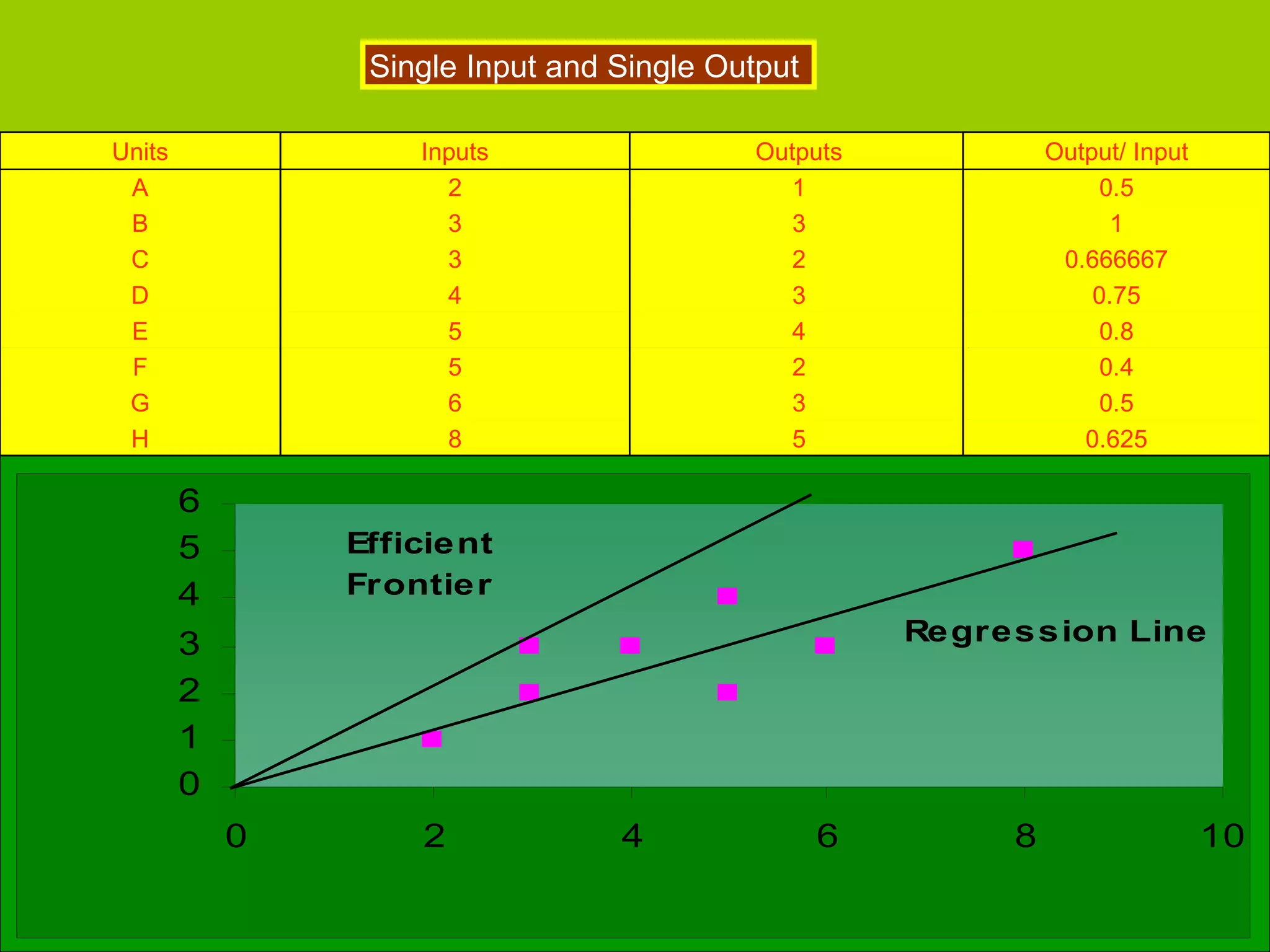
Single Input and Single Output

Units                               Inputs                              Outputs                       Output/ Input
 A                                    2                                    1                               0.5
 B                                    3                                    3                                1
 C                                    3                                    2                           0.666667
 D                                    4                                    3                              0.75
 E                                    5                                    4                               0.8
 F                                    5                                    2                               0.4
 G                                    6                                    3                               0.5
 H                                    8                                    5                             0.625
                     66
        6
        5            55       Efficient
        4                     Frontie r
            Output


                     44
                                                                                      Regres sion Line
            Output


        3
                     33
        2
        1            22


        0            11
                                                                                          Input
                                                                                             Input
             0                      2                   4                    6                    8                   10
                     00
                          0
                          0    11       2   2   3   3   4   4   5   5    6   6    7   7   8   8   9     9
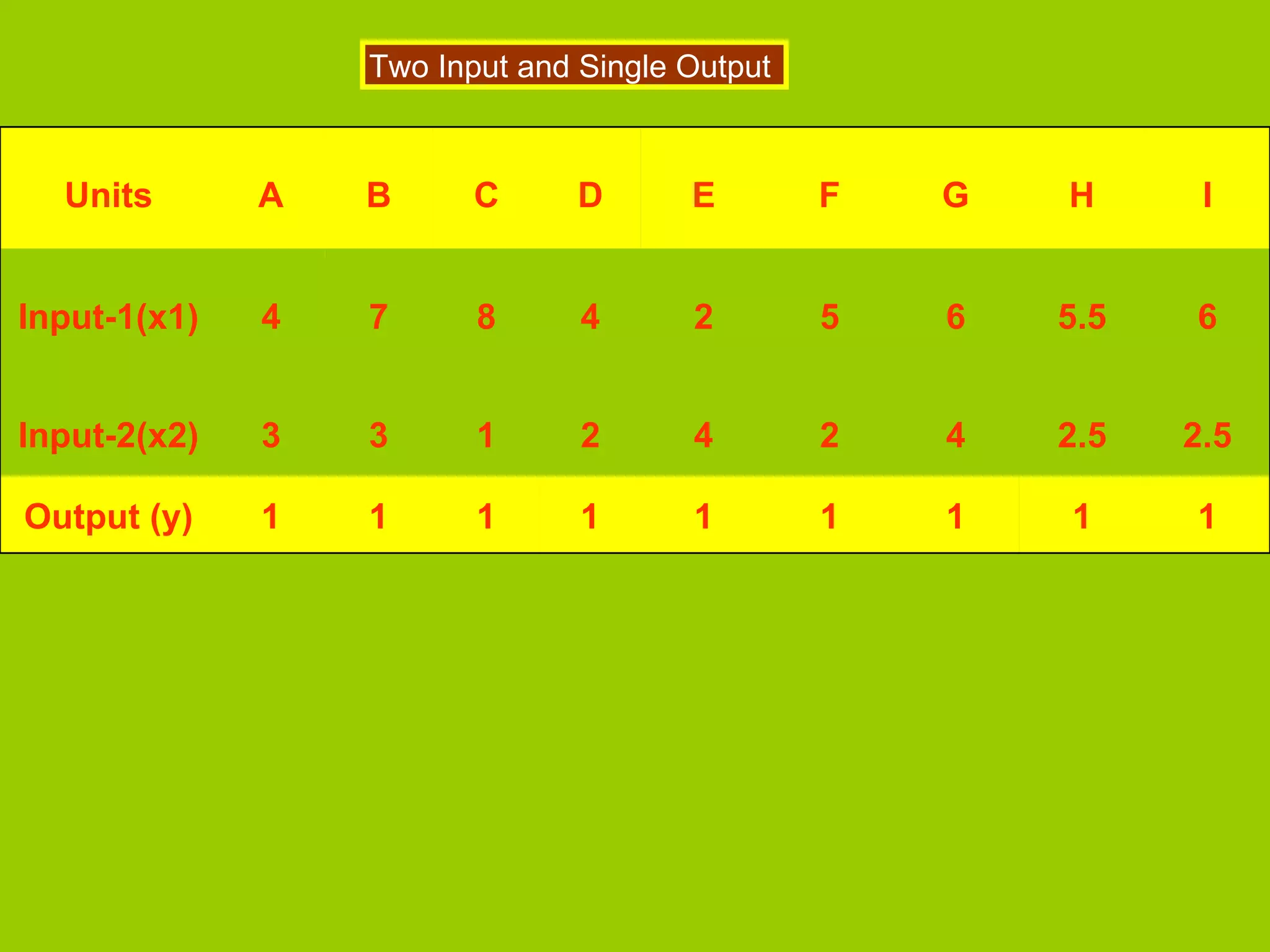
Two Input and Single Output


  Units       A   B      C      D      E        F   G   H      I


Input-1(x1)   4   7      8      4      2        5   6   5.5   6


Input-2(x2)   3   3      1      2      4        2   4   2.5   2.5

Output (y)    1   1      1      1      1        1   1   1     1
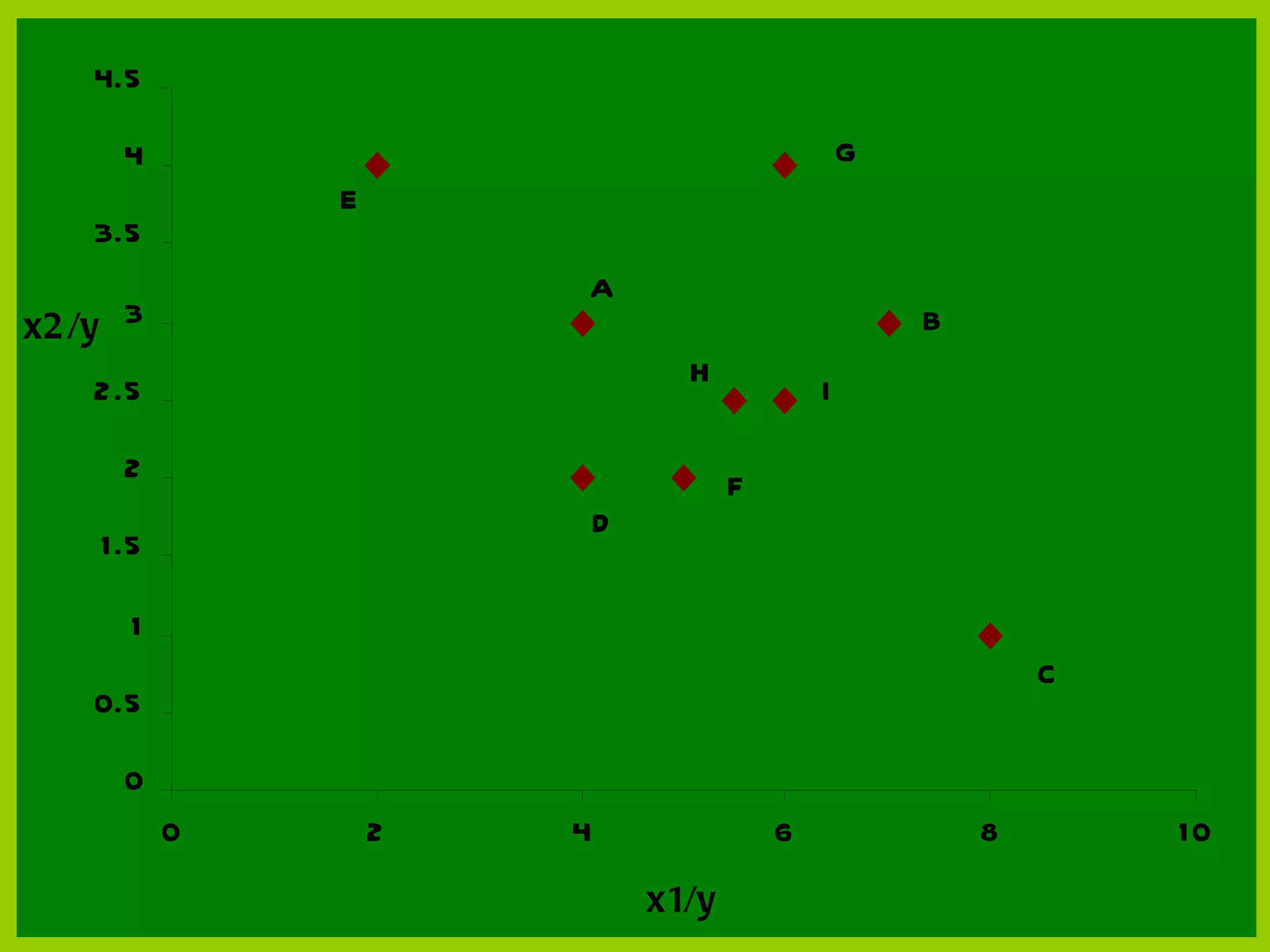
4.5
     4.5

       4                                                                 G
        4
                         E                                                   G
    3.5              E
     3.5
                                     A


x2/y
                                         A
x2 /y 3
      3                                                                          B
                                                                                             B
                                                       H
    22.5
       .5                                                        H   I       I

       2
       2                                                         F
                                                           F
                                         D   D
                 Efficient Frontier Line
      1. 5
    1.5
         1
         1
                                                                                                 C
     0.5                                                                                         C
    0.5
        0
       00        1           2   3               4           5           6           7               8    9
             0               2           4
                                                     x1/y
                                                      x1/y
                                                                 6                       8               10
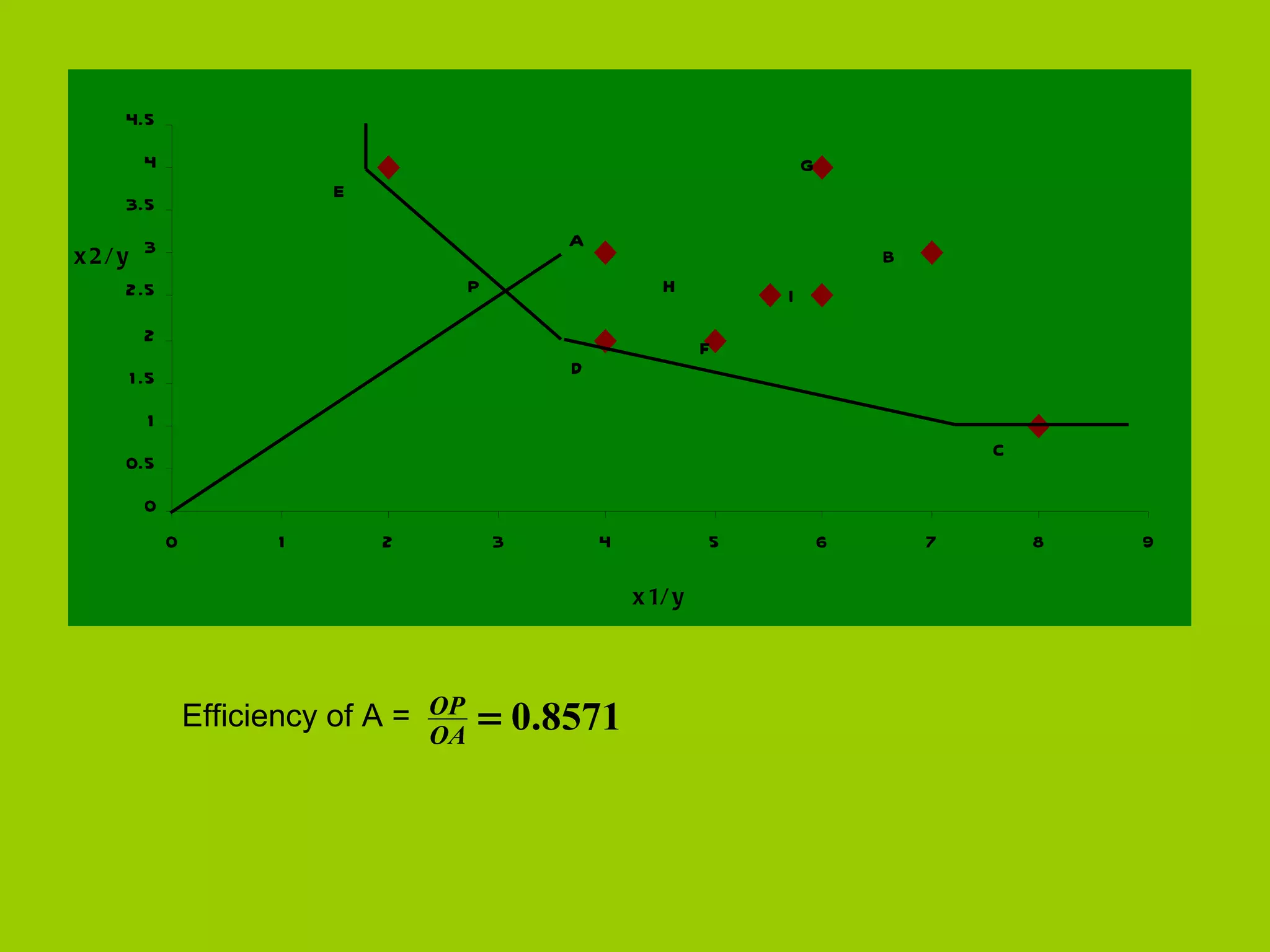
4.5
      4                                                                G
                         E
    3.5
                                              A
x2/y 3                                                                         B
    2.5                               P                  H         I
      2
                                                               F
    1 .5                                      D

      1
                                                                                       C
    0.5
      0
           0         1       2            3       4            5           6       7       8   9

                                                      x 1/ y


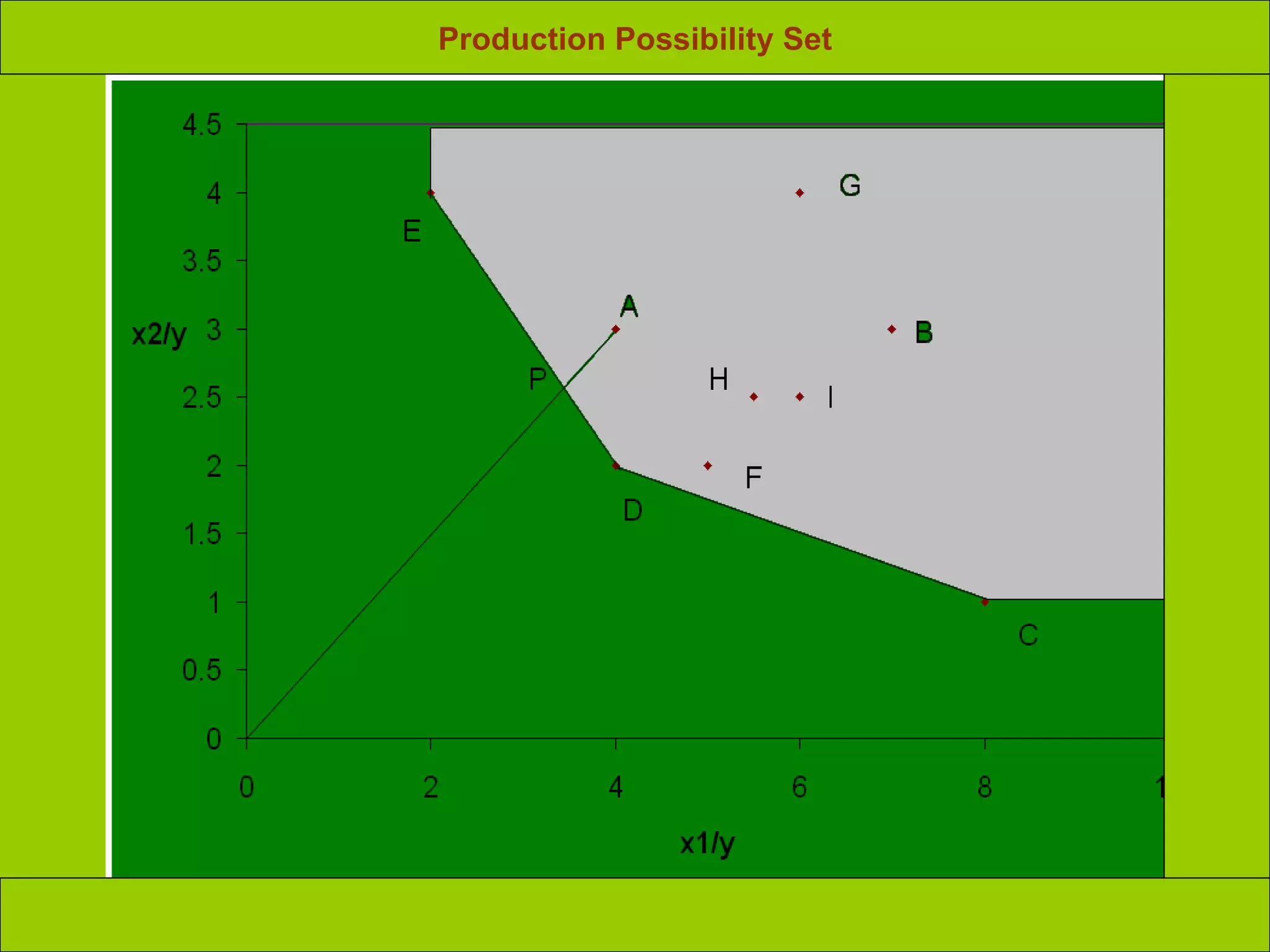
               Efficiency of A = OP
                                 OA
                                      = 0.8571
Production Possibility Set
4.5
      4                                                          G
                   E
    3.5
                                        A
x2/y 3                     A1                                            B
    2.5                         P                  H         I
      2
                                                         F
    1 .5                                D

      1
                                                                                 C
    0.5
      0
           0   1       2            3       4            5           6       7       8   9

                                                x 1/ y


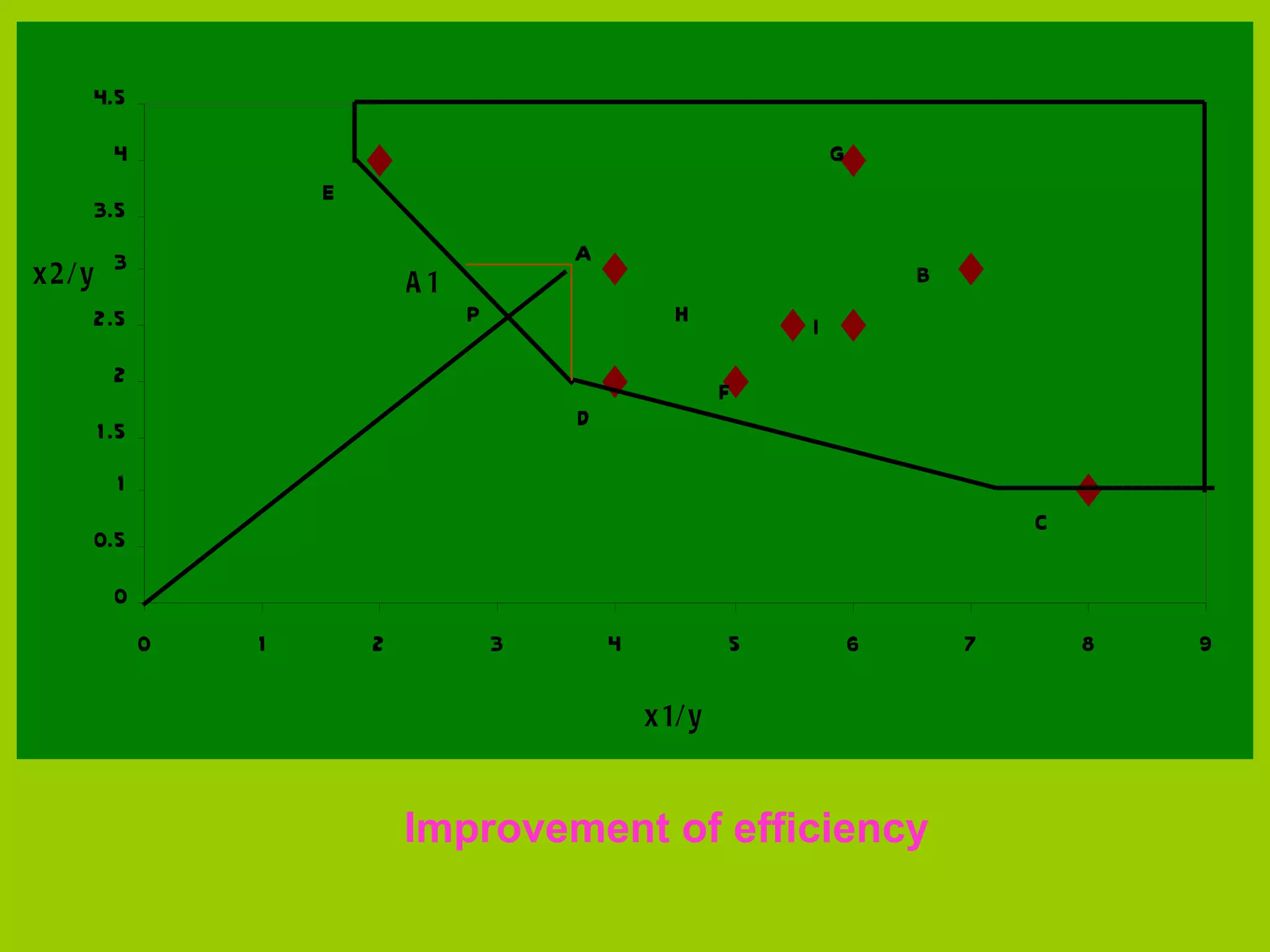
                           Improvement of efficiency
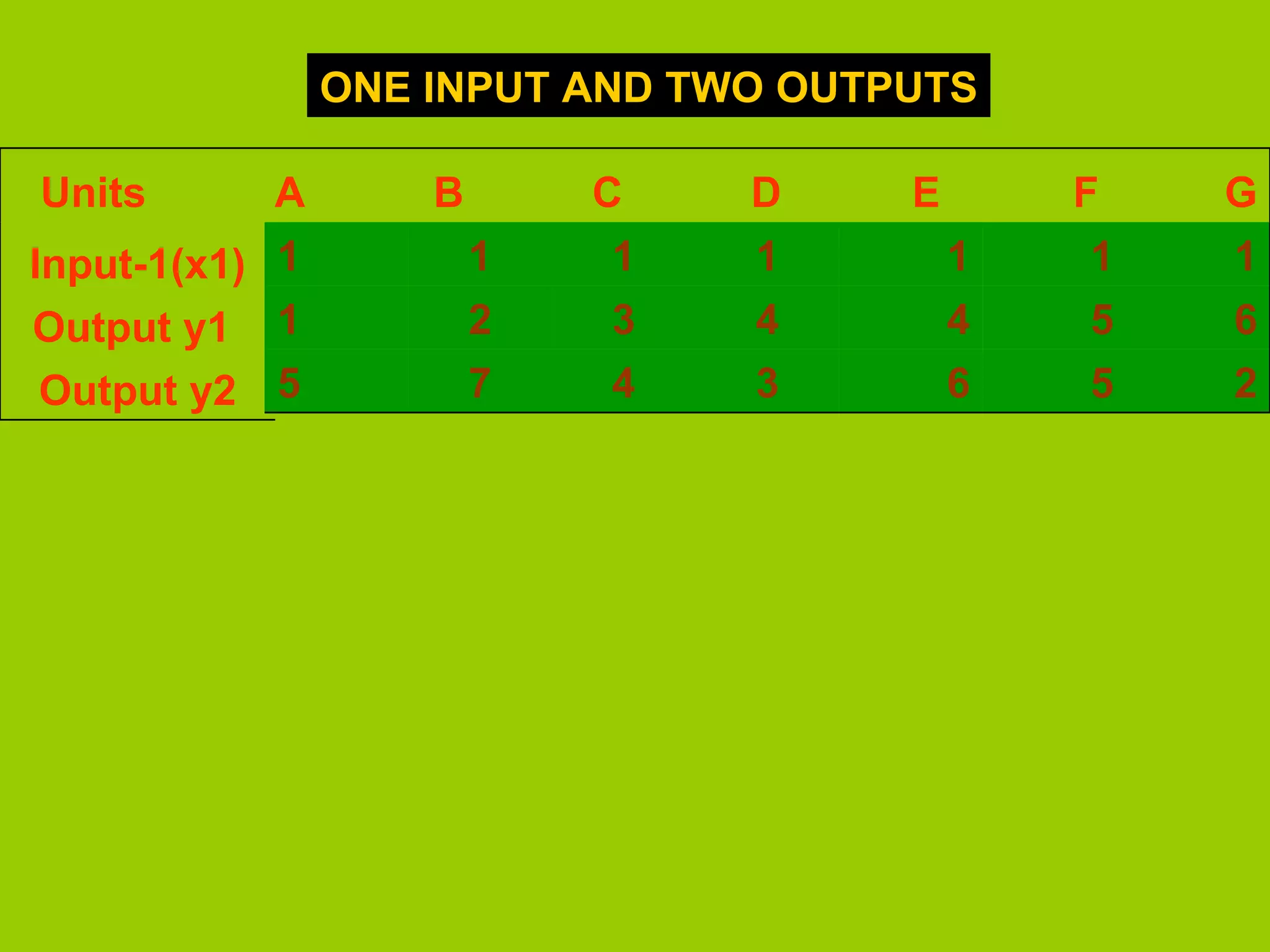
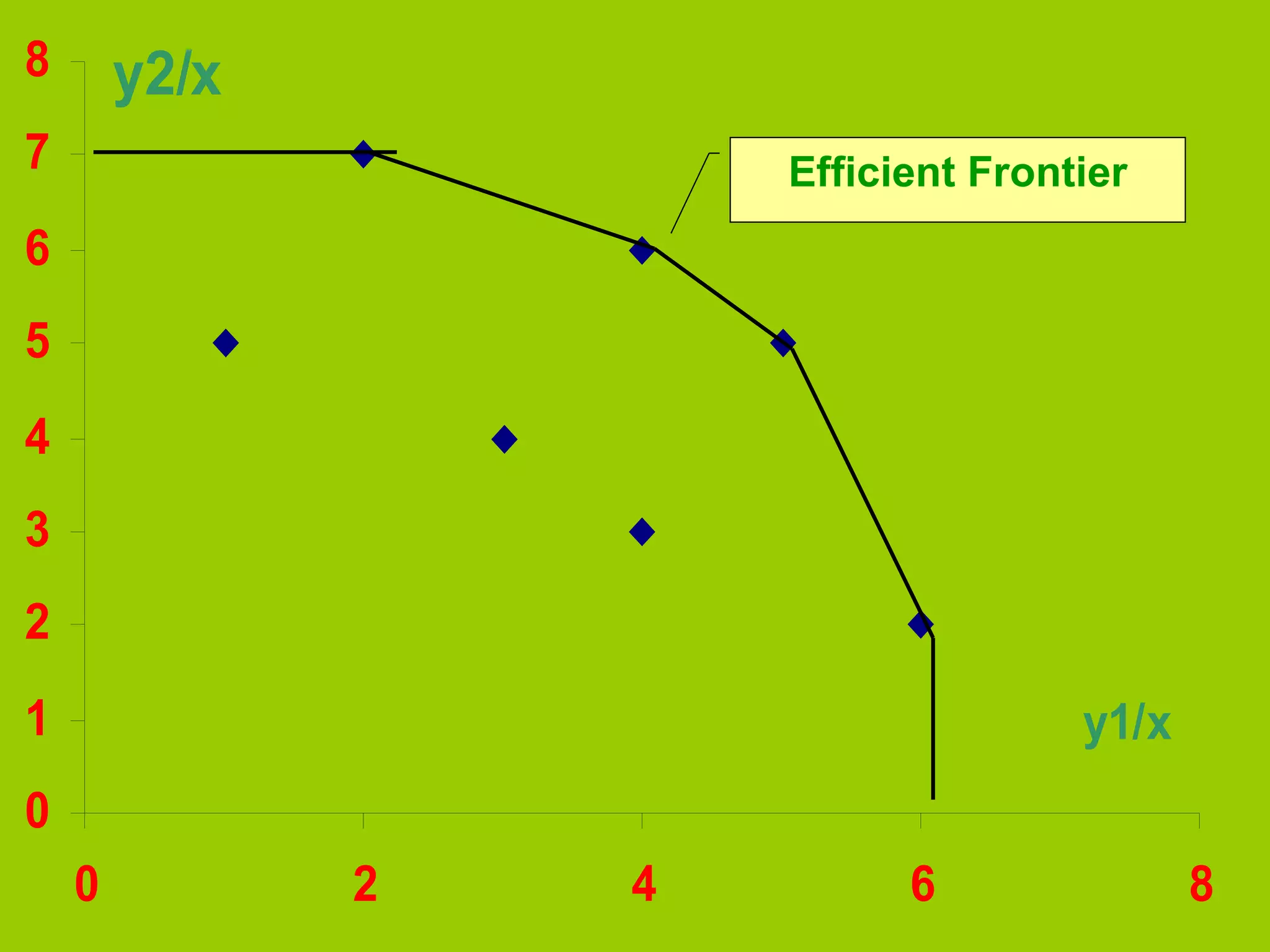
ONE INPUT AND TWO OUTPUTS

Units      A        B       C   D     E       F   G
Input-1(x1) 1           1   1   1         1   1   1
Output y1 1             2   3   4         4   5   6
 Output y2 5            7   4   3         6   5   2
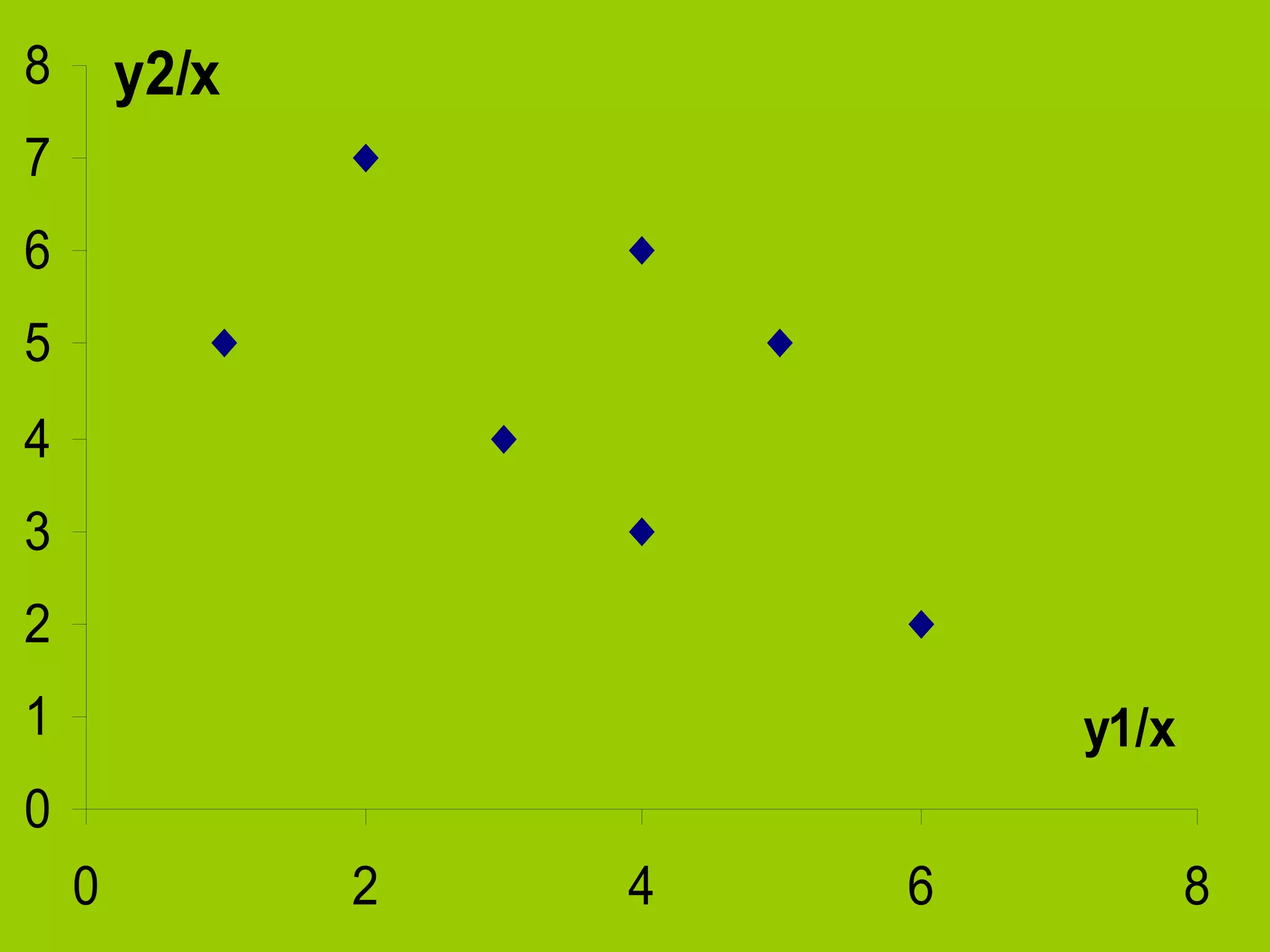
8       y2/x
7
6
5
4
3
2
1                          y1/x
0
    0          2   4   6          8
8       y2/x
7                      Efficient Frontier
6
5
4
3
2
1                                     y1/x
0
    0          2   4         6               8
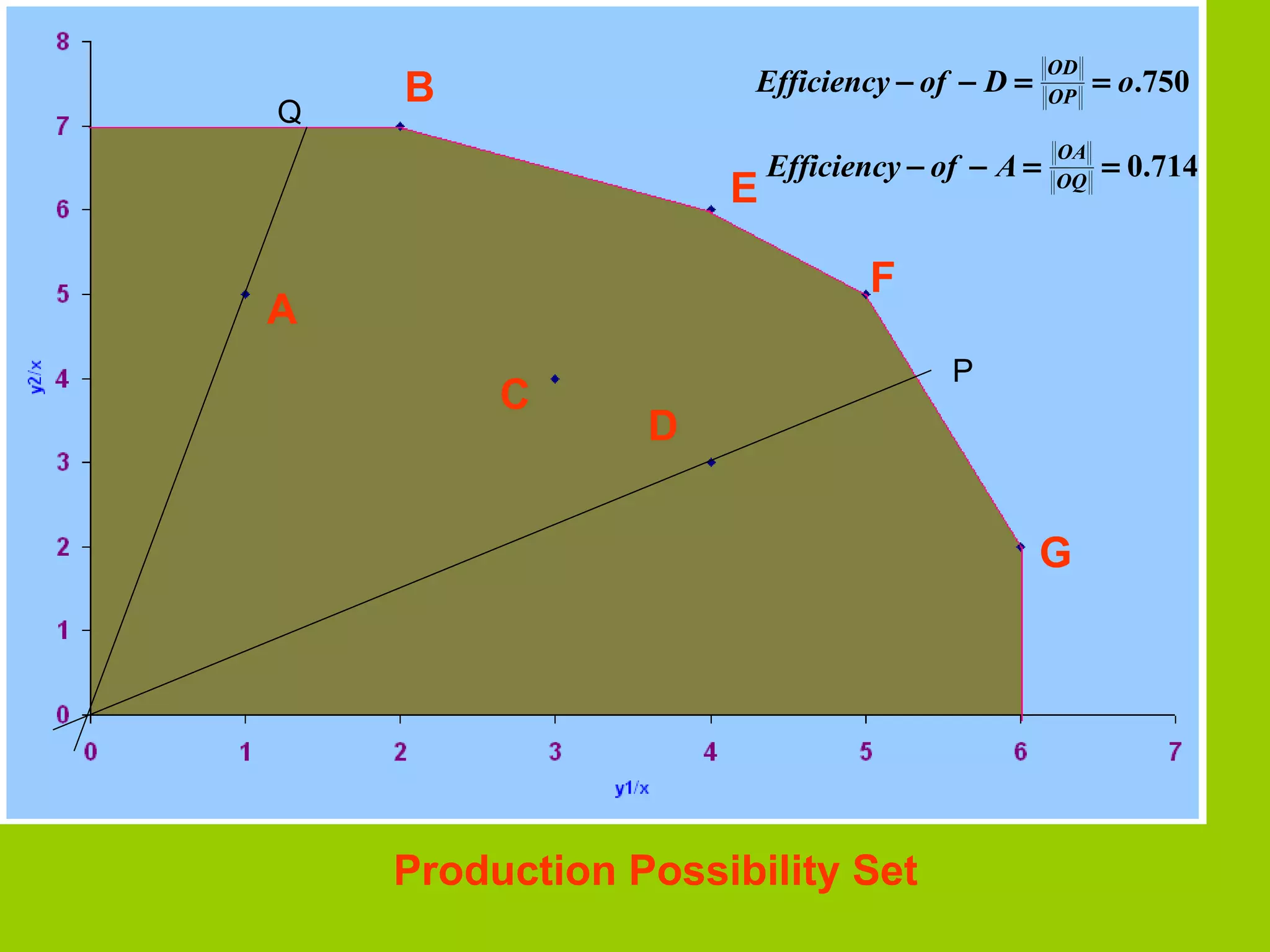
OD
    B                Efficiency − of − D =      OP
                                                     = o.750
Q
                                                OA
                        Efficiency − of − A =        = 0.714
                    E                           OQ


                               F
A
                                      P
         C
                D


                                             G


    Production Possibility Set
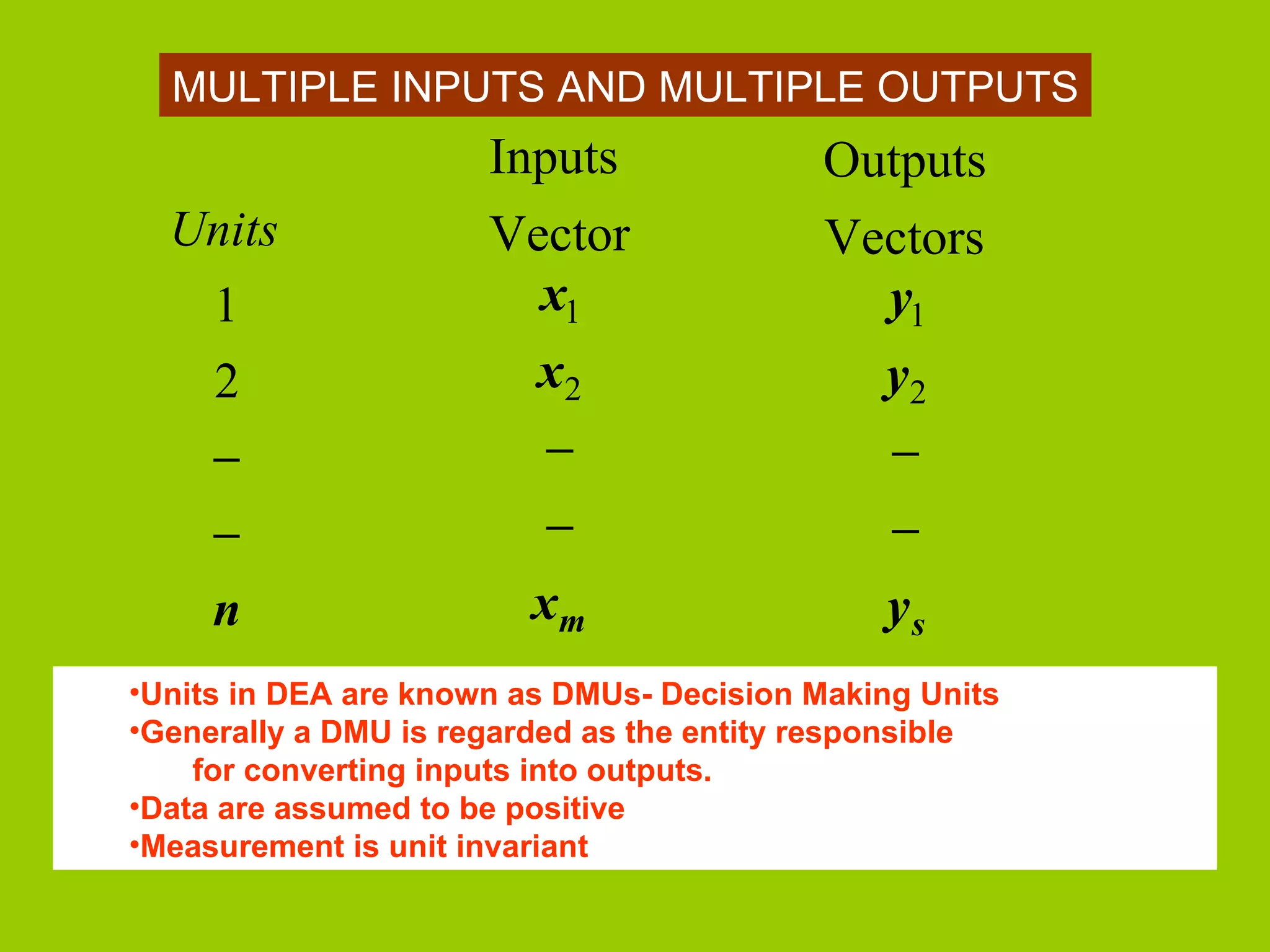
MULTIPLE INPUTS AND MULTIPLE OUTPUTS
                      Inputs               Outputs
  Units               Vector               Vectors
     1                  x1                   y1
     2                  x2                   y2
     −                   −                   −
     −                   −                   −
     n                  xm                   ys
•Units in DEA are known as DMUs- Decision Making Units
•Generally a DMU is regarded as the entity responsible
    for converting inputs into outputs.
•Data are assumed to be positive
•Measurement is unit invariant
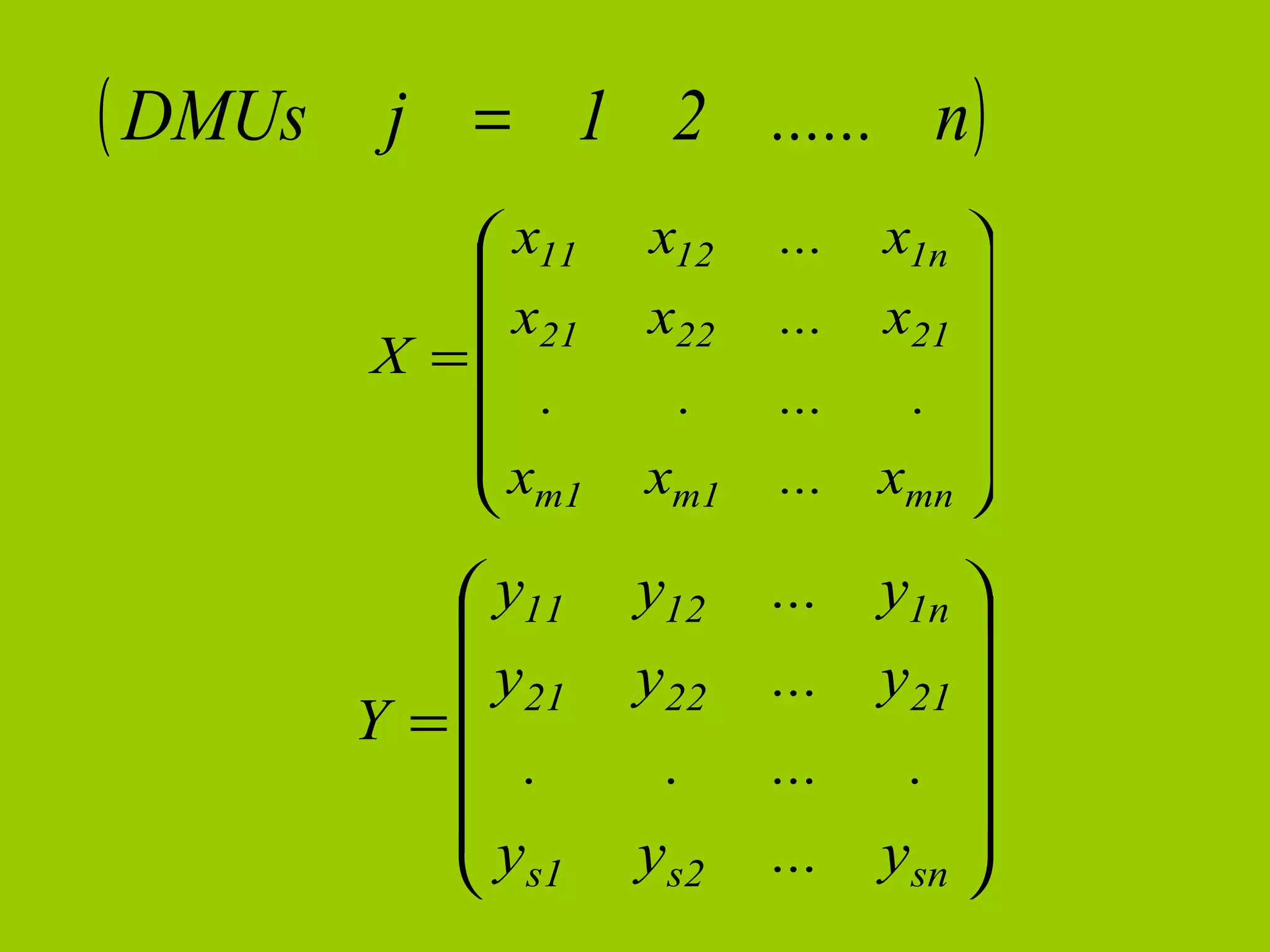
( DMUs    j = 1 2 ...... n )
             x11   x12   ...   x1n 
                                   
             x21   x22   ...   x21 
         X =
               .     .    ...    . 
            
            x                      
             m1    xm1   ...   xmn 
                                    

             y11   y12   ...   y1n 
                                   
             y21   y22   ...   y21 
         Y =
               .     .    ...    . 
            
            y                      
             s1    ys2   ...   ysn 
                                    
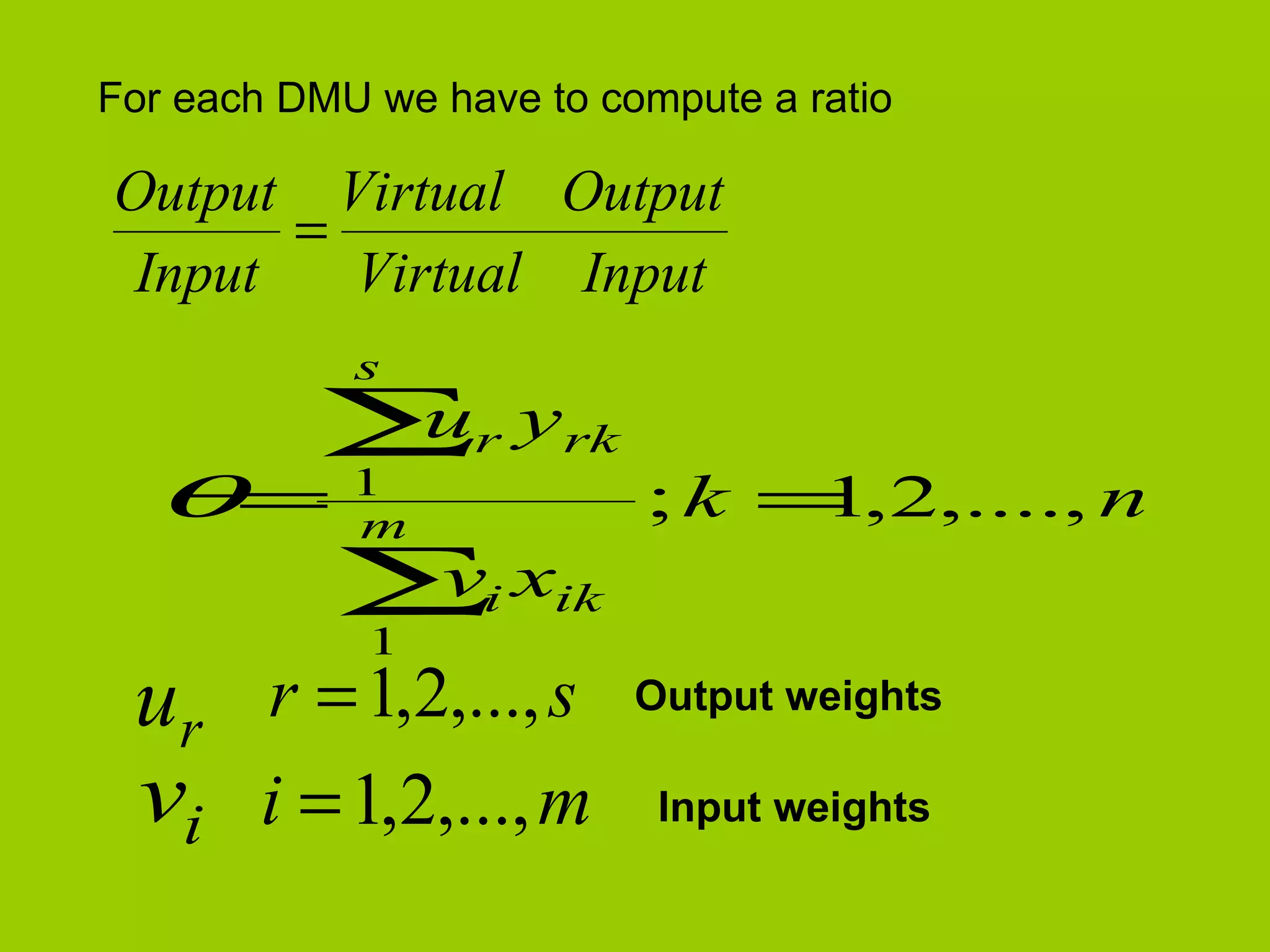
For each DMU we have to compute a ratio

Output Virtual Output
       =
 Input   Virtual Input
            s
          ∑r yrk
           u
  θ= 1
     m
                          ; k = ,2,...., n
                               1
           ∑i xik
            v
             1
 ur r = 1,2,..., s        Output weights

 vi i = 1,2,..., m         Input weights
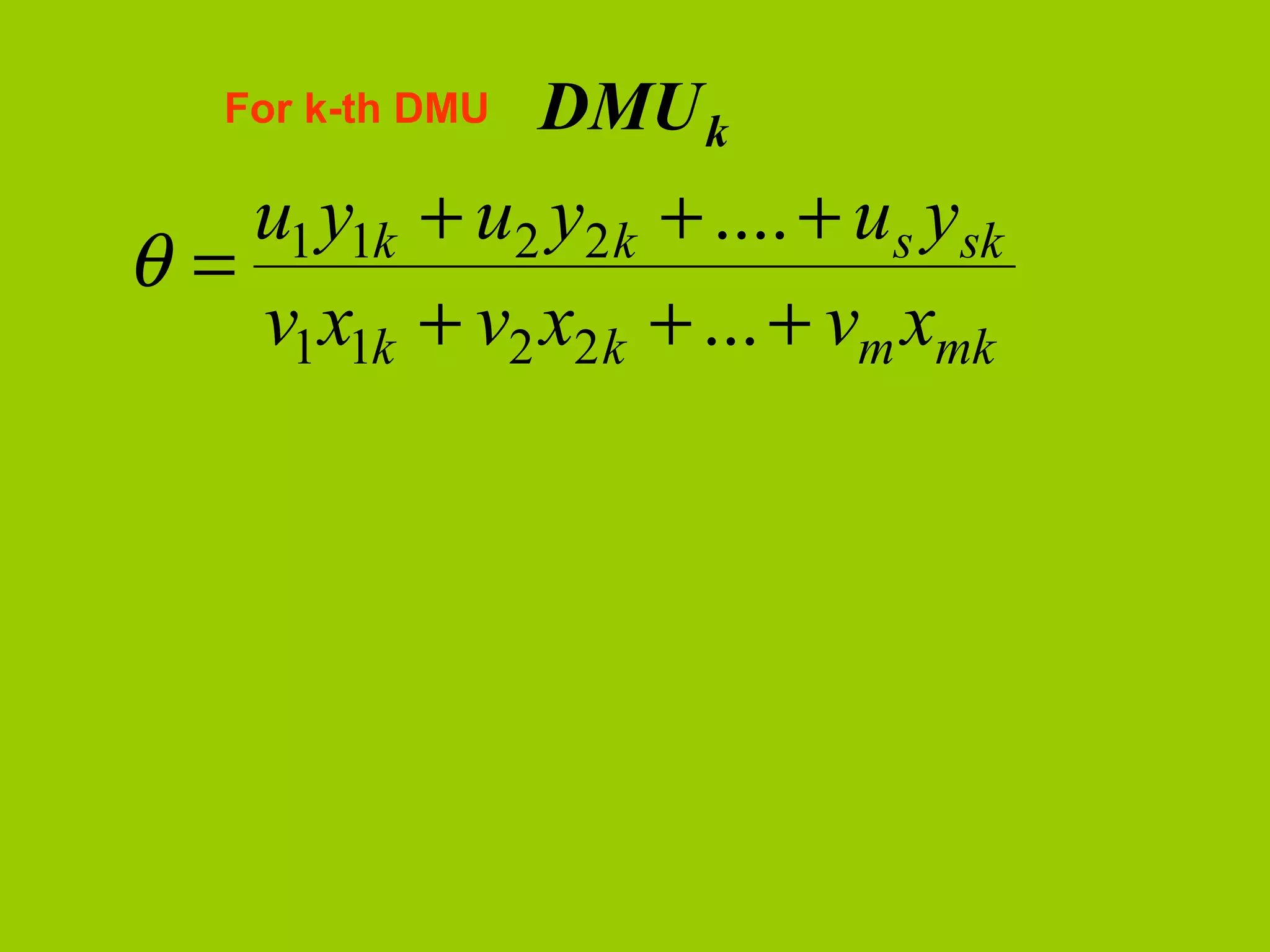
For k-th DMU   DMU k
   u1 y1k + u2 y2 k + .... + us ysk
θ=
   v1 x1k + v2 x2 k + ... + vm xmk
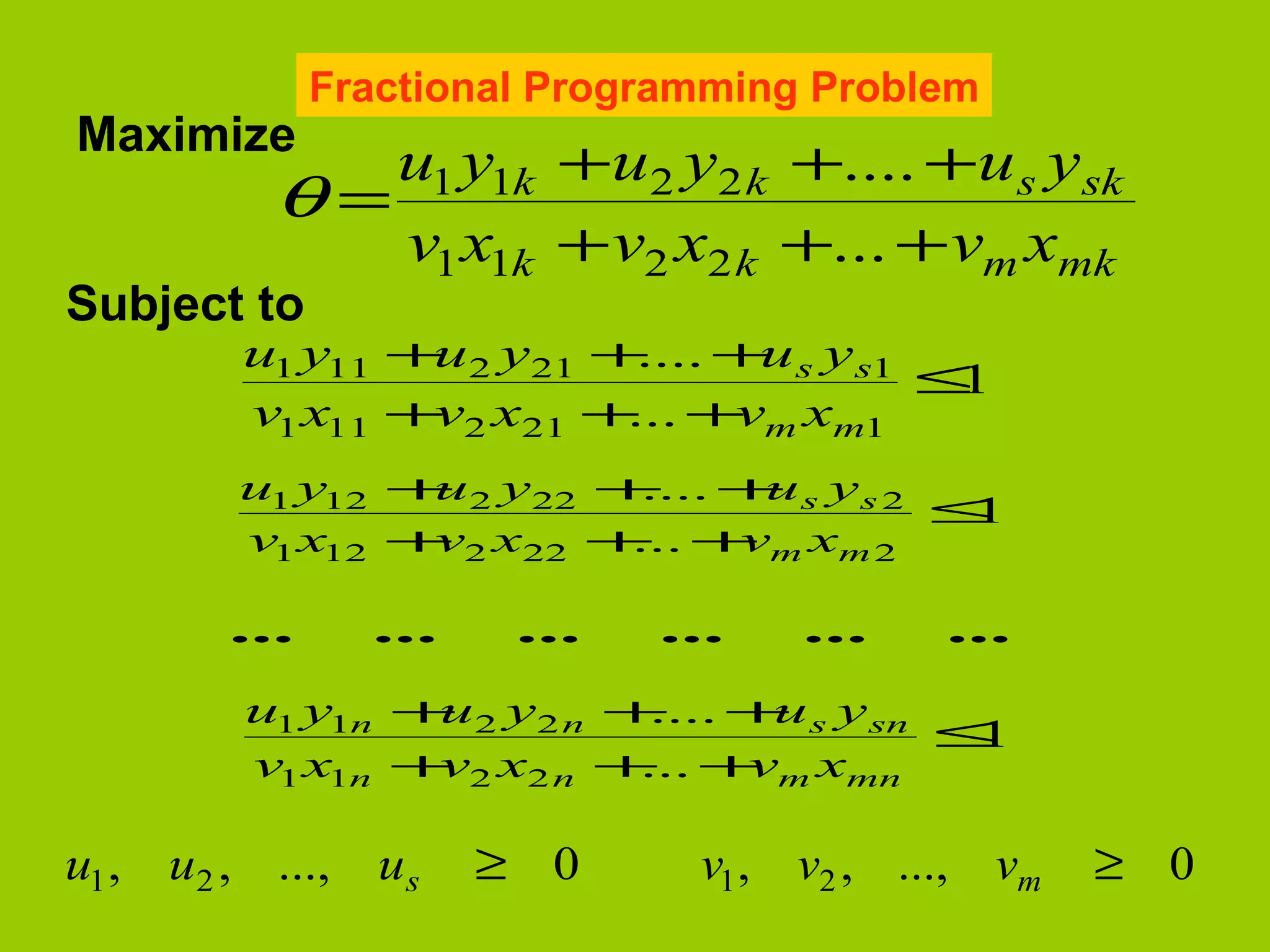
Fractional Programming Problem
Maximize
               u1 y1k +u2 y2 k +.... +u s ysk
            θ=
               v1 x1k + v2 x2 k +... + vm xmk
Subject to
           u1 y11 + 2 y21 + + s y s1
                   u        .... u
                                     ≤1
           v1 x11 + 2 x21 + + m xm1
                   v       ... v
          u1 y12 + 2 y22 + + s y s 2
                  u        ....  u
                                     ≤1
          v1 x12 + 2 x22 + + m xm 2
                  v       ...   v

          ...      ...    ...   ...   ...    ...
           u1 y1n + 2 y2 n + + s y sn
                   u         .... u
                                      ≤1
           v1 x1n + 2 x2 n + + m xmn
                   v        ... v

u1 ,   u2 , ...,   us    ≥ 0     v1 , v2 , ..., vm   ≥ 0
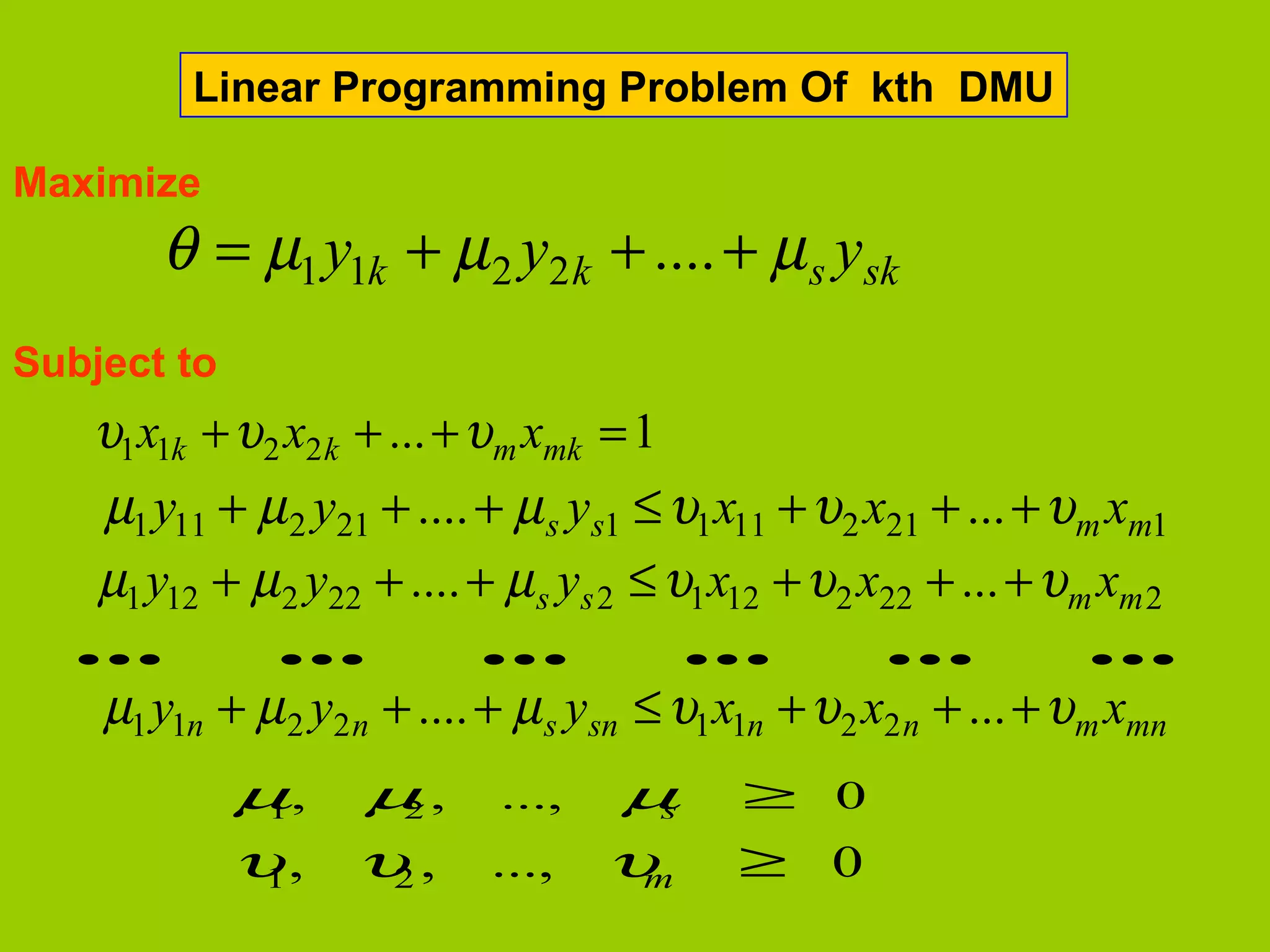
Linear Programming Problem Of kth DMU

Maximize
       θ = µ1 y1k + µ 2 y2 k + .... + µ s ysk
Subject to
   υ1 x1k + υ 2 x2 k + ... + υ m xmk = 1
   µ1 y11 + µ 2 y21 + .... + µ s ys1 ≤ υ1 x11 + υ2 x21 + ... + υm xm1
   µ1 y12 + µ2 y22 + .... + µ s ys 2 ≤ υ1 x12 + υ2 x22 + ... + υm xm 2
  ...          ...         ...            ...         ...         ...
    µ1 y1n + µ 2 y2 n + .... + µ s ysn ≤ υ1 x1n + υ2 x2 n + ... + υm xmn
             µ,
              1     µ,
                     2       ...,    µs     ≥ 0
             υ,
              1     υ,
                     2      ...,    υm      ≥     0
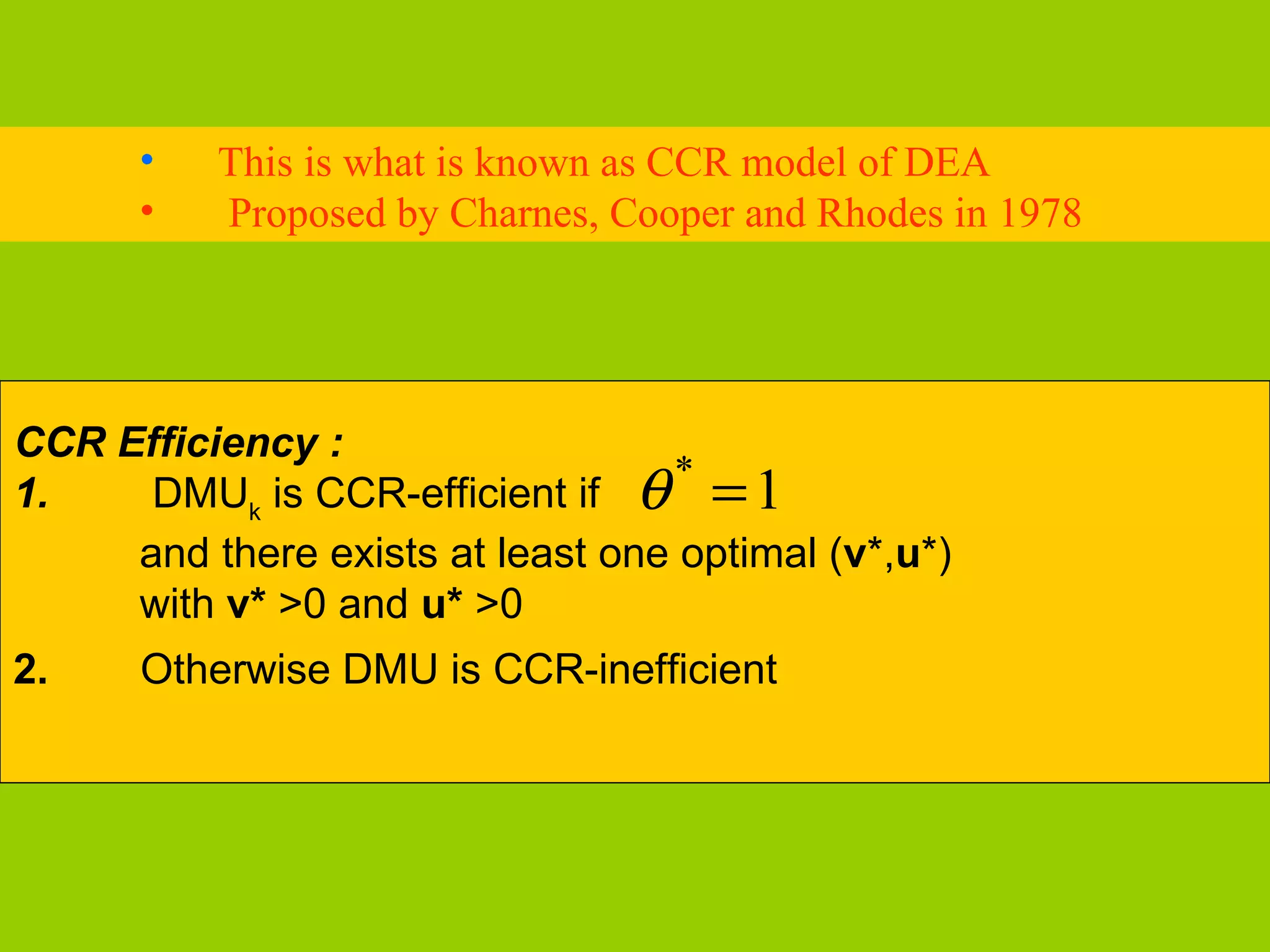
•   This is what is known as CCR model of DEA
      •   Proposed by Charnes, Cooper and Rhodes in 1978


CCR Efficiency :
      DMUk is CCR-efficient if θ = 1
                                  *
1.
     and there exists at least one optimal (v*,u*)
     with v* >0 and u* >0
2.    Otherwise DMU is CCR-inefficient
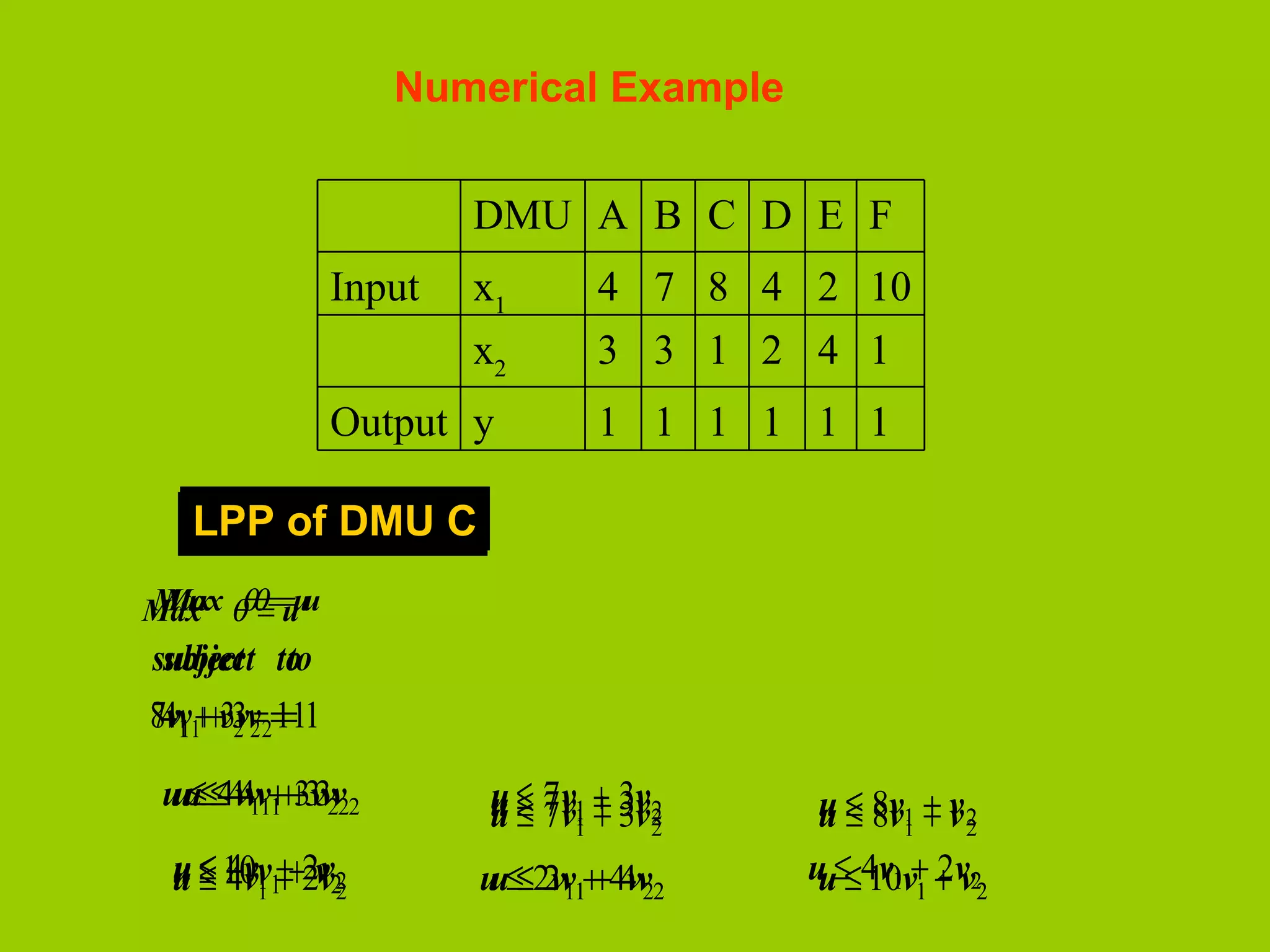
Numerical Example


                          DMU A B C D E F
                  Input   x1         4 7 8 4 2 10
                          x2         3 3 1 2 4 1
                  Output y           1 1 1 1 1 1

   LPP of DMU A
              C
              B

Max θθθ=u u
Max = =u
 Max
subject to
 subject to
84v1++v3v=2==11
7v1 32 2 1
       v

 u u≤≤441v+++33222
  u≤ 4vv11 3vvv            u ≤ 7v1 + 3v2
                           u ≤ 7v1 + 3v2
                           u ≤ 7v + 3v        u ≤ 8v1 + v 2
                                              u ≤ 8v1 + v 2
                                 1     2
  u ≤ 10v1++2v22
  u ≤ 4v1 + 2v2
      4v1 v               u ≤≤22v1++44v2
                           u v1 v2           u ≤≤4v1v+ + v2
                                              u 10 2 v
                                                     1    2
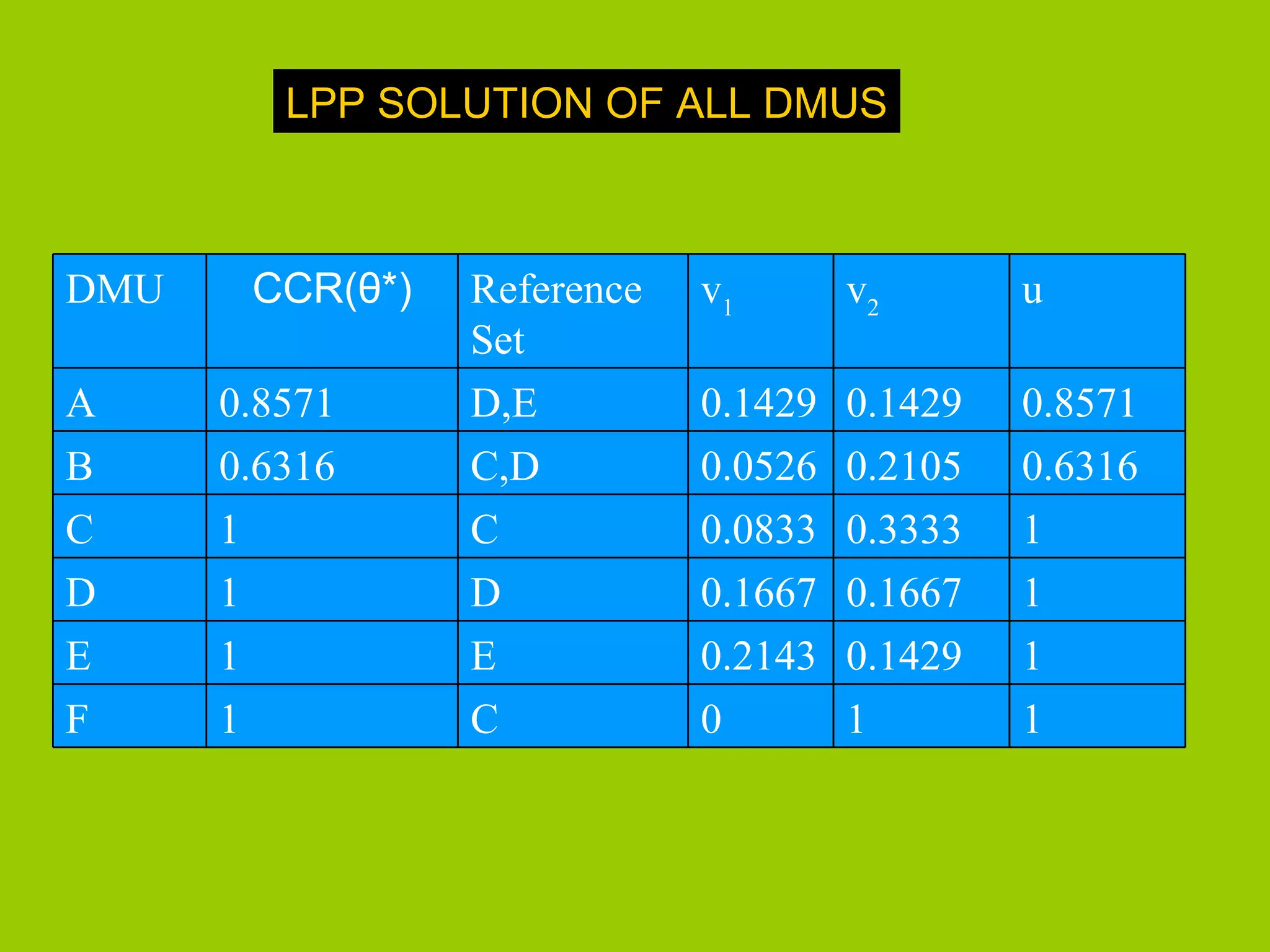
LPP SOLUTION OF ALL DMUS


DMU    CCR(θ*)   Reference   v1       v2       u
                 Set
A     0.8571     D,E         0.1429   0.1429   0.8571
B     0.6316     C,D         0.0526   0.2105   0.6316
C     1          C           0.0833   0.3333   1
D     1          D           0.1667   0.1667   1
E     1          E           0.2143   0.1429   1
F     1          C           0        1        1
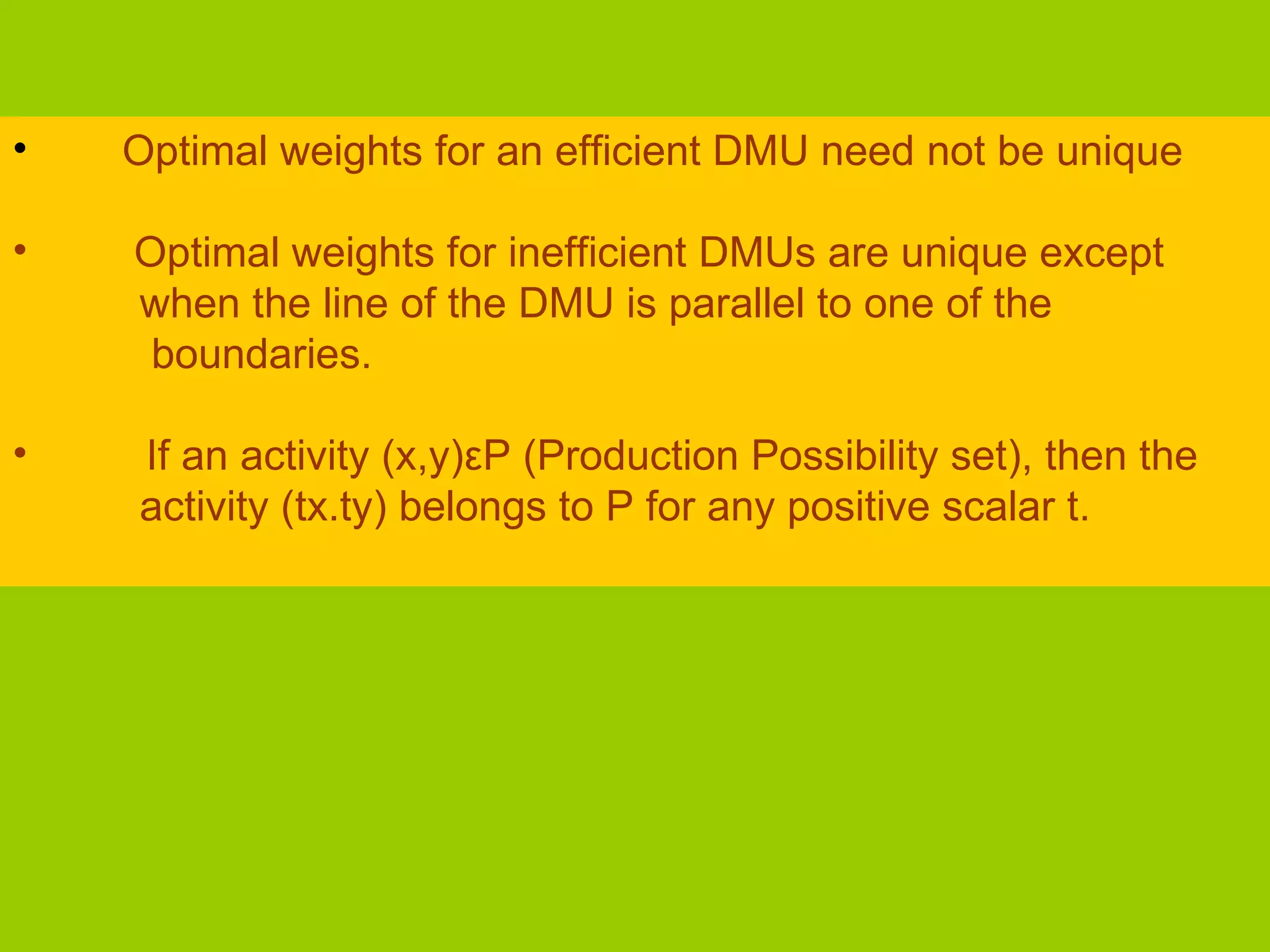
•   Optimal weights for an efficient DMU need not be unique

•   Optimal weights for inefficient DMUs are unique except
    when the line of the DMU is parallel to one of the
     boundaries.

•   If an activity (x,y)εP (Production Possibility set), then the
    activity (tx.ty) belongs to P for any positive scalar t.
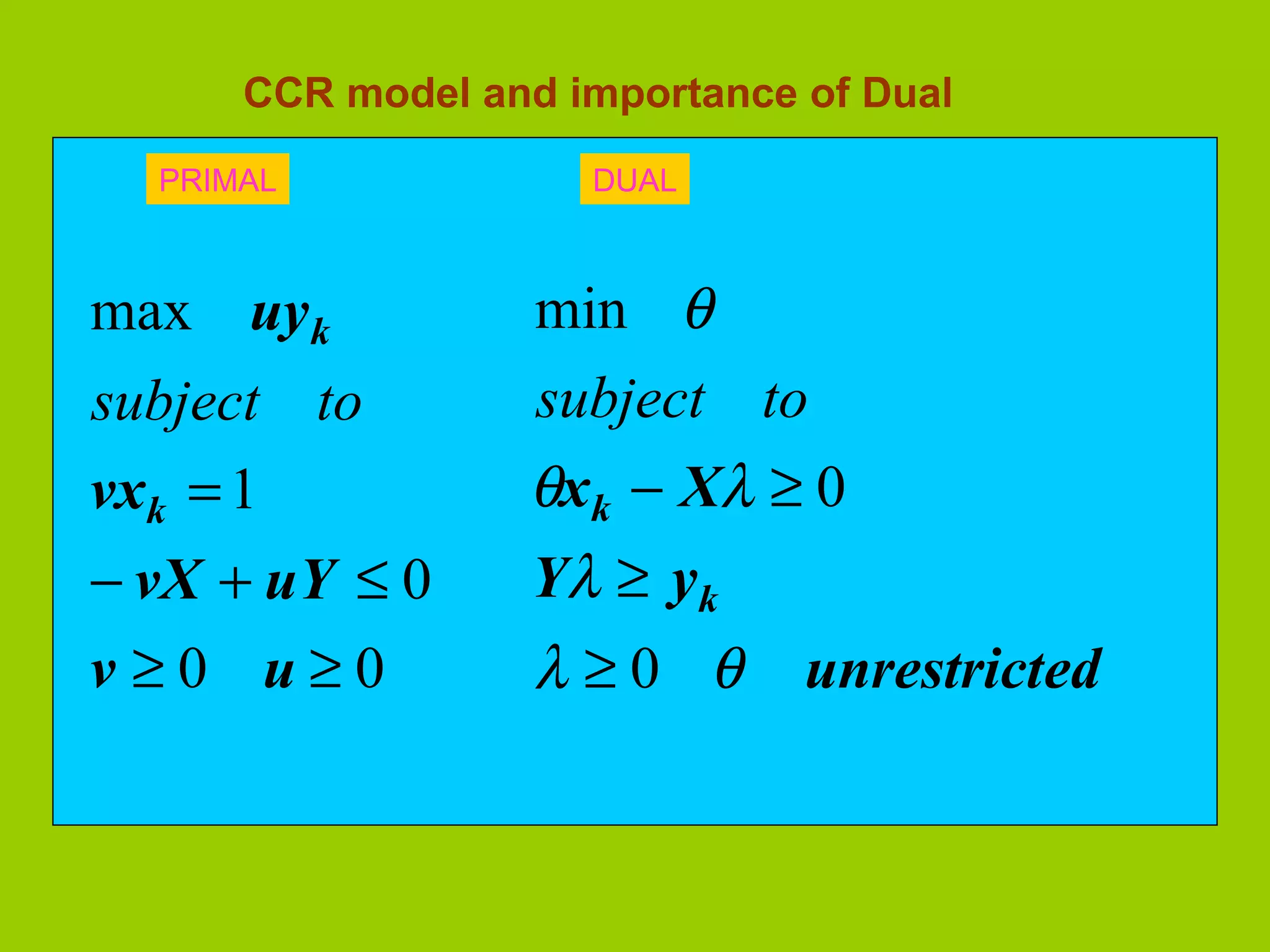
CCR model and importance of Dual
  PRIMAL             DUAL


max uyk            min θ
subject to         subject to
vxk = 1           θxk − Xλ ≥ 0
− vX + uY ≤ 0     Yλ ≥ yk
v≥0 u≥0           λ ≥ 0 θ unrestricted
Input excesses and output shortfalls
min θ
subject to
θ k −Xλ≥0
 x
Yλ≥ yk
λ≥0      θ       unrestrict
min      θ
subject       to
θ k −Xλ−s =0
 x                  −


Yλ−s + =yk
λ≥0 θ unrestrict
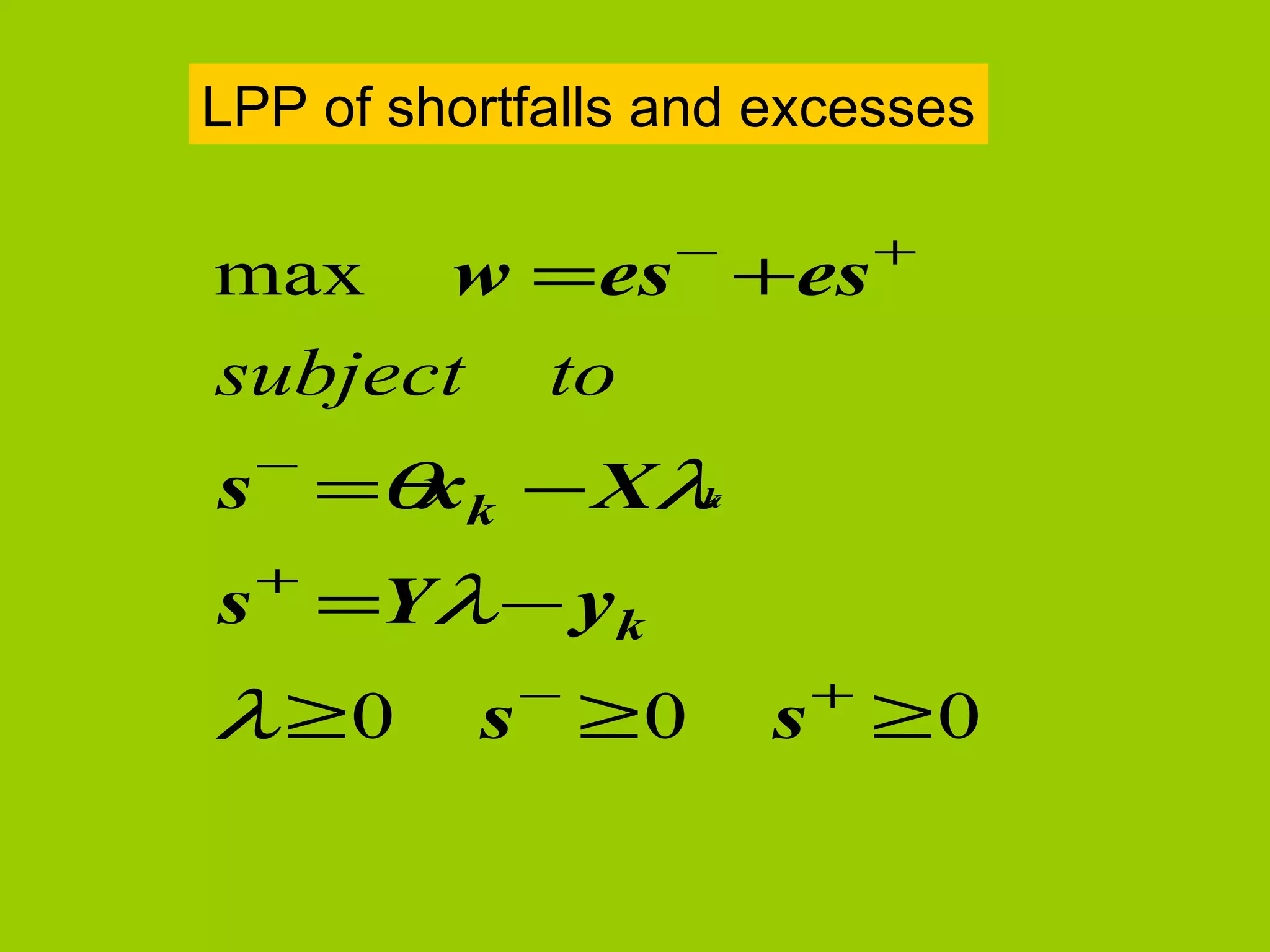
LPP of shortfalls and excesses

                  −        +
max w = es +es
subject to
  −
s =θ k − Xλ
    x      k

  +
s =Yλ − yk
            −          +
λ ≥0      s ≥0        s ≥0
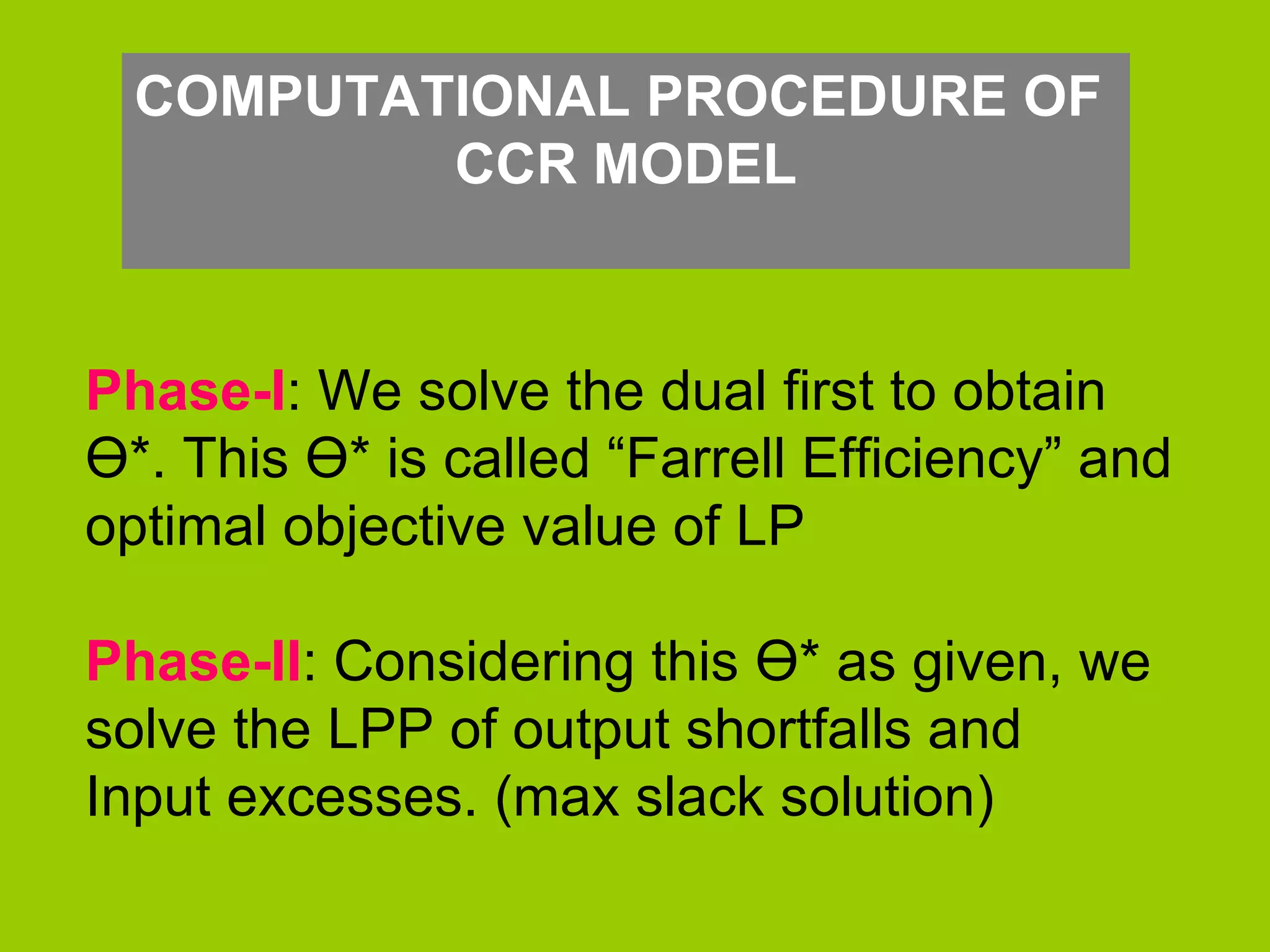
COMPUTATIONAL PROCEDURE OF
          CCR MODEL


Phase-I: We solve the dual first to obtain
Ө*. This Ө* is called “Farrell Efficiency” and
optimal objective value of LP

Phase-II: Considering this Ө* as given, we
solve the LPP of output shortfalls and
Input excesses. (max slack solution)
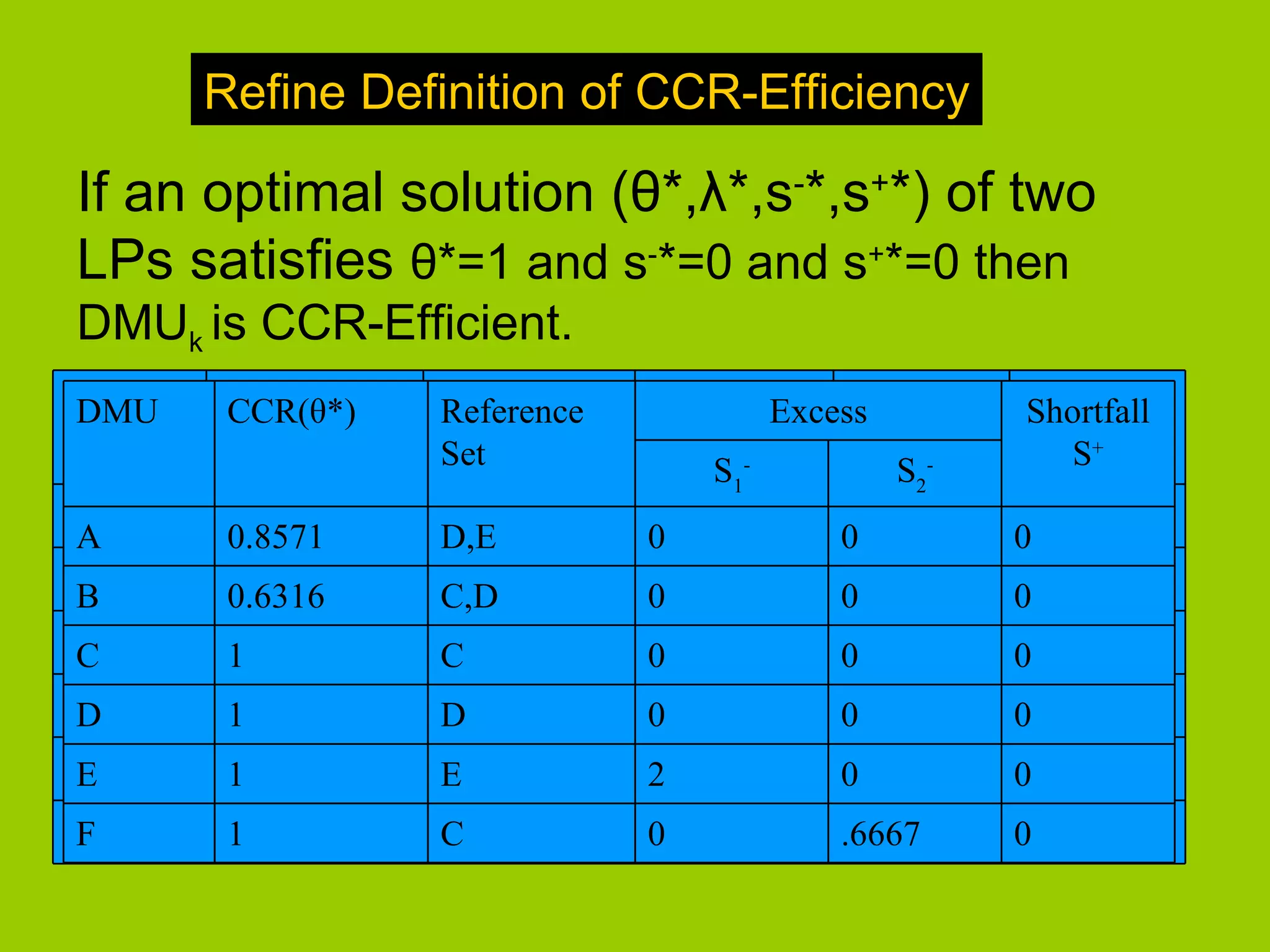
Refine Definition of CCR-Efficiency

If an optimal solution (θ*,λ*,s-*,s+*) of two
LPs satisfies θ*=1 and s-*=0 and s+*=0 then
DMUk is CCR-Efficient.
DMU
DMU    CCR(θ*)
       CCR(θ*)   Reference
                 Reference   v1                v
                                           Excess2            u
                                                              Shortfall
                 Set
                 Set              S1   -
                                                     S2   -       S+
A
A     0.8571
      0.8571     D,E
                 D,E         0.1429
                             0                 0.1429
                                               0              0.8571
                                                              0
B
B     0.6316
      0.6316     C,D
                 C,D         0.0526
                             0                 0.2105
                                               0              0.6316
                                                              0
C
C     1
      1          C
                 C           0.0833
                             0                 0.3333
                                               0              1
                                                              0
D
D     1
      1          D
                 D           0.1667
                             0                 0.1667
                                               0              1
                                                              0
E
E     1
      1          E
                 E           0.2143
                             2                 0.1429
                                               0              1
                                                              0
F
F     1
      1          C
                 C           0                  1
                                               .6667          1
                                                              0
EXTENSION OF TWO-PHASE


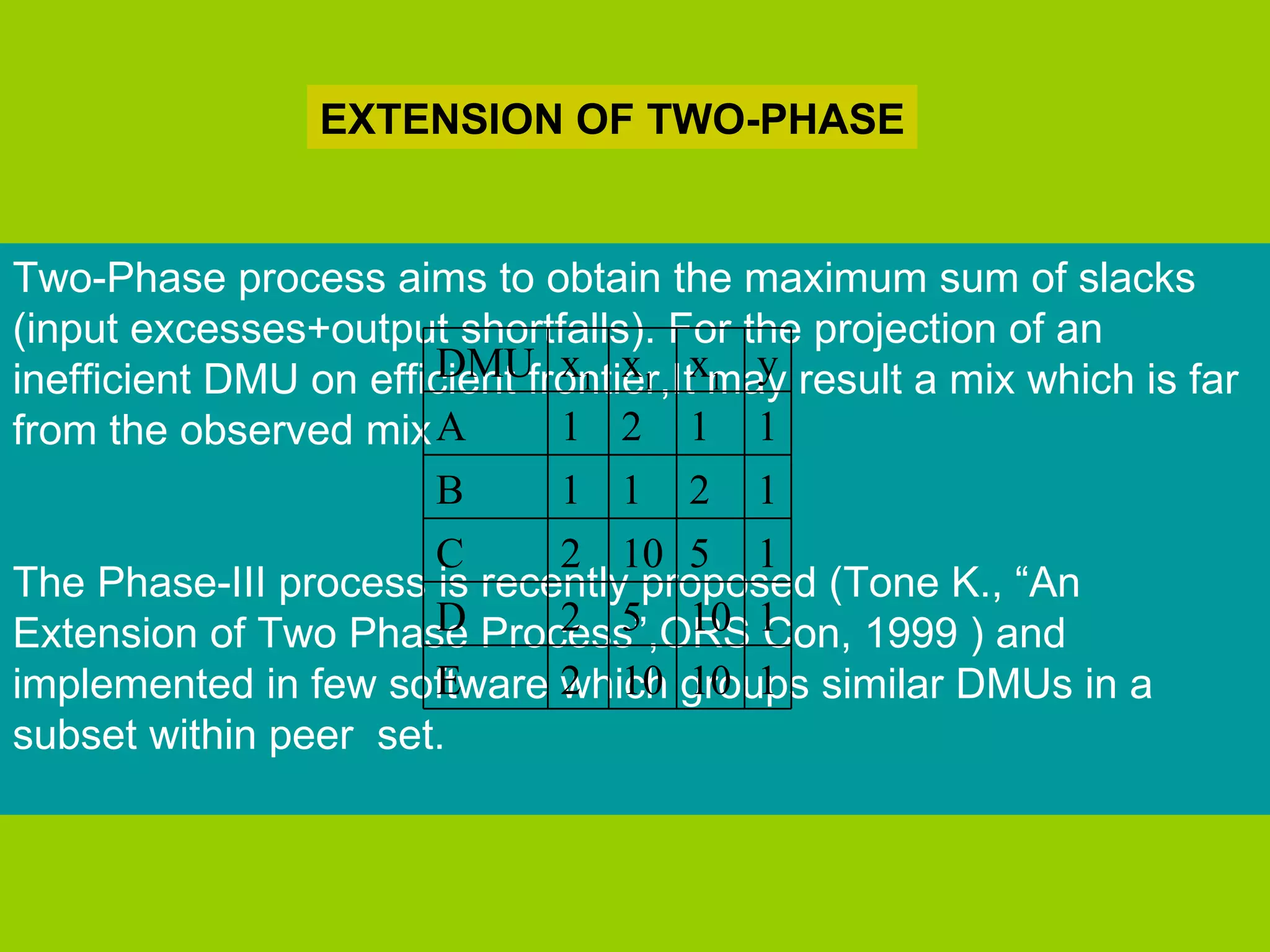
Two-Phase process aims to obtain the maximum sum of slacks
(input excesses+output shortfalls). For the projection of an
inefficient DMU on efficient frontier,Itxmay result a mix which is far
                       DMU x1 x1 1 y
from the observed mix A        1 2 1 1
                       B       1 1 2 1
                       C       2 10 5 1
The Phase-III process is recently proposed (Tone K., “An
Extension of Two Phase Process”,ORS 1
                       D       2 5 10 Con, 1999 ) and
implemented in few software 2 10 groups similar DMUs in a
                       E       which 10 1
subset within peer set.
INPUT ORIENTED AND OUTPUT ORIENTED MODELS


We discuss so far input-oriented models whose objective
is to minimize inputs while producing atleast given level of
Outputs.

There is another type of model that attempts to maximize
 outputs while using no more than the given (observed)
inputs. This is known as output-oriented model.
Comparing Input-oriented CCR Model
        with Output-oriented CCR model
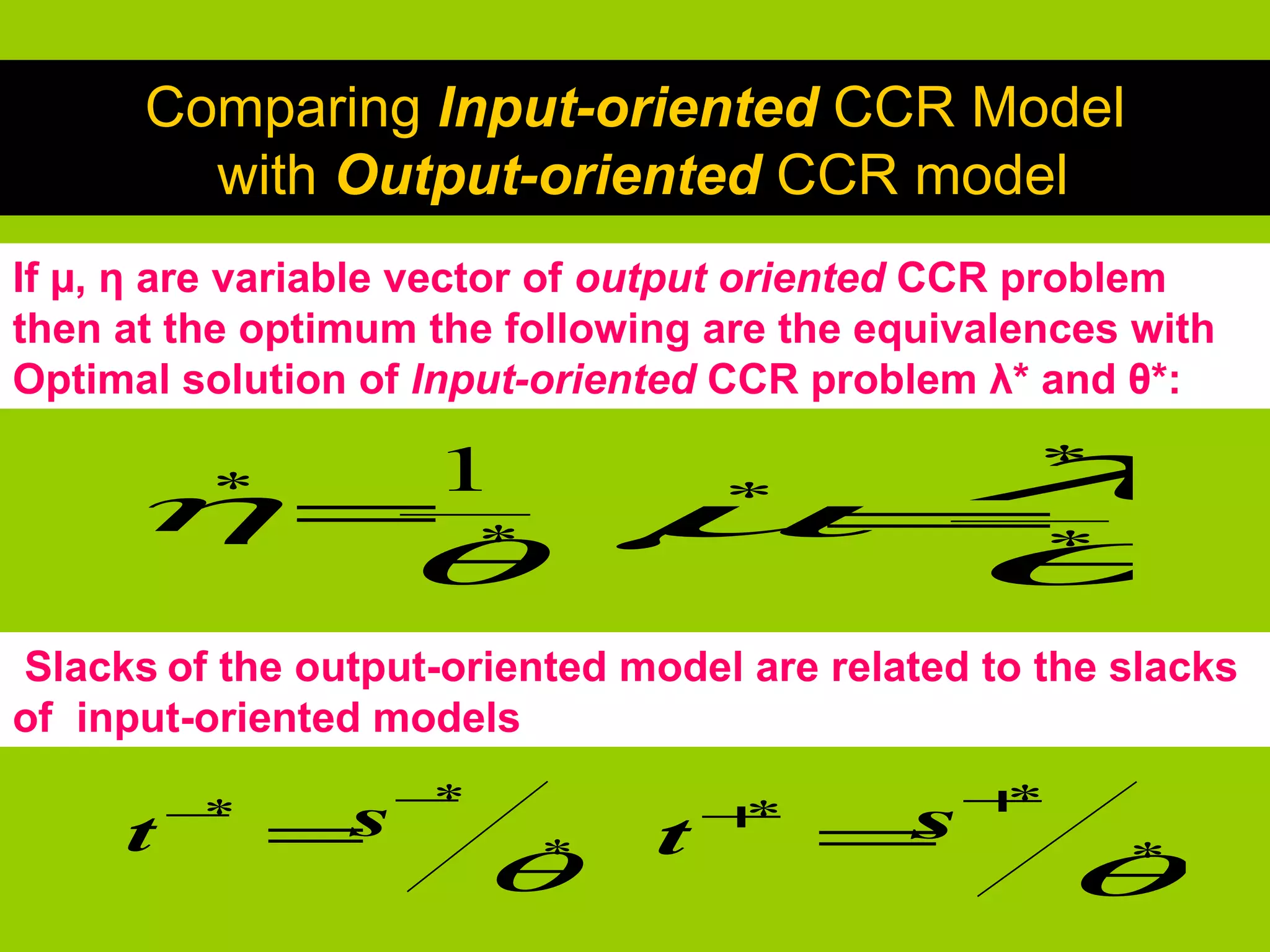
If µ, η are variable vector of output oriented CCR problem
then at the optimum the following are the equivalences with
Optimal solution of Input-oriented CCR problem λ* and θ*:

      * 1
     η= *                      =
                                λ
                              µ θ   *
                                                   *

                   θ                               *


Slacks of the output-oriented model are related to the slacks
of input-oriented models
                   −
     t   −*
              =s    *
                                t   +*
                                         =s+*

                        θ *
                                                   θ*
It suggests that an input-oriented CCR model will be efficient
for any DMU iff it is also efficient when the output –oriented
CCR model is used to evaluate its performance.
BCC MODEL

CCR model has been developed on the assumption of constant
return to scale. A variation of DEA model is BCC (Banker,
Charnes and Cooper) which is based on
 variable return to scale.
•      Increasing return to scale
•      Decreasing return to scale
•      Constant return to scale

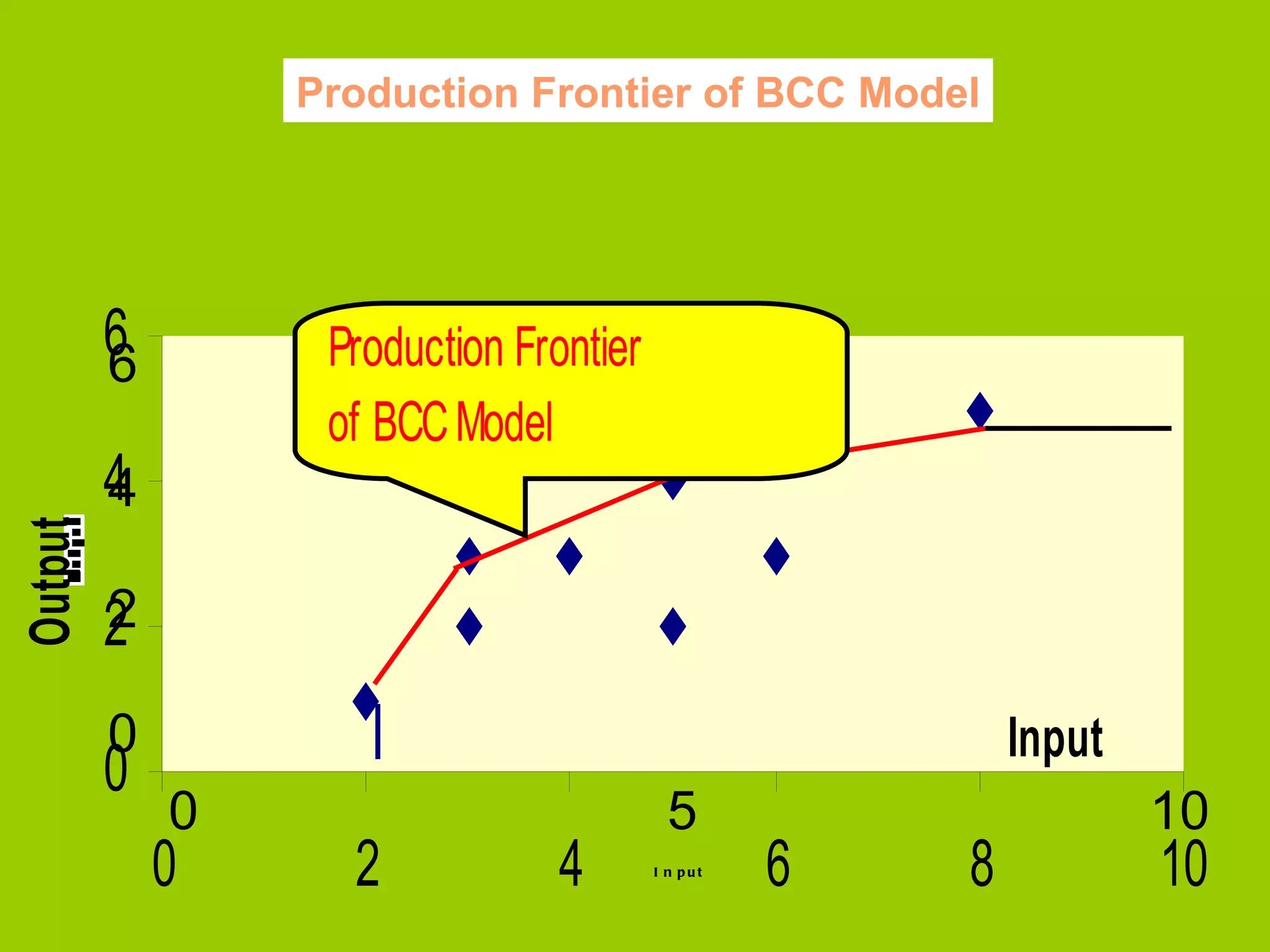
The BCC model has its production frontiers spanned by the
Convex Hull of the existing DMUs
Production Frontier of BCC Model


         6
         6        Production Frontier
                  of BCC Model
         4
         4
Output


         2
         2
         0                                                Input
         0
             0                           5                        10
             0     2            4       I n put
                                                  6   8           10
Acknowledgement:

Cooper, Seiford & Tone: Data Envelopment Analysis – A Comprehensive
Text with Models, Applications, References
Kluwer Academic Publishers, London (Fifth Ed, 2004)


                          Thanks

Data envelopment analysis

  • 1.
    DEPARTMENT OF COMMERCE DEA NORTH BENGAL UNICVERSITY 26-27 FEBRUARY, 2010 DATA ENVELOPMENT ANALYSIS A QUANTITATIVE TECHNIQUE TO MEASURE EFFICIENCY Click Mouse for Next
  • 2.
    Single Input andSingle Output Units Inputs Outputs Output/ Input A 2 1 0.5 B 3 3 1 C 3 2 0.666667 D 4 3 0.75 E 5 4 0.8 F 5 2 0.4 G 6 3 0.5 H 8 5 0.625 66 6 5 55 Efficient 4 Frontie r Output 44 Regres sion Line Output 3 33 2 1 22 0 11 Input Input 0 2 4 6 8 10 00 0 0 11 2 2 3 3 4 4 5 5 6 6 7 7 8 8 9 9
  • 3.
    Two Input andSingle Output Units A B C D E F G H I Input-1(x1) 4 7 8 4 2 5 6 5.5 6 Input-2(x2) 3 3 1 2 4 2 4 2.5 2.5 Output (y) 1 1 1 1 1 1 1 1 1
  • 4.
    4.5 4.5 4 G 4 E G 3.5 E 3.5 A x2/y A x2 /y 3 3 B B H 22.5 .5 H I I 2 2 F F D D Efficient Frontier Line 1. 5 1.5 1 1 C 0.5 C 0.5 0 00 1 2 3 4 5 6 7 8 9 0 2 4 x1/y x1/y 6 8 10
  • 5.
    4.5 4 G E 3.5 A x2/y 3 B 2.5 P H I 2 F 1 .5 D 1 C 0.5 0 0 1 2 3 4 5 6 7 8 9 x 1/ y Efficiency of A = OP OA = 0.8571
  • 6.
  • 7.
    4.5 4 G E 3.5 A x2/y 3 A1 B 2.5 P H I 2 F 1 .5 D 1 C 0.5 0 0 1 2 3 4 5 6 7 8 9 x 1/ y Improvement of efficiency
  • 8.
    ONE INPUT ANDTWO OUTPUTS Units A B C D E F G Input-1(x1) 1 1 1 1 1 1 1 Output y1 1 2 3 4 4 5 6 Output y2 5 7 4 3 6 5 2
  • 9.
    8 y2/x 7 6 5 4 3 2 1 y1/x 0 0 2 4 6 8
  • 10.
    8 y2/x 7 Efficient Frontier 6 5 4 3 2 1 y1/x 0 0 2 4 6 8
  • 11.
    OD B Efficiency − of − D = OP = o.750 Q OA Efficiency − of − A = = 0.714 E OQ F A P C D G Production Possibility Set
  • 12.
    MULTIPLE INPUTS ANDMULTIPLE OUTPUTS Inputs Outputs Units Vector Vectors 1 x1 y1 2 x2 y2 − − − − − − n xm ys •Units in DEA are known as DMUs- Decision Making Units •Generally a DMU is regarded as the entity responsible for converting inputs into outputs. •Data are assumed to be positive •Measurement is unit invariant
  • 13.
    ( DMUs j = 1 2 ...... n )  x11 x12 ... x1n     x21 x22 ... x21  X = . . ... .   x   m1 xm1 ... xmn    y11 y12 ... y1n     y21 y22 ... y21  Y = . . ... .   y   s1 ys2 ... ysn  
  • 14.
    For each DMUwe have to compute a ratio Output Virtual Output = Input Virtual Input s ∑r yrk u θ= 1 m ; k = ,2,...., n 1 ∑i xik v 1 ur r = 1,2,..., s Output weights vi i = 1,2,..., m Input weights
  • 15.
    For k-th DMU DMU k u1 y1k + u2 y2 k + .... + us ysk θ= v1 x1k + v2 x2 k + ... + vm xmk
  • 16.
    Fractional Programming Problem Maximize u1 y1k +u2 y2 k +.... +u s ysk θ= v1 x1k + v2 x2 k +... + vm xmk Subject to u1 y11 + 2 y21 + + s y s1 u .... u ≤1 v1 x11 + 2 x21 + + m xm1 v ... v u1 y12 + 2 y22 + + s y s 2 u .... u ≤1 v1 x12 + 2 x22 + + m xm 2 v ... v ... ... ... ... ... ... u1 y1n + 2 y2 n + + s y sn u .... u ≤1 v1 x1n + 2 x2 n + + m xmn v ... v u1 , u2 , ..., us ≥ 0 v1 , v2 , ..., vm ≥ 0
  • 17.
    Linear Programming ProblemOf kth DMU Maximize θ = µ1 y1k + µ 2 y2 k + .... + µ s ysk Subject to υ1 x1k + υ 2 x2 k + ... + υ m xmk = 1 µ1 y11 + µ 2 y21 + .... + µ s ys1 ≤ υ1 x11 + υ2 x21 + ... + υm xm1 µ1 y12 + µ2 y22 + .... + µ s ys 2 ≤ υ1 x12 + υ2 x22 + ... + υm xm 2 ... ... ... ... ... ... µ1 y1n + µ 2 y2 n + .... + µ s ysn ≤ υ1 x1n + υ2 x2 n + ... + υm xmn µ, 1 µ, 2 ..., µs ≥ 0 υ, 1 υ, 2 ..., υm ≥ 0
  • 18.
    This is what is known as CCR model of DEA • Proposed by Charnes, Cooper and Rhodes in 1978 CCR Efficiency : DMUk is CCR-efficient if θ = 1 * 1. and there exists at least one optimal (v*,u*) with v* >0 and u* >0 2. Otherwise DMU is CCR-inefficient
  • 19.
    Numerical Example DMU A B C D E F Input x1 4 7 8 4 2 10 x2 3 3 1 2 4 1 Output y 1 1 1 1 1 1 LPP of DMU A C B Max θθθ=u u Max = =u Max subject to subject to 84v1++v3v=2==11 7v1 32 2 1 v u u≤≤441v+++33222 u≤ 4vv11 3vvv u ≤ 7v1 + 3v2 u ≤ 7v1 + 3v2 u ≤ 7v + 3v u ≤ 8v1 + v 2 u ≤ 8v1 + v 2 1 2 u ≤ 10v1++2v22 u ≤ 4v1 + 2v2 4v1 v u ≤≤22v1++44v2 u v1 v2 u ≤≤4v1v+ + v2 u 10 2 v 1 2
  • 20.
    LPP SOLUTION OFALL DMUS DMU CCR(θ*) Reference v1 v2 u Set A 0.8571 D,E 0.1429 0.1429 0.8571 B 0.6316 C,D 0.0526 0.2105 0.6316 C 1 C 0.0833 0.3333 1 D 1 D 0.1667 0.1667 1 E 1 E 0.2143 0.1429 1 F 1 C 0 1 1
  • 21.
    Optimal weights for an efficient DMU need not be unique • Optimal weights for inefficient DMUs are unique except when the line of the DMU is parallel to one of the boundaries. • If an activity (x,y)εP (Production Possibility set), then the activity (tx.ty) belongs to P for any positive scalar t.
  • 22.
    CCR model andimportance of Dual PRIMAL DUAL max uyk min θ subject to subject to vxk = 1 θxk − Xλ ≥ 0 − vX + uY ≤ 0 Yλ ≥ yk v≥0 u≥0 λ ≥ 0 θ unrestricted
  • 23.
    Input excesses andoutput shortfalls min θ subject to θ k −Xλ≥0 x Yλ≥ yk λ≥0 θ unrestrict min θ subject to θ k −Xλ−s =0 x − Yλ−s + =yk λ≥0 θ unrestrict
  • 24.
    LPP of shortfallsand excesses − + max w = es +es subject to − s =θ k − Xλ x k + s =Yλ − yk − + λ ≥0 s ≥0 s ≥0
  • 25.
    COMPUTATIONAL PROCEDURE OF CCR MODEL Phase-I: We solve the dual first to obtain Ө*. This Ө* is called “Farrell Efficiency” and optimal objective value of LP Phase-II: Considering this Ө* as given, we solve the LPP of output shortfalls and Input excesses. (max slack solution)
  • 26.
    Refine Definition ofCCR-Efficiency If an optimal solution (θ*,λ*,s-*,s+*) of two LPs satisfies θ*=1 and s-*=0 and s+*=0 then DMUk is CCR-Efficient. DMU DMU CCR(θ*) CCR(θ*) Reference Reference v1 v Excess2 u Shortfall Set Set S1 - S2 - S+ A A 0.8571 0.8571 D,E D,E 0.1429 0 0.1429 0 0.8571 0 B B 0.6316 0.6316 C,D C,D 0.0526 0 0.2105 0 0.6316 0 C C 1 1 C C 0.0833 0 0.3333 0 1 0 D D 1 1 D D 0.1667 0 0.1667 0 1 0 E E 1 1 E E 0.2143 2 0.1429 0 1 0 F F 1 1 C C 0 1 .6667 1 0
  • 27.
    EXTENSION OF TWO-PHASE Two-Phaseprocess aims to obtain the maximum sum of slacks (input excesses+output shortfalls). For the projection of an inefficient DMU on efficient frontier,Itxmay result a mix which is far DMU x1 x1 1 y from the observed mix A 1 2 1 1 B 1 1 2 1 C 2 10 5 1 The Phase-III process is recently proposed (Tone K., “An Extension of Two Phase Process”,ORS 1 D 2 5 10 Con, 1999 ) and implemented in few software 2 10 groups similar DMUs in a E which 10 1 subset within peer set.
  • 28.
    INPUT ORIENTED ANDOUTPUT ORIENTED MODELS We discuss so far input-oriented models whose objective is to minimize inputs while producing atleast given level of Outputs. There is another type of model that attempts to maximize outputs while using no more than the given (observed) inputs. This is known as output-oriented model.
  • 29.
    Comparing Input-oriented CCRModel with Output-oriented CCR model If µ, η are variable vector of output oriented CCR problem then at the optimum the following are the equivalences with Optimal solution of Input-oriented CCR problem λ* and θ*: * 1 η= * = λ µ θ * * θ * Slacks of the output-oriented model are related to the slacks of input-oriented models − t −* =s * t +* =s+* θ * θ*
  • 30.
    It suggests thatan input-oriented CCR model will be efficient for any DMU iff it is also efficient when the output –oriented CCR model is used to evaluate its performance.
  • 31.
    BCC MODEL CCR modelhas been developed on the assumption of constant return to scale. A variation of DEA model is BCC (Banker, Charnes and Cooper) which is based on variable return to scale. • Increasing return to scale • Decreasing return to scale • Constant return to scale The BCC model has its production frontiers spanned by the Convex Hull of the existing DMUs
  • 32.
    Production Frontier ofBCC Model 6 6 Production Frontier of BCC Model 4 4 Output 2 2 0 Input 0 0 5 10 0 2 4 I n put 6 8 10
  • 33.
    Acknowledgement: Cooper, Seiford &Tone: Data Envelopment Analysis – A Comprehensive Text with Models, Applications, References Kluwer Academic Publishers, London (Fifth Ed, 2004) Thanks