Law of Returns to Scale
In the long run all factors of production are
variable. No factor is fixed. Accordingly, the
scale of production can be changed by
changing the quantity of all factors of
production.
Definition
• “The term returns to scale refers to the
changes in output as all factors change by the
same proportion.” Koutsoyiannis
• “Returns to scale relates to the behaviour of
total output as all inputs are varied and is a
long run concept”.
Returns to scale are of the following
three types:
• 1. Increasing Returns to scale.
• 2. Constant Returns to Scale
• 3. Diminishing Returns to Scale
• Explanation:
• In the long run, output can be increased by
increasing all factors in the same proportion.
Generally, laws of returns to scale refer to an
increase in output due to increase in all factors
in the same proportion. Such an increase is
called returns to scale.
• Suppose, initially production function is as
follows:
• P = f (L, K)
Now, if both the factors of production i.e., labour and capital are increased in same
proportion i.e., x, product function will be rewritten as.
• 1. Increasing Returns to Scale:
• Increasing returns to scale or diminishing cost
refers to a situation when all factors of
production are increased, output increases at
a higher rate. It means if all inputs are
doubled, output will also increase at the faster
rate than double. Hence, it is said to be
increasing returns to scale. This increase is
due to many reasons like division external
economies of scale. Increasing returns to scale
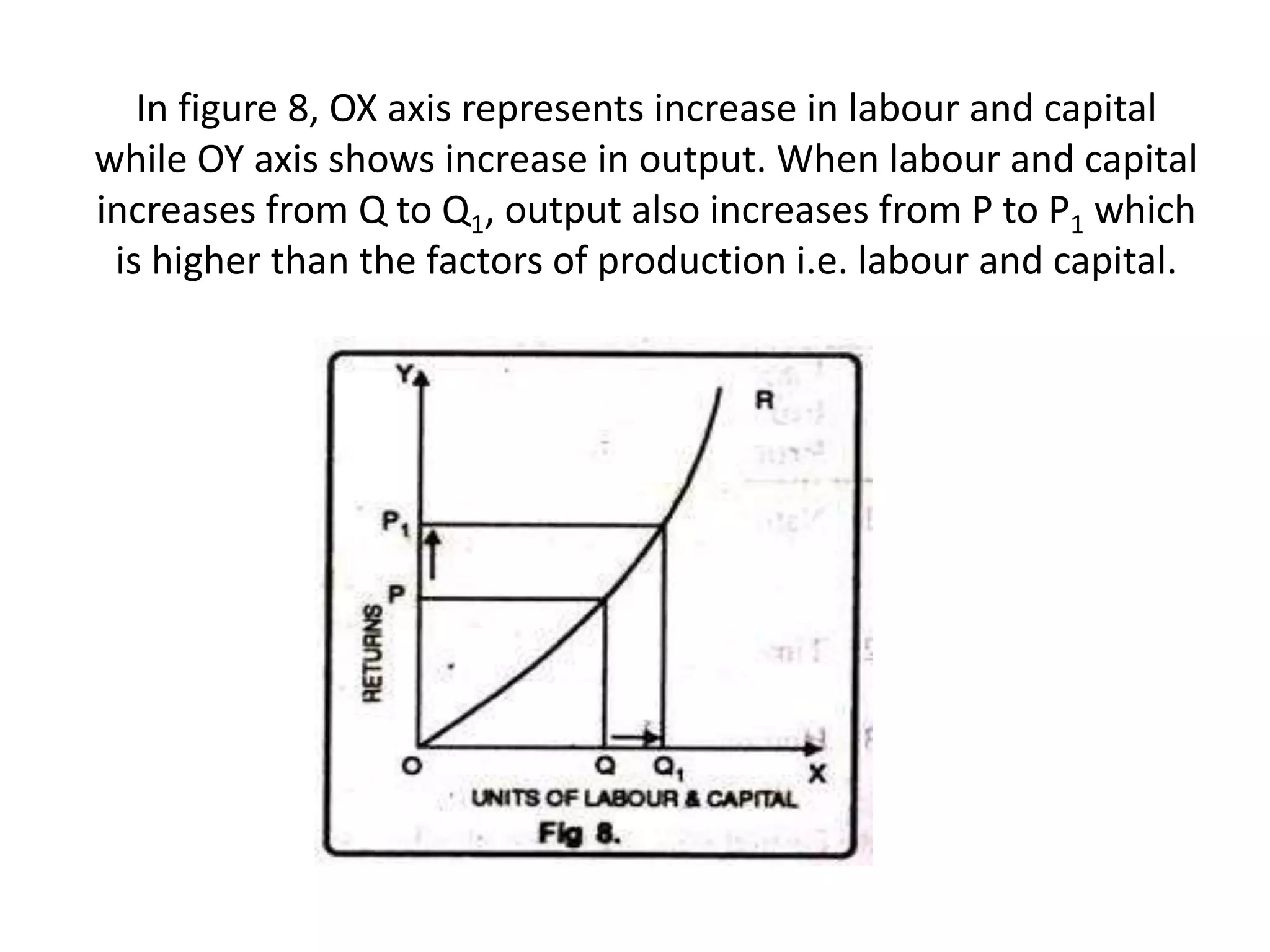
can be illustrated with the help of a diagram 8.
•
In figure 8, OX axis represents increase in labour and capital
while OY axis shows increase in output. When labour and capital
increases from Q to Q1, output also increases from P to P1 which
is higher than the factors of production i.e. labour and capital.
Diminishing Returns to Scale:
Diminishing returns or increasing costs refer to
that production situation, where if all the factors
of production are increased in a given
proportion, output increases in a smaller
proportion. It means, if inputs are doubled,
output will be less than doubled. If 20 percent
increase in labour and capital is followed by 10
percent increase in output, then it is an instance
of diminishing returns to scale.
In this diagram 9, diminishing returns to scale has been shown.
On OX axis, labour and capital are given while on OY axis, output.
When factors of production increase from Q to Q1 (more
quantity) but as a result increase in output, i.e. P to P1 is less. We
see that increase in factors of production is more and increase in
production is comparatively less, thus diminishing returns to
scale apply.
Constant Returns to Scale:
• Constant returns to scale or constant cost refers to the
production situation in which output increases exactly
in the same proportion in which factors of production
are increased. In simple terms, if factors of production
are doubled output will also be doubled.
• In this case internal and external economies are exactly
equal to internal and external diseconomies. This
situation arises when after reaching a certain level of
production, economies of scale are balanced by
diseconomies of scale. This is known as homogeneous
production function. Cobb-Douglas linear homogenous
production function is a good example of this kind.
Constant Returns to Scale
THANK YOU
PRESENTATION BY
MUNIJYOTHISHKUMAR .M
ASSISTANT PROFESSOR

Law of returns to scale

  • 1.
    Law of Returnsto Scale In the long run all factors of production are variable. No factor is fixed. Accordingly, the scale of production can be changed by changing the quantity of all factors of production.
  • 2.
    Definition • “The termreturns to scale refers to the changes in output as all factors change by the same proportion.” Koutsoyiannis • “Returns to scale relates to the behaviour of total output as all inputs are varied and is a long run concept”.
  • 3.
    Returns to scaleare of the following three types: • 1. Increasing Returns to scale. • 2. Constant Returns to Scale • 3. Diminishing Returns to Scale
  • 4.
    • Explanation: • Inthe long run, output can be increased by increasing all factors in the same proportion. Generally, laws of returns to scale refer to an increase in output due to increase in all factors in the same proportion. Such an increase is called returns to scale. • Suppose, initially production function is as follows: • P = f (L, K)
  • 5.
    Now, if boththe factors of production i.e., labour and capital are increased in same proportion i.e., x, product function will be rewritten as.
  • 6.
    • 1. IncreasingReturns to Scale: • Increasing returns to scale or diminishing cost refers to a situation when all factors of production are increased, output increases at a higher rate. It means if all inputs are doubled, output will also increase at the faster rate than double. Hence, it is said to be increasing returns to scale. This increase is due to many reasons like division external economies of scale. Increasing returns to scale can be illustrated with the help of a diagram 8. •
  • 7.
    In figure 8,OX axis represents increase in labour and capital while OY axis shows increase in output. When labour and capital increases from Q to Q1, output also increases from P to P1 which is higher than the factors of production i.e. labour and capital.
  • 8.
    Diminishing Returns toScale: Diminishing returns or increasing costs refer to that production situation, where if all the factors of production are increased in a given proportion, output increases in a smaller proportion. It means, if inputs are doubled, output will be less than doubled. If 20 percent increase in labour and capital is followed by 10 percent increase in output, then it is an instance of diminishing returns to scale.
  • 9.
    In this diagram9, diminishing returns to scale has been shown. On OX axis, labour and capital are given while on OY axis, output. When factors of production increase from Q to Q1 (more quantity) but as a result increase in output, i.e. P to P1 is less. We see that increase in factors of production is more and increase in production is comparatively less, thus diminishing returns to scale apply.
  • 10.
    Constant Returns toScale: • Constant returns to scale or constant cost refers to the production situation in which output increases exactly in the same proportion in which factors of production are increased. In simple terms, if factors of production are doubled output will also be doubled. • In this case internal and external economies are exactly equal to internal and external diseconomies. This situation arises when after reaching a certain level of production, economies of scale are balanced by diseconomies of scale. This is known as homogeneous production function. Cobb-Douglas linear homogenous production function is a good example of this kind.
  • 11.
  • 13.