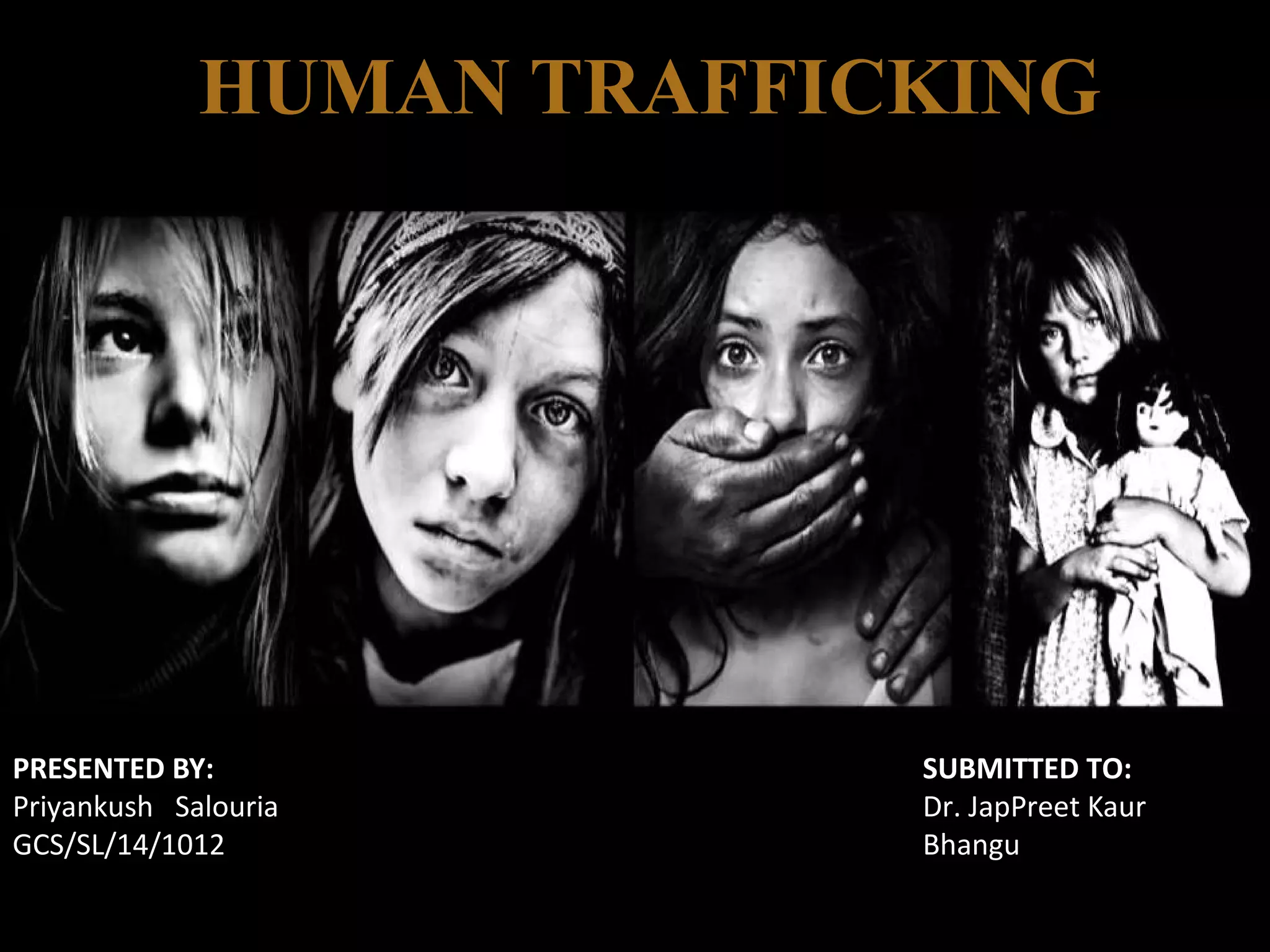
HUMAN TRAFFICKING
PRESENTED BY:
Priyankush Salouria
GCS/SL/14/1012
SUBMITTED TO:
Dr. JapPreet Kaur
Bhangu
CONTENTS
Definition
Introduction
How it works?
Types of human trafficking
Causes
How Does it Sometimes Happen?
How we help to prevent HT
Top 10 Countries Infamous for Human Trafficking
Status of Human Trafficking in India
Conclusion
INTRODUCTION
 Human trafficking is a group of crimes involving the exploitation of men,
women and children for financial gains which is violation of fundamental
human rights
 Human trafficking is the 3rd largest international crime
 Over one million people trafficked annually
 Millions of men, women and children are victims of human trafficking
 Human trafficking is a part of the larger problem of slavery
 human trafficking is when people are transported, by force or deception,
to become enslaved
 Traffickers use blackmail, abuse, and threats to force victims to comply
with their wishes in the destination country
 Usually caused by poverty/lack of economic opportunities, especially for
women and children, and a demand for certain services in the destination
country
DEFINITION
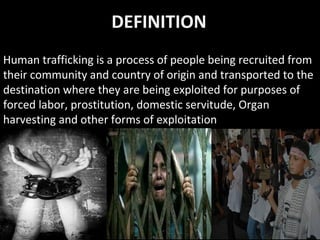
Human trafficking is a process of people being recruited from
their community and country of origin and transported to the
destination where they are being exploited for purposes of
forced labor, prostitution, domestic servitude, Organ
harvesting and other forms of exploitation
How it works?
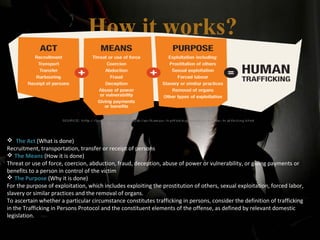
 The Act (What is done)
Recruitment, transportation, transfer or receipt of persons
 The Means (How it is done)
Threat or use of force, coercion, abduction, fraud, deception, abuse of power or vulnerability, or giving payments or 
benefits to a person in control of the victim
 The Purpose (Why it is done)
For the purpose of exploitation, which includes exploiting the prostitution of others, sexual exploitation, forced labor, 
slavery or similar practices and the removal of organs.
To ascertain whether a particular circumstance constitutes trafficking in persons, consider the definition of trafficking 
in the Trafficking in Persons Protocol and the constituent elements of the offense, as defined by relevant domestic 
legislation.
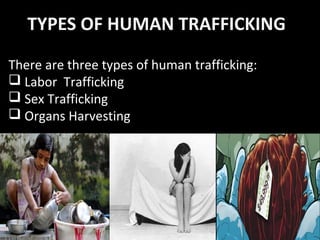
TYPES OF HUMAN TRAFFICKING
There are three types of human trafficking:
 Labor  Trafficking
 Sex Trafficking
 Organs Harvesting
HOW DOES IT SOMETIMES HAPPEN?
Poor families sell children
Children work to buy freedom
Poor, desperate women/men Promised jobs
Bonded into a debt they have no chance of
repaying
Traffickers seek mainly younger girls
CAUSES OF HUMAN TRAFFICKING
Unemployment
Poverty
Absence of a social safety
Political instability
Status of violence against women & children
The low risk, high-profit
How you can help to prevent Human
trafficking?
Call your local police department
Report suspected trafficking crimes
Get help by calling the national 24/7 toll-free Human
Trafficking Resource Center at 1-888-373-7888.
Call on 24x7 Helpline No. 011 – 24368638 of CBI for
reporting "Illegal Human Trafficking especially
Trafficking of Children & Women"
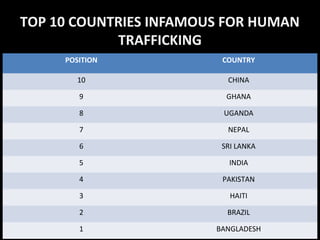
TOP 10 COUNTRIES INFAMOUS FOR HUMAN
TRAFFICKING
POSITION COUNTRY
10 CHINA
9 GHANA
8 UGANDA
7 NEPAL
6 SRI LANKA
5 INDIA
4 PAKISTAN
3 HAITI
2 BRAZIL
1 BANGLADESH
STATUS OF HUMAN TRAFFICKING IN INDIA
 Nepali children are also trafficked to India for forced labor
 India is also a destination for women and girls from Nepal and
Bangladesh trafficked for the purpose of commercial sexual
exploitation
Indian women are trafficked to the Middle East for commercial
sexual exploitation.
 In India, there is a large number of children trafficked for various
reasons such as labor, begging, and sexual exploitation
Debt bondage in India was legally abolished in 1976 but it
remains prevalent , Mostly in Agricultural areas.
India police have arrested the kingpin of a trafficking racket who
sold hundreds of poor tribal girls for domestic slavery in the
country's capital.
CONCLUSION
Slavery and Human Trafficking happens in nearly
every country in the world, developing or
developed countries. We are now living in a world
where Human Trafficking is the fastest growing
criminal enterprise. 75% Of Human Trafficking is for
sexual exploitation and are female. And over 50%
of all Human Trafficking victims are children. These
individuals are forced to work every single day
without pay, under threat of violence, and they’re
unable to walk away. Stand against Human
Trafficking before its too late.
THANK YOU

Human Trafficking

  • 1.
    HUMAN TRAFFICKING PRESENTED BY: PriyankushSalouria GCS/SL/14/1012 SUBMITTED TO: Dr. JapPreet Kaur Bhangu
  • 2.
    CONTENTS Definition Introduction How it works? Typesof human trafficking Causes How Does it Sometimes Happen? How we help to prevent HT Top 10 Countries Infamous for Human Trafficking Status of Human Trafficking in India Conclusion
  • 3.
    INTRODUCTION  Human traffickingis a group of crimes involving the exploitation of men, women and children for financial gains which is violation of fundamental human rights  Human trafficking is the 3rd largest international crime  Over one million people trafficked annually  Millions of men, women and children are victims of human trafficking  Human trafficking is a part of the larger problem of slavery  human trafficking is when people are transported, by force or deception, to become enslaved  Traffickers use blackmail, abuse, and threats to force victims to comply with their wishes in the destination country  Usually caused by poverty/lack of economic opportunities, especially for women and children, and a demand for certain services in the destination country
  • 4.
    DEFINITION Human trafficking isa process of people being recruited from their community and country of origin and transported to the destination where they are being exploited for purposes of forced labor, prostitution, domestic servitude, Organ harvesting and other forms of exploitation
  • 5.
    How it works? The Act (What is done) Recruitment, transportation, transfer or receipt of persons  The Means (How it is done) Threat or use of force, coercion, abduction, fraud, deception, abuse of power or vulnerability, or giving payments or  benefits to a person in control of the victim  The Purpose (Why it is done) For the purpose of exploitation, which includes exploiting the prostitution of others, sexual exploitation, forced labor,  slavery or similar practices and the removal of organs. To ascertain whether a particular circumstance constitutes trafficking in persons, consider the definition of trafficking  in the Trafficking in Persons Protocol and the constituent elements of the offense, as defined by relevant domestic  legislation.
  • 6.
    TYPES OF HUMANTRAFFICKING There are three types of human trafficking:  Labor  Trafficking  Sex Trafficking  Organs Harvesting
  • 7.
    HOW DOES ITSOMETIMES HAPPEN? Poor families sell children Children work to buy freedom Poor, desperate women/men Promised jobs Bonded into a debt they have no chance of repaying Traffickers seek mainly younger girls
  • 8.
    CAUSES OF HUMANTRAFFICKING Unemployment Poverty Absence of a social safety Political instability Status of violence against women & children The low risk, high-profit
  • 9.
    How you canhelp to prevent Human trafficking? Call your local police department Report suspected trafficking crimes Get help by calling the national 24/7 toll-free Human Trafficking Resource Center at 1-888-373-7888. Call on 24x7 Helpline No. 011 – 24368638 of CBI for reporting "Illegal Human Trafficking especially Trafficking of Children & Women"
  • 10.
    TOP 10 COUNTRIESINFAMOUS FOR HUMAN TRAFFICKING POSITION COUNTRY 10 CHINA 9 GHANA 8 UGANDA 7 NEPAL 6 SRI LANKA 5 INDIA 4 PAKISTAN 3 HAITI 2 BRAZIL 1 BANGLADESH
  • 11.
    STATUS OF HUMANTRAFFICKING IN INDIA  Nepali children are also trafficked to India for forced labor  India is also a destination for women and girls from Nepal and Bangladesh trafficked for the purpose of commercial sexual exploitation Indian women are trafficked to the Middle East for commercial sexual exploitation.  In India, there is a large number of children trafficked for various reasons such as labor, begging, and sexual exploitation Debt bondage in India was legally abolished in 1976 but it remains prevalent , Mostly in Agricultural areas. India police have arrested the kingpin of a trafficking racket who sold hundreds of poor tribal girls for domestic slavery in the country's capital.
  • 12.
    CONCLUSION Slavery and HumanTrafficking happens in nearly every country in the world, developing or developed countries. We are now living in a world where Human Trafficking is the fastest growing criminal enterprise. 75% Of Human Trafficking is for sexual exploitation and are female. And over 50% of all Human Trafficking victims are children. These individuals are forced to work every single day without pay, under threat of violence, and they’re unable to walk away. Stand against Human Trafficking before its too late.
  • 14.