Database ModelsDatabase Models
Database Systems ArchitectureDatabase Systems Architecture
Version 1.0Version 1.0
1Rushdi Shams, Dept of CSE, KUET
 Database is structured collection of
records of data stored in a computer
system
 Database Management System (DBMS) is
a computer software designed to
manage (Access/Manipulate/Duplicate)
database based on various Data
Models.
Rushdi Shams, Dept of CSE, KUET
2
Rushdi Shams, Dept of CSE, KUET
3
Database
 A data model is a formal description of
how data maybe structure, represented,
and accessed
 A database model is a theory or
specification describing how a database
is structured and can be used
Rushdi Shams, Dept of CSE, KUET
4
1. Hierarchical Model
2. Network Model
3. Relational Model
4. Entity-Relationship Model
5. Object Relational Model
Rushdi Shams, Dept of CSE, KUET
5
 Organized in Tree Structure
 Allows repeating information using
parent/child relationships
 Each parent can have many children but
a child will have only one parent
Rushdi Shams, Dept of CSE, KUET
6
Rushdi Shams, Dept of CSE, KUET
7
Customer Data
Name Address Phone Pointer to Checking
Acct. Data
Pointer to Auto
Loan Data
Maria Chavez 1441 Adams Court 605-777-8992
John Severson 8988 Grover Road 605-898-2314
Harold Brown 3511 Pluto Drive 605-666-3298
Checking Account Data
Acct. Number Current Balance Date Last
Transaction
986-335 445.11 07/11/03
988-310 2988.44 07/01/03
355-822 898.14 06/15/03
Auto Loan Data
Acct. Number Current Balance Date Last Pmt
100988 5676 06/15/03
101732 1545.33 07/01/03
Parent
Data
Child
Data
Pointer
Rushdi Shams, Dept of CSE, KUET
8
 Employee has many children
 But a child has only one parent
Rushdi Shams, Dept of CSE, KUET
9
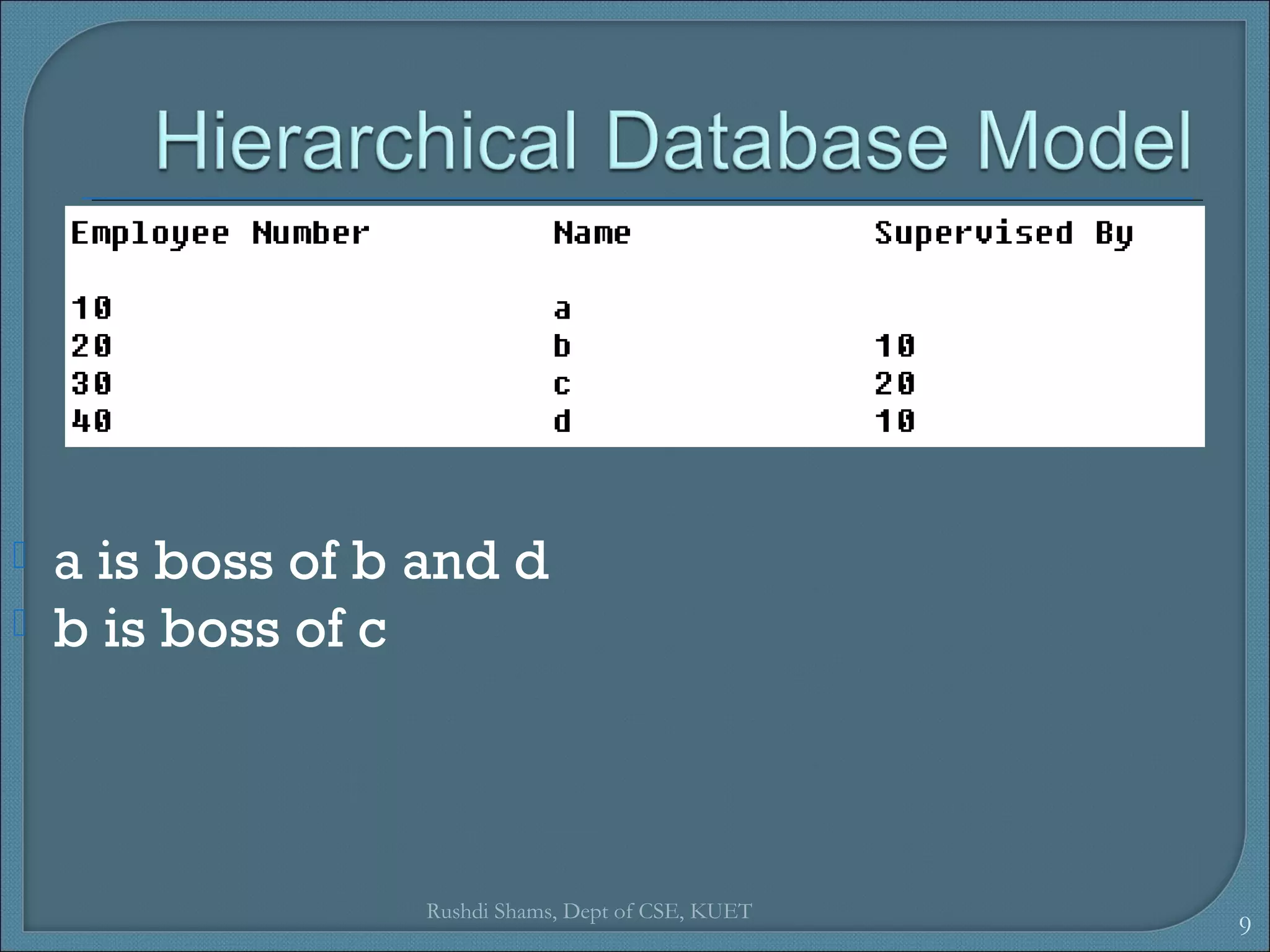
 a is boss of b and d
 b is boss of c
 Allows each record to have multiple
parent and multiple children records
 More natural modelling than
hierarchical model
 But network model failed-
1. IBM made an improvement on
hierarchical model making it semi-
networked
2. Displaced by relational model, which
offered higher level of interface
Rushdi Shams, Dept of CSE, KUET
10
 Based on predicate logic and set theory
 Enforced database integrity
 Data are operated upon by means of
relational algebra
 Designs relations (tables) by
normalization
 Accessing data differs according to the
DBMS
Rushdi Shams, Dept of CSE, KUET
11
 The basic building blocks of this model
is-
1. Data type
2. Rows
3. Columns
4. Values
 Rows are called body and columns are
called heading
Rushdi Shams, Dept of CSE, KUET
12
 Illustrates logical database
 Commonly aids relational database
design
 End product of the model is Entity
Relation Diagram (ERD)
Rushdi Shams, Dept of CSE, KUET
13
Rushdi Shams, Dept of CSE, KUET
14
 Relational model but allows user to
integrate a database with their own data
types and methods
 Mostly, external software runs over
traditional DBMS to provide this
functionality
 Polymorphism, inheritance, function
overloading, etc are present
Rushdi Shams, Dept of CSE, KUET
15
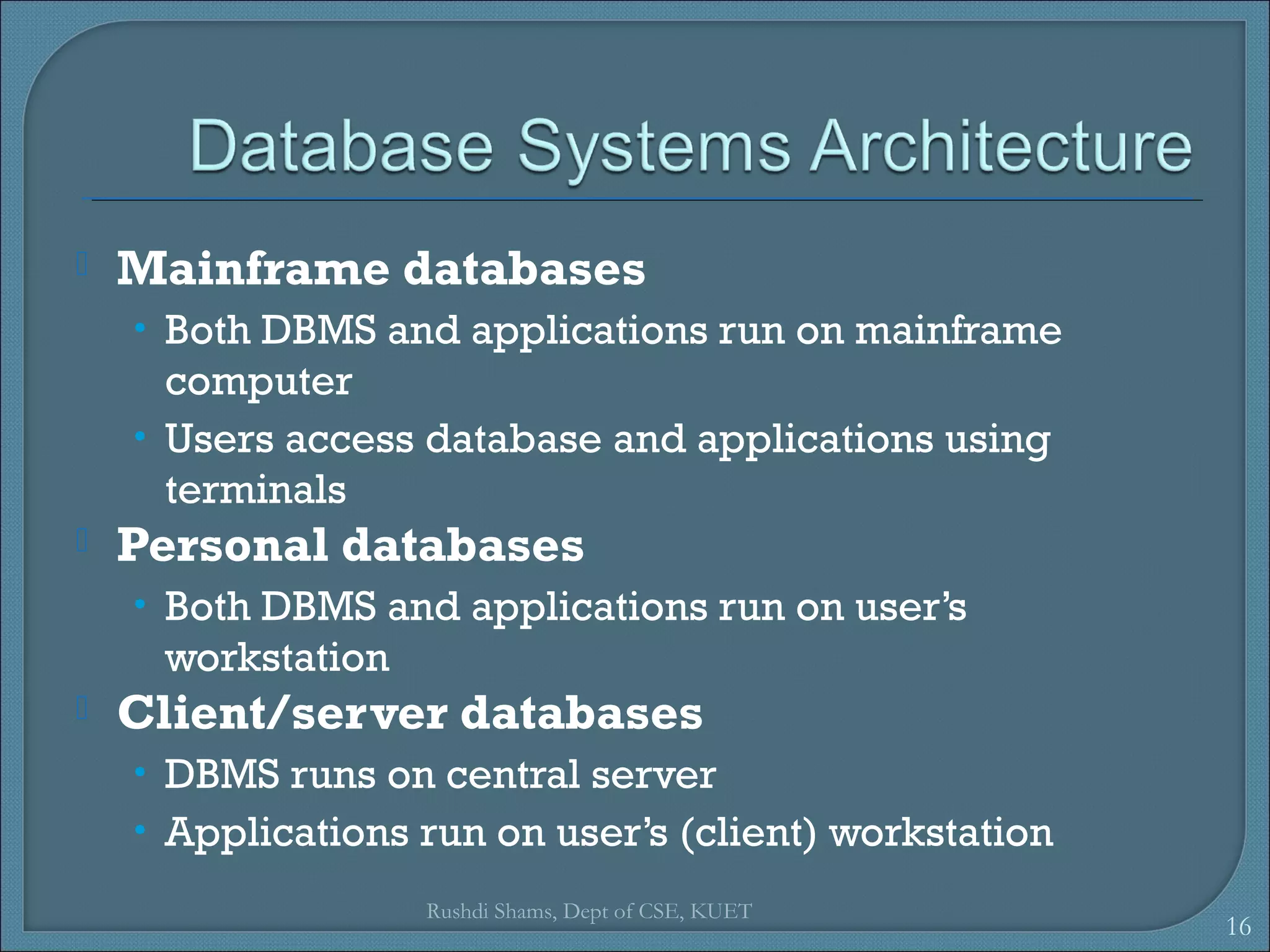
 Mainframe databases
• Both DBMS and applications run on mainframe
computer
• Users access database and applications using
terminals
 Personal databases
• Both DBMS and applications run on user’s
workstation
 Client/server databases
• DBMS runs on central server
• Applications run on user’s (client) workstation
Rushdi Shams, Dept of CSE, KUET
16
 Handling server and client failures
 Processing transactions
 Handling high data volumes
 Providing security
 Servicing multiple simultaneous users
Rushdi Shams, Dept of CSE, KUET
17
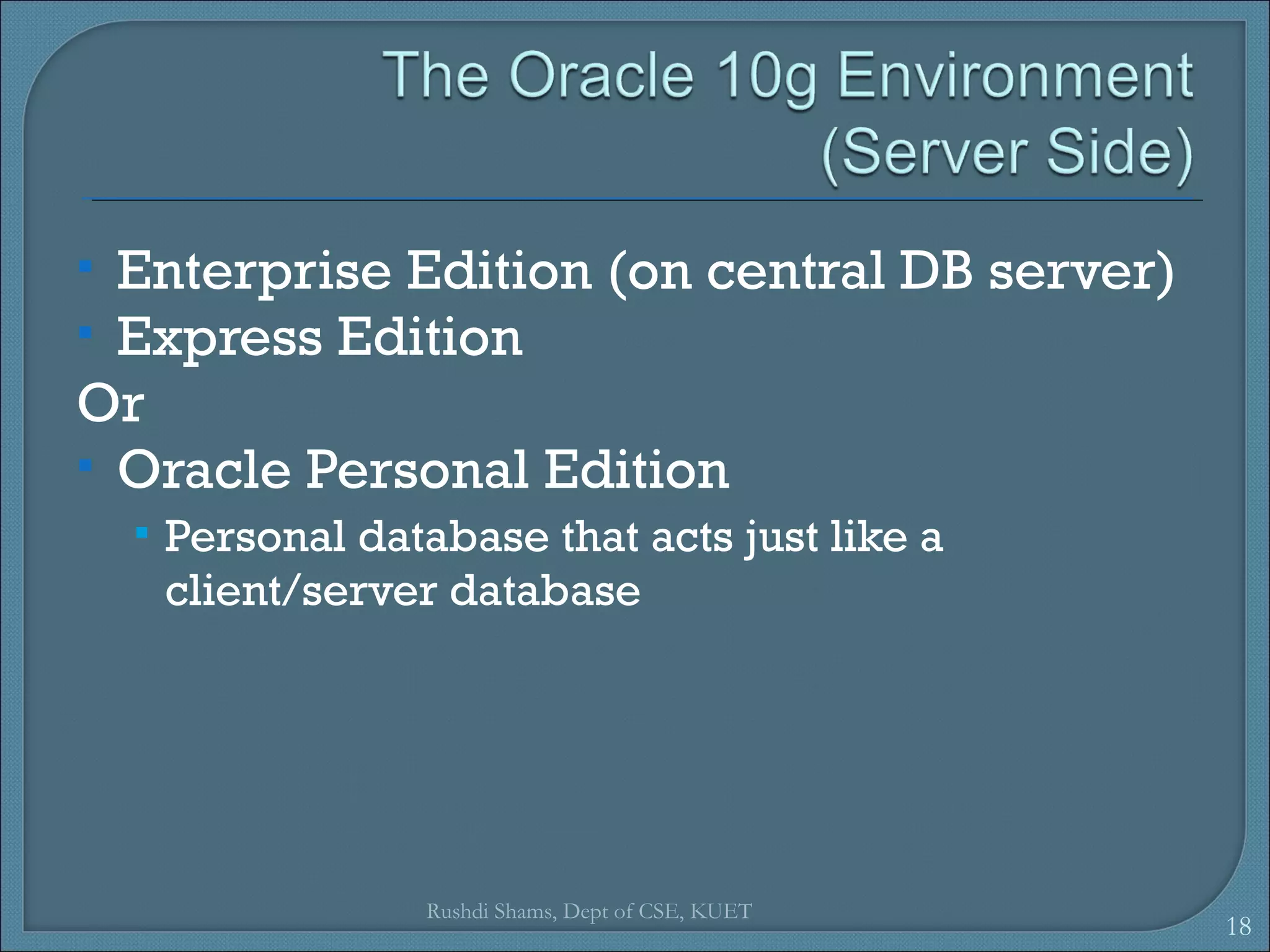
 Enterprise Edition (on central DB server)
 Express Edition
Or
 Oracle Personal Edition
 Personal database that acts just like a
client/server database
Rushdi Shams, Dept of CSE, KUET
18
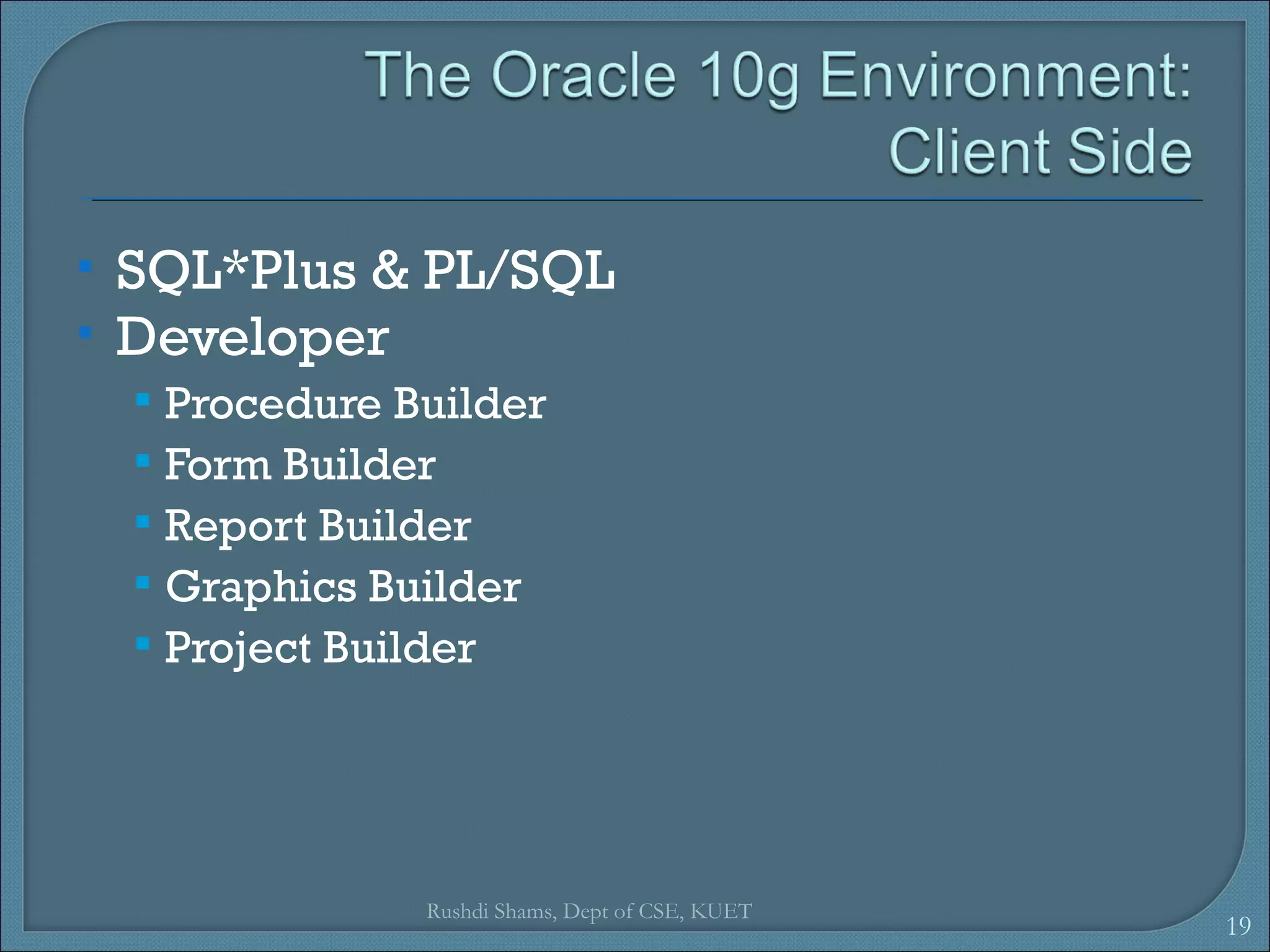
 SQL*Plus & PL/SQL
 Developer
 Procedure Builder
 Form Builder
 Report Builder
 Graphics Builder
 Project Builder
Rushdi Shams, Dept of CSE, KUET
19

L7 data model and dbms architecture

  • 1.
    Database ModelsDatabase Models DatabaseSystems ArchitectureDatabase Systems Architecture Version 1.0Version 1.0 1Rushdi Shams, Dept of CSE, KUET
  • 2.
     Database isstructured collection of records of data stored in a computer system  Database Management System (DBMS) is a computer software designed to manage (Access/Manipulate/Duplicate) database based on various Data Models. Rushdi Shams, Dept of CSE, KUET 2
  • 3.
    Rushdi Shams, Deptof CSE, KUET 3 Database
  • 4.
     A datamodel is a formal description of how data maybe structure, represented, and accessed  A database model is a theory or specification describing how a database is structured and can be used Rushdi Shams, Dept of CSE, KUET 4
  • 5.
    1. Hierarchical Model 2.Network Model 3. Relational Model 4. Entity-Relationship Model 5. Object Relational Model Rushdi Shams, Dept of CSE, KUET 5
  • 6.
     Organized inTree Structure  Allows repeating information using parent/child relationships  Each parent can have many children but a child will have only one parent Rushdi Shams, Dept of CSE, KUET 6
  • 7.
    Rushdi Shams, Deptof CSE, KUET 7 Customer Data Name Address Phone Pointer to Checking Acct. Data Pointer to Auto Loan Data Maria Chavez 1441 Adams Court 605-777-8992 John Severson 8988 Grover Road 605-898-2314 Harold Brown 3511 Pluto Drive 605-666-3298 Checking Account Data Acct. Number Current Balance Date Last Transaction 986-335 445.11 07/11/03 988-310 2988.44 07/01/03 355-822 898.14 06/15/03 Auto Loan Data Acct. Number Current Balance Date Last Pmt 100988 5676 06/15/03 101732 1545.33 07/01/03 Parent Data Child Data Pointer
  • 8.
    Rushdi Shams, Deptof CSE, KUET 8  Employee has many children  But a child has only one parent
  • 9.
    Rushdi Shams, Deptof CSE, KUET 9  a is boss of b and d  b is boss of c
  • 10.
     Allows eachrecord to have multiple parent and multiple children records  More natural modelling than hierarchical model  But network model failed- 1. IBM made an improvement on hierarchical model making it semi- networked 2. Displaced by relational model, which offered higher level of interface Rushdi Shams, Dept of CSE, KUET 10
  • 11.
     Based onpredicate logic and set theory  Enforced database integrity  Data are operated upon by means of relational algebra  Designs relations (tables) by normalization  Accessing data differs according to the DBMS Rushdi Shams, Dept of CSE, KUET 11
  • 12.
     The basicbuilding blocks of this model is- 1. Data type 2. Rows 3. Columns 4. Values  Rows are called body and columns are called heading Rushdi Shams, Dept of CSE, KUET 12
  • 13.
     Illustrates logicaldatabase  Commonly aids relational database design  End product of the model is Entity Relation Diagram (ERD) Rushdi Shams, Dept of CSE, KUET 13
  • 14.
    Rushdi Shams, Deptof CSE, KUET 14
  • 15.
     Relational modelbut allows user to integrate a database with their own data types and methods  Mostly, external software runs over traditional DBMS to provide this functionality  Polymorphism, inheritance, function overloading, etc are present Rushdi Shams, Dept of CSE, KUET 15
  • 16.
     Mainframe databases •Both DBMS and applications run on mainframe computer • Users access database and applications using terminals  Personal databases • Both DBMS and applications run on user’s workstation  Client/server databases • DBMS runs on central server • Applications run on user’s (client) workstation Rushdi Shams, Dept of CSE, KUET 16
  • 17.
     Handling serverand client failures  Processing transactions  Handling high data volumes  Providing security  Servicing multiple simultaneous users Rushdi Shams, Dept of CSE, KUET 17
  • 18.
     Enterprise Edition(on central DB server)  Express Edition Or  Oracle Personal Edition  Personal database that acts just like a client/server database Rushdi Shams, Dept of CSE, KUET 18
  • 19.
     SQL*Plus &PL/SQL  Developer  Procedure Builder  Form Builder  Report Builder  Graphics Builder  Project Builder Rushdi Shams, Dept of CSE, KUET 19