The database isa collection of inter-related data which is used to retrieve,
insert and delete the data efficiently.
It is also used to organize the data in the form of a table, schema, views,
and reports, etc.
For example: The college Database organizes the data about the admin,
staff, students and faculty etc.
Using the database, you can easily retrieve, insert, and delete the
information.
WHAT IS DATABASE
1
3.
Database management systemis a software which is used to manage the
database.
For example: MySQL, Oracle, etc are a very popular commercial database
which is used in different applications.
DBMS provides an interface to perform various operations like database
creation, storing data in it, updating data, creating a table in the database
and a lot more.
It provides protection and security to the database. In the case of multiple
users, it also maintains data consistency.
2
DATABASE MANAGEMENT SYSTEM
4.
Data Definition: Itis used for creation, modification, and removal of
definition that defines the organization of data in the database.
Data Updation: It is used for the insertion, modification, and deletion of
the actual data in the database.
Data Retrieval: It is used to retrieve the data from the database which can
be used by applications for various purposes.
User Administration: It is used for registering and monitoring users,
maintain data integrity, enforcing data security, dealing with concurrency
control, monitoring performance and recovering information corrupted
by unexpected failure.
3
DBMS ALLOWS USERS THE FOLLOWING TASKS
5.
It uses adigital repository established on a server to store and
manage the information.
It can provide a clear and logical view of the process that manipulates
data.
DBMS contains automatic backup and recovery procedures.
It contains ACID properties which maintain data in a healthy state in
case of failure.
It can reduce the complex relationship between data.
4
CHARACTERISTICS OF DBMS
6.
It is usedto support manipulation and processing of data.
It is used to provide security of data.
It can view the database from different viewpoints according to the
requirements of the user.
5
CHARACTERISTICS OF DBMS
7.
Controls database redundancy:It can control data redundancy because it
stores all the data in one single database file and that recorded data is
placed in the database.
Data sharing: In DBMS, the authorized users of an organization can share
the data among multiple users.
Easily Maintenance: It can be easily maintainable due to the centralized
nature of the database system.
6
ADVANTAGES OF DBMS
8.
Reduce Time: Itreduces development time and maintenance need.
Backup: It provides backup and recovery subsystems which create
automatic backup of data from hardware and software failures and
restores the data if required.
Multiple User Interface: It provides different types of user interfaces like
graphical user interfaces, application program interfaces
7
ADVANTAGES OF DBMS
9.
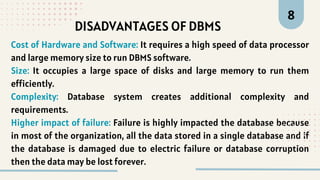
Cost of Hardwareand Software: It requires a high speed of data processor
and large memory size to run DBMS software.
Size: It occupies a large space of disks and large memory to run them
efficiently.
Complexity: Database system creates additional complexity and
requirements.
Higher impact of failure: Failure is highly impacted the database because
in most of the organization, all the data stored in a single database and if
the database is damaged due to electric failure or database corruption
then the data may be lost forever.
8
DISADVANTAGES OF DBMS




![Presentation AICT Improved version[1].pptx](https://cdn.slidesharecdn.com/ss_thumbnails/presentationaictimprovedversion1-241213140004-f34d119f-thumbnail.jpg?width=640&height=640&fit=bounds)


![Main_Slides_AI[1]vahwgwbbwbwhhwbwwhh.pptx](https://cdn.slidesharecdn.com/ss_thumbnails/mainslidesai1-250802072616-46c647a4-thumbnail.jpg?width=640&height=640&fit=bounds)


