1-1CSE-Network Management—Introduction © 1999, Cisco Systems, Inc.www.cisco.com
Understanding
Routing
7-2CSE: Networking Fundamentals—Routing © 1999, Cisco Systems, Inc.www.cisco.com
Agenda
• What Is Routing?
• Routing Protocols
1-3CSE-Network Management—Introduction © 1999, Cisco Systems, Inc.www.cisco.comwww.cisco.com© 1999, Cisco Systems, Inc.
What is Routing?
7-4CSE: Networking Fundamentals—Routing © 1999, Cisco Systems, Inc.www.cisco.com
What Is Routing?
• Routing is:
– Finding a path between a source and
destination (path determination)
– Moving information across an internetwork
from a source to a destination (switching*)
– Very complex in large networks because
of the many potential intermediate nodes
• A router is:
– A network layer device that forwards packets
from one network to another and determines
the optimal path for forwarding network traffic
* The term “switching”, when used to describe a router’s
function, is different from a switch (the network device).
7-5CSE: Networking Fundamentals—Routing © 1999, Cisco Systems, Inc.www.cisco.com
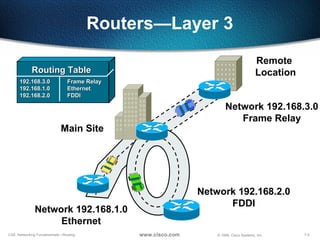
Routing TableRouting Table
192.168.3.0192.168.3.0 Frame RelayFrame Relay
192.168.1.0192.168.1.0 EthernetEthernet
192.168.2.0192.168.2.0 FDDIFDDI
Network 192.168.2.0
FDDI
Network 192.168.3.0
Frame Relay
Remote
Location
Network 192.168.1.0
Ethernet
Main Site
Routers—Layer 3
7-6CSE: Networking Fundamentals—Routing © 1999, Cisco Systems, Inc.www.cisco.com
• LAN-to-LAN connectivity
• LAN-to-WAN connectivity
• Remote access
Where are Routers Used?
7-7CSE: Networking Fundamentals—Routing © 1999, Cisco Systems, Inc.www.cisco.com
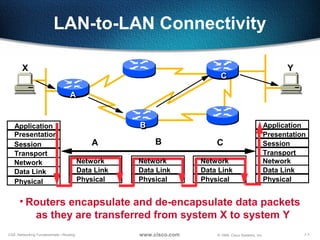
LAN-to-LAN Connectivity
• Routers encapsulate and de-encapsulate data packets
as they are transferred from system X to system Y
X Y
AA
BB
CC
Presentation
Data Link
Physical
Data Link
Physical
A B C
Data Link
Physical
Data Link
Network
Transport
Session
Presentation
Application
Physical
Data Link
Network
Transport
Session
Application
Physical
Network Network Network
7-8CSE: Networking Fundamentals—Routing © 1999, Cisco Systems, Inc.www.cisco.com
Path Determination
1
2
3
4
5
6
7
8 9
10 11
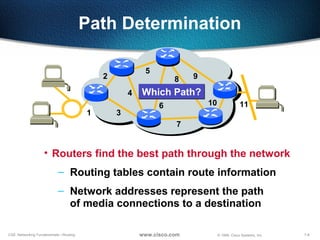
• Routers find the best path through the network
– Routing tables contain route information
– Network addresses represent the path
of media connections to a destination
Which Path?Which Path?
7-9CSE: Networking Fundamentals—Routing © 1999, Cisco Systems, Inc.www.cisco.com
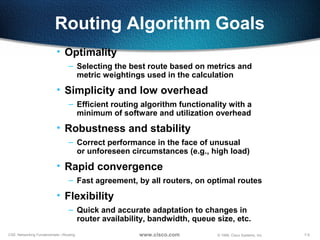
Routing Algorithm Goals
• Optimality
– Selecting the best route based on metrics and
metric weightings used in the calculation
• Simplicity and low overhead
– Efficient routing algorithm functionality with a
minimum of software and utilization overhead
• Robustness and stability
– Correct performance in the face of unusual
or unforeseen circumstances (e.g., high load)
• Rapid convergence
– Fast agreement, by all routers, on optimal routes
• Flexibility
– Quick and accurate adaptation to changes in
router availability, bandwidth, queue size, etc.
7-10CSE: Networking Fundamentals—Routing © 1999, Cisco Systems, Inc.www.cisco.com
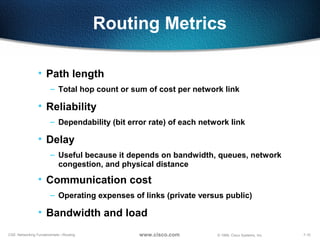
Routing Metrics
• Path length
– Total hop count or sum of cost per network link
• Reliability
– Dependability (bit error rate) of each network link
• Delay
– Useful because it depends on bandwidth, queues, network
congestion, and physical distance
• Communication cost
– Operating expenses of links (private versus public)
• Bandwidth and load
7-11CSE: Networking Fundamentals—Routing © 1999, Cisco Systems, Inc.www.cisco.com
Types of Routing.
 Static routing
 Default routing
 Dynamic routing.
7-12CSE: Networking Fundamentals—Routing © 1999, Cisco Systems, Inc.www.cisco.com
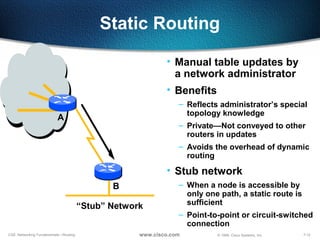
Static Routing
“Stub” Network
A
B
• Manual table updates by
a network administrator
• Benefits
– Reflects administrator’s special
topology knowledge
– Private—Not conveyed to other
routers in updates
– Avoids the overhead of dynamic
routing
• Stub network
– When a node is accessible by
only one path, a static route is
sufficient
– Point-to-point or circuit-switched
connection
7-13CSE: Networking Fundamentals—Routing © 1999, Cisco Systems, Inc.www.cisco.com
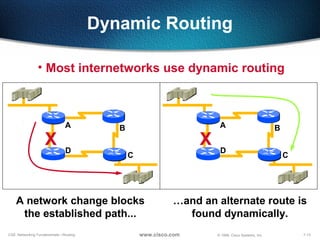
Dynamic Routing
A network change blocks
the established path...
A B
C
D
X
A B
C
D
X
…and an alternate route is
found dynamically.
• Most internetworks use dynamic routing
1-14CSE-Network Management—Introduction © 1999, Cisco Systems, Inc.www.cisco.comwww.cisco.com© 1999, Cisco Systems, Inc.
Routing Protocols
7-15CSE: Networking Fundamentals—Routing © 1999, Cisco Systems, Inc.www.cisco.com
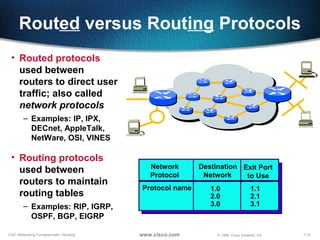
Routed versus Routing Protocols
• Routed protocols
used between
routers to direct user
traffic; also called
network protocols
– Examples: IP, IPX,
DECnet, AppleTalk,
NetWare, OSI, VINES
1.0
2.0
3.0
1.1
2.1
3.1
Destination
Network
Network
Protocol
Protocol name
Exit Port
to Use
• Routing protocols
used between
routers to maintain
routing tables
– Examples: RIP, IGRP,
OSPF, BGP, EIGRP
7-16CSE: Networking Fundamentals—Routing © 1999, Cisco Systems, Inc.www.cisco.com
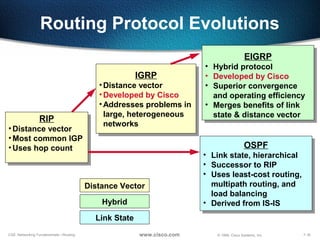
Routing Protocol Evolutions
Distance Vector
Link State
RIP
•Distance vector
•Most common IGP
•Uses hop count
RIP
•Distance vector
•Most common IGP
•Uses hop count
IGRP
•Distance vector
•Developed by Cisco
•Addresses problems in
large, heterogeneous
networks
IGRP
•Distance vector
•Developed by Cisco
•Addresses problems in
large, heterogeneous
networks
OSPF
• Link state, hierarchical
• Successor to RIP
• Uses least-cost routing,
multipath routing, and
load balancing
• Derived from IS-IS
OSPF
• Link state, hierarchical
• Successor to RIP
• Uses least-cost routing,
multipath routing, and
load balancing
• Derived from IS-IS
EIGRP
• Hybrid protocol
• Developed by Cisco
• Superior convergence
and operating efficiency
• Merges benefits of link
state & distance vector
EIGRP
• Hybrid protocol
• Developed by Cisco
• Superior convergence
and operating efficiency
• Merges benefits of link
state & distance vector
Hybrid
7-17CSE: Networking Fundamentals—Routing © 1999, Cisco Systems, Inc.www.cisco.com
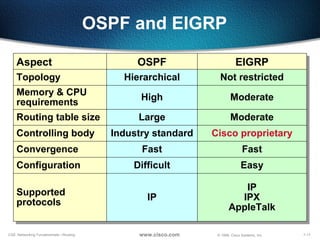
OSPF and EIGRP
Aspect OSPF EIGRP
Topology Hierarchical Not restricted
Memory & CPU
requirements
High Moderate
Routing table size Large Moderate
Controlling body Industry standard Cisco proprietary
Convergence Fast Fast
Supported
protocols
IP
IP
IPX
AppleTalk
Configuration Difficult Easy
7-18CSE: Networking Fundamentals—Routing © 1999, Cisco Systems, Inc.www.cisco.com
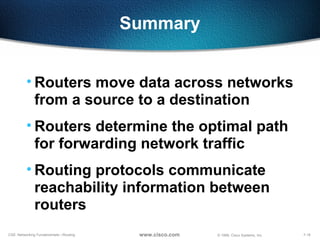
Summary
• Routers move data across networks
from a source to a destination
• Routers determine the optimal path
for forwarding network traffic
• Routing protocols communicate
reachability information between
routers

Day 3.1 basic routing

  • 1.
    1-1CSE-Network Management—Introduction ©1999, Cisco Systems, Inc.www.cisco.com Understanding Routing
  • 2.
    7-2CSE: Networking Fundamentals—Routing© 1999, Cisco Systems, Inc.www.cisco.com Agenda • What Is Routing? • Routing Protocols
  • 3.
    1-3CSE-Network Management—Introduction ©1999, Cisco Systems, Inc.www.cisco.comwww.cisco.com© 1999, Cisco Systems, Inc. What is Routing?
  • 4.
    7-4CSE: Networking Fundamentals—Routing© 1999, Cisco Systems, Inc.www.cisco.com What Is Routing? • Routing is: – Finding a path between a source and destination (path determination) – Moving information across an internetwork from a source to a destination (switching*) – Very complex in large networks because of the many potential intermediate nodes • A router is: – A network layer device that forwards packets from one network to another and determines the optimal path for forwarding network traffic * The term “switching”, when used to describe a router’s function, is different from a switch (the network device).
  • 5.
    7-5CSE: Networking Fundamentals—Routing© 1999, Cisco Systems, Inc.www.cisco.com Routing TableRouting Table 192.168.3.0192.168.3.0 Frame RelayFrame Relay 192.168.1.0192.168.1.0 EthernetEthernet 192.168.2.0192.168.2.0 FDDIFDDI Network 192.168.2.0 FDDI Network 192.168.3.0 Frame Relay Remote Location Network 192.168.1.0 Ethernet Main Site Routers—Layer 3
  • 6.
    7-6CSE: Networking Fundamentals—Routing© 1999, Cisco Systems, Inc.www.cisco.com • LAN-to-LAN connectivity • LAN-to-WAN connectivity • Remote access Where are Routers Used?
  • 7.
    7-7CSE: Networking Fundamentals—Routing© 1999, Cisco Systems, Inc.www.cisco.com LAN-to-LAN Connectivity • Routers encapsulate and de-encapsulate data packets as they are transferred from system X to system Y X Y AA BB CC Presentation Data Link Physical Data Link Physical A B C Data Link Physical Data Link Network Transport Session Presentation Application Physical Data Link Network Transport Session Application Physical Network Network Network
  • 8.
    7-8CSE: Networking Fundamentals—Routing© 1999, Cisco Systems, Inc.www.cisco.com Path Determination 1 2 3 4 5 6 7 8 9 10 11 • Routers find the best path through the network – Routing tables contain route information – Network addresses represent the path of media connections to a destination Which Path?Which Path?
  • 9.
    7-9CSE: Networking Fundamentals—Routing© 1999, Cisco Systems, Inc.www.cisco.com Routing Algorithm Goals • Optimality – Selecting the best route based on metrics and metric weightings used in the calculation • Simplicity and low overhead – Efficient routing algorithm functionality with a minimum of software and utilization overhead • Robustness and stability – Correct performance in the face of unusual or unforeseen circumstances (e.g., high load) • Rapid convergence – Fast agreement, by all routers, on optimal routes • Flexibility – Quick and accurate adaptation to changes in router availability, bandwidth, queue size, etc.
  • 10.
    7-10CSE: Networking Fundamentals—Routing© 1999, Cisco Systems, Inc.www.cisco.com Routing Metrics • Path length – Total hop count or sum of cost per network link • Reliability – Dependability (bit error rate) of each network link • Delay – Useful because it depends on bandwidth, queues, network congestion, and physical distance • Communication cost – Operating expenses of links (private versus public) • Bandwidth and load
  • 11.
    7-11CSE: Networking Fundamentals—Routing© 1999, Cisco Systems, Inc.www.cisco.com Types of Routing.  Static routing  Default routing  Dynamic routing.
  • 12.
    7-12CSE: Networking Fundamentals—Routing© 1999, Cisco Systems, Inc.www.cisco.com Static Routing “Stub” Network A B • Manual table updates by a network administrator • Benefits – Reflects administrator’s special topology knowledge – Private—Not conveyed to other routers in updates – Avoids the overhead of dynamic routing • Stub network – When a node is accessible by only one path, a static route is sufficient – Point-to-point or circuit-switched connection
  • 13.
    7-13CSE: Networking Fundamentals—Routing© 1999, Cisco Systems, Inc.www.cisco.com Dynamic Routing A network change blocks the established path... A B C D X A B C D X …and an alternate route is found dynamically. • Most internetworks use dynamic routing
  • 14.
    1-14CSE-Network Management—Introduction ©1999, Cisco Systems, Inc.www.cisco.comwww.cisco.com© 1999, Cisco Systems, Inc. Routing Protocols
  • 15.
    7-15CSE: Networking Fundamentals—Routing© 1999, Cisco Systems, Inc.www.cisco.com Routed versus Routing Protocols • Routed protocols used between routers to direct user traffic; also called network protocols – Examples: IP, IPX, DECnet, AppleTalk, NetWare, OSI, VINES 1.0 2.0 3.0 1.1 2.1 3.1 Destination Network Network Protocol Protocol name Exit Port to Use • Routing protocols used between routers to maintain routing tables – Examples: RIP, IGRP, OSPF, BGP, EIGRP
  • 16.
    7-16CSE: Networking Fundamentals—Routing© 1999, Cisco Systems, Inc.www.cisco.com Routing Protocol Evolutions Distance Vector Link State RIP •Distance vector •Most common IGP •Uses hop count RIP •Distance vector •Most common IGP •Uses hop count IGRP •Distance vector •Developed by Cisco •Addresses problems in large, heterogeneous networks IGRP •Distance vector •Developed by Cisco •Addresses problems in large, heterogeneous networks OSPF • Link state, hierarchical • Successor to RIP • Uses least-cost routing, multipath routing, and load balancing • Derived from IS-IS OSPF • Link state, hierarchical • Successor to RIP • Uses least-cost routing, multipath routing, and load balancing • Derived from IS-IS EIGRP • Hybrid protocol • Developed by Cisco • Superior convergence and operating efficiency • Merges benefits of link state & distance vector EIGRP • Hybrid protocol • Developed by Cisco • Superior convergence and operating efficiency • Merges benefits of link state & distance vector Hybrid
  • 17.
    7-17CSE: Networking Fundamentals—Routing© 1999, Cisco Systems, Inc.www.cisco.com OSPF and EIGRP Aspect OSPF EIGRP Topology Hierarchical Not restricted Memory & CPU requirements High Moderate Routing table size Large Moderate Controlling body Industry standard Cisco proprietary Convergence Fast Fast Supported protocols IP IP IPX AppleTalk Configuration Difficult Easy
  • 18.
    7-18CSE: Networking Fundamentals—Routing© 1999, Cisco Systems, Inc.www.cisco.com Summary • Routers move data across networks from a source to a destination • Routers determine the optimal path for forwarding network traffic • Routing protocols communicate reachability information between routers

Editor's Notes

  • #3 The objective of this module is to explain routing. We’ll start by first defining what routing is. We’ll follow that with a discussion on addressing. There is a section on routing terminology which covers subjects like routed vs. routing protocols and dynamic and static routing. Finally, we’ll talk about routing protocols.
  • #5 Routing is the process of finding a path to a destination host and of moving information across an internetwork from a source to a destination. Along the way, at least one intermediate node typically is encountered. Routing is very complex in large networks because of the many potential intermediate destinations a packet might traverse before reaching its destination host. A router is a device that forwards packets from one network to another and determines the optimal path along which network traffic should be forwarded. Routers forward packets from one network to another based on network layer information. Routers are occasionally called gateways (although this definition of gateway is becoming increasingly outdated).
  • #6 A router is a more sophisticated device than a hub or a switch.. It determines the appropriate network path to send the packet along by keeping an up-to-date network topology in memory, its routing table. A router keeps a table of network addresses and knows which path to take to get to each network. Routers keep track of each other’s routes by alternately listening, and periodically sending, route information. When a router hears a routing update, it updates its routing table. Routing is often contrasted with bridging, which might seem to accomplish precisely the same thing to the causal observer. The primary difference between the two is that bridging occurs at Layer 2 (the data link layer) of the OSI reference model, whereas routing occurs at Layer 3 (the network layer). This distinction provides routing and bridging with different information to use in the process of moving information from source to destination, so that the two functions accomplish their tasks in different ways. In addition, bridges can’t block a broadcast (where a data packet is sent to all nodes on a network). Broadcasts can consume a great deal of bandwidth. Routers are able to block broadcasts, so they provide security and assist in bandwidth control. You might ask, if bridging is faster than routing, why do companies move from a bridged/switched network to a routed network? There are many reasons, but LAN segmentation is a key reason. Also, routers increase scalability and control broadcast transmissions.
  • #7 So, where are routers used? A router can perform LAN-to-LAN routing through its ability to route packet traffic from one network to another. It checks its router table entries to determine the best path to the destination network. A router can perform LAN-to-WAN and remote access routing through its ability to route packet traffic from one network to another while handling different WAN services in between. Popular WAN service options include Integrated Services Digital Network, or ISDN, leased lines, Frame Relay, and X.25. Let’s look at routing in more detail.
  • #8 This slide illustrates the flow of packets through a routed network using the example of an e-mail message being sent from system X to system Y. The message exits system X and travel through an organization’s internal network until it gets to a point where it needs an Internet service provider. The message will bounce through their network and eventually arrive at system Y’s internet provider. While this example shows three routers, the message could actually travel through many different networks before it arrives at its destination. From the OSI model reference point of view, when the e-mail is converted into packets and sent to a different network, a data-link frame is received on one of a router's interfaces. The router de-encapsulates and examines the frame to determine what type of network layer data is being carried. The network layer data is sent to the appropriate network layer process, and the frame itself is discarded. The network layer process examines the header to determine the destination network and then references the routing table that associates networks to outgoing interfaces. The packet is again encapsulated in the link frame for the selected interface and sent on. This process occurs each time the packet transfers to another router. At the router connected to the network containing the destination host, the packet is encapsulated in the destination LAN’s data-link frame type for delivery to the protocol stack on the destination host.
  • #9 Routing involves two basic activities: determining optimal routing paths and transporting information groups (typically called packets) through an internetwork. In the context of the routing process, the latter of these is referred to as switching. Although switching is relatively straightforward, path determination can be very complex. During path determination, routers evaluate the available paths to a destination and to establish the preferred handling of a packet. Routing services use internetwork topology information (such as metrics) when evaluating network paths. This information can be configured by the network administrator or collected through dynamic processes running in the internetwork. After the router determines which path to use, it can proceed with switching the packet: Taking the packet it accepted on one interface and forwarding it to another interface or port that reflects the best path to the packet’s destination.
  • #10 Routing tables contain information used by software to select the best route. But how, specifically, are routing tables built? What is the specific nature of the information they contain? How do routing algorithms determine that one route is preferable to others? Routing algorithms often have one or more of the following design goals: Optimality - the capability of the routing algorithm to select the best route, depending on metrics and metric weightings used in the calculation. For example, one algorithm may use a number of hops and delays, but may weight delay more heavily in the calculation. Simplicity and low overhead - efficient routing algorithm functionality with a minimum of software and utilization overhead. Particularly important when routing algorithm software must run on a computer with limited physical resources. Robustness and stability - routing algorithm should perform correctly in the face of unusual or unforeseen circumstances, such as hardware failures, high load conditions, and incorrect implementations. Because of their locations at network junctions, failures can cause extensive problems. Rapid convergence - Convergence is the process of agreement, by all routers, on optimal routes. When a network event causes changes in router availability, recalculations are need to reestablish networks. Routing algorithms that converge slowly can cause routing loops or network outages. Flexibility - routing algorithm should quickly and accurately adapt to a variety of network circumstances. Changes of consequence include router availability, changes in network bandwidth, queue size, and network delay. We’ll talk more about the different types of routing algorithms in a few minutes.
  • #11 Routing algorithms have used many different metrics to determine the best route. Sophisticated routing algorithms can base route selection on multiple metrics, combining them in a single (hybrid) metric. All the following metrics have been used: Path length - The most common metric. The sum of either an assigned cost per network link or hop count, a metric specify the number of passes through network devices between source and destination. Reliability - dependability (bit-error rate) of each network link. Some network links might go down more often than others. Also, some links may be easier or faster to repair after a failure. Delay - The length of time required to move a packet from source to destination through the internetwork. Depends on bandwidth of intermediate links, port queues at each router, network congestion, and physical distance. A common and useful metric. Bandwidth - available traffic capacity of a link. Load - Degree to which a network resource, such as a router, is busy (uses CPU utilization or packets processed per second). Communication cost - operating expenses of network links (private versus public lines). Now let’s talk a little about network addressing.
  • #12 Routing algorithms can be classified by type. Key differentiators include: Single-path versus multi-path: Multi-path routing algorithms support multiple paths to the same destination and permit traffic multiplexing over multiple lines. Multi-path routing algorithms can provide better throughput and reliability. Flat versus hierarchical: In a flat routing system, the routers are peers of all others. In a hierarchical routing system, some routers form what amounts to a routing backbone. In hierarchical systems, some routers in a given domain can communicate with routers in other domains, while others can communicate only with routers in their own domain. Host-intelligent versus router-intelligent: In host-intelligent routing algorithms, the source end-node determines the entire route and routers act simply as store-and-forward devices. In router-intelligent routing algorithms, host are assumed to know nothing about routes and routers determine the optimal path. Intradomain versus interdomain: Some routing algorithms work only within domains; others work within and between domains. Static versus dynamic - this classification will be discussed in the following two slides. Link state versus distance vector: will be discussed after static versus dynamic routing.
  • #13 Static routing knowledge is administered manually: a network administrator enters it into the router’s configuration. The administrator must manually update this static route entry whenever an internetwork topology change requires an update. Static knowledge is private—it is not conveyed to other routers as part of an update process. Static routing has several useful applications when it reflects a network administrator’s special knowledge about network topology. When an internetwork partition is accessible by only one path, a static route to the partition can be sufficient. This type of partition is called a stub network. Configuring static routing to a stub network avoids the overhead of dynamic routing.
  • #14 After the network administrator enters configuration commands to start dynamic routing, route knowledge is updated automatically by a routing process whenever new topology information is received from the internetwork. Changes in dynamic knowledge are exchanged between routers as part of the update process. Dynamic routing tends to reveal everything known about an internetwork. For security reasons, it might be appropriate to conceal parts of an internetwork. Static routing allows an internetwork administrator to specify what is advertised about restricted partitions. In the illustration above, the preferred path between routers A and C is through router D. If the path between Router A and Router D fails, dynamic routing determines an alternate path from A to C. According to the routing table generated by Router A, a packet can reach its destination over the preferred route through Router D. However, a second path to the destination is available by way of Router B. When Router A recognizes that the link to Router D is down, it adjusts its routing table, making the path through Router B the preferred path to the destination. The routers continue sending packets over this link. When the path between Routers A and D is restored to service, Router A can once again change its routing table to indicate a preference for the counterclockwise path through Routers D and C to the destination network.
  • #16 Confusion often exists between the similar terms routing protocol and routed protocol. Routed protocols are any network protocol suite that provides enough information in its network layer address to allow a packet to direct user traffic. Routed protocols define the format and use of the fields within a packet. Packets generally are conveyed from end system to end system. The Internet IP protocol and Novell’s IPX are examples of routed protocols. Other examples include DECnet, AppleTalk, Novell NetWare, Open Systems Interconnect (OSI), Banyan VINES, and Xerox Network System (XNS). A routing protocol supports a routed protocol by providing mechanisms for sharing routing information. Routing protocol messages move between the routers. A routing protocol allows the routers to communicate with other routers to update and maintain tables. Routing protocol messages do not carry end-user traffic from network to network. A routing protocol uses the routed protocol to pass information between routers. TCP/IP examples of routing protocols are the Routing Information Protocol (RIP), Interior Gateway Routing Protocol (IGRP), Open Shortest Path First (OSPF), Border Gateway Protocol (BGP), and Enhanced IGRP (EIGRP).
  • #17 Distance Vector RIP - Routing Information Protocol. The most common IGP in the Internet. RIP uses hop count as a routing metric. IGRP - Interior Gateway Routing Protocol. IGP developed by Cisco to address the issues associated with routing in large, heterogeneous networks. Link State OSPF - Open Shortest Path First. Link-state, hierarchical IGP routing algorithm proposed as a successor to RIP in the Internet community. OSPF features include least-cost routing, multipath routing, and load balancing. OSPF was derived from an early version of the IS-IS protocol. NLSP - NetWare Link Services Protocol. Link-state routing protocol based on IS-IS. IS-IS - Intermediate System-to-Intermediate System. OSI link-state hierarchical routing protocol based on DECnet Phase V routing, whereby ISs (routers) exchange routing information based on a single metric, to determine network topology. Hybrid EIGRP - Enhanced Interior Gateway Routing Protocol. Advanced version of IGRP developed by Cisco. Provides superior convergence properties and operating efficiency, and combines the advantages of link state protocols with those of distance vector protocols.
  • #18 OSPF - Open Shortest Path First. Link-state, hierarchical IGP routing algorithm proposed as a successor to RIP in the Internet community. OSPF features include least-cost routing, multipath routing, and load balancing. OSPF was derived from an early version of the IS-IS protocol. EIGRP - Enhanced Interior Gateway Routing Protocol. Advanced version of IGRP developed by Cisco. Provides superior convergence properties and operating efficiency, and combines the advantages of link state protocols with those of distance vector protocols.