Secure Shell (SSH)
Presented By
Scott Duckworth
April 19, 2007
April 19, 2007 Scott Duckworth 2
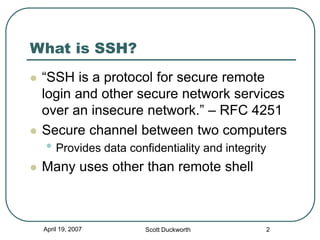
What is SSH?
 “SSH is a protocol for secure remote
login and other secure network services
over an insecure network.” – RFC 4251
 Secure channel between two computers
• Provides data confidentiality and integrity
 Many uses other than remote shell
April 19, 2007 Scott Duckworth 3
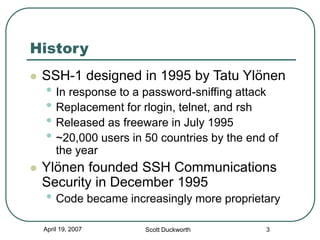
History
 SSH-1 designed in 1995 by Tatu Ylönen
• In response to a password-sniffing attack
• Replacement for rlogin, telnet, and rsh
• Released as freeware in July 1995
• ~20,000 users in 50 countries by the end of
the year
 Ylönen founded SSH Communications
Security in December 1995
• Code became increasingly more proprietary
April 19, 2007 Scott Duckworth 4
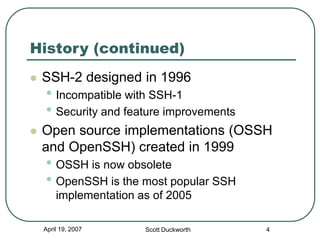
History (continued)
 SSH-2 designed in 1996
• Incompatible with SSH-1
• Security and feature improvements
 Open source implementations (OSSH
and OpenSSH) created in 1999
• OSSH is now obsolete
• OpenSSH is the most popular SSH
implementation as of 2005
April 19, 2007 Scott Duckworth 5
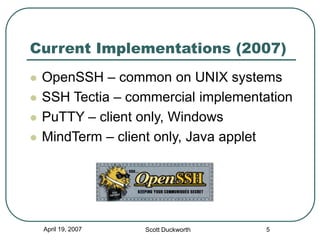
Current Implementations (2007)
 OpenSSH – common on UNIX systems
 SSH Tectia – commercial implementation
 PuTTY – client only, Windows
 MindTerm – client only, Java applet
April 19, 2007 Scott Duckworth 6
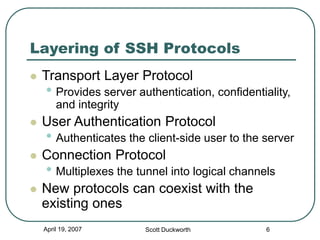
Layering of SSH Protocols
 Transport Layer Protocol
• Provides server authentication, confidentiality,
and integrity
 User Authentication Protocol
• Authenticates the client-side user to the server
 Connection Protocol
• Multiplexes the tunnel into logical channels
 New protocols can coexist with the
existing ones
April 19, 2007 Scott Duckworth 7
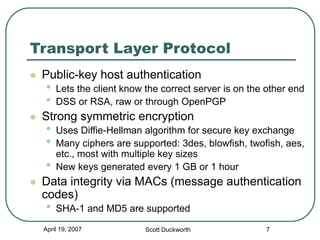
Transport Layer Protocol
 Public-key host authentication
• Lets the client know the correct server is on the other end
• DSS or RSA, raw or through OpenPGP
 Strong symmetric encryption
• Uses Diffie-Hellman algorithm for secure key exchange
• Many ciphers are supported: 3des, blowfish, twofish, aes,
etc., most with multiple key sizes
• New keys generated every 1 GB or 1 hour
 Data integrity via MACs (message authentication
codes)
• SHA-1 and MD5 are supported
April 19, 2007 Scott Duckworth 8
User Authentication Protocol
 Multiple authentication methods
• public-key, password, host-based
• Extensible
 Server tells client which methods can be
used, client picks the most convenient
 Provides a single authenticated channel
to the connection protocol
April 19, 2007 Scott Duckworth 9
Connection Protocol
 Provides multiple channels:
• interactive login sessions
• remote execution of commands
• forwarded X11 connections
• forwarded TCP/IP connections
 All channels are multiplexed into a single
encryption tunnel
April 19, 2007 Scott Duckworth 10
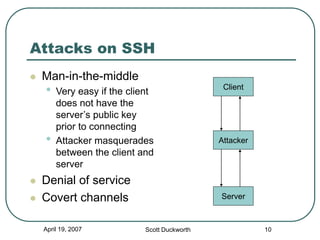
Attacks on SSH
 Man-in-the-middle
• Very easy if the client
does not have the
server’s public key
prior to connecting
• Attacker masquerades
between the client and
server
 Denial of service
 Covert channels Server
Attacker
Client
April 19, 2007 Scott Duckworth 11
System Configuration Files
(OpenSSH)
 /etc/ssh/
• sshd_config – SSH server configuration
• ssh_config – SSH client configuration
• ssh_host_*_key – private host keys
• ssh_host_*_key.pub – public host keys
• ssh_known_hosts – list of known public host
keys
April 19, 2007 Scott Duckworth 12
User Configuration Files
(OpenSSH)
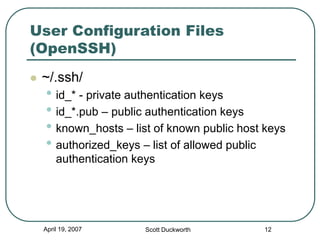
 ~/.ssh/
• id_* - private authentication keys
• id_*.pub – public authentication keys
• known_hosts – list of known public host keys
• authorized_keys – list of allowed public
authentication keys
April 19, 2007 Scott Duckworth 13
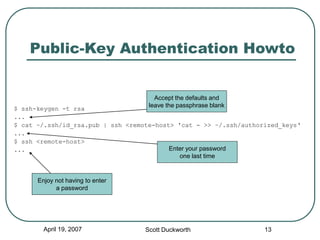
Public-Key Authentication Howto
$ ssh-keygen -t rsa
...
$ cat ~/.ssh/id_rsa.pub | ssh <remote-host> 'cat - >> ~/.ssh/authorized_keys‘
...
$ ssh <remote-host>
...
Accept the defaults and
leave the passphrase blank
Enter your password
one last time
Enjoy not having to enter
a password
April 19, 2007 Scott Duckworth 14
References and Resources
 RFC 4250-4254
 SSH: The Secure Shell – The Definitive
Guide
• http://www.snailbook.com/index.html
 http://en.wikipedia.org/wiki/Secure_Shell
 http://www.cs.clemson.edu/~duckwos/ssh_lab/

ssh.ppt

  • 1.
    Secure Shell (SSH) PresentedBy Scott Duckworth April 19, 2007
  • 2.
    April 19, 2007Scott Duckworth 2 What is SSH?  “SSH is a protocol for secure remote login and other secure network services over an insecure network.” – RFC 4251  Secure channel between two computers • Provides data confidentiality and integrity  Many uses other than remote shell
  • 3.
    April 19, 2007Scott Duckworth 3 History  SSH-1 designed in 1995 by Tatu Ylönen • In response to a password-sniffing attack • Replacement for rlogin, telnet, and rsh • Released as freeware in July 1995 • ~20,000 users in 50 countries by the end of the year  Ylönen founded SSH Communications Security in December 1995 • Code became increasingly more proprietary
  • 4.
    April 19, 2007Scott Duckworth 4 History (continued)  SSH-2 designed in 1996 • Incompatible with SSH-1 • Security and feature improvements  Open source implementations (OSSH and OpenSSH) created in 1999 • OSSH is now obsolete • OpenSSH is the most popular SSH implementation as of 2005
  • 5.
    April 19, 2007Scott Duckworth 5 Current Implementations (2007)  OpenSSH – common on UNIX systems  SSH Tectia – commercial implementation  PuTTY – client only, Windows  MindTerm – client only, Java applet
  • 6.
    April 19, 2007Scott Duckworth 6 Layering of SSH Protocols  Transport Layer Protocol • Provides server authentication, confidentiality, and integrity  User Authentication Protocol • Authenticates the client-side user to the server  Connection Protocol • Multiplexes the tunnel into logical channels  New protocols can coexist with the existing ones
  • 7.
    April 19, 2007Scott Duckworth 7 Transport Layer Protocol  Public-key host authentication • Lets the client know the correct server is on the other end • DSS or RSA, raw or through OpenPGP  Strong symmetric encryption • Uses Diffie-Hellman algorithm for secure key exchange • Many ciphers are supported: 3des, blowfish, twofish, aes, etc., most with multiple key sizes • New keys generated every 1 GB or 1 hour  Data integrity via MACs (message authentication codes) • SHA-1 and MD5 are supported
  • 8.
    April 19, 2007Scott Duckworth 8 User Authentication Protocol  Multiple authentication methods • public-key, password, host-based • Extensible  Server tells client which methods can be used, client picks the most convenient  Provides a single authenticated channel to the connection protocol
  • 9.
    April 19, 2007Scott Duckworth 9 Connection Protocol  Provides multiple channels: • interactive login sessions • remote execution of commands • forwarded X11 connections • forwarded TCP/IP connections  All channels are multiplexed into a single encryption tunnel
  • 10.
    April 19, 2007Scott Duckworth 10 Attacks on SSH  Man-in-the-middle • Very easy if the client does not have the server’s public key prior to connecting • Attacker masquerades between the client and server  Denial of service  Covert channels Server Attacker Client
  • 11.
    April 19, 2007Scott Duckworth 11 System Configuration Files (OpenSSH)  /etc/ssh/ • sshd_config – SSH server configuration • ssh_config – SSH client configuration • ssh_host_*_key – private host keys • ssh_host_*_key.pub – public host keys • ssh_known_hosts – list of known public host keys
  • 12.
    April 19, 2007Scott Duckworth 12 User Configuration Files (OpenSSH)  ~/.ssh/ • id_* - private authentication keys • id_*.pub – public authentication keys • known_hosts – list of known public host keys • authorized_keys – list of allowed public authentication keys
  • 13.
    April 19, 2007Scott Duckworth 13 Public-Key Authentication Howto $ ssh-keygen -t rsa ... $ cat ~/.ssh/id_rsa.pub | ssh <remote-host> 'cat - >> ~/.ssh/authorized_keys‘ ... $ ssh <remote-host> ... Accept the defaults and leave the passphrase blank Enter your password one last time Enjoy not having to enter a password
  • 14.
    April 19, 2007Scott Duckworth 14 References and Resources  RFC 4250-4254  SSH: The Secure Shell – The Definitive Guide • http://www.snailbook.com/index.html  http://en.wikipedia.org/wiki/Secure_Shell  http://www.cs.clemson.edu/~duckwos/ssh_lab/