POST TRAUMATIC SEIZURES
(PTS)
Dhaval Shukla
Assoc. Prof. of Neurosurgery
NIMHANS, Bangalore
Glossary
Happen at or minutes after impact
• “Immediate,” “Contact,” or “Concussive” seizures (IPTS)
Seizures those occurring while the patient is still suffering from the direct effects of
the injury” (< 1 week)
• Early (EPTS), Acute Symptomatic
Seizures > 1 week
• Late (LPTS), Remote Symptomatic
Two or more unprovoked seizures after 1 week
• Post traumatic Epilepsy (PTE)
Episodic behavioral events that superficially resemble epileptic attacks
• Nonepileptic Seizures (NES)
Teasell. ABIEBR 2012.
Neurotrauma 2012, Kochi
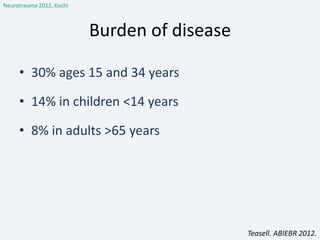
Burden of disease
• 30% ages 15 and 34 years
• 14% in children <14 years
• 8% in adults >65 years
Teasell. ABIEBR 2012.
Neurotrauma 2012, Kochi
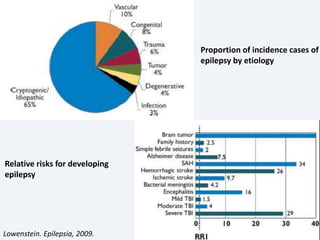
Proportion of incidence cases of
epilepsy by etiology
Relative risks for developing
epilepsy
Lowenstein. Epilepsia, 2009.
Burden of disease
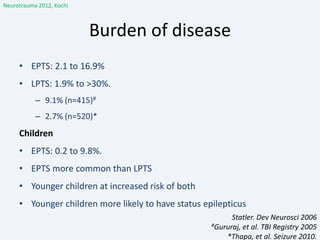
• EPTS: 2.1 to 16.9%
• LPTS: 1.9% to >30%.
– 9.1% (n=415)#
– 2.7% (n=520)*
Children
• EPTS: 0.2 to 9.8%.
• EPTS more common than LPTS
• Younger children at increased risk of both
• Younger children more likely to have status epilepticus
Statler. Dev Neurosci 2006
#Gururaj, et al. TBI Registry 2005
*Thapa, et al. Seizure 2010.
Neurotrauma 2012, Kochi
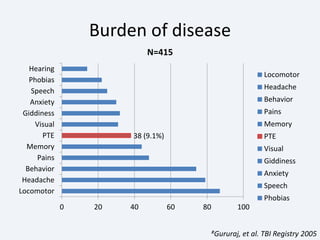
Burden of disease
38 (9.1%)
0 20 40 60 80 100
Locomotor
Headache
Behavior
Pains
Memory
PTE
Visual
Giddiness
Anxiety
Speech
Phobias
Hearing
N=415
Locomotor
Headache
Behavior
Pains
Memory
PTE
Visual
Giddiness
Anxiety
Speech
Phobias
#Gururaj, et al. TBI Registry 2005
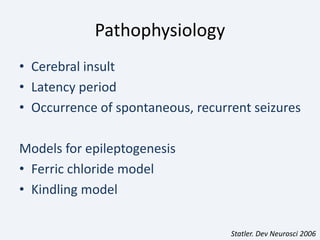
Pathophysiology
• Cerebral insult
• Latency period
• Occurrence of spontaneous, recurrent seizures
Models for epileptogenesis
• Ferric chloride model
• Kindling model
Statler. Dev Neurosci 2006
Pathophysiology
Multi-factorial
• Involves changes in excitatory and inhibitory
networks
• Altered calcium-mediated second messenger
activity
• Changes in ionotropic receptor function and
composition
• Altered endogenous neuroprotectant activity
• TBI-induced cortical dysplasia
Statler, Dev Neurosci 2006
Pathophysiology
Therapeutic relevence
Kindling
• Application of brief trains of weak electrical
stimulation over brain until a seizure is observed
• Over a prolonged period of time spontaneous
seizures eventually appear
• Agents that retard or abort the kindling process are
considered antiepileptogenic
• Agents that suppress or block seizures in fully
“kindled” brain are anticonvulsant
Yablon. TB Brain Injury 2007.
Pathophysiology
Therapeutic relevence
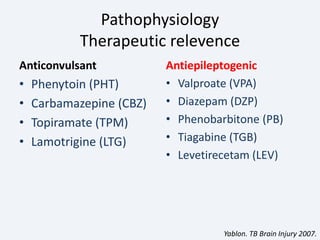
Anticonvulsant
• Phenytoin (PHT)
• Carbamazepine (CBZ)
• Topiramate (TPM)
• Lamotrigine (LTG)
Antiepileptogenic
• Valproate (VPA)
• Diazepam (DZP)
• Phenobarbitone (PB)
• Tiagabine (TGB)
• Levetirecetam (LEV)
Yablon. TB Brain Injury 2007.
Risk of EPTS
• GCS <10
• Contusion
• Depressed fracture
• SDH
• EDH
• ICH
• Penetrating injury
• Seizure <24 h of injury
Bullock, et al. J Neurotrauma 2007.
Neurotrauma 2012, Kochi
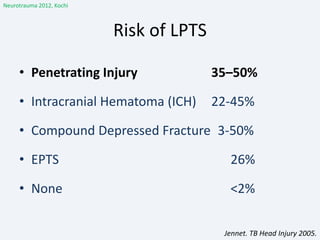
Risk of LPTS
• Penetrating Injury 35–50%
• Intracranial Hematoma (ICH) 22-45%
• Compound Depressed Fracture 3-50%
• EPTS 26%
• None <2%
Jennet. TB Head Injury 2005.
Neurotrauma 2012, Kochi
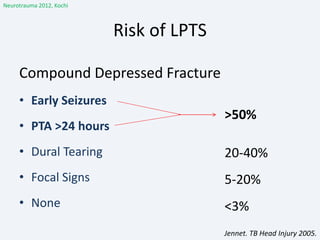
Risk of LPTS
Compound Depressed Fracture
• Early Seizures
• PTA >24 hours
• Dural Tearing
• Focal Signs
• None
Jennet. TB Head Injury 2005.
Neurotrauma 2012, Kochi
>50%
20-40%
5-20%
<3%
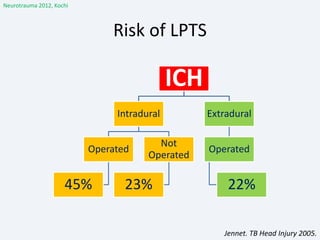
Risk of LPTS
Jennet. TB Head Injury 2005.
Neurotrauma 2012, Kochi
ICH
Intradural
Operated
45%
Not
Operated
23%
Extradural
Operated
22%
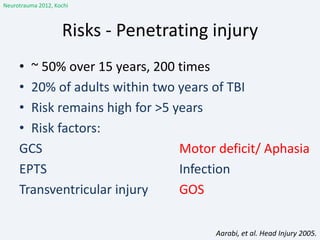
Risks - Penetrating injury
• ~ 50% over 15 years, 200 times
• 20% of adults within two years of TBI
• Risk remains high for >5 years
• Risk factors:
GCS Motor deficit/ Aphasia
EPTS Infection
Transventricular injury GOS
Aarabi, et al. Head Injury 2005.
Neurotrauma 2012, Kochi
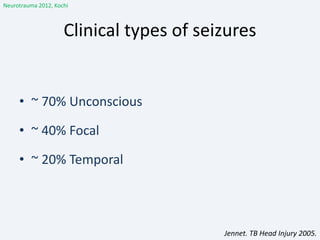
Clinical types of seizures
• ~ 70% Unconscious
• ~ 40% Focal
• ~ 20% Temporal
Jennet. TB Head Injury 2005.
Neurotrauma 2012, Kochi
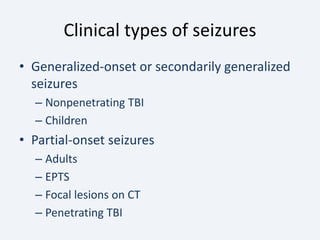
Clinical types of seizures
• Generalized-onset or secondarily generalized
seizures
– Nonpenetrating TBI
– Children
• Partial-onset seizures
– Adults
– EPTS
– Focal lesions on CT
– Penetrating TBI
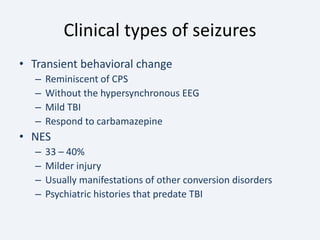
Clinical types of seizures
• Transient behavioral change
– Reminiscent of CPS
– Without the hypersynchronous EEG
– Mild TBI
– Respond to carbamazepine
• NES
– 33 – 40%
– Milder injury
– Usually manifestations of other conversion disorders
– Psychiatric histories that predate TBI
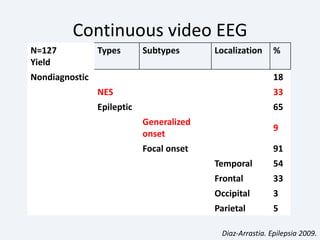
Continuous video EEG
N=127
Yield
Types Subtypes Localization %
Nondiagnostic 18
NES 33
Epileptic 65
Generalized
onset
9
Focal onset 91
Temporal 54
Frontal 33
Occipital 3
Parietal 5
Diaz-Arrastia. Epilepsia 2009.
Natural history - EPTS
• Only 50% patients have a recurrence
• 25% only 2-3 seizures
Seizure precipitants
• Sepsis
• Hypoxia/ Hypocarbia
• Metabolic abnormalities
– Hypoglycemia
– Hyponatremia
• Hemorrhage
• Antibiotics: Imipenem and Quinolones
• 60% have precipitants Teasell. ABIEBR 2012.
Yablon. TB Brain Injury 2007.
Natural history - LPTS
• 20% of people who have a single LPTS never
have any further seizures
• 50-66% have seizure onset within first 1 year
• 75-80% have seizures by the end of 2nd year
• About half the patients who develop LPTS
have 3 or fewer seizures and go into
spontaneous remission thereafter
Teasell. ABIEBR 2012.
Neurotrauma 2012, Kochi
Natural history - LPTS
• Remission over 3 years
– 35% became seizure-free
– 21% had > 1 seizure per week
• After 5 years
– mild TBI no longer increased risk
– moderate or severe TBI or penetrating TBI remain
at increased risk
Teasell. ABIEBR 2012.
Neurotrauma 2012, Kochi
Natural history - LPTS
Increased risk of recurrence/ persistence
• Partial seizures
• Seizure frequency within the first year
• Combined seizure patterns
• AED noncompliance
• Alcohol abuse
• Seizures began later after injury
Neurotrauma 2012, Kochi
Teasell. ABIEBR 2012.
Complications - EPTS
Secondary brain damage
• Increased metabolic demands
• Increased intracranial pressure
• Excessive neurotransmitter release
• Impairment of neurologic recovery
Teasell. ABIEBR 2012.
Complications - LPTS
Cognitive and behavioral function
• Persistent behavioral abnormalities
– Disinhibited behavior
– Irritability
– Aggressive behavior
– Higher incidence of psychiatric-related hospitalizations
Functional status
• Penetrating TBI: affects employment and cognitive
performance
• Nonpenetrating TBI: not significant
Status Epilepticus
• Infrequent
Teasell. ABIEBR 2012.
Complications -LPTS
Mortality
• Mortality rates with epilepsy of any cause are 2-5
times
• N=508, 71 with LPTS, 8–15 years post-injury
• 27% as compared to 10% of non-LPTS patients
• LPTS died at a younger age (54.1 versus 67.7 years)
• Males and patient with SDH more likely to die
• No significant difference in time from injury to death
• Causes variable and not specifically related to epilepsy
• Only one death attributable to seizures
Teasell. ABIEBR 2012.
Englander, et al. J Neurotrauma 2009.
Treatment and prophylaxis - EPTS
• Midazolam/ Lorazepam for acute seizure cessation
• Phenytoin 15 – 20 mg/ kg
– 4-7mg/ day for 7 days
• AED given during the first 24 hours reduce the
occurrence of early seizures significantly
• N=890
• AED reduce RR to 0.34 (95% CI 0.21, 0.54)
• NNT to keep 1patient seizure-free in acute phase -10
• AED do not reduce death and disability
Schierhout, et al. Cochrane Database, 2001
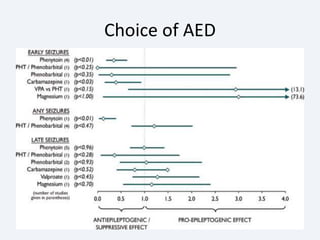
Choice of AED
Choice of AED
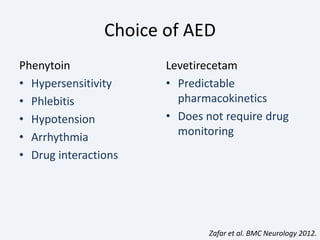
Phenytoin
• Hypersensitivity
• Phlebitis
• Hypotension
• Arrhythmia
• Drug interactions
Levetirecetam
• Predictable
pharmacokinetics
• Does not require drug
monitoring
Zafar et al. BMC Neurology 2012.
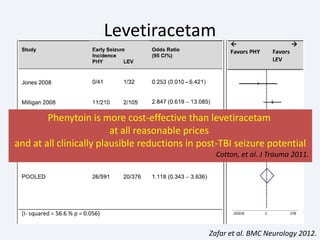
Levetiracetam
Zafar et al. BMC Neurology 2012.
Phenytoin is more cost-effective than levetiracetam
at all reasonable prices
and at all clinically plausible reductions in post-TBI seizure potential
Cotton, et al. J Trauma 2011.
Treatment and prophylaxis - LPTS
• No AED is effective in preventing LPTS
• Standard AEDs are effective for treatment
• Choice of AED
– Cognitive effects
• Treatment guidelines similar to any other
epileptic patients
Yablon. TB Brain Injury 2007.
Treatment LPTS
Focal epilepsy
• CBZ extended release/ OXC/ PHT/LTG
Generalized epilepsy
• VPA/ PHT/ OXC/ LTG
• Duration – 2 years
• AED substitution
• Failure of seizure control
• Adverse drug reaction
• Cognitive decline
Yablon. TB Brain Injury 2007.
Prophylaxis in adults
Recommendation
Level II
• Prophylactic use of phenytoin or valproate is
not recommended for preventing LPTS
• Anticonvulsants are indicated to decrease the
incidence of EPTS (within 7 days of injury)
• EPTS is not associated with worse outcomes.
Prophylaxis in Children
• Phenytoin vs placebo
• N=41 and N=102
• No significant differences in incidence of EPTS
(phenytoin = 7% vs. placebo = 5%)
• Ineffective in reducing incidence of LPTS
• Phenytoin does not reduce EPTS or LPTS in
children
Young et al. 2004
Young et al. 1983
Prophylaxis in Children
• N=275, risk of EPTS
• Severe TBI: 8.7 times
• Non-accidental injury: 3.4 times
• Age <2 years: 3 times
• AED: 0.2 times
Liesemer, et al. J Neurotrauma 2011
Prophylaxis in Children
Recommendation
Level III
• Prophylactic treatment with phenytoin may be
considered to reduce the incidence of EPTS in
pediatric patients with severe TBI
Level II
• Prophylactic use of antiseizure therapy is not
recommended for children with severe TBI for
preventing LPTS
Kochanek, et al. Pediatr Crit Care Med 2012
Surgical treatment
Challenges
• Accurate localization
• Multiple and bilateral sites
• N=25
• Successfully localized in 9 patients
– Hippocampus or neocortex
• All underwent surgical excision
• All seizure free 1-year post surgery
Marks, et al.1995
Issues in treatment
• Continuation of AED in EPTS
• Alcohol related seizures
• Cognitive side effects
• Drug interaction
• Adverse effects
• Continuous EEG monitoring
Continuation of AED in EPTS
• Onset (day 1 versus day 7)
• Severity
• Frequency
• Risk factors
• Monitored withdrawal of AED therapy
Most patients with nonpenetrating TBI and isolated
EPTS will tolerate discontinuation of AED therapy
without seizure recurrence
Alcohol related
• 6-48 hours of withdrawal
• Lorazepam prevents recurrent seizures
• Phenytoin is ineffective in prevention
Gaughwin, et al. Head Injury 2005.
Neurotrauma 2012, Kochi
AED and cognition
• N=244, Phenytoin
• Severely injured impaired neuropsychological
performance at 1 month
• Moderately injured no significant differences
• Patients who stopped receiving phenytoin
between 1 and 2 years improved more
Dikmen et al. 1991
AED and cognition
• N = 82, Phenytoin or Carbamazepine
• Significant improvement in performance
following cessation of AED
LTG extended release 300mg monotherapy
useful for substitution
Smith. et al. 1994
AED and other adverse effects
• A trend towards an increased risk of skin
rashes
• Inappropriate dose related
– Giddiness and ataxia
Schierhout & Roberts, 2001
PTS and other drugs interaction
• Early steroids may increase PTS
• Antidepressant
– Tricyclic antidepressants: 19% developed seizures
– Sustained-release formulations of buproprion
– SSRIs lower proconvulsant activity
• Antipsychotics including clozapine
• Bromocriptine and amantadine, dopamine
receptor agonists - anecdotal
• Amphetamine,methylphenidate and
dextroamphetamine do not increase risk of PTS
Dikmen et al. 1991
Continuous EEG monitoring
• Should be monitored for 7 days
• Upto 50% are non-convulsive
• Help in titration of AED
• Detection of rebound seizures
• No correlation with clinical seizures
• Long term benefits of suppression of EPTS is
not known
Vespa. Epilepsy and Intensive Care Monitoring 2010.
Future Investigation
Neurotrauma 2012, Kochi
• Additional studies to determine if reduction in
early PTS has an effect on outcome.
• Continuous EEG monitoring to identify
seizures
• PTS in patients treated with neuroprotective
agents that have antiepileptic activity, such as
magnesium and other NMDA receptor
antagonists
Post traumatic seizure and epilepsy

Post traumatic seizure and epilepsy

  • 1.
    POST TRAUMATIC SEIZURES (PTS) DhavalShukla Assoc. Prof. of Neurosurgery NIMHANS, Bangalore
  • 2.
    Glossary Happen at orminutes after impact • “Immediate,” “Contact,” or “Concussive” seizures (IPTS) Seizures those occurring while the patient is still suffering from the direct effects of the injury” (< 1 week) • Early (EPTS), Acute Symptomatic Seizures > 1 week • Late (LPTS), Remote Symptomatic Two or more unprovoked seizures after 1 week • Post traumatic Epilepsy (PTE) Episodic behavioral events that superficially resemble epileptic attacks • Nonepileptic Seizures (NES) Teasell. ABIEBR 2012. Neurotrauma 2012, Kochi
  • 3.
    Burden of disease •30% ages 15 and 34 years • 14% in children <14 years • 8% in adults >65 years Teasell. ABIEBR 2012. Neurotrauma 2012, Kochi
  • 4.
    Proportion of incidencecases of epilepsy by etiology Relative risks for developing epilepsy Lowenstein. Epilepsia, 2009.
  • 5.
    Burden of disease •EPTS: 2.1 to 16.9% • LPTS: 1.9% to >30%. – 9.1% (n=415)# – 2.7% (n=520)* Children • EPTS: 0.2 to 9.8%. • EPTS more common than LPTS • Younger children at increased risk of both • Younger children more likely to have status epilepticus Statler. Dev Neurosci 2006 #Gururaj, et al. TBI Registry 2005 *Thapa, et al. Seizure 2010. Neurotrauma 2012, Kochi
  • 6.
    Burden of disease 38(9.1%) 0 20 40 60 80 100 Locomotor Headache Behavior Pains Memory PTE Visual Giddiness Anxiety Speech Phobias Hearing N=415 Locomotor Headache Behavior Pains Memory PTE Visual Giddiness Anxiety Speech Phobias #Gururaj, et al. TBI Registry 2005
  • 7.
    Pathophysiology • Cerebral insult •Latency period • Occurrence of spontaneous, recurrent seizures Models for epileptogenesis • Ferric chloride model • Kindling model Statler. Dev Neurosci 2006
  • 8.
    Pathophysiology Multi-factorial • Involves changesin excitatory and inhibitory networks • Altered calcium-mediated second messenger activity • Changes in ionotropic receptor function and composition • Altered endogenous neuroprotectant activity • TBI-induced cortical dysplasia Statler, Dev Neurosci 2006
  • 9.
    Pathophysiology Therapeutic relevence Kindling • Applicationof brief trains of weak electrical stimulation over brain until a seizure is observed • Over a prolonged period of time spontaneous seizures eventually appear • Agents that retard or abort the kindling process are considered antiepileptogenic • Agents that suppress or block seizures in fully “kindled” brain are anticonvulsant Yablon. TB Brain Injury 2007.
  • 10.
    Pathophysiology Therapeutic relevence Anticonvulsant • Phenytoin(PHT) • Carbamazepine (CBZ) • Topiramate (TPM) • Lamotrigine (LTG) Antiepileptogenic • Valproate (VPA) • Diazepam (DZP) • Phenobarbitone (PB) • Tiagabine (TGB) • Levetirecetam (LEV) Yablon. TB Brain Injury 2007.
  • 11.
    Risk of EPTS •GCS <10 • Contusion • Depressed fracture • SDH • EDH • ICH • Penetrating injury • Seizure <24 h of injury Bullock, et al. J Neurotrauma 2007. Neurotrauma 2012, Kochi
  • 12.
    Risk of LPTS •Penetrating Injury 35–50% • Intracranial Hematoma (ICH) 22-45% • Compound Depressed Fracture 3-50% • EPTS 26% • None <2% Jennet. TB Head Injury 2005. Neurotrauma 2012, Kochi
  • 13.
    Risk of LPTS CompoundDepressed Fracture • Early Seizures • PTA >24 hours • Dural Tearing • Focal Signs • None Jennet. TB Head Injury 2005. Neurotrauma 2012, Kochi >50% 20-40% 5-20% <3%
  • 14.
    Risk of LPTS Jennet.TB Head Injury 2005. Neurotrauma 2012, Kochi ICH Intradural Operated 45% Not Operated 23% Extradural Operated 22%
  • 15.
    Risks - Penetratinginjury • ~ 50% over 15 years, 200 times • 20% of adults within two years of TBI • Risk remains high for >5 years • Risk factors: GCS Motor deficit/ Aphasia EPTS Infection Transventricular injury GOS Aarabi, et al. Head Injury 2005. Neurotrauma 2012, Kochi
  • 16.
    Clinical types ofseizures • ~ 70% Unconscious • ~ 40% Focal • ~ 20% Temporal Jennet. TB Head Injury 2005. Neurotrauma 2012, Kochi
  • 17.
    Clinical types ofseizures • Generalized-onset or secondarily generalized seizures – Nonpenetrating TBI – Children • Partial-onset seizures – Adults – EPTS – Focal lesions on CT – Penetrating TBI
  • 18.
    Clinical types ofseizures • Transient behavioral change – Reminiscent of CPS – Without the hypersynchronous EEG – Mild TBI – Respond to carbamazepine • NES – 33 – 40% – Milder injury – Usually manifestations of other conversion disorders – Psychiatric histories that predate TBI
  • 19.
    Continuous video EEG N=127 Yield TypesSubtypes Localization % Nondiagnostic 18 NES 33 Epileptic 65 Generalized onset 9 Focal onset 91 Temporal 54 Frontal 33 Occipital 3 Parietal 5 Diaz-Arrastia. Epilepsia 2009.
  • 20.
    Natural history -EPTS • Only 50% patients have a recurrence • 25% only 2-3 seizures Seizure precipitants • Sepsis • Hypoxia/ Hypocarbia • Metabolic abnormalities – Hypoglycemia – Hyponatremia • Hemorrhage • Antibiotics: Imipenem and Quinolones • 60% have precipitants Teasell. ABIEBR 2012. Yablon. TB Brain Injury 2007.
  • 21.
    Natural history -LPTS • 20% of people who have a single LPTS never have any further seizures • 50-66% have seizure onset within first 1 year • 75-80% have seizures by the end of 2nd year • About half the patients who develop LPTS have 3 or fewer seizures and go into spontaneous remission thereafter Teasell. ABIEBR 2012. Neurotrauma 2012, Kochi
  • 22.
    Natural history -LPTS • Remission over 3 years – 35% became seizure-free – 21% had > 1 seizure per week • After 5 years – mild TBI no longer increased risk – moderate or severe TBI or penetrating TBI remain at increased risk Teasell. ABIEBR 2012. Neurotrauma 2012, Kochi
  • 23.
    Natural history -LPTS Increased risk of recurrence/ persistence • Partial seizures • Seizure frequency within the first year • Combined seizure patterns • AED noncompliance • Alcohol abuse • Seizures began later after injury Neurotrauma 2012, Kochi Teasell. ABIEBR 2012.
  • 24.
    Complications - EPTS Secondarybrain damage • Increased metabolic demands • Increased intracranial pressure • Excessive neurotransmitter release • Impairment of neurologic recovery Teasell. ABIEBR 2012.
  • 25.
    Complications - LPTS Cognitiveand behavioral function • Persistent behavioral abnormalities – Disinhibited behavior – Irritability – Aggressive behavior – Higher incidence of psychiatric-related hospitalizations Functional status • Penetrating TBI: affects employment and cognitive performance • Nonpenetrating TBI: not significant Status Epilepticus • Infrequent Teasell. ABIEBR 2012.
  • 26.
    Complications -LPTS Mortality • Mortalityrates with epilepsy of any cause are 2-5 times • N=508, 71 with LPTS, 8–15 years post-injury • 27% as compared to 10% of non-LPTS patients • LPTS died at a younger age (54.1 versus 67.7 years) • Males and patient with SDH more likely to die • No significant difference in time from injury to death • Causes variable and not specifically related to epilepsy • Only one death attributable to seizures Teasell. ABIEBR 2012. Englander, et al. J Neurotrauma 2009.
  • 27.
    Treatment and prophylaxis- EPTS • Midazolam/ Lorazepam for acute seizure cessation • Phenytoin 15 – 20 mg/ kg – 4-7mg/ day for 7 days • AED given during the first 24 hours reduce the occurrence of early seizures significantly • N=890 • AED reduce RR to 0.34 (95% CI 0.21, 0.54) • NNT to keep 1patient seizure-free in acute phase -10 • AED do not reduce death and disability Schierhout, et al. Cochrane Database, 2001
  • 28.
  • 29.
    Choice of AED Phenytoin •Hypersensitivity • Phlebitis • Hypotension • Arrhythmia • Drug interactions Levetirecetam • Predictable pharmacokinetics • Does not require drug monitoring Zafar et al. BMC Neurology 2012.
  • 30.
    Levetiracetam Zafar et al.BMC Neurology 2012. Phenytoin is more cost-effective than levetiracetam at all reasonable prices and at all clinically plausible reductions in post-TBI seizure potential Cotton, et al. J Trauma 2011.
  • 31.
    Treatment and prophylaxis- LPTS • No AED is effective in preventing LPTS • Standard AEDs are effective for treatment • Choice of AED – Cognitive effects • Treatment guidelines similar to any other epileptic patients Yablon. TB Brain Injury 2007.
  • 32.
    Treatment LPTS Focal epilepsy •CBZ extended release/ OXC/ PHT/LTG Generalized epilepsy • VPA/ PHT/ OXC/ LTG • Duration – 2 years • AED substitution • Failure of seizure control • Adverse drug reaction • Cognitive decline Yablon. TB Brain Injury 2007.
  • 33.
    Prophylaxis in adults Recommendation LevelII • Prophylactic use of phenytoin or valproate is not recommended for preventing LPTS • Anticonvulsants are indicated to decrease the incidence of EPTS (within 7 days of injury) • EPTS is not associated with worse outcomes.
  • 34.
    Prophylaxis in Children •Phenytoin vs placebo • N=41 and N=102 • No significant differences in incidence of EPTS (phenytoin = 7% vs. placebo = 5%) • Ineffective in reducing incidence of LPTS • Phenytoin does not reduce EPTS or LPTS in children Young et al. 2004 Young et al. 1983
  • 35.
    Prophylaxis in Children •N=275, risk of EPTS • Severe TBI: 8.7 times • Non-accidental injury: 3.4 times • Age <2 years: 3 times • AED: 0.2 times Liesemer, et al. J Neurotrauma 2011
  • 36.
    Prophylaxis in Children Recommendation LevelIII • Prophylactic treatment with phenytoin may be considered to reduce the incidence of EPTS in pediatric patients with severe TBI Level II • Prophylactic use of antiseizure therapy is not recommended for children with severe TBI for preventing LPTS Kochanek, et al. Pediatr Crit Care Med 2012
  • 37.
    Surgical treatment Challenges • Accuratelocalization • Multiple and bilateral sites • N=25 • Successfully localized in 9 patients – Hippocampus or neocortex • All underwent surgical excision • All seizure free 1-year post surgery Marks, et al.1995
  • 38.
    Issues in treatment •Continuation of AED in EPTS • Alcohol related seizures • Cognitive side effects • Drug interaction • Adverse effects • Continuous EEG monitoring
  • 39.
    Continuation of AEDin EPTS • Onset (day 1 versus day 7) • Severity • Frequency • Risk factors • Monitored withdrawal of AED therapy Most patients with nonpenetrating TBI and isolated EPTS will tolerate discontinuation of AED therapy without seizure recurrence
  • 40.
    Alcohol related • 6-48hours of withdrawal • Lorazepam prevents recurrent seizures • Phenytoin is ineffective in prevention Gaughwin, et al. Head Injury 2005. Neurotrauma 2012, Kochi
  • 41.
    AED and cognition •N=244, Phenytoin • Severely injured impaired neuropsychological performance at 1 month • Moderately injured no significant differences • Patients who stopped receiving phenytoin between 1 and 2 years improved more Dikmen et al. 1991
  • 42.
    AED and cognition •N = 82, Phenytoin or Carbamazepine • Significant improvement in performance following cessation of AED LTG extended release 300mg monotherapy useful for substitution Smith. et al. 1994
  • 43.
    AED and otheradverse effects • A trend towards an increased risk of skin rashes • Inappropriate dose related – Giddiness and ataxia Schierhout & Roberts, 2001
  • 44.
    PTS and otherdrugs interaction • Early steroids may increase PTS • Antidepressant – Tricyclic antidepressants: 19% developed seizures – Sustained-release formulations of buproprion – SSRIs lower proconvulsant activity • Antipsychotics including clozapine • Bromocriptine and amantadine, dopamine receptor agonists - anecdotal • Amphetamine,methylphenidate and dextroamphetamine do not increase risk of PTS Dikmen et al. 1991
  • 45.
    Continuous EEG monitoring •Should be monitored for 7 days • Upto 50% are non-convulsive • Help in titration of AED • Detection of rebound seizures • No correlation with clinical seizures • Long term benefits of suppression of EPTS is not known Vespa. Epilepsy and Intensive Care Monitoring 2010.
  • 46.
    Future Investigation Neurotrauma 2012,Kochi • Additional studies to determine if reduction in early PTS has an effect on outcome. • Continuous EEG monitoring to identify seizures • PTS in patients treated with neuroprotective agents that have antiepileptic activity, such as magnesium and other NMDA receptor antagonists

Editor's Notes

  • #2 In ‘The Edwin Smith Surgical Papirus’, Breasted described patients with skull fractures which developed epilepsy, referring to observations made as far back as 3,000 B.C4. During the Reinassance in Italy, Berengarius da Carpi described a patient with a severe wound of the head who developed  seizures 60 days after the injury. But it was not until Duretus (1527-1586) that we have the first clinical description of posttraumatic epilepsy (PTE). In the modern era, William Spratling noted that TBI was the cause of epilepsy in 6.7% of 1,323 patients who had come under his observation5.
  • #3 There is little data to suggest that seizures that occur at day 8 or 14 have recurrence characteristics that justify classification as late seizures, and underlying mechanisms of seizure appearance are more likely to reflect acute pathophysiologic processes rather than those of chronic epilepsy.
  • #27 Mortality rates in individuals with epilepsy of any cause are estimated to be two to five times higher than in the normal population
  • #32 monotherapy in the treatment of partial onset seizures with or without secondary generalisation in patients from 16 years of age with newly diagnosed epilepsy adjunctive therapy for partial onset seizures with or without secondary generalisation in adults, children and infants from 1 month of age with epilepsy adjunctive therapy for myoclonic seizures in adults and adolescents from 12 years of age with Juvenile Myoclonic Epilepsy (JME) adjunctive therapy for the treatment of Primary Generalised Tonic-Clonic (PGTC) seizures in adults and adolescents from 12 years of age with Idiopathic Generalised Epilepsy (IGE). In Europe, Keppra® is also indicated for intravenous administration and is available as 100 mg/mL concentrate for solution for infusion. Keppra® is indicated in the US as: adjunctive therapy in the treatment of partial onset seizures in patients one month of age and older with epilepsy adjunctive therapy in the treatment of myoclonic seizures in patients 12 years of age and older with Juvenile Myoclonic Epilepsy (JME) adjunctive therapy in the treatment of Primary Generalised Tonic-Clonic (PGTC) seizures in patients 6 years of age and older with Idiopathic Generalised Epilepsy (IGE).
  • #41 Lorazepam 24 vs 3%.
  • #47 Extreme hypocarbia