THE SPHERE _ HUMANITARIAN CHARTER AND    MINIMUM STANDARDS IN DISASTER RESPONSE Case: Turkey Sphere Project Zeynep M. Turkmen Sanduvac Bogazici University Disaster Management Center
THE SPHERE _ HUMANITARIAN CHARTER AND    MINIMUM STANDARDS  IN DISASTER RESPONSE Background of Sphere Sphere Project  Sphere and  INEE  Turkey Sphere Project Conclusion  Resources   CONTENT
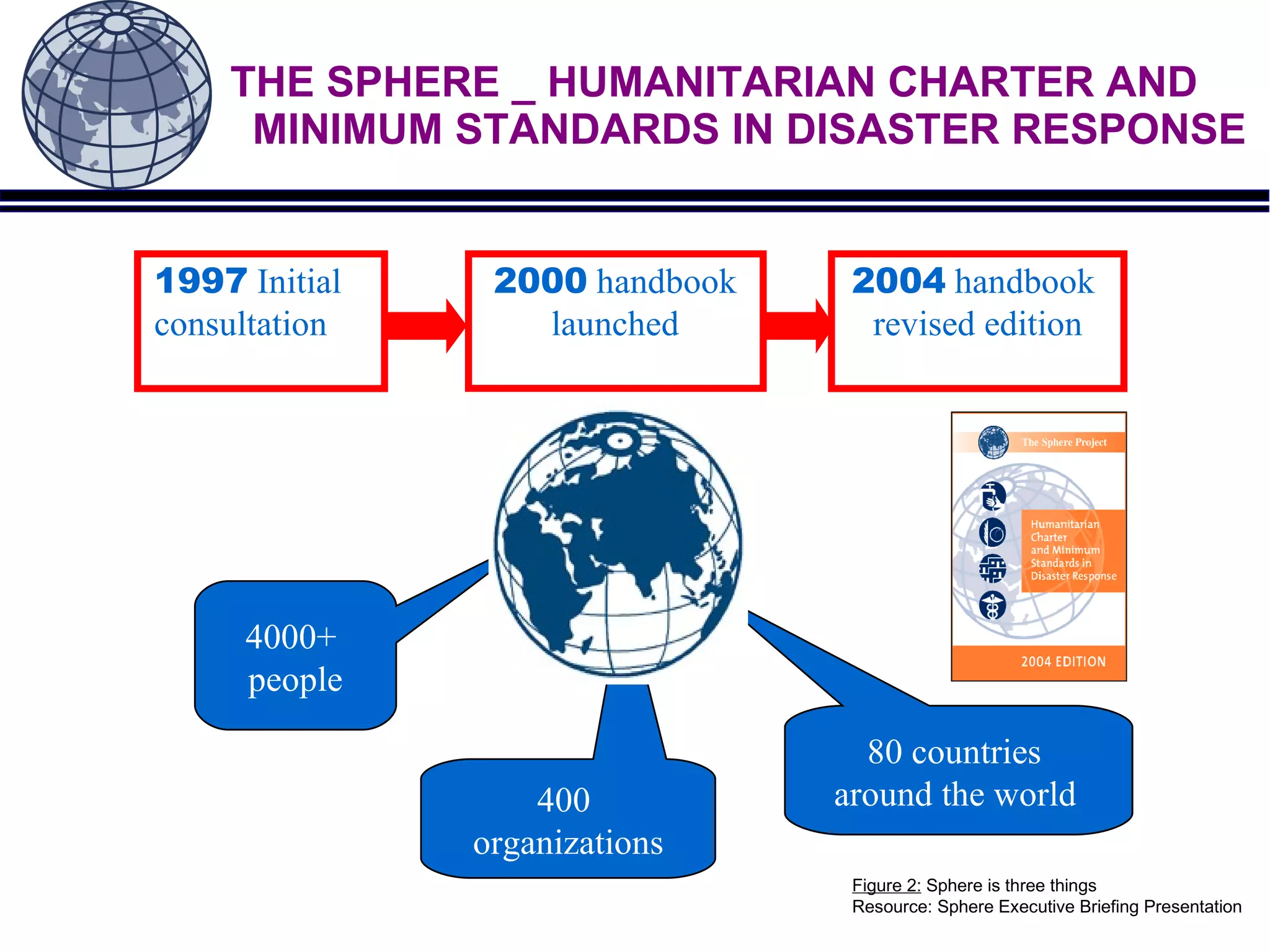
THE SPHERE _ HUMANITARIAN CHARTER AND    MINIMUM STANDARDS IN DISASTER RESPONSE Figure 2:  Sphere is three things Resource: Sphere Executive Briefing Presentation 2000  handbook launched 2004  handbook  revised edition 1997  Initial consultation 4000+  people 80 countries  around the world   400  organizations
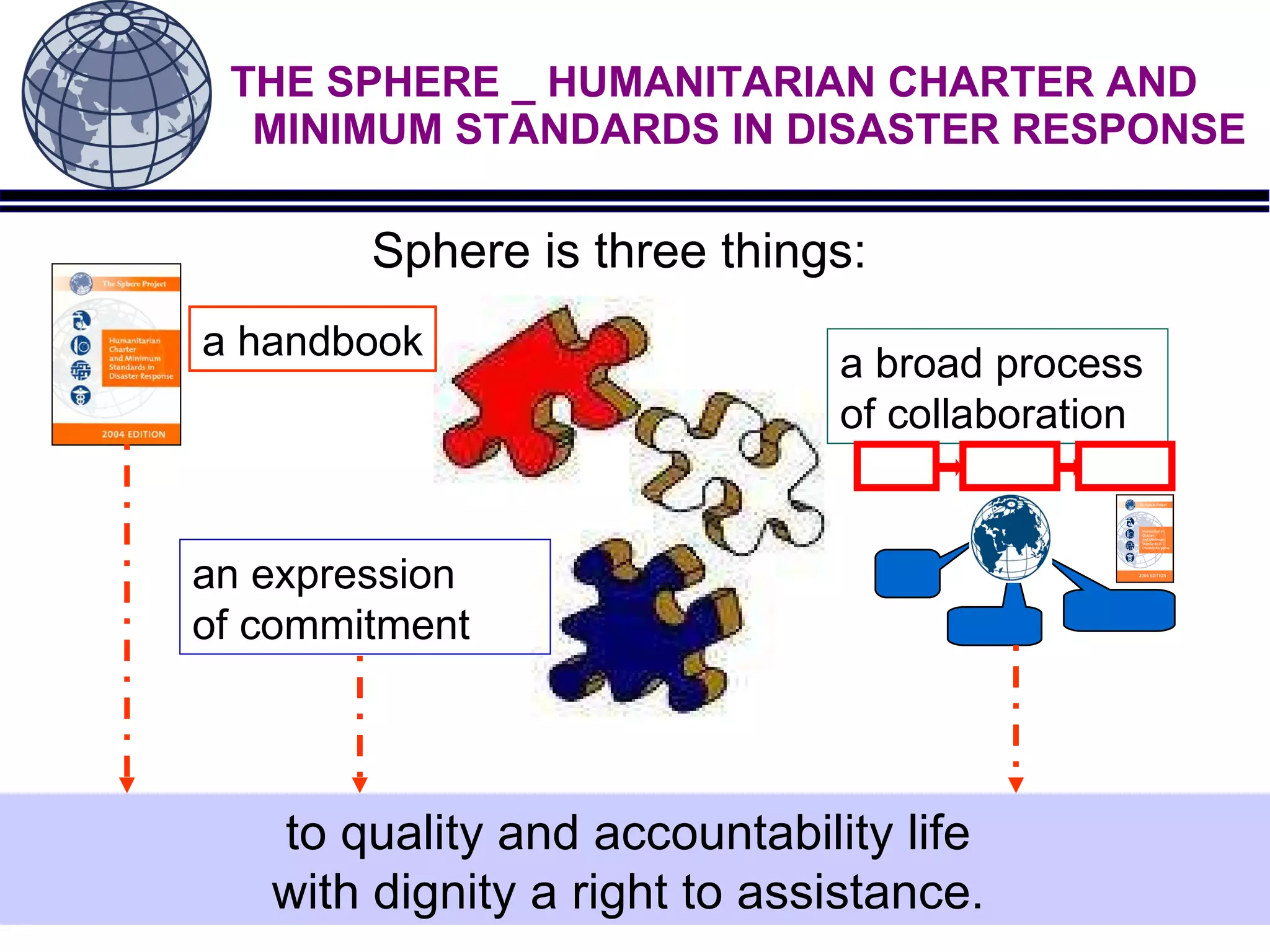
THE SPHERE _ HUMANITARIAN CHARTER AND    MINIMUM STANDARDS IN DISASTER RESPONSE Sphere is three things: a  handbook a broad process  of collaboration  an expression  of commitment  to quality and accountability life  with dignity   a right to assistance. 
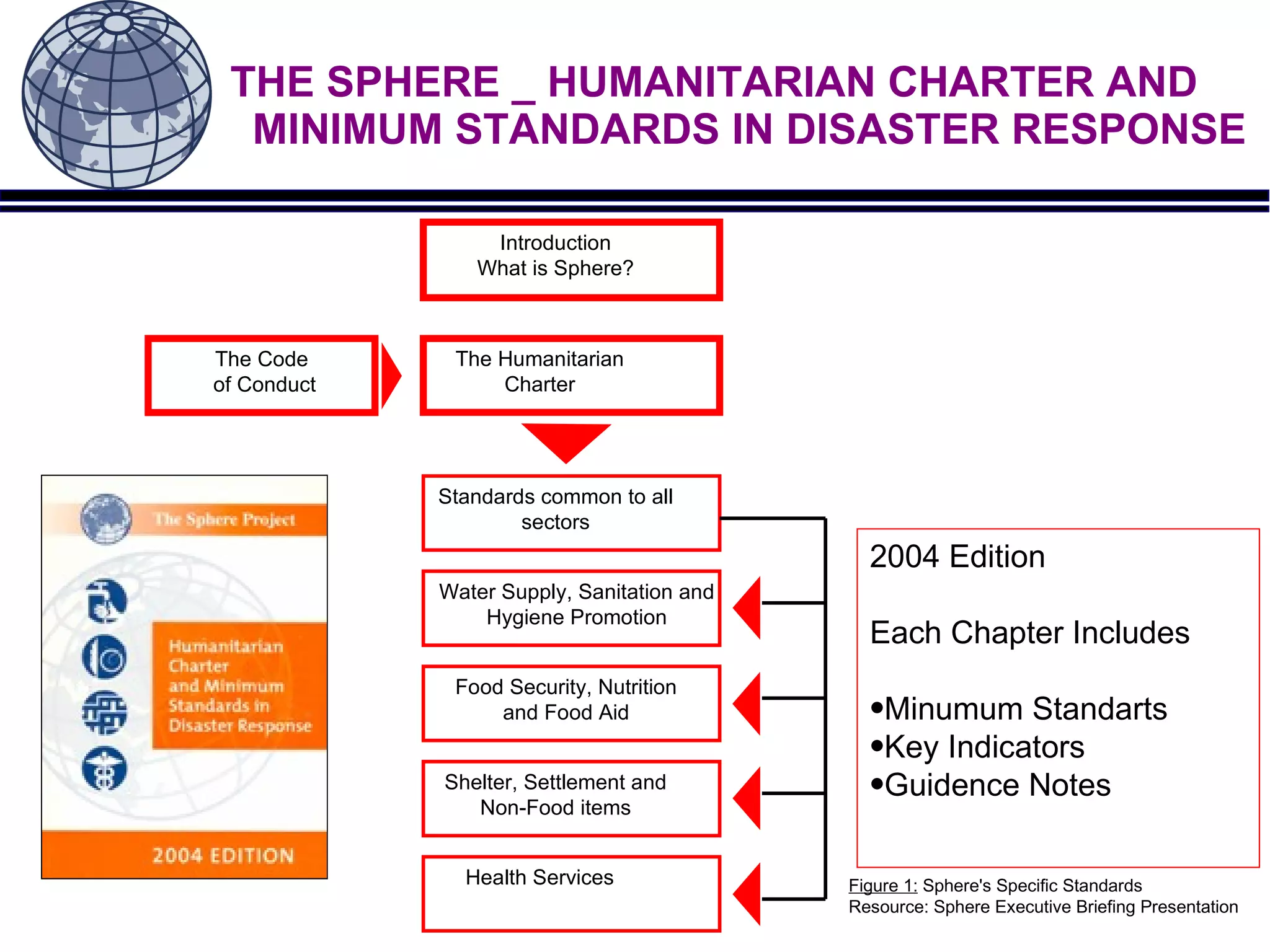
THE SPHERE _ HUMANITARIAN CHARTER AND    MINIMUM STANDARDS IN DISASTER RESPONSE The Code  of Conduct 2004 Edition Each Chapter Includes Minumum Standarts Key Indicators Guidence Notes Figure 1:   Sphere's Specific Standards   Resource: Sphere Executive Briefing Presentation Health Services Food Security, Nutrition and Food Aid Shelter, Settlement and Non-Food items Water Supply, Sanitation and Hygiene Promotion Standards common to all sectors Introduction What is Sphere? The Humanitarian Charter
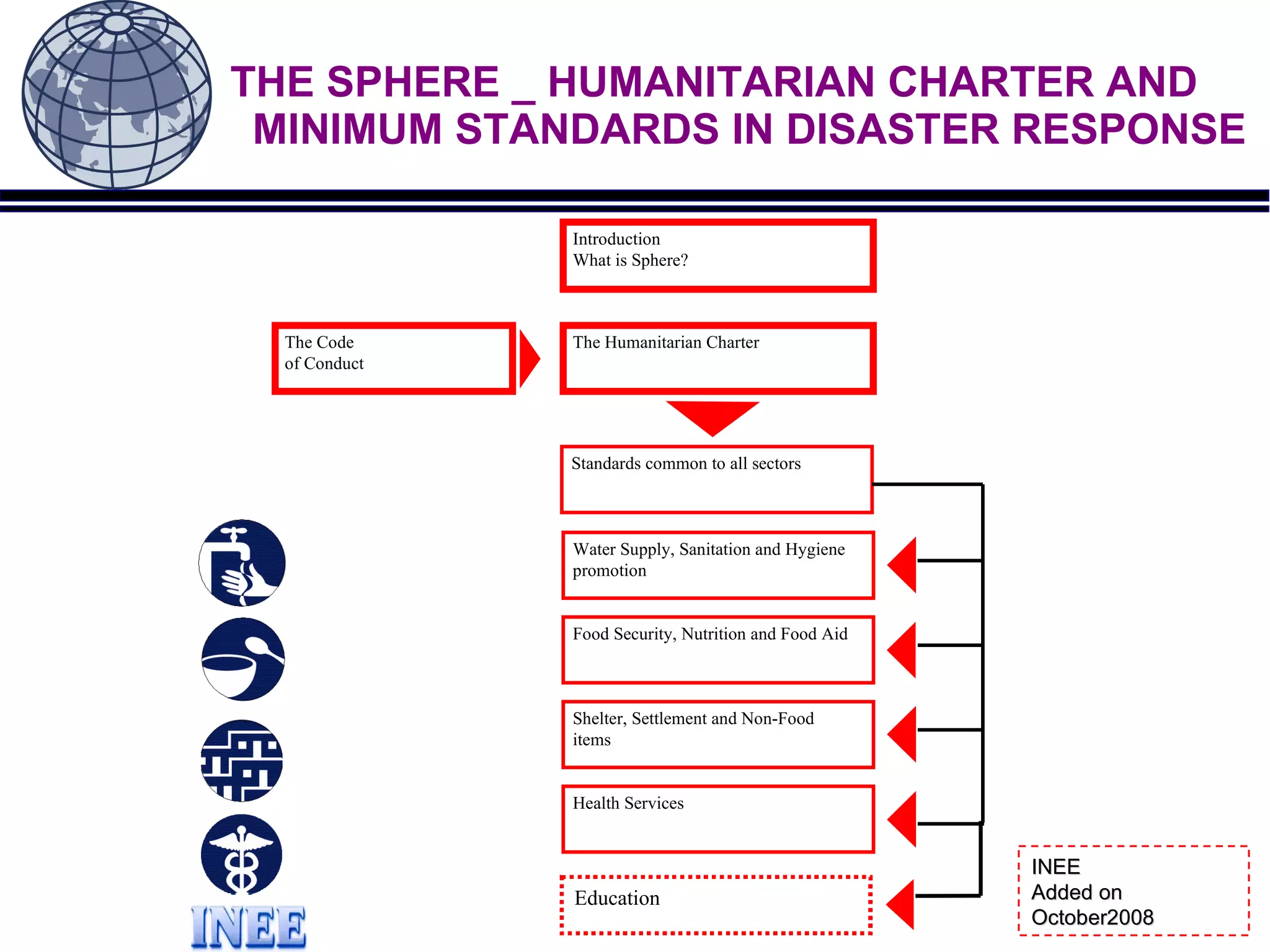
THE SPHERE _ HUMANITARIAN CHARTER AND    MINIMUM STANDARDS IN DISASTER RESPONSE INEE Added on October2008 The Code  of Conduct Introduction What is Sphere? The Humanitarian Charter Standards common to all sectors Water Supply, Sanitation and Hygiene promotion Food Security, Nutrition and Food Aid Shelter, Settlement and Non-Food items Health Services Education
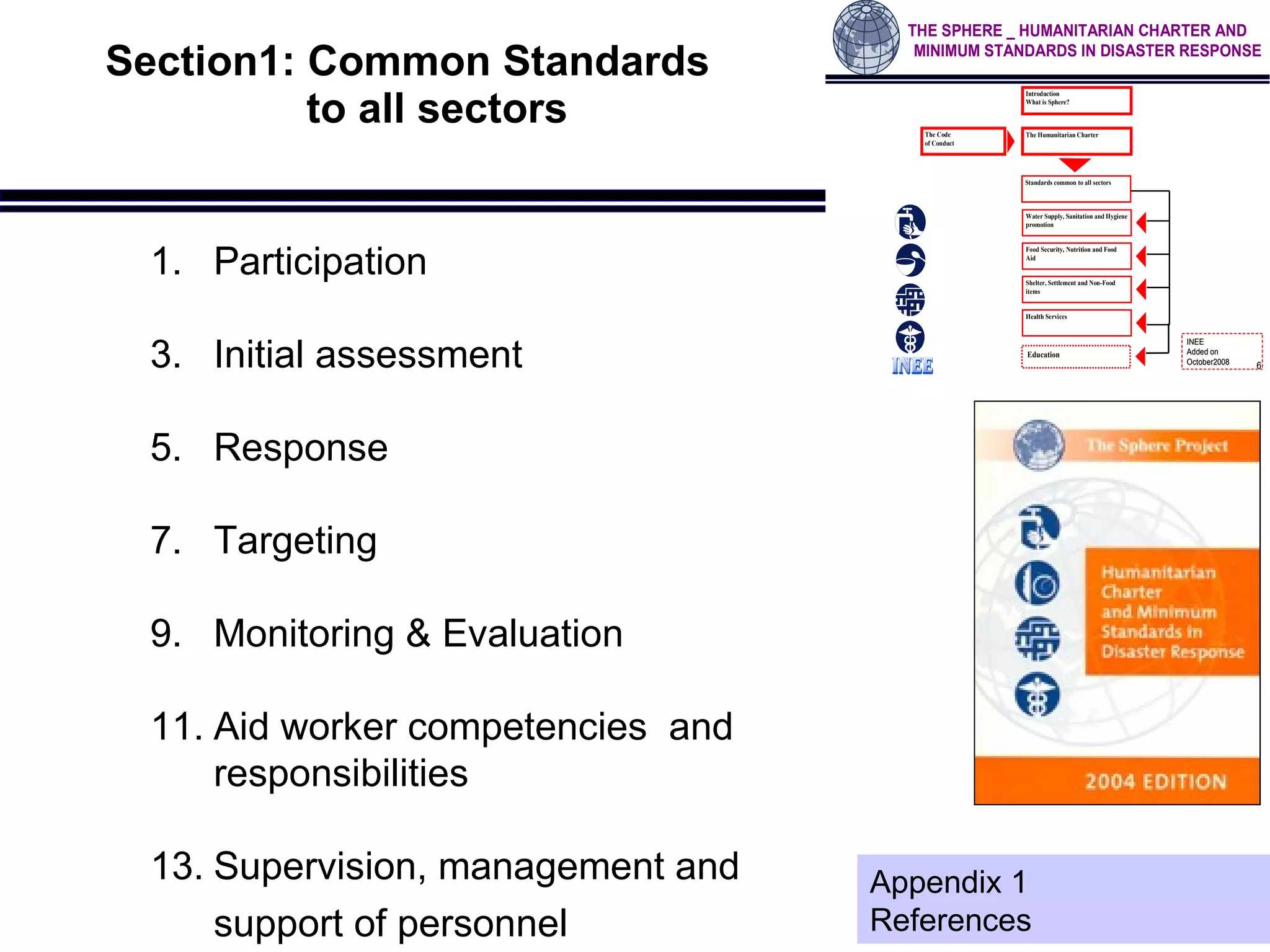
Section1:  Common Standards   to all sectors Participation Initial   assessment Response Targeting Monitoring  &  Evaluation Aid worker   competencies   and  responsibilities Supervision,   management  and  support o f  personnel   Appendix 1 References
Section 2: Water Supply, Sanitation  and Hygiene Promotion
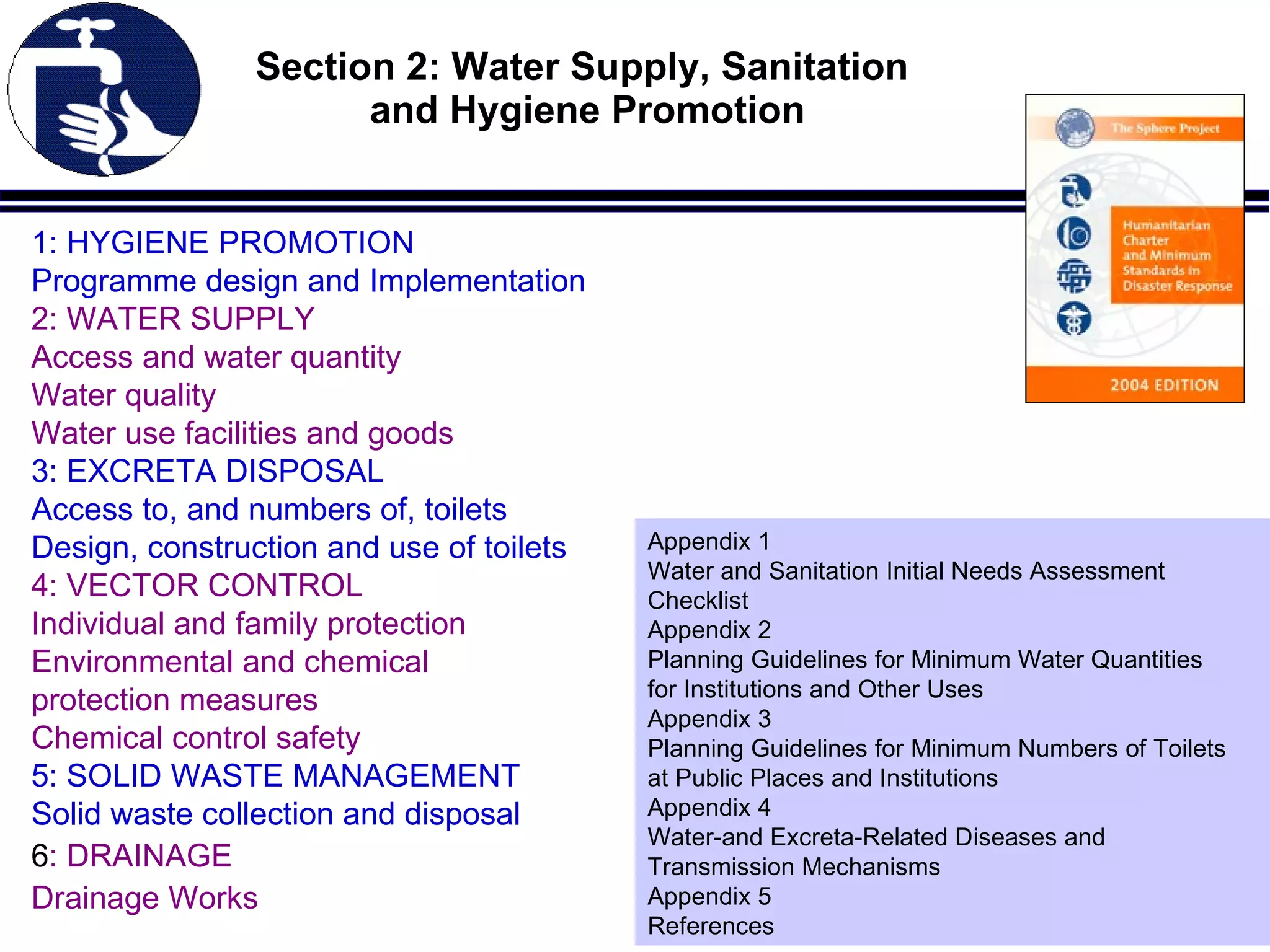
Section 2: Water Supply, Sanitation  and Hygiene Promotion 1: HYGIENE PROMOTION Programme design and Implementation 2: WATER SUPPLY Access and water quantity Water quality  Water use facilities and goods 3: EXCRETA DISPOSAL Access to, and numbers of, toilets Design, construction and use of toilets 4: VECTOR CONTROL Individual and family protection Environmental and chemical  protection measures Chemical control safety 5: SOLID WASTE MANAGEMENT Solid waste collection and disposal 6 : DRAINAGE Drainage Works Appendix 1 Water and Sanitation Initial Needs Assessment Checklist Appendix 2 Planning Guidelines for Minimum Water Quantities for Institutions and Other Uses Appendix 3 Planning Guidelines for Minimum Numbers of Toilets at Public Places and Institutions Appendix 4 Water-and Excreta-Related Diseases and Transmission Mechanisms Appendix 5 References
Section 3: Food Security,  Nutrition and Food Aid
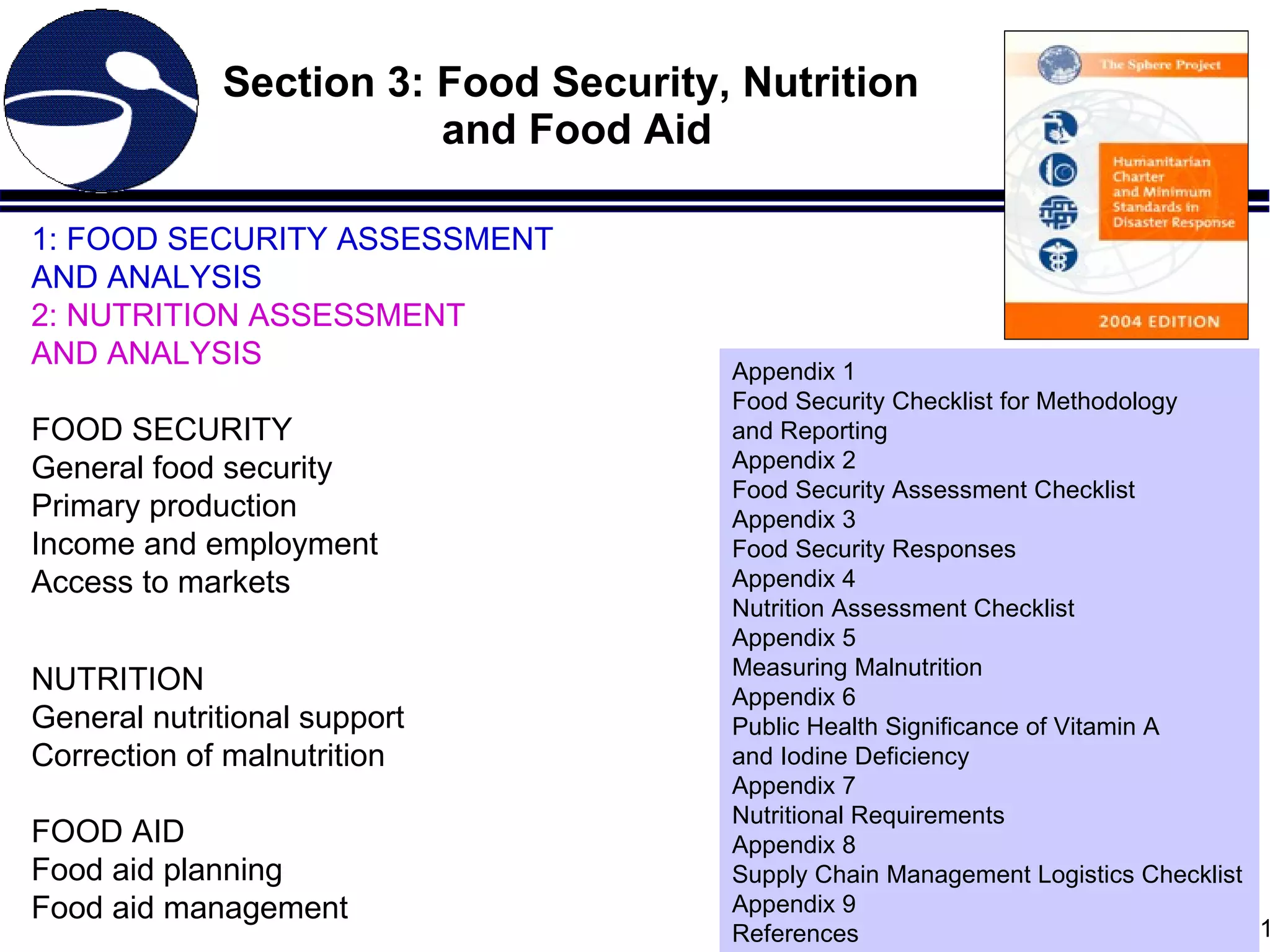
Section 3: Food Security, Nutrition  and Food Aid 1: FOOD SECURITY ASSESSMENT AND ANALYSIS 2: NUTRITION ASSESSMENT AND ANALYSIS FOOD SECURITY General food security Primary production Income and employment Access to markets NUTRITION General nutritional support Correction of malnutrition FOOD AID Food aid planning Food aid management Appendix 1 Food Security Checklist for Methodology  and Reporting Appendix 2 Food Security Assessment Checklist Appendix 3 Food Security Responses Appendix 4 Nutrition Assessment Checklist Appendix 5 Measuring Malnutrition Appendix 6 Public Health Significance of Vitamin A  and Iodine Deficiency Appendix 7 Nutritional Requirements Appendix 8 Supply Chain Management Logistics Checklist Appendix 9 References
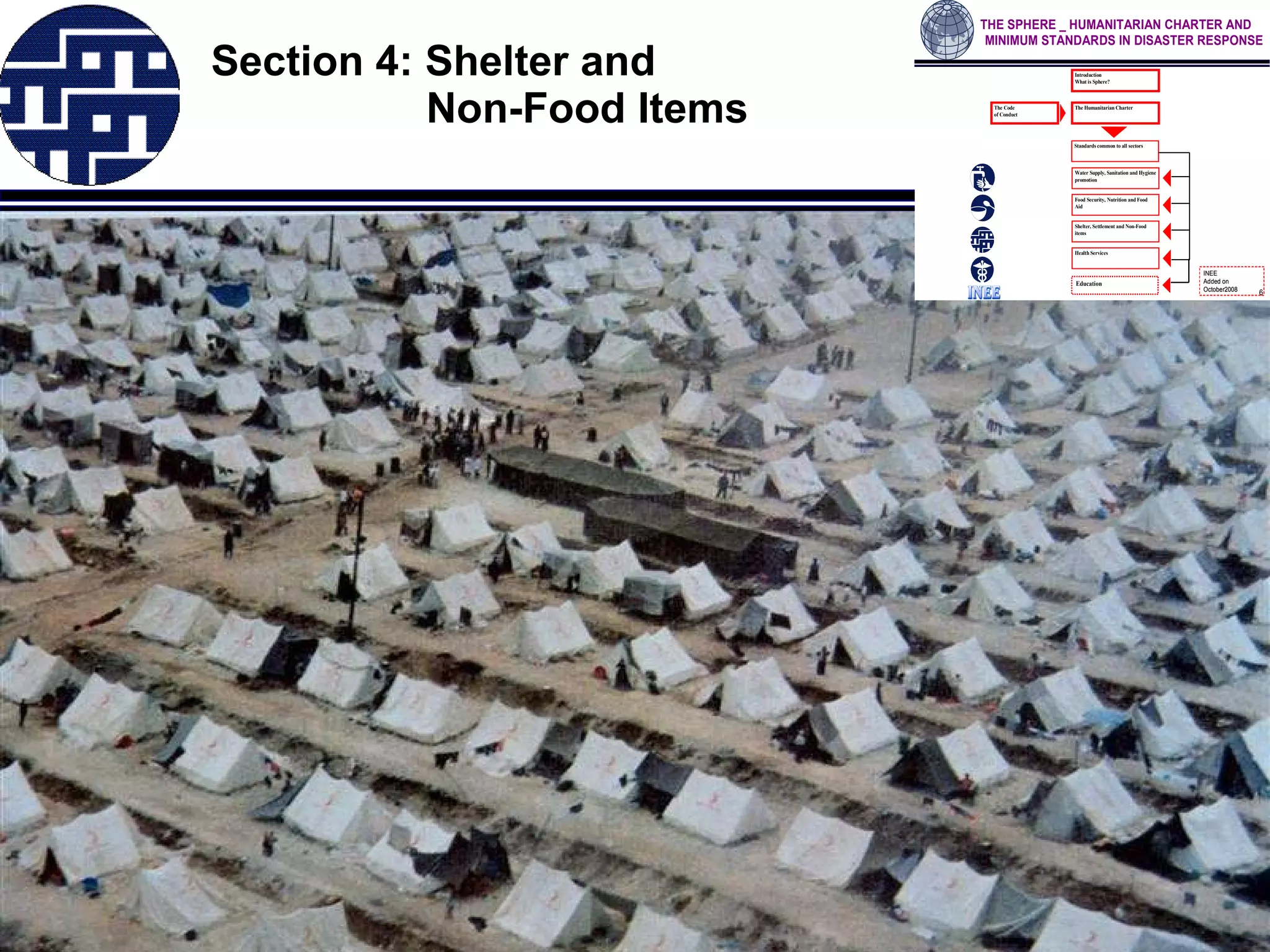
Section 4: Shelter and    Non-Food Items
Section 4: Shelter and    Non-Food Items 1. SHELTER, SETTLEMENT  Strategic Planning Physical planning  Covered living space  Environmental impact Construction Design 2.  NON-FOOD ITEMS :   Clothing, Bedding  and Household Items   Clothing and bedding  Personal hygiene Cooking and eating utensils Tools and equipment Stoves, fuel and lighting Appendix  1 Shelter, Settlement and Non-Food Items Initial Needs Assessment Checklist Appendix 2 References
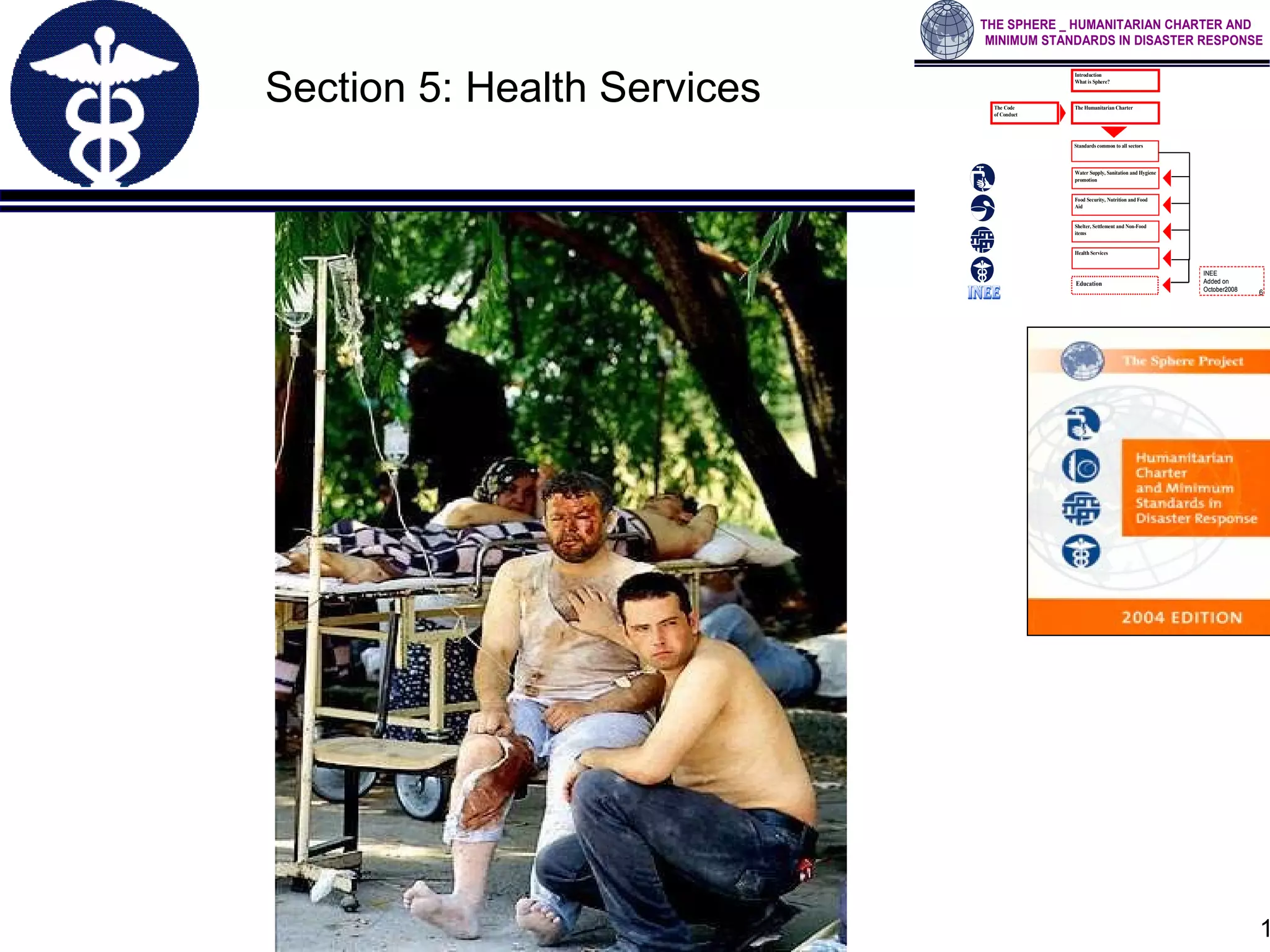
Section 5: Health Services
HEALTH SYSTEMS AND INFRASTRUCTURE Prioritizing health services  Supportıng natıonal and Local health systems  C oordination Primary health care  Clinical services Health information systems 2. CONTROL OF COMMUNICABLE DISEASES Prevention Measles preventıon  diagnosis and case Management mental and social aspects o f health Diagnosis and case management Outbreak preparedness Outbreak detection, investigation  and response HIV/AIDS Section 5: Health Services 3. CONTROL OF NON-COMMUNICABLE DISEASES Injury Reproductive health Diagnosis and case management Mental and social aspects of health  Chronic diseases Appendix 1 Health Services Assessment Checklist Appendix 2 Sample Weekly Surveillance Reporting Forms Appendix 3 Formulas for Calculating Rates of Mortality and Morbidity Appendix 4 References
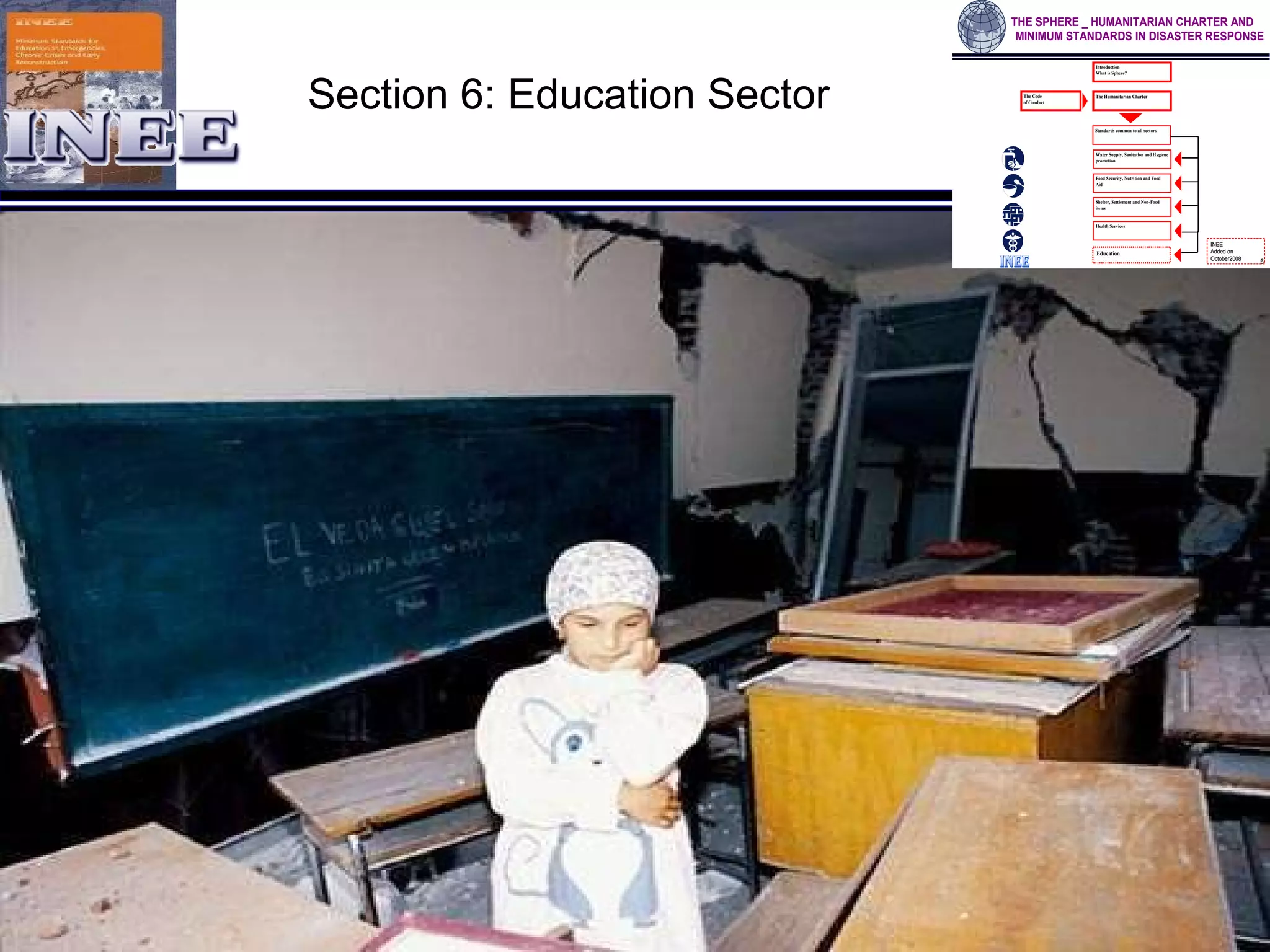
Section  6: Education Sector
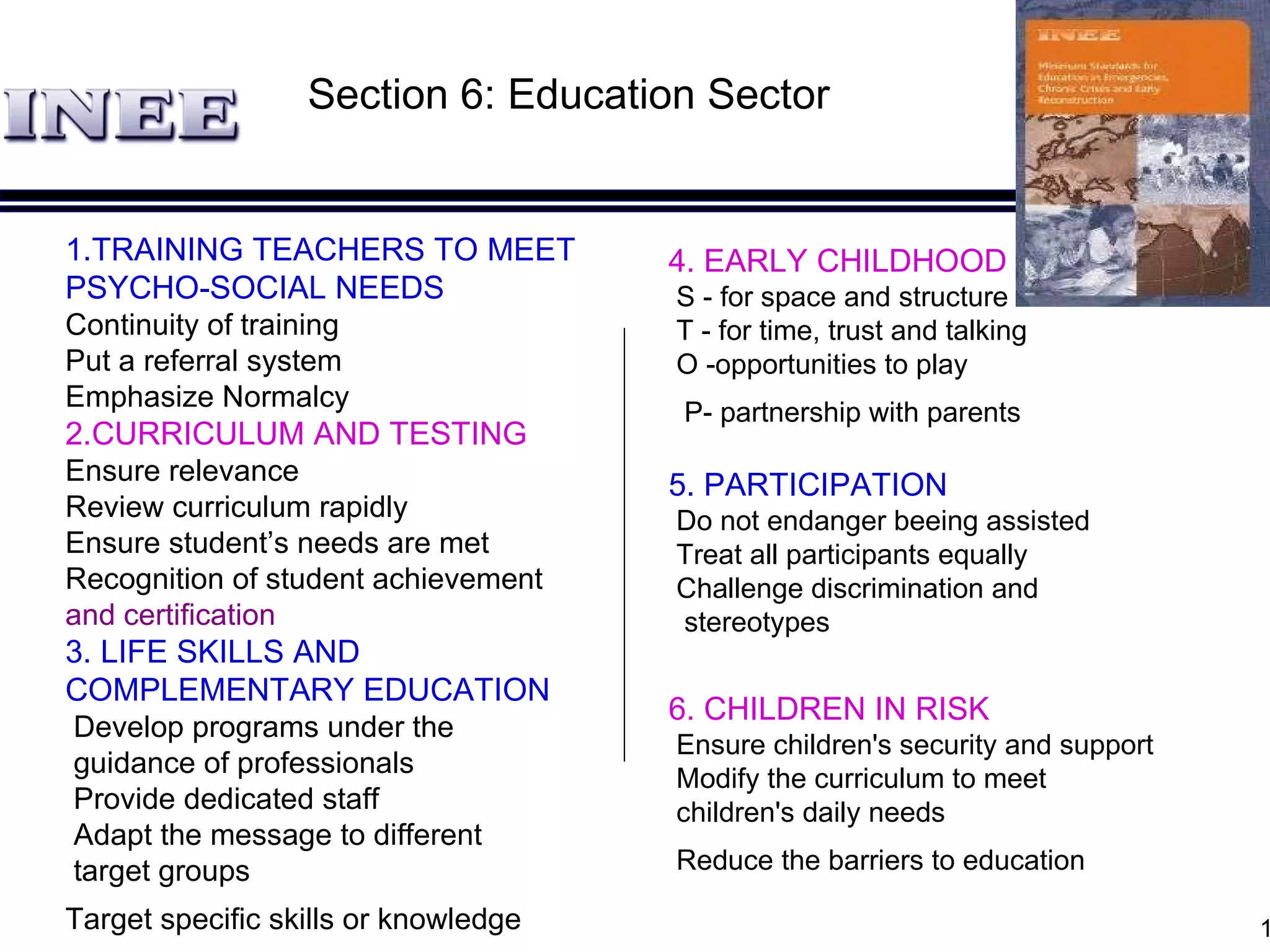
1. TRAINING TEACHERS TO MEET PSYCHO-SOCIAL NEEDS Continuity of training Put a referral system Emphasize Normalcy 2. CURRICULUM AND TESTING Ensure relevance  Review curriculum rapidly   Ensure student’s needs are met Recognition of student   achievement  and certification 3.  LIFE SKILLS AND COMPLEMENTARY EDUCATION Develop program s  under the guidance of professional s  Provide dedicated staff Adapt the message to different target groups Target specific skills or knowledge   4. EARLY CHILDHOOD EDUCATION  S - for space and structure T - for time, trust and talking  O -opportunities to play P - partnership with parents   5. PARTICIPATION Do not endanger beeing assisted Treat all participants equally   Challenge discrimination and stereotypes 6. CHILDREN IN RISK Ensure children's security and support  Modify the curriculum to meet children's daily needs Re duce the barriers to education   Section  6: Education Sector
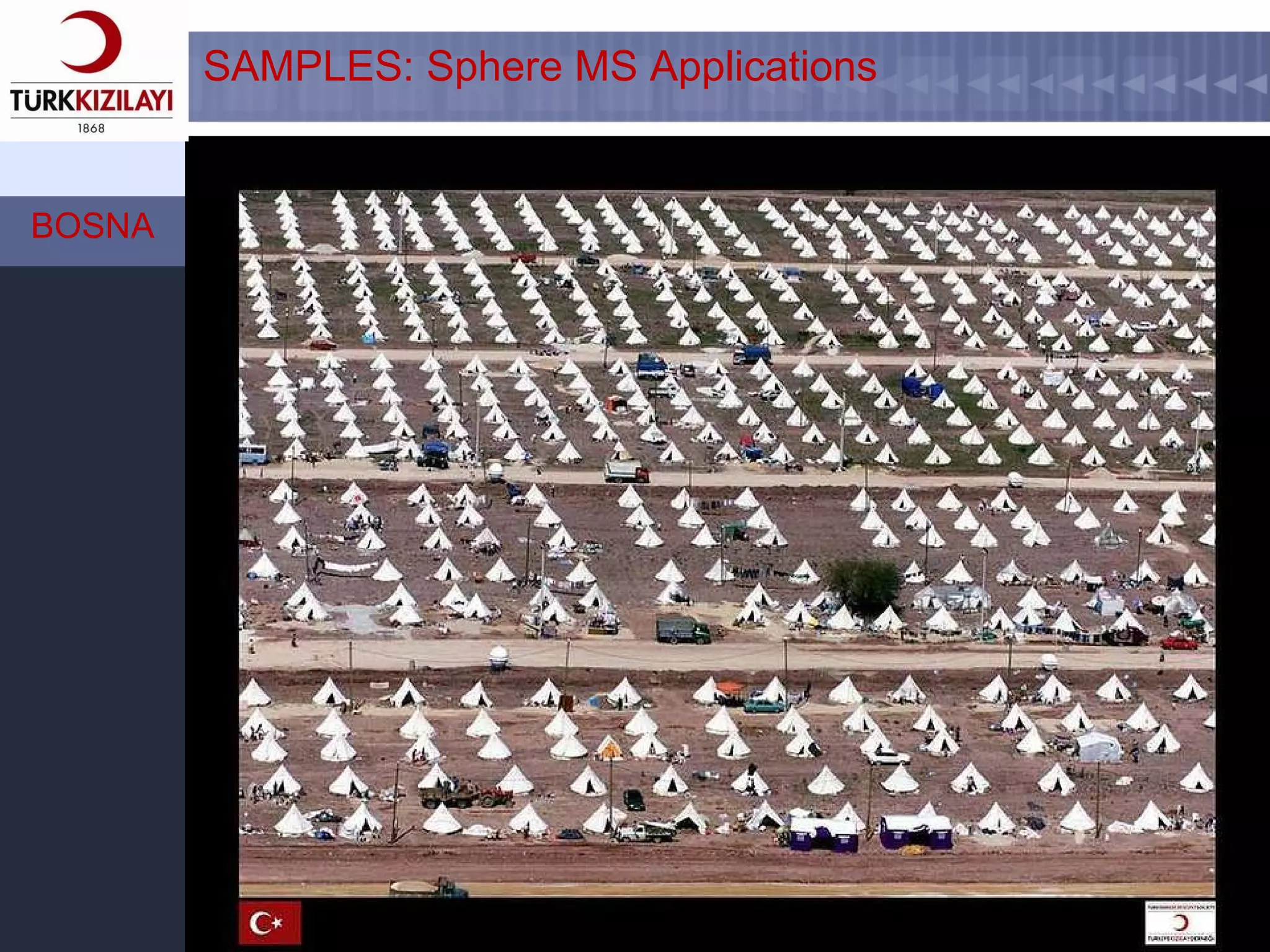
BOSNA SAMPLES: Sphere MS Applications
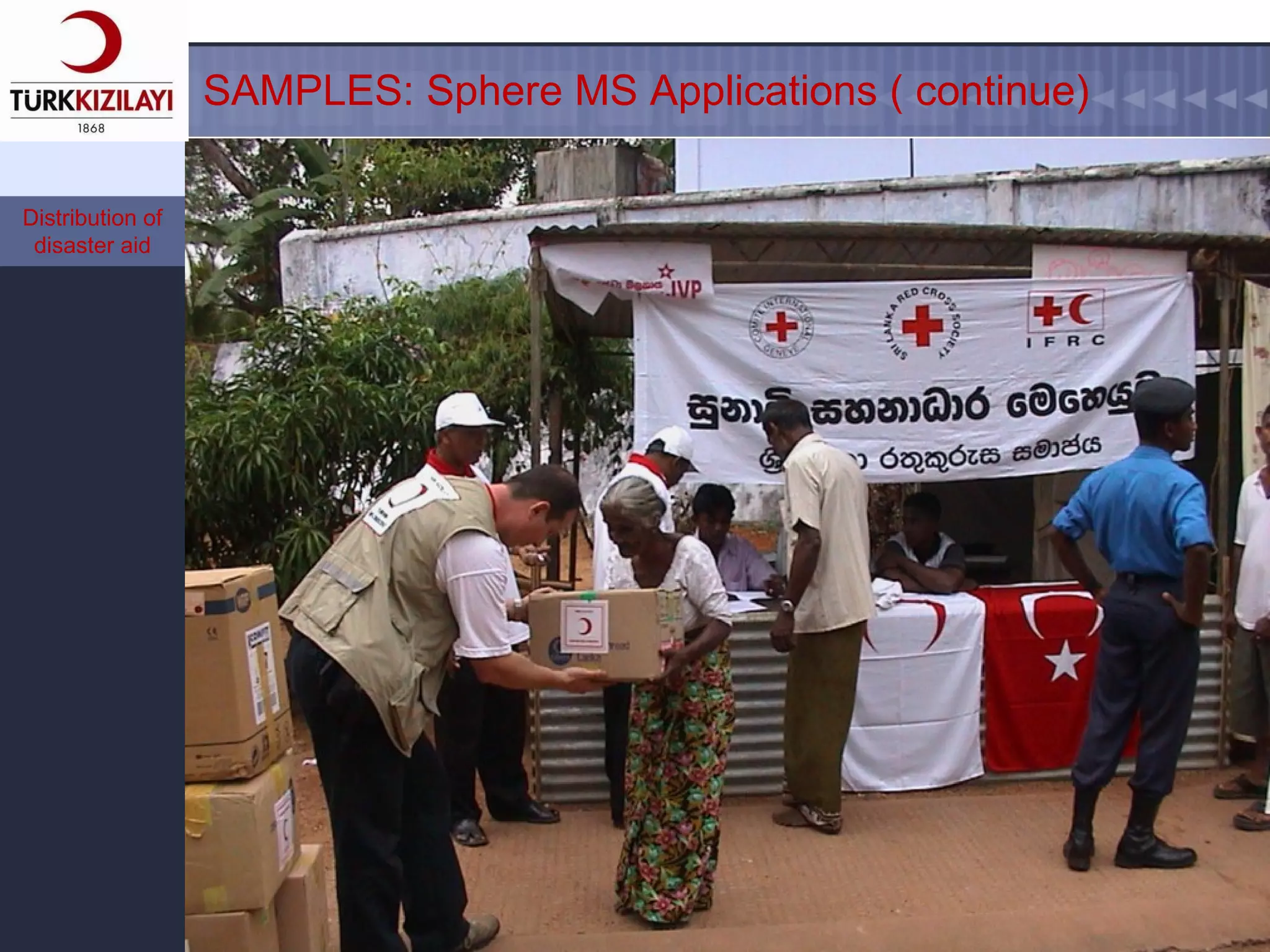
  Afet Müdahale ve Yardımlar Yönetimi Bölümü   Distribution of disaster aid SAMPLES: Sphere MS Applications ( continue)
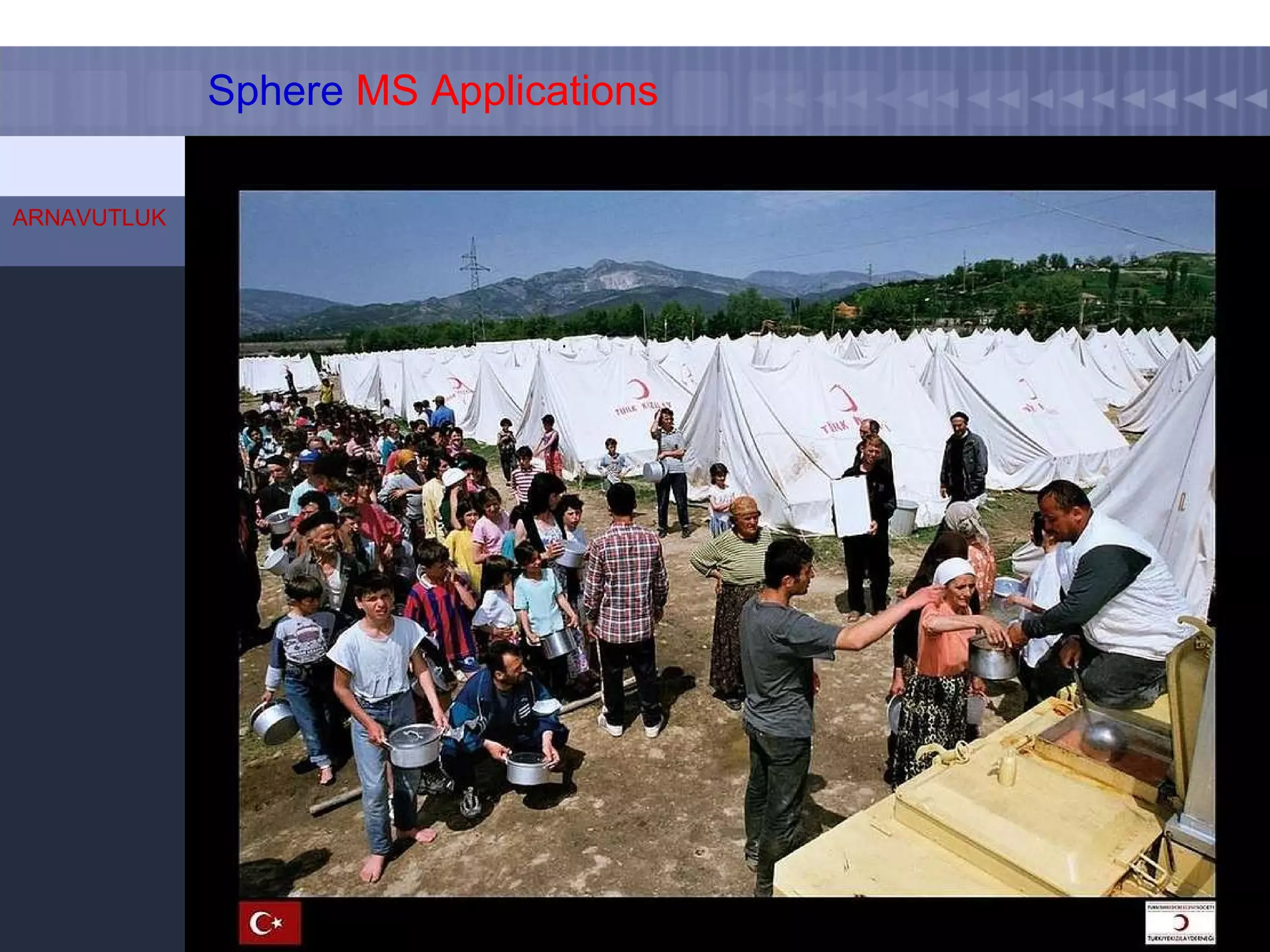
ARNAVUTLUK Sphere  MS Applications
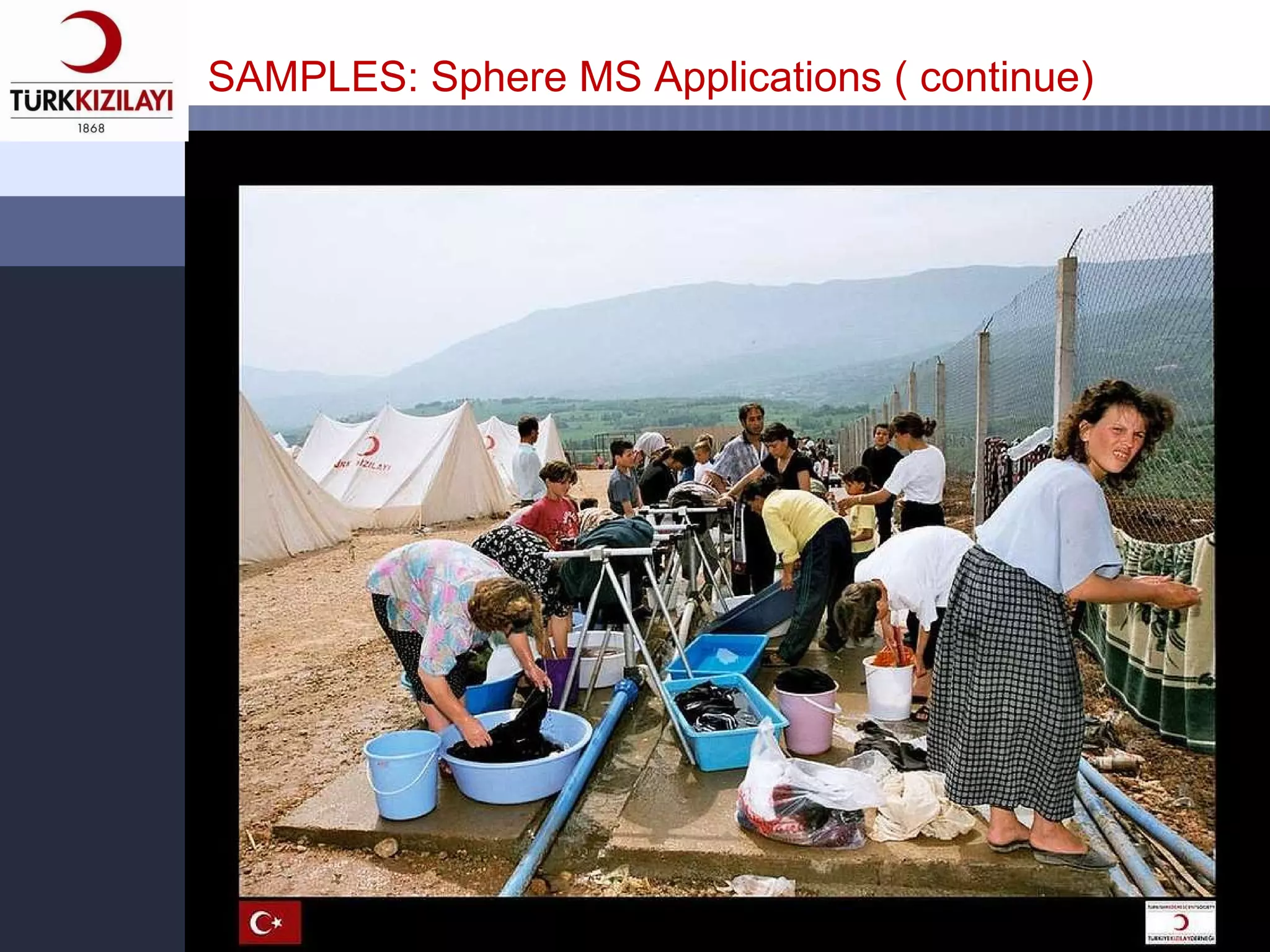
SAMPLES: Sphere MS Applications ( continue)
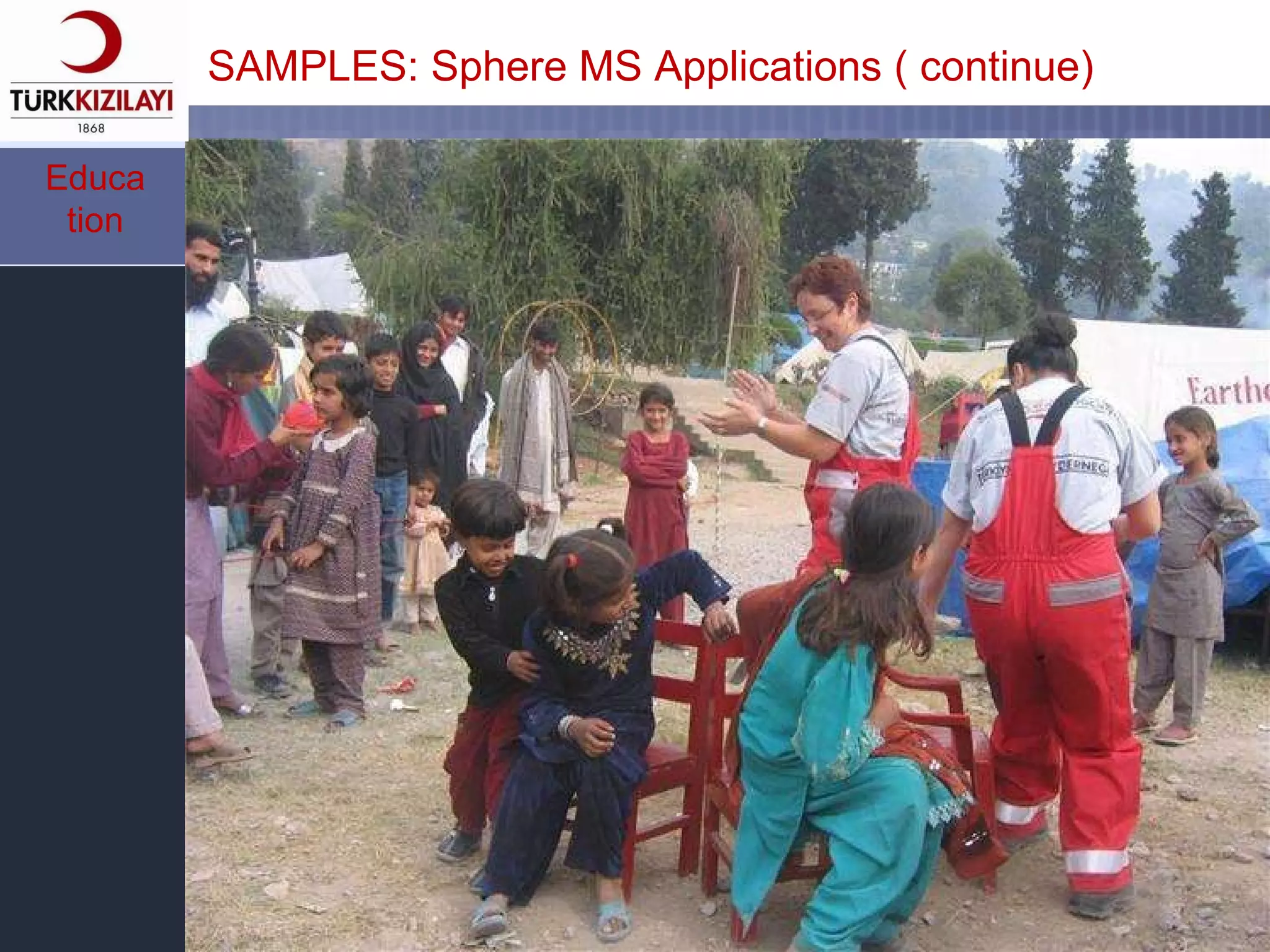
Educa tion SAMPLES: Sphere MS Applications ( continue)
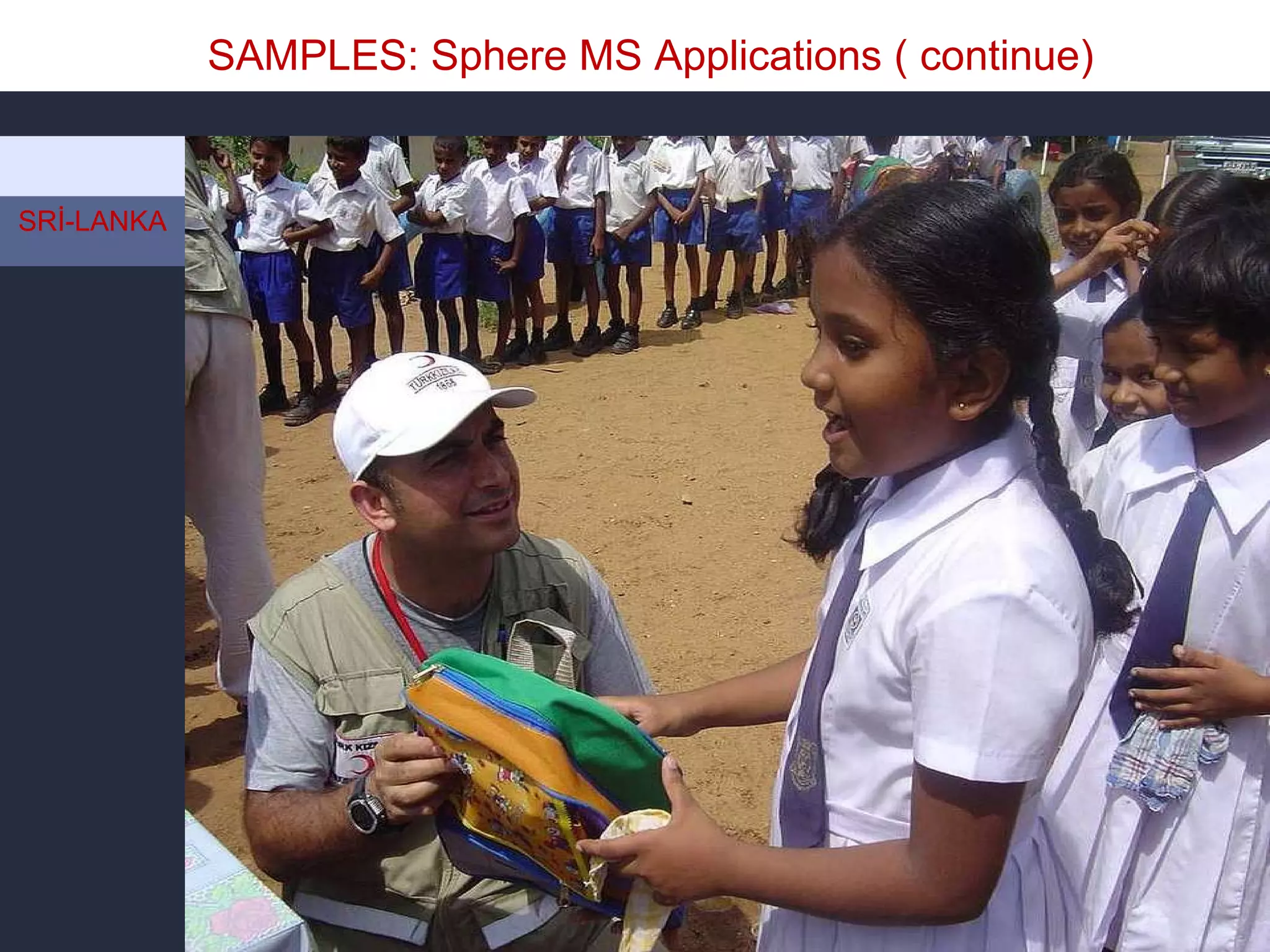
  SRİ-LANKA SAMPLES:  Sphere  MS Applications   SAMPLES: Sphere MS Applications ( continue)
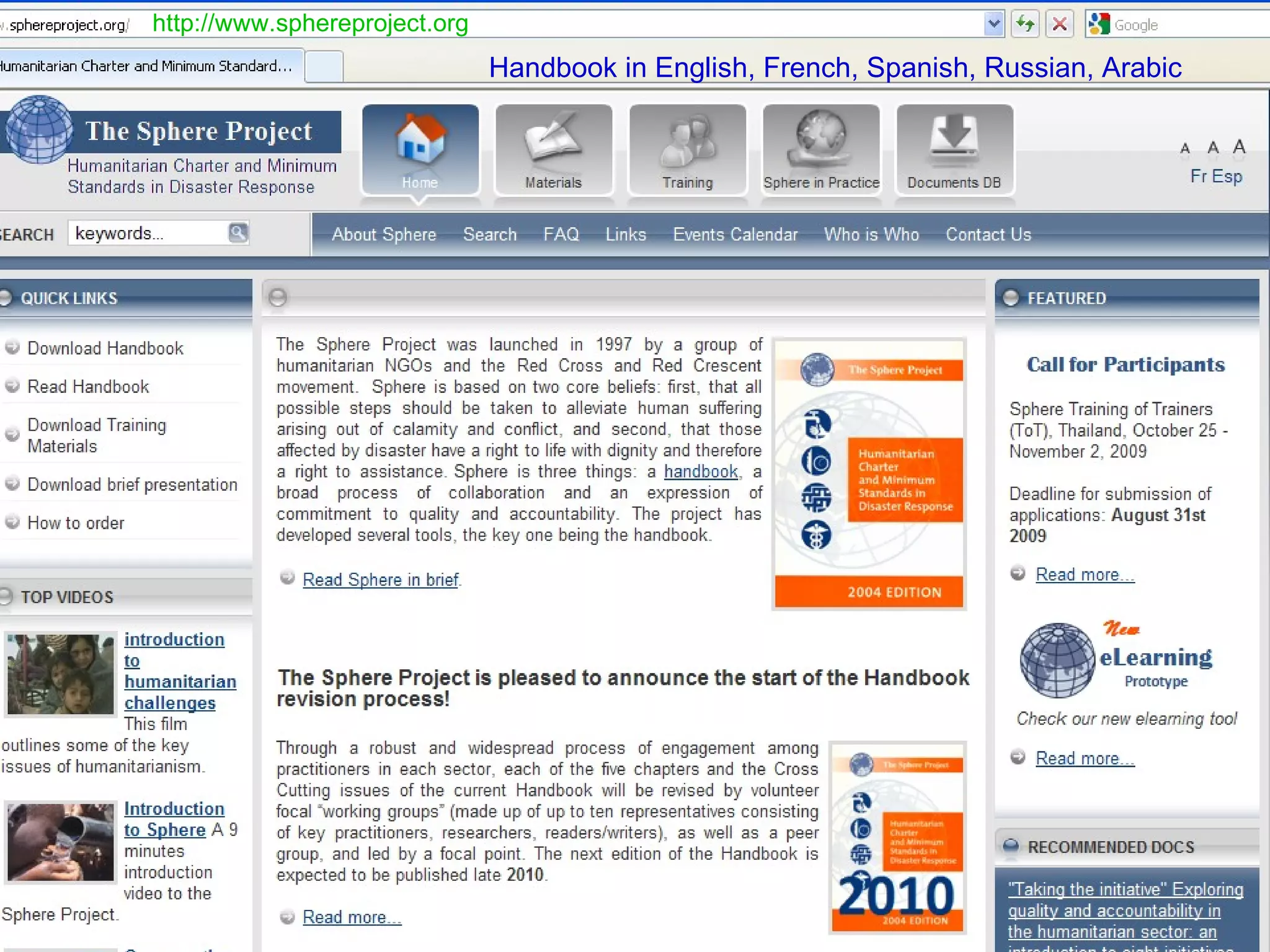
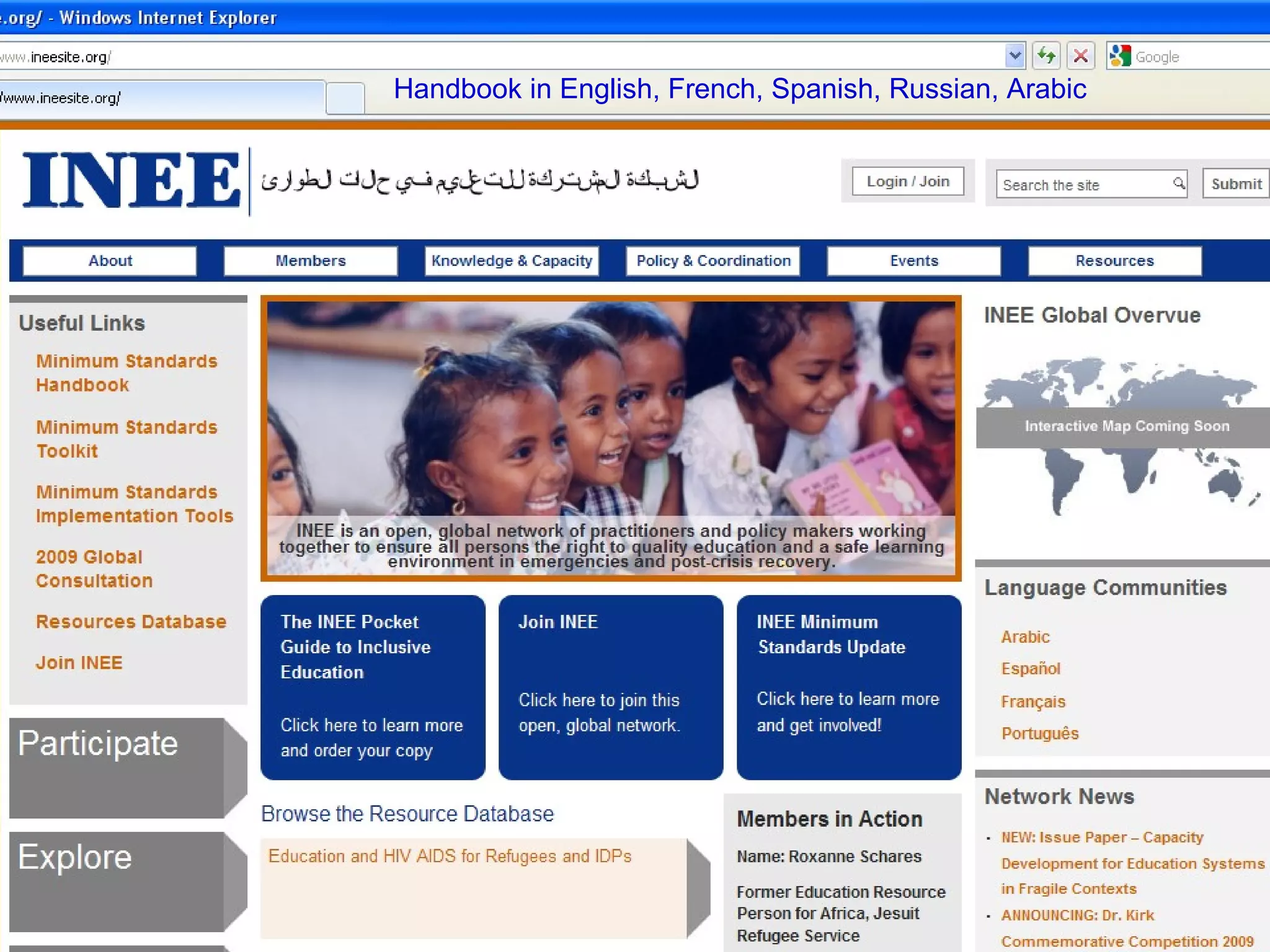
THE SPHERE _ HUMANITARIAN CHARTER AND    MINIMUM STANDARDS IN DISASTER RESPONSE http://www.sphereproject.org Handbook   in English ,  French ,  Spanish ,  Russian ,  Arabic
Handbook   in English ,  French ,  Spanish ,  Russian ,  Arabic
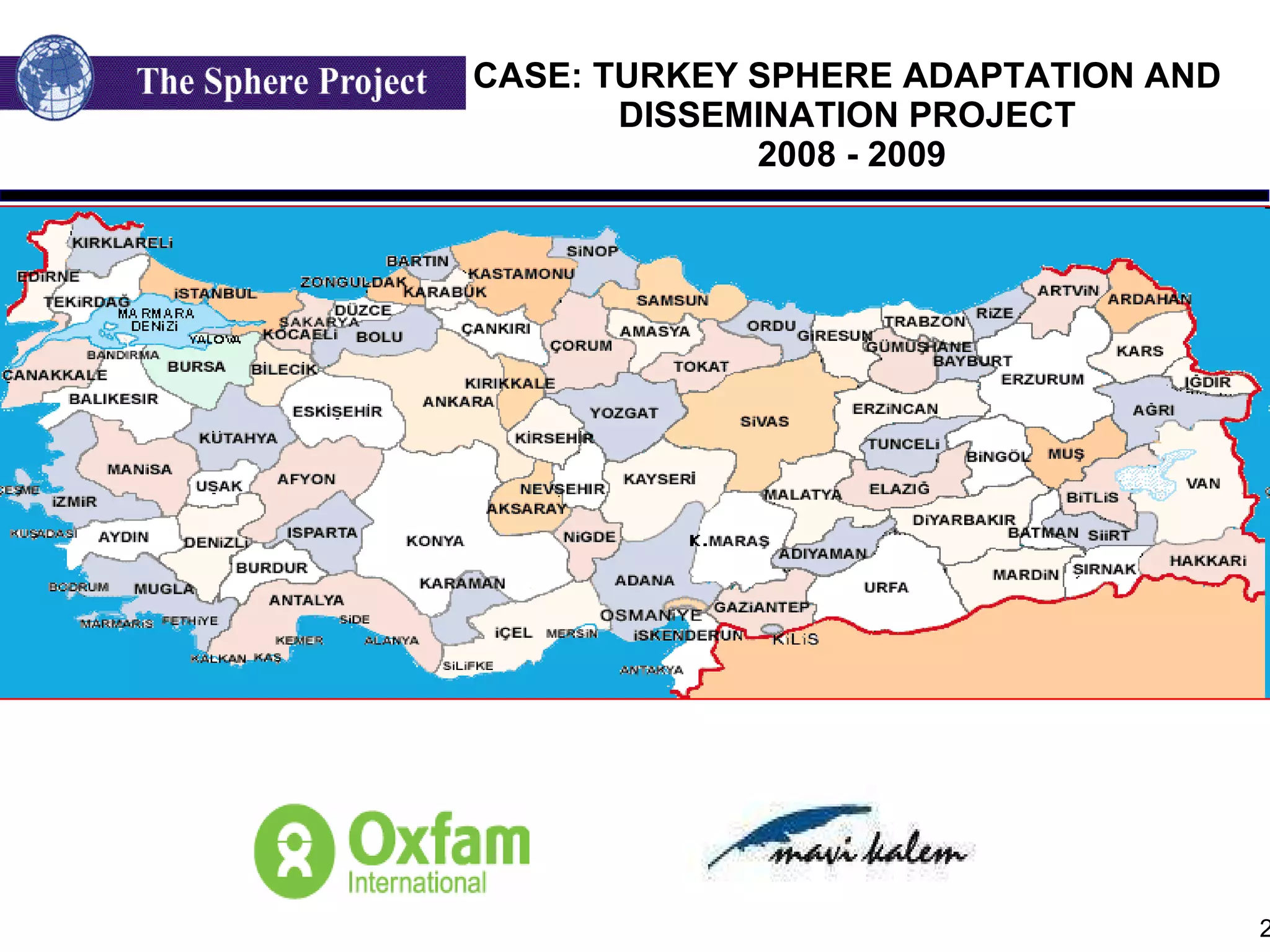
CASE: TURKEY SPHERE ADAPTATION AND  DISSEMINATION PROJECT  2008 - 2009
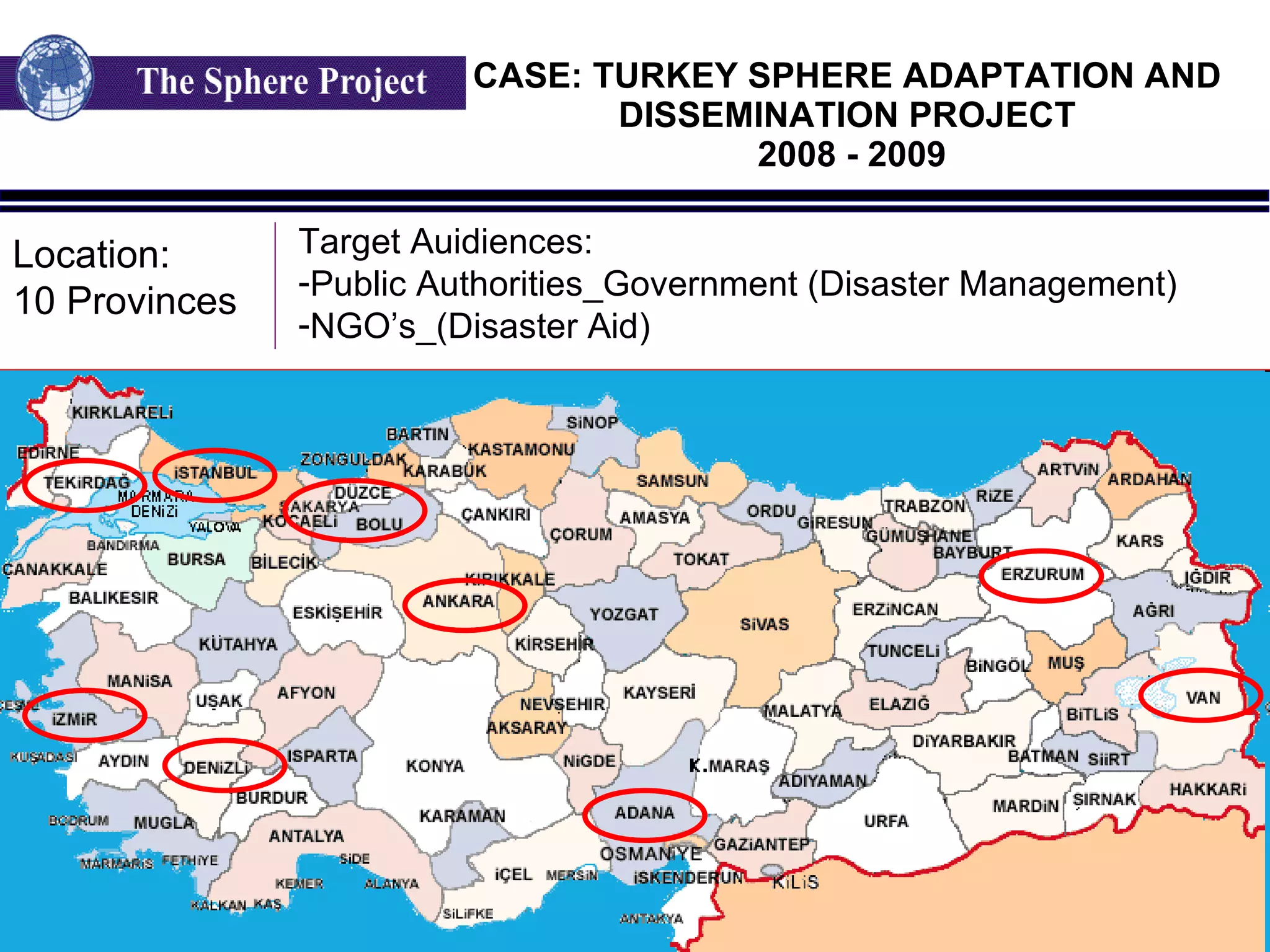
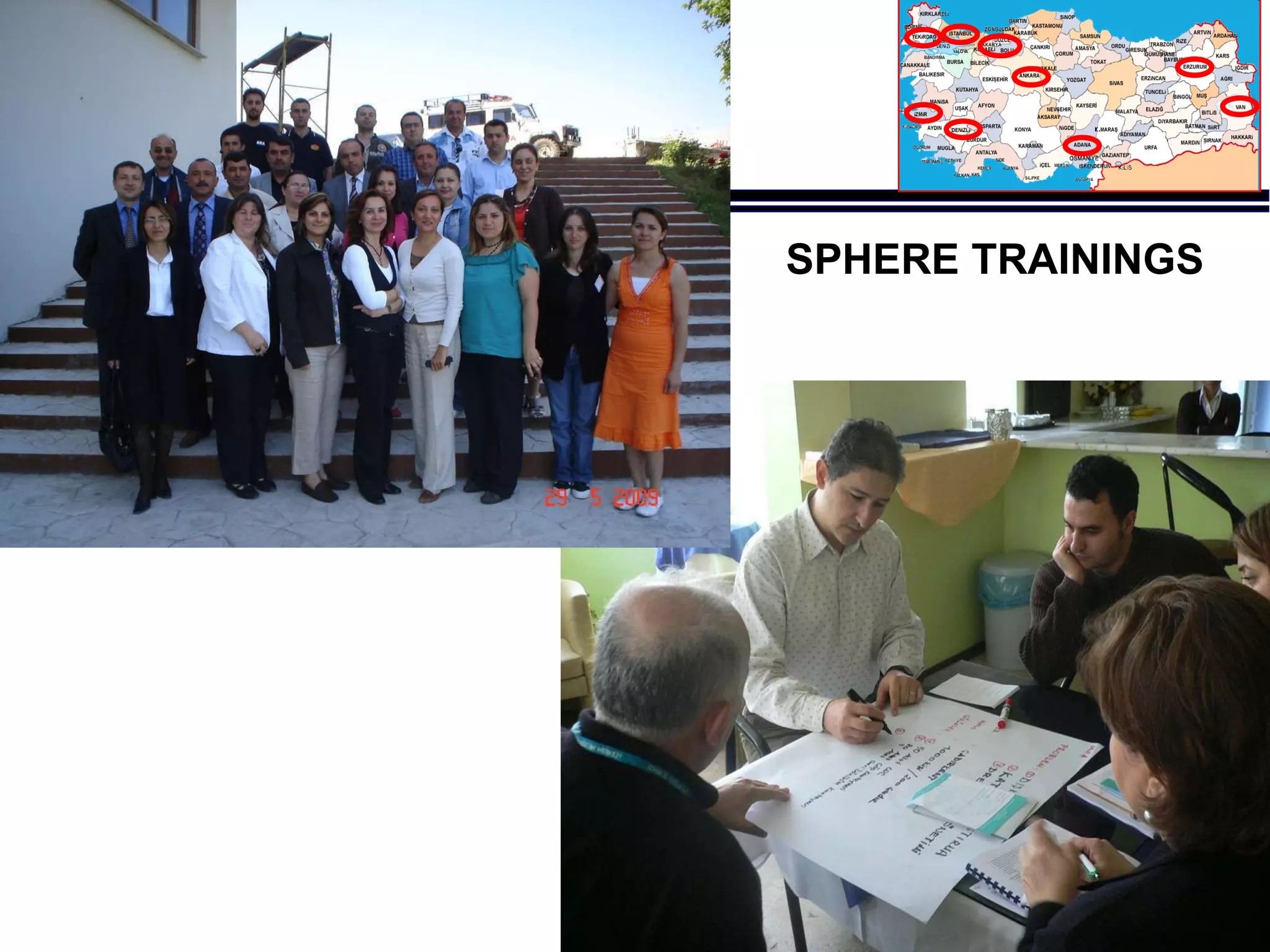
CASE: TURKEY SPHERE ADAPTATION AND  DISSEMINATION PROJECT  2008 - 2009 Location: 10 Provinces Target Auidiences: Public Authorities_Government (Disaster Management) NGO’s_(Disaster Aid)
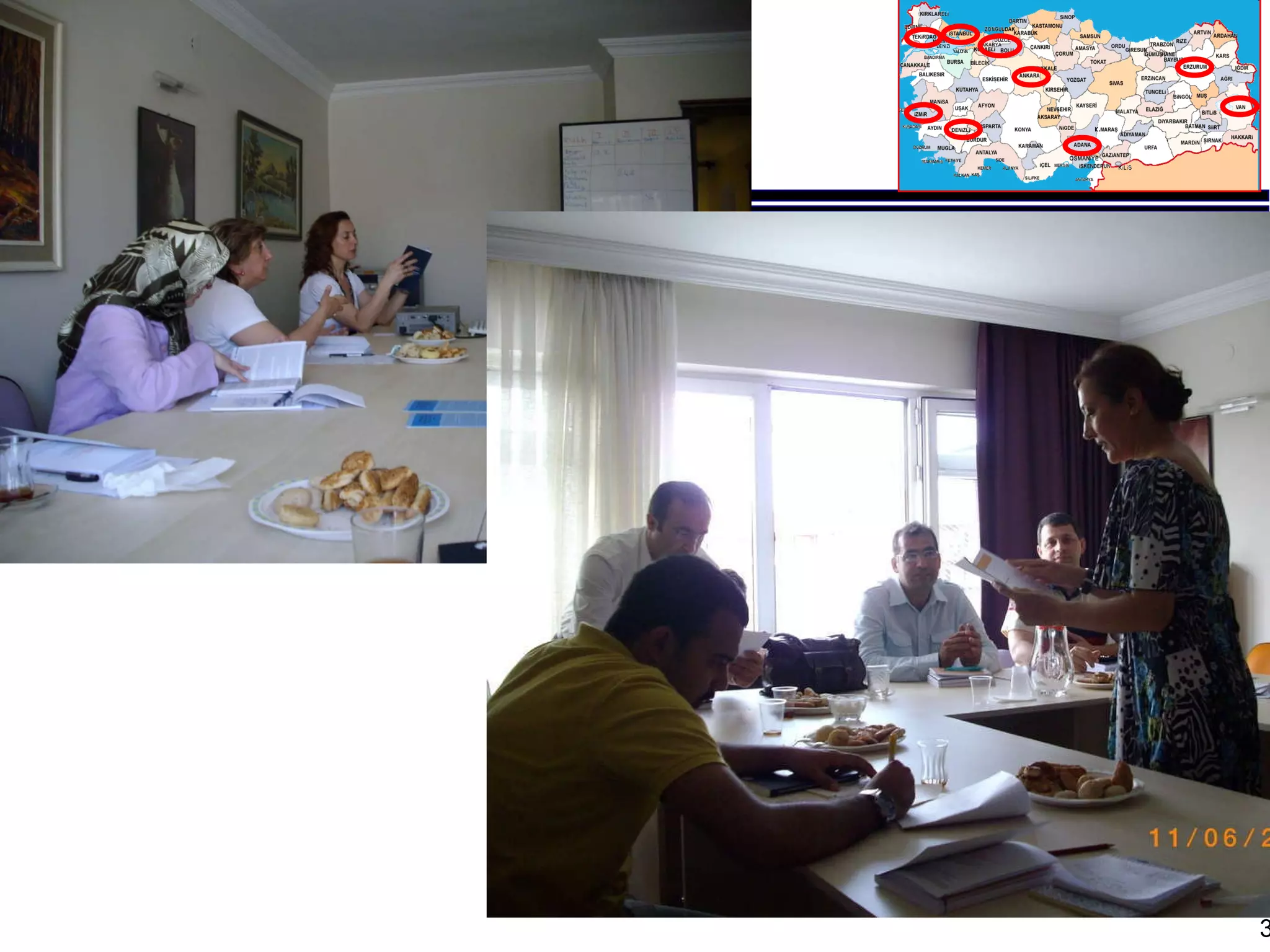
SPHERE TRAININGS
SPHERE TRAININGS
Support of Turkish Ministry of Health Reviewing of content of the Sphere Handbook from the aspect of appropriatness to our country (Turkey) The Formal Support Letter to the Sphere Turkey Project  Support for organizing the Sphere Trainings at 10 provinces
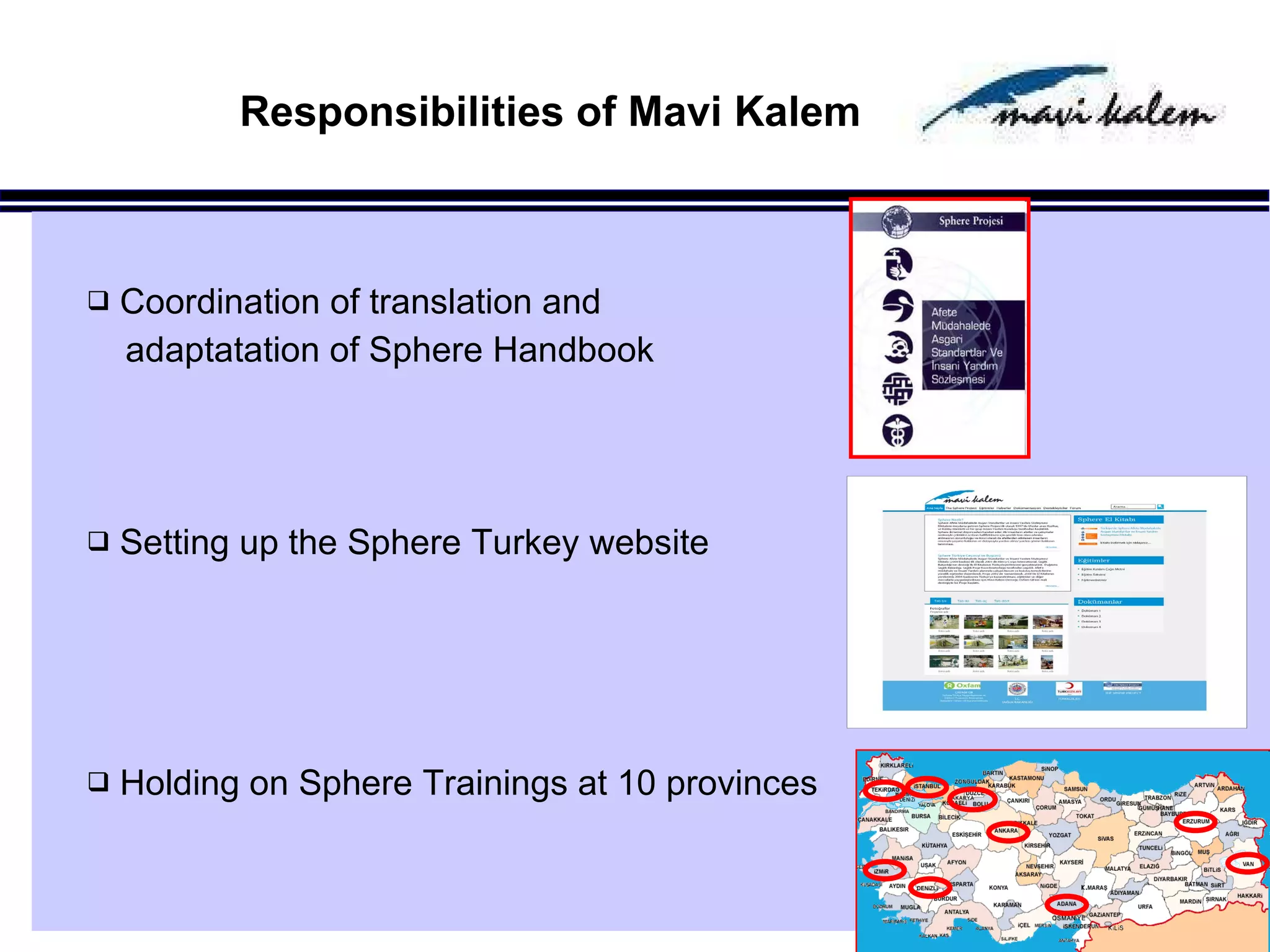
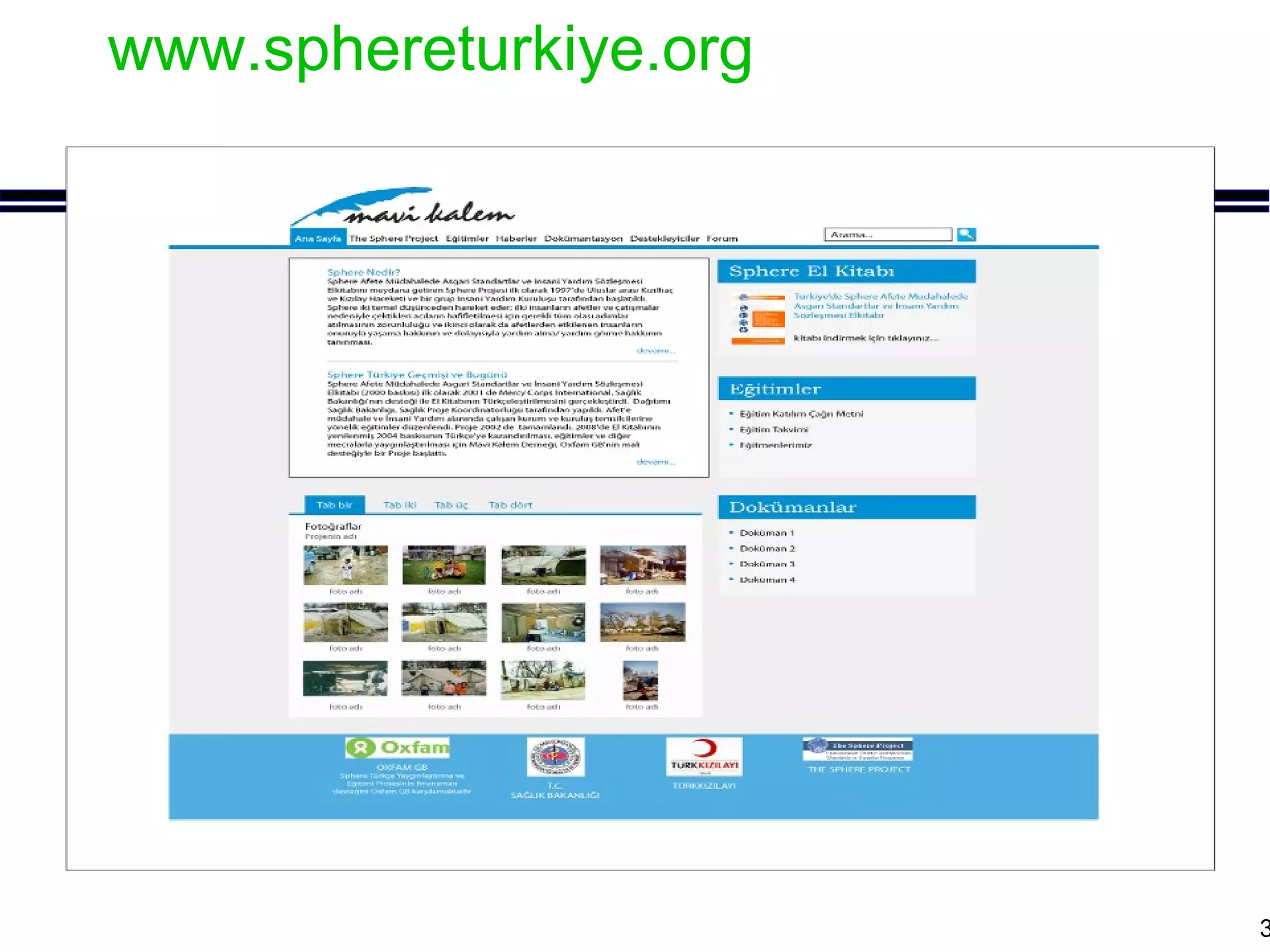
Responsibilities of Mavi Kalem Coordination of translation and  adaptatation of Sphere Handbook  Setting up the Sphere Turkey website Holding on Sphere Trainings at 10 provinces
www.spheretur k iye.org
 
 
THE SPHERE _ HUMANITARIAN CHARTER AND    MINIMUM STANDARDS IN DISASTER RESPONSE Case: Turkey Sphere Project Zeynep M. Turkmen Sanduvac Social Development Consultant Istanbul, Turkey [email_address] T H A N K  Y O U

The Sphere Program_ Humanitarian Charter and Minimum Standards in Disaster Response

  • 1.
    THE SPHERE _HUMANITARIAN CHARTER AND MINIMUM STANDARDS IN DISASTER RESPONSE Case: Turkey Sphere Project Zeynep M. Turkmen Sanduvac Bogazici University Disaster Management Center
  • 2.
    THE SPHERE _HUMANITARIAN CHARTER AND MINIMUM STANDARDS IN DISASTER RESPONSE Background of Sphere Sphere Project Sphere and INEE Turkey Sphere Project Conclusion Resources CONTENT
  • 4.
    THE SPHERE _HUMANITARIAN CHARTER AND MINIMUM STANDARDS IN DISASTER RESPONSE Figure 2: Sphere is three things Resource: Sphere Executive Briefing Presentation 2000 handbook launched 2004 handbook revised edition 1997 Initial consultation 4000+ people 80 countries around the world 400 organizations
  • 5.
    THE SPHERE _HUMANITARIAN CHARTER AND MINIMUM STANDARDS IN DISASTER RESPONSE Sphere is three things: a handbook a broad process of collaboration an expression of commitment to quality and accountability life with dignity a right to assistance. 
  • 6.
    THE SPHERE _HUMANITARIAN CHARTER AND MINIMUM STANDARDS IN DISASTER RESPONSE The Code of Conduct 2004 Edition Each Chapter Includes Minumum Standarts Key Indicators Guidence Notes Figure 1: Sphere's Specific Standards Resource: Sphere Executive Briefing Presentation Health Services Food Security, Nutrition and Food Aid Shelter, Settlement and Non-Food items Water Supply, Sanitation and Hygiene Promotion Standards common to all sectors Introduction What is Sphere? The Humanitarian Charter
  • 7.
    THE SPHERE _HUMANITARIAN CHARTER AND MINIMUM STANDARDS IN DISASTER RESPONSE INEE Added on October2008 The Code of Conduct Introduction What is Sphere? The Humanitarian Charter Standards common to all sectors Water Supply, Sanitation and Hygiene promotion Food Security, Nutrition and Food Aid Shelter, Settlement and Non-Food items Health Services Education
  • 8.
    Section1: CommonStandards to all sectors Participation Initial assessment Response Targeting Monitoring & Evaluation Aid worker competencies and responsibilities Supervision, management and support o f personnel Appendix 1 References
  • 9.
    Section 2: WaterSupply, Sanitation and Hygiene Promotion
  • 10.
    Section 2: WaterSupply, Sanitation and Hygiene Promotion 1: HYGIENE PROMOTION Programme design and Implementation 2: WATER SUPPLY Access and water quantity Water quality Water use facilities and goods 3: EXCRETA DISPOSAL Access to, and numbers of, toilets Design, construction and use of toilets 4: VECTOR CONTROL Individual and family protection Environmental and chemical protection measures Chemical control safety 5: SOLID WASTE MANAGEMENT Solid waste collection and disposal 6 : DRAINAGE Drainage Works Appendix 1 Water and Sanitation Initial Needs Assessment Checklist Appendix 2 Planning Guidelines for Minimum Water Quantities for Institutions and Other Uses Appendix 3 Planning Guidelines for Minimum Numbers of Toilets at Public Places and Institutions Appendix 4 Water-and Excreta-Related Diseases and Transmission Mechanisms Appendix 5 References
  • 11.
    Section 3: FoodSecurity, Nutrition and Food Aid
  • 12.
    Section 3: FoodSecurity, Nutrition and Food Aid 1: FOOD SECURITY ASSESSMENT AND ANALYSIS 2: NUTRITION ASSESSMENT AND ANALYSIS FOOD SECURITY General food security Primary production Income and employment Access to markets NUTRITION General nutritional support Correction of malnutrition FOOD AID Food aid planning Food aid management Appendix 1 Food Security Checklist for Methodology and Reporting Appendix 2 Food Security Assessment Checklist Appendix 3 Food Security Responses Appendix 4 Nutrition Assessment Checklist Appendix 5 Measuring Malnutrition Appendix 6 Public Health Significance of Vitamin A and Iodine Deficiency Appendix 7 Nutritional Requirements Appendix 8 Supply Chain Management Logistics Checklist Appendix 9 References
  • 13.
    Section 4: Shelterand Non-Food Items
  • 14.
    Section 4: Shelterand Non-Food Items 1. SHELTER, SETTLEMENT Strategic Planning Physical planning Covered living space Environmental impact Construction Design 2. NON-FOOD ITEMS : Clothing, Bedding and Household Items Clothing and bedding Personal hygiene Cooking and eating utensils Tools and equipment Stoves, fuel and lighting Appendix 1 Shelter, Settlement and Non-Food Items Initial Needs Assessment Checklist Appendix 2 References
  • 15.
  • 16.
    HEALTH SYSTEMS ANDINFRASTRUCTURE Prioritizing health services Supportıng natıonal and Local health systems C oordination Primary health care Clinical services Health information systems 2. CONTROL OF COMMUNICABLE DISEASES Prevention Measles preventıon diagnosis and case Management mental and social aspects o f health Diagnosis and case management Outbreak preparedness Outbreak detection, investigation and response HIV/AIDS Section 5: Health Services 3. CONTROL OF NON-COMMUNICABLE DISEASES Injury Reproductive health Diagnosis and case management Mental and social aspects of health Chronic diseases Appendix 1 Health Services Assessment Checklist Appendix 2 Sample Weekly Surveillance Reporting Forms Appendix 3 Formulas for Calculating Rates of Mortality and Morbidity Appendix 4 References
  • 17.
    Section 6:Education Sector
  • 18.
    1. TRAINING TEACHERSTO MEET PSYCHO-SOCIAL NEEDS Continuity of training Put a referral system Emphasize Normalcy 2. CURRICULUM AND TESTING Ensure relevance Review curriculum rapidly Ensure student’s needs are met Recognition of student achievement and certification 3. LIFE SKILLS AND COMPLEMENTARY EDUCATION Develop program s under the guidance of professional s Provide dedicated staff Adapt the message to different target groups Target specific skills or knowledge 4. EARLY CHILDHOOD EDUCATION S - for space and structure T - for time, trust and talking O -opportunities to play P - partnership with parents 5. PARTICIPATION Do not endanger beeing assisted Treat all participants equally Challenge discrimination and stereotypes 6. CHILDREN IN RISK Ensure children's security and support Modify the curriculum to meet children's daily needs Re duce the barriers to education Section 6: Education Sector
  • 19.
    BOSNA SAMPLES: SphereMS Applications
  • 20.
    AfetMüdahale ve Yardımlar Yönetimi Bölümü Distribution of disaster aid SAMPLES: Sphere MS Applications ( continue)
  • 21.
    ARNAVUTLUK Sphere MS Applications
  • 22.
    SAMPLES: Sphere MSApplications ( continue)
  • 23.
    Educa tion SAMPLES:Sphere MS Applications ( continue)
  • 24.
    SRİ-LANKASAMPLES: Sphere MS Applications SAMPLES: Sphere MS Applications ( continue)
  • 25.
    THE SPHERE _HUMANITARIAN CHARTER AND MINIMUM STANDARDS IN DISASTER RESPONSE http://www.sphereproject.org Handbook in English , French , Spanish , Russian , Arabic
  • 26.
    Handbook in English , French , Spanish , Russian , Arabic
  • 27.
    CASE: TURKEY SPHEREADAPTATION AND DISSEMINATION PROJECT 2008 - 2009
  • 28.
    CASE: TURKEY SPHEREADAPTATION AND DISSEMINATION PROJECT 2008 - 2009 Location: 10 Provinces Target Auidiences: Public Authorities_Government (Disaster Management) NGO’s_(Disaster Aid)
  • 29.
  • 30.
  • 31.
    Support of TurkishMinistry of Health Reviewing of content of the Sphere Handbook from the aspect of appropriatness to our country (Turkey) The Formal Support Letter to the Sphere Turkey Project Support for organizing the Sphere Trainings at 10 provinces
  • 32.
    Responsibilities of MaviKalem Coordination of translation and adaptatation of Sphere Handbook Setting up the Sphere Turkey website Holding on Sphere Trainings at 10 provinces
  • 33.
  • 34.
  • 35.
  • 36.
    THE SPHERE _HUMANITARIAN CHARTER AND MINIMUM STANDARDS IN DISASTER RESPONSE Case: Turkey Sphere Project Zeynep M. Turkmen Sanduvac Social Development Consultant Istanbul, Turkey [email_address] T H A N K Y O U

Editor's Notes

  • #5 Figure 2: Sphere is three things: a handbook , a broad process of collaboration and an expression of commitment to quality and accountability life with dignity and therefore a right to assistance.  Resource: Sphere Executive Briefing Presentation Although the Sphere Handbook was compiled and written in English, contributions were provided from all over the world. In order (to acknowledge this) and to enable the use of Sphere globally, the Sphere Handbook has been translated into a number of different languages. The Sphere Project Office has directly coordinated the translation and production of the 2004 Handbook in French and Spanish. It is currently coordinating translation and production in Arabic and Russian. The 2000 Edition was translated by the Sphere Project Office into Arabic, French, Portuguese, Russian, Spanish and Swahili. However, most of the translated versions of the Handbook were produced spontaneously in response to local demands. The 2000 edition was translated locally into over 20 languages in total, including Chinese, Indonesian, Turkish and Urdu; while the 2004 edition has already been translated into 4 languages (Farsi, Japanese, Oriya and Vietnamese), and is currently being further translated into other languages too.
  • #6 Sphere Project T he main aim of the Sphere Project is to improve the quality of assistance to people affected by disaster and improve the accountability of states and humanitarian agencies to their constituents, donors and the affected populations. In term of this frame, Sphere's specific standards in the provision of health care, water and sanitation, shelter, food security and nutrition, education translate people's rights into specific agency duties. Figure 2: Sphere is three things: a handbook , a broad process of collaboration and an expression of commitment to quality and accountability life with dignity and therefore a right to assistance.  Resource: Sphere Executive Briefing Presentation Although the Sphere Handbook was compiled and written in English, contributions were provided from all over the world. In order (to acknowledge this) and to enable the use of Sphere globally, the Sphere Handbook has been translated into a number of different languages. The Sphere Project Office has directly coordinated the translation and production of the 2004 Handbook in French and Spanish. It is currently coordinating translation and production in Arabic and Russian. The 2000 Edition was translated by the Sphere Project Office into Arabic, French, Portuguese, Russian, Spanish and Swahili. However, most of the translated versions of the Handbook were produced spontaneously in response to local demands. The 2000 edition was translated locally into over 20 languages in total, including Chinese, Indonesian, Turkish and Urdu; while the 2004 edition has already been translated into 4 languages (Farsi, Japanese, Oriya and Vietnamese), and is currently being further translated into other languages too.
  • #7 Figure 1: Sphere's Specific Standards Resource: Sphere Executive Briefing Presentation
  • #20 Fotografı incelemelerini iste! Neler gördüklerini açıklasınlar. Çadır düzeni, bazı çadırların farklı ebat larda ve sayıca az olduğu, elektrik direkleri, çadırların kapılarının yönleri,ana yollar, telefon direkleri.. V.b göster. SORU SOR? Sizce bu çadır kent kaç kişiye hizmet ediyordur? 6 çadır x 7 Sıra=42 her bir çadır öbeğinde 42 çadır bulunuyor. Tahmini 20 öbek var. 20x42=840 yaklaşık olarak. Fotograf kadrajına girmemiş kısımları saymıyoruz.
  • #21 Aynı şekilde katılımcılara bu foto da neler gördüklerini sor. Katılımcıları zorla… ----------------------------------------------------------- dAĞITIMLARDA ihtiyaç sahiplerinin din kültürel özelliklerine dikkat çek! Kızılaycının yardım malzemesini verirken SriLankalı kadınla göz teması kurmadığına, saygıyla eğildiğine dikkat çek. Bu eğilme aynı zamanda SriLanka ‘da selamlama yerine de geçtiğini söyle. Arkada beyaz şapkalı iki yetişkin adamın SriLanka Kızılhaçı personeli olduğunu yardım malzemelerinin planlamasının, ihtiyaç tespitinin ve dağıtımının birlikte yapıldığını vurgula Varsa başka örnek ver.
  • #22 Aynı şekilde katılımcılara bu foto da neler gördüklerini sor. Katılımcıları zorla… ----------------------------------------------------------- Sırada bekleyenlerin çoğunun çocuk olmasına dikkat çek. Fotoda yukarıda görülen elektrik direği ve telleri belirt. Sırada bekleyen çocukların önünde sıra başını belirtmek için konulmuş, çizgi sopasını, yemek dağıtımının nasıl yapıldığını (sabit bir yerden değil, mobil araçla başka bir yerde yapılmış ve dağıtılmak üzere oraya getirilmiş) Bulmak istediğimiz ve vurgulamak istediğimiz sırada yemek için bekleyenlerin ellerindeki KAPLAR! Hepsi standart. FARKLI KAP YOK! Sağ tarafta ayakta bulunan sarı kafalı genç adamın elinde bulunan şeyin ne olduğunu sor! Ne olabilir? ( o yemek dağıtım noktasında kimlerin ne kadar yemek alabileceği, yemek listesi, yemek dağıtım saatlerindeki düzenlemeler v.b bilgiler olabilir. )
  • #23 soru sor. Yıkama kaplarına dikkat çek! Musluklar! Ancak çamaşırları asmak için düzenek konulmamış. HER ZAMAN HER ŞEY DÖRTDÖRTLÜK OLMUYOR? 
  • #24 Pakistan Azad Jammu Keshmir de kurulan çadır okul bahçesinde çocuklarla oyun.
  • #25 SRİ-LANKA’da oluşturulan kamplarda öğrencilere okul malzemesi dağıtılırken. (Çanta-kalem silgi defter v.b)
  • #26 Sphere Project website address is: http://www.sphereproject.org . Resources on the website included: Handbook in English, French, Spanish, Russian and Arabic. Training Material and Trainer’s Guide. Case studies, Lessons from institutionalising Sphere. Annual Reports. Newsletters.