 India has been traditionally vulnerable to natural disasters on account of
its unique geo-climatic conditions.
 Floods, droughts, cyclones, earthquakes and landslides have been a
recurrent phenomena.
Over the past couple of years, the Government of India have brought
about a paradigm shift in the approach to disaster management.
Disaster management occupies an important place in this country’s
policy framework as it is the poor and the underprivileged who are worst
affected on account of calamities/disasters.
The Disaster Management Act, 2005 defines disaster as “A catastrophe,
mishap, calamity or grave occurrence in any area, arising from natural or
man made causes, or by accident or negligence which results in
substantial loss of life or human suffering or damage to, and destruction
of, property, or damage to, or degradation of, environment, and is of such
a nature or magnitude as to be beyond the coping capacity of the
community of the affected area”.
The United Nations defines disaster as “The occurrence of sudden or
major misfortune which disrupts the basic fabric and normal functioning
of the society or community”.
 This Act provides for the effective management of disaster and for matters
connected there with or incidental thereto.
It provides institutional mechanisms for drawing up and monitoring the
implementation of the disaster management.
 The Act also ensures measures by the various wings of the Govt. for
prevention and mitigation of disasters and prompt response to any disaster
situation.
 The Act further provides for the constitution of different Executive
Committee at national and state levels.
The Act also provides specific roles to local bodies in disaster management.
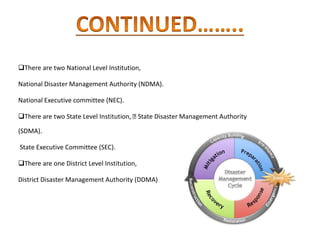
There are two National Level Institution,
National Disaster Management Authority (NDMA).
National Executive committee (NEC).
There are two State Level Institution, State Disaster Management Authority
(SDMA).
State Executive Committee (SEC).
There are one District Level Institution,
District Disaster Management Authority (DDMA)
Approve the National Plan.
Approve plans prepared by the Ministries or Departments of the Government of India
in accordance with the National Plan.
 Lay down guidelines to be followed by the State Authorities in drawing up the State
Plan.
Co-ordinate the enforcement and implementation of the policy and plan for disaster
management.
Recommend provision of funds for the purpose of mitigation.
Provide such support to other countries affected by major disasters as may be
determined by the Central Government
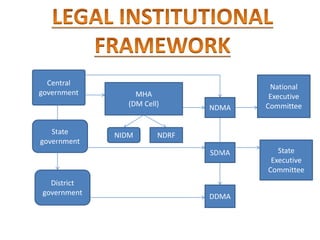
Central
government
State
government
District
government
MHA
(DM Cell)
NIDM NDRF
NDMA
SDMA
DDMA
National
Executive
Committee
State
Executive
Committee
• Shifting from relief and response mode, disaster management in India
started to address the issues of early warning systems, forecasting and
monitoring setup for various weather related hazards.
• A structure for flow of information, in the form of warnings, alert sand
updates about the oncoming hazard, also emerged within this framework.
• A multi-stakeholder High powered group was setup by involving
representatives from different ministries and departments.
• Some of these ministries were also designated as the nodal authorities for
specific disasters.
 The National Policy on Disaster Management (NPDM) has been approved by the
central govt. on October 22, 2009 and circulated to all concerned.
The policy covers all aspects of disaster management including institutional and
legal arrangements, financial arrangements, disaster prevention, mitigation and
preparedness etc.
 It focuses on the areas where action is needed and the institutional mechanism
through which such action can be channelized.
It aims to bring in transparency and accountability in all aspects of disaster
management through involvement of community, community based organisations
An institutional mechanism for preparation of the National
Plan has been put in place, which is under preparation in
three parts namely:
National Response Plan,
National Mitigation Plan &
National Capacity Building Plan.
 The National in the Ministry of Home Affairs functions 24×7 to monitor the
disaster or disaster like situation.
 During the south west monsoon, daily situation reports are prepared based
on the feedback received from the affected States and concerned Central
Ministries and organizations, and are sent to all concerned.
During the calamities of severe nature, special situation reports are also
prepared and issued to all concerned.
It also developed a branch called National Disaster Response Force (NDRF).
The main task of NDRF is to provide specialist response in case of disasters.
For large relief agencies & NGOs, the main response is to provide material
relief & rescue operation during times of disaster including medical relief.
 This is followed by a longer period of reconstruction activities of the physical
infrastructure like roads, houses, community buildings, drinking water facilities
etc. & continuation of medical aid.
For small & localized NGOs, initial response is in the form of rescue & material
relief. Most of larger India agencies stay back in disaster prone areas.
Local NGOs, who also participate in relief & reconstruction activities during
times of disaster, revert back to their usual predisaster activities after initial
phase
Public administration in disaster management

Public administration in disaster management

  • 2.
     India hasbeen traditionally vulnerable to natural disasters on account of its unique geo-climatic conditions.  Floods, droughts, cyclones, earthquakes and landslides have been a recurrent phenomena. Over the past couple of years, the Government of India have brought about a paradigm shift in the approach to disaster management. Disaster management occupies an important place in this country’s policy framework as it is the poor and the underprivileged who are worst affected on account of calamities/disasters.
  • 3.
    The Disaster ManagementAct, 2005 defines disaster as “A catastrophe, mishap, calamity or grave occurrence in any area, arising from natural or man made causes, or by accident or negligence which results in substantial loss of life or human suffering or damage to, and destruction of, property, or damage to, or degradation of, environment, and is of such a nature or magnitude as to be beyond the coping capacity of the community of the affected area”. The United Nations defines disaster as “The occurrence of sudden or major misfortune which disrupts the basic fabric and normal functioning of the society or community”.
  • 4.
     This Actprovides for the effective management of disaster and for matters connected there with or incidental thereto. It provides institutional mechanisms for drawing up and monitoring the implementation of the disaster management.  The Act also ensures measures by the various wings of the Govt. for prevention and mitigation of disasters and prompt response to any disaster situation.  The Act further provides for the constitution of different Executive Committee at national and state levels. The Act also provides specific roles to local bodies in disaster management.
  • 5.
    There are twoNational Level Institution, National Disaster Management Authority (NDMA). National Executive committee (NEC). There are two State Level Institution, State Disaster Management Authority (SDMA). State Executive Committee (SEC). There are one District Level Institution, District Disaster Management Authority (DDMA)
  • 6.
    Approve the NationalPlan. Approve plans prepared by the Ministries or Departments of the Government of India in accordance with the National Plan.  Lay down guidelines to be followed by the State Authorities in drawing up the State Plan. Co-ordinate the enforcement and implementation of the policy and plan for disaster management. Recommend provision of funds for the purpose of mitigation. Provide such support to other countries affected by major disasters as may be determined by the Central Government
  • 7.
  • 8.
    • Shifting fromrelief and response mode, disaster management in India started to address the issues of early warning systems, forecasting and monitoring setup for various weather related hazards. • A structure for flow of information, in the form of warnings, alert sand updates about the oncoming hazard, also emerged within this framework. • A multi-stakeholder High powered group was setup by involving representatives from different ministries and departments. • Some of these ministries were also designated as the nodal authorities for specific disasters.
  • 9.
     The NationalPolicy on Disaster Management (NPDM) has been approved by the central govt. on October 22, 2009 and circulated to all concerned. The policy covers all aspects of disaster management including institutional and legal arrangements, financial arrangements, disaster prevention, mitigation and preparedness etc.  It focuses on the areas where action is needed and the institutional mechanism through which such action can be channelized. It aims to bring in transparency and accountability in all aspects of disaster management through involvement of community, community based organisations
  • 10.
    An institutional mechanismfor preparation of the National Plan has been put in place, which is under preparation in three parts namely: National Response Plan, National Mitigation Plan & National Capacity Building Plan.
  • 11.
     The Nationalin the Ministry of Home Affairs functions 24×7 to monitor the disaster or disaster like situation.  During the south west monsoon, daily situation reports are prepared based on the feedback received from the affected States and concerned Central Ministries and organizations, and are sent to all concerned. During the calamities of severe nature, special situation reports are also prepared and issued to all concerned. It also developed a branch called National Disaster Response Force (NDRF). The main task of NDRF is to provide specialist response in case of disasters.
  • 12.
    For large reliefagencies & NGOs, the main response is to provide material relief & rescue operation during times of disaster including medical relief.  This is followed by a longer period of reconstruction activities of the physical infrastructure like roads, houses, community buildings, drinking water facilities etc. & continuation of medical aid. For small & localized NGOs, initial response is in the form of rescue & material relief. Most of larger India agencies stay back in disaster prone areas. Local NGOs, who also participate in relief & reconstruction activities during times of disaster, revert back to their usual predisaster activities after initial phase