Principles and practices of health systems strengthening in
fragile settings: conceptual reflections and operational
perspectives
Satellite session
Health System Research Symposium 2024
Tuesday, 19 November
Welcome
• Health system strengthening (HSS) remains an elusive concept – even more so in
fragile and conflict-affected settings. This session reflects on HSS in FCAS, from an
operational experiential perspective, combining conceptual thinking, photos, stories,
and participatory discussion.
• The findings presented are based on a study conducted by ReBUILD for Resilience
(ReBUILD), with World Vision and IRC.
• We gratefully acknowledge support for this satellite session from ReBUILD, WHO
EMRO, Action for Global Health (AfGH), World Vision – in collaboration with the TWG
FCAS
Outline
Part 1
• Presentations:
▫ The NGO perspective: why HSS in FCAS is relevant and progress so far
▫ Findings from key informant interviews: challenges and promising approaches for
HSS in FCAS
• Discussion: reflections on findings in relation to country and regional
experiences
Part 2
• Introduction to photo panels: Findings from photo elicitation
• Group work and discussion: what’s next for HSS programming in FCAS?
Speakers
• Egbert Sondorp (KIT & TWG FCAS Chair) – Session chair
• Jieun Lee (World Vision) - presenter
• Maria Bertone (ReBUILD & QMU) – presenter
• Fouad M Fouad (LSTM/AUB, UK/Lebanon) - discussant
• Cynthia Maung (Mae Tao Clinic, Thailand/Myanmar) - discussant
• Wastina Sintayehu (ACF, Somalia) - discussant
• Ali Ardalan (WHO EMRO) – discussant and conclusions
Health Systems Strengthening in the
Fragile and Conflict Affected Settings:
Why the Operational perspective?
HSR 2024
Satellite Session SS-103
Jieun Lee, Senior Health Advisor, World Vision UK
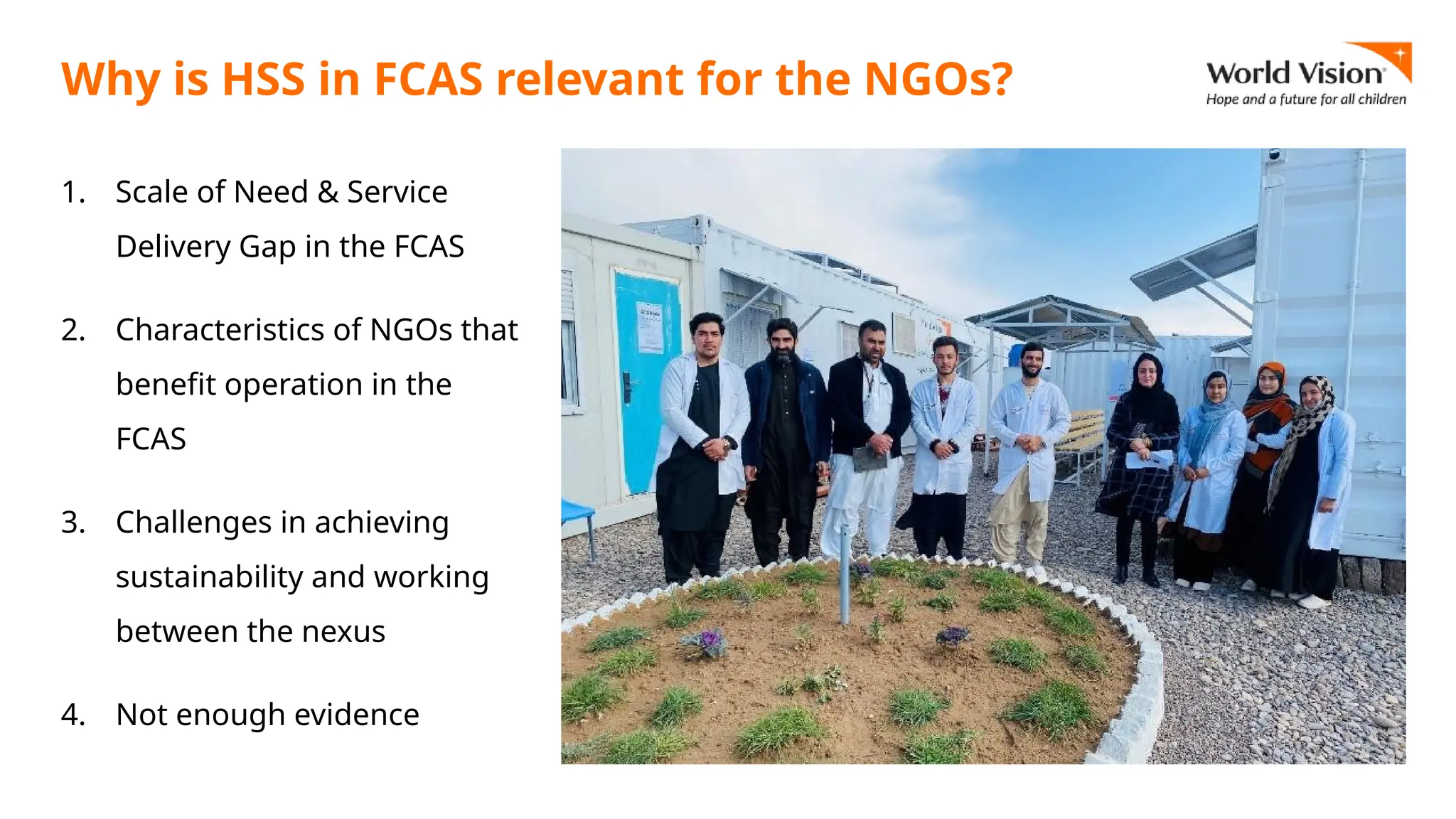
Why is HSS in FCAS relevant for the NGOs?
1. Scale of Need & Service
Delivery Gap in the FCAS
2. Characteristics of NGOs that
benefit operation in the
FCAS
3. Challenges in achieving
sustainability and working
between the nexus
4. Not enough evidence
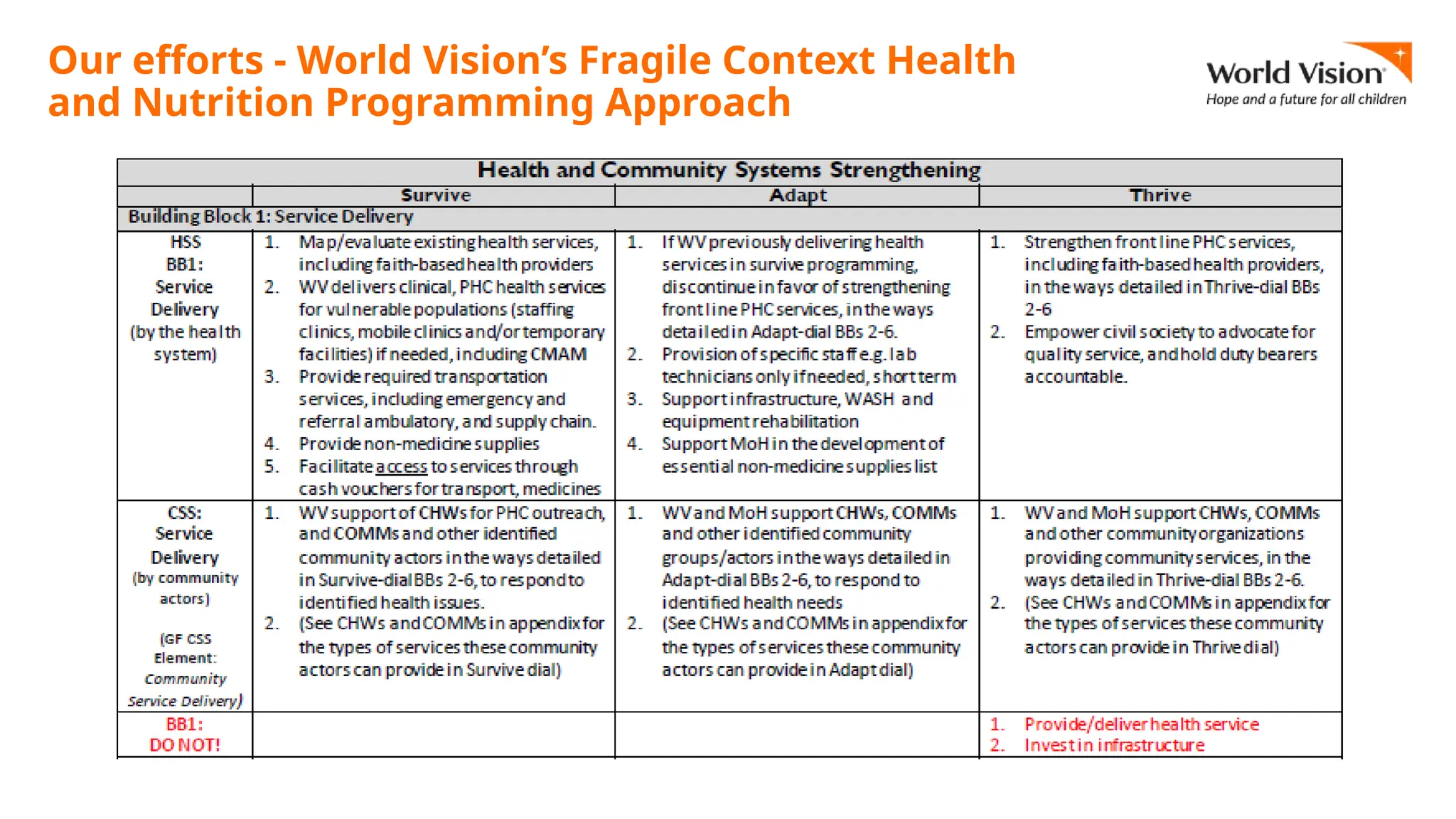
Our efforts - World Vision’s Fragile Context Health
and Nutrition Programming Approach
Our efforts - Somalia Global Fund TB programme
1. Navigating the politics,
operationalising a stable local
governing system
2. Adaptation to crisis –
COVID19 diagnosis through
existing diagnostics
equipment
3. Strengthening community-
based care, integration of
different vertical programs
4. Create an effective
information system for TB
data
Our efforts – UK-based Collaborative Advocacy Initiative
of CSOs (AfGH) and government (FCDO) (2022)
• Maximise frontline actors’ roles – invest in community and lower-level MoH capacity
strengthening
• Political will to invest in longer-term resilience building approaches
• Important to build common narrative across different sectors and nexuses
• Have better coordination mechanisms in-country (pooling funds, clusters)
• Generating evidence through agreeing on common, realistic and practical metrics
• Need to focus on 'how' to implement rather than just 'what' to do
Key Recommendations (Brief & Roundtable)
Principles and practices of health systems
strengthening in fragile settings:
findings from key informant interviews
Maria Bertone
Institute for Global Health and Development
Queen Margaret University, Edinburgh
Background
• Health system strengthening (HSS) is a term commonly used in global
health and HSS is seen as essential to ensure sustainable
improvements to health outcomes.
• However, it remains an elusive concept, and much debated
▫ how to define HSS?
▫ how to measure progress towards HSS?
• HSS in even more so in fragile and conflict-affected settings (FCAS),
where HSS efforts are complicated by weak governance and
fragmented response
 Focus on operational, experiential perspectives
Definitions and distinctions
• HSS as an intervention – focus on external interventions, how to “do” HSS
• HSS definition in relation to: scope, scale, sustainability, effects (Witter et al,
2019)
• HSS ≠ health system support
• HSS ≠ health system resilience
• HSS ≠ health system recovery (i.e. process undertaken to restore and
strengthen the health system following a shock)
▫ Relations to be explored
• FCAS:
▫ Adopt World Bank list but recognising heterogeneity
Aims of the study
• Adapt (conceptual) thinking on HSS to FCAS contexts
• Present experiential perspectives on ‘doing’ HSS in FCAS
• Influence NGOs and donors’ practice on HSS programming
Methods
Data collection
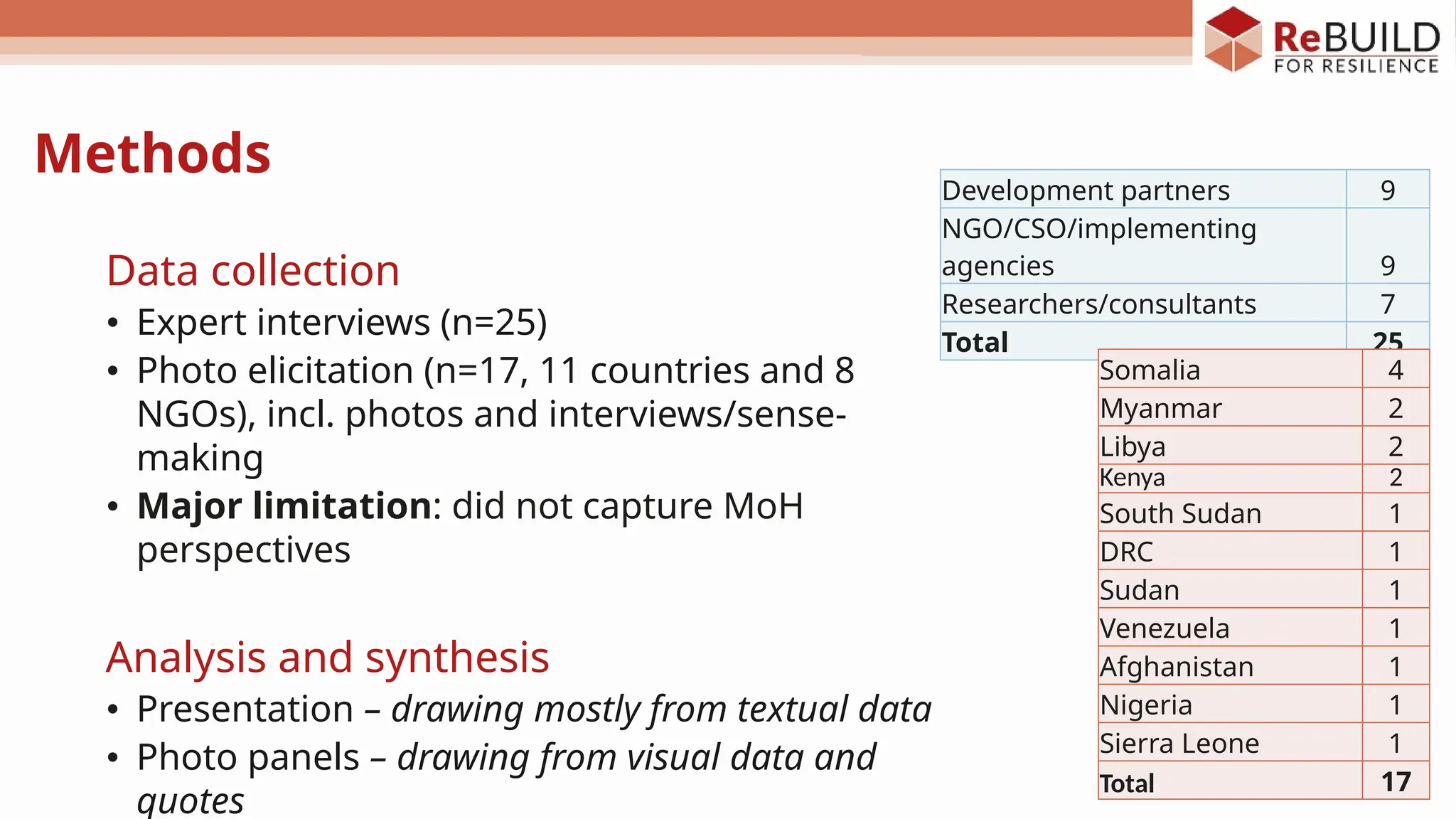
• Expert interviews (n=25)
• Photo elicitation (n=17, 11 countries and 8
NGOs), incl. photos and interviews/sense-
making
• Major limitation: did not capture MoH
perspectives
Analysis and synthesis
• Presentation – drawing mostly from textual data
• Photo panels – drawing from visual data and
quotes
Development partners 9
NGO/CSO/implementing
agencies 9
Researchers/consultants 7
Total 25
Somalia 4
Myanmar 2
Libya 2
Kenya 2
South Sudan 1
DRC 1
Sudan 1
Venezuela 1
Afghanistan 1
Nigeria 1
Sierra Leone 1
Total 17
Findings
Main themes
Challenges
Entry points
and promising
HSS
approaches
Fragility,
insecurity,
humanitaria
n priorities
Governanc
e
Aid
architectur
e
Role of
NGOs
Fragility, insecurity, humanitarian priorities
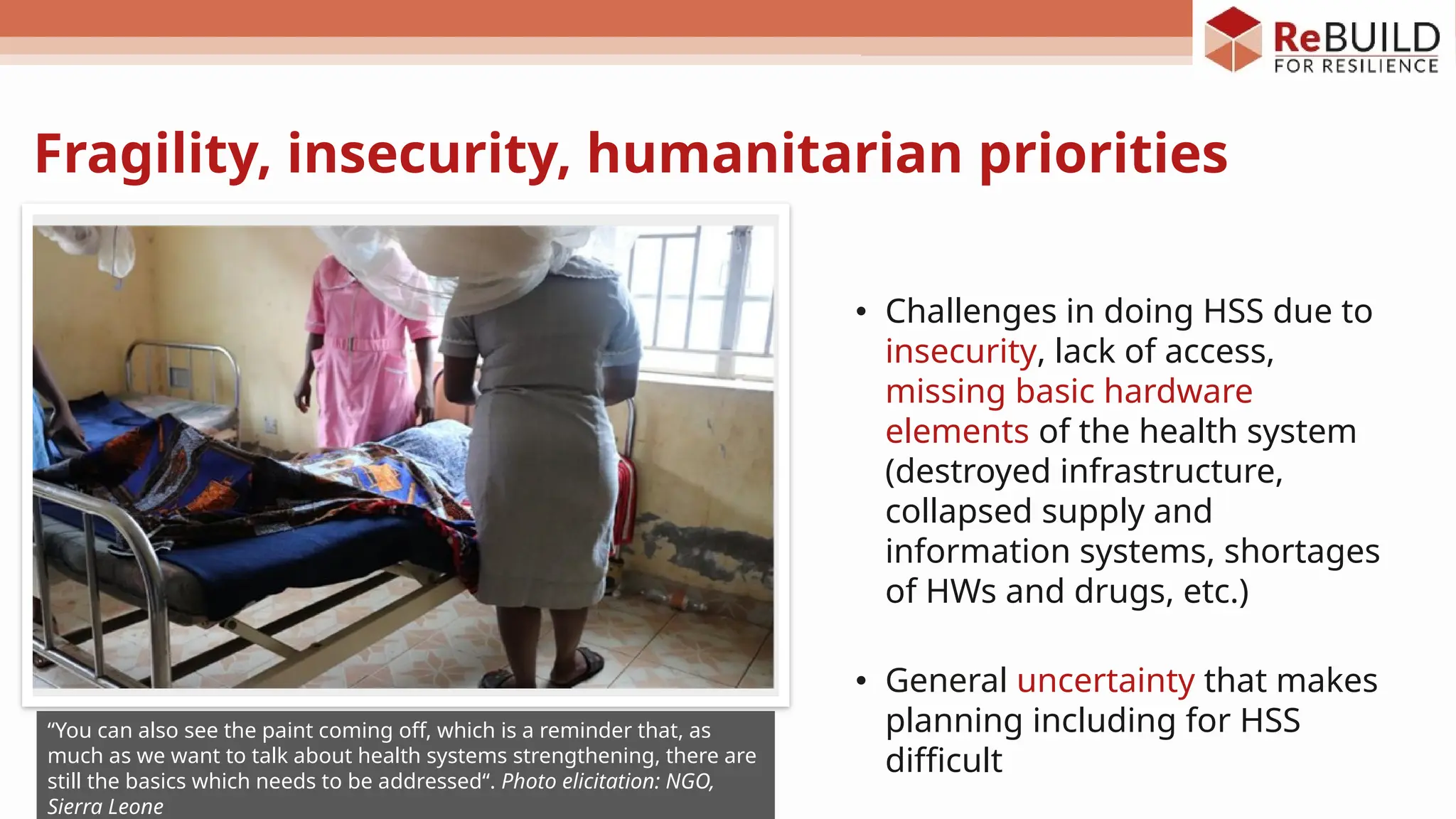
• Challenges in doing HSS due to
insecurity, lack of access,
missing basic hardware
elements of the health system
(destroyed infrastructure,
collapsed supply and
information systems, shortages
of HWs and drugs, etc.)
• General uncertainty that makes
planning including for HSS
difficult
“You can also see the paint coming off, which is a reminder that, as
much as we want to talk about health systems strengthening, there are
still the basics which needs to be addressed“. Photo elicitation: NGO,
Sierra Leone
• Potential to leverage the
humanitarian phase for HSS
• In some cases, crisis can even
provide windows for reforms / HSS:
▫ COVID-19
▫ Ukraine
▫ Vulnerabilities are more visible
“We need to have a clear understanding of what is
possible in each setting. We have to be realistic
about what is possible in terms of HSS. It is very
contextualised” (KII).
“It is important not to overestimate the priority of
HSS in humanitarian contexts, where the priority is
saving lives. Humanitarian actors are happy to use
existing systems where possible, but gaps are
sometimes too big. NGOs need to deliver, so having
to hire externally or bringing their own systems
might be needed” (KII).
• Priority is saving lives
• Focus on service delivery and
health system support at most “Emergencies are cyclical in a setting like eastern
DRC. We need to be able to capitalise on the
emergency response for HSS” (KII)
“Humanitarian actors are not mandated to do HSS
but [should] at least “do no harm”” (KII)
Fragility, insecurity, humanitarian priorities
• “That wretched Nexus stuff” (KII8)
• Considering the HDPNx is unavoidable as the emergency / development
distinction becomes increasingly less relevant, but it needs better
operationalisation.
• Operationalising the Nexus should start with financing: transparency on
funding (both humanitarian and development) and on activities carried out
“The Nexus is a positive idea, it opens up a conversation, but in practice
it is difficult to harmonise and operationalise” (KII)
“The Nexus is a blindspot. There is a lot of talk about it but no one knows
how to operationalise it, it is not happening at all” (KII)
Governance
• Lack of political peace and weak
governance and leadership make HSS
more difficult.
▫ Governments are weak, absent or multiple,
not legitimate (internally or externally), etc.
• HSS somewhat assumes the existence of a
single, national government and a public
health system as a precondition, what can
be done without it?
• Even more fundamentally, if there is no
government leadership/stewardship, how
can local ownership be fostered which
would make interventions sustainable?
“We are trying to build capacity at all
levels in case the transition [to
Government ownership] has to happen,
but the Somali government is very
politically fragmented, for any
activities there is the need for a lot of
negotiations, to sit with them at
different levels and multiple times, to
bring all to the table”. Photo elicitation:
NGO, Somalia
Governance and sustainability
Photo elicitation: NGO, Sierra Leone
“But the sustainability of the infrastructure investment depends on
leadership and governance. There is a need to partner with the government and
local authorities to build support systems to sustain infrastructure.“ Photo
Sustainability is a
core element of
HSS, but
interventions are
often planned and
implemented in
ways that are not
sustainable.
Trade-off between
“getting work
done” directly and
working through
the government.
Approaches to address governance issues
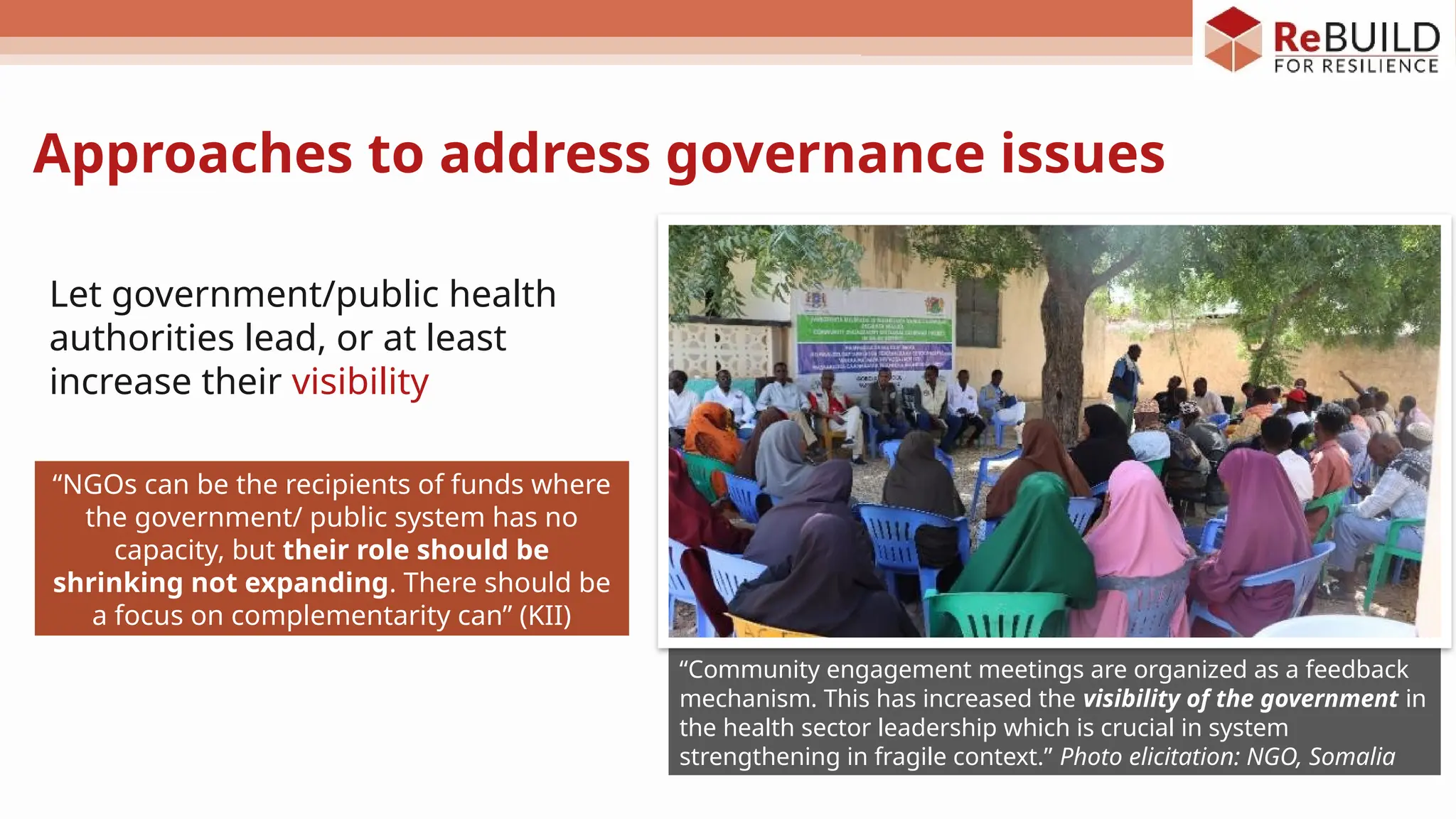
Let government/public health
authorities lead, or at least
increase their visibility
“Community engagement meetings are organized as a feedback
mechanism. This has increased the visibility of the government in
the health sector leadership which is crucial in system
strengthening in fragile context.” Photo elicitation: NGO, Somalia
“NGOs can be the recipients of funds where
the government/ public system has no
capacity, but their role should be
shrinking not expanding. There should be
a focus on complementarity can” (KII)
Approaches to address governance issues
Work with local (health)
authorities where “national”
governments are absent,
contested or not recognised
Work with non-public actors and
with a multisectoral approach
▫ Community actors and civil society
▫ Faith based
organisations/providers
▫ Private sector
Photo elicitation: DR Congo
Aid architecture
• Politics of HSS: different mandates, agendas and interests
▫ Humanitarian and development funders, GHIs, embassies/political and military
departments
• Which correspond to different activities, timelines, funding sources and coordination
approaches, as well as different understanding of HSS
• Fiduciary rules and mistrust in government: fragility as ‘convenient excuse’ to
bypass governments and avoid HSS?
• NGOs’ interests: reticence for HSS/government ownership?
 Results in fragmented, short-term funding; focus on service delivery or disease-
specific HS support (inputs & building blocks); focus on measurable/countable
outputs and outcomes of dubious attribution (‘lives saved’)
Aid architecture
Promising approaches:
• A focus on PHC and integrated
healthcare is seen as a possible
approach to support HSS and
sustainability of interventions,
while keeping a focus on service
delivery
• Move away from service delivery
and inputs (ex., in-service
training) to allow space/funding
for ‘truer’ HSS activities
“The different donors are doing vertical
programmes. Imagine we put them together
and do one comprehensive programme? It
could really benefit the Somalian population.
It’s about service delivery, innovation of
technology, patient centered approach,
accessibility. Some difficult questions that are
being asked about sustainability – the answer
is integration.“ Photo elicitation: NGO, Somalia
Aid architecture
Promising approaches
• Intentional, flexible approaches to HSS programming that allow experimentation and
adaptation/tailoring to context, and foster a culture of learning:
▫ PDIA in Nigeria
▫ hand-holding in NW Syria
• Longer-term funding
• Different approach to HSS measurements
▫ focus on processes
(health system process goals - Bertone et al., 2023)
“Donors should put more emphasis on
integrating HSS into project more
systematically. At the moment, it is left to the
NGOs to decide how to integrate HSS. Often
HSS is facilitated when projects are long, where
there is not much staff turnover, where the NGO
can build a good relation with the government”
(KII).
“Adaptability to context is key. NGOs often
operate in the same way, with the same models
across contexts and overtime. We talk about
localisation and empowering local partners but
this is still not happening” (KII)
Aid architecture & coordination
Coordination emerges as a major challenge
▫ Health cluster approach: working better?
▫ Coordination of humanitarian and development actors?
▫ Different approaches among partners (World Bank, GHIs,
bilateral actors)
If government is too weak to take leadership in coordination,
development partners should have a more decisive role
▫ But who should do it? WHO and UN agencies sometimes
seen as weak and with potential conflicts of interest (vis-à-
vis MoH and/or GHIs); others?
“Humanitarian actors should be
more aware of the system effects
of their interventions. For
example, in South Sudan there
was a process to harmonise the
incentives for health workers to
which all NGOs subscribed. But
humanitarian actors did not
accept it.” (KII)
• NGOs are not better placed for HSS and
taking the “strategic view”
• They needs supportive structures and a
clear set of incentives from funders to be
able to facilitate/do HSS
• There is also need for more understanding
and capacity building around HSS
▫ Varying definitions and level of
conceptual reflections
▫ Also reflecting mandates and funding
sources (e.g. humanitarian or GHI
funding)
Role of NGOs
“NGOs have more competence in service delivery and
less in working across the building blocks. Is [HSS]
really their role? They can’t work if [governance]
structures are not well set up. But at the same time, is it
their role to do it [set up governance structures]?” (KII).
“We can’t expect NGOs to be strategic at such high level
(...). But they can be involved in the discussions to
ensure empowerment, allow them to contribute to the
debate and share their learnings, ask donors to set the
right incentives for NGOs” (KII).
“Donors should allow, NGOs should do” (KII).
Conclusions & next steps
What can we learn?
• Insights into important, often overlooked perspectives and operational experiences of
implementing actors – the “middle level” of the ecosystem
• Findings highlight challenges (not unknown), entry points and promising approaches, and
gaps in evidence or blind spots in policy and practice that have not been systematically
discussed and even less so addressed:
▫ Why? politics and incentives; lack of learning culture; little engagement of operational
actors?
▫ Opportunity for change with Lusaka Agenda and potential policy openings?
Next steps: more data (KIIs, photos, doc review), further analysis/reflections, and
engagement of key actors on clear messages on HSS programming in FCAS
Thank you
This project is funded with UK aid from the British people
Many thanks to Jieun Lee (World Vision, UK)
and Ezinne Peters (IRC) for support with study
design and data collection for this study.
Discussion and Q&A with audience
• What are your thoughts and reflections on the themes and
findings coming out of the analysis? how to they relate to your
experience at country and regional level?
• Are there other challenges and promising approaches or entry
points for HSS in FCAS that should be included in our thinking?
Part 2 - Engaging with photo panels
Principles and practices of health systems
strengthening in fragile settings: engaging with photo
panels
Maria Bertone
Institute for Global Health and Development
Queen Margaret University, Edinburgh
Photo Elicitation
IRC 7
World Vision 2
IMC 2
CPI 2
Good Health
Community 1
Trocaire 1
ACF 1
UCB 1
Somalia 4
Myanmar 2
Libya 2
Kenya 2
South Sudan 1
DRC 1
Sudan 1
Venezuela 1
Afghanistan 1
Nigeria 1
Sierra Leone 1
Total 17
Main themes
Themes
Fragility,
insecurity,
access
challenges
Governance
Sustainability
Health
workforce
PHC and
integrated
healthcare
delivery
Health
system
elements
and
complexity
Challenges
Entry points
and promising
HSS
approaches
Main themes
Themes
Fragility,
insecurity,
access
challenges
Governance
Sustainabilit
y
Health
workforce
PHC and
integrated
healthcare
delivery
Health
system
elements
and
complexity
• Challenges in access
due to insecurity, lack
of infrastructure, etc.
is a major challenge
for HSS.
Main themes
Themes
Fragility,
insecurity,
access
challenges
Governance
Sustainabilit
y
Health
workforce
PHC and
integrated
healthcare
delivery
Health
system
elements
and
complexity
Lack of governance and
leadership makes HSS
more difficult
Main themes
Themes
Fragility,
insecurity,
access
challenges
Governance
Sustainability
Health
workforce
PHC and
integrated
healthcare
delivery
Health
system
elements
and
complexity
• Core element of HSS
• Trade-off between “getting work done”
directly and sustainability, e.g. through
government ownership.
• Longer project timeframes are critical to
ensure sustainability.
Main themes
Themes
Fragility,
insecurity,
access
challenges
Governance
Sustainability
Health
workforce
PHC and
integrated
healthcare
delivery
Health
system
elements
and
complexity
• Health workforce as a starting
point for HSS
• Issues around sustainability
(e.g. with focus on short term
in-service training; CHWs
support)
Main themes
Themes
Fragility,
insecurity,
access
challenges
Governance
Sustainabilit
y
Health
workforce
PHC and
integrated
healthcare
delivery
Health
system
elements
and
complexity
• Often funders push for
focus on service delivery,
rather than HSS.
• Focus on PHC and
integrated healthcare as
approach to support HSS
and sustainability of
interventions, while
keeping a focus on service
delivery
Main themes
Themes
Fragility,
insecurity,
access
challenges
Governance
Sustainabilit
y
Health
workforce
PHC and
integrated
healthcare
delivery
Health
system
elements
and
complexity
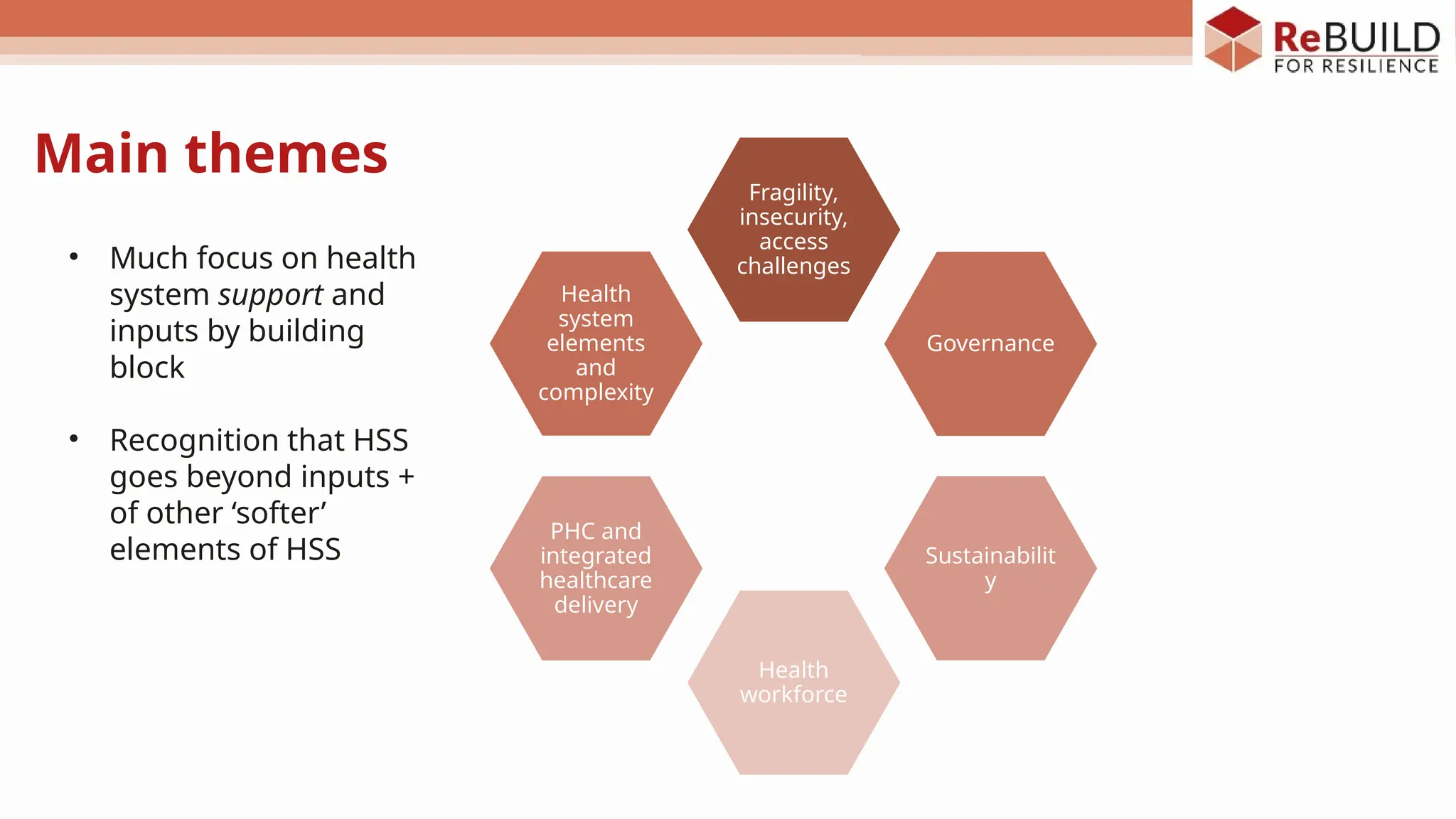
• Much focus on health
system support and
inputs by building
block
• Recognition that HSS
goes beyond inputs +
of other ‘softer’
elements of HSS
Thank you
This project is funded with UK aid from the British people
Many thanks to Jieun Lee (World Vision, UK) and
Ezinne Peters (IRC) for support with study design
and data collection for this study, and to
Kate Hawkins for communications and design
advice.
Group work
• Pick a photo panel/group and reflect on the questions below –
individually or with others
• Note your reflections on the post-its provided
• Feel free to move around between different panels
• Do the photos and quotes resonate with your experience of doing HSS in
FCAS? What is similar or different?
• How can HSS programming in FCAS be improved to address challenges
and build on lessons learned?
▫ Who should do what?
Discussion and Q&A with audience
• Feedback from group discussion: do the photos and quotes
resonate with your experience of doing HSS in FCAS? What is
similar or different?
• More broadly, how can HSS programming in FCAS be
improved
▫ In relation to design, implementation, funding, management, ...
▫ Who should do what? What are the respective roles of key actors
for HSS in FCAS?
Thank you
Thank you to ReBUILD for Resilience,
WHO EMRO, Action for Global Health
(AfGH), World Vision, IRC and the
TWG FCAS for support conducting the
study and for the organisation of this
satellite session

Health System Strengthening in Fragile & Conflict-Affected Settings

  • 1.
    Principles and practicesof health systems strengthening in fragile settings: conceptual reflections and operational perspectives Satellite session Health System Research Symposium 2024 Tuesday, 19 November
  • 2.
    Welcome • Health systemstrengthening (HSS) remains an elusive concept – even more so in fragile and conflict-affected settings. This session reflects on HSS in FCAS, from an operational experiential perspective, combining conceptual thinking, photos, stories, and participatory discussion. • The findings presented are based on a study conducted by ReBUILD for Resilience (ReBUILD), with World Vision and IRC. • We gratefully acknowledge support for this satellite session from ReBUILD, WHO EMRO, Action for Global Health (AfGH), World Vision – in collaboration with the TWG FCAS
  • 3.
    Outline Part 1 • Presentations: ▫The NGO perspective: why HSS in FCAS is relevant and progress so far ▫ Findings from key informant interviews: challenges and promising approaches for HSS in FCAS • Discussion: reflections on findings in relation to country and regional experiences Part 2 • Introduction to photo panels: Findings from photo elicitation • Group work and discussion: what’s next for HSS programming in FCAS?
  • 4.
    Speakers • Egbert Sondorp(KIT & TWG FCAS Chair) – Session chair • Jieun Lee (World Vision) - presenter • Maria Bertone (ReBUILD & QMU) – presenter • Fouad M Fouad (LSTM/AUB, UK/Lebanon) - discussant • Cynthia Maung (Mae Tao Clinic, Thailand/Myanmar) - discussant • Wastina Sintayehu (ACF, Somalia) - discussant • Ali Ardalan (WHO EMRO) – discussant and conclusions
  • 5.
    Health Systems Strengtheningin the Fragile and Conflict Affected Settings: Why the Operational perspective? HSR 2024 Satellite Session SS-103 Jieun Lee, Senior Health Advisor, World Vision UK
  • 6.
    Why is HSSin FCAS relevant for the NGOs? 1. Scale of Need & Service Delivery Gap in the FCAS 2. Characteristics of NGOs that benefit operation in the FCAS 3. Challenges in achieving sustainability and working between the nexus 4. Not enough evidence
  • 7.
    Our efforts -World Vision’s Fragile Context Health and Nutrition Programming Approach
  • 8.
    Our efforts -Somalia Global Fund TB programme 1. Navigating the politics, operationalising a stable local governing system 2. Adaptation to crisis – COVID19 diagnosis through existing diagnostics equipment 3. Strengthening community- based care, integration of different vertical programs 4. Create an effective information system for TB data
  • 9.
    Our efforts –UK-based Collaborative Advocacy Initiative of CSOs (AfGH) and government (FCDO) (2022)
  • 10.
    • Maximise frontlineactors’ roles – invest in community and lower-level MoH capacity strengthening • Political will to invest in longer-term resilience building approaches • Important to build common narrative across different sectors and nexuses • Have better coordination mechanisms in-country (pooling funds, clusters) • Generating evidence through agreeing on common, realistic and practical metrics • Need to focus on 'how' to implement rather than just 'what' to do Key Recommendations (Brief & Roundtable)
  • 11.
    Principles and practicesof health systems strengthening in fragile settings: findings from key informant interviews Maria Bertone Institute for Global Health and Development Queen Margaret University, Edinburgh
  • 12.
    Background • Health systemstrengthening (HSS) is a term commonly used in global health and HSS is seen as essential to ensure sustainable improvements to health outcomes. • However, it remains an elusive concept, and much debated ▫ how to define HSS? ▫ how to measure progress towards HSS? • HSS in even more so in fragile and conflict-affected settings (FCAS), where HSS efforts are complicated by weak governance and fragmented response  Focus on operational, experiential perspectives
  • 13.
    Definitions and distinctions •HSS as an intervention – focus on external interventions, how to “do” HSS • HSS definition in relation to: scope, scale, sustainability, effects (Witter et al, 2019) • HSS ≠ health system support • HSS ≠ health system resilience • HSS ≠ health system recovery (i.e. process undertaken to restore and strengthen the health system following a shock) ▫ Relations to be explored • FCAS: ▫ Adopt World Bank list but recognising heterogeneity
  • 14.
    Aims of thestudy • Adapt (conceptual) thinking on HSS to FCAS contexts • Present experiential perspectives on ‘doing’ HSS in FCAS • Influence NGOs and donors’ practice on HSS programming
  • 15.
    Methods Data collection • Expertinterviews (n=25) • Photo elicitation (n=17, 11 countries and 8 NGOs), incl. photos and interviews/sense- making • Major limitation: did not capture MoH perspectives Analysis and synthesis • Presentation – drawing mostly from textual data • Photo panels – drawing from visual data and quotes Development partners 9 NGO/CSO/implementing agencies 9 Researchers/consultants 7 Total 25 Somalia 4 Myanmar 2 Libya 2 Kenya 2 South Sudan 1 DRC 1 Sudan 1 Venezuela 1 Afghanistan 1 Nigeria 1 Sierra Leone 1 Total 17
  • 16.
  • 17.
    Main themes Challenges Entry points andpromising HSS approaches Fragility, insecurity, humanitaria n priorities Governanc e Aid architectur e Role of NGOs
  • 18.
    Fragility, insecurity, humanitarianpriorities • Challenges in doing HSS due to insecurity, lack of access, missing basic hardware elements of the health system (destroyed infrastructure, collapsed supply and information systems, shortages of HWs and drugs, etc.) • General uncertainty that makes planning including for HSS difficult “You can also see the paint coming off, which is a reminder that, as much as we want to talk about health systems strengthening, there are still the basics which needs to be addressed“. Photo elicitation: NGO, Sierra Leone
  • 19.
    • Potential toleverage the humanitarian phase for HSS • In some cases, crisis can even provide windows for reforms / HSS: ▫ COVID-19 ▫ Ukraine ▫ Vulnerabilities are more visible “We need to have a clear understanding of what is possible in each setting. We have to be realistic about what is possible in terms of HSS. It is very contextualised” (KII). “It is important not to overestimate the priority of HSS in humanitarian contexts, where the priority is saving lives. Humanitarian actors are happy to use existing systems where possible, but gaps are sometimes too big. NGOs need to deliver, so having to hire externally or bringing their own systems might be needed” (KII). • Priority is saving lives • Focus on service delivery and health system support at most “Emergencies are cyclical in a setting like eastern DRC. We need to be able to capitalise on the emergency response for HSS” (KII) “Humanitarian actors are not mandated to do HSS but [should] at least “do no harm”” (KII) Fragility, insecurity, humanitarian priorities
  • 20.
    Fragility, insecurity, humanitarianpriorities • “That wretched Nexus stuff” (KII8) • Considering the HDPNx is unavoidable as the emergency / development distinction becomes increasingly less relevant, but it needs better operationalisation. • Operationalising the Nexus should start with financing: transparency on funding (both humanitarian and development) and on activities carried out “The Nexus is a positive idea, it opens up a conversation, but in practice it is difficult to harmonise and operationalise” (KII) “The Nexus is a blindspot. There is a lot of talk about it but no one knows how to operationalise it, it is not happening at all” (KII)
  • 21.
    Governance • Lack ofpolitical peace and weak governance and leadership make HSS more difficult. ▫ Governments are weak, absent or multiple, not legitimate (internally or externally), etc. • HSS somewhat assumes the existence of a single, national government and a public health system as a precondition, what can be done without it? • Even more fundamentally, if there is no government leadership/stewardship, how can local ownership be fostered which would make interventions sustainable? “We are trying to build capacity at all levels in case the transition [to Government ownership] has to happen, but the Somali government is very politically fragmented, for any activities there is the need for a lot of negotiations, to sit with them at different levels and multiple times, to bring all to the table”. Photo elicitation: NGO, Somalia
  • 22.
    Governance and sustainability Photoelicitation: NGO, Sierra Leone “But the sustainability of the infrastructure investment depends on leadership and governance. There is a need to partner with the government and local authorities to build support systems to sustain infrastructure.“ Photo Sustainability is a core element of HSS, but interventions are often planned and implemented in ways that are not sustainable. Trade-off between “getting work done” directly and working through the government.
  • 23.
    Approaches to addressgovernance issues Let government/public health authorities lead, or at least increase their visibility “Community engagement meetings are organized as a feedback mechanism. This has increased the visibility of the government in the health sector leadership which is crucial in system strengthening in fragile context.” Photo elicitation: NGO, Somalia “NGOs can be the recipients of funds where the government/ public system has no capacity, but their role should be shrinking not expanding. There should be a focus on complementarity can” (KII)
  • 24.
    Approaches to addressgovernance issues Work with local (health) authorities where “national” governments are absent, contested or not recognised Work with non-public actors and with a multisectoral approach ▫ Community actors and civil society ▫ Faith based organisations/providers ▫ Private sector Photo elicitation: DR Congo
  • 25.
    Aid architecture • Politicsof HSS: different mandates, agendas and interests ▫ Humanitarian and development funders, GHIs, embassies/political and military departments • Which correspond to different activities, timelines, funding sources and coordination approaches, as well as different understanding of HSS • Fiduciary rules and mistrust in government: fragility as ‘convenient excuse’ to bypass governments and avoid HSS? • NGOs’ interests: reticence for HSS/government ownership?  Results in fragmented, short-term funding; focus on service delivery or disease- specific HS support (inputs & building blocks); focus on measurable/countable outputs and outcomes of dubious attribution (‘lives saved’)
  • 26.
    Aid architecture Promising approaches: •A focus on PHC and integrated healthcare is seen as a possible approach to support HSS and sustainability of interventions, while keeping a focus on service delivery • Move away from service delivery and inputs (ex., in-service training) to allow space/funding for ‘truer’ HSS activities “The different donors are doing vertical programmes. Imagine we put them together and do one comprehensive programme? It could really benefit the Somalian population. It’s about service delivery, innovation of technology, patient centered approach, accessibility. Some difficult questions that are being asked about sustainability – the answer is integration.“ Photo elicitation: NGO, Somalia
  • 27.
    Aid architecture Promising approaches •Intentional, flexible approaches to HSS programming that allow experimentation and adaptation/tailoring to context, and foster a culture of learning: ▫ PDIA in Nigeria ▫ hand-holding in NW Syria • Longer-term funding • Different approach to HSS measurements ▫ focus on processes (health system process goals - Bertone et al., 2023) “Donors should put more emphasis on integrating HSS into project more systematically. At the moment, it is left to the NGOs to decide how to integrate HSS. Often HSS is facilitated when projects are long, where there is not much staff turnover, where the NGO can build a good relation with the government” (KII). “Adaptability to context is key. NGOs often operate in the same way, with the same models across contexts and overtime. We talk about localisation and empowering local partners but this is still not happening” (KII)
  • 28.
    Aid architecture &coordination Coordination emerges as a major challenge ▫ Health cluster approach: working better? ▫ Coordination of humanitarian and development actors? ▫ Different approaches among partners (World Bank, GHIs, bilateral actors) If government is too weak to take leadership in coordination, development partners should have a more decisive role ▫ But who should do it? WHO and UN agencies sometimes seen as weak and with potential conflicts of interest (vis-à- vis MoH and/or GHIs); others? “Humanitarian actors should be more aware of the system effects of their interventions. For example, in South Sudan there was a process to harmonise the incentives for health workers to which all NGOs subscribed. But humanitarian actors did not accept it.” (KII)
  • 29.
    • NGOs arenot better placed for HSS and taking the “strategic view” • They needs supportive structures and a clear set of incentives from funders to be able to facilitate/do HSS • There is also need for more understanding and capacity building around HSS ▫ Varying definitions and level of conceptual reflections ▫ Also reflecting mandates and funding sources (e.g. humanitarian or GHI funding) Role of NGOs “NGOs have more competence in service delivery and less in working across the building blocks. Is [HSS] really their role? They can’t work if [governance] structures are not well set up. But at the same time, is it their role to do it [set up governance structures]?” (KII). “We can’t expect NGOs to be strategic at such high level (...). But they can be involved in the discussions to ensure empowerment, allow them to contribute to the debate and share their learnings, ask donors to set the right incentives for NGOs” (KII). “Donors should allow, NGOs should do” (KII).
  • 30.
  • 31.
    What can welearn? • Insights into important, often overlooked perspectives and operational experiences of implementing actors – the “middle level” of the ecosystem • Findings highlight challenges (not unknown), entry points and promising approaches, and gaps in evidence or blind spots in policy and practice that have not been systematically discussed and even less so addressed: ▫ Why? politics and incentives; lack of learning culture; little engagement of operational actors? ▫ Opportunity for change with Lusaka Agenda and potential policy openings? Next steps: more data (KIIs, photos, doc review), further analysis/reflections, and engagement of key actors on clear messages on HSS programming in FCAS
  • 32.
    Thank you This projectis funded with UK aid from the British people Many thanks to Jieun Lee (World Vision, UK) and Ezinne Peters (IRC) for support with study design and data collection for this study.
  • 33.
    Discussion and Q&Awith audience • What are your thoughts and reflections on the themes and findings coming out of the analysis? how to they relate to your experience at country and regional level? • Are there other challenges and promising approaches or entry points for HSS in FCAS that should be included in our thinking?
  • 34.
    Part 2 -Engaging with photo panels
  • 35.
    Principles and practicesof health systems strengthening in fragile settings: engaging with photo panels Maria Bertone Institute for Global Health and Development Queen Margaret University, Edinburgh
  • 36.
    Photo Elicitation IRC 7 WorldVision 2 IMC 2 CPI 2 Good Health Community 1 Trocaire 1 ACF 1 UCB 1 Somalia 4 Myanmar 2 Libya 2 Kenya 2 South Sudan 1 DRC 1 Sudan 1 Venezuela 1 Afghanistan 1 Nigeria 1 Sierra Leone 1 Total 17
  • 37.
  • 38.
  • 39.
  • 40.
    Main themes Themes Fragility, insecurity, access challenges Governance Sustainability Health workforce PHC and integrated healthcare delivery Health system elements and complexity •Core element of HSS • Trade-off between “getting work done” directly and sustainability, e.g. through government ownership. • Longer project timeframes are critical to ensure sustainability.
  • 41.
    Main themes Themes Fragility, insecurity, access challenges Governance Sustainability Health workforce PHC and integrated healthcare delivery Health system elements and complexity •Health workforce as a starting point for HSS • Issues around sustainability (e.g. with focus on short term in-service training; CHWs support)
  • 42.
    Main themes Themes Fragility, insecurity, access challenges Governance Sustainabilit y Health workforce PHC and integrated healthcare delivery Health system elements and complexity •Often funders push for focus on service delivery, rather than HSS. • Focus on PHC and integrated healthcare as approach to support HSS and sustainability of interventions, while keeping a focus on service delivery
  • 43.
    Main themes Themes Fragility, insecurity, access challenges Governance Sustainabilit y Health workforce PHC and integrated healthcare delivery Health system elements and complexity •Much focus on health system support and inputs by building block • Recognition that HSS goes beyond inputs + of other ‘softer’ elements of HSS
  • 44.
    Thank you This projectis funded with UK aid from the British people Many thanks to Jieun Lee (World Vision, UK) and Ezinne Peters (IRC) for support with study design and data collection for this study, and to Kate Hawkins for communications and design advice.
  • 45.
    Group work • Picka photo panel/group and reflect on the questions below – individually or with others • Note your reflections on the post-its provided • Feel free to move around between different panels • Do the photos and quotes resonate with your experience of doing HSS in FCAS? What is similar or different? • How can HSS programming in FCAS be improved to address challenges and build on lessons learned? ▫ Who should do what?
  • 46.
    Discussion and Q&Awith audience • Feedback from group discussion: do the photos and quotes resonate with your experience of doing HSS in FCAS? What is similar or different? • More broadly, how can HSS programming in FCAS be improved ▫ In relation to design, implementation, funding, management, ... ▫ Who should do what? What are the respective roles of key actors for HSS in FCAS?
  • 47.
    Thank you Thank youto ReBUILD for Resilience, WHO EMRO, Action for Global Health (AfGH), World Vision, IRC and the TWG FCAS for support conducting the study and for the organisation of this satellite session

Editor's Notes

  • #2 Egbert: you can leave this slide on and speak to it as you prefer – to briefly introduce the topic/its relevance
  • #5 Good afternoon. My name is Jieun Lee, Senior Health Advisor for World Vision UK. For those of you who don’t know, World Vision is the largest international Christian NGO established in1950’s. We work for children and communities in almost 100 countries. Today, I'll present the rationale behind our collective research on operationalizing Health Systems Strengthening in Fragile and Conflict-Affected States (FCAS)
  • #6 The imperative for HSS in FCAS is evidenced by stark demographics: 1.8 billion people—23% of the global population—reside in FCAS, where under-five mortality rates double the global average and maternal mortality quadruples non-fragile contexts. By 2030, the affected population is projected to reach 2.2 billion. NGOs have emerged as critical actors in these contexts, often serving as primary healthcare providers where state systems are compromised. However, the transition from essential service provision to systematic HSS remains challenging, constrained by donor parameters, risk management considerations, and limited empirical evidence on effective HSS implementation in FCAS --------------------------------- 1. Scale of Need: 1.8 billion people (23% of world population) live in FCAS These areas have twice the under-five mortality rate of global average Maternal mortality is four times higher than in non-fragile contexts By 2030, affected population expected to reach 2.2 billion 2. Service Delivery Gap: NGOs often become primary healthcare providers when state systems fail They fill critical gaps where government facilities are non-functional or weak They're often the only organizations able to reach vulnerable populations in conflict zones 3. Community Trust & Access: NGOs can build trust where government systems have lost credibility They often have better access to communities through established networks Can help combat misinformation and stigma through community engagement 4. Operational Flexibility: Can work in areas where traditional government services can't operate Able to adapt quickly to changing security situations Can maintain service delivery despite fragmented systems However, NGOs often end at provision of essential services, and struggle to do HSS work. This often comes with remits set by the donors, balancing managing risk vs. handing over responsibilities to the public actors (i.e. governments), but also because of difficulty to be ‘intentional’ in programme design and lack of evidence on what a good HSS in FCAS is practically.
  • #7 World Vision's operational presence in 50% of World Bank-designated FCAS has informed our development of the Fragile Context Programming Approach. This framework operates across the humanitarian-development-peacebuilding nexus through three operational modes: Survive, Adapt, and Thrive. Our operational framework delineates specific interventions across these dials: in the Survive phase, WV directly delivers essential health services and supports community health workers, while in Adapt and Thrive phases, we progressively transition to strengthening frontline PHC services and building local capacity. This systematic approach ensures a clear progression from emergency response to sustainable health system strengthening, with explicit guidance on activities to undertake or avoid at each stage - notably avoiding direct service delivery and infrastructure investment in the Thrive phase. ------------------------------ There are efforts that are being made to be more ‘intentional’ such as this of World Vision’s. World Vision, operates in half of the countries listed as FCAS by the WB. Recognising the complexity of working in such context, WV has developed a fragile context programming approach, which is one of the few approaches that works across the humanitarian-development-peacebuilding Nexus at scale. We intentionally promote an integrated approach to look at short- and long-term needs, addressing its root causes, and catalysing recovery and resilience. The flexible and adaptable design process means programmes can move back and forward depending on the context staying the same, deteriorating or improving. We work under 3 different dials, Survive, Adapt, and Thrive. The survive dial is where immediate needs for survival needs to be met in which case we usually engage in humanitarian/emergency response. In general, this may require organisations like WV to deliver health services on behalf and in the absence of local health actors; as well as to train, support and remunerate CHWs to take the lead in primary health care outreach. The Adapt and Thrive dials will see WV increasingly transitioning service delivery responsibilities back to the MoH and will see some CHWs’ work task-shifted back to health facility staff. However, particularly in a prolonged humanitarian response – in addition to addressing immediate needs, there should be emphasis on identifying and addressing root causes and supporting the (re)-establishment of functioning health systems and social ties as soon as reasonably possible. In other words, a prolonged humanitarian response should broaden the scope from only survive/emergency response, to incorporate interventions taken from the adapt and/or thrive dials as well, as possible. The chart, though may be hard to see, is an example of this.
  • #8 To illustrate this approach's efficacy, consider our Somalia TB program implementation since 2004. Key achievements include: Establishment of an effective multi-state coordination mechanism Systems adaptation during COVID-19 through repurposing GeneXpert diagnostics Integration of vertical interventions into primary healthcare Strengthening community-based health systems Integration of program data into national DHIS2 ---------------------- Another example of our own. World Vision has been implementing a national TB programme since 2004 in Somalia, funded by Global Fund. We run over 110 TB control centres across the country with an aim to eradicate TB in Somalia, where there is high burden of Multidrug resistant TB. During the past 2 decades, we’ve seen decrease in TB incidence, high TB treatment success rate, and MDR TB treatment success rate. But what I’d like to highlight is our intentional efforts made to foster sustainability. First, we were successful in navigating the politics, and operationalising a local governing system. As there were 7 autonomous states with conflicting priorities, we spent years establish a stable country-coordinating mechanism which involves all states as well as active partners working in Somalia related to TB control. At the absence of a functioning and unified government, this led not only to a smoother implementation with easier decision-making process, but contributed to creating a sustainable environment where various national-level decisions were made not only on TB but on various health related topics. This was recognised by Global Fund as one of the major achievements. Secondly, we were able to help the health system adapt to crisis by using the existing diagnostics machine for TB called the Gene Xpert to diagnose COVID-19. This was significant at the time as there was no other means to diagnose TB at the start of the outbreak in Somalia. Thirdly, where the programme was traditionally designed as a vertical intervention, meaning only focused on treating TB, over the years we were able to transition to integrate into primary healthcare facilities. This helped reduce stigma hence contribute to the access to TB care, as well as accessibility of comprehensive healthcare to the population. We have also started providing TB/HIV treatment together, given that it is often a co-morbidity. We also work with community-level actors such as community health workers, so that adherence to regimen, which is crucial to treatment success, can be more effectively managed, but also to build up community-based actors’ capacity. Lastly, we’ve put our efforts into consolidating the national TB data that is routinely generated through the programme to be fed into DHIS, the national health information system, so that more evidence-based decision making can be made.
  • #9 HSS a key pillar in UK government’s global health priority. UK-based CSOs under the Action for Global Health network has collaborated to publish a policy brief that lays out the need and rational for HSS work in the FCAS, challenges, and the evidence on what works, as well as some policy recommendations in 2022. This resulted in a co-hosted roundtable with the FCDO on the topic, where just over 50 people, most of whom were FCDO staff from around the world across the sectors and the nexus, as well as scholars both in the UK and globally and CSO members working in FCAS both in the UK and globally. You can scan the QR code to get the link to the brief for more details.
  • #10 Such efforts culminated in policy recommendations emphasizing: Enhanced frontline capacity strengthening Investment in long-term resilience Cross-sectoral coordination Evidence generation through standardized metrics This context frames our current research examining operational perspectives of HSS in FCAS, focusing on implementation processes and stakeholder collaboration. I'll now hand over to Maria for the detailed findings
  • #12 Focus on operational, experiential perspectives What are the challenges and what works for HSS in FCAS? Leaving aside debates on definitions and measurement
  • #13 scope: HSS has effects cutting across building blocks in practice, even if not in intervention design, and also tackling more than one disease. scale: HSS has national reach and cutting across more than one level of the system. sustainability: HSS has effects being sustained over time and addressing systemic blockages effects: HSS has impact on outcomes, equity [including gender equity], financial risk protection, and responsiveness, even though these impacts may occur after a time lag. What is health system strengthening? oSupporting focuses on filling gaps to produce better short-term outcomes oStrengthening is about making the system function better in the long term Recovery is a process of restoring and rebuilding a crisis-affected health system. The goal is to design a resilient health system that will enable advancement toward UHC, and this can be achieved by strengthening health systems activities and investing in essential public health functions (EPHFs).
  • #14 what are the experiences of doing HSS in practice for a range of stakeholders? How do health interventions that aim to do go beyond emergency response, i.e. focus on health system recovery and aim to have a longer-term, systemic impact, look like in FCAS? how can HSS programmes be better managed and supported in fragile settings
  • #15 MoH: why? Partially reflects the contexts (which government??) and the remote approach that does not work well in such settings (emails, Teams calls, etc.) Might also reflect the fact that HSS is an external framing/terminology, not used in country? Who is responsible for HSS in a MOH? To be discussed
  • #18 In these setting, the priority is saving lives rather than HSS. Focus on service delivery and health system support comes first
  • #20 Finance is the key to the Nexus, everyone should be transparent about how much funding they have and for what. But all partners are secretive about it! Ideally, all partners, development and humanitarian partners should be providing the same package and all partners should be accountable for how they use the funds. This would help coordination, but everyone remains secretive. NGOs sometimes receive funding from different donors so they prefer not to share the information. Almost no information is shared with local government and authorities (KII).
  • #21 While the political settlement is being negotiated, how can HSS be done? (KII). The real, difficult issue is the political side: pushing for change and managing change. Governance comes first compared to the other blocks (KII)
  • #22 Getting work done directly and meeting donors’ objectives and planned indicators in a short timeframe
  • #23 The case of South Sudan and the end of the HPF with the bankruptcy of Crown Agents is a good example of HSS failure. DFID/FCDO budget had already decreased drastically in the previous years. Was the partnership [HPF] even more fragile than the setting itself? KII
  • #24 Working with local health authorities: This requires strong leadership in aid agencies and a local presence.
  • #25 The discussions with donors about HSS are very frustrating. You [NGO] have to say you are doing HSS but there is no actual focus on it, or money for it. It is just a tickbox exercise Sometimes even development donors are not serious about HSS. For example, in Sierra Leone: is SLSL really HSS? In Nigeria, HSS was more explicitly set out from the beginning of the project, but it is true that sometimes HSS happens in a serendipitous way, not planned (KII).
  • #26 In Somalia, GF is largest funder!
  • #27 The focus is often on the visible stuff (infrastructure, labs), but it is the invisible that drives change and HSS – how are interventions operationalised from the soft side? the processes, the relations, etc (KII).
  • #28 Add quotes
  • #32 Perspectives of operational actors: tried to keep in quotes and pictures and let them speak as much as possible
  • #37  Present experiential perspectives on ‘doing’ HSS in FCAS Photo elicitation : adapted from PhotoVoice due to time, budget and virtual approach n=17, 11 countries and 8 NGOs, incl. (i) photos and (ii) interviews/sense-making
  • #38 Partially align to themes in textual analysis but (necessarily) broader. Not going in much details as I will let you engage directly with the panels
  • #44 Processes Relations and power dynamics Trust and legitimacy/visibility Ownership