

STORAGE MANAGEMENT
IN THIS POWERPOINT I AM GONNA TELL YOU, HOW MEMORY PLAYS A
CENTRAL ROLE IN A COMPUTER SYSTEM?
ILTWATS INDIA WORK 1
FLOW OF MEMORY!!!
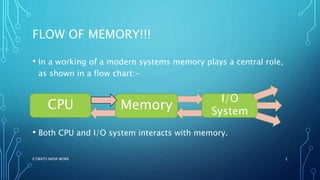
• In a working of a modern systems memory plays a central role,
as shown in a flow chart:-
• Both CPU and I/O system interacts with memory.
CPU Memory
I/O
System
ILTWATS INDIA WORK 2
WHAT IS MEMORY?
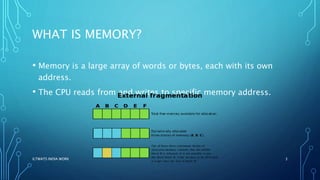
• Memory is a large array of words or bytes, each with its own
address.
• The CPU reads from and writes to specific memory address.
ILTWATS INDIA WORK 3
MEMORY EXECUTION
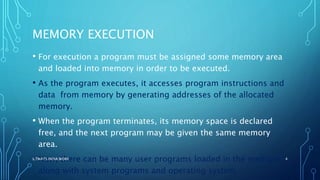
• For execution a program must be assigned some memory area
and loaded into memory in order to be executed.
• As the program executes, it accesses program instructions and
data from memory by generating addresses of the allocated
memory.
• When the program terminates, its memory space is declared
free, and the next program may be given the same memory
area.
• Now, there can be many user programs loaded in the memory
along with system programs and operating system.
ILTWATS INDIA WORK 4
THEN, HOW IS MEMORY MANAGED IN SUCH
A SITUATION?
Different approach to a memory allocation and its management
are with its relative effectiveness:-
1. Contiguous Storage Allocation.
2. Non Contiguous Storage Allocation.
3. Virtual Storage using Paging.
4. Virtual Storage using Segmentation.
ILTWATS INDIA WORK 5
1.CONTIGUOUS STORAGE ALLOCATION.
• Each problem, which is to be executed ,is allocated a
contiguous storage memory.
• Each job step is considered as a single independent entity for
allocation of a contiguous storage area.
• At every job step initiation, the OS has to ensure that sufficient
contiguous area is available to accommodate it.
ILTWATS INDIA WORK 6
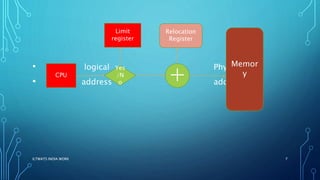
• logical Physical
• address address
CPU
Yes
/N
o
Limit
register
+
Relocation
Register
Memor
y
ILTWATS INDIA WORK 7
2.NON CONTIGUOUS STORAGE
ALLOCATION.
• A program can be stored in non contiguous memory areas.
• Here, a program is divided into smaller components of equal sizes.
One of more components can be stored in the non contiguous
memory areas.
• Each component in the particular memory area is provided addresses
0,1,2..n.
• Now a program can be stored at non contiguous locations, but what
if we use all available free memory is still the program can not be
loaded into the main storage because the total free memory is still
less than the size of the program.
ILTWATS INDIA WORK 8
NOW THE PROBLEM MENTIONED IN LAST POINT ,
HOW TO OVERCOME THAT PROBLEM?
• To solve such a problem we require a technique with which a
program can still be executed even if all of its is not loaded in a
memory.
• Solution is . They are of 2 types namely:
• Program Paging
• Program Segmentation
ILTWATS INDIA WORK 9
• Divide physical memory into fixed-sized (power of 2) blocks called
frames.
• Divide logical memory into blocks of same size called pages.
• Keep track of all free frames.
• To run a program of size n pages, need to find n free frames and load
program.
• Page table : used to translate logical to physical addresses.
ILTWATS INDIA WORK 10
• Now when a required page is not in the main storage an interrupt is
known as missing page interrupt, is raised.
• This fault is commonly called as page fault.
• The OS takes action by bringing required page from the secondary
storage into an empty page block, this is called demand paging or
page in.
• After page in page table is modified and new physical address is
stored in it and execution resumes.
• In some cases now storage is left then storage block is vacated by
process page out.
• This reading and writing of pages determines page traffic.If page
traffic is too much situation is called thrashing.
ILTWATS INDIA WORK 11
• Memory-management scheme that supports user view of memory.
• A program is a collection of segments. A segment can be any logical unit
eg: code, global variables, heap, stack,...
• Segment sizes may be different
• Segmentation Architecture:-
• Segment table– maps two-dimensional physical addresses; each table entry
has:
1.base – contains the starting physical address where the segments
reside in memory.
2.limit – specifies the length of the segment.
• Segment-table base register (STBR)-points to the segment table’s location in
memory.
• Segment-table length register (STLR)-indicates number of segments used by
ILTWATS INDIA WORK 12
• In the same way as of paging, segment in the memory are processed
and if a segment is not available in the memory segment missing
fault is raised.
• To increase the efficiency of a system sometimes paging and
segmentation is combined. A large segmentation is broken into
pages and is stored in contiguous area.
• Now within the pages `swapping’ is possible as it improves the
efficiency of system as access of pages within the segment is
fastened up.
• Thus the address now contains the segment id, page number within
the segment and the word in a page.
• OS like IBM 360/67 and MULTICS use this very technique
segmentation with paging.
ILTWATS INDIA WORK 13
THANK YOU
A Presentation By- ATUL SHARMA
ILTWATS INDIA WORK 14

Storage management

  • 1.
    STORAGE MANAGEMENT IN THISPOWERPOINT I AM GONNA TELL YOU, HOW MEMORY PLAYS A CENTRAL ROLE IN A COMPUTER SYSTEM? ILTWATS INDIA WORK 1
  • 2.
    FLOW OF MEMORY!!! •In a working of a modern systems memory plays a central role, as shown in a flow chart:- • Both CPU and I/O system interacts with memory. CPU Memory I/O System ILTWATS INDIA WORK 2
  • 3.
    WHAT IS MEMORY? •Memory is a large array of words or bytes, each with its own address. • The CPU reads from and writes to specific memory address. ILTWATS INDIA WORK 3
  • 4.
    MEMORY EXECUTION • Forexecution a program must be assigned some memory area and loaded into memory in order to be executed. • As the program executes, it accesses program instructions and data from memory by generating addresses of the allocated memory. • When the program terminates, its memory space is declared free, and the next program may be given the same memory area. • Now, there can be many user programs loaded in the memory along with system programs and operating system. ILTWATS INDIA WORK 4
  • 5.
    THEN, HOW ISMEMORY MANAGED IN SUCH A SITUATION? Different approach to a memory allocation and its management are with its relative effectiveness:- 1. Contiguous Storage Allocation. 2. Non Contiguous Storage Allocation. 3. Virtual Storage using Paging. 4. Virtual Storage using Segmentation. ILTWATS INDIA WORK 5
  • 6.
    1.CONTIGUOUS STORAGE ALLOCATION. •Each problem, which is to be executed ,is allocated a contiguous storage memory. • Each job step is considered as a single independent entity for allocation of a contiguous storage area. • At every job step initiation, the OS has to ensure that sufficient contiguous area is available to accommodate it. ILTWATS INDIA WORK 6
  • 7.
    • logical Physical •address address CPU Yes /N o Limit register + Relocation Register Memor y ILTWATS INDIA WORK 7
  • 8.
    2.NON CONTIGUOUS STORAGE ALLOCATION. •A program can be stored in non contiguous memory areas. • Here, a program is divided into smaller components of equal sizes. One of more components can be stored in the non contiguous memory areas. • Each component in the particular memory area is provided addresses 0,1,2..n. • Now a program can be stored at non contiguous locations, but what if we use all available free memory is still the program can not be loaded into the main storage because the total free memory is still less than the size of the program. ILTWATS INDIA WORK 8
  • 9.
    NOW THE PROBLEMMENTIONED IN LAST POINT , HOW TO OVERCOME THAT PROBLEM? • To solve such a problem we require a technique with which a program can still be executed even if all of its is not loaded in a memory. • Solution is . They are of 2 types namely: • Program Paging • Program Segmentation ILTWATS INDIA WORK 9
  • 10.
    • Divide physicalmemory into fixed-sized (power of 2) blocks called frames. • Divide logical memory into blocks of same size called pages. • Keep track of all free frames. • To run a program of size n pages, need to find n free frames and load program. • Page table : used to translate logical to physical addresses. ILTWATS INDIA WORK 10
  • 11.
    • Now whena required page is not in the main storage an interrupt is known as missing page interrupt, is raised. • This fault is commonly called as page fault. • The OS takes action by bringing required page from the secondary storage into an empty page block, this is called demand paging or page in. • After page in page table is modified and new physical address is stored in it and execution resumes. • In some cases now storage is left then storage block is vacated by process page out. • This reading and writing of pages determines page traffic.If page traffic is too much situation is called thrashing. ILTWATS INDIA WORK 11
  • 12.
    • Memory-management schemethat supports user view of memory. • A program is a collection of segments. A segment can be any logical unit eg: code, global variables, heap, stack,... • Segment sizes may be different • Segmentation Architecture:- • Segment table– maps two-dimensional physical addresses; each table entry has: 1.base – contains the starting physical address where the segments reside in memory. 2.limit – specifies the length of the segment. • Segment-table base register (STBR)-points to the segment table’s location in memory. • Segment-table length register (STLR)-indicates number of segments used by ILTWATS INDIA WORK 12
  • 13.
    • In thesame way as of paging, segment in the memory are processed and if a segment is not available in the memory segment missing fault is raised. • To increase the efficiency of a system sometimes paging and segmentation is combined. A large segmentation is broken into pages and is stored in contiguous area. • Now within the pages `swapping’ is possible as it improves the efficiency of system as access of pages within the segment is fastened up. • Thus the address now contains the segment id, page number within the segment and the word in a page. • OS like IBM 360/67 and MULTICS use this very technique segmentation with paging. ILTWATS INDIA WORK 13
  • 14.
    THANK YOU A PresentationBy- ATUL SHARMA ILTWATS INDIA WORK 14