Data Integrity Test
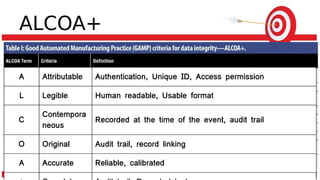
ALCOA+
ALCOA+
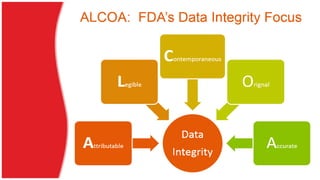
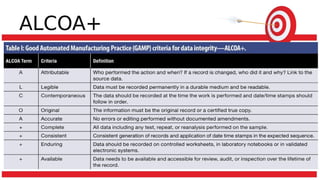
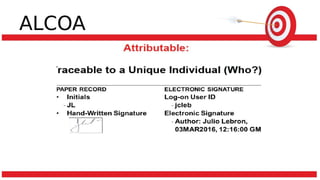
A Attributable Authentication, Unique ID, Access permission
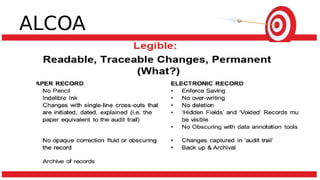
L Legible Human readable, Usable format
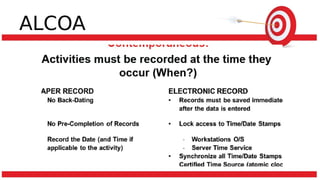
C
Contempora
neous
Recorded at the time of the event, audit trail
O Original Audit trail, record linking
A Accurate Reliable, calibrated
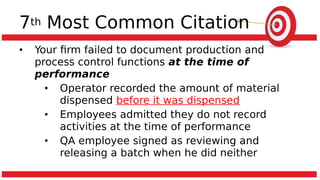
7th Most Common Citation
• Your firm failed to document production and
process control functions at the time of
performance
• Operator recorded the amount of material
dispensed before it was dispensed
• Employees admitted they do not record
activities at the time of performance
• QA employee signed as reviewing and
releasing a batch when he did neither
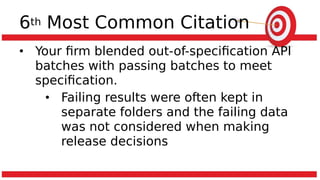
6th Most Common Citation
• Your firm blended out-of-specification API
batches with passing batches to meet
specification.
• Failing results were often kept in
separate folders and the failing data
was not considered when making
release decisions
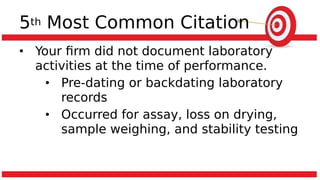
5th Most Common Citation
• Your firm did not document laboratory
activities at the time of performance.
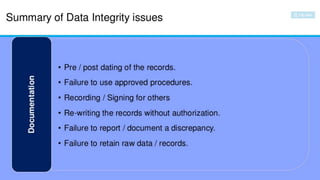
• Pre-dating or backdating laboratory
records
• Occurred for assay, loss on drying,
sample weighing, and stability testing
4th Most Common Citation
• Your firm failed to maintain complete
information relating to the production and control
of each batch
• Records for 23 batches did not contain batch
numbers, manufacturing dates, expiration or
retest dates
• Approximately 75 ripped batch production
records (BPRs) were found in the garbage
(some with failing results)
4th Most Common Citation
• Ten bags of torn or partially destroyed
original records including CAPAs,
preventative maintenance forms, and
calibration records were found
• Raw data was written on scratch paper and
sometimes differed from the data in the BPR
• Correction fluid was used on production
records
3rd Most Common Citation
• Your firm failed to thoroughly investigate any
unexplained discrepancy or failure of a batch or any of
its components to meet any of it specifications, whether
or not the batch has already been distributed
• 4 batches of failing API were used in fifteen finished
dosage batches
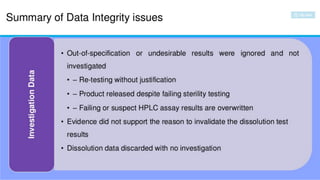
• Failing assays were repeated until passing results
were obtained (occurred at numerous firms)
• Environmental monitoring results were recorded as
zero but actually had growth
3rd Most Common Citation
• “Unofficial” visual exam conducted for
sterile injectables to remove vials with
visible contamination so that the batch
would pass the official visual exam
(occurred at 2 firms)
• Used three different analytical methods
until obtaining passing results
2nd Most Common Citation
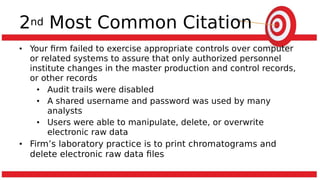
• Your firm failed to exercise appropriate controls over computer
or related systems to assure that only authorized personnel
institute changes in the master production and control records,
or other records
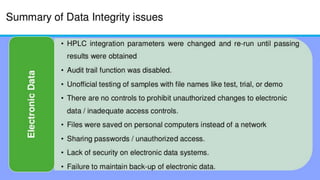
• Audit trails were disabled
• A shared username and password was used by many
analysts
• Users were able to manipulate, delete, or overwrite
electronic raw data
• Firm’s laboratory practice is to print chromatograms and
delete electronic raw data files
Most Common Citation
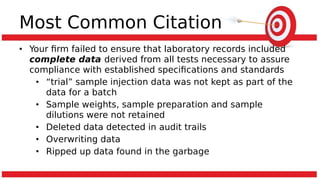
• Your firm failed to ensure that laboratory records included
complete data derived from all tests necessary to assure
compliance with established specifications and standards
• “trial” sample injection data was not kept as part of the
data for a batch
• Sample weights, sample preparation and sample
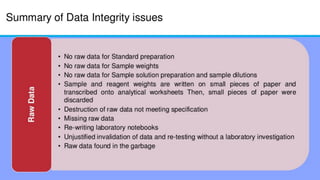
dilutions were not retained
• Deleted data detected in audit trails
• Overwriting data
• Ripped up data found in the garbage
Most Common Citation
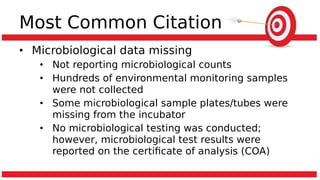
• Microbiological data missing
• Not reporting microbiological counts
• Hundreds of environmental monitoring samples
were not collected
• Some microbiological sample plates/tubes were
missing from the incubator
• No microbiological testing was conducted;
however, microbiological test results were
reported on the certificate of analysis (COA)
Most Common Citation
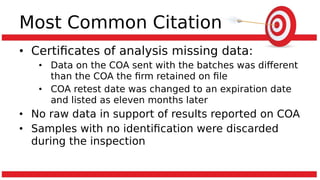
• Certificates of analysis missing data:
• Data on the COA sent with the batches was different
than the COA the firm retained on file
• COA retest date was changed to an expiration date
and listed as eleven months later
• No raw data in support of results reported on COA
• Samples with no identification were discarded
during the inspection
Most Common Citation
• Firm deleted all electronic raw data supporting
HPLC release testing
• Standards were injected and used as sample
results
• Duplicate logbooks were kept
• Complete raw data to support test method
validation was not retained
• Integration parameters for HPLC analysis were not
retained
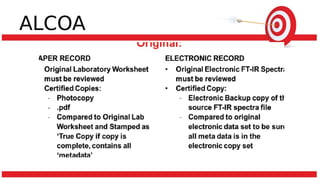
ALCOA
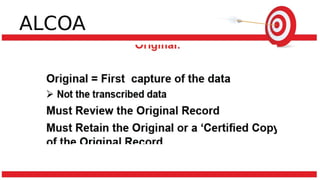
ALCOA
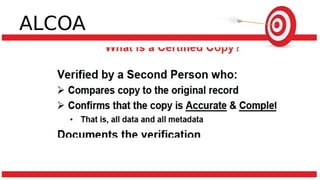
ALCOA
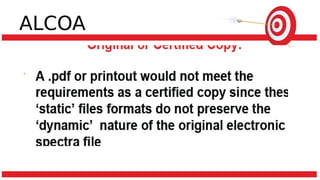
ALCOA
ALCOA
ALCOA
ALCOA
ALCOA
ALCOA
ALCOA
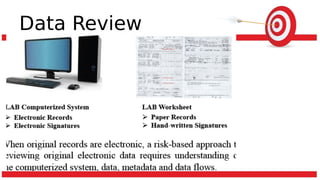
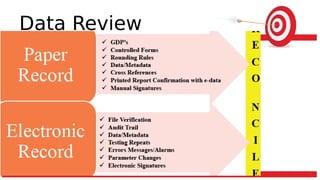
Data Review
Data Review
Data Review
Data Review
Data Review
Data Review
Data Review
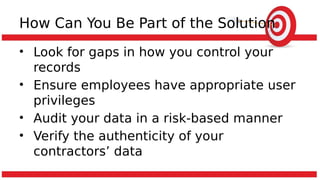
How Can You Be Part of the Solution
• Look for gaps in how you control your
records
• Ensure employees have appropriate user
privileges
• Audit your data in a risk-based manner
• Verify the authenticity of your
contractors’ data
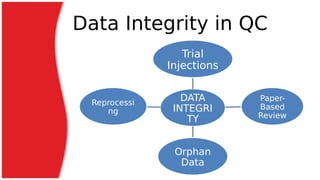
Data Integrity in QC
DATA
INTEGRI
TY
Trial
Injections
Paper-
Based
Review
Orphan
Data
Reprocessi
ng
Data Integrity Overview and data integrity test.pdf

Data Integrity Overview and data integrity test.pdf

  • 1.
  • 3.
  • 4.
    ALCOA+ A Attributable Authentication,Unique ID, Access permission L Legible Human readable, Usable format C Contempora neous Recorded at the time of the event, audit trail O Original Audit trail, record linking A Accurate Reliable, calibrated
  • 5.
    7th Most CommonCitation • Your firm failed to document production and process control functions at the time of performance • Operator recorded the amount of material dispensed before it was dispensed • Employees admitted they do not record activities at the time of performance • QA employee signed as reviewing and releasing a batch when he did neither
  • 6.
    6th Most CommonCitation • Your firm blended out-of-specification API batches with passing batches to meet specification. • Failing results were often kept in separate folders and the failing data was not considered when making release decisions
  • 7.
    5th Most CommonCitation • Your firm did not document laboratory activities at the time of performance. • Pre-dating or backdating laboratory records • Occurred for assay, loss on drying, sample weighing, and stability testing
  • 8.
    4th Most CommonCitation • Your firm failed to maintain complete information relating to the production and control of each batch • Records for 23 batches did not contain batch numbers, manufacturing dates, expiration or retest dates • Approximately 75 ripped batch production records (BPRs) were found in the garbage (some with failing results)
  • 9.
    4th Most CommonCitation • Ten bags of torn or partially destroyed original records including CAPAs, preventative maintenance forms, and calibration records were found • Raw data was written on scratch paper and sometimes differed from the data in the BPR • Correction fluid was used on production records
  • 10.
    3rd Most CommonCitation • Your firm failed to thoroughly investigate any unexplained discrepancy or failure of a batch or any of its components to meet any of it specifications, whether or not the batch has already been distributed • 4 batches of failing API were used in fifteen finished dosage batches • Failing assays were repeated until passing results were obtained (occurred at numerous firms) • Environmental monitoring results were recorded as zero but actually had growth
  • 11.
    3rd Most CommonCitation • “Unofficial” visual exam conducted for sterile injectables to remove vials with visible contamination so that the batch would pass the official visual exam (occurred at 2 firms) • Used three different analytical methods until obtaining passing results
  • 12.
    2nd Most CommonCitation • Your firm failed to exercise appropriate controls over computer or related systems to assure that only authorized personnel institute changes in the master production and control records, or other records • Audit trails were disabled • A shared username and password was used by many analysts • Users were able to manipulate, delete, or overwrite electronic raw data • Firm’s laboratory practice is to print chromatograms and delete electronic raw data files
  • 13.
    Most Common Citation •Your firm failed to ensure that laboratory records included complete data derived from all tests necessary to assure compliance with established specifications and standards • “trial” sample injection data was not kept as part of the data for a batch • Sample weights, sample preparation and sample dilutions were not retained • Deleted data detected in audit trails • Overwriting data • Ripped up data found in the garbage
  • 14.
    Most Common Citation •Microbiological data missing • Not reporting microbiological counts • Hundreds of environmental monitoring samples were not collected • Some microbiological sample plates/tubes were missing from the incubator • No microbiological testing was conducted; however, microbiological test results were reported on the certificate of analysis (COA)
  • 15.
    Most Common Citation •Certificates of analysis missing data: • Data on the COA sent with the batches was different than the COA the firm retained on file • COA retest date was changed to an expiration date and listed as eleven months later • No raw data in support of results reported on COA • Samples with no identification were discarded during the inspection
  • 16.
    Most Common Citation •Firm deleted all electronic raw data supporting HPLC release testing • Standards were injected and used as sample results • Duplicate logbooks were kept • Complete raw data to support test method validation was not retained • Integration parameters for HPLC analysis were not retained
  • 17.
  • 18.
  • 19.
  • 20.
  • 21.
  • 22.
  • 23.
  • 24.
  • 25.
  • 26.
  • 27.
  • 28.
  • 29.
  • 30.
  • 31.
  • 32.
  • 33.
  • 40.
    How Can YouBe Part of the Solution • Look for gaps in how you control your records • Ensure employees have appropriate user privileges • Audit your data in a risk-based manner • Verify the authenticity of your contractors’ data
  • 41.
    Data Integrity inQC DATA INTEGRI TY Trial Injections Paper- Based Review Orphan Data Reprocessi ng