Data
Communication
Presented By: Muhammad
Faheem
Presented To: Eng.Zeshan Ali
Data Communication
When we communicate, we are sharing
information. This sharing can be local or
remote. Between individuals, local
communication usually occurs face to
face, While remote communication take
place over distance. The term
telecommunication, which includes
telephony, telegraphy, and television,
means communication at distance.
Data Communication
Data: The word data, refers to the information
presented in whatever from is agreed upon
by the parties creating and using data.
Data Communications are the exchange of
data between two device via some form of
transmission medium such as a wire cable.
The effectiveness of data communication
system depends on four fundamentals
characteristics:
• Delivery: The system must deliver data to
the correct destination.
• Accuracy: The system must deliver the data
accurately.
• Timeliness: The system must deliver in a
timely manner. Data delivered late are
useless.
• Jitter: Jitter refers to the variation in the
packet arrival time. It is uneven delay in the
delivery of audio or video packets.
Data Communication
Component
Components: A data communication system
has five components.
• Message: The is the information to be
communicated. Popular form of information
include text, numbers, picture, audio, and
video.
• Sender: The sender is the device that sends
message. It can be a computer, workstation,
telephone handset, video camera, and so on.
• Receiver: The receiver the device that
receives the message. It can be a computer,
workstation, telephone handset, television,
and so on.
• Transmission Medium: The transmission
medium is the physical path by which a
message travels from sender to receiver.
Some examples of transmission media
include twisted –pair wire, coaxial cable, fiber
optic cable, and radio waves.
• Protocol : A protocol is a set of rules that
governs data communications. It
represents an agreement communication
devices. Without protocol, two devices
may be connected but not communicating.
Data Representation
Information today comes in different forms
such as text, numbers, images, audio, and
video.
Text: In data communications, text is
represented as a bit pattern, a sequence of
bits(0s or 1s). Different sets bit patterns have
been designed to represent text symbols.
Each set is called code, and the processing
representing symbols is called coding.
Numbers: Numbers are also represented by bit
patterns. The number is directly converted to
a binary number to simplify mathematical
operations.
Images: Images are also represented by bit
patterns. In its simplest form, an image is
composed of a matrix of pixels, where each
pixel is a small dot. The size of pixel depends
on the resolution.
Audio: Audio refers to the recording or
broadcasting of sound or music. It is
continuous, not discrete. Even when we use
a microphone to change voice or music to an
electrical signal, we create continuous signal.
Video: Video refers to the recording or
broadcasting of picture or movie. Video
can either be produced as a continuous
entity, or it can be a combination of
images, each a discrete entity, arranged to
convey the idea of motion.
Data Flow
Data communication between two devices
can be
Simplex
Half-duplex
Full-duplex
Data Flow
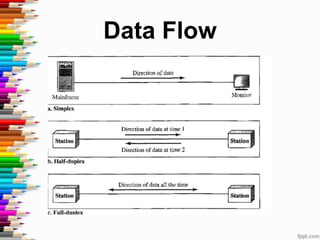
Simplex
In simplex mode, the communication is
unidirectional, as one-way street. Only one
of the two devices on a link can transmit;
the other can only receive.
Keyboards and traditional monitors are
example of simplex devices.
Half Duplex
In half duplex mode, each station can both
transmit and receive, but not at the same
time. When one device is sending, the
other can only receive, vice versa.
The half duplex mode is used in cases
where there is no need for communication
in both direction at the same time; the
entire capacity of the channel utilized for
each direction.
Full Duplex
In full duplex mode, both station can
transmit and receive simultaneously.
One common example of full duplex
communication is the telephone network.
When two people are communicating by a
telephone line, both can talk listen at the
same time.
Data communication

Data communication

  • 1.
  • 2.
    Data Communication When wecommunicate, we are sharing information. This sharing can be local or remote. Between individuals, local communication usually occurs face to face, While remote communication take place over distance. The term telecommunication, which includes telephony, telegraphy, and television, means communication at distance.
  • 3.
    Data Communication Data: Theword data, refers to the information presented in whatever from is agreed upon by the parties creating and using data. Data Communications are the exchange of data between two device via some form of transmission medium such as a wire cable. The effectiveness of data communication system depends on four fundamentals characteristics:
  • 4.
    • Delivery: Thesystem must deliver data to the correct destination. • Accuracy: The system must deliver the data accurately. • Timeliness: The system must deliver in a timely manner. Data delivered late are useless. • Jitter: Jitter refers to the variation in the packet arrival time. It is uneven delay in the delivery of audio or video packets.
  • 5.
    Data Communication Component Components: Adata communication system has five components. • Message: The is the information to be communicated. Popular form of information include text, numbers, picture, audio, and video. • Sender: The sender is the device that sends message. It can be a computer, workstation, telephone handset, video camera, and so on.
  • 6.
    • Receiver: Thereceiver the device that receives the message. It can be a computer, workstation, telephone handset, television, and so on. • Transmission Medium: The transmission medium is the physical path by which a message travels from sender to receiver. Some examples of transmission media include twisted –pair wire, coaxial cable, fiber optic cable, and radio waves.
  • 7.
    • Protocol :A protocol is a set of rules that governs data communications. It represents an agreement communication devices. Without protocol, two devices may be connected but not communicating. Data Representation Information today comes in different forms such as text, numbers, images, audio, and video.
  • 8.
    Text: In datacommunications, text is represented as a bit pattern, a sequence of bits(0s or 1s). Different sets bit patterns have been designed to represent text symbols. Each set is called code, and the processing representing symbols is called coding. Numbers: Numbers are also represented by bit patterns. The number is directly converted to a binary number to simplify mathematical operations.
  • 9.
    Images: Images arealso represented by bit patterns. In its simplest form, an image is composed of a matrix of pixels, where each pixel is a small dot. The size of pixel depends on the resolution. Audio: Audio refers to the recording or broadcasting of sound or music. It is continuous, not discrete. Even when we use a microphone to change voice or music to an electrical signal, we create continuous signal.
  • 10.
    Video: Video refersto the recording or broadcasting of picture or movie. Video can either be produced as a continuous entity, or it can be a combination of images, each a discrete entity, arranged to convey the idea of motion.
  • 11.
    Data Flow Data communicationbetween two devices can be Simplex Half-duplex Full-duplex
  • 12.
  • 13.
    Simplex In simplex mode,the communication is unidirectional, as one-way street. Only one of the two devices on a link can transmit; the other can only receive. Keyboards and traditional monitors are example of simplex devices.
  • 14.
    Half Duplex In halfduplex mode, each station can both transmit and receive, but not at the same time. When one device is sending, the other can only receive, vice versa. The half duplex mode is used in cases where there is no need for communication in both direction at the same time; the entire capacity of the channel utilized for each direction.
  • 15.
    Full Duplex In fullduplex mode, both station can transmit and receive simultaneously. One common example of full duplex communication is the telephone network. When two people are communicating by a telephone line, both can talk listen at the same time.