PRESENTATI
ON
DATACOMMUNICATIONS
Prepared by:
Anum Chaudhary
CONTENTS
 Introduction to data communication.
 Components of data communication
 Data flow:- Simplex, Half duplex, Full deplex
 Signals:- Analog and Digital signals.
 Transmission media:- Guided and Unguided media
 Networking devices
WHAT IS DATA COMMUNICATIONS?
 Exchange of data between two devices via
some forms of transmission medium(such
as wire cable) is Data Communications.
 For data communications to occur, the
communicating devices must be part of a
communication system made of a
combination of hardware and software.
 The effectiveness of a data
communication system depends on four
fundamental characteristics:- delivery,
accuracy, timeliness and jitter.
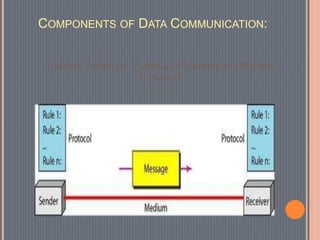
COMPONENTS OF DATA COMMUNICATION:
1.Sender 2.Receiver 3.Message 4.Tramsmission Medium
5. Protocol
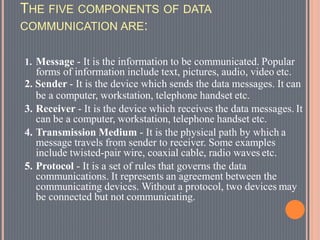
THE FIVE COMPONENTS OF DATA
COMMUNICATION ARE:
1. Message - It is the information to be communicated. Popular
forms of information include text, pictures, audio, video etc.
2. Sender - It is the device which sends the data messages. It can
be a computer, workstation, telephone handset etc.
3. Receiver - It is the device which receives the data messages. It
can be a computer, workstation, telephone handset etc.
4. Transmission Medium - It is the physical path by which a
message travels from sender to receiver. Some examples
include twisted-pair wire, coaxial cable, radio waves etc.
5. Protocol - It is a set of rules that governs the data
communications. It represents an agreement between the
communicating devices. Without a protocol, two devices may
be connected but not communicating.
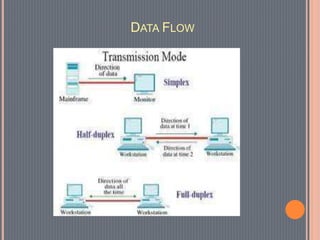
DATA FLOW
DATA FLOW CAN OCCUR IN THREE WAYS:
1. Simplex:In simplex mode,the communication is
unidirectional.only one of the devices on a link can
transmit, the other can only receive. e.g.
keyboards,monitors,etc.
2. Half-duplex:In this mode,each station can both
transmit and receive,but not at the same time.When
one device is sending,the other can only receive,and
vice-versa. e.g. walkie-talkies etc.
3.Full Duplex : In full duplex mode, both stations can
transmit and receive simultaneously. One common
example of full duplex is the Telephone network.
When two people are communicating by a telephone
line, both can talk and listen at the same time. The
full-duplex mode is used when communication in
both directions is required all the time.
SIGNAL
S
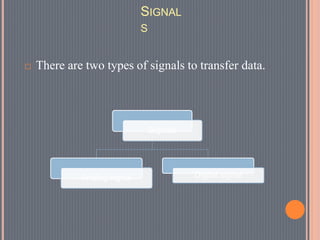
 There are two types of signals to transfer data.
Signals
Analog signal Digital signal
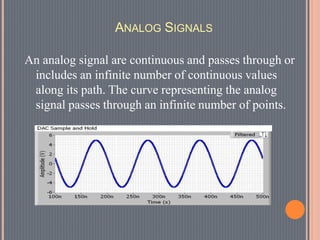
ANALOG SIGNALS
An analog signal are continuous and passes through or
includes an infinite number of continuous values
along its path. The curve representing the analog
signal passes through an infinite number of points.
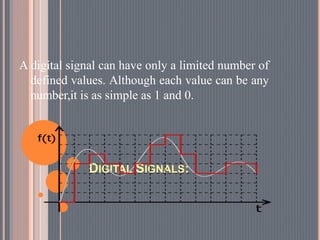
DIGITAL SIGNALS:
A digital signal can have only a limited number of
defined values. Although each value can be any
number,it is as simple as 1 and 0.
TRANSMISSION MEDIA
The means through which data is
transformed from one place to
another is called transmission or
communication media.
There are two categories of
transmission media used in
computer communications.
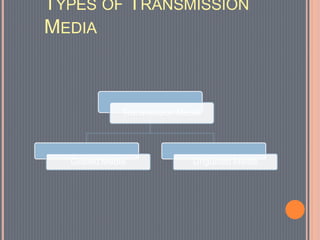
TYPES OF TRANSMISSION
MEDIA
Transmission Media
Guided Media Unguided Media
GUIDED MEDIA
 Guided media are the physical links through which
signals are restricted to narrow path.
 These are also called guide media. Bounded media are
made up of a external conductor (Usually Copper)
bounded by jacket material. Bounded media offer high
speed, good security and low cost.
 Three common types of bounded media are used for the
data transmission. These are
• Coaxial Cable
• Twisted Pairs Cable
• Fiber Optics Cable
UNGUIDED MEDIA
Unguided media or wireless media doesn't use
any physical connectors between the two
devices communicating. Usually the
transmission is send through the atmosphere.
The three types of wireless media are:
 Radio waves
 Micro waves
 Infrared waves
DEVICES USED IN NETWORKING
Mainly four devices are used in networking:-
 Modem
 Hub
 Switch
 Router
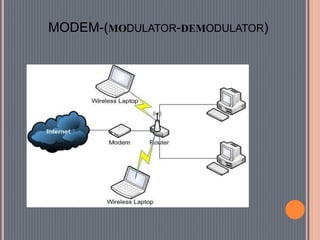
MODEM-(MODULATOR-DEMODULATOR)
MODEM
Amodem is a device that modulates an analog carrier
signal to encode digital information and also
demodulates such a carrier signal to decode the
transmitted information. The goal is to produce a signal
that can be transmitted easily and decoded to reproduce
the original digital data. Modems can be used over any
means of transmitting analog signals, from light
emitting diodes to radio.
There are two types of modem:-
1. internal modem
2. external modem
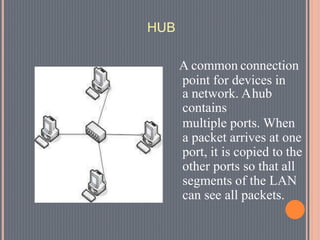
HUB
A common connection
point for devices in
a network. Ahub
contains
multiple ports. When
a packet arrives at one
port, it is copied to the
other ports so that all
segments of the LAN
can see all packets.
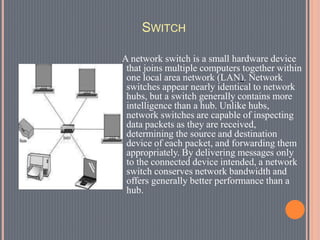
SWITCH
A network switch is a small hardware device
that joins multiple computers together within
one local area network (LAN). Network
switches appear nearly identical to network
hubs, but a switch generally contains more
intelligence than a hub. Unlike hubs,
network switches are capable of inspecting
data packets as they are received,
determining the source and destination
device of each packet, and forwarding them
appropriately. By delivering messages only
to the connected device intended, a network
switch conserves network bandwidth and
offers generally better performance than a
hub.
ROUTER
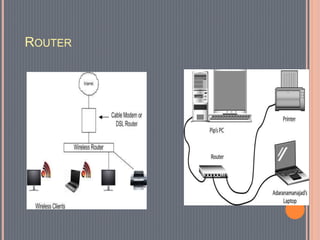
 A router is a device that forwards data
 packets between computer networks, creating an
overlay internetwork. A router is connected to two or
more data lines from different networks. When a data
packet comes in on one of the lines, the router reads
the address information in the packet to determine
its ultimate destination. Then, using information in
 its routing table it directs the packet to the next
network on its journey. Routers perform the "traffic
directing" functions on the Internet. A data packet is
typically forwarded from one router to another
through the networks that constitute the internetwork
until it gets to its destination node.
ROUTER

Data Communication

  • 1.
  • 2.
    CONTENTS  Introduction todata communication.  Components of data communication  Data flow:- Simplex, Half duplex, Full deplex  Signals:- Analog and Digital signals.  Transmission media:- Guided and Unguided media  Networking devices
  • 3.
    WHAT IS DATACOMMUNICATIONS?  Exchange of data between two devices via some forms of transmission medium(such as wire cable) is Data Communications.  For data communications to occur, the communicating devices must be part of a communication system made of a combination of hardware and software.  The effectiveness of a data communication system depends on four fundamental characteristics:- delivery, accuracy, timeliness and jitter.
  • 4.
    COMPONENTS OF DATACOMMUNICATION: 1.Sender 2.Receiver 3.Message 4.Tramsmission Medium 5. Protocol
  • 5.
    THE FIVE COMPONENTSOF DATA COMMUNICATION ARE: 1. Message - It is the information to be communicated. Popular forms of information include text, pictures, audio, video etc. 2. Sender - It is the device which sends the data messages. It can be a computer, workstation, telephone handset etc. 3. Receiver - It is the device which receives the data messages. It can be a computer, workstation, telephone handset etc. 4. Transmission Medium - It is the physical path by which a message travels from sender to receiver. Some examples include twisted-pair wire, coaxial cable, radio waves etc. 5. Protocol - It is a set of rules that governs the data communications. It represents an agreement between the communicating devices. Without a protocol, two devices may be connected but not communicating.
  • 6.
  • 7.
    DATA FLOW CANOCCUR IN THREE WAYS: 1. Simplex:In simplex mode,the communication is unidirectional.only one of the devices on a link can transmit, the other can only receive. e.g. keyboards,monitors,etc. 2. Half-duplex:In this mode,each station can both transmit and receive,but not at the same time.When one device is sending,the other can only receive,and vice-versa. e.g. walkie-talkies etc.
  • 8.
    3.Full Duplex :In full duplex mode, both stations can transmit and receive simultaneously. One common example of full duplex is the Telephone network. When two people are communicating by a telephone line, both can talk and listen at the same time. The full-duplex mode is used when communication in both directions is required all the time.
  • 9.
    SIGNAL S  There aretwo types of signals to transfer data. Signals Analog signal Digital signal
  • 10.
    ANALOG SIGNALS An analogsignal are continuous and passes through or includes an infinite number of continuous values along its path. The curve representing the analog signal passes through an infinite number of points.
  • 11.
    DIGITAL SIGNALS: A digitalsignal can have only a limited number of defined values. Although each value can be any number,it is as simple as 1 and 0.
  • 12.
    TRANSMISSION MEDIA The meansthrough which data is transformed from one place to another is called transmission or communication media. There are two categories of transmission media used in computer communications.
  • 13.
    TYPES OF TRANSMISSION MEDIA TransmissionMedia Guided Media Unguided Media
  • 14.
    GUIDED MEDIA  Guidedmedia are the physical links through which signals are restricted to narrow path.  These are also called guide media. Bounded media are made up of a external conductor (Usually Copper) bounded by jacket material. Bounded media offer high speed, good security and low cost.  Three common types of bounded media are used for the data transmission. These are • Coaxial Cable • Twisted Pairs Cable • Fiber Optics Cable
  • 15.
    UNGUIDED MEDIA Unguided mediaor wireless media doesn't use any physical connectors between the two devices communicating. Usually the transmission is send through the atmosphere. The three types of wireless media are:  Radio waves  Micro waves  Infrared waves
  • 16.
    DEVICES USED INNETWORKING Mainly four devices are used in networking:-  Modem  Hub  Switch  Router
  • 17.
  • 18.
    MODEM Amodem is adevice that modulates an analog carrier signal to encode digital information and also demodulates such a carrier signal to decode the transmitted information. The goal is to produce a signal that can be transmitted easily and decoded to reproduce the original digital data. Modems can be used over any means of transmitting analog signals, from light emitting diodes to radio. There are two types of modem:- 1. internal modem 2. external modem
  • 19.
    HUB A common connection pointfor devices in a network. Ahub contains multiple ports. When a packet arrives at one port, it is copied to the other ports so that all segments of the LAN can see all packets.
  • 20.
    SWITCH A network switchis a small hardware device that joins multiple computers together within one local area network (LAN). Network switches appear nearly identical to network hubs, but a switch generally contains more intelligence than a hub. Unlike hubs, network switches are capable of inspecting data packets as they are received, determining the source and destination device of each packet, and forwarding them appropriately. By delivering messages only to the connected device intended, a network switch conserves network bandwidth and offers generally better performance than a hub.
  • 21.
    ROUTER  A routeris a device that forwards data  packets between computer networks, creating an overlay internetwork. A router is connected to two or more data lines from different networks. When a data packet comes in on one of the lines, the router reads the address information in the packet to determine its ultimate destination. Then, using information in  its routing table it directs the packet to the next network on its journey. Routers perform the "traffic directing" functions on the Internet. A data packet is typically forwarded from one router to another through the networks that constitute the internetwork until it gets to its destination node.
  • 22.