DATABASE MANAGEMENTDATABASE MANAGEMENT
SYSTEMSSYSTEMS
MJS-15
BY
Abhishek & Sai Kumar
Introduction to DBMS
What is Database?
Purpose of Database Systems
File System vs. DBMS
View of Data
Data Models
RDBMS
DDL
DML
DCL
TCL
MJS-15 Index
MJS-15 Introduction
1
• A software used to manage data.
• A very large, integrated collection of data.
• A collection of information stored in a computer in
a systematic way.
Databases
• MySql
• Postgresql
• Oracle
What is Database..?
Database Management System
(DMBS)
Collection of interrelated data
DMBS contains information about a particular
enterprise
DBMS provides an environment that it both
convenient and efficient to use
MJS-15 Introduction
2
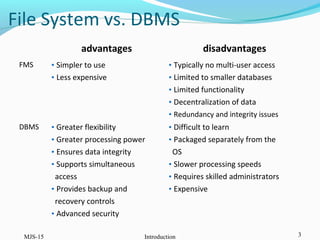
File System vs. DBMS
advantages disadvantages
FMS • Simpler to use
• Less expensive
• Typically no multi-user access
• Limited to smaller databases
• Limited functionality
• Decentralization of data
• Redundancy and integrity issues
DBMS • Greater flexibility
• Greater processing power
• Ensures data integrity
• Supports simultaneous
access
• Provides backup and
recovery controls
• Advanced security
• Difficult to learn
• Packaged separately from the
OS
• Slower processing speeds
• Requires skilled administrators
• Expensive
MJS-15 Introduction 3
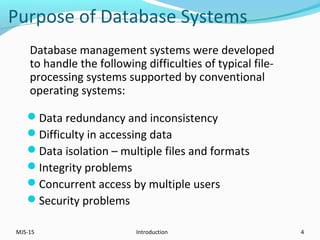
Purpose of Database Systems
Data redundancy and inconsistency
Difficulty in accessing data
Data isolation – multiple files and formats
Integrity problems
Concurrent access by multiple users
Security problems
MJS-15 Introduction 4
Database management systems were developed
to handle the following difficulties of typical file-
processing systems supported by conventional
operating systems:
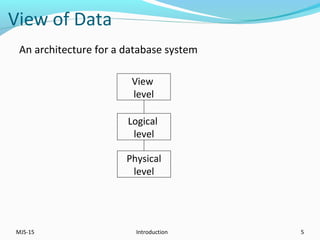
View of Data
An architecture for a database system
MJS-15 Introduction 5
Physical
level
Logical
level
View
level
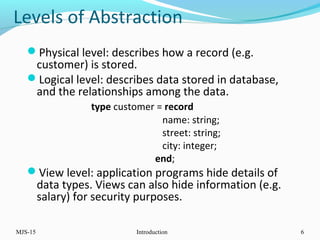
Levels of Abstraction
Physical level: describes how a record (e.g.
customer) is stored.
Logical level: describes data stored in database,
and the relationships among the data.
type customer = record
name: string;
street: string;
city: integer;
end;
View level: application programs hide details of
data types. Views can also hide information (e.g.
salary) for security purposes.
MJS-15 Introduction 6
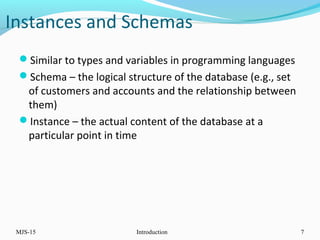
Instances and Schemas
Similar to types and variables in programming languages
Schema – the logical structure of the database (e.g., set
of customers and accounts and the relationship between
them)
Instance – the actual content of the database at a
particular point in time
MJS-15 Introduction 7
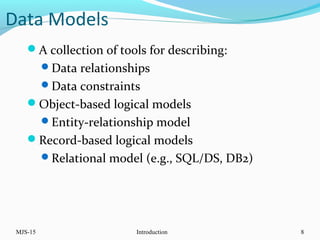
Data Models
A collection of tools for describing:
Data relationships
Data constraints
Object-based logical models
Entity-relationship model
Record-based logical models
Relational model (e.g., SQL/DS, DB2)
MJS-15 Introduction 8
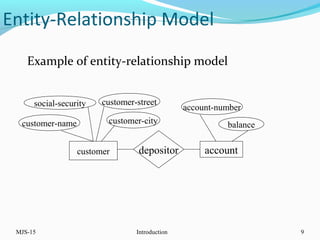
Entity-Relationship Model
Example of entity-relationship model
MJS-15 Introduction 9
customer accountdepositor
social-security customer-street
customer-name
account-number
balancecustomer-city
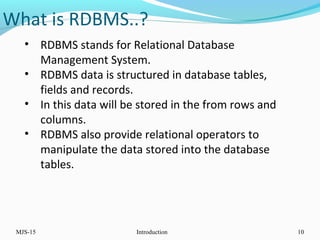
What is RDBMS..?
MJS-15 Introduction 10
• RDBMS stands for Relational Database
Management System.
• RDBMS data is structured in database tables,
fields and records.
• In this data will be stored in the from rows and
columns.
• RDBMS also provide relational operators to
manipulate the data stored into the database
tables.
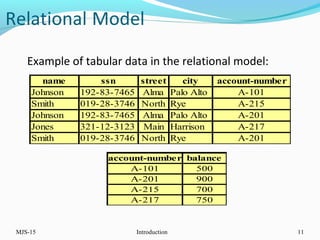
Relational Model
Example of tabular data in the relational model:
MJS-15 Introduction 11
name ssn street city account-number
Johnson 192-83-7465 Alma Palo Alto A-101
Smith 019-28-3746 North Rye A-215
Johnson 192-83-7465 Alma Palo Alto A-201
Jones 321-12-3123 Main Harrison A-217
Smith 019-28-3746 North Rye A-201
account-number balance
A-101 500
A-201 900
A-215 700
A-217 750
MJS-15 Introduction 12
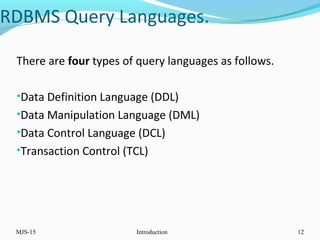
There are four types of query languages as follows.
•Data Definition Language (DDL)
•Data Manipulation Language (DML)
•Data Control Language (DCL)
•Transaction Control (TCL)
RDBMS Query Languages.
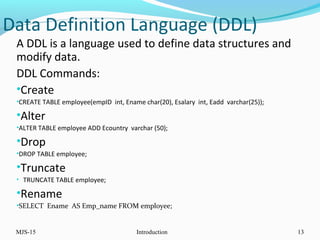
Data Definition Language (DDL)
A DDL is a language used to define data structures and
modify data.
DDL Commands:
•Create
•CREATE TABLE employee(empID int, Ename char(20), Esalary int, Eadd varchar(25));
•Alter
•ALTER TABLE employee ADD Ecountry varchar (50);
•Drop
•DROP TABLE employee;
•Truncate
• TRUNCATE TABLE employee;
•Rename
•SELECT Ename AS Emp_name FROM employee;
MJS-15 Introduction 13
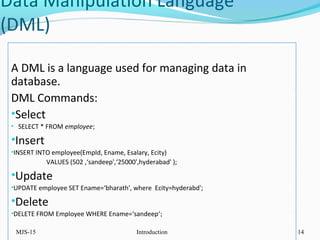
Data Manipulation Language
(DML)
A DML is a language used for managing data in
database.
DML Commands:
•Select
• SELECT * FROM employee;
•Insert
•INSERT INTO employee(EmpId, Ename, Esalary, Ecity)
VALUES (502 ,‘sandeep',‘25000',hyderabad' );
•Update
•UPDATE employee SET Ename=‘bharath', where Ecity=hyderabd';
•Delete
•DELETE FROM Employee WHERE Ename=‘sandeep‘;
MJS-15 Introduction 14
Data Control Language (DCL)
A DCL is a language used to control privilege in
Database
DCL Commands:
•Grant
•Syntax: REVOKE [permission] ON database.table FROM 'user‘@'localhost';
Example: GRANT [write] ON [company_details].[employee] TO ‘[sandeep]’@'localhost’;
•Revoke
•Syntax: REVOKE [permission ]ON database.table FROM 'user‘@'localhost';
Example: REVOKE [write] ON Company_details.Employee FROM ‘Sandeep'@'localhost';
MJS-15 Introduction 15
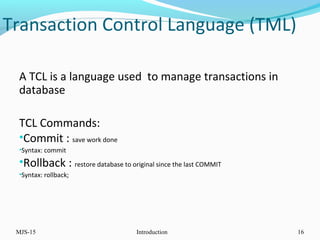
Transaction Control Language (TML)
A TCL is a language used to manage transactions in
database
TCL Commands:
•Commit : save work done
•Syntax: commit
•Rollback : restore database to original since the last COMMIT
•Syntax: rollback;
MJS-15 Introduction 16
Any Queries…?
MJS-15 12

Dbms presentaion

  • 1.
  • 2.
    Introduction to DBMS Whatis Database? Purpose of Database Systems File System vs. DBMS View of Data Data Models RDBMS DDL DML DCL TCL MJS-15 Index
  • 3.
    MJS-15 Introduction 1 • Asoftware used to manage data. • A very large, integrated collection of data. • A collection of information stored in a computer in a systematic way. Databases • MySql • Postgresql • Oracle What is Database..?
  • 4.
    Database Management System (DMBS) Collectionof interrelated data DMBS contains information about a particular enterprise DBMS provides an environment that it both convenient and efficient to use MJS-15 Introduction 2
  • 5.
    File System vs.DBMS advantages disadvantages FMS • Simpler to use • Less expensive • Typically no multi-user access • Limited to smaller databases • Limited functionality • Decentralization of data • Redundancy and integrity issues DBMS • Greater flexibility • Greater processing power • Ensures data integrity • Supports simultaneous access • Provides backup and recovery controls • Advanced security • Difficult to learn • Packaged separately from the OS • Slower processing speeds • Requires skilled administrators • Expensive MJS-15 Introduction 3
  • 6.
    Purpose of DatabaseSystems Data redundancy and inconsistency Difficulty in accessing data Data isolation – multiple files and formats Integrity problems Concurrent access by multiple users Security problems MJS-15 Introduction 4 Database management systems were developed to handle the following difficulties of typical file- processing systems supported by conventional operating systems:
  • 7.
    View of Data Anarchitecture for a database system MJS-15 Introduction 5 Physical level Logical level View level
  • 8.
    Levels of Abstraction Physicallevel: describes how a record (e.g. customer) is stored. Logical level: describes data stored in database, and the relationships among the data. type customer = record name: string; street: string; city: integer; end; View level: application programs hide details of data types. Views can also hide information (e.g. salary) for security purposes. MJS-15 Introduction 6
  • 9.
    Instances and Schemas Similarto types and variables in programming languages Schema – the logical structure of the database (e.g., set of customers and accounts and the relationship between them) Instance – the actual content of the database at a particular point in time MJS-15 Introduction 7
  • 10.
    Data Models A collectionof tools for describing: Data relationships Data constraints Object-based logical models Entity-relationship model Record-based logical models Relational model (e.g., SQL/DS, DB2) MJS-15 Introduction 8
  • 11.
    Entity-Relationship Model Example ofentity-relationship model MJS-15 Introduction 9 customer accountdepositor social-security customer-street customer-name account-number balancecustomer-city
  • 12.
    What is RDBMS..? MJS-15Introduction 10 • RDBMS stands for Relational Database Management System. • RDBMS data is structured in database tables, fields and records. • In this data will be stored in the from rows and columns. • RDBMS also provide relational operators to manipulate the data stored into the database tables.
  • 13.
    Relational Model Example oftabular data in the relational model: MJS-15 Introduction 11 name ssn street city account-number Johnson 192-83-7465 Alma Palo Alto A-101 Smith 019-28-3746 North Rye A-215 Johnson 192-83-7465 Alma Palo Alto A-201 Jones 321-12-3123 Main Harrison A-217 Smith 019-28-3746 North Rye A-201 account-number balance A-101 500 A-201 900 A-215 700 A-217 750
  • 14.
    MJS-15 Introduction 12 Thereare four types of query languages as follows. •Data Definition Language (DDL) •Data Manipulation Language (DML) •Data Control Language (DCL) •Transaction Control (TCL) RDBMS Query Languages.
  • 15.
    Data Definition Language(DDL) A DDL is a language used to define data structures and modify data. DDL Commands: •Create •CREATE TABLE employee(empID int, Ename char(20), Esalary int, Eadd varchar(25)); •Alter •ALTER TABLE employee ADD Ecountry varchar (50); •Drop •DROP TABLE employee; •Truncate • TRUNCATE TABLE employee; •Rename •SELECT Ename AS Emp_name FROM employee; MJS-15 Introduction 13
  • 16.
    Data Manipulation Language (DML) ADML is a language used for managing data in database. DML Commands: •Select • SELECT * FROM employee; •Insert •INSERT INTO employee(EmpId, Ename, Esalary, Ecity) VALUES (502 ,‘sandeep',‘25000',hyderabad' ); •Update •UPDATE employee SET Ename=‘bharath', where Ecity=hyderabd'; •Delete •DELETE FROM Employee WHERE Ename=‘sandeep‘; MJS-15 Introduction 14
  • 17.
    Data Control Language(DCL) A DCL is a language used to control privilege in Database DCL Commands: •Grant •Syntax: REVOKE [permission] ON database.table FROM 'user‘@'localhost'; Example: GRANT [write] ON [company_details].[employee] TO ‘[sandeep]’@'localhost’; •Revoke •Syntax: REVOKE [permission ]ON database.table FROM 'user‘@'localhost'; Example: REVOKE [write] ON Company_details.Employee FROM ‘Sandeep'@'localhost'; MJS-15 Introduction 15
  • 18.
    Transaction Control Language(TML) A TCL is a language used to manage transactions in database TCL Commands: •Commit : save work done •Syntax: commit •Rollback : restore database to original since the last COMMIT •Syntax: rollback; MJS-15 Introduction 16
  • 19.

Editor's Notes

  • #10 Database changes over time when information is inserted or deleted. The collection of information stored in the database at a particular moment is called an instance of the database