Database
Introduction
• Good decisions require good information derived from raw
facts
• Data is managed most efficiently when stored in a database
• Databases evolved from computer file systems
• Understanding file system characteristics is important
Introduction
• Database
– is collection of related data and its metadata organized in a structured format
– for optimized information management
• Database Management System (DBMS)
– is a software that enables easy creation, access, and modification of databases
– for efficient and effective database management
• Database System
– is an integrated system of hardware, software, people, procedures, and data
– that define and regulate the collection, storage, management, and use of data
within a database environment
Why Database
• Databases solve many of the problems encountered in data
management
– Used in almost all modern settings involving data management:
• Business
• Research
• Administration
• Important to understand how databases work and interact with
other applications
Data vs. Information
• Data are raw facts
• Information is the result of processing raw data to reveal
meaning
• Information requires context to reveal meaning
• Raw data must be formatted for storage, processing, and
presentation
• Data are the foundation of information, which is the bedrock of
knowledge
Database Management
System
• Database Management System or DBMS in
short refers to the technology of storing and
retrieving users data with atmost efficiency
along with appropriate security measures.
• In DBMS, we can create its architecture, data
models, data schemas, E-R model, relation
model, relational database design, and storage
and file structure and much more.
Users
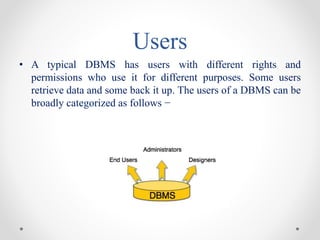
• A typical DBMS has users with different rights and
permissions who use it for different purposes. Some users
retrieve data and some back it up. The users of a DBMS can be
broadly categorized as follows −
Role and Advantages of the
DBMS
• DBMS is the intermediary between the user and the database
– Database structure stored as file collection
– Can only access files through the DBMS
• DBMS enables data to be shared
• DBMS integrates many users’ views of the data
Why Database Design Is
Important
• Database design focuses on design of database structure used
for end-user data
– Designer must identify database’s expected use
• Well-designed database:
– Facilitates data management
– Generates accurate and valuable information
• Poorly designed database:
– Causes difficult-to-trace errors
DBMS Software
• Oracle
• Microsoft SQL Server
• My SQL
• NO SQL
• MS- ACCESS
• MS- EXCEL

Database

  • 1.
  • 2.
    Introduction • Good decisionsrequire good information derived from raw facts • Data is managed most efficiently when stored in a database • Databases evolved from computer file systems • Understanding file system characteristics is important
  • 3.
    Introduction • Database – iscollection of related data and its metadata organized in a structured format – for optimized information management • Database Management System (DBMS) – is a software that enables easy creation, access, and modification of databases – for efficient and effective database management • Database System – is an integrated system of hardware, software, people, procedures, and data – that define and regulate the collection, storage, management, and use of data within a database environment
  • 4.
    Why Database • Databasessolve many of the problems encountered in data management – Used in almost all modern settings involving data management: • Business • Research • Administration • Important to understand how databases work and interact with other applications
  • 5.
    Data vs. Information •Data are raw facts • Information is the result of processing raw data to reveal meaning • Information requires context to reveal meaning • Raw data must be formatted for storage, processing, and presentation • Data are the foundation of information, which is the bedrock of knowledge
  • 6.
    Database Management System • DatabaseManagement System or DBMS in short refers to the technology of storing and retrieving users data with atmost efficiency along with appropriate security measures. • In DBMS, we can create its architecture, data models, data schemas, E-R model, relation model, relational database design, and storage and file structure and much more.
  • 7.
    Users • A typicalDBMS has users with different rights and permissions who use it for different purposes. Some users retrieve data and some back it up. The users of a DBMS can be broadly categorized as follows −
  • 8.
    Role and Advantagesof the DBMS • DBMS is the intermediary between the user and the database – Database structure stored as file collection – Can only access files through the DBMS • DBMS enables data to be shared • DBMS integrates many users’ views of the data
  • 9.
    Why Database DesignIs Important • Database design focuses on design of database structure used for end-user data – Designer must identify database’s expected use • Well-designed database: – Facilitates data management – Generates accurate and valuable information • Poorly designed database: – Causes difficult-to-trace errors
  • 10.
    DBMS Software • Oracle •Microsoft SQL Server • My SQL • NO SQL • MS- ACCESS • MS- EXCEL