Video Transcoding for Mobile Telephony M. Bonuccelli F. Martelli L. D’Amaro
Overview Motivations Video Coding Video Transcoding Future work
Motivations In the 3 rd  generation mobile telephony, many complex applications are foreseen Video on demand Video telephony Web browsing …
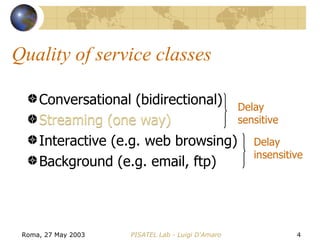
Quality of service classes Conversational (bidirectional) Streaming (one way) Interactive (e.g. web browsing) Background (e.g. email, ftp) Delay sensitive Delay insensitive Streaming (one way)
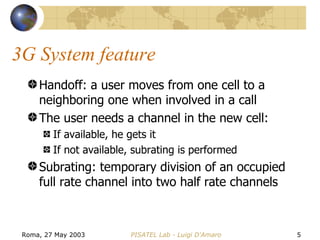
3G System feature Handoff: a user moves from one cell to a neighboring one when involved in a call The user needs a channel in the new cell: If available, he gets it If not available, subrating is performed Subrating: temporary division of an occupied full rate channel into two half rate channels
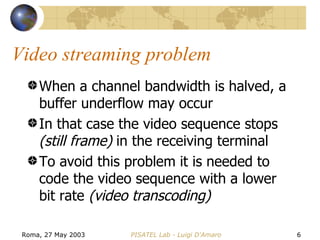
Video streaming problem When a channel bandwidth is halved, a buffer underflow may occur In that case the video sequence stops  (still frame)  in the receiving terminal To avoid this problem it is needed to code the video sequence with a lower bit rate  (video transcoding)
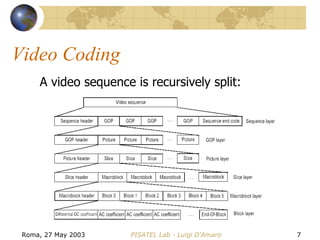
Video Coding A video sequence is recursively split:
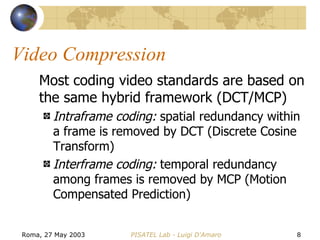
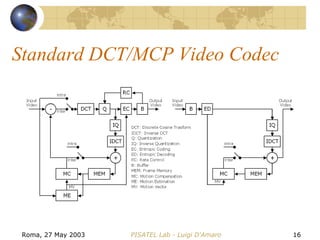
Video Compression Most coding video standards are based on the same hybrid framework (DCT/MCP) Intraframe coding:  spatial redundancy within a frame is removed by DCT (Discrete Cosine Transform) Interframe coding:  temporal redundancy among frames is removed by MCP (Motion Compensated Prediction)
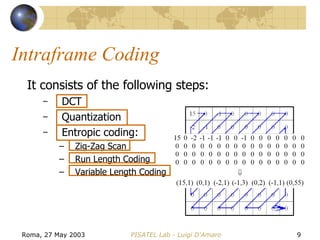
Intraframe Coding It consists of the following steps: DCT Quantization Entropic coding: Zig-Zag Scan Run Length Coding Variable Length Coding
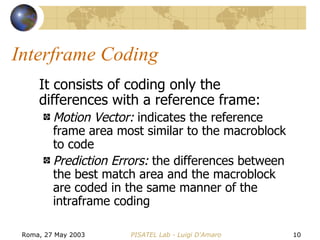
Interframe Coding It consists of coding only the differences with a reference frame: Motion Vector:  indicates the reference frame area most similar to the macroblock to code Prediction Errors:  the differences between the best match area and the macroblock are coded in the same manner of the intraframe coding
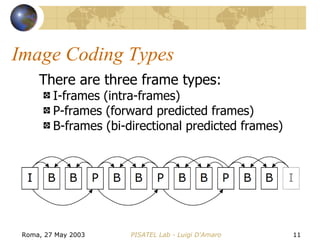
Image Coding Types There are three frame types: I-frames (intra-frames) P-frames (forward predicted frames) B-frames (bi-directional predicted frames)
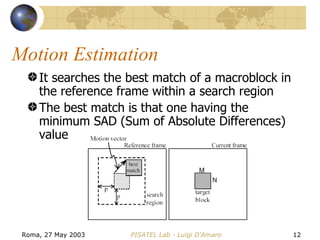
Motion Estimation It searches the best match of a macroblock in the reference frame within a search region The best match is that one having the minimum SAD (Sum of Absolute Differences) value
Motion Estimation Algorithm The Full Search algorithm computes the SAD values of all possible matching areas in the search region It is the most computational complex motion estimation algorithm (it requires about 60-70% of video compression total time)
Fast Motion Estimation Algorithms Many algorithms of fast ME have been proposed to reduce the complexity of Full Search They significantly reduce the number of reference frame areas to test 3 step search PMVFAST (Predictive Motion Vector Field Adaptive Search Technique) APDZS (Advanced Predictive Diamond Zonal search) …
Rate Control By using fixed quantization parameters, the compressed video sequence has a variable bit rate; this may cause buffer underflow or overflow The rate control concerns about the computation of quantization parameters in order to adapt the video streaming bit rate with the channel bandwidth It computes the complexity estimation of the current frame by using that one of previous frame
Standard DCT/MCP Video Codec
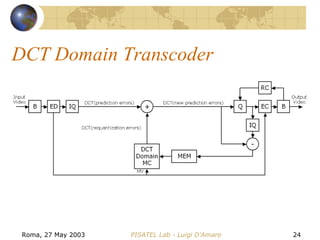
Video Transcoding It is a process in which a compressed video is converted in another one with: Different format Different frame resolution (spatial transcoding) Different frame rate (temporal transcoding) Different video quality (bit rate transcoding) Differently from a conventional video encoder, a video transcoder takes as input a compressed video stream from which it can extract parameters and statistics to encode the output video stream, without recomputing them
Spatial Transcoding It consists of reducing the frame resolution of the input video stream There are two types of spatial transconding: Subsampling 2:1 Arbitrary sampling In both approaches it is necessary to recompute the motion vectors and the prediction errors by combining and scaling the original ones
Temporal Transcoding It consists of dropping some frames, then it is needed to recompute the motion vectors not still valid (because they point to discarded frames) The new motion vectors can be obtained by interpolating the motion vectors of all dropped frames between the current frame and the last not dropped frame The prediction errors must be computed according to the new motion vector
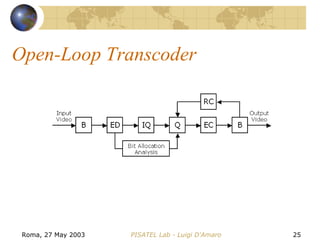
Bit-Rate Transcoding It consists of decreasing the video stream bit rate by reducing the video quality without changing the frame rate or the frame resolution It can be performed by a specific Rate Control function, where the complexity of the current frame, instead of being estimated, can be directly extracted from the input video
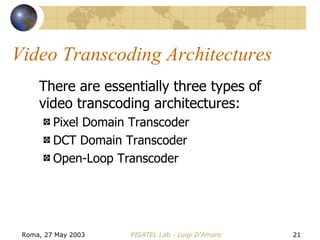
Video Transcoding Architectures There are essentially three types of video transcoding architectures: Pixel Domain Transcoder DCT Domain Transcoder   Open-Loop Transcoder
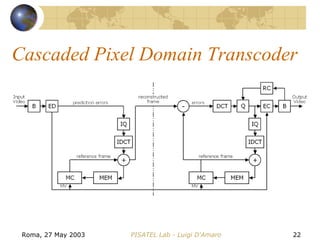
Cascaded Pixel Domain Transcoder
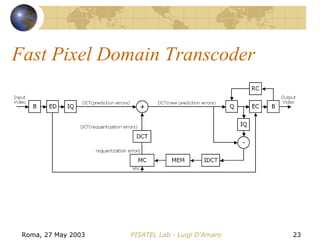
Fast Pixel Domain Transcoder
DCT Domain Transcoder
Open-Loop Transcoder
Future Work Investigate the video transcoding problem caused by subrating Propose new algorithmic and/or architectural solutions

damaro.ppt

  • 1.
    Video Transcoding forMobile Telephony M. Bonuccelli F. Martelli L. D’Amaro
  • 2.
    Overview Motivations VideoCoding Video Transcoding Future work
  • 3.
    Motivations In the3 rd generation mobile telephony, many complex applications are foreseen Video on demand Video telephony Web browsing …
  • 4.
    Quality of serviceclasses Conversational (bidirectional) Streaming (one way) Interactive (e.g. web browsing) Background (e.g. email, ftp) Delay sensitive Delay insensitive Streaming (one way)
  • 5.
    3G System featureHandoff: a user moves from one cell to a neighboring one when involved in a call The user needs a channel in the new cell: If available, he gets it If not available, subrating is performed Subrating: temporary division of an occupied full rate channel into two half rate channels
  • 6.
    Video streaming problemWhen a channel bandwidth is halved, a buffer underflow may occur In that case the video sequence stops (still frame) in the receiving terminal To avoid this problem it is needed to code the video sequence with a lower bit rate (video transcoding)
  • 7.
    Video Coding Avideo sequence is recursively split:
  • 8.
    Video Compression Mostcoding video standards are based on the same hybrid framework (DCT/MCP) Intraframe coding: spatial redundancy within a frame is removed by DCT (Discrete Cosine Transform) Interframe coding: temporal redundancy among frames is removed by MCP (Motion Compensated Prediction)
  • 9.
    Intraframe Coding Itconsists of the following steps: DCT Quantization Entropic coding: Zig-Zag Scan Run Length Coding Variable Length Coding
  • 10.
    Interframe Coding Itconsists of coding only the differences with a reference frame: Motion Vector: indicates the reference frame area most similar to the macroblock to code Prediction Errors: the differences between the best match area and the macroblock are coded in the same manner of the intraframe coding
  • 11.
    Image Coding TypesThere are three frame types: I-frames (intra-frames) P-frames (forward predicted frames) B-frames (bi-directional predicted frames)
  • 12.
    Motion Estimation Itsearches the best match of a macroblock in the reference frame within a search region The best match is that one having the minimum SAD (Sum of Absolute Differences) value
  • 13.
    Motion Estimation AlgorithmThe Full Search algorithm computes the SAD values of all possible matching areas in the search region It is the most computational complex motion estimation algorithm (it requires about 60-70% of video compression total time)
  • 14.
    Fast Motion EstimationAlgorithms Many algorithms of fast ME have been proposed to reduce the complexity of Full Search They significantly reduce the number of reference frame areas to test 3 step search PMVFAST (Predictive Motion Vector Field Adaptive Search Technique) APDZS (Advanced Predictive Diamond Zonal search) …
  • 15.
    Rate Control Byusing fixed quantization parameters, the compressed video sequence has a variable bit rate; this may cause buffer underflow or overflow The rate control concerns about the computation of quantization parameters in order to adapt the video streaming bit rate with the channel bandwidth It computes the complexity estimation of the current frame by using that one of previous frame
  • 16.
  • 17.
    Video Transcoding Itis a process in which a compressed video is converted in another one with: Different format Different frame resolution (spatial transcoding) Different frame rate (temporal transcoding) Different video quality (bit rate transcoding) Differently from a conventional video encoder, a video transcoder takes as input a compressed video stream from which it can extract parameters and statistics to encode the output video stream, without recomputing them
  • 18.
    Spatial Transcoding Itconsists of reducing the frame resolution of the input video stream There are two types of spatial transconding: Subsampling 2:1 Arbitrary sampling In both approaches it is necessary to recompute the motion vectors and the prediction errors by combining and scaling the original ones
  • 19.
    Temporal Transcoding Itconsists of dropping some frames, then it is needed to recompute the motion vectors not still valid (because they point to discarded frames) The new motion vectors can be obtained by interpolating the motion vectors of all dropped frames between the current frame and the last not dropped frame The prediction errors must be computed according to the new motion vector
  • 20.
    Bit-Rate Transcoding Itconsists of decreasing the video stream bit rate by reducing the video quality without changing the frame rate or the frame resolution It can be performed by a specific Rate Control function, where the complexity of the current frame, instead of being estimated, can be directly extracted from the input video
  • 21.
    Video Transcoding ArchitecturesThere are essentially three types of video transcoding architectures: Pixel Domain Transcoder DCT Domain Transcoder Open-Loop Transcoder
  • 22.
  • 23.
  • 24.
  • 25.
  • 26.
    Future Work Investigatethe video transcoding problem caused by subrating Propose new algorithmic and/or architectural solutions