Networked Interactive Media Codec Algorithm  Kostas E. Psannis  and  Yutaka Ishibashi  Department of Technology Management  University of Macedonia, Thessaloniki 540 06, Greece [email_address] ,  [email_address] Department of Computer Science and Engineering,  Nagoya Institute of Technology, Nagoya 466-8555, Japan
PRELIMINARY Interactive access to video content is generally defined as a program or service controlled by the user and which can affect the content itself, the presentation manner of the content, or the presentation order of the content   Full range of interactive functions include play/resume, stop, pause, Jump Forward (JF)/ Jump Backward (JB), Fast Forward (FF)/ Fast Rewind FR), Slow down (SD), and Slow Reverse (SR), Rewind.
Introduction MPEG/H.264 codec Interactive Media Codec Algorithms  Proposed Interactive Media Algorithm Experiments  Conclusions
MPEG/H.264-structure (a) Video Compression technologies have evolved in the series of MPEG-1/2 and  MPEG-4/H.264 Given a bandwidth of several hundred kilobits per second, the recent codecs (H.264) can transmit quality video  MPEG/H.264-based video compression is based on motion compensated predictive coding with an I-B-P structure.
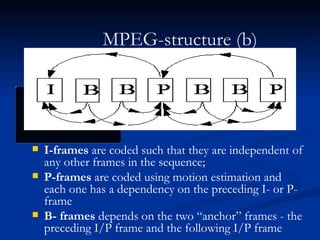
I-frames  are coded such that they are independent of any other frames in the sequence;  P-frames  are coded using motion estimation and each one has a dependency on the preceding I- or P- frame B- frames  depends on the two “anchor” frames - the preceding I/P frame and the following I/P frame   MPEG-structure (b)
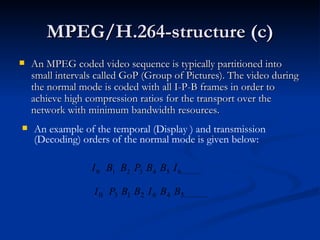
MPEG/H.264-structure (c) An MPEG coded video sequence is typically partitioned into small intervals called GoP (Group of Pictures).  The video during the normal mode is coded with all I-P-B frames in order to achieve high compression ratios for the transport over the network with minimum bandwidth resources.  An example of the temporal ( Display )  and transmission (Decoding) orders of the normal mode is given below:
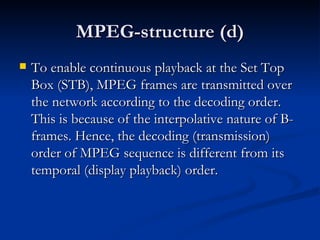
MPEG-structure (d) To enable continuous playback at the Set Top Box (STB), MPEG frames are transmitted over the network according to the decoding order. This is because of the interpolative nature of B-frames. Hence, the decoding (transmission) order of MPEG sequence is different from its temporal (display playback) order.
Streaming Interactive Media Algorithms  Drop parts of the original video stream  -  Send only I - P frames  -  GoP-Skipping  -  Partial GoPs-skipping  Separate Copies of the movie  -  Skipping row of frames  -  Alternative special file
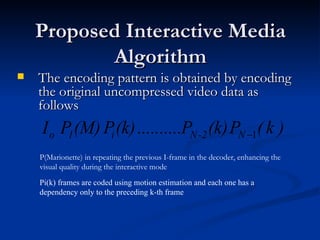
Proposed Interactive Media Algorithm The encoding pattern is obtained by encoding the original uncompressed video data as follows  P(Marionette) in repeating the previous I-frame in the decoder, enhancing the visual quality during the interactive mode   Pi(k)  frames are coded using motion estimation and each one has a dependency only to the preceding k-th frame
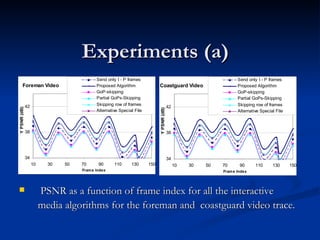
Experiments (a) PSNR as a function of frame index for all the interactive  media algorithms for the foreman and  coastguard video trace.
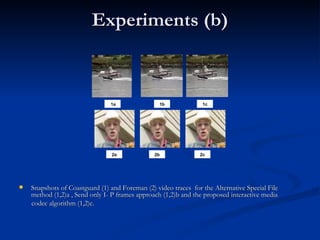
Experiments (b) Snapshots of Coastguard  (1) and Foreman (2) video traces  for the  Alternative Special File method (1,2)a , Send only I- P frames approach (1,2)b and the proposed interactive media  codec algorithm (1,2)c. 1a 1c 1b 2a 2c 2b
Conclusions- Future Work By proper encoding MPEG/ H.264 media streams, I-P(M)-Pi(k) frames,  of the original video sequence, interactive   functionality can be supported with considerably reduced network bandwidth and decoder complexity and acceptable visual quality at the clients end   Future work involves network simulation of all the algorithms over combined networks from wireline to wireless links.

Ppt1140802001

  • 1.
    Networked Interactive MediaCodec Algorithm Kostas E. Psannis and Yutaka Ishibashi Department of Technology Management University of Macedonia, Thessaloniki 540 06, Greece [email_address] , [email_address] Department of Computer Science and Engineering, Nagoya Institute of Technology, Nagoya 466-8555, Japan
  • 2.
    PRELIMINARY Interactive accessto video content is generally defined as a program or service controlled by the user and which can affect the content itself, the presentation manner of the content, or the presentation order of the content Full range of interactive functions include play/resume, stop, pause, Jump Forward (JF)/ Jump Backward (JB), Fast Forward (FF)/ Fast Rewind FR), Slow down (SD), and Slow Reverse (SR), Rewind.
  • 3.
    Introduction MPEG/H.264 codecInteractive Media Codec Algorithms Proposed Interactive Media Algorithm Experiments Conclusions
  • 4.
    MPEG/H.264-structure (a) VideoCompression technologies have evolved in the series of MPEG-1/2 and MPEG-4/H.264 Given a bandwidth of several hundred kilobits per second, the recent codecs (H.264) can transmit quality video MPEG/H.264-based video compression is based on motion compensated predictive coding with an I-B-P structure.
  • 5.
    I-frames arecoded such that they are independent of any other frames in the sequence; P-frames are coded using motion estimation and each one has a dependency on the preceding I- or P- frame B- frames depends on the two “anchor” frames - the preceding I/P frame and the following I/P frame MPEG-structure (b)
  • 6.
    MPEG/H.264-structure (c) AnMPEG coded video sequence is typically partitioned into small intervals called GoP (Group of Pictures). The video during the normal mode is coded with all I-P-B frames in order to achieve high compression ratios for the transport over the network with minimum bandwidth resources. An example of the temporal ( Display ) and transmission (Decoding) orders of the normal mode is given below:
  • 7.
    MPEG-structure (d) Toenable continuous playback at the Set Top Box (STB), MPEG frames are transmitted over the network according to the decoding order. This is because of the interpolative nature of B-frames. Hence, the decoding (transmission) order of MPEG sequence is different from its temporal (display playback) order.
  • 8.
    Streaming Interactive MediaAlgorithms Drop parts of the original video stream - Send only I - P frames - GoP-Skipping - Partial GoPs-skipping Separate Copies of the movie - Skipping row of frames - Alternative special file
  • 9.
    Proposed Interactive MediaAlgorithm The encoding pattern is obtained by encoding the original uncompressed video data as follows P(Marionette) in repeating the previous I-frame in the decoder, enhancing the visual quality during the interactive mode Pi(k) frames are coded using motion estimation and each one has a dependency only to the preceding k-th frame
  • 10.
    Experiments (a) PSNRas a function of frame index for all the interactive media algorithms for the foreman and coastguard video trace.
  • 11.
    Experiments (b) Snapshotsof Coastguard (1) and Foreman (2) video traces for the Alternative Special File method (1,2)a , Send only I- P frames approach (1,2)b and the proposed interactive media codec algorithm (1,2)c. 1a 1c 1b 2a 2c 2b
  • 12.
    Conclusions- Future WorkBy proper encoding MPEG/ H.264 media streams, I-P(M)-Pi(k) frames, of the original video sequence, interactive functionality can be supported with considerably reduced network bandwidth and decoder complexity and acceptable visual quality at the clients end Future work involves network simulation of all the algorithms over combined networks from wireline to wireless links.