www.oeclib.in
Submitted By:
Odisha Electronics Control Library
Seminar
On
Daknet
2
CONTENTS
1 Abstract
2 Introduction
3 Mobile Ad Hoc Connectivity
- 3.1 The real-time aspect of telephony
- 3.2 Seamless Scalability
4 Daknet
- 4.1 In Action
- 4.2 A Lat Mile Stone
5 DakNet’s Network’s Architecture,
-5.1 How it works.
6 Daknet’s Advantages & Disadvantages
7 Conclusion
8 References
INTRODUCTION
 DakNet is an internet service based on the technology, which was
spun-off from an idea, known as DonkeyNet.
 DakNet is an ad hoc network which uses wireless technology to
provide digital connectivity.
 It uses a store and forward technique through Wi-Fi, which is
described as "Cached Wi-Fi Intelligence”
 DakNet, derives from the Hindi word for “post” or “postal,”
3
Mobile Ad hoc Connectivity
 DakNet wireless network takes advantage of the existing communications
and transportation infrastructure.
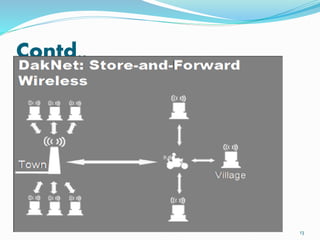
 DakNet transmits data over short point-to-point links between kiosks and
portable storage devices, called mobile access points (MAPs).
 Mounted on and powered by a bus, a motorcycle, or even a bicycle with a
small generator
 The Daknet operation thus has two types:
 MAP-equipped vehicle comes within range of a village WiFi- enabled
kiosk
 MAP-equipped vehicle comes within range of an Internet access point
(the hub)
4
Contd..
5
Seamless Scalability
 In addition to its tremendous cost reduction, a critical feature of DakNet
is its ability to provide a seamless method of upgrading to always-on
broadband connectivity.
 The only change is the addition of fixed-location wireless antennas and
towers—a change that is entirely transparent to end users because they
need not learn any new skills or buy any new hardware or software.
 DakNet makes it practical for individual households and private users to
get connected.
6
Daknet in Action
 Villages in India and northern Cambodia are actively using DakNet with
good results.
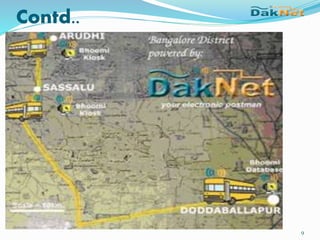
 One of DakNet’s earliest deployments was as an affordable rural
connectivity solution for the Bhoomi e-governance project.
 In September 2003,we also implemented DakNet in a remote province of
Cambodia for 15 solar-powered village schools, telemedicine clinics, and
a governor’s office.
7
Moto-Bike innovation
8
Contd..
9
Myths And Truths
 Myth : The village telephone is the best model for poor
communities.
Truth : Giving everyone access to digital messaging is better
than installing a community telephone.
 Myth :Poor people don’t need computers.
Truth : The poor not only need digital services, but they are
willing and able to pay for them.
10
Daknet’s network architecture
 The main parts of daknet architecture are:
 Mobile access point
 Hub
 Kiosk
11
How It Works?
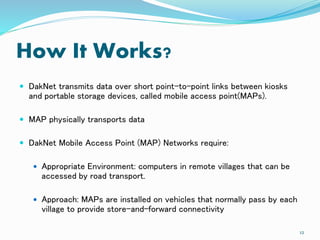
 DakNet transmits data over short point-to-point links between kiosks
and portable storage devices, called mobile access point(MAPs).
 MAP physically transports data
 DakNet Mobile Access Point (MAP) Networks require:
 Appropriate Environment: computers in remote villages that can be
accessed by road transport.
 Approach: MAPs are installed on vehicles that normally pass by each
village to provide store-and-forward connectivity
12
Contd..
13
Contd..
 “Daknet” allows rural villages to exchange messages and video through
a mobile ISP.
 Villagers are able to send message and record videos through these
kiosks.
 All information is downloaded to the central system at the office station.
14
Advantages & Disadvantages
of daknet
Real-time communications not required for public
kiosks
 1. Communications tend to be asynchronous
 2. Villager’s trade –off latency for affordability
Leverages two major trends
 1. Cost of wireless broad (WiFi)
 2. Cost of digital storage
15
Contd..
 Easy to implement on widespread basis
 Lower uplink costs and maintenance
requirements
 Bandwidth does not decrease with distance
 Seed infrastructure that is scalable with demand
 Reduced regulatory challenges and licensing fees
16
Disadvantages
 Token ring constraint if a lower tier goes down, all
higher tier goes down
 Experience and Expertise person can only handled
kiosk
 Efficiency of bandwidth reduced for each tier
17
APPLICATIONS
 EDUCATION
 TELEMEDICINE
 E-GOVERNMENT
 E-COMMERCE
18
Conclusion
 DakNet’s low deployment cost and its enthusiastic reception by rural
users has motivated dozens of inquires for further deployments.
 The larger goal is to shift the policy focus of the government’s
universal-service-obligation funds from wire line village telephones to
wireless ad hoc networking.
 Country wide connectivity through Daknet.
19
References
 www.google.com
 www.wikipedia.com
 www.oeclib.in
20
Thanks
21

Daknet ppt

  • 1.
    www.oeclib.in Submitted By: Odisha ElectronicsControl Library Seminar On Daknet
  • 2.
    2 CONTENTS 1 Abstract 2 Introduction 3Mobile Ad Hoc Connectivity - 3.1 The real-time aspect of telephony - 3.2 Seamless Scalability 4 Daknet - 4.1 In Action - 4.2 A Lat Mile Stone 5 DakNet’s Network’s Architecture, -5.1 How it works. 6 Daknet’s Advantages & Disadvantages 7 Conclusion 8 References
  • 3.
    INTRODUCTION  DakNet isan internet service based on the technology, which was spun-off from an idea, known as DonkeyNet.  DakNet is an ad hoc network which uses wireless technology to provide digital connectivity.  It uses a store and forward technique through Wi-Fi, which is described as "Cached Wi-Fi Intelligence”  DakNet, derives from the Hindi word for “post” or “postal,” 3
  • 4.
    Mobile Ad hocConnectivity  DakNet wireless network takes advantage of the existing communications and transportation infrastructure.  DakNet transmits data over short point-to-point links between kiosks and portable storage devices, called mobile access points (MAPs).  Mounted on and powered by a bus, a motorcycle, or even a bicycle with a small generator  The Daknet operation thus has two types:  MAP-equipped vehicle comes within range of a village WiFi- enabled kiosk  MAP-equipped vehicle comes within range of an Internet access point (the hub) 4
  • 5.
  • 6.
    Seamless Scalability  Inaddition to its tremendous cost reduction, a critical feature of DakNet is its ability to provide a seamless method of upgrading to always-on broadband connectivity.  The only change is the addition of fixed-location wireless antennas and towers—a change that is entirely transparent to end users because they need not learn any new skills or buy any new hardware or software.  DakNet makes it practical for individual households and private users to get connected. 6
  • 7.
    Daknet in Action Villages in India and northern Cambodia are actively using DakNet with good results.  One of DakNet’s earliest deployments was as an affordable rural connectivity solution for the Bhoomi e-governance project.  In September 2003,we also implemented DakNet in a remote province of Cambodia for 15 solar-powered village schools, telemedicine clinics, and a governor’s office. 7
  • 8.
  • 9.
  • 10.
    Myths And Truths Myth : The village telephone is the best model for poor communities. Truth : Giving everyone access to digital messaging is better than installing a community telephone.  Myth :Poor people don’t need computers. Truth : The poor not only need digital services, but they are willing and able to pay for them. 10
  • 11.
    Daknet’s network architecture The main parts of daknet architecture are:  Mobile access point  Hub  Kiosk 11
  • 12.
    How It Works? DakNet transmits data over short point-to-point links between kiosks and portable storage devices, called mobile access point(MAPs).  MAP physically transports data  DakNet Mobile Access Point (MAP) Networks require:  Appropriate Environment: computers in remote villages that can be accessed by road transport.  Approach: MAPs are installed on vehicles that normally pass by each village to provide store-and-forward connectivity 12
  • 13.
  • 14.
    Contd..  “Daknet” allowsrural villages to exchange messages and video through a mobile ISP.  Villagers are able to send message and record videos through these kiosks.  All information is downloaded to the central system at the office station. 14
  • 15.
    Advantages & Disadvantages ofdaknet Real-time communications not required for public kiosks  1. Communications tend to be asynchronous  2. Villager’s trade –off latency for affordability Leverages two major trends  1. Cost of wireless broad (WiFi)  2. Cost of digital storage 15
  • 16.
    Contd..  Easy toimplement on widespread basis  Lower uplink costs and maintenance requirements  Bandwidth does not decrease with distance  Seed infrastructure that is scalable with demand  Reduced regulatory challenges and licensing fees 16
  • 17.
    Disadvantages  Token ringconstraint if a lower tier goes down, all higher tier goes down  Experience and Expertise person can only handled kiosk  Efficiency of bandwidth reduced for each tier 17
  • 18.
  • 19.
    Conclusion  DakNet’s lowdeployment cost and its enthusiastic reception by rural users has motivated dozens of inquires for further deployments.  The larger goal is to shift the policy focus of the government’s universal-service-obligation funds from wire line village telephones to wireless ad hoc networking.  Country wide connectivity through Daknet. 19
  • 20.
  • 21.

Editor's Notes