1
VISVESVARAYA TECHNOLOGICAL UNIVERSITY BELAGAVI
Technical seminar Presentation on
DAKNET
Presentation by
NIKHIL JAIN C S 4BB13CS021
Under the guidance of
Ms. PRATHIBHA M J B.E., M.Tech, M.B.A.
Asst. professor
DEPARTMENT OF COMPUTER SCIENCE AND ENGINEERING
Bahubali College of Engineering
Shravanabelagola-573135
2016-17
2
 Introduction
 Daknet Network Architecture
 Daknet Working
 Daknet In Action
 Applications
 Features
 Conclusion
 references
3
DakNet is an ad hoc network which uses wireless technology
to provide digital connectivity.
DakNet takes advantages of the existing transportation and
communication infrastructure to provide digital connectivity.
Store and forward concept is used.
It is introduced by First Mile Solutions in 2002.
This idea was introduced in India in 2005.
4
There are three main parts of DakNet
architecture
Mobile access point
 Hub
 Kiosk
5
Mobile access point
 Data is transported by means of a mobile access point.
 It automatically and wirelessly collects and delivers
data from/to each kiosk on the network.
 Low cost WIFI radio transceivers automatically
transfer the data stored in the MAP.
 Mobile Access Point is mounted on and powered by a
bus or motorcycle, or even a bicycle
6
7
Fig: Mobile Access Point
HUB
 It is a common connection point for devices in a
network.
 It is used to connect segments of a LAN.
 It contains multiple ports.
 When the vehicle passes near the hub, it
synchronizes all the data from different kiosks
using the internet.
8
9
Fig: Hub
KIOSK
 It is a booth providing a computer related service
such as ATM.
 In each village there is kiosk.
 It requires a user interface that can be used
without training.
10
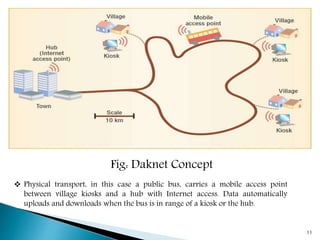
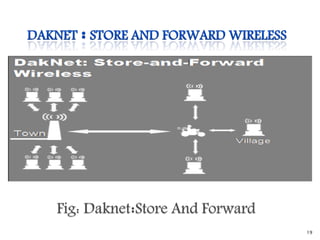
Fig: Daknet Concept
11
 Physical transport, in this case a public bus, carries a mobile access point
between village kiosks and a hub with Internet access. Data automatically
uploads and downloads when the bus is in range of a kiosk or the hub.
 Store-and-forward concept.
 Government bus is used.
 The bus contains a simple WiFi installation
and server.
 Low cost Wi-Fi radio transceivers transfer
data stored in MAP
12
 As the MAP equipped vehicle comes within the range of a village
Wi-Fi enabled kiosk it automatically senses the wireless
connection and uploads and downloads the data.
 As it comes in the range of Internet access points (the hub) it
automatically synchronizes the data from kiosks using the
Internet.
Daknet has following two functions:
13
14
Fig: Daknet Network Architecture
 The average cost to make a village kiosk ready is $185.
 Assuming each bus serves 10 villages the average cost for
enabling each village is $243.
Daknet is currently in action in many places. They
are
Bhoomi initiative in Karnataka.
 SARI (Sustainable Access for Rural India) project
of Tamilnadu.
 Ratnakiri project in Cambodia.
15
BHOOMI INITIATIVE IN INDIA
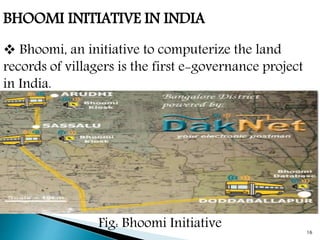
 Bhoomi, an initiative to computerize the land
records of villagers is the first e-governance project
in India.
Fig: Bhoomi Initiative 16
17
Fig: The Internet Motorman Project In Cambodia.
18
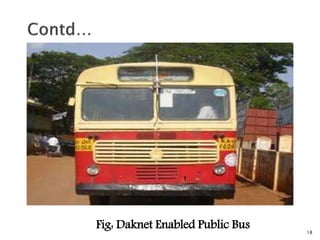
Fig: Daknet Enabled Public Bus
19
MOTO-BIKE INNOVATION
 The moto drivers equipped with a small box and
antenna at the rear of their vehicle.
Fig: Daknet Moto Bike Innovation
20
DakNet store-and-forward drive-by wifi model
21
EDUCATION
TELEMEDICINE
E-GOVERNMENT
E-COMMERCE
22
Avoids Using Phone Lines.
No Expensive Equipment.
Easy To Install.
Upgradability.
23
Low deployment cost.
Possibility of digital connectivity.
Increases economic growth.
24
 [1] Pentland, A et al. "Daknet: rethiniking connectivity in developing nations". Mobile
communication conference. 2004.
 [2] Jun Liu And Fukuda, K. "Towards a taxonomy of darknet traffic". Wireless
communication and mobile computing conference (IWCMC), 2014 international conforence
 [3] Roos,s. And Strufe, T. "A contribution to analyzing and enhancing Darknet routing". IEEE
Conference on Computer Communications 2013.
 [4] Qian Wang et al. "Daknet-based Inference of Internet Worm Temporal Characteristics"
information forensics and security, IEEE transation.
 [5] McManamon and Mtenzi, F. "The development and deployment of daknet." Internet
technology and secured transactions (ICITST), 2010 international conference.
 [6] Mizoguchi,S. et al. "Daknet Monitoring on real-operated Networks. Broadband, wireless
computing, communication and application (BWCCA), 2010 international conference.
25
26

Daknet ppt ( prepared by me for seminar in my college )

  • 1.
    1 VISVESVARAYA TECHNOLOGICAL UNIVERSITYBELAGAVI Technical seminar Presentation on DAKNET Presentation by NIKHIL JAIN C S 4BB13CS021 Under the guidance of Ms. PRATHIBHA M J B.E., M.Tech, M.B.A. Asst. professor DEPARTMENT OF COMPUTER SCIENCE AND ENGINEERING Bahubali College of Engineering Shravanabelagola-573135 2016-17
  • 2.
  • 3.
     Introduction  DaknetNetwork Architecture  Daknet Working  Daknet In Action  Applications  Features  Conclusion  references 3
  • 4.
    DakNet is anad hoc network which uses wireless technology to provide digital connectivity. DakNet takes advantages of the existing transportation and communication infrastructure to provide digital connectivity. Store and forward concept is used. It is introduced by First Mile Solutions in 2002. This idea was introduced in India in 2005. 4
  • 5.
    There are threemain parts of DakNet architecture Mobile access point  Hub  Kiosk 5
  • 6.
    Mobile access point Data is transported by means of a mobile access point.  It automatically and wirelessly collects and delivers data from/to each kiosk on the network.  Low cost WIFI radio transceivers automatically transfer the data stored in the MAP.  Mobile Access Point is mounted on and powered by a bus or motorcycle, or even a bicycle 6
  • 7.
  • 8.
    HUB  It isa common connection point for devices in a network.  It is used to connect segments of a LAN.  It contains multiple ports.  When the vehicle passes near the hub, it synchronizes all the data from different kiosks using the internet. 8
  • 9.
  • 10.
    KIOSK  It isa booth providing a computer related service such as ATM.  In each village there is kiosk.  It requires a user interface that can be used without training. 10
  • 11.
    Fig: Daknet Concept 11 Physical transport, in this case a public bus, carries a mobile access point between village kiosks and a hub with Internet access. Data automatically uploads and downloads when the bus is in range of a kiosk or the hub.
  • 12.
     Store-and-forward concept. Government bus is used.  The bus contains a simple WiFi installation and server.  Low cost Wi-Fi radio transceivers transfer data stored in MAP 12
  • 13.
     As theMAP equipped vehicle comes within the range of a village Wi-Fi enabled kiosk it automatically senses the wireless connection and uploads and downloads the data.  As it comes in the range of Internet access points (the hub) it automatically synchronizes the data from kiosks using the Internet. Daknet has following two functions: 13
  • 14.
    14 Fig: Daknet NetworkArchitecture  The average cost to make a village kiosk ready is $185.  Assuming each bus serves 10 villages the average cost for enabling each village is $243.
  • 15.
    Daknet is currentlyin action in many places. They are Bhoomi initiative in Karnataka.  SARI (Sustainable Access for Rural India) project of Tamilnadu.  Ratnakiri project in Cambodia. 15
  • 16.
    BHOOMI INITIATIVE ININDIA  Bhoomi, an initiative to computerize the land records of villagers is the first e-governance project in India. Fig: Bhoomi Initiative 16
  • 17.
    17 Fig: The InternetMotorman Project In Cambodia.
  • 18.
  • 19.
  • 20.
    MOTO-BIKE INNOVATION  Themoto drivers equipped with a small box and antenna at the rear of their vehicle. Fig: Daknet Moto Bike Innovation 20
  • 21.
  • 22.
  • 23.
    Avoids Using PhoneLines. No Expensive Equipment. Easy To Install. Upgradability. 23
  • 24.
    Low deployment cost. Possibilityof digital connectivity. Increases economic growth. 24
  • 25.
     [1] Pentland,A et al. "Daknet: rethiniking connectivity in developing nations". Mobile communication conference. 2004.  [2] Jun Liu And Fukuda, K. "Towards a taxonomy of darknet traffic". Wireless communication and mobile computing conference (IWCMC), 2014 international conforence  [3] Roos,s. And Strufe, T. "A contribution to analyzing and enhancing Darknet routing". IEEE Conference on Computer Communications 2013.  [4] Qian Wang et al. "Daknet-based Inference of Internet Worm Temporal Characteristics" information forensics and security, IEEE transation.  [5] McManamon and Mtenzi, F. "The development and deployment of daknet." Internet technology and secured transactions (ICITST), 2010 international conference.  [6] Mizoguchi,S. et al. "Daknet Monitoring on real-operated Networks. Broadband, wireless computing, communication and application (BWCCA), 2010 international conference. 25
  • 26.