By
Syed Moinuddin
IT-B
160412737086
From
MUFFAKHAM COLLEGE OF ENGG. & TECHNOLOGY.
Banjara Hills - Hyderabad
Daknet
11/03/2016
Content
1. ABSTRACT.
2. INTRODUCTION.
3. HISTORY.
4. WORKING.
5. APPLICATION.
6. ADVANTAGES.
7. DISADVANTAGES.
8. CONCLUSION.
9. REFERENCES.
11/03/2016
Abstract
 DakNet, an ad hoc network that uses wireless technology to provide
asynchronous digital connectivity.
 It provides extraordinarily low-cost digital communication, letting remote
villages leapfrog past the expense of traditional connectivity solutions and
begin development of a full-coverage broadband wireless infrastructure.
 DakNet has been successfully deployed in remote parts of both India and
Cambodia at a cost two orders of magnitude less than that of traditional
landline solutions.
11/03/2016
Introduction
11/03/2016
 Daknet is defined as a wireless network which takes advantage of
existing transportation system & communication system to provide
digital connectivity.
 This compromise is particularly tragic given recent advances in
wireless technology, which make running a copper line to an analog
telephone far more expensive than broadband wireless Internet
connectivity.
 Exchange of information is done wirelessly by means of physical
transportation to extend the internet connectivity.
History
11/03/2016
 Daknet is introduced for the ancient
concept of exchanging information
through pigeons.
Working
11/03/2016
Working
11/03/2016
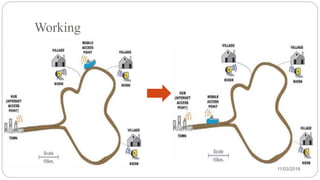
 Mobile Access Point(MAP) sense the Kiosks and uses them.
 Kiosks are Wi-Fi enabled.
 MAP travels across the villages.
Working
11/03/2016
Working
11/03/2016
 Daknet is implemented in Bhoomi Initiative Project (Karnataka).
 Villages in India & northern Cambodia are active with daknet.
 Daknet is implemented in 20 villages of Orissa.
Application
11/03/2016
 Distribution/Broadcasting:
 Announcements, news broadcasting and transfer of education material.
 Information Collection:
 Health records, land records, climatic conditions.
 Web Searching:
 Accessing web for social services.
 Bhoomi Project:
 Computerize land records.
Advantages
 Cost effective.
 Wireless.
 No interference problem.
 Information collection.
11/03/2016
Disadvantages
 Power consumption is high.
 Limited range.
 Uses 2.4 GHz spectrum which is already crowded.
11/03/2016
Conclusion
 It is an electronic postman.
 Its goal is to shift the wired communication to wireless ad-hoc networking
which ensuring development of rural public.
 It also encourages the economic growth in rural areas.
11/03/2016
THANK YOU…
11/03/2016

Daknet by moinuddin

  • 1.
    By Syed Moinuddin IT-B 160412737086 From MUFFAKHAM COLLEGEOF ENGG. & TECHNOLOGY. Banjara Hills - Hyderabad Daknet 11/03/2016
  • 2.
    Content 1. ABSTRACT. 2. INTRODUCTION. 3.HISTORY. 4. WORKING. 5. APPLICATION. 6. ADVANTAGES. 7. DISADVANTAGES. 8. CONCLUSION. 9. REFERENCES. 11/03/2016
  • 3.
    Abstract  DakNet, anad hoc network that uses wireless technology to provide asynchronous digital connectivity.  It provides extraordinarily low-cost digital communication, letting remote villages leapfrog past the expense of traditional connectivity solutions and begin development of a full-coverage broadband wireless infrastructure.  DakNet has been successfully deployed in remote parts of both India and Cambodia at a cost two orders of magnitude less than that of traditional landline solutions. 11/03/2016
  • 4.
    Introduction 11/03/2016  Daknet isdefined as a wireless network which takes advantage of existing transportation system & communication system to provide digital connectivity.  This compromise is particularly tragic given recent advances in wireless technology, which make running a copper line to an analog telephone far more expensive than broadband wireless Internet connectivity.  Exchange of information is done wirelessly by means of physical transportation to extend the internet connectivity.
  • 5.
    History 11/03/2016  Daknet isintroduced for the ancient concept of exchanging information through pigeons.
  • 6.
  • 7.
    Working 11/03/2016  Mobile AccessPoint(MAP) sense the Kiosks and uses them.  Kiosks are Wi-Fi enabled.  MAP travels across the villages.
  • 8.
  • 9.
    Working 11/03/2016  Daknet isimplemented in Bhoomi Initiative Project (Karnataka).  Villages in India & northern Cambodia are active with daknet.  Daknet is implemented in 20 villages of Orissa.
  • 10.
    Application 11/03/2016  Distribution/Broadcasting:  Announcements,news broadcasting and transfer of education material.  Information Collection:  Health records, land records, climatic conditions.  Web Searching:  Accessing web for social services.  Bhoomi Project:  Computerize land records.
  • 11.
    Advantages  Cost effective. Wireless.  No interference problem.  Information collection. 11/03/2016
  • 12.
    Disadvantages  Power consumptionis high.  Limited range.  Uses 2.4 GHz spectrum which is already crowded. 11/03/2016
  • 13.
    Conclusion  It isan electronic postman.  Its goal is to shift the wired communication to wireless ad-hoc networking which ensuring development of rural public.  It also encourages the economic growth in rural areas. 11/03/2016
  • 14.