“ 
” 
DakNet 
Rethinking Connectivity in developing nations 
By 
V.V.Krishnadeepu
Meaning and origin 
 It is a word which is derived from Hindi and 
English 
 Dak – In Hindi which means “postal” or to be 
precise “mobile”. 
 Net – In English network or even internet .
Definition: 
 Daknet is a wireless network provider for rural 
areas. It requires bare minimum investment and 
equipment and efficiently provides connectivity 
to the third world countries. It uses wireless 
technology to provide asynchronous digital 
connectivity.
Developed by and at 
 MIT -Massachusetts Institute of Technology. 
 Mostly by Indian graduates . 
 With co-operation of United Villages Inc. 
 It is an ad hoc network. 
 Ad hoc-A wireless ad hoc network is a decentralized type of wireless network.
Need for DakNet 
 A phone is a dutifully installed as a part of current govt. mandate to connect 
villages to the neighbouring towns . 
 The phone is use occasionally 
 Most people travel miles to get forms and data 
 Even for a phone call people travel 20 miles in some villages in India like village 
called Kalapathar in Orissa 
 Analog phones are far more expensive (Hard lines)
Architecture of Daknet 
 Components of architecture 
 Hub -Internet access point 
 Kiosk - cabin or a telephone booth like structured 
 MAP -Mobile access point 
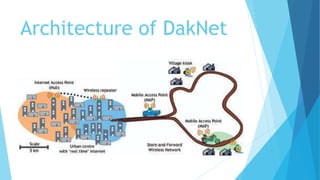
DakNet transmit data over short point to point links b/w kiosks and portable storage 
devices called MAPs(Mobile Access Points).These are digitalized storage devices.
Architecture of DakNet
Daknet Technology Architecture 
 The hub server software and the kiosk client software are pre-installed and 
pre-configured. 
 The Mobile Access Points also have the network software pre-installed and 
configured. 
 The software consists of system, transport, and application level codes 
written to optimize the use of the physical network and serve as a platform 
to interface with numerous end-user applications while retaining a small 
data overhead and processing power requirements.
ICT 
Information Communication Technologies 
 The UN’s target is also to connect the 
remote areas with the help of their R&D 
Developing countries have their advantages 
to adopt this type of optimal and cheap 
equipment tech to get their remote areas 
connected
Challenges in adopting ICT 
Rural and remote areas have been slow to 
change for several reasons- 
High cost and limited access are the main 
obstacles to telephone services 
The ratio of communication 
infrastructure to income in many times 
larger
First Mile Solutions 
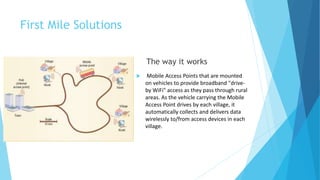
The way it works 
 Mobile Access Points that are mounted 
on vehicles to provide broadband "drive-by 
WiFi" access as they pass through rural 
areas. As the vehicle carrying the Mobile 
Access Point drives by each village, it 
automatically collects and delivers data 
wirelessly to/from access devices in each 
village.
Seamless Scalability 
 Daknet provides the ability to seamlessly upgrade to the always-on broadband 
connectivity. 
 The wireless broadband connectivity provides sophisticated services like voice 
over internet protocol which allows “normal” real-time telephony. 
 Daknet supports easy user-interface and low cost hardware that allows 
individuals, with no professional skills of using communication devices, 
operate the software and get connected.
Daknet Economics 
 A capital investment of $1500 mill could equip each of India’s 50000rural 
buses with MAP and their by provides connectivity to about 750 million people 
living in rural India . 
 Costs for user interactive user devises that DakNet supports includes-client 
terminals ,PDAs and VolP telephones also became far more affordable than 
traditional PCs or WLL equipment.
Advantages 
• Daknet allows for low cost and low power radio devices to be used. 
• The use of short distance radio links also ensures high data rated. 
• Does not have the interference problem. 
• Security problem is not there. 
• And maintenance cost associated with long distance wireless links.
Applications 
 Internet/Internet messaging 
 Information distribution/Broadcasting 
 Information collection 
 Rural supply chain management 
 Information searching & web searching
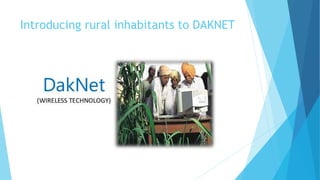
Introducing rural inhabitants to DAKNET
Daknet in action 
 Bhoomi initiative in India is recognized as the first national e-governance initiative in 
India. Pioneered by the State Government of Karnataka, Bhoomi has been successfully 
implemented across the state to completely replace the physical land records system. 
 Villagers along the bus route have enthusiastically received the DakNet-Bhoomi 
system. They are grateful to avoid making the long, expensive trip into the main city to 
obtain land records.
Conclusion 
We have discussed all the benefits of the DakNet and it is evidentially going to 
help the developing nations like India eradicate the-digital-divide by bringing 
technology to everyone . The current focus is on further reduction of cost of 
required equipment.
Thank you for your consideration 
V.V.Krishnadeepu

Dak Net

  • 1.
    “ ” DakNet Rethinking Connectivity in developing nations By V.V.Krishnadeepu
  • 2.
    Meaning and origin  It is a word which is derived from Hindi and English  Dak – In Hindi which means “postal” or to be precise “mobile”.  Net – In English network or even internet .
  • 3.
    Definition:  Daknetis a wireless network provider for rural areas. It requires bare minimum investment and equipment and efficiently provides connectivity to the third world countries. It uses wireless technology to provide asynchronous digital connectivity.
  • 4.
    Developed by andat  MIT -Massachusetts Institute of Technology.  Mostly by Indian graduates .  With co-operation of United Villages Inc.  It is an ad hoc network.  Ad hoc-A wireless ad hoc network is a decentralized type of wireless network.
  • 5.
    Need for DakNet  A phone is a dutifully installed as a part of current govt. mandate to connect villages to the neighbouring towns .  The phone is use occasionally  Most people travel miles to get forms and data  Even for a phone call people travel 20 miles in some villages in India like village called Kalapathar in Orissa  Analog phones are far more expensive (Hard lines)
  • 6.
    Architecture of Daknet  Components of architecture  Hub -Internet access point  Kiosk - cabin or a telephone booth like structured  MAP -Mobile access point DakNet transmit data over short point to point links b/w kiosks and portable storage devices called MAPs(Mobile Access Points).These are digitalized storage devices.
  • 7.
  • 8.
    Daknet Technology Architecture  The hub server software and the kiosk client software are pre-installed and pre-configured.  The Mobile Access Points also have the network software pre-installed and configured.  The software consists of system, transport, and application level codes written to optimize the use of the physical network and serve as a platform to interface with numerous end-user applications while retaining a small data overhead and processing power requirements.
  • 9.
    ICT Information CommunicationTechnologies  The UN’s target is also to connect the remote areas with the help of their R&D Developing countries have their advantages to adopt this type of optimal and cheap equipment tech to get their remote areas connected
  • 10.
    Challenges in adoptingICT Rural and remote areas have been slow to change for several reasons- High cost and limited access are the main obstacles to telephone services The ratio of communication infrastructure to income in many times larger
  • 11.
    First Mile Solutions The way it works  Mobile Access Points that are mounted on vehicles to provide broadband "drive-by WiFi" access as they pass through rural areas. As the vehicle carrying the Mobile Access Point drives by each village, it automatically collects and delivers data wirelessly to/from access devices in each village.
  • 12.
    Seamless Scalability Daknet provides the ability to seamlessly upgrade to the always-on broadband connectivity.  The wireless broadband connectivity provides sophisticated services like voice over internet protocol which allows “normal” real-time telephony.  Daknet supports easy user-interface and low cost hardware that allows individuals, with no professional skills of using communication devices, operate the software and get connected.
  • 13.
    Daknet Economics A capital investment of $1500 mill could equip each of India’s 50000rural buses with MAP and their by provides connectivity to about 750 million people living in rural India .  Costs for user interactive user devises that DakNet supports includes-client terminals ,PDAs and VolP telephones also became far more affordable than traditional PCs or WLL equipment.
  • 14.
    Advantages • Daknetallows for low cost and low power radio devices to be used. • The use of short distance radio links also ensures high data rated. • Does not have the interference problem. • Security problem is not there. • And maintenance cost associated with long distance wireless links.
  • 15.
    Applications  Internet/Internetmessaging  Information distribution/Broadcasting  Information collection  Rural supply chain management  Information searching & web searching
  • 16.
  • 17.
    Daknet in action  Bhoomi initiative in India is recognized as the first national e-governance initiative in India. Pioneered by the State Government of Karnataka, Bhoomi has been successfully implemented across the state to completely replace the physical land records system.  Villagers along the bus route have enthusiastically received the DakNet-Bhoomi system. They are grateful to avoid making the long, expensive trip into the main city to obtain land records.
  • 18.
    Conclusion We havediscussed all the benefits of the DakNet and it is evidentially going to help the developing nations like India eradicate the-digital-divide by bringing technology to everyone . The current focus is on further reduction of cost of required equipment.
  • 19.
    Thank you foryour consideration V.V.Krishnadeepu