West Virginia
      Broadband Connectivity
          Working Team
A presentation to the Joint Committee on Technology
              West Virginia Legislature
                    June 13, 2004

        Larry Malone, Malone Consulting Services
      Jack Shaffer, Columbia Natural Resources LLC
Why Broadband?

“Fourth Utility” – Key Development Tool

• Employment/Jobs
• Business Retention & Investment
• Competitiveness
• Community Development
• Education, Health, Well-Being
• Self-Improvement and Sufficiency
The Challenge

Rural America already faces huge economic challenges
and is being left behind because they simply can't
compete without affordable high-speed access to the
Internet. That is where the jobs are, and that is where
businesses invest.

Competition and active participation in today’s vigorous
new economy requires not only a computer, but also high-
speed, high-capacity (broadband) access to information
and data on the Internet.

- Rural Broadband Coalition
Putting It Into Perspective
Despite its economic and political might, the USA is falling behind other nations in
arming consumers and small businesses with a key economic tool: high-speed
Internet access, also known as broadband. The USA ranks 11th worldwide in
broadband use, according to a recent United Nations report, behind such
places as South Korea, Hong Kong and Iceland.

For now, nations besting the USA have smaller economies and don't present an
immediate economic threat. But as other nations leap ahead in broadband, their
industries — from South Korean automakers to Canadian doctors — prosper.
Meanwhile, hundreds of thousands of U.S. companies, waste time and money
that could otherwise help drive growth.

Spreading fast Internet access in the USA is so critical to long-term
economic might that TechNet, a group of top U.S. tech CEOs, says it's the
21st-century equivalent of landing a man on the moon.

That gap matters as the Web drives more of the global economy. The longer it
takes to do a task — from downloading forms to bidding on contracts — the more
it chips away at U.S. productivity.

Source: USAToday, 1/18/2004 http://www.usatoday.com/tech/techinvestor/2004-01-19-broadband_x.htm
                            http://www.usatoday.com/tech/techinvestor/2004-01-19-broadband_x.htm
Putting It Into Perspective
America has made great strides in providing Internet access to schools and
underserved communities. However, despite these efforts, there is still a wide gap
between communities on the cutting edge of technology and those still awaiting
their first taste of the Internet. As wealthier towns and neighborhoods connect
to broadband networks, many rural, hard-to-reach and underserved
communities fall further behind, deprived of a key developmental tool.

As knowledge of technology becomes increasingly essential, the lack of access to
advanced services will deprive some of the ability to acquire the tools necessary
to succeed. There is a tremendous need in all communities for training in the
"twenty-first century skills" to take advantage of the new opportunities
broadband can provide.

As with the Internet itself, the nation must realize the unique value of broadband
access. More than just a new vehicle for entertainment, broadband can play an
important role in providing valuable services -- such as telemedicine,
distance education, independent living, and even e-commerce solutions to
create more viable communities, particularly in underserved areas.

Alliance for Public Technology - http://apt.org/publica/broadband-world.html
West Virginia Broadband
Connectivity Working Team


• Business/Technology
• Telecommunications/Cable
• Government – Federal, State, County
• Economic and Community Development
• Higher Education and Education
• Non-Profits
• Foundations – Benedum
• Reps – Health care, tourism, banking
Mission/Purpose
   To leverage the knowledge of interested
   stakeholders in a collaborative effort to:
1) Collect and analyze available research and best practices
   on high-speed Internet connectivity and services
2) Determine and develop a statewide strategy and
   recommendations on:
   a. building demand for high-speed Internet access
      and expanding connectivity levels in all
      communities
   b. offering affordable, sustainable and simplistic
      high-speed connection service throughout the state
3) Link this to improving the overall well-being and
    prosperity of communities
Core Focus
Core areas of examination and focus:

1) Demand: Broadband Use and Applications Awareness
      - Distance learning
      - Telemedicine
      - e-Government
      - e-Commerce/e-marketing
      - Home-based work
      - ASP applications

2) Affordability/Rates and System Management/Operati ons

3) Issues Associated with Physical Installation and Expansion
     of Infrastructure (wired/wireless/satellite)
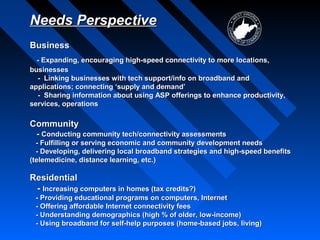
Needs Perspective
Business
  - Expanding, encouraging high-speed connectivity to more locations,
businesses
  - Linking businesses with tech support/info on broadband and
applications; connecting ‘supply and demand’
  - Sharing information about using ASP offerings to enhance productivity,
services, operations

Community
 - Conducting community tech/connectivity assessments
  - Fulfilling or serving economic and community development needs
  - Developing, delivering local broadband strategies and high-speed benefits
(telemedicine, distance learning, etc.)

Residential
 - Increasing computers in homes (tax credits?)
 - Providing educational programs on computers, Internet
 - Offering affordable Internet connectivity fees
 - Understanding demographics (high % of older, low-income)
 - Using broadband for self-help purposes (home-based jobs, living)
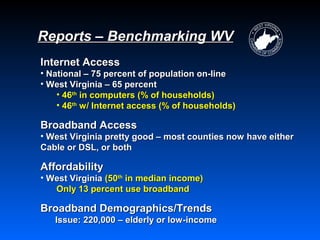
Reports – Benchmarking WV
Internet Access
• National – 75 percent of population on-line
• West Virginia – 65 percent
    • 46th in computers (% of households)
    • 46th w/ Internet access (% of households)

Broadband Access
• West Virginia pretty good – most counties now have either
Cable or DSL, or both

Affordability
• West Virginia (50th in median income)
   Only 13 percent use broadband

Broadband Demographics/Trends
   Issue: 220,000 – elderly or low-income
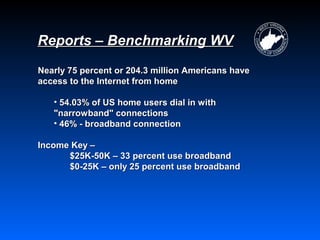
Reports – Benchmarking WV
Nearly 75 percent or 204.3 million Americans have
access to the Internet from home

   • 54.03% of US home users dial in with
   "narrowband" connections
   • 46% - broadband connection

Income Key –
      $25K-50K – 33 percent use broadband
      $0-25K – only 25 percent use broadband
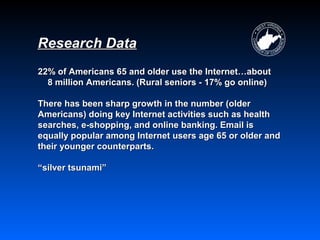
Research Data
22% of Americans 65 and older use the Internet…about
  8 million Americans. (Rural seniors - 17% go online)

There has been sharp growth in the number (older
Americans) doing key Internet activities such as health
searches, e-shopping, and online banking. Email is
equally popular among Internet users age 65 or older and
their younger counterparts.

“silver tsunami”
Research Data
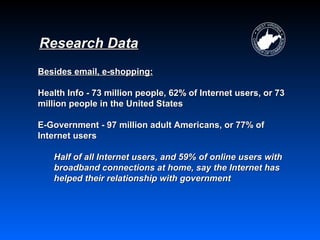
Besides email, e-shopping:

Health Info - 73 million people, 62% of Internet users, or 73
million people in the United States

E-Government - 97 million adult Americans, or 77% of
Internet users

   Half of all Internet users, and 59% of online users with
   broadband connections at home, say the Internet has
   helped their relationship with government
Resources/Linkages
Federal
• ARC
• USDA RUS
• FCC
• State Delegation
State
Local
Non-Profit
Educational
Foundation
Timeline

Fall 2004 –
 Complete recommendations and report
 Possible conference

2005 Session –
  Legislative agenda
WV Rural Broadband Committee
       Broadband 101
               Jack L. Shaffer, Jr.
  Manager, Technology Services and Development
        Columbia Natural Resources, LLC
WV Rural Broadband Committee
              Technology Overview

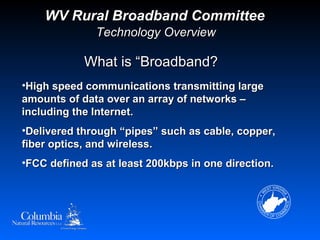
            What is “Broadband?
•High speed communications transmitting large
amounts of data over an array of networks –
including the Internet.
•Delivered through “pipes” such as cable, copper,
fiber optics, and wireless.
•FCC defined as at least 200kbps in one direction.
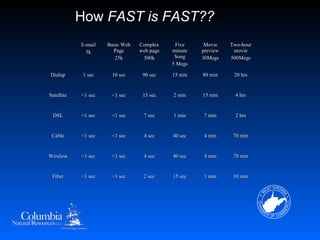
How FAST is FAST??
            E-mail   Basic Web   Complex     Five     Movie    Two-hour
              5k       Page      web page   minute   preview    movie
                        25k       500k       Song    30Megs    500Megs
                                            5 Megs

Dialup       1 sec    10 sec      90 sec    15 min   80 min     20 hrs


Satellite   <1 sec    <1 sec      15 sec    2 min    15 min      4 hrs


 DSL        <1 sec    <1 sec      7 sec     1 min    7 min       2 hrs


 Cable      <1 sec    <1 sec      4 sec     40 sec   4 min      70 min


Wireless    <1 sec    <1 sec      4 sec     40 sec   4 min      70 min


 Fiber      <1 sec    <1 sec      2 sec     15 sec   1 min      10 min
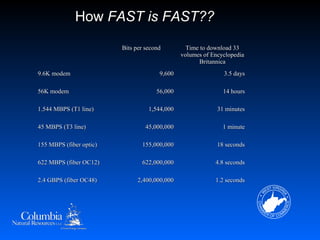
How FAST is FAST??

                         Bits per second         Time to download 33
                                               volumes of Encyclopedia
                                                     Britannica
9.6K modem                             9,600                  3.5 days

56K modem                             56,000                  14 hours

1.544 MBPS (T1 line)               1,544,000                31 minutes

45 MBPS (T3 line)                 45,000,000                  1 minute

155 MBPS (fiber optic)          155,000,000                 18 seconds

622 MBPS (fiber OC12)           622,000,000                4.8 seconds

2.4 GBPS (fiber OC48)          2,400,000,000               1.2 seconds
WV Rural Broadband Committee
            Technology Overview

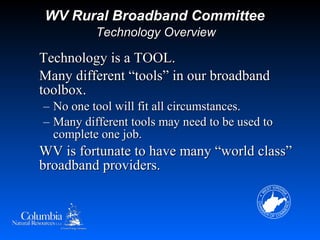
Technology is a TOOL.
Many different “tools” in our broadband
toolbox.
–   No one tool will fit all circumstances.
–   Many different tools may need to be used to
    complete one job.
WV is fortunate to have many “world class”
broadband providers.
WV Rural Broadband Committee
          Technology Overview

We must focus on the end result and avoid
“technology holy wars.”
All of our broadband tools have pros and
cons.
There is NO MAGIC BULLET!
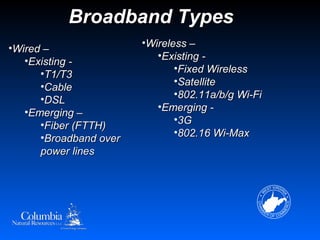
Broadband Types
                        •Wireless –
•Wired –
                           •Existing -
   •Existing -
                               •Fixed Wireless
      •T1/T3
                               •Satellite
      •Cable
                               •802.11a/b/g Wi-Fi
      •DSL
                           •Emerging -
   •Emerging –
                               •3G
      •Fiber (FTTH)
                               •802.16 Wi-Max
      •Broadband over
      power lines
WV Rural Broadband Committee
                   Technology Overview
T1 – A 24 channel circuit that can be used over copper or fiber lines.
 – 1.54Mbps
 – 99% availability
 – Expensive
 – Typically used to connect “edge” or “last mile” technologies to the Internet
Cable – Coax or Fiber connection to the Internet.
 – 2Mbps download/512Mbps upload
 – Cost effective
 – “shared pipe”
 – Typically used to connect directly to the Internet
WV Rural Broadband Committee
                Technology Overview
xDSL – Digital Subscriber Line a high speed connection that uses the
same wires as a regular telephone line.
 – 1.5Mbps download/256Mbps upload
 – Cost effective
 – Distance limitations
 – Typically used to connect directly to the Internet
WV Rural Broadband Committee
                    Technology Overview
Fiber – Fiber to the home (FTTH) – Internet data transmitted across fiber optic cable.
 – Up to 1 Gigabit per second
 – Uses cable modem standard DOCSIS
 – Can be expensive and time consuming to build
 – Connections can be problematic
Broadband over power lines (BPL or PLC) – Internet data transmitted across existing
power lines.
 – 3Mbps (upload/download speeds are the same)
 – Requires specialized equipment to bridge transformers
 – Possible Radio Interference
      » Cinergy & the FCC disputes this claim
WV Rural Broadband Committee
               Technology Overview
Fixed Wireless – Wireless data transfer between fixed antennas (like
the Motorola Canopy system at Glenville)
 – 6.2Mbps
 – 10 mile radius between access points
 – Basically line of site
 – Interference can be problematic
 – Used in “Last Mile” coverage
WV Rural Broadband Committee
               Technology Overview
Satellite Broadband
 – 1 Mbps download / 100 Kbps upload
 – Latency can be problematic
 – Can be expensive
 – Primarily used where other broadband choices are not available.
Wi-Fi (802.11 a/b/g) – Wireless LAN
 – 11 Mbps – 54 Mbps depending upon protocol
 – 1000 ft radius
 – Primarily used in local area networks
WV Rural Broadband Committee
                      Technology Overview
Mesh Point-to-Point via satellite broadband
 – 50 Mbps download / 16 Mbps upload (theoretical limits)
 – VSAT line of site
 – Satellites will contain switching technology to reduce latency
 – Will still be fairly expensive
 – Primarily used where other broadband alternatives are not available
Wi-Max / Wireless Man (802.16) – long range wireless
 – 70 Mbps transmission speed
 – 30 mile non-line of site radius
 – Still a fixed wireless solution
 – Works in tandem with Wi-Fi
 – Primarily used as a “last mile” connection
WV Rural Broadband Committee
                  Technology Overview
3G – Wireless technologies used to transmit data
 – Many different standards/products
     » CDMA2001x
     » TD-SCDMA
     » W-CDMA
     » EDGE
     » 1xEV-DO
 – Speeds < 1 Mbps
 – Availability problems
 – Mainly targeted at the mobile user
WV Rural Broadband Committee
            Technology Overview
                 SUMMARY
Many broadband options today – more tomorrow.
Any successful project will contain some mix of
broadband tools.
Focus on demand and the project – not the
technology.
Return on Investment and Continuous Operations
costs MUST be considered.

Broadband presentation to WV Legislature

  • 1.
    West Virginia Broadband Connectivity Working Team A presentation to the Joint Committee on Technology West Virginia Legislature June 13, 2004 Larry Malone, Malone Consulting Services Jack Shaffer, Columbia Natural Resources LLC
  • 2.
    Why Broadband? “Fourth Utility”– Key Development Tool • Employment/Jobs • Business Retention & Investment • Competitiveness • Community Development • Education, Health, Well-Being • Self-Improvement and Sufficiency
  • 3.
    The Challenge Rural Americaalready faces huge economic challenges and is being left behind because they simply can't compete without affordable high-speed access to the Internet. That is where the jobs are, and that is where businesses invest. Competition and active participation in today’s vigorous new economy requires not only a computer, but also high- speed, high-capacity (broadband) access to information and data on the Internet. - Rural Broadband Coalition
  • 4.
    Putting It IntoPerspective Despite its economic and political might, the USA is falling behind other nations in arming consumers and small businesses with a key economic tool: high-speed Internet access, also known as broadband. The USA ranks 11th worldwide in broadband use, according to a recent United Nations report, behind such places as South Korea, Hong Kong and Iceland. For now, nations besting the USA have smaller economies and don't present an immediate economic threat. But as other nations leap ahead in broadband, their industries — from South Korean automakers to Canadian doctors — prosper. Meanwhile, hundreds of thousands of U.S. companies, waste time and money that could otherwise help drive growth. Spreading fast Internet access in the USA is so critical to long-term economic might that TechNet, a group of top U.S. tech CEOs, says it's the 21st-century equivalent of landing a man on the moon. That gap matters as the Web drives more of the global economy. The longer it takes to do a task — from downloading forms to bidding on contracts — the more it chips away at U.S. productivity. Source: USAToday, 1/18/2004 http://www.usatoday.com/tech/techinvestor/2004-01-19-broadband_x.htm http://www.usatoday.com/tech/techinvestor/2004-01-19-broadband_x.htm
  • 5.
    Putting It IntoPerspective America has made great strides in providing Internet access to schools and underserved communities. However, despite these efforts, there is still a wide gap between communities on the cutting edge of technology and those still awaiting their first taste of the Internet. As wealthier towns and neighborhoods connect to broadband networks, many rural, hard-to-reach and underserved communities fall further behind, deprived of a key developmental tool. As knowledge of technology becomes increasingly essential, the lack of access to advanced services will deprive some of the ability to acquire the tools necessary to succeed. There is a tremendous need in all communities for training in the "twenty-first century skills" to take advantage of the new opportunities broadband can provide. As with the Internet itself, the nation must realize the unique value of broadband access. More than just a new vehicle for entertainment, broadband can play an important role in providing valuable services -- such as telemedicine, distance education, independent living, and even e-commerce solutions to create more viable communities, particularly in underserved areas. Alliance for Public Technology - http://apt.org/publica/broadband-world.html
  • 6.
    West Virginia Broadband ConnectivityWorking Team • Business/Technology • Telecommunications/Cable • Government – Federal, State, County • Economic and Community Development • Higher Education and Education • Non-Profits • Foundations – Benedum • Reps – Health care, tourism, banking
  • 7.
    Mission/Purpose To leverage the knowledge of interested stakeholders in a collaborative effort to: 1) Collect and analyze available research and best practices on high-speed Internet connectivity and services 2) Determine and develop a statewide strategy and recommendations on: a. building demand for high-speed Internet access and expanding connectivity levels in all communities b. offering affordable, sustainable and simplistic high-speed connection service throughout the state 3) Link this to improving the overall well-being and prosperity of communities
  • 8.
    Core Focus Core areasof examination and focus: 1) Demand: Broadband Use and Applications Awareness - Distance learning - Telemedicine - e-Government - e-Commerce/e-marketing - Home-based work - ASP applications 2) Affordability/Rates and System Management/Operati ons 3) Issues Associated with Physical Installation and Expansion of Infrastructure (wired/wireless/satellite)
  • 9.
    Needs Perspective Business - Expanding, encouraging high-speed connectivity to more locations, businesses - Linking businesses with tech support/info on broadband and applications; connecting ‘supply and demand’ - Sharing information about using ASP offerings to enhance productivity, services, operations Community - Conducting community tech/connectivity assessments - Fulfilling or serving economic and community development needs - Developing, delivering local broadband strategies and high-speed benefits (telemedicine, distance learning, etc.) Residential - Increasing computers in homes (tax credits?) - Providing educational programs on computers, Internet - Offering affordable Internet connectivity fees - Understanding demographics (high % of older, low-income) - Using broadband for self-help purposes (home-based jobs, living)
  • 10.
    Reports – BenchmarkingWV Internet Access • National – 75 percent of population on-line • West Virginia – 65 percent • 46th in computers (% of households) • 46th w/ Internet access (% of households) Broadband Access • West Virginia pretty good – most counties now have either Cable or DSL, or both Affordability • West Virginia (50th in median income) Only 13 percent use broadband Broadband Demographics/Trends Issue: 220,000 – elderly or low-income
  • 11.
    Reports – BenchmarkingWV Nearly 75 percent or 204.3 million Americans have access to the Internet from home • 54.03% of US home users dial in with "narrowband" connections • 46% - broadband connection Income Key – $25K-50K – 33 percent use broadband $0-25K – only 25 percent use broadband
  • 12.
    Research Data 22% ofAmericans 65 and older use the Internet…about 8 million Americans. (Rural seniors - 17% go online) There has been sharp growth in the number (older Americans) doing key Internet activities such as health searches, e-shopping, and online banking. Email is equally popular among Internet users age 65 or older and their younger counterparts. “silver tsunami”
  • 13.
    Research Data Besides email,e-shopping: Health Info - 73 million people, 62% of Internet users, or 73 million people in the United States E-Government - 97 million adult Americans, or 77% of Internet users Half of all Internet users, and 59% of online users with broadband connections at home, say the Internet has helped their relationship with government
  • 14.
    Resources/Linkages Federal • ARC • USDARUS • FCC • State Delegation State Local Non-Profit Educational Foundation
  • 15.
    Timeline Fall 2004 – Complete recommendations and report Possible conference 2005 Session – Legislative agenda
  • 16.
    WV Rural BroadbandCommittee Broadband 101 Jack L. Shaffer, Jr. Manager, Technology Services and Development Columbia Natural Resources, LLC
  • 17.
    WV Rural BroadbandCommittee Technology Overview What is “Broadband? •High speed communications transmitting large amounts of data over an array of networks – including the Internet. •Delivered through “pipes” such as cable, copper, fiber optics, and wireless. •FCC defined as at least 200kbps in one direction.
  • 18.
    How FAST isFAST?? E-mail Basic Web Complex Five Movie Two-hour 5k Page web page minute preview movie 25k 500k Song 30Megs 500Megs 5 Megs Dialup 1 sec 10 sec 90 sec 15 min 80 min 20 hrs Satellite <1 sec <1 sec 15 sec 2 min 15 min 4 hrs DSL <1 sec <1 sec 7 sec 1 min 7 min 2 hrs Cable <1 sec <1 sec 4 sec 40 sec 4 min 70 min Wireless <1 sec <1 sec 4 sec 40 sec 4 min 70 min Fiber <1 sec <1 sec 2 sec 15 sec 1 min 10 min
  • 19.
    How FAST isFAST?? Bits per second Time to download 33 volumes of Encyclopedia Britannica 9.6K modem 9,600 3.5 days 56K modem 56,000 14 hours 1.544 MBPS (T1 line) 1,544,000 31 minutes 45 MBPS (T3 line) 45,000,000 1 minute 155 MBPS (fiber optic) 155,000,000 18 seconds 622 MBPS (fiber OC12) 622,000,000 4.8 seconds 2.4 GBPS (fiber OC48) 2,400,000,000 1.2 seconds
  • 20.
    WV Rural BroadbandCommittee Technology Overview Technology is a TOOL. Many different “tools” in our broadband toolbox. – No one tool will fit all circumstances. – Many different tools may need to be used to complete one job. WV is fortunate to have many “world class” broadband providers.
  • 21.
    WV Rural BroadbandCommittee Technology Overview We must focus on the end result and avoid “technology holy wars.” All of our broadband tools have pros and cons. There is NO MAGIC BULLET!
  • 22.
    Broadband Types •Wireless – •Wired – •Existing - •Existing - •Fixed Wireless •T1/T3 •Satellite •Cable •802.11a/b/g Wi-Fi •DSL •Emerging - •Emerging – •3G •Fiber (FTTH) •802.16 Wi-Max •Broadband over power lines
  • 23.
    WV Rural BroadbandCommittee Technology Overview T1 – A 24 channel circuit that can be used over copper or fiber lines. – 1.54Mbps – 99% availability – Expensive – Typically used to connect “edge” or “last mile” technologies to the Internet Cable – Coax or Fiber connection to the Internet. – 2Mbps download/512Mbps upload – Cost effective – “shared pipe” – Typically used to connect directly to the Internet
  • 24.
    WV Rural BroadbandCommittee Technology Overview xDSL – Digital Subscriber Line a high speed connection that uses the same wires as a regular telephone line. – 1.5Mbps download/256Mbps upload – Cost effective – Distance limitations – Typically used to connect directly to the Internet
  • 25.
    WV Rural BroadbandCommittee Technology Overview Fiber – Fiber to the home (FTTH) – Internet data transmitted across fiber optic cable. – Up to 1 Gigabit per second – Uses cable modem standard DOCSIS – Can be expensive and time consuming to build – Connections can be problematic Broadband over power lines (BPL or PLC) – Internet data transmitted across existing power lines. – 3Mbps (upload/download speeds are the same) – Requires specialized equipment to bridge transformers – Possible Radio Interference » Cinergy & the FCC disputes this claim
  • 26.
    WV Rural BroadbandCommittee Technology Overview Fixed Wireless – Wireless data transfer between fixed antennas (like the Motorola Canopy system at Glenville) – 6.2Mbps – 10 mile radius between access points – Basically line of site – Interference can be problematic – Used in “Last Mile” coverage
  • 27.
    WV Rural BroadbandCommittee Technology Overview Satellite Broadband – 1 Mbps download / 100 Kbps upload – Latency can be problematic – Can be expensive – Primarily used where other broadband choices are not available. Wi-Fi (802.11 a/b/g) – Wireless LAN – 11 Mbps – 54 Mbps depending upon protocol – 1000 ft radius – Primarily used in local area networks
  • 28.
    WV Rural BroadbandCommittee Technology Overview Mesh Point-to-Point via satellite broadband – 50 Mbps download / 16 Mbps upload (theoretical limits) – VSAT line of site – Satellites will contain switching technology to reduce latency – Will still be fairly expensive – Primarily used where other broadband alternatives are not available Wi-Max / Wireless Man (802.16) – long range wireless – 70 Mbps transmission speed – 30 mile non-line of site radius – Still a fixed wireless solution – Works in tandem with Wi-Fi – Primarily used as a “last mile” connection
  • 29.
    WV Rural BroadbandCommittee Technology Overview 3G – Wireless technologies used to transmit data – Many different standards/products » CDMA2001x » TD-SCDMA » W-CDMA » EDGE » 1xEV-DO – Speeds < 1 Mbps – Availability problems – Mainly targeted at the mobile user
  • 30.
    WV Rural BroadbandCommittee Technology Overview SUMMARY Many broadband options today – more tomorrow. Any successful project will contain some mix of broadband tools. Focus on demand and the project – not the technology. Return on Investment and Continuous Operations costs MUST be considered.