1Q. Define pattern recognition. Discuss it’s application area.
Pattern recognition is the automated recognition of patterns and regularities in
data. Pattern recognition is closely related to artificial intelligence and machine
learning, together with applications such as data mining and knowledge discovery
in databases (KDD), and is often used interchangeably with these terms.
PATTERN RECOGNITION AREAS:
1. Optical Character Recognition (OCR)
2. Analysis and identification of human patterns
3. Banking and insurance applications
4. Diagnosis systems
5. Prediction systems
6. Security and military applications
7. Industrial Area
Q. List & explain pattern recognition approaches.
• PR APPROACHES: There are two main PR approaches. One is Sub-
Symbolic and other is Symbolic.
1. Sub-Symbolic PR Approaches: Reasoning model: Connectionist reasoning
2. Symbolic Level: Reasoning Systems -
• Not modeled on the human brain
• Machine manipulate numeric symbols (0 to 9) as well as non numeric symbols encoding
domain specific information.
• Statistical PR: based on underlying statistical model of patterns and
pattern classes.
• Structural (or syntactic) PR: pattern classes represented by means of formal
structures as grammars, automata, strings, etc.
• Neural networks: classifier is represented as a network of cells modeling
neurons of the human brain (connectionist approach).
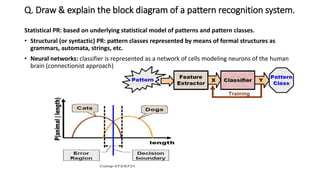
Q. Draw & explain the block diagram of a pattern recognition system.
Statistical PR: based on underlying statistical model of patterns and pattern classes.
• Structural (or syntactic) PR: pattern classes represented by means of formal structures as
grammars, automata, strings, etc.
• Neural networks: classifier is represented as a network of cells modeling neurons of the human
brain (connectionist approach)
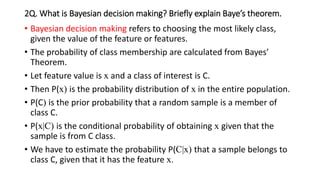
2Q. What is Bayesian decision making? Briefly explain Baye’s theorem.
• Bayesian decision making refers to choosing the most likely class,
given the value of the feature or features.
• The probability of class membership are calculated from Bayes’
Theorem.
• Let feature value is x and a class of interest is C.
• Then P(x) is the probability distribution of x in the entire population.
• P(C) is the prior probability that a random sample is a member of
class C.
• P(x|C) is the conditional probability of obtaining x given that the
sample is from C class.
• We have to estimate the probability P(C|x) that a sample belongs to
class C, given that it has the feature x.
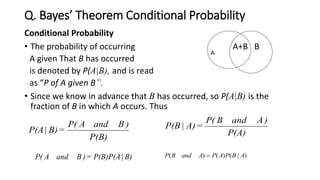
Q. Bayes’ Theorem Conditional Probability
Conditional Probability
• The probability of occurring A+B B
A given That B has occurred
is denoted by P(A|B), and is read
as “P of A given B”.
• Since we know in advance that B has occurred, so P(A|B) is the
fraction of B in which A occurs. Thus
P(B)
)BandAP(
=B)|P(A P(A)
)AandBP(
=A)|P(B
)|()()( ABPAPAandBP B)|P(B)P(A=)BandAP(
A
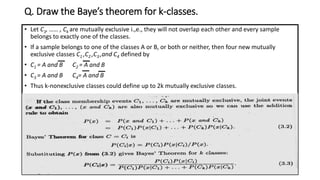
Q. Draw the Baye’s theorem for k-classes.
• Let C1, …… , Ck are mutually exclusive i.,e., they will not overlap each other and every sample
belongs to exactly one of the classes.
• If a sample belongs to one of the classes A or B, or both or neither, then four new mutually
exclusive classes C1 ,C2 ,C3 ,and C4 defined by
• C1 = A and B C2 = A and B
• C3 = A and B C4= A and B
• Thus k-nonexclusive classes could define up to 2k mutually exclusive classes.
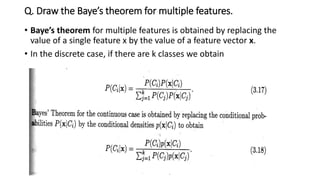
Q. Draw the Baye’s theorem for multiple features.
• Baye’s theorem for multiple features is obtained by replacing the
value of a single feature x by the value of a feature vector x.
• In the discrete case, if there are k classes we obtain
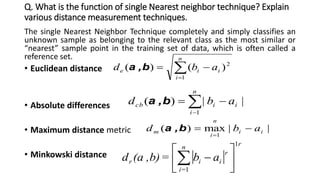
Q. What is the function of single Nearest neighbor technique? Explain
various distance measurement techniques.
The single Nearest Neighbor Technique completely and simply classifies an
unknown sample as belonging to the relevant class as the most similar or
“nearest” sample point in the training set of data, which is often called a
reference set.
• Euclidean distance
• Absolute differences
• Maximum distance metric
• Minkowski distance


n
i
iie abd
1
2
)()( b,a
||)(
1
i
n
i
icb abd  
b,a
||max)(
1
ii
n
i
m abd 

b,a
 
rn
=i
r
iir ab=b),(ad
1
1







3Q. What do you mean by clustering? Classify clustering.
• Clustering refers to the process of grouping samples so that the samples are
similar within each group. The groups are called clusters.
• Clustering can be classified into two major types, Hierarchical and Partitional
clustering. Hierarchical clustering algorithms can be further divided into
agglomerative and divisive.
• Hierarchical clustering refers to a process that organizes data into large groups,
which contain smaller groups, and so on.
• Hierarchical clustering usually drawn pictorially by a tree or dendrogram in which
the finest grouping is at the bottom, each sample forms a cluster.
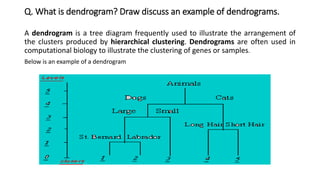
Q. What is dendrogram? Draw discuss an example of dendrograms.
A dendrogram is a tree diagram frequently used to illustrate the arrangement of
the clusters produced by hierarchical clustering. Dendrograms are often used in
computational biology to illustrate the clustering of genes or samples.
Below is an example of a dendrogram
Q. List Agglomerative clustering algorithms.
• Hierarchical clustering algorithms are called agglomerative if they
build the dendrogram from the bottom up and they are called divisive
if they build the dendrogram from the top down.
• Agglomerative clustering algorithms with n number of samples is as
below
• Begin with n clusters, each consisting of one sample.
• Repeat step 3 a total of n-1 times.
• Find the most similar clusters Ci and Cj and merge Ci and Cj into
one cluster. If there is a tie, merge the first pair found.
4Q. Define Single-Linkage, Complete-Linkage & Average Linkage
algorithms.
• Single-Linkage algorithm: In statistics, single-linkage clustering is one
of several methods of hierarchical clustering. It is based on grouping
clusters in bottom-up fashion (agglomerative clustering), at each step
combining two clusters that contain the closest pair of elements not
yet belonging to the same cluster as each other.
• Complete-Linkage algorithm: Complete-linkage clustering is one of
several methods of agglomerative hierarchical clustering. The clusters
are then sequentially combined into larger clusters until all elements
end up being in the same cluster. The method is also known as
farthest neighbour clustering.
• Average Linkage algorithm: In average linkage hierarchical clustering,
the distance between two clusters is defined as the average distance
between each point in one cluster to every point in the other cluster.
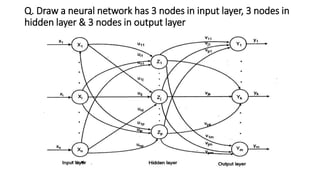
Q. Draw a neural network has 3 nodes in input layer, 3 nodes in
hidden layer & 3 nodes in output layer
5Q. What do you mean by ANN? Mc-CULLOCH – PITTS:
NOT Function.
ANN: Artificial Neural Networks (ANN) are the pieces of a computing system
designed to simulate the way the human brain analyses and processes
information. They are the foundations of Artificial Intelligence (AI) and solve
problems that would prove impossible or difficult by human or statistical
standards.
Mc-CULLOCH – PITTS: NOT Function
1. Medicine
2. Intelligent control
3. Function Approximation
4. Financial Forecasting
5. Condition Monitoring
6. Process Monitoring and Control
7. Neuro Forecasting
8. Pattern Analysis
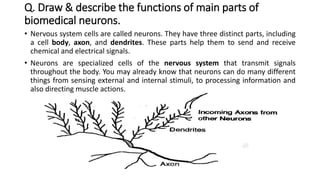
Q. Draw & describe the functions of main parts of
biomedical neurons.
• Nervous system cells are called neurons. They have three distinct parts, including
a cell body, axon, and dendrites. These parts help them to send and receive
chemical and electrical signals.
• Neurons are specialized cells of the nervous system that transmit signals
throughout the body. You may already know that neurons can do many different
things from sensing external and internal stimuli, to processing information and
also directing muscle actions.
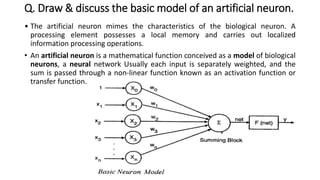
Q. Draw & discuss the basic model of an artificial neuron.
• The artificial neuron mimes the characteristics of the biological neuron. A
processing element possesses a local memory and carries out localized
information processing operations.
• An artificial neuron is a mathematical function conceived as a model of biological
neurons, a neural network Usually each input is separately weighted, and the
sum is passed through a non-linear function known as an activation function or
transfer function.
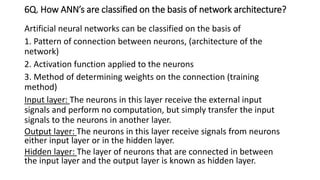
6Q. How ANN’s are classified on the basis of network architecture?
Artificial neural networks can be classified on the basis of
1. Pattern of connection between neurons, (architecture of the
network)
2. Activation function applied to the neurons
3. Method of determining weights on the connection (training
method)
Input layer: The neurons in this layer receive the external input
signals and perform no computation, but simply transfer the input
signals to the neurons in another layer.
Output layer: The neurons in this layer receive signals from neurons
either input layer or in the hidden layer.
Hidden layer: The layer of neurons that are connected in between
the input layer and the output layer is known as hidden layer.
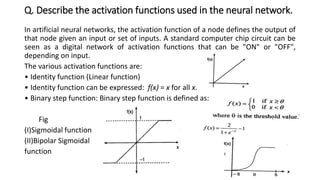
Q. Describe the activation functions used in the neural network.
In artificial neural networks, the activation function of a node defines the output of
that node given an input or set of inputs. A standard computer chip circuit can be
seen as a digital network of activation functions that can be "ON" or "OFF",
depending on input.
The various activation functions are:
• Identity function (Linear function)
• Identity function can be expressed: f(x) = x for all x.
• Binary step function: Binary step function is defined as:
Fig
(I)Sigmoidal function
(II)Bipolar Sigmoidal
function
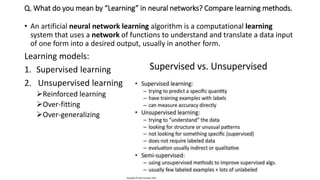
Q. What do you mean by “Learning” in neural networks? Compare learning methods.
• An artificial neural network learning algorithm is a computational learning
system that uses a network of functions to understand and translate a data input
of one form into a desired output, usually in another form.
Learning models:
1. Supervised learning
2. Unsupervised learning
Reinforced learning
Over-fitting
Over-generalizing
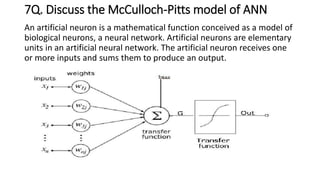
7Q. Discuss the McCulloch-Pitts model of ANN
An artificial neuron is a mathematical function conceived as a model of
biological neurons, a neural network. Artificial neurons are elementary
units in an artificial neural network. The artificial neuron receives one
or more inputs and sums them to produce an output.
Q. Discuss the application areas of ANN.
There have been many impressive demonstrations of artificial
neural networks. A few areas where neural networks are
mentioned below.
• Speech Recognition
• Character Recognition
• Signature Verification Application
• Human Face Recognition
• Image Processing and Character recognition
• Handwriting Recognition
• Image Compression
• Robotics
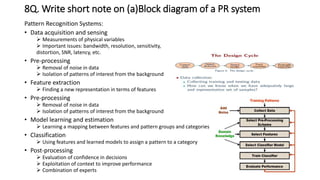
8Q. Write short note on (a)Block diagram of a PR system
Pattern Recognition Systems:
• Data acquisition and sensing
 Measurements of physical variables
 Important issues: bandwidth, resolution, sensitivity,
distortion, SNR, latency, etc.
• Pre-processing
 Removal of noise in data
 Isolation of patterns of interest from the background
• Feature extraction
 Finding a new representation in terms of features
• Pre-processing
 Removal of noise in data
 Isolation of patterns of interest from the background
• Model learning and estimation
 Learning a mapping between features and pattern groups and categories
• Classification
 Using features and learned models to assign a pattern to a category
• Post-processing
 Evaluation of confidence in decisions
 Exploitation of context to improve performance
 Combination of experts
8Q. Write short note on (b)Conditional probability (c) Forgy’s algorithms (e) Auto
associative memory.
(a) Conditional probability: In probability theory, conditional
probability is a measure of the probability of an event given that
another event has occurred. Using conditional probabilities, we
can have conditional information.
(b) Forgy’s algorithms: K-means clustering also known as Forgy's
algorithm, is one of the most well-known methods for data
clustering. The goal of k-means is to find k points of a dataset that
can best represent the dataset in a certain mathematical.
(c) Auto associative memory: This is a single layer neural network in
which the input training vector and the output target vectors are
the same. The weights are determined so that the network stores a
set of patterns.
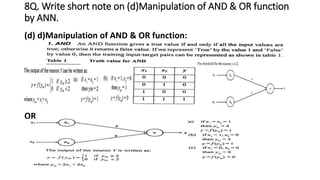
8Q. Write short note on (d)Manipulation of AND & OR function
by ANN.
(d) d)Manipulation of AND & OR function:
OR

Islamic University Pattern Recognition & Neural Network 2019

  • 2.
    1Q. Define patternrecognition. Discuss it’s application area. Pattern recognition is the automated recognition of patterns and regularities in data. Pattern recognition is closely related to artificial intelligence and machine learning, together with applications such as data mining and knowledge discovery in databases (KDD), and is often used interchangeably with these terms. PATTERN RECOGNITION AREAS: 1. Optical Character Recognition (OCR) 2. Analysis and identification of human patterns 3. Banking and insurance applications 4. Diagnosis systems 5. Prediction systems 6. Security and military applications 7. Industrial Area
  • 3.
    Q. List &explain pattern recognition approaches. • PR APPROACHES: There are two main PR approaches. One is Sub- Symbolic and other is Symbolic. 1. Sub-Symbolic PR Approaches: Reasoning model: Connectionist reasoning 2. Symbolic Level: Reasoning Systems - • Not modeled on the human brain • Machine manipulate numeric symbols (0 to 9) as well as non numeric symbols encoding domain specific information. • Statistical PR: based on underlying statistical model of patterns and pattern classes. • Structural (or syntactic) PR: pattern classes represented by means of formal structures as grammars, automata, strings, etc. • Neural networks: classifier is represented as a network of cells modeling neurons of the human brain (connectionist approach).
  • 4.
    Q. Draw &explain the block diagram of a pattern recognition system. Statistical PR: based on underlying statistical model of patterns and pattern classes. • Structural (or syntactic) PR: pattern classes represented by means of formal structures as grammars, automata, strings, etc. • Neural networks: classifier is represented as a network of cells modeling neurons of the human brain (connectionist approach)
  • 5.
    2Q. What isBayesian decision making? Briefly explain Baye’s theorem. • Bayesian decision making refers to choosing the most likely class, given the value of the feature or features. • The probability of class membership are calculated from Bayes’ Theorem. • Let feature value is x and a class of interest is C. • Then P(x) is the probability distribution of x in the entire population. • P(C) is the prior probability that a random sample is a member of class C. • P(x|C) is the conditional probability of obtaining x given that the sample is from C class. • We have to estimate the probability P(C|x) that a sample belongs to class C, given that it has the feature x.
  • 6.
    Q. Bayes’ TheoremConditional Probability Conditional Probability • The probability of occurring A+B B A given That B has occurred is denoted by P(A|B), and is read as “P of A given B”. • Since we know in advance that B has occurred, so P(A|B) is the fraction of B in which A occurs. Thus P(B) )BandAP( =B)|P(A P(A) )AandBP( =A)|P(B )|()()( ABPAPAandBP B)|P(B)P(A=)BandAP( A
  • 7.
    Q. Draw theBaye’s theorem for k-classes. • Let C1, …… , Ck are mutually exclusive i.,e., they will not overlap each other and every sample belongs to exactly one of the classes. • If a sample belongs to one of the classes A or B, or both or neither, then four new mutually exclusive classes C1 ,C2 ,C3 ,and C4 defined by • C1 = A and B C2 = A and B • C3 = A and B C4= A and B • Thus k-nonexclusive classes could define up to 2k mutually exclusive classes.
  • 8.
    Q. Draw theBaye’s theorem for multiple features. • Baye’s theorem for multiple features is obtained by replacing the value of a single feature x by the value of a feature vector x. • In the discrete case, if there are k classes we obtain
  • 9.
    Q. What isthe function of single Nearest neighbor technique? Explain various distance measurement techniques. The single Nearest Neighbor Technique completely and simply classifies an unknown sample as belonging to the relevant class as the most similar or “nearest” sample point in the training set of data, which is often called a reference set. • Euclidean distance • Absolute differences • Maximum distance metric • Minkowski distance   n i iie abd 1 2 )()( b,a ||)( 1 i n i icb abd   b,a ||max)( 1 ii n i m abd   b,a   rn =i r iir ab=b),(ad 1 1       
  • 10.
    3Q. What doyou mean by clustering? Classify clustering. • Clustering refers to the process of grouping samples so that the samples are similar within each group. The groups are called clusters. • Clustering can be classified into two major types, Hierarchical and Partitional clustering. Hierarchical clustering algorithms can be further divided into agglomerative and divisive. • Hierarchical clustering refers to a process that organizes data into large groups, which contain smaller groups, and so on. • Hierarchical clustering usually drawn pictorially by a tree or dendrogram in which the finest grouping is at the bottom, each sample forms a cluster.
  • 11.
    Q. What isdendrogram? Draw discuss an example of dendrograms. A dendrogram is a tree diagram frequently used to illustrate the arrangement of the clusters produced by hierarchical clustering. Dendrograms are often used in computational biology to illustrate the clustering of genes or samples. Below is an example of a dendrogram
  • 12.
    Q. List Agglomerativeclustering algorithms. • Hierarchical clustering algorithms are called agglomerative if they build the dendrogram from the bottom up and they are called divisive if they build the dendrogram from the top down. • Agglomerative clustering algorithms with n number of samples is as below • Begin with n clusters, each consisting of one sample. • Repeat step 3 a total of n-1 times. • Find the most similar clusters Ci and Cj and merge Ci and Cj into one cluster. If there is a tie, merge the first pair found.
  • 13.
    4Q. Define Single-Linkage,Complete-Linkage & Average Linkage algorithms. • Single-Linkage algorithm: In statistics, single-linkage clustering is one of several methods of hierarchical clustering. It is based on grouping clusters in bottom-up fashion (agglomerative clustering), at each step combining two clusters that contain the closest pair of elements not yet belonging to the same cluster as each other. • Complete-Linkage algorithm: Complete-linkage clustering is one of several methods of agglomerative hierarchical clustering. The clusters are then sequentially combined into larger clusters until all elements end up being in the same cluster. The method is also known as farthest neighbour clustering. • Average Linkage algorithm: In average linkage hierarchical clustering, the distance between two clusters is defined as the average distance between each point in one cluster to every point in the other cluster.
  • 14.
    Q. Draw aneural network has 3 nodes in input layer, 3 nodes in hidden layer & 3 nodes in output layer
  • 15.
    5Q. What doyou mean by ANN? Mc-CULLOCH – PITTS: NOT Function. ANN: Artificial Neural Networks (ANN) are the pieces of a computing system designed to simulate the way the human brain analyses and processes information. They are the foundations of Artificial Intelligence (AI) and solve problems that would prove impossible or difficult by human or statistical standards. Mc-CULLOCH – PITTS: NOT Function 1. Medicine 2. Intelligent control 3. Function Approximation 4. Financial Forecasting 5. Condition Monitoring 6. Process Monitoring and Control 7. Neuro Forecasting 8. Pattern Analysis
  • 16.
    Q. Draw &describe the functions of main parts of biomedical neurons. • Nervous system cells are called neurons. They have three distinct parts, including a cell body, axon, and dendrites. These parts help them to send and receive chemical and electrical signals. • Neurons are specialized cells of the nervous system that transmit signals throughout the body. You may already know that neurons can do many different things from sensing external and internal stimuli, to processing information and also directing muscle actions.
  • 17.
    Q. Draw &discuss the basic model of an artificial neuron. • The artificial neuron mimes the characteristics of the biological neuron. A processing element possesses a local memory and carries out localized information processing operations. • An artificial neuron is a mathematical function conceived as a model of biological neurons, a neural network Usually each input is separately weighted, and the sum is passed through a non-linear function known as an activation function or transfer function.
  • 18.
    6Q. How ANN’sare classified on the basis of network architecture? Artificial neural networks can be classified on the basis of 1. Pattern of connection between neurons, (architecture of the network) 2. Activation function applied to the neurons 3. Method of determining weights on the connection (training method) Input layer: The neurons in this layer receive the external input signals and perform no computation, but simply transfer the input signals to the neurons in another layer. Output layer: The neurons in this layer receive signals from neurons either input layer or in the hidden layer. Hidden layer: The layer of neurons that are connected in between the input layer and the output layer is known as hidden layer.
  • 19.
    Q. Describe theactivation functions used in the neural network. In artificial neural networks, the activation function of a node defines the output of that node given an input or set of inputs. A standard computer chip circuit can be seen as a digital network of activation functions that can be "ON" or "OFF", depending on input. The various activation functions are: • Identity function (Linear function) • Identity function can be expressed: f(x) = x for all x. • Binary step function: Binary step function is defined as: Fig (I)Sigmoidal function (II)Bipolar Sigmoidal function
  • 20.
    Q. What doyou mean by “Learning” in neural networks? Compare learning methods. • An artificial neural network learning algorithm is a computational learning system that uses a network of functions to understand and translate a data input of one form into a desired output, usually in another form. Learning models: 1. Supervised learning 2. Unsupervised learning Reinforced learning Over-fitting Over-generalizing
  • 21.
    7Q. Discuss theMcCulloch-Pitts model of ANN An artificial neuron is a mathematical function conceived as a model of biological neurons, a neural network. Artificial neurons are elementary units in an artificial neural network. The artificial neuron receives one or more inputs and sums them to produce an output.
  • 22.
    Q. Discuss theapplication areas of ANN. There have been many impressive demonstrations of artificial neural networks. A few areas where neural networks are mentioned below. • Speech Recognition • Character Recognition • Signature Verification Application • Human Face Recognition • Image Processing and Character recognition • Handwriting Recognition • Image Compression • Robotics
  • 23.
    8Q. Write shortnote on (a)Block diagram of a PR system Pattern Recognition Systems: • Data acquisition and sensing  Measurements of physical variables  Important issues: bandwidth, resolution, sensitivity, distortion, SNR, latency, etc. • Pre-processing  Removal of noise in data  Isolation of patterns of interest from the background • Feature extraction  Finding a new representation in terms of features • Pre-processing  Removal of noise in data  Isolation of patterns of interest from the background • Model learning and estimation  Learning a mapping between features and pattern groups and categories • Classification  Using features and learned models to assign a pattern to a category • Post-processing  Evaluation of confidence in decisions  Exploitation of context to improve performance  Combination of experts
  • 24.
    8Q. Write shortnote on (b)Conditional probability (c) Forgy’s algorithms (e) Auto associative memory. (a) Conditional probability: In probability theory, conditional probability is a measure of the probability of an event given that another event has occurred. Using conditional probabilities, we can have conditional information. (b) Forgy’s algorithms: K-means clustering also known as Forgy's algorithm, is one of the most well-known methods for data clustering. The goal of k-means is to find k points of a dataset that can best represent the dataset in a certain mathematical. (c) Auto associative memory: This is a single layer neural network in which the input training vector and the output target vectors are the same. The weights are determined so that the network stores a set of patterns.
  • 25.
    8Q. Write shortnote on (d)Manipulation of AND & OR function by ANN. (d) d)Manipulation of AND & OR function: OR