Machine Learning & Data Mining
2
What is Machine Learning?
• a branch of artificial intelligence, concerns the construction
and study of systems that can learn from data.
• The core of machine learning deals with representation and
generalization: Representation of data instances and functions
evaluated on these instances are part of all machine learning
systems. Generalization is the property that the system will
perform well on unseen data instances
• Tom M. Mitchell: "A computer program is said to learn from
experience E with respect to some class of tasks T and
performance measure P, if its performance at tasks in T, as
measured by P, improves with experience E”
From Wikipedia (Machine Learning)
Machine Learning Types
• Supervised learning
– Classification
– Regression/Prediction
• Unsupervised learning
– Clustering
• Semi-supervised learning
• Association Analysis
• Reinforcement learning
Growth of Machine Learning
• Machine learning is preferred approach to
– Speech recognition, Natural language processing
– Computer vision
– Medical outcomes analysis
– Robot control
– Computational biology
• This trend is accelerating
– Improved machine learning algorithms
– Improved data capture, networking, faster computers
– Software too complex to write by hand
– New sensors / IO devices
– Demand for self-customization to user, environment
– It turns out to be difficult to extract knowledge from human
expertsfailure of expert systems in the 1980’s.
4
5
Data Mining/KDD
• Retail: Market basket analysis, Customer
relationship management (CRM)
• Finance: Credit scoring, fraud detection
• Manufacturing: Optimization, troubleshooting
• Medicine: Medical diagnosis
• Telecommunications: Quality of service
optimization
• Bioinformatics: Motifs, alignment
• ...
Definition := “KDD is the non-trivial process of
identifying valid, novel, potentially useful, and
ultimately understandable patterns in data” (Fayyad)
Applications:
6
Machine Learning & Data Mining
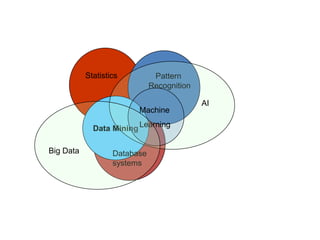
• Machine learning focuses on prediction, based on
known properties learned from the training data.
• Data mining focuses on the discovery of (previously)
unknown properties in the data. This is the analysis
step of Knowledge Discovery in Databases.
• Data mining uses many machine learning methods,
but often with a slightly different goal in mind
• Machine learning also employs data mining methods
as "unsupervised learning" or as a preprocessing step
to improve learner accuracy.
Pattern
Recognition
Statistics
Data Mining
Database
systems
AI
Machine
Learning
Big Data
Unsupervised Learning:
Cluster Analysis
What is Cluster Analysis?
• Finding groups of objects such that the objects in a group will
be similar (or related) to one another and different from (or
unrelated to) the objects in other groups
Inter-cluster
distances are
maximized
Intra-cluster
distances are
minimized
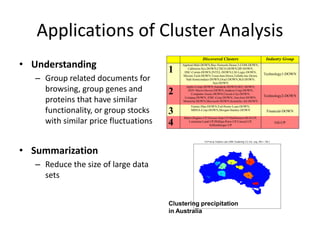
Applications of Cluster Analysis
• Understanding
– Group related documents for
browsing, group genes and
proteins that have similar
functionality, or group stocks
with similar price fluctuations
• Summarization
– Reduce the size of large data
sets
Discovered Clusters Industry Group
1
Applied-Matl-DOWN,Bay-Network-Down,3-COM-DOWN,
Cabletron-Sys-DOWN,CISCO-DOWN,HP-DOWN,
DSC-Comm-DOWN,INTEL-DOWN,LSI-Logic-DOWN,
Micron-Tech-DOWN,Texas-Inst-Down,Tellabs-Inc-Down,
Natl-Semiconduct-DOWN,Oracl-DOWN,SGI-DOWN,
Sun-DOWN
Technology1-DOWN
2
Apple-Comp-DOWN,Autodesk-DOWN,DEC-DOWN,
ADV-Micro-Device-DOWN,Andrew-Corp-DOWN,
Computer-Assoc-DOWN,Circuit-City-DOWN,
Compaq-DOWN, EMC-Corp-DOWN, Gen-Inst-DOWN,
Motorola-DOWN,Microsoft-DOWN,Scientific-Atl-DOWN
Technology2-DOWN
3
Fannie-Mae-DOWN,Fed-Home-Loan-DOWN,
MBNA-Corp-DOWN,Morgan-Stanley-DOWN Financial-DOWN
4
Baker-Hughes-UP,Dresser-Inds-UP,Halliburton-HLD-UP,
Louisiana-Land-UP,Phillips-Petro-UP,Unocal-UP,
Schlumberger-UP
Oil-UP
Clustering precipitation
in Australia
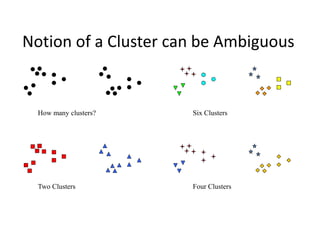
Notion of a Cluster can be Ambiguous
How many clusters?
Four Clusters
Two Clusters
Six Clusters
Types of Clusterings
• A clustering is a set of clusters
• Important distinction between hierarchical
and partitional sets of clusters
• Partitional Clustering
– A division data objects into non-overlapping subsets (clusters) such
that each data object is in exactly one subset
• Hierarchical clustering
– A set of nested clusters organized as a hierarchical tree
Partitional Clustering
Original Points A Partitional Clustering
Hierarchical Clustering
p4
p1
p3
p2
p4
p1
p3
p2
p4
p1 p2 p3
p4
p1 p2 p3
Traditional Hierarchical Clustering
Non-traditional Hierarchical Clustering Non-traditional Dendrogram
Traditional Dendrogram
Other Distinctions Between Sets of Clusters
• Exclusive versus non-exclusive
– In non-exclusive clusterings, points may belong to multiple clusters.
– Can represent multiple classes or ‘border’ points
• Fuzzy versus non-fuzzy
– In fuzzy clustering, a point belongs to every cluster with some
weight between 0 and 1
– Weights must sum to 1
– Probabilistic clustering has similar characteristics
• Partial versus complete
– In some cases, we only want to cluster some of the data
• Heterogeneous versus homogeneous
– Cluster of widely different sizes, shapes, and densities
Clustering Algorithms
• K-means and its variants
• Hierarchical clustering
• Density-based clustering
K-means Clustering
• Partitional clustering approach
– Each cluster is associated with a centroid (center point)
– Each point is assigned to the cluster with the closest centroid
• Number of clusters, K, must be specified
• The basic algorithm is very simple
K-means Clustering – Details
• Initial centroids are often chosen randomly.
– Clusters produced vary from one run to another.
• The centroid is (typically) the mean of the points in the cluster.
• ‘Closeness’ is measured by Euclidean distance, cosine
similarity, correlation, etc.
K-means Clustering – Details
• K-means will converge for common similarity measures
mentioned above.
• Most of the convergence happens in the first few iterations.
– Often the stopping condition is changed to ‘Until relatively few
points change clusters’
• Complexity is O( n * K * I * d )
– n = number of points, K = number of clusters,
I = number of iterations, d = number of attributes
Evaluating K-means Clusters

 

K
i C
x
i
i
x
m
dist
SSE
1
2
)
,
(
• Most common measure is Sum of Squared Error
(SSE)
– For each point, the error is the distance to the nearest
cluster
– To get SSE, we square these errors and sum them.
– x is a data point in cluster Ci and mi is the representative
point for cluster Ci
• can show that mi corresponds to the center (mean) of the cluster
– Given two clusters, we can choose the one with the
smallest error
– One easy way to reduce SSE is to increase K, the number of
clusters
• A good clustering with smaller K can have a lower SSE than a poor
clustering with higher K
Issues and Limitations for K-means
• How to choose initial centers?
• How to choose K?
• How to handle Outliers?
• Clusters different in
– Shape
– Density
– Size
Two different K-means Clusterings
-2 -1.5 -1 -0.5 0 0.5 1 1.5 2
0
0.5
1
1.5
2
2.5
3
x
y
-2 -1.5 -1 -0.5 0 0.5 1 1.5 2
0
0.5
1
1.5
2
2.5
3
x
y
Sub-optimal Clustering
-2 -1.5 -1 -0.5 0 0.5 1 1.5 2
0
0.5
1
1.5
2
2.5
3
x
y
Optimal Clustering
Original Points
Importance of Choosing Initial Centroids
-2 -1.5 -1 -0.5 0 0.5 1 1.5 2
0
0.5
1
1.5
2
2.5
3
x
y Iteration 1
-2 -1.5 -1 -0.5 0 0.5 1 1.5 2
0
0.5
1
1.5
2
2.5
3
x
y Iteration 2
-2 -1.5 -1 -0.5 0 0.5 1 1.5 2
0
0.5
1
1.5
2
2.5
3
x
y Iteration 3
-2 -1.5 -1 -0.5 0 0.5 1 1.5 2
0
0.5
1
1.5
2
2.5
3
x
y Iteration 4
-2 -1.5 -1 -0.5 0 0.5 1 1.5 2
0
0.5
1
1.5
2
2.5
3
x
y Iteration 5
-2 -1.5 -1 -0.5 0 0.5 1 1.5 2
0
0.5
1
1.5
2
2.5
3
x
y Iteration 6
Importance of Choosing Initial Centroids
-2 -1.5 -1 -0.5 0 0.5 1 1.5 2
0
0.5
1
1.5
2
2.5
3
x
y
Iteration 1
-2 -1.5 -1 -0.5 0 0.5 1 1.5 2
0
0.5
1
1.5
2
2.5
3
x
y
Iteration 2
-2 -1.5 -1 -0.5 0 0.5 1 1.5 2
0
0.5
1
1.5
2
2.5
3
x
y
Iteration 3
-2 -1.5 -1 -0.5 0 0.5 1 1.5 2
0
0.5
1
1.5
2
2.5
3
x
y
Iteration 4
-2 -1.5 -1 -0.5 0 0.5 1 1.5 2
0
0.5
1
1.5
2
2.5
3
x
y
Iteration 5
-2 -1.5 -1 -0.5 0 0.5 1 1.5 2
0
0.5
1
1.5
2
2.5
3
x
y
Iteration 6
Importance of Choosing Initial Centroids …
-2 -1.5 -1 -0.5 0 0.5 1 1.5 2
0
0.5
1
1.5
2
2.5
3
x
y Iteration 1
-2 -1.5 -1 -0.5 0 0.5 1 1.5 2
0
0.5
1
1.5
2
2.5
3
x
y Iteration 2
-2 -1.5 -1 -0.5 0 0.5 1 1.5 2
0
0.5
1
1.5
2
2.5
3
x
y Iteration 3
-2 -1.5 -1 -0.5 0 0.5 1 1.5 2
0
0.5
1
1.5
2
2.5
3
x
y Iteration 4
-2 -1.5 -1 -0.5 0 0.5 1 1.5 2
0
0.5
1
1.5
2
2.5
3
x
y Iteration 5
Importance of Choosing Initial Centroids …
-2 -1.5 -1 -0.5 0 0.5 1 1.5 2
0
0.5
1
1.5
2
2.5
3
x
y
Iteration 1
-2 -1.5 -1 -0.5 0 0.5 1 1.5 2
0
0.5
1
1.5
2
2.5
3
x
y
Iteration 2
-2 -1.5 -1 -0.5 0 0.5 1 1.5 2
0
0.5
1
1.5
2
2.5
3
x
y
Iteration 3
-2 -1.5 -1 -0.5 0 0.5 1 1.5 2
0
0.5
1
1.5
2
2.5
3
x
y
Iteration 4
-2 -1.5 -1 -0.5 0 0.5 1 1.5 2
0
0.5
1
1.5
2
2.5
3
x
y
Iteration 5
Problems with Selecting Initial Points
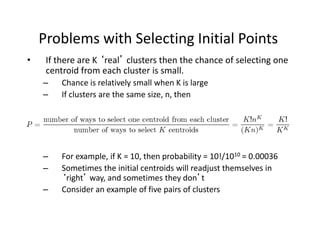
• If there are K ‘real’ clusters then the chance of selecting one
centroid from each cluster is small.
– Chance is relatively small when K is large
– If clusters are the same size, n, then
– For example, if K = 10, then probability = 10!/1010 = 0.00036
– Sometimes the initial centroids will readjust themselves in
‘right’ way, and sometimes they don’t
– Consider an example of five pairs of clusters
Solutions to Initial Centroids Problem
• Multiple runs
– Helps, but probability is not on your side
• Sample and use hierarchical clustering to
determine initial centroids
• Select more than k initial centroids and then
select among these initial centroids
– Select most widely separated
• Postprocessing
• Bisecting K-means
– Not as susceptible to initialization issues
Hierarchical Clustering
• Produces a set of nested clusters organized as
a hierarchical tree
• Can be visualized as a dendrogram
– A tree like diagram that records the sequences of
merges or splits
1 3 2 5 4 6
0
0.05
0.1
0.15
0.2
1
2
3
4
5
6
1
2
3 4
5
Strengths of Hierarchical Clustering
• Do not have to assume any particular number
of clusters
– Any desired number of clusters can be obtained
by ‘cutting’ the dendogram at the proper level
• They may correspond to meaningful
taxonomies
– Example in biological sciences (e.g., animal
kingdom, phylogeny reconstruction, …)
Hierarchical Clustering
• Two main types of hierarchical clustering
– Agglomerative:
• Start with the points as individual clusters
• At each step, merge the closest pair of clusters until only one cluster (or k
clusters) left
– Divisive:
• Start with one, all-inclusive cluster
• At each step, split a cluster until each cluster contains a point (or there
are k clusters)
• Traditional hierarchical algorithms use a similarity or distance
matrix
– Merge or split one cluster at a time
Agglomerative Clustering Algorithm
• More popular hierarchical clustering technique
• Basic algorithm is straightforward
1. Compute the proximity matrix
2. Let each data point be a cluster
3. Repeat
4. Merge the two closest clusters
5. Update the proximity matrix
6. Until only a single cluster remains
• Key operation is the computation of the proximity of two
clusters
– Different approaches to defining the distance between clusters
distinguish the different algorithms
Starting Situation
...
p1 p2 p3 p4 p9 p10 p11 p12
• Start with clusters of individual points and a
proximity matrix p1
p3
p5
p4
p2
p1 p2 p3 p4 p5 . . .
.
.
. Proximity Matrix
Intermediate Situation
...
p1 p2 p3 p4 p9 p10 p11 p12
• After some merging steps, we have some clusters
C1
C4
C2 C5
C3
C2
C1
C1
C3
C5
C4
C2
C3 C4 C5
Proximity Matrix
Intermediate Situation
...
p1 p2 p3 p4 p9 p10 p11 p12
• We want to merge the two closest clusters (C2 and C5) and update
the proximity matrix.
C1
C4
C2 C5
C3
C2
C1
C1
C3
C5
C4
C2
C3 C4 C5
Proximity Matrix
After Merging
...
p1 p2 p3 p4 p9 p10 p11 p12
• The question is “How do we update the proximity matrix?”
C1
C4
C2 U C5
C3
? ? ? ?
?
?
?
C2
U
C5
C1
C1
C3
C4
C2 U C5
C3 C4
Proximity Matrix
How to Define Inter-Cluster Similarity
p1
p3
p5
p4
p2
p1 p2 p3 p4 p5 . . .
.
.
.
Similarity?
 MIN
 MAX
 Group Average
 Distance Between Centroids
 Other methods driven by an objective
function
 Ward’s Method uses squared error
Proximity Matrix
How to Define Inter-Cluster Similarity
p1
p3
p5
p4
p2
p1 p2 p3 p4 p5 . . .
.
.
.
Proximity Matrix
 MIN
 MAX
 Group Average
 Distance Between Centroids
 Other methods driven by an
objective function
 Ward’s Method uses squared error
How to Define Inter-Cluster Similarity
p1
p3
p5
p4
p2
p1 p2 p3 p4 p5 . . .
.
.
.
Proximity Matrix
 MIN
 MAX
 Group Average
 Distance Between Centroids
 Other methods driven by an
objective function
 Ward’s Method uses squared error
How to Define Inter-Cluster Similarity
p1
p3
p5
p4
p2
p1 p2 p3 p4 p5 . . .
.
.
.
Proximity Matrix
 MIN
 MAX
 Group Average
 Distance Between Centroids
 Other methods driven by an
objective function
 Ward’s Method uses squared error
How to Define Inter-Cluster Similarity
p1
p3
p5
p4
p2
p1 p2 p3 p4 p5 . . .
.
.
.
Proximity Matrix
 MIN
 MAX
 Group Average
 Distance Between Centroids
 Other methods driven by an
objective function
 Ward’s Method uses squared error
 
Cluster Similarity: MIN or Single Link
• Similarity of two clusters is based on the two
most similar (closest) points in the different
clusters
– Determined by one pair of points, i.e., by one link
in the proximity graph.
I1 I2 I3 I4 I5
I1 1.00 0.90 0.10 0.65 0.20
I2 0.90 1.00 0.70 0.60 0.50
I3 0.10 0.70 1.00 0.40 0.30
I4 0.65 0.60 0.40 1.00 0.80
I5 0.20 0.50 0.30 0.80 1.00 1 2 3 4 5
Hierarchical Clustering: MIN
Nested Clusters Dendrogram
1
2
3
4
5
6
1
2
3
4
5
3 6 2 5 4 1
0
0.05
0.1
0.15
0.2
Strength of MIN
Original Points Two Clusters
• Can handle non-elliptical shapes
Limitations of MIN
Original Points Two Clusters
• Sensitive to noise and outliers
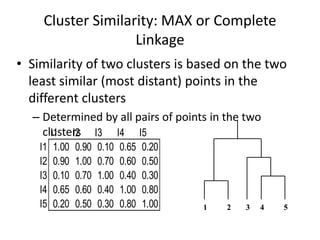
Cluster Similarity: MAX or Complete
Linkage
• Similarity of two clusters is based on the two
least similar (most distant) points in the
different clusters
– Determined by all pairs of points in the two
clusters
I1 I2 I3 I4 I5
I1 1.00 0.90 0.10 0.65 0.20
I2 0.90 1.00 0.70 0.60 0.50
I3 0.10 0.70 1.00 0.40 0.30
I4 0.65 0.60 0.40 1.00 0.80
I5 0.20 0.50 0.30 0.80 1.00 1 2 3 4 5
Hierarchical Clustering: MAX
Nested Clusters Dendrogram
3 6 4 1 2 5
0
0.05
0.1
0.15
0.2
0.25
0.3
0.35
0.4
1
2
3
4
5
6
1
2 5
3
4
Strength of MAX
Original Points Two Clusters
• Less susceptible to noise and outliers
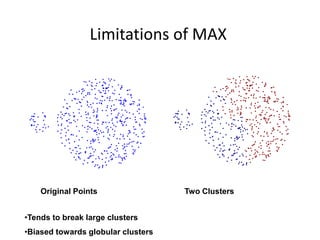
Limitations of MAX
Original Points Two Clusters
•Tends to break large clusters
•Biased towards globular clusters
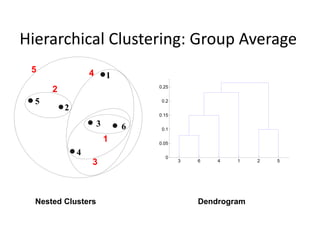
Cluster Similarity: Group Average
• Proximity of two clusters is the average of pairwise proximity between
points in the two clusters.
• Need to use average connectivity for scalability since total proximity favors
large clusters
|
|Cluster
|
|Cluster
)
p
,
p
proximity(
)
Cluster
,
Cluster
proximity(
j
i
Cluster
p
Cluster
p
j
i
j
i
j
j
i
i





I1 I2 I3 I4 I5
I1 1.00 0.90 0.10 0.65 0.20
I2 0.90 1.00 0.70 0.60 0.50
I3 0.10 0.70 1.00 0.40 0.30
I4 0.65 0.60 0.40 1.00 0.80
I5 0.20 0.50 0.30 0.80 1.00 1 2 3 4 5
Hierarchical Clustering: Group Average
Nested Clusters Dendrogram
3 6 4 1 2 5
0
0.05
0.1
0.15
0.2
0.25
1
2
3
4
5
6
1
2
5
3
4
Hierarchical Clustering: Group Average
• Compromise between Single and Complete
Link
• Strengths
– Less susceptible to noise and outliers
• Limitations
– Biased towards globular clusters
Cluster Similarity: Ward’s Method
• Similarity of two clusters is based on the increase
in squared error when two clusters are merged
– Similar to group average if distance between points is
distance squared
• Less susceptible to noise and outliers
• Biased towards globular clusters
• Hierarchical analogue of K-means
– Can be used to initialize K-means
Hierarchical Clustering: Comparison
Group Average
Ward’s Method
1
2
3
4
5
6
1
2
5
3
4
MIN MAX
1
2
3
4
5
6
1
2
5
3
4
1
2
3
4
5
6
1
2 5
3
4
1
2
3
4
5
6
1
2
3
4
5
Hierarchical Clustering: Time and Space
requirements
• O(N2) space since it uses the proximity matrix.
– N is the number of points.
• O(N3) time in many cases
– There are N steps and at each step the size, N2,
proximity matrix must be updated and searched
– Complexity can be reduced to O(N2 log(N) ) time
for some approaches
Hierarchical Clustering: Problems and
Limitations
• Once a decision is made to combine two clusters,
it cannot be undone
• No objective function is directly minimized
• Different schemes have problems with one or
more of the following:
– Sensitivity to noise and outliers
– Difficulty handling different sized clusters and convex
shapes
– Breaking large clusters
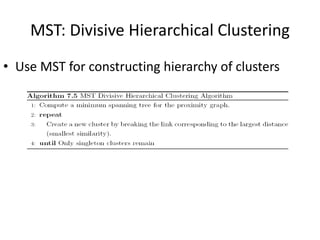
MST: Divisive Hierarchical Clustering
• Build MST (Minimum Spanning Tree)
– Start with a tree that consists of any point
– In successive steps, look for the closest pair of points (p, q) such that
one point (p) is in the current tree but the other (q) is not
– Add q to the tree and put an edge between p and q
MST: Divisive Hierarchical Clustering
• Use MST for constructing hierarchy of clusters
DBSCAN
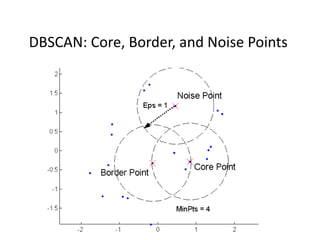
• DBSCAN is a density-based algorithm.
– Density = number of points within a specified radius (Eps)
– A point is a core point if it has more than a specified number of
points (MinPts) within Eps
• These are points that are at the interior of a cluster
– A border point has fewer than MinPts within Eps, but is in the
neighborhood of a core point
– A noise point is any point that is not a core point or a border
point.
DBSCAN: Core, Border, and Noise Points
Density Reachable
• (Directly) density reachable
– A point x is directly density reachable from
another point y, if x  N(y) and y is a core point
– A point x is density reachable from y, if there
exists a chain of points, x=x0,x1,x2,…xl=y, such that
xi is directly density reachable from xi-1
• Density Connected
– Two points x and y are density connected if there
exists a core point z, such that both x and y are
density reachable from z
DBSCAN: Core, Border and Noise Points
Original Points Point types: core,
border and noise
Eps = 10, MinPts = 4
When DBSCAN Works Well
Original Points Clusters
• Resistant to Noise
• Can handle clusters of different shapes and sizes
When DBSCAN Does NOT Work Well
Original Points
(MinPts=4, Eps=9.75).
(MinPts=4, Eps=9.92)
• Varying densities
• High-dimensional data
DBSCAN: Determining EPS and MinPts
• Idea is that for points in a cluster, their kth nearest
neighbors are at roughly the same distance
• Noise points have the kth nearest neighbor at farther
distance
• So, plot sorted distance of every point to its kth nearest
neighbor
Cluster Validation
Cluster Validity
• For cluster analysis, the question is how to evaluate the
“goodness” of the resulting clusters?
• But “clusters are in the eye of the beholder”!
• Then why do we want to evaluate them?
– To avoid finding patterns in noise
– To compare clustering algorithms
– To compare two sets of clusters
– To compare two clusters
Clusters found in Random Data
0 0.2 0.4 0.6 0.8 1
0
0.1
0.2
0.3
0.4
0.5
0.6
0.7
0.8
0.9
1
x
y
Random
Points
0 0.2 0.4 0.6 0.8 1
0
0.1
0.2
0.3
0.4
0.5
0.6
0.7
0.8
0.9
1
x
y
K-means
0 0.2 0.4 0.6 0.8 1
0
0.1
0.2
0.3
0.4
0.5
0.6
0.7
0.8
0.9
1
x
y
DBSCAN
0 0.2 0.4 0.6 0.8 1
0
0.1
0.2
0.3
0.4
0.5
0.6
0.7
0.8
0.9
1
x
y
Complete
Link
Different Aspects of Cluster Validation
1. Determining the clustering tendency of a set of data, i.e., distinguishing
whether non-random structure actually exists in the data.
2. Comparing the results of a cluster analysis to externally known results,
e.g., to externally given class labels.
3. Evaluating how well the results of a cluster analysis fit the data without
reference to external information.
- Use only the data
4. Comparing the results of two different sets of cluster analyses to
determine which is better.
5. Determining the ‘correct’ number of clusters.
For 2, 3, and 4, we can further distinguish whether we want to evaluate
the entire clustering or just individual clusters.
Framework for Cluster Validity
• Need a framework to interpret any measure.
– For example, if our measure of evaluation has the value, 10, is that
good, fair, or poor?
• Statistics provide a framework for cluster validity
– The more “atypical” a clustering result is, the more likely it represents
valid structure in the data
– Can compare the values of an index that result from random data or
clusterings to those of a clustering result.
• If the value of the index is unlikely, then the cluster results are valid
– These approaches are more complicated and harder to understand.
• For comparing the results of two different sets of cluster
analyses, a framework is less necessary.
– However, there is the question of whether the difference between
two index values is significant
Measures of Cluster Validity
• Numerical measures that are applied to judge various aspects of
cluster validity, are classified into the following three types.
– External Index: Used to measure the extent to which cluster labels match
externally supplied class labels.
• Entropy
– Internal Index: Used to measure the goodness of a clustering structure
without respect to external information.
• Sum of Squared Error (SSE)
– Relative Index: Used to compare two different clusterings or clusters.
• Often an external or internal index is used for this function, e.g., SSE or entropy
• Sometimes these are referred to as criteria instead of indices
– However, sometimes criterion is the general strategy and index is the numerical
measure that implements the criterion.
External Validation
Purity-Based Measure
• Purity
–
• Precision/Recall/F-Measure
prec(i,j), recall(i,j),
• Entropy
Matching Measure
• Rand Statistic:
• Jaccard Coefficient:
Correlation Measure
• Hubert’s Tau Statistics:
• Normalized Tau Statistics:
Measuring Cluster Validity Via Correlation
• Two matrices
– Proximity Matrix
– “Incidence” Matrix
• One row and one column for each data point
• An entry is 1 if the associated pair of points belong to the same cluster
• An entry is 0 if the associated pair of points belongs to different
clusters
• Compute the correlation between the two matrices
– Since the matrices are symmetric, only the correlation between
n(n-1) / 2 entries needs to be calculated.
• High correlation indicates that points that belong to the
same cluster are close to each other.
• Not a good measure for some density or contiguity based
clusters.
Measuring Cluster Validity Via Correlation
• Correlation of incidence and proximity
matrices for the K-means clusterings of the
following two data sets.
0 0.2 0.4 0.6 0.8 1
0
0.1
0.2
0.3
0.4
0.5
0.6
0.7
0.8
0.9
1
x
y
0 0.2 0.4 0.6 0.8 1
0
0.1
0.2
0.3
0.4
0.5
0.6
0.7
0.8
0.9
1
x
y
Corr = -0.9235 Corr = -0.5810
Using Similarity Matrix for Cluster Validation
• Order the similarity matrix with respect to cluster labels
and inspect visually.
0 0.2 0.4 0.6 0.8 1
0
0.1
0.2
0.3
0.4
0.5
0.6
0.7
0.8
0.9
1
x
y
Points
Points
20 40 60 80 100
10
20
30
40
50
60
70
80
90
100
Similarity
0
0.1
0.2
0.3
0.4
0.5
0.6
0.7
0.8
0.9
1
Using Similarity Matrix for Cluster
Validation
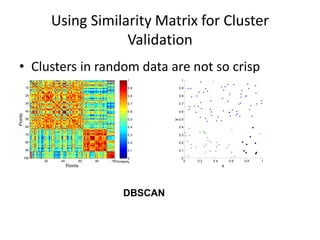
• Clusters in random data are not so crisp
Points
Points
20 40 60 80 100
10
20
30
40
50
60
70
80
90
100
Similarity
0
0.1
0.2
0.3
0.4
0.5
0.6
0.7
0.8
0.9
1
DBSCAN
0 0.2 0.4 0.6 0.8 1
0
0.1
0.2
0.3
0.4
0.5
0.6
0.7
0.8
0.9
1
x
y
Points
Points
20 40 60 80 100
10
20
30
40
50
60
70
80
90
100
Similarity
0
0.1
0.2
0.3
0.4
0.5
0.6
0.7
0.8
0.9
1
Using Similarity Matrix for Cluster
Validation
• Clusters in random data are not so crisp
K-means
0 0.2 0.4 0.6 0.8 1
0
0.1
0.2
0.3
0.4
0.5
0.6
0.7
0.8
0.9
1
x
y
Using Similarity Matrix for Cluster
Validation
• Clusters in random data are not so crisp
0 0.2 0.4 0.6 0.8 1
0
0.1
0.2
0.3
0.4
0.5
0.6
0.7
0.8
0.9
1
x
y
Points
Points
20 40 60 80 100
10
20
30
40
50
60
70
80
90
100
Similarity
0
0.1
0.2
0.3
0.4
0.5
0.6
0.7
0.8
0.9
1
Complete Link
Using Similarity Matrix for Cluster Validation
1
2
3
5
6
4
7
DBSCAN
0
0.1
0.2
0.3
0.4
0.5
0.6
0.7
0.8
0.9
1
500 1000 1500 2000 2500 3000
500
1000
1500
2000
2500
3000
Internal Measures: SSE
• Clusters in more complicated figures aren’t well separated
• Internal Index: Used to measure the goodness of a clustering
structure without respect to external information
– SSE
• SSE is good for comparing two clusterings or two clusters
(average SSE).
• Can also be used to estimate the number of clusters
2 5 10 15 20 25 30
0
1
2
3
4
5
6
7
8
9
10
K
SSE
5 10 15
-6
-4
-2
0
2
4
6
Internal Measures: SSE
• SSE curve for a more complicated data set
1
2
3
5
6
4
7
SSE of clusters found using K-means
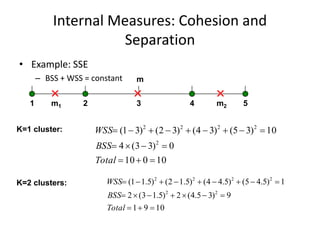
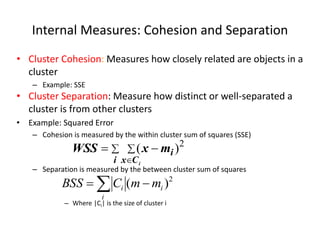
Internal Measures: Cohesion and Separation
• Cluster Cohesion: Measures how closely related are objects in a
cluster
– Example: SSE
• Cluster Separation: Measure how distinct or well-separated a
cluster is from other clusters
• Example: Squared Error
– Cohesion is measured by the within cluster sum of squares (SSE)
– Separation is measured by the between cluster sum of squares
– Where |Ci| is the size of cluster i
 



i C
x
i
i
m
x
WSS 2
)
(
 

i
i
i m
m
C
BSS 2
)
(
Internal Measures: Cohesion and
Separation
• Example: SSE
– BSS + WSS = constant
10
9
1
9
)
3
5
.
4
(
2
)
5
.
1
3
(
2
1
)
5
.
4
5
(
)
5
.
4
4
(
)
5
.
1
2
(
)
5
.
1
1
(
2
2
2
2
2
2



















Total
BSS
WSS
1 2 3 4 5
 

m1 m2
m
K=2 clusters:
10
0
10
0
)
3
3
(
4
10
)
3
5
(
)
3
4
(
)
3
2
(
)
3
1
(
2
2
2
2
2
















Total
BSS
WSS
K=1 cluster:
Internal Measures: Cohesion and Separation
• A proximity graph based approach can also be used for
cohesion and separation.
– Cluster cohesion is the sum of the weight of all links within a
cluster.
– Cluster separation is the sum of the weights between nodes
in the cluster and nodes outside the cluster.
cohesion separation
BetaCV
Internal Measures: Silhouette Coefficient
• Silhouette Coefficient combine ideas of both cohesion and
separation, but for individual points, as well as clusters and
clusterings
• For an individual point, i
– Calculate a = average distance of i to the points in its cluster
– Calculate b = min (average distance of i to points in another cluster)
– The silhouette coefficient for a point is then given by
s = 1 – a/b if a < b, (or s = b/a - 1 if a  b, not the usual case)
– Typically between 0 and 1.
– The closer to 1 the better.
• Can calculate the Average Silhouette width for a
cluster or a clustering
a
b
External Measures of Cluster Validity: Entropy and Purity
Final Comment on Cluster Validity
“The validation of clustering structures is the most difficult and
frustrating part of cluster analysis.
Without a strong effort in this direction, cluster analysis will
remain a black art accessible only to those true believers who
have experience and great courage.”
Algorithms for Clustering Data, Jain and Dubes
Extra Slides
Statistical Framework for SSE
• Example
– Compare SSE of 0.005 against three clusters in random data
– Histogram shows SSE of three clusters in 500 sets of random data points of size
100 distributed over the range 0.2 – 0.8 for x and y values
0.016 0.018 0.02 0.022 0.024 0.026 0.028 0.03 0.032 0.034
0
5
10
15
20
25
30
35
40
45
50
SSE
Count
0 0.2 0.4 0.6 0.8 1
0
0.1
0.2
0.3
0.4
0.5
0.6
0.7
0.8
0.9
1
x
y
Statistical Framework for Correlation
• Correlation of incidence and proximity matrices for the K-means
clusterings of the following two data sets.
0 0.2 0.4 0.6 0.8 1
0
0.1
0.2
0.3
0.4
0.5
0.6
0.7
0.8
0.9
1
x
y
0 0.2 0.4 0.6 0.8 1
0
0.1
0.2
0.3
0.4
0.5
0.6
0.7
0.8
0.9
1
x
y
Corr = -0.9235 Corr = -0.5810

Machine Learning, Statistics And Data Mining

  • 1.
    Machine Learning &Data Mining
  • 2.
    2 What is MachineLearning? • a branch of artificial intelligence, concerns the construction and study of systems that can learn from data. • The core of machine learning deals with representation and generalization: Representation of data instances and functions evaluated on these instances are part of all machine learning systems. Generalization is the property that the system will perform well on unseen data instances • Tom M. Mitchell: "A computer program is said to learn from experience E with respect to some class of tasks T and performance measure P, if its performance at tasks in T, as measured by P, improves with experience E” From Wikipedia (Machine Learning)
  • 3.
    Machine Learning Types •Supervised learning – Classification – Regression/Prediction • Unsupervised learning – Clustering • Semi-supervised learning • Association Analysis • Reinforcement learning
  • 4.
    Growth of MachineLearning • Machine learning is preferred approach to – Speech recognition, Natural language processing – Computer vision – Medical outcomes analysis – Robot control – Computational biology • This trend is accelerating – Improved machine learning algorithms – Improved data capture, networking, faster computers – Software too complex to write by hand – New sensors / IO devices – Demand for self-customization to user, environment – It turns out to be difficult to extract knowledge from human expertsfailure of expert systems in the 1980’s. 4
  • 5.
    5 Data Mining/KDD • Retail:Market basket analysis, Customer relationship management (CRM) • Finance: Credit scoring, fraud detection • Manufacturing: Optimization, troubleshooting • Medicine: Medical diagnosis • Telecommunications: Quality of service optimization • Bioinformatics: Motifs, alignment • ... Definition := “KDD is the non-trivial process of identifying valid, novel, potentially useful, and ultimately understandable patterns in data” (Fayyad) Applications:
  • 6.
    6 Machine Learning &Data Mining • Machine learning focuses on prediction, based on known properties learned from the training data. • Data mining focuses on the discovery of (previously) unknown properties in the data. This is the analysis step of Knowledge Discovery in Databases. • Data mining uses many machine learning methods, but often with a slightly different goal in mind • Machine learning also employs data mining methods as "unsupervised learning" or as a preprocessing step to improve learner accuracy.
  • 7.
  • 8.
  • 9.
    What is ClusterAnalysis? • Finding groups of objects such that the objects in a group will be similar (or related) to one another and different from (or unrelated to) the objects in other groups Inter-cluster distances are maximized Intra-cluster distances are minimized
  • 10.
    Applications of ClusterAnalysis • Understanding – Group related documents for browsing, group genes and proteins that have similar functionality, or group stocks with similar price fluctuations • Summarization – Reduce the size of large data sets Discovered Clusters Industry Group 1 Applied-Matl-DOWN,Bay-Network-Down,3-COM-DOWN, Cabletron-Sys-DOWN,CISCO-DOWN,HP-DOWN, DSC-Comm-DOWN,INTEL-DOWN,LSI-Logic-DOWN, Micron-Tech-DOWN,Texas-Inst-Down,Tellabs-Inc-Down, Natl-Semiconduct-DOWN,Oracl-DOWN,SGI-DOWN, Sun-DOWN Technology1-DOWN 2 Apple-Comp-DOWN,Autodesk-DOWN,DEC-DOWN, ADV-Micro-Device-DOWN,Andrew-Corp-DOWN, Computer-Assoc-DOWN,Circuit-City-DOWN, Compaq-DOWN, EMC-Corp-DOWN, Gen-Inst-DOWN, Motorola-DOWN,Microsoft-DOWN,Scientific-Atl-DOWN Technology2-DOWN 3 Fannie-Mae-DOWN,Fed-Home-Loan-DOWN, MBNA-Corp-DOWN,Morgan-Stanley-DOWN Financial-DOWN 4 Baker-Hughes-UP,Dresser-Inds-UP,Halliburton-HLD-UP, Louisiana-Land-UP,Phillips-Petro-UP,Unocal-UP, Schlumberger-UP Oil-UP Clustering precipitation in Australia
  • 11.
    Notion of aCluster can be Ambiguous How many clusters? Four Clusters Two Clusters Six Clusters
  • 12.
    Types of Clusterings •A clustering is a set of clusters • Important distinction between hierarchical and partitional sets of clusters • Partitional Clustering – A division data objects into non-overlapping subsets (clusters) such that each data object is in exactly one subset • Hierarchical clustering – A set of nested clusters organized as a hierarchical tree
  • 13.
  • 14.
    Hierarchical Clustering p4 p1 p3 p2 p4 p1 p3 p2 p4 p1 p2p3 p4 p1 p2 p3 Traditional Hierarchical Clustering Non-traditional Hierarchical Clustering Non-traditional Dendrogram Traditional Dendrogram
  • 15.
    Other Distinctions BetweenSets of Clusters • Exclusive versus non-exclusive – In non-exclusive clusterings, points may belong to multiple clusters. – Can represent multiple classes or ‘border’ points • Fuzzy versus non-fuzzy – In fuzzy clustering, a point belongs to every cluster with some weight between 0 and 1 – Weights must sum to 1 – Probabilistic clustering has similar characteristics • Partial versus complete – In some cases, we only want to cluster some of the data • Heterogeneous versus homogeneous – Cluster of widely different sizes, shapes, and densities
  • 16.
    Clustering Algorithms • K-meansand its variants • Hierarchical clustering • Density-based clustering
  • 17.
    K-means Clustering • Partitionalclustering approach – Each cluster is associated with a centroid (center point) – Each point is assigned to the cluster with the closest centroid • Number of clusters, K, must be specified • The basic algorithm is very simple
  • 18.
    K-means Clustering –Details • Initial centroids are often chosen randomly. – Clusters produced vary from one run to another. • The centroid is (typically) the mean of the points in the cluster. • ‘Closeness’ is measured by Euclidean distance, cosine similarity, correlation, etc.
  • 21.
    K-means Clustering –Details • K-means will converge for common similarity measures mentioned above. • Most of the convergence happens in the first few iterations. – Often the stopping condition is changed to ‘Until relatively few points change clusters’ • Complexity is O( n * K * I * d ) – n = number of points, K = number of clusters, I = number of iterations, d = number of attributes
  • 22.
    Evaluating K-means Clusters    K i C x i i x m dist SSE 1 2 ) , ( • Most common measure is Sum of Squared Error (SSE) – For each point, the error is the distance to the nearest cluster – To get SSE, we square these errors and sum them. – x is a data point in cluster Ci and mi is the representative point for cluster Ci • can show that mi corresponds to the center (mean) of the cluster – Given two clusters, we can choose the one with the smallest error – One easy way to reduce SSE is to increase K, the number of clusters • A good clustering with smaller K can have a lower SSE than a poor clustering with higher K
  • 27.
    Issues and Limitationsfor K-means • How to choose initial centers? • How to choose K? • How to handle Outliers? • Clusters different in – Shape – Density – Size
  • 28.
    Two different K-meansClusterings -2 -1.5 -1 -0.5 0 0.5 1 1.5 2 0 0.5 1 1.5 2 2.5 3 x y -2 -1.5 -1 -0.5 0 0.5 1 1.5 2 0 0.5 1 1.5 2 2.5 3 x y Sub-optimal Clustering -2 -1.5 -1 -0.5 0 0.5 1 1.5 2 0 0.5 1 1.5 2 2.5 3 x y Optimal Clustering Original Points
  • 29.
    Importance of ChoosingInitial Centroids -2 -1.5 -1 -0.5 0 0.5 1 1.5 2 0 0.5 1 1.5 2 2.5 3 x y Iteration 1 -2 -1.5 -1 -0.5 0 0.5 1 1.5 2 0 0.5 1 1.5 2 2.5 3 x y Iteration 2 -2 -1.5 -1 -0.5 0 0.5 1 1.5 2 0 0.5 1 1.5 2 2.5 3 x y Iteration 3 -2 -1.5 -1 -0.5 0 0.5 1 1.5 2 0 0.5 1 1.5 2 2.5 3 x y Iteration 4 -2 -1.5 -1 -0.5 0 0.5 1 1.5 2 0 0.5 1 1.5 2 2.5 3 x y Iteration 5 -2 -1.5 -1 -0.5 0 0.5 1 1.5 2 0 0.5 1 1.5 2 2.5 3 x y Iteration 6
  • 30.
    Importance of ChoosingInitial Centroids -2 -1.5 -1 -0.5 0 0.5 1 1.5 2 0 0.5 1 1.5 2 2.5 3 x y Iteration 1 -2 -1.5 -1 -0.5 0 0.5 1 1.5 2 0 0.5 1 1.5 2 2.5 3 x y Iteration 2 -2 -1.5 -1 -0.5 0 0.5 1 1.5 2 0 0.5 1 1.5 2 2.5 3 x y Iteration 3 -2 -1.5 -1 -0.5 0 0.5 1 1.5 2 0 0.5 1 1.5 2 2.5 3 x y Iteration 4 -2 -1.5 -1 -0.5 0 0.5 1 1.5 2 0 0.5 1 1.5 2 2.5 3 x y Iteration 5 -2 -1.5 -1 -0.5 0 0.5 1 1.5 2 0 0.5 1 1.5 2 2.5 3 x y Iteration 6
  • 31.
    Importance of ChoosingInitial Centroids … -2 -1.5 -1 -0.5 0 0.5 1 1.5 2 0 0.5 1 1.5 2 2.5 3 x y Iteration 1 -2 -1.5 -1 -0.5 0 0.5 1 1.5 2 0 0.5 1 1.5 2 2.5 3 x y Iteration 2 -2 -1.5 -1 -0.5 0 0.5 1 1.5 2 0 0.5 1 1.5 2 2.5 3 x y Iteration 3 -2 -1.5 -1 -0.5 0 0.5 1 1.5 2 0 0.5 1 1.5 2 2.5 3 x y Iteration 4 -2 -1.5 -1 -0.5 0 0.5 1 1.5 2 0 0.5 1 1.5 2 2.5 3 x y Iteration 5
  • 32.
    Importance of ChoosingInitial Centroids … -2 -1.5 -1 -0.5 0 0.5 1 1.5 2 0 0.5 1 1.5 2 2.5 3 x y Iteration 1 -2 -1.5 -1 -0.5 0 0.5 1 1.5 2 0 0.5 1 1.5 2 2.5 3 x y Iteration 2 -2 -1.5 -1 -0.5 0 0.5 1 1.5 2 0 0.5 1 1.5 2 2.5 3 x y Iteration 3 -2 -1.5 -1 -0.5 0 0.5 1 1.5 2 0 0.5 1 1.5 2 2.5 3 x y Iteration 4 -2 -1.5 -1 -0.5 0 0.5 1 1.5 2 0 0.5 1 1.5 2 2.5 3 x y Iteration 5
  • 33.
    Problems with SelectingInitial Points • If there are K ‘real’ clusters then the chance of selecting one centroid from each cluster is small. – Chance is relatively small when K is large – If clusters are the same size, n, then – For example, if K = 10, then probability = 10!/1010 = 0.00036 – Sometimes the initial centroids will readjust themselves in ‘right’ way, and sometimes they don’t – Consider an example of five pairs of clusters
  • 34.
    Solutions to InitialCentroids Problem • Multiple runs – Helps, but probability is not on your side • Sample and use hierarchical clustering to determine initial centroids • Select more than k initial centroids and then select among these initial centroids – Select most widely separated • Postprocessing • Bisecting K-means – Not as susceptible to initialization issues
  • 35.
    Hierarchical Clustering • Producesa set of nested clusters organized as a hierarchical tree • Can be visualized as a dendrogram – A tree like diagram that records the sequences of merges or splits 1 3 2 5 4 6 0 0.05 0.1 0.15 0.2 1 2 3 4 5 6 1 2 3 4 5
  • 36.
    Strengths of HierarchicalClustering • Do not have to assume any particular number of clusters – Any desired number of clusters can be obtained by ‘cutting’ the dendogram at the proper level • They may correspond to meaningful taxonomies – Example in biological sciences (e.g., animal kingdom, phylogeny reconstruction, …)
  • 37.
    Hierarchical Clustering • Twomain types of hierarchical clustering – Agglomerative: • Start with the points as individual clusters • At each step, merge the closest pair of clusters until only one cluster (or k clusters) left – Divisive: • Start with one, all-inclusive cluster • At each step, split a cluster until each cluster contains a point (or there are k clusters) • Traditional hierarchical algorithms use a similarity or distance matrix – Merge or split one cluster at a time
  • 38.
    Agglomerative Clustering Algorithm •More popular hierarchical clustering technique • Basic algorithm is straightforward 1. Compute the proximity matrix 2. Let each data point be a cluster 3. Repeat 4. Merge the two closest clusters 5. Update the proximity matrix 6. Until only a single cluster remains • Key operation is the computation of the proximity of two clusters – Different approaches to defining the distance between clusters distinguish the different algorithms
  • 39.
    Starting Situation ... p1 p2p3 p4 p9 p10 p11 p12 • Start with clusters of individual points and a proximity matrix p1 p3 p5 p4 p2 p1 p2 p3 p4 p5 . . . . . . Proximity Matrix
  • 40.
    Intermediate Situation ... p1 p2p3 p4 p9 p10 p11 p12 • After some merging steps, we have some clusters C1 C4 C2 C5 C3 C2 C1 C1 C3 C5 C4 C2 C3 C4 C5 Proximity Matrix
  • 41.
    Intermediate Situation ... p1 p2p3 p4 p9 p10 p11 p12 • We want to merge the two closest clusters (C2 and C5) and update the proximity matrix. C1 C4 C2 C5 C3 C2 C1 C1 C3 C5 C4 C2 C3 C4 C5 Proximity Matrix
  • 42.
    After Merging ... p1 p2p3 p4 p9 p10 p11 p12 • The question is “How do we update the proximity matrix?” C1 C4 C2 U C5 C3 ? ? ? ? ? ? ? C2 U C5 C1 C1 C3 C4 C2 U C5 C3 C4 Proximity Matrix
  • 43.
    How to DefineInter-Cluster Similarity p1 p3 p5 p4 p2 p1 p2 p3 p4 p5 . . . . . . Similarity?  MIN  MAX  Group Average  Distance Between Centroids  Other methods driven by an objective function  Ward’s Method uses squared error Proximity Matrix
  • 44.
    How to DefineInter-Cluster Similarity p1 p3 p5 p4 p2 p1 p2 p3 p4 p5 . . . . . . Proximity Matrix  MIN  MAX  Group Average  Distance Between Centroids  Other methods driven by an objective function  Ward’s Method uses squared error
  • 45.
    How to DefineInter-Cluster Similarity p1 p3 p5 p4 p2 p1 p2 p3 p4 p5 . . . . . . Proximity Matrix  MIN  MAX  Group Average  Distance Between Centroids  Other methods driven by an objective function  Ward’s Method uses squared error
  • 46.
    How to DefineInter-Cluster Similarity p1 p3 p5 p4 p2 p1 p2 p3 p4 p5 . . . . . . Proximity Matrix  MIN  MAX  Group Average  Distance Between Centroids  Other methods driven by an objective function  Ward’s Method uses squared error
  • 47.
    How to DefineInter-Cluster Similarity p1 p3 p5 p4 p2 p1 p2 p3 p4 p5 . . . . . . Proximity Matrix  MIN  MAX  Group Average  Distance Between Centroids  Other methods driven by an objective function  Ward’s Method uses squared error  
  • 48.
    Cluster Similarity: MINor Single Link • Similarity of two clusters is based on the two most similar (closest) points in the different clusters – Determined by one pair of points, i.e., by one link in the proximity graph. I1 I2 I3 I4 I5 I1 1.00 0.90 0.10 0.65 0.20 I2 0.90 1.00 0.70 0.60 0.50 I3 0.10 0.70 1.00 0.40 0.30 I4 0.65 0.60 0.40 1.00 0.80 I5 0.20 0.50 0.30 0.80 1.00 1 2 3 4 5
  • 49.
    Hierarchical Clustering: MIN NestedClusters Dendrogram 1 2 3 4 5 6 1 2 3 4 5 3 6 2 5 4 1 0 0.05 0.1 0.15 0.2
  • 50.
    Strength of MIN OriginalPoints Two Clusters • Can handle non-elliptical shapes
  • 51.
    Limitations of MIN OriginalPoints Two Clusters • Sensitive to noise and outliers
  • 52.
    Cluster Similarity: MAXor Complete Linkage • Similarity of two clusters is based on the two least similar (most distant) points in the different clusters – Determined by all pairs of points in the two clusters I1 I2 I3 I4 I5 I1 1.00 0.90 0.10 0.65 0.20 I2 0.90 1.00 0.70 0.60 0.50 I3 0.10 0.70 1.00 0.40 0.30 I4 0.65 0.60 0.40 1.00 0.80 I5 0.20 0.50 0.30 0.80 1.00 1 2 3 4 5
  • 53.
    Hierarchical Clustering: MAX NestedClusters Dendrogram 3 6 4 1 2 5 0 0.05 0.1 0.15 0.2 0.25 0.3 0.35 0.4 1 2 3 4 5 6 1 2 5 3 4
  • 54.
    Strength of MAX OriginalPoints Two Clusters • Less susceptible to noise and outliers
  • 55.
    Limitations of MAX OriginalPoints Two Clusters •Tends to break large clusters •Biased towards globular clusters
  • 56.
    Cluster Similarity: GroupAverage • Proximity of two clusters is the average of pairwise proximity between points in the two clusters. • Need to use average connectivity for scalability since total proximity favors large clusters | |Cluster | |Cluster ) p , p proximity( ) Cluster , Cluster proximity( j i Cluster p Cluster p j i j i j j i i      I1 I2 I3 I4 I5 I1 1.00 0.90 0.10 0.65 0.20 I2 0.90 1.00 0.70 0.60 0.50 I3 0.10 0.70 1.00 0.40 0.30 I4 0.65 0.60 0.40 1.00 0.80 I5 0.20 0.50 0.30 0.80 1.00 1 2 3 4 5
  • 57.
    Hierarchical Clustering: GroupAverage Nested Clusters Dendrogram 3 6 4 1 2 5 0 0.05 0.1 0.15 0.2 0.25 1 2 3 4 5 6 1 2 5 3 4
  • 58.
    Hierarchical Clustering: GroupAverage • Compromise between Single and Complete Link • Strengths – Less susceptible to noise and outliers • Limitations – Biased towards globular clusters
  • 59.
    Cluster Similarity: Ward’sMethod • Similarity of two clusters is based on the increase in squared error when two clusters are merged – Similar to group average if distance between points is distance squared • Less susceptible to noise and outliers • Biased towards globular clusters • Hierarchical analogue of K-means – Can be used to initialize K-means
  • 60.
    Hierarchical Clustering: Comparison GroupAverage Ward’s Method 1 2 3 4 5 6 1 2 5 3 4 MIN MAX 1 2 3 4 5 6 1 2 5 3 4 1 2 3 4 5 6 1 2 5 3 4 1 2 3 4 5 6 1 2 3 4 5
  • 61.
    Hierarchical Clustering: Timeand Space requirements • O(N2) space since it uses the proximity matrix. – N is the number of points. • O(N3) time in many cases – There are N steps and at each step the size, N2, proximity matrix must be updated and searched – Complexity can be reduced to O(N2 log(N) ) time for some approaches
  • 62.
    Hierarchical Clustering: Problemsand Limitations • Once a decision is made to combine two clusters, it cannot be undone • No objective function is directly minimized • Different schemes have problems with one or more of the following: – Sensitivity to noise and outliers – Difficulty handling different sized clusters and convex shapes – Breaking large clusters
  • 63.
    MST: Divisive HierarchicalClustering • Build MST (Minimum Spanning Tree) – Start with a tree that consists of any point – In successive steps, look for the closest pair of points (p, q) such that one point (p) is in the current tree but the other (q) is not – Add q to the tree and put an edge between p and q
  • 64.
    MST: Divisive HierarchicalClustering • Use MST for constructing hierarchy of clusters
  • 65.
    DBSCAN • DBSCAN isa density-based algorithm. – Density = number of points within a specified radius (Eps) – A point is a core point if it has more than a specified number of points (MinPts) within Eps • These are points that are at the interior of a cluster – A border point has fewer than MinPts within Eps, but is in the neighborhood of a core point – A noise point is any point that is not a core point or a border point.
  • 66.
    DBSCAN: Core, Border,and Noise Points
  • 68.
    Density Reachable • (Directly)density reachable – A point x is directly density reachable from another point y, if x  N(y) and y is a core point – A point x is density reachable from y, if there exists a chain of points, x=x0,x1,x2,…xl=y, such that xi is directly density reachable from xi-1 • Density Connected – Two points x and y are density connected if there exists a core point z, such that both x and y are density reachable from z
  • 70.
    DBSCAN: Core, Borderand Noise Points Original Points Point types: core, border and noise Eps = 10, MinPts = 4
  • 71.
    When DBSCAN WorksWell Original Points Clusters • Resistant to Noise • Can handle clusters of different shapes and sizes
  • 73.
    When DBSCAN DoesNOT Work Well Original Points (MinPts=4, Eps=9.75). (MinPts=4, Eps=9.92) • Varying densities • High-dimensional data
  • 74.
    DBSCAN: Determining EPSand MinPts • Idea is that for points in a cluster, their kth nearest neighbors are at roughly the same distance • Noise points have the kth nearest neighbor at farther distance • So, plot sorted distance of every point to its kth nearest neighbor
  • 80.
  • 81.
    Cluster Validity • Forcluster analysis, the question is how to evaluate the “goodness” of the resulting clusters? • But “clusters are in the eye of the beholder”! • Then why do we want to evaluate them? – To avoid finding patterns in noise – To compare clustering algorithms – To compare two sets of clusters – To compare two clusters
  • 82.
    Clusters found inRandom Data 0 0.2 0.4 0.6 0.8 1 0 0.1 0.2 0.3 0.4 0.5 0.6 0.7 0.8 0.9 1 x y Random Points 0 0.2 0.4 0.6 0.8 1 0 0.1 0.2 0.3 0.4 0.5 0.6 0.7 0.8 0.9 1 x y K-means 0 0.2 0.4 0.6 0.8 1 0 0.1 0.2 0.3 0.4 0.5 0.6 0.7 0.8 0.9 1 x y DBSCAN 0 0.2 0.4 0.6 0.8 1 0 0.1 0.2 0.3 0.4 0.5 0.6 0.7 0.8 0.9 1 x y Complete Link
  • 83.
    Different Aspects ofCluster Validation 1. Determining the clustering tendency of a set of data, i.e., distinguishing whether non-random structure actually exists in the data. 2. Comparing the results of a cluster analysis to externally known results, e.g., to externally given class labels. 3. Evaluating how well the results of a cluster analysis fit the data without reference to external information. - Use only the data 4. Comparing the results of two different sets of cluster analyses to determine which is better. 5. Determining the ‘correct’ number of clusters. For 2, 3, and 4, we can further distinguish whether we want to evaluate the entire clustering or just individual clusters.
  • 84.
    Framework for ClusterValidity • Need a framework to interpret any measure. – For example, if our measure of evaluation has the value, 10, is that good, fair, or poor? • Statistics provide a framework for cluster validity – The more “atypical” a clustering result is, the more likely it represents valid structure in the data – Can compare the values of an index that result from random data or clusterings to those of a clustering result. • If the value of the index is unlikely, then the cluster results are valid – These approaches are more complicated and harder to understand. • For comparing the results of two different sets of cluster analyses, a framework is less necessary. – However, there is the question of whether the difference between two index values is significant
  • 85.
    Measures of ClusterValidity • Numerical measures that are applied to judge various aspects of cluster validity, are classified into the following three types. – External Index: Used to measure the extent to which cluster labels match externally supplied class labels. • Entropy – Internal Index: Used to measure the goodness of a clustering structure without respect to external information. • Sum of Squared Error (SSE) – Relative Index: Used to compare two different clusterings or clusters. • Often an external or internal index is used for this function, e.g., SSE or entropy • Sometimes these are referred to as criteria instead of indices – However, sometimes criterion is the general strategy and index is the numerical measure that implements the criterion.
  • 86.
  • 87.
    Purity-Based Measure • Purity – •Precision/Recall/F-Measure prec(i,j), recall(i,j), • Entropy
  • 88.
    Matching Measure • RandStatistic: • Jaccard Coefficient:
  • 89.
    Correlation Measure • Hubert’sTau Statistics: • Normalized Tau Statistics:
  • 90.
    Measuring Cluster ValidityVia Correlation • Two matrices – Proximity Matrix – “Incidence” Matrix • One row and one column for each data point • An entry is 1 if the associated pair of points belong to the same cluster • An entry is 0 if the associated pair of points belongs to different clusters • Compute the correlation between the two matrices – Since the matrices are symmetric, only the correlation between n(n-1) / 2 entries needs to be calculated. • High correlation indicates that points that belong to the same cluster are close to each other. • Not a good measure for some density or contiguity based clusters.
  • 91.
    Measuring Cluster ValidityVia Correlation • Correlation of incidence and proximity matrices for the K-means clusterings of the following two data sets. 0 0.2 0.4 0.6 0.8 1 0 0.1 0.2 0.3 0.4 0.5 0.6 0.7 0.8 0.9 1 x y 0 0.2 0.4 0.6 0.8 1 0 0.1 0.2 0.3 0.4 0.5 0.6 0.7 0.8 0.9 1 x y Corr = -0.9235 Corr = -0.5810
  • 92.
    Using Similarity Matrixfor Cluster Validation • Order the similarity matrix with respect to cluster labels and inspect visually. 0 0.2 0.4 0.6 0.8 1 0 0.1 0.2 0.3 0.4 0.5 0.6 0.7 0.8 0.9 1 x y Points Points 20 40 60 80 100 10 20 30 40 50 60 70 80 90 100 Similarity 0 0.1 0.2 0.3 0.4 0.5 0.6 0.7 0.8 0.9 1
  • 93.
    Using Similarity Matrixfor Cluster Validation • Clusters in random data are not so crisp Points Points 20 40 60 80 100 10 20 30 40 50 60 70 80 90 100 Similarity 0 0.1 0.2 0.3 0.4 0.5 0.6 0.7 0.8 0.9 1 DBSCAN 0 0.2 0.4 0.6 0.8 1 0 0.1 0.2 0.3 0.4 0.5 0.6 0.7 0.8 0.9 1 x y
  • 94.
    Points Points 20 40 6080 100 10 20 30 40 50 60 70 80 90 100 Similarity 0 0.1 0.2 0.3 0.4 0.5 0.6 0.7 0.8 0.9 1 Using Similarity Matrix for Cluster Validation • Clusters in random data are not so crisp K-means 0 0.2 0.4 0.6 0.8 1 0 0.1 0.2 0.3 0.4 0.5 0.6 0.7 0.8 0.9 1 x y
  • 95.
    Using Similarity Matrixfor Cluster Validation • Clusters in random data are not so crisp 0 0.2 0.4 0.6 0.8 1 0 0.1 0.2 0.3 0.4 0.5 0.6 0.7 0.8 0.9 1 x y Points Points 20 40 60 80 100 10 20 30 40 50 60 70 80 90 100 Similarity 0 0.1 0.2 0.3 0.4 0.5 0.6 0.7 0.8 0.9 1 Complete Link
  • 96.
    Using Similarity Matrixfor Cluster Validation 1 2 3 5 6 4 7 DBSCAN 0 0.1 0.2 0.3 0.4 0.5 0.6 0.7 0.8 0.9 1 500 1000 1500 2000 2500 3000 500 1000 1500 2000 2500 3000
  • 97.
    Internal Measures: SSE •Clusters in more complicated figures aren’t well separated • Internal Index: Used to measure the goodness of a clustering structure without respect to external information – SSE • SSE is good for comparing two clusterings or two clusters (average SSE). • Can also be used to estimate the number of clusters 2 5 10 15 20 25 30 0 1 2 3 4 5 6 7 8 9 10 K SSE 5 10 15 -6 -4 -2 0 2 4 6
  • 98.
    Internal Measures: SSE •SSE curve for a more complicated data set 1 2 3 5 6 4 7 SSE of clusters found using K-means
  • 99.
    Internal Measures: Cohesionand Separation • Cluster Cohesion: Measures how closely related are objects in a cluster – Example: SSE • Cluster Separation: Measure how distinct or well-separated a cluster is from other clusters • Example: Squared Error – Cohesion is measured by the within cluster sum of squares (SSE) – Separation is measured by the between cluster sum of squares – Where |Ci| is the size of cluster i      i C x i i m x WSS 2 ) (    i i i m m C BSS 2 ) (
  • 100.
    Internal Measures: Cohesionand Separation • Example: SSE – BSS + WSS = constant 10 9 1 9 ) 3 5 . 4 ( 2 ) 5 . 1 3 ( 2 1 ) 5 . 4 5 ( ) 5 . 4 4 ( ) 5 . 1 2 ( ) 5 . 1 1 ( 2 2 2 2 2 2                    Total BSS WSS 1 2 3 4 5    m1 m2 m K=2 clusters: 10 0 10 0 ) 3 3 ( 4 10 ) 3 5 ( ) 3 4 ( ) 3 2 ( ) 3 1 ( 2 2 2 2 2                 Total BSS WSS K=1 cluster:
  • 101.
    Internal Measures: Cohesionand Separation • A proximity graph based approach can also be used for cohesion and separation. – Cluster cohesion is the sum of the weight of all links within a cluster. – Cluster separation is the sum of the weights between nodes in the cluster and nodes outside the cluster. cohesion separation
  • 102.
  • 103.
    Internal Measures: SilhouetteCoefficient • Silhouette Coefficient combine ideas of both cohesion and separation, but for individual points, as well as clusters and clusterings • For an individual point, i – Calculate a = average distance of i to the points in its cluster – Calculate b = min (average distance of i to points in another cluster) – The silhouette coefficient for a point is then given by s = 1 – a/b if a < b, (or s = b/a - 1 if a  b, not the usual case) – Typically between 0 and 1. – The closer to 1 the better. • Can calculate the Average Silhouette width for a cluster or a clustering a b
  • 104.
    External Measures ofCluster Validity: Entropy and Purity
  • 105.
    Final Comment onCluster Validity “The validation of clustering structures is the most difficult and frustrating part of cluster analysis. Without a strong effort in this direction, cluster analysis will remain a black art accessible only to those true believers who have experience and great courage.” Algorithms for Clustering Data, Jain and Dubes
  • 106.
  • 107.
    Statistical Framework forSSE • Example – Compare SSE of 0.005 against three clusters in random data – Histogram shows SSE of three clusters in 500 sets of random data points of size 100 distributed over the range 0.2 – 0.8 for x and y values 0.016 0.018 0.02 0.022 0.024 0.026 0.028 0.03 0.032 0.034 0 5 10 15 20 25 30 35 40 45 50 SSE Count 0 0.2 0.4 0.6 0.8 1 0 0.1 0.2 0.3 0.4 0.5 0.6 0.7 0.8 0.9 1 x y
  • 108.
    Statistical Framework forCorrelation • Correlation of incidence and proximity matrices for the K-means clusterings of the following two data sets. 0 0.2 0.4 0.6 0.8 1 0 0.1 0.2 0.3 0.4 0.5 0.6 0.7 0.8 0.9 1 x y 0 0.2 0.4 0.6 0.8 1 0 0.1 0.2 0.3 0.4 0.5 0.6 0.7 0.8 0.9 1 x y Corr = -0.9235 Corr = -0.5810