This paper presents a probabilistic framework for recognizing 2D shapes, particularly handwritten Arabic characters, using a hierarchical model that combines geometric and symbolic information. It decomposes shapes into stroke primitives and applies the expectation maximization algorithm to recover stroke parameters and assign labels, resulting in an improved recognition accuracy of 97% compared to 93.2% using a global point distribution model. The methodology highlights the significance of sophisticated structural approaches for enhancing shape recognition in the field of computer vision.
![Dhinaharan Nagamalai et al. (Eds) : CoSIT, SIGL, AIAPP, CYBI, CRIS, SEC, DMA - 2017
pp. 39– 47, 2017. © CS & IT-CSCP 2017 DOI : 10.5121/csit.2017.70405
HANDWRITTEN CHARACTER
RECOGNITION USING STRUCTURAL
SHAPE DECOMPOSITION
Abdullah A. Al-Shaher1
and Edwin R. Hancock2
1
Department of Computer and Information Systems, College of Business
Studies, Public Authority for Applied Education and Training, Kuwait
2
Department of Computer Science, University of York, York, United Kingdom
ABSTRACT
This paper presents a statistical framework for recognising 2D shapes which are represented as
an arrangement of curves or strokes. The approach is a hierarchical one which mixes geometric
and symbolic information in a three-layer architecture. Each curve primitive is represented
using a point-distribution model which describes how its shape varies over a set of training
data. We assign stroke labels to the primitives and these indicate to which class they belong.
Shapes are decomposed into an arrangement of primitives and the global shape representation
has two components. The first of these is a second point distribution model that is used to
represent the geometric arrangement of the curve centre-points. The second component is a
string of stroke labels that represents the symbolic arrangement of strokes. Hence each shape
can be represented by a set of centre-point deformation parameters and a dictionary of
permissible stroke label configurations. The hierarchy is a two-level architecture in which the
curve models reside at the nonterminal lower level of the tree. The top level represents the curve
arrangements allowed by the dictionary of permissible stroke combinations. The aim in
recognition is to minimise the cross entropy between the probability distributions for geometric
alignment errors and curve label errors. We show how the stroke parameters, shape-alignment
parameters and stroke labels may be recovered by applying the expectation maximization EM
algorithm to the utility measure. We apply the resulting shape-recognition method to Arabic
character recognition.
KEYWORDS
point distribution models, expectation maximization algorithm, discrete relaxation, hierarchical
mixture of experts, Arabic scripts, handwritten characters
1. INTRODUCTION
The analysis and recognition of curved shapes has attracted considerable attention in the
computer vision literature. Current work is nicely exemplified by point distribution models [1]
and shape-contexts [2]. However, both of these methods are based on global shape-descriptors.
This is potentially a limitation since a new model must be acquired for each class of shape and
this is an inefficient process. An alternative and potentially more flexible route is to use a
structural approach to the problem, in which shapes are decomposed into arrangements of](https://image.slidesharecdn.com/csit76605-170411103826/75/HANDWRITTEN-CHARACTER-RECOGNITION-USING-STRUCTURAL-SHAPE-DECOMPOSITION-1-2048.jpg)
![40 Computer Science & Information Technology (CS & IT)
primitives. This idea was central to the work of Marr [3]. Shape learning may then be
decomposed into a two-stage process. The first stage is to acquire a models of the variability is
the distinct primitives. The second stage is to learn the arrangements of the primitives
corresponding to different shape classes.
Although this structural approach has found widespread use in the character recognition
community, it has not proved popular in the computer vision domain. The reason for this is that
the segmentation of shapes into stable primitives has proved to be an elusive problem. Hence,
there is a considerable literature on curve polygonalisation, segmentation and grouping. However,
one of the reasons that the structural approach has proved fragile is that it has been approached
using geometric rather than statistical methods. Hence, the models learned and the recognition
results obtained are highly sensitive to segmentation error. In order to overcome these problems,
in this paper we explore the use of probabilistic framework for recognition.
We focus on the problem of developing hierarchical shape models for handwritten Arabic
characters. These characters are decomposed into concave or convex strokes. Our statistical
learning architecture is reminiscent of the hierarchical mixture of experts algorithm. This is a
variant of the expectation maximisation algorithm, which can deal with hierarchically structured
models. The method was first introduced in 1994 by Jordan and Jacobs [4]. In its simplest form
the method models data using a doubly nested mixture model. At the top layer the mixture is over
a set of distinct object classes. This is sometimes referred to as the gating layer. At the lower
level, the objects are represented as a mixture over object subclasses. These sub-classes feed into
the gating later with predetermined weights. The parameters of the architecture reside in the
sublayer, which is frequently represented using a Gaussian mixture model. The hierarchical
mixture of experts algorithm provides a means of learning both the gating weights and the
parameters of the Gaussian mixture model.
Here our structural decomposition of 2D shapes is a hierarchical one which mixes geometric and
symbolic information. The hierarchy has a two-layer architecture. At the bottom layer we have
strokes or curve primitives. These fall into different classes. For each class the curve primitive is
represented using a point-distribution model [5] which describes how its shape varies over a set
of training data. We assign stroke labels to the primitives to distinguish their class identity. At the
top level of the hierarchy, shapes are represented as an arrangement of primitives. The
representation of the arrangement of primitives has two components. The first of these is a second
point distribution model that is used to represent how the arrangement of the primitive centre-
points varies over the training data. The second component is a dictionary of configurations of
stroke labels that represents the arrangements of strokes at a symbolic level. Recognition hence
involves assigning stroke symbols to curves primitives, and recovering both stroke and shape
deformation parameters. We present a probabilistic framework which can be for the purposes of
shape-recognition in the hierarchy. We apply the resulting shape-recognition method to Arabic
character recognition.
2. SHAPE REPRESENTATION
We are concerned with recognising a shape },...,{= 1 pwwW
ρρ
which consists of a set of p
ordered but unlabelled landmark points with 2D co-ordinate vectors 1w
ρ
, ...., pw
ρ
. The shape is
assumed to be segmented into a set of K non-overlapping strokes. Each stroke consists of a set](https://image.slidesharecdn.com/csit76605-170411103826/75/HANDWRITTEN-CHARACTER-RECOGNITION-USING-STRUCTURAL-SHAPE-DECOMPOSITION-2-2048.jpg)
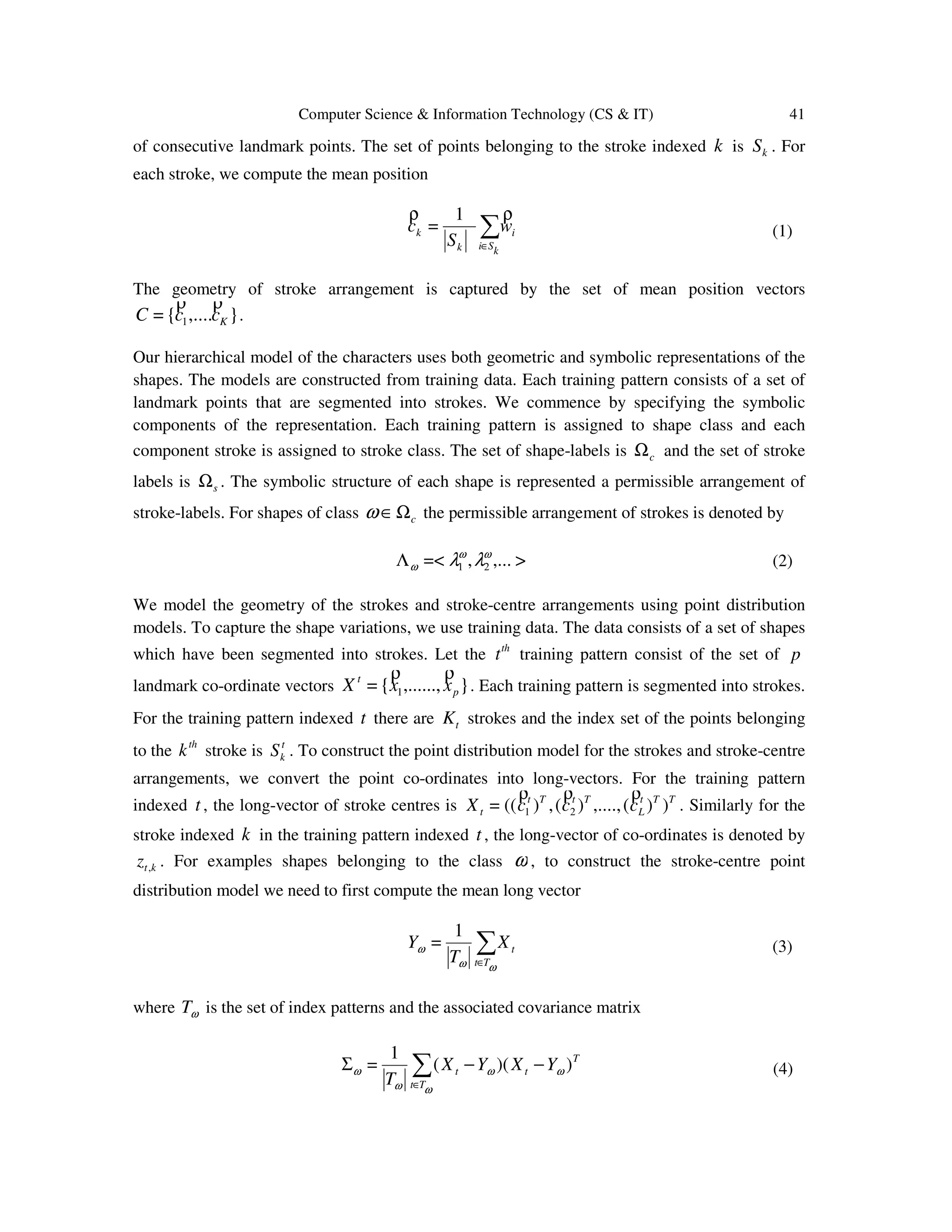
![42 Computer Science & Information Technology (CS & IT)
The eigenmodes of the stroke-centre covariance matrix are used to construct the point-distribution
model. First, the eigenvalues e of the stroke covariance matrix are found by solving the
eigenvalue equation 0|=| Ieω
ω −Σ where I is the LL 22 × identity matrix. The eigen-vector
iφ corresponding to the eigenvalue ω
ie is found by solving the eigenvector equation
ωωω
φφ iii e=Σ . According to Cootes and Taylor [6], the landmark points are allowed to undergo
displacements relative to the mean-shape in directions defined by the eigenvectors of the
covariance matrix ωΣ . To compute the set of possible displacement directions, the M most
significant eigenvectors are ordered according to the magnitudes of their corresponding
eigenvalues to form the matrix of column-vectors )|...||(= 21
ωωω
ω φφφ MΦ , where ωωω
Meee ,.....,, 21
is the order of the magnitudes of the eigenvectors. The landmark points are allowed to move in a
direction which is a linear combination of the eigenvectors. The updated landmark positions are
given by ωωω γΦ+YX =ˆ , where ωγ is a vector of modal co-efficients. This vector represents
the free-parameters of the global shape-model.
This procedure may be repeated to construct a point distribution model for each stroke class. The
set of long vectors for strokes of class λ is }=|{= , λλλ
t
kktZT . The mean and covariance
matrix for this set of long-vectors are denoted by λY and λΣ and the associated modal matrix is
λΦ . The point distribution model for the stroke landmark points is λλλ γΦ+YZ =ˆ .
We have recently described how a mixture of point-distribution models may be fitted to samples
of shapes. The method is based on the EM algorithm and can be used to learn point distribution
models for both the stroke and shape classes in an unsupervised manner. We have used this
method to learn the mean shapes and the modal matrices for the strokes. More details of the
method are found in [7].
3. HIERARCHICAL ARCHITECTURE
With the stroke and shape point distribution models to hand, our recognition method proceeds in
a hierarchical manner. To commence, we make maximum likelihood estimates of the best-fit
parameters of each stroke-model to each set of stroke-points. The best-fit parameters k
λγ of the
stroke-model with class-label λ to the set of points constituting the stroke indexed k is
),|(maxarg= γγ λ
γ
λ Φk
k
zp (5)
We use the best-fit parameters to assign a label to each stroke. The label is that which has
maximum a posteriori probability given the stroke parameters. The label assigned to the stroke
indexed k is](https://image.slidesharecdn.com/csit76605-170411103826/75/HANDWRITTEN-CHARACTER-RECOGNITION-USING-STRUCTURAL-SHAPE-DECOMPOSITION-4-2048.jpg)
![Computer Science & Information Technology (CS & IT) 43
),,|(maxarg= λλ
λ
γ Φ
Ω∈
k
s
k zlPl (6)
In practice, we assume that the fit error residuals follow a Gaussian distribution. As a result, the
class label is that associated with the minimum squared error. This process is repeated for each
stroke in turn. The class identity of the set of strokes is summarised the string of assigned stroke-
labels
>,.....,=< 21 llL (7)
Hence, the input layer is initialised using maximum likelihood stroke parameters and maximum a
posteriori probability stroke labels.
The shape-layer takes this information as input. The goal of computation in this second layer is to
refine the configuration of stroke labels using global constraints on the arrangement of strokes to
form consistent shapes. The constraints come from both geometric and symbolic sources. The
geometric constraints are provided by the fit of a stroke-centre point distribution model. The
symbolic constraints are provide by a dictionary of permissible stroke-label strings for different
shapes.
The parameters of the stroke-centre point distribution model are found using the EM algorithm
[8]. Here we borrow ideas from the hierarchical mixture of experts algorithm, and pose the
recovery of parameters as that of maximising a gated expected log-likelihood function for the
distribution of stroke-centre alignment errors ),|( ωω ΓΦXp . The likelihood function is gated by
two sets of probabilities. The first of these are the a posteriori probabilities ),,|( ωλωλ
ω
γλ
kk
kk zP Φ
of the individual strokes. The second are the conditional probabilities )|( ωΛLP of the assigned
stroke-label string given the dictionary of permissible configurations for shapes of class ω . The
expected log-likelihood function is given by
),|(ln)},,|(){|(= ωωωλωλ
ω
ω
ω
γλ ΓΦΦΛ ∏∑Ω∈
XpzPLPL
kk
kk
kc
(8)
The optimal set of stroke-centre alignment parameters satisfies the condition
),|(ln)},,|(){|(maxarg=*
ωωωλωλ
ω
ωω γλ ΓΦΦΛΓ ∏Γ
XpzPLP
kk
kk
k
(9)
From the maximum likelihood alignment parameters we identify the shape-class of maximum a
posteriori probability. The class is the one for which
),,|(maxarg= **
ωω
ω
ωω ΓΦ
Ω∈
XP
c
(10)](https://image.slidesharecdn.com/csit76605-170411103826/75/HANDWRITTEN-CHARACTER-RECOGNITION-USING-STRUCTURAL-SHAPE-DECOMPOSITION-5-2048.jpg)
![44 Computer Science & Information Technology (CS & IT)
The class identity of the maximum a posteriori probability shape is passed back to the stroke-
layer of the architecture. The stroke labels can then be refined in the light of the consistent
assignments for the stroke-label configuration associated with the shape-class ω .
)|),((),,|(maxarg= ωλ
λ
λγλ ΛΦ
Ω∈
kLPzPl k
lk
s
k (11)
Finally, the maximum likelihood parameters for the strokes are refined
)),,|(maxarg= *
ω
γ
γγ ΓΦ
klkk zp
ρ
(12)
These labels are passed to the shape-layer and the process is iterated to convergence.
4. MODELS
In this section we describe the probability distributions used to model the point-distribution
alignment process and the symbol assignment process.
4.1 Point-Set Alignment
To develop a useful alignment algorithm we require a model for the measurement process. Here
we assume that the observed position vectors, i.e. iw
ρ
are derived from the model points through a
Gaussian error process. According to our Gaussian model of the alignment errors,
)]()(12[exp12=),|( 2
λωωλωωλλ γγσπσγ Φ−−Φ−−−Φ YzYzzp k
T
kk
ρρρ
(13)
where 2
σ is the variance of the point-position errors which for simplicity are assumed to be
isotropic. The maximum likelihood parameter vector is given by
))(()(
2
1
= 1
ωωωωωλγ Yzk
TTk
−Φ+ΦΦΦ − ρ
(14)
A similar procedure may be applied to estimate the parameters of the stroke centre point
distribution model.
4.2 Label Assignment
The distribution of label errors is modelled using the method developed by Hancock and Kittler
[9]. To measure the degree of error we measure the Hamming distance between the assigned
string of labels L and the dictionary item Λ . The Hamming distance is given by
ωλω δ
iil
K
i
LH
,
1=
=),( ∑Λ (15)
where δ is the DiracDelta function. With the Hamming distance to hand, the probability of the
assigned string of labels L given the dictionary item Λ is
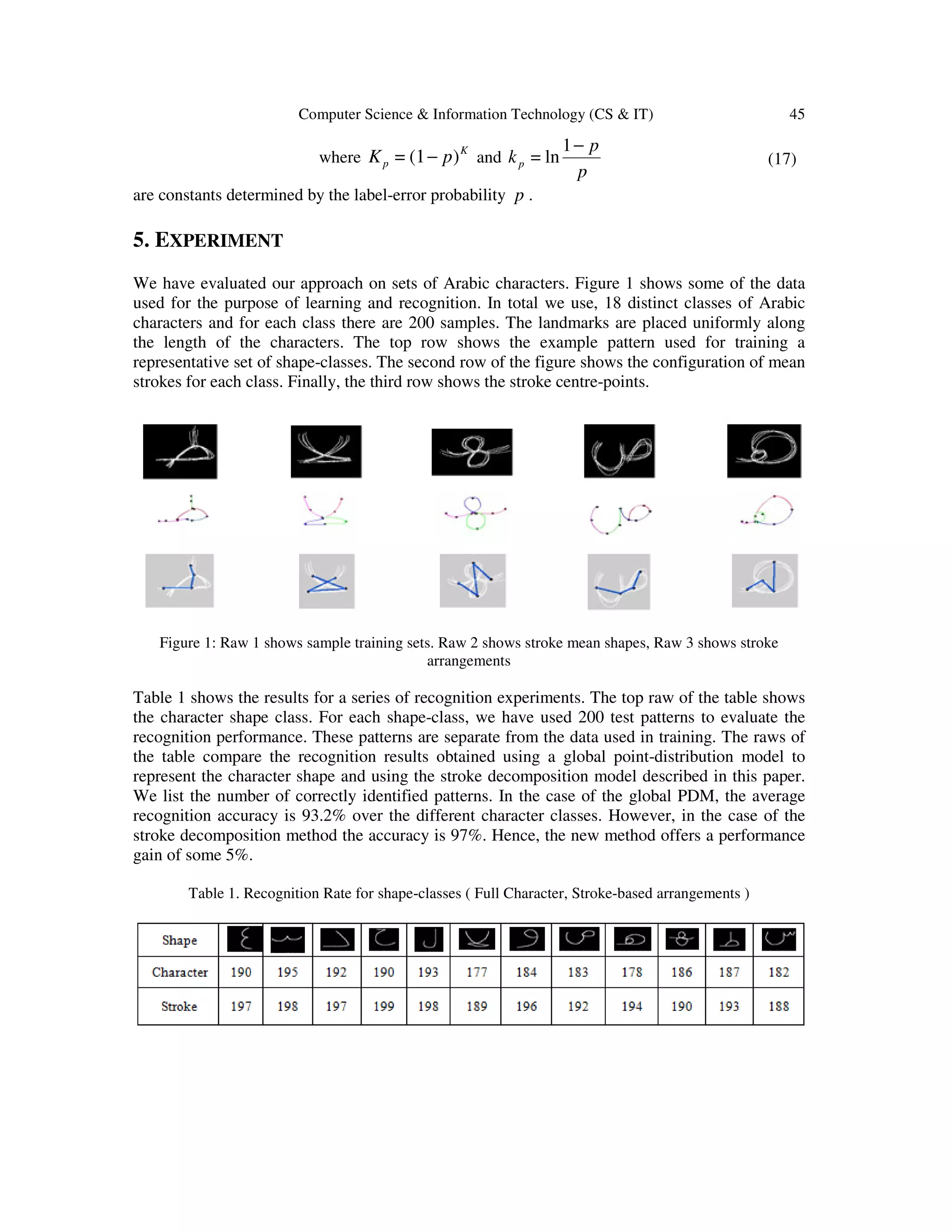
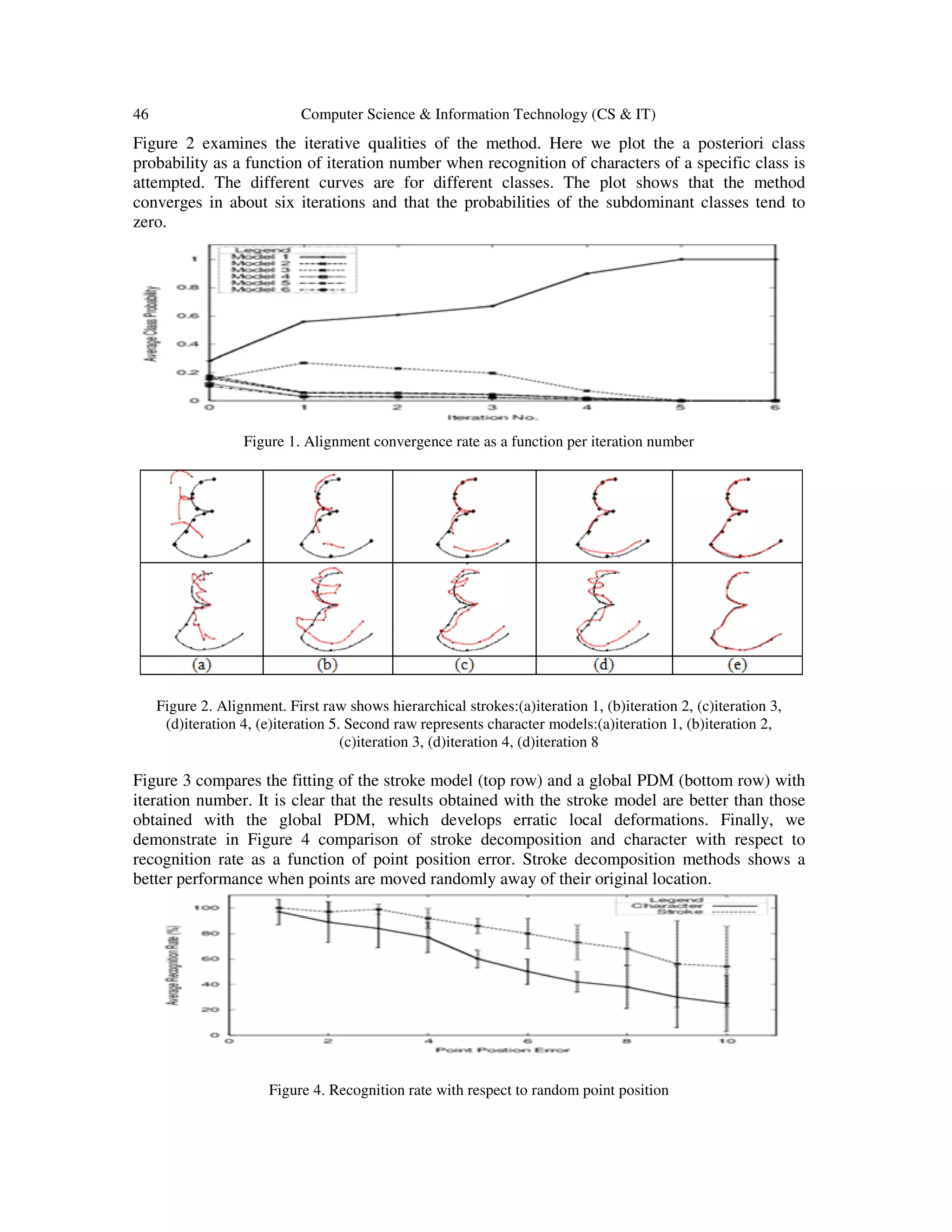
)],([exp=)|( ωω Λ−Λ LHkKLP pp (16)](https://image.slidesharecdn.com/csit76605-170411103826/75/HANDWRITTEN-CHARACTER-RECOGNITION-USING-STRUCTURAL-SHAPE-DECOMPOSITION-6-2048.jpg)
![Computer Science & Information Technology (CS & IT) 47
6. CONCLUSION
In This Paper, we have described a hierarchical probabilistic framework for shape recognition via
stroke decomposition. The structural component of the method is represented using symbolic
dictionaries, while geometric component is represented using Point Distribution Models.
Experiments on Arabic character recognition reveal that the method offers advantages over a
global PDM.
REFERENCES
[1] T. Cootes, C. Taylor, D. Cooper and J. Graham, "Active Shape Models-Their Training and
Application," Computer Vision and Image Understanding, vol. 61, no. 1, pp. 38-59, 1995.
[2] S. Belongie, J. Malik and a. J. Puzicha, "Shape matching and object recognition using shape
contexts," IEEE Transactions on PAMI, vol. 24, no. 24, pp. 509-522, 2002.
[3] D. C. Marr, Vision: a computational investigation into the human representation and processing of
visual information, San Francisco: Freeman, 1982.
[4] M. Jordan and R. Jacobs, "Hierarchical mixtures of experts and the em algorithm," Neural
Computation, vol. 6, pp. 181-214, 1994.
[5] C. T. and T. C., "A mixture models for representing shape variation," Image and Vision Computing,
vol. 17, pp. 403-409, 1999.
[6] C. T. and T. C., "Combining point distribution models with shape models based on finite element
analysis," Image and Vision Computing, vol. 13, no. 5, pp. 403-409, 1995.
[7] A. A. Al-Shaher and E. R. Hancock, "Linear shape recognition with mixtures of point distribution
models," in SSPR, Windsor, Canada, 2002.
[8] A. Dempster, L. N. and R. D., "Maximum likelihood from incomplete data via the em algorithm,"
Journal of Royal Statistical Soc. Ser., vol. 39, pp. 1-38, 1977.
[9] E. R. Hancock and J. Kittler, "Discrete relaxation," Pattern Recognition, vol. 23, no. 7, pp. 711-733,
1990.](https://image.slidesharecdn.com/csit76605-170411103826/75/HANDWRITTEN-CHARACTER-RECOGNITION-USING-STRUCTURAL-SHAPE-DECOMPOSITION-9-2048.jpg)


