Direct and Indirect Objects Objetos directos e indirectos
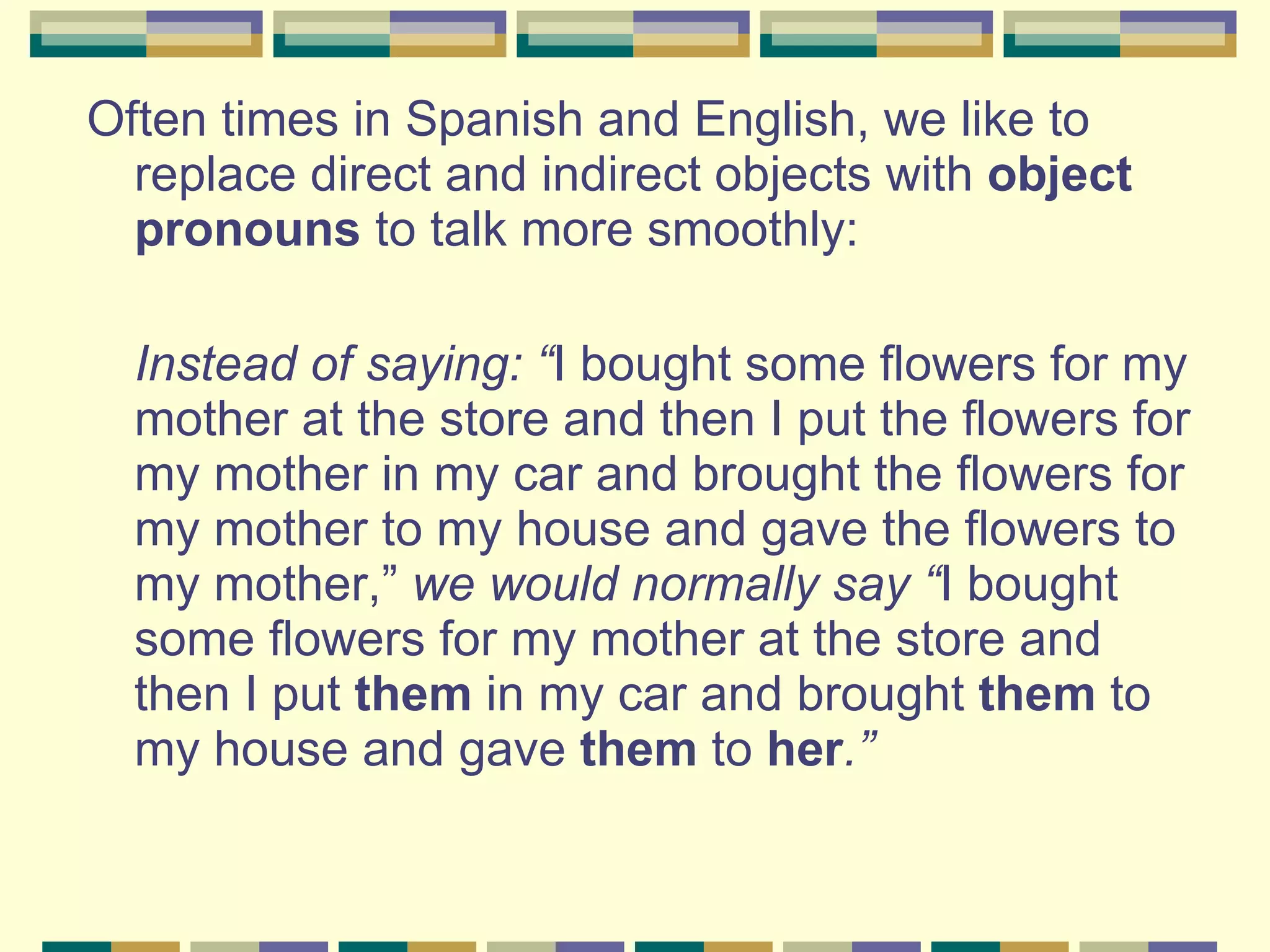
Often times in Spanish and English, we like to replace direct and indirect objects with  object pronouns  to talk more smoothly: Instead of saying: “ I bought some flowers for my mother at the store and then I put the flowers for my mother in my car and brought the flowers for my mother to my house and gave the flowers to my mother,”  we would normally say “ I bought some flowers for my mother at the store and then I put  them  in my car and brought  them  to my house and gave  them  to  her .”
What are direct objects? Direct objects tell us who or what is receiving the action of the verb Typically they answer the questions Who?  ¿   Qui é n? What?  ¿ Qu é ? Examples: I am buying  pizza  for lunch today. You are taking  a quiz  on your Bellwork today.
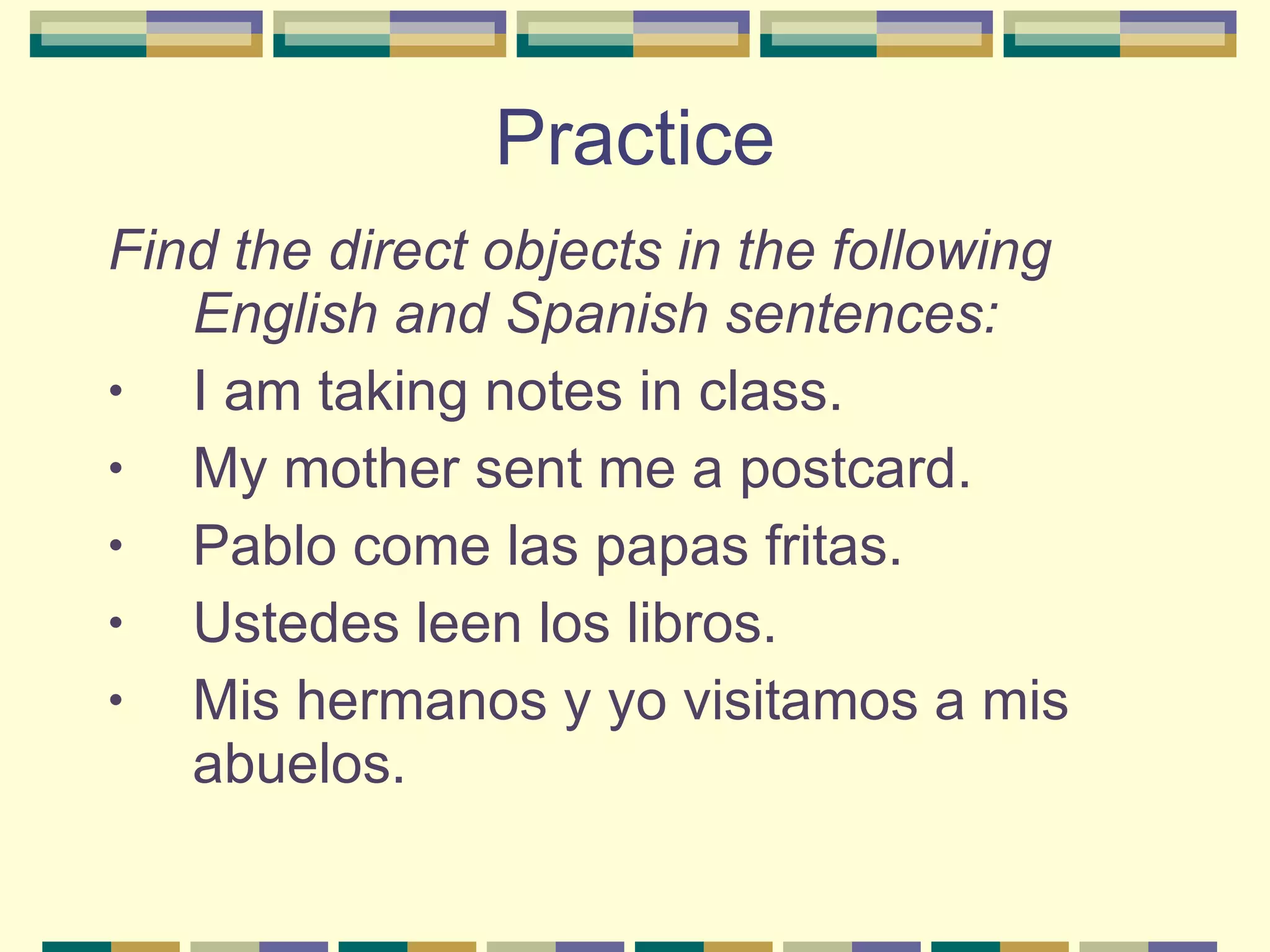
Practice Find the direct objects in the following English and Spanish sentences: I am taking notes in class. My mother sent me a postcard. Pablo come las papas fritas. Ustedes leen los libros. Mis hermanos y yo visitamos a mis abuelos.
What are indirect objects? Indirect objects tell us to whom/what or for whom/what an action is occuring Typically answer the questions: To whom?  ¿ A  qui é n? For whom?   ¿ Para   qui é n? Examples: Maria bought flowers  for her mother . I gave a sweater  to my brother  for his birthday.
Practice Find the indirect objects in the following English and Spanish sentences . He gave a tissue to Pablo. Marta said to me that she is hungry. Rosa compra una olla para Antonio. Maria da una flor a su madre. Selena quiere comprar un libro para su abuelo.
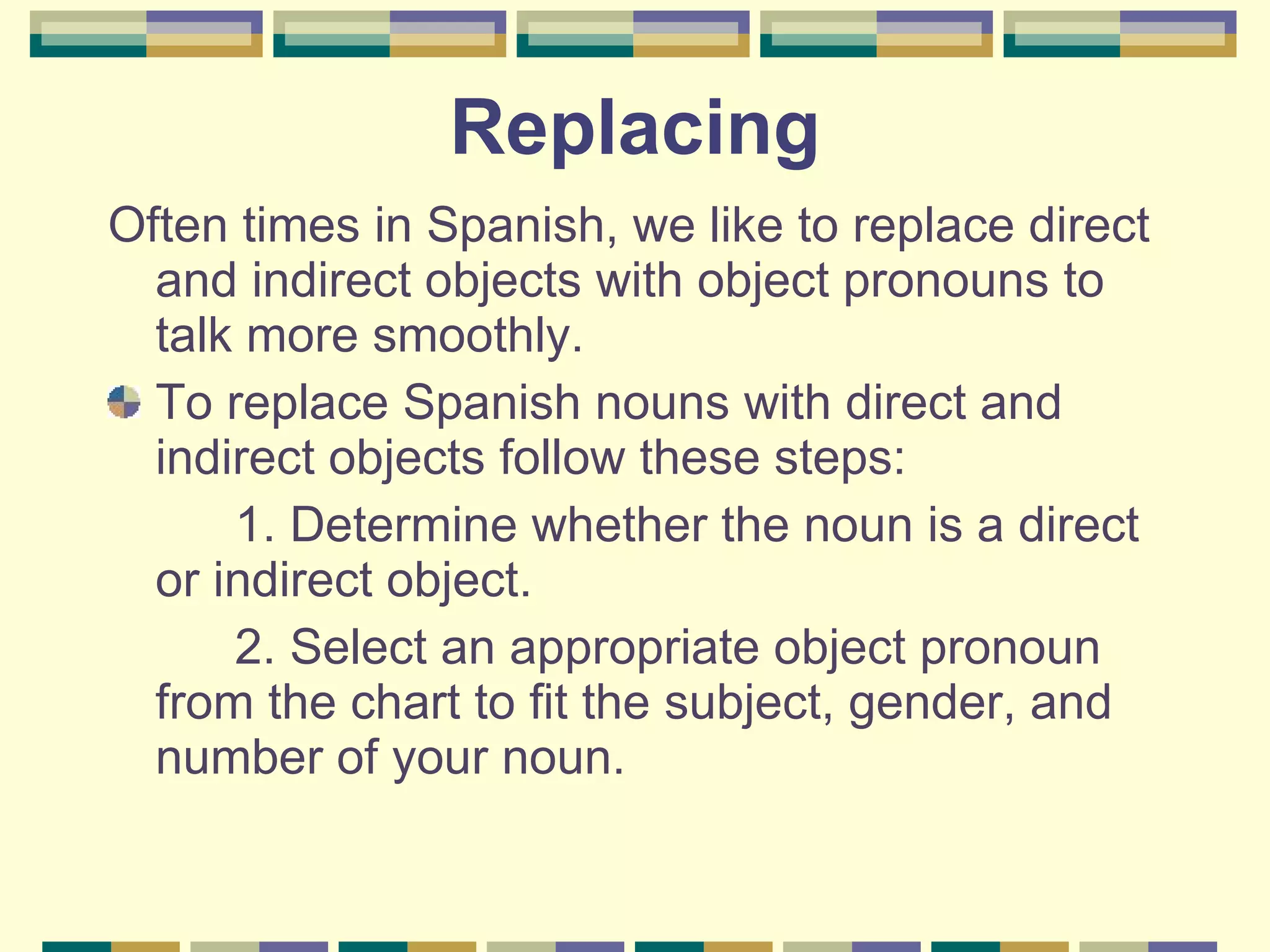
Replacing Often times in Spanish, we like to replace direct and indirect objects with object pronouns to talk more smoothly. To replace Spanish nouns with direct and indirect objects follow these steps: 1. Determine whether the noun is a direct or indirect object. 2. Select an appropriate object pronoun from the chart to fit the subject, gender, and number of your noun.
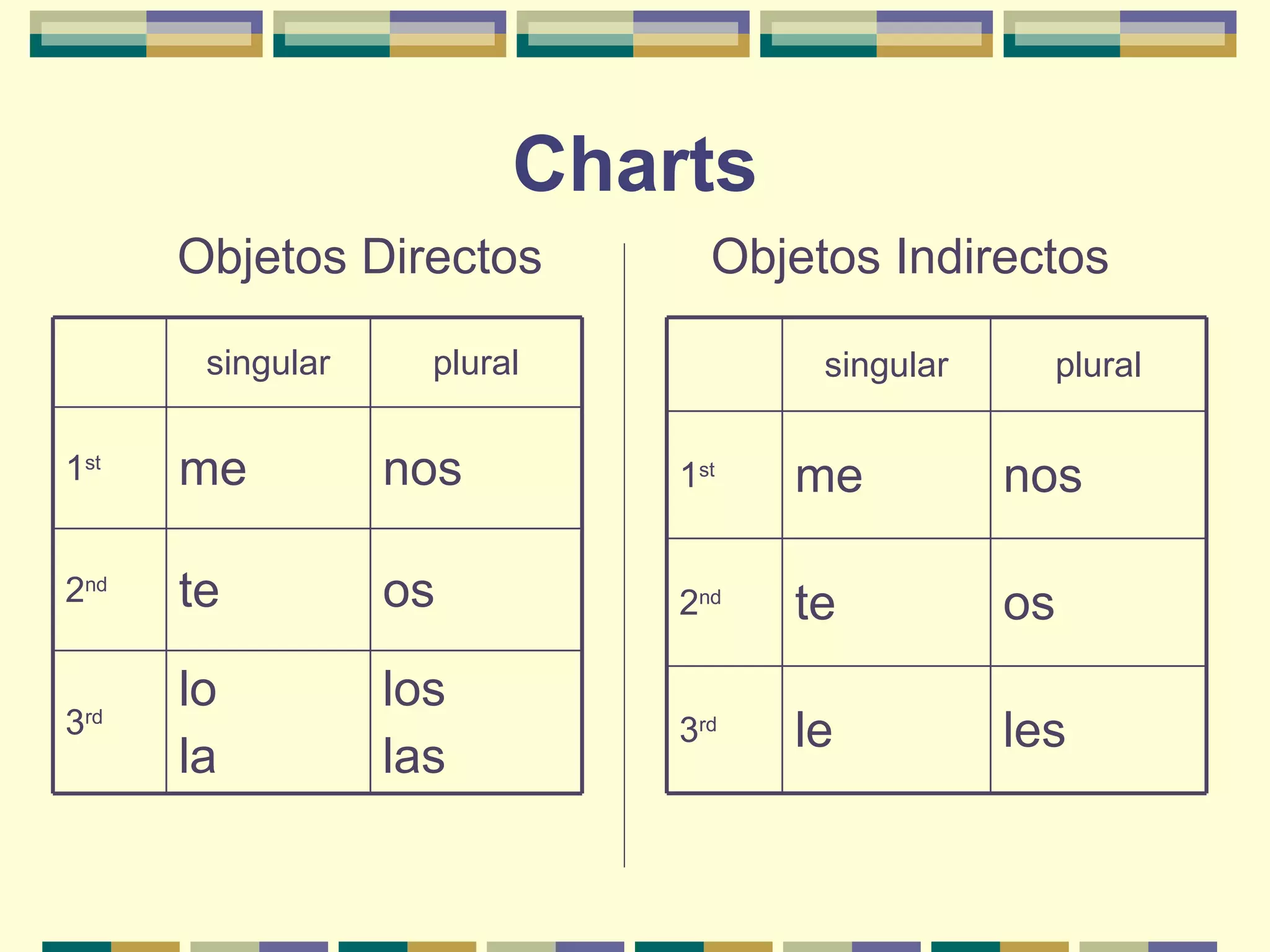
Charts Objetos Directos   Objetos Indirectos plural singular los las lo la 3 rd   os te 2 nd   nos me 1 st   plural singular les le 3 rd   os te 2 nd   nos me 1 st
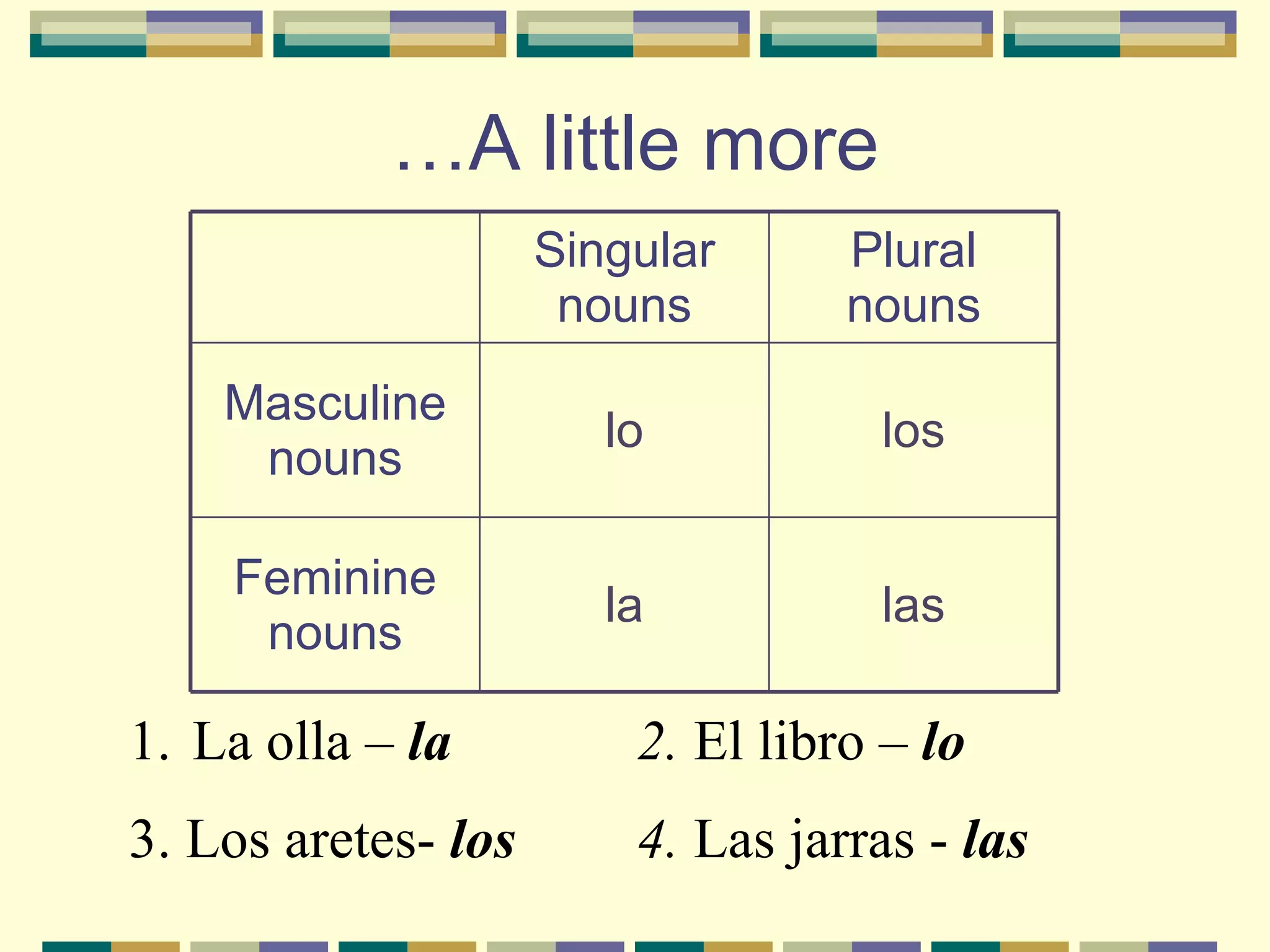
…A little more La olla –  la 2.  El libro –  lo 3. Los aretes-  los 4.  Las jarras -  las las la Feminine nouns los lo Masculine nouns Plural nouns Singular nouns
Rules We replace the noun using these rules: 1. The direct or indirect object goes  before   the conjugated verb. example:   Mi madre compra un regalo para mí. Mi madre  me   compra un regalo.
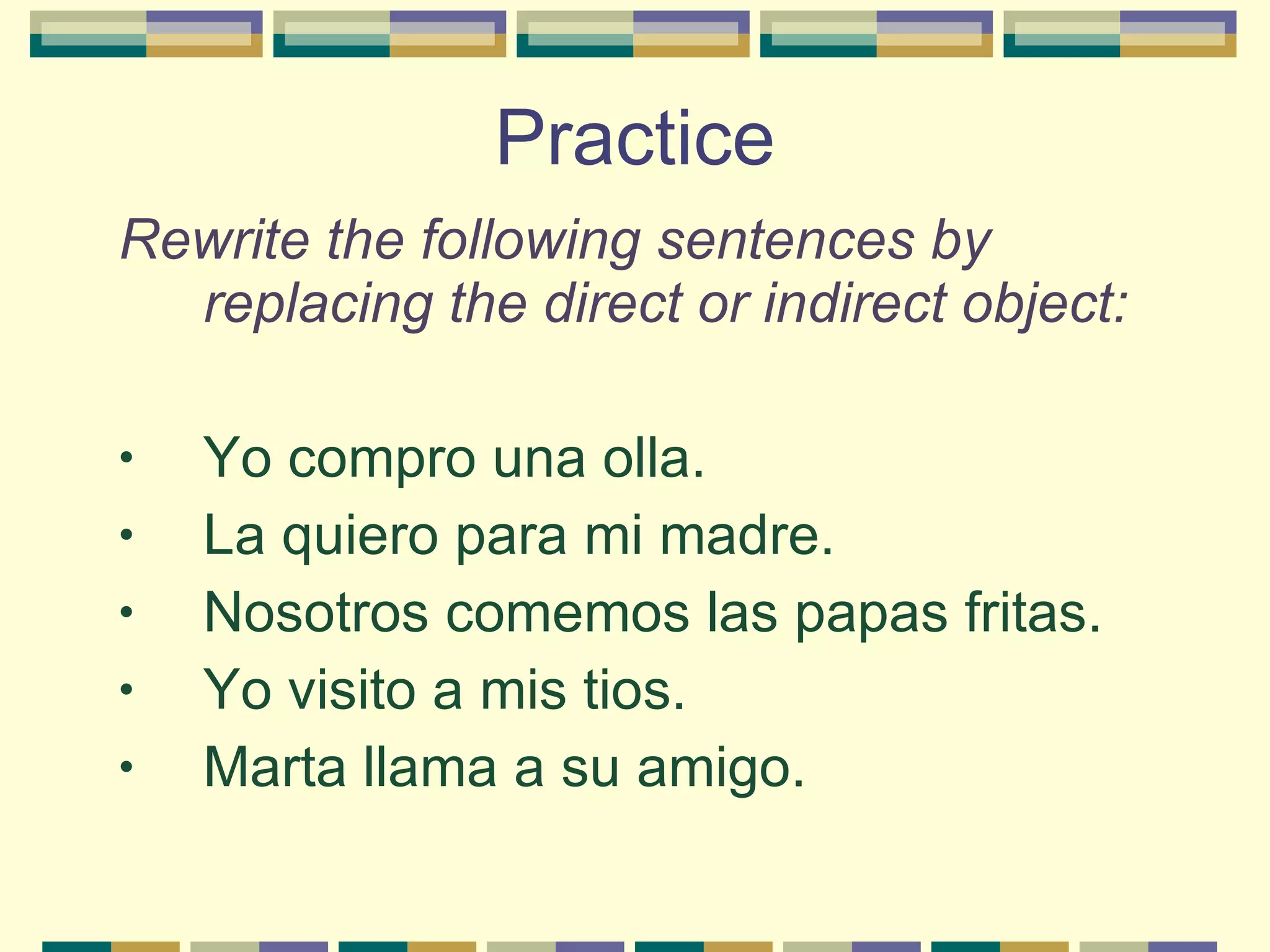
Practice Rewrite the following sentences by replacing the direct or indirect object: Yo compro una olla. La quiero para mi madre. Nosotros comemos las papas fritas. Yo visito a mis tios. Marta llama a su amigo.
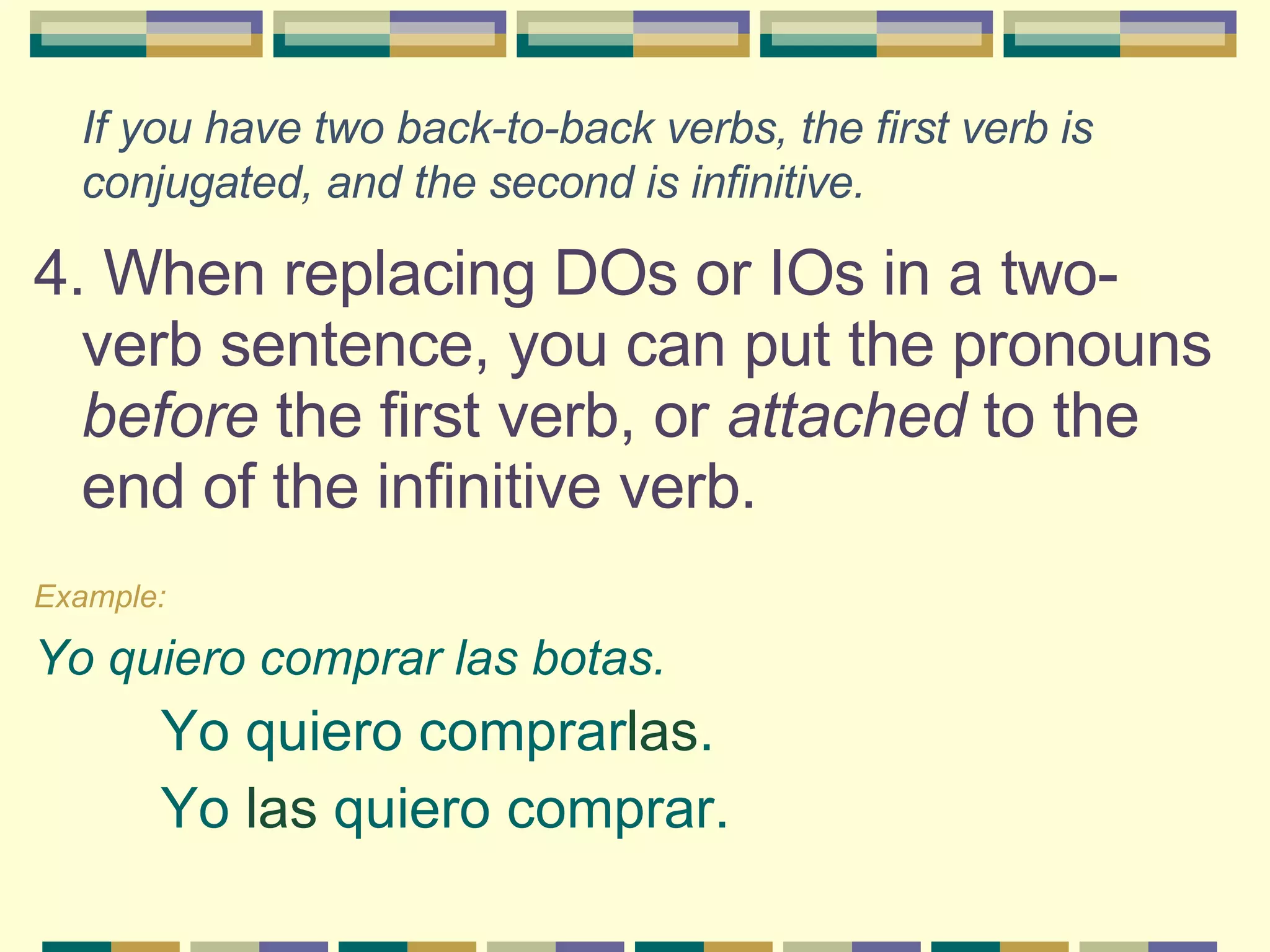
If you have two back-to-back verbs, the first verb is conjugated, and the second is infinitive.   4. When replacing DOs or IOs in a two-verb sentence, you can put the pronouns  before  the first verb, or  attached  to the end of the infinitive verb.   Example:   Yo quiero comprar las botas.  Yo quiero comprar las . Yo  las  quiero comprar.
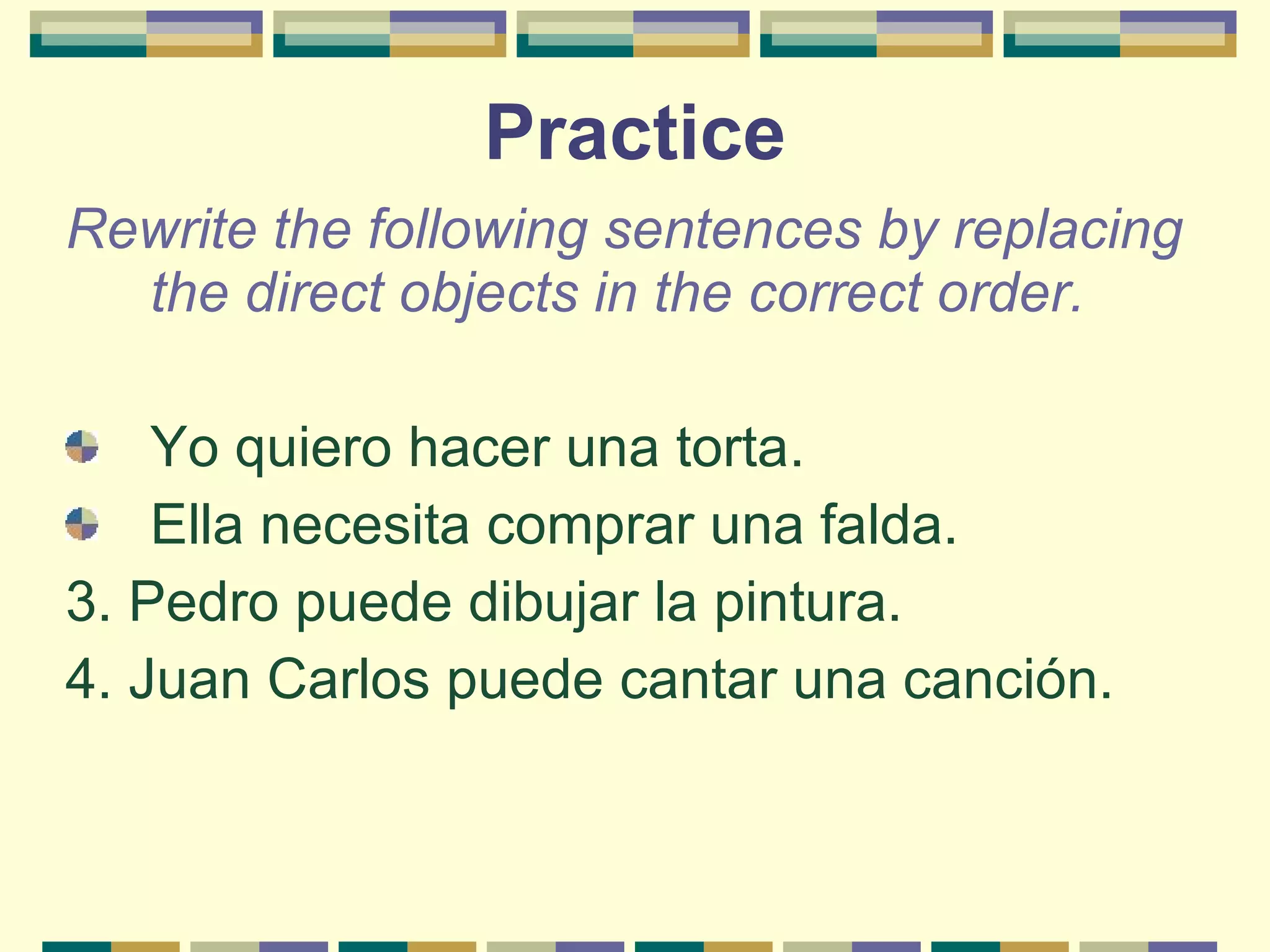
Practice Rewrite the following sentences by replacing the direct objects in the correct order. Yo quiero hacer una torta. Ella necesita comprar una falda. 3. Pedro puede dibujar la pintura. 4. Juan Carlos puede cantar una canción.
El fín ( the end)

D Oand I Oppt

  • 1.
    Direct and IndirectObjects Objetos directos e indirectos
  • 2.
    Often times inSpanish and English, we like to replace direct and indirect objects with object pronouns to talk more smoothly: Instead of saying: “ I bought some flowers for my mother at the store and then I put the flowers for my mother in my car and brought the flowers for my mother to my house and gave the flowers to my mother,” we would normally say “ I bought some flowers for my mother at the store and then I put them in my car and brought them to my house and gave them to her .”
  • 3.
    What are directobjects? Direct objects tell us who or what is receiving the action of the verb Typically they answer the questions Who? ¿ Qui é n? What? ¿ Qu é ? Examples: I am buying pizza for lunch today. You are taking a quiz on your Bellwork today.
  • 4.
    Practice Find thedirect objects in the following English and Spanish sentences: I am taking notes in class. My mother sent me a postcard. Pablo come las papas fritas. Ustedes leen los libros. Mis hermanos y yo visitamos a mis abuelos.
  • 5.
    What are indirectobjects? Indirect objects tell us to whom/what or for whom/what an action is occuring Typically answer the questions: To whom? ¿ A qui é n? For whom? ¿ Para qui é n? Examples: Maria bought flowers for her mother . I gave a sweater to my brother for his birthday.
  • 6.
    Practice Find theindirect objects in the following English and Spanish sentences . He gave a tissue to Pablo. Marta said to me that she is hungry. Rosa compra una olla para Antonio. Maria da una flor a su madre. Selena quiere comprar un libro para su abuelo.
  • 7.
    Replacing Often timesin Spanish, we like to replace direct and indirect objects with object pronouns to talk more smoothly. To replace Spanish nouns with direct and indirect objects follow these steps: 1. Determine whether the noun is a direct or indirect object. 2. Select an appropriate object pronoun from the chart to fit the subject, gender, and number of your noun.
  • 8.
    Charts Objetos Directos  Objetos Indirectos plural singular los las lo la 3 rd os te 2 nd nos me 1 st plural singular les le 3 rd os te 2 nd nos me 1 st
  • 9.
    …A little moreLa olla – la 2. El libro – lo 3. Los aretes- los 4. Las jarras - las las la Feminine nouns los lo Masculine nouns Plural nouns Singular nouns
  • 10.
    Rules We replacethe noun using these rules: 1. The direct or indirect object goes before the conjugated verb. example: Mi madre compra un regalo para mí. Mi madre me compra un regalo.
  • 11.
    Practice Rewrite thefollowing sentences by replacing the direct or indirect object: Yo compro una olla. La quiero para mi madre. Nosotros comemos las papas fritas. Yo visito a mis tios. Marta llama a su amigo.
  • 12.
    If you havetwo back-to-back verbs, the first verb is conjugated, and the second is infinitive. 4. When replacing DOs or IOs in a two-verb sentence, you can put the pronouns before the first verb, or attached to the end of the infinitive verb. Example: Yo quiero comprar las botas. Yo quiero comprar las . Yo las quiero comprar.
  • 13.
    Practice Rewrite thefollowing sentences by replacing the direct objects in the correct order. Yo quiero hacer una torta. Ella necesita comprar una falda. 3. Pedro puede dibujar la pintura. 4. Juan Carlos puede cantar una canción.
  • 14.
    El fín (the end)