En esta lección aprenderás a expandir información sobre algo o
alguien, es decir dar información extra sobre esa persona
animal o cosa mediante unas palabras que sirven como
conectores de la primera oración y el complemento o
información extra de la misma
Relative Pronouns (who, which, that ) and adverbs where
Relative Pronouns (who, which, that) and adverbs where
The relative pronouns who, which that, whose and the relative adverb where introduce relative clauses, which give
information about the subject or object of the main clause
Who is used for people
Ben is the person who gave me this comic
Alexander Graham Bell is the scientist who invented the telephone
Which is used for animals, things and abstract nouns.
Have you seen the cake which I prepared for Jane?
Lions are animals which live in Africa
That is used for people, animals, things and abstract nouns. It can replace who and which.
Here are the shoes that I bought last week
Fred Mills is the student that won the competition
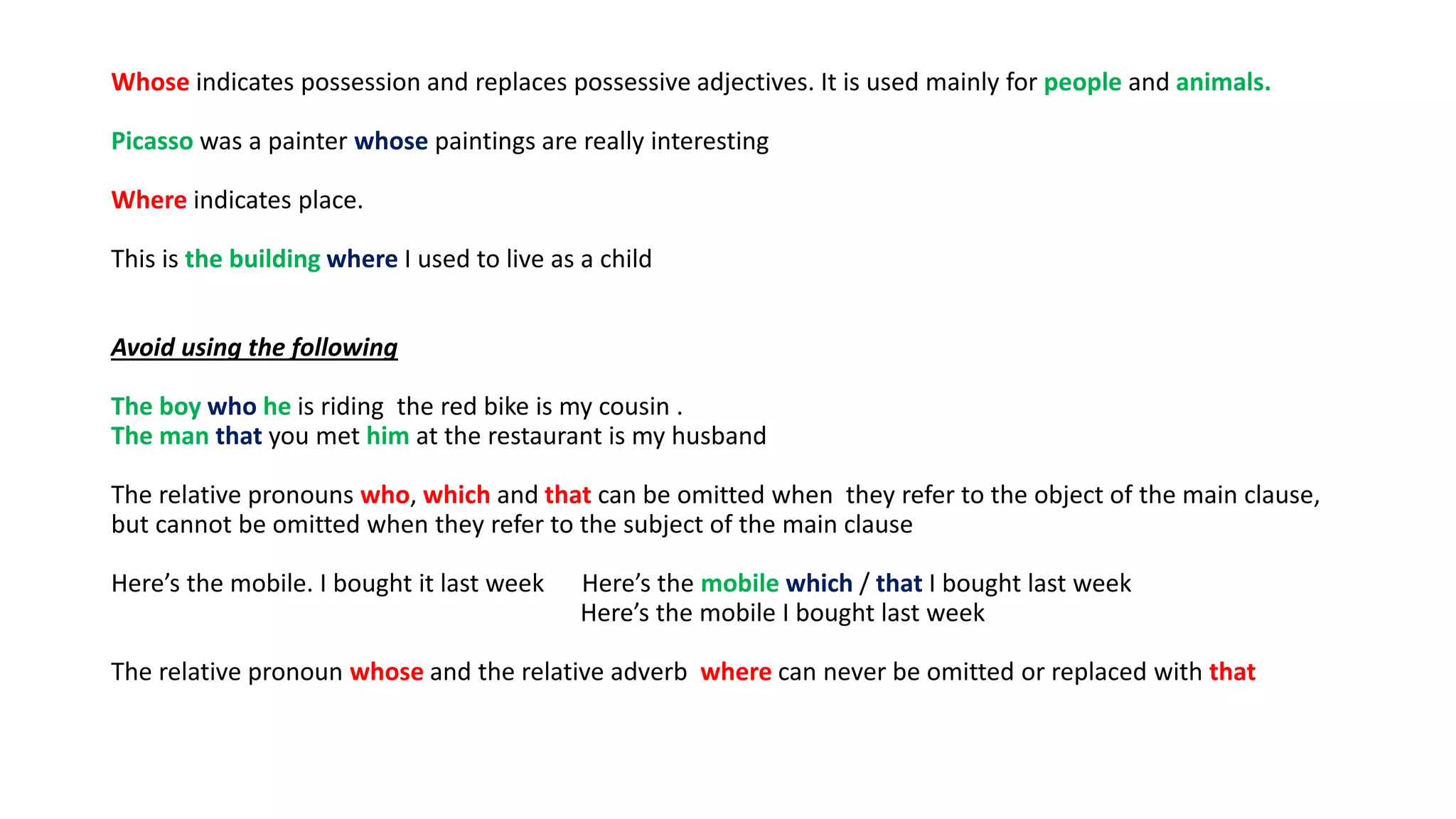
Whose indicates possession and replaces possessive adjectives. It is used mainly for people and animals.
Picasso was a painter whose paintings are really interesting
Where indicates place.
This is the building where I used to live as a child
Avoid using the following
The boy who he is riding the red bike is my cousin .
The man that you met him at the restaurant is my husband
The relative pronouns who, which and that can be omitted when they refer to the object of the main clause,
but cannot be omitted when they refer to the subject of the main clause
Here’s the mobile. I bought it last week Here’s the mobile which / that I bought last week
Here’s the mobile I bought last week
The relative pronoun whose and the relative adverb where can never be omitted or replaced with that
Pudiste distinguir el uso de who, which, that y where, bueno cada uno
se refiere a un objeto en particular, who se refiere a la persona de la
que estamos hablando, which se refiere al objeto, animal o situación
de la que se esta hablando y that puede sustituir indistintamente a
ambos who y which y además tenemos a where que se refiere a
lugares, los relative pronouns se utilizan cuando queremos agregar
extra información sobre ellos, es como cuando decimos en español:
Recuerdas a Mary? Si, Mary la chica que atiende la tienda / Ese es el
perro que mordió a Juanito la semana pasada / La escuela en la que
estudiábamos esta cruzando la calle.
Espero que haya quedado claro, de lo contrario ya sabes que cuentas
con el apoyo del profesor a cargo del grupo quien con gusto resolverá
tus dudas. Suerte !!
TECNOLÓGICO DE ESTUDIOS SUPERIORES DE CUAUTITLAN
IZCALLI (TESCI)

Relative Pronouns

  • 1.
    En esta lecciónaprenderás a expandir información sobre algo o alguien, es decir dar información extra sobre esa persona animal o cosa mediante unas palabras que sirven como conectores de la primera oración y el complemento o información extra de la misma Relative Pronouns (who, which, that ) and adverbs where
  • 2.
    Relative Pronouns (who,which, that) and adverbs where The relative pronouns who, which that, whose and the relative adverb where introduce relative clauses, which give information about the subject or object of the main clause Who is used for people Ben is the person who gave me this comic Alexander Graham Bell is the scientist who invented the telephone Which is used for animals, things and abstract nouns. Have you seen the cake which I prepared for Jane? Lions are animals which live in Africa That is used for people, animals, things and abstract nouns. It can replace who and which. Here are the shoes that I bought last week Fred Mills is the student that won the competition
  • 3.
    Whose indicates possessionand replaces possessive adjectives. It is used mainly for people and animals. Picasso was a painter whose paintings are really interesting Where indicates place. This is the building where I used to live as a child Avoid using the following The boy who he is riding the red bike is my cousin . The man that you met him at the restaurant is my husband The relative pronouns who, which and that can be omitted when they refer to the object of the main clause, but cannot be omitted when they refer to the subject of the main clause Here’s the mobile. I bought it last week Here’s the mobile which / that I bought last week Here’s the mobile I bought last week The relative pronoun whose and the relative adverb where can never be omitted or replaced with that
  • 5.
    Pudiste distinguir eluso de who, which, that y where, bueno cada uno se refiere a un objeto en particular, who se refiere a la persona de la que estamos hablando, which se refiere al objeto, animal o situación de la que se esta hablando y that puede sustituir indistintamente a ambos who y which y además tenemos a where que se refiere a lugares, los relative pronouns se utilizan cuando queremos agregar extra información sobre ellos, es como cuando decimos en español: Recuerdas a Mary? Si, Mary la chica que atiende la tienda / Ese es el perro que mordió a Juanito la semana pasada / La escuela en la que estudiábamos esta cruzando la calle. Espero que haya quedado claro, de lo contrario ya sabes que cuentas con el apoyo del profesor a cargo del grupo quien con gusto resolverá tus dudas. Suerte !!
  • 6.
    TECNOLÓGICO DE ESTUDIOSSUPERIORES DE CUAUTITLAN IZCALLI (TESCI)