The Sentence Direct and indirect
                    Object
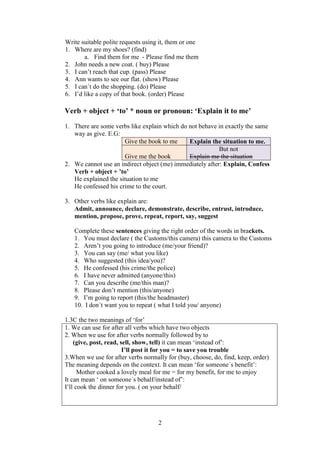
                   Indirect objects        Direct objects are
                   Are nouns with action   Nouns [1]
                   verbs usually persons
                                           with action verb
                   always have a DO
                                           usually things.
                   who receive             What did I make?
                   the benefits of         Recipe the
                   an action.              action of the
                                           verb
                   answer the questions
                   'to whom', 'to what',
                   'for whom' or 'for
                   what'

                    S-V-IO-DO

(Subject + verb + indirect object + direct object)
Show me that photo
   1. We can use two objects after verbs like give and buy

             Instead of:             we can say
             Give the book to me     Give me the book
             Buy the book for me     Buy me the book.
   2. Some verbs combine with to orders with for
                     to                                for
     Bring, give, lend, pay, post,   Buy, choose, cook, cut, do, fetch,
     sell, send, show, tell, write   find, get, make, order
     Bring that book to me           Please order a meal for me
     Bring me that book              Please order me a meal
     Give something to me            Cook something for me
     Give me something               Cook me something

   3. WE CAN PUT IT AND THEM AFTER THE VERB MANDATORI. When the
      direct object is a pronoun always go (it and them)
     Give it to me. Buy them for me. Do it for me
     Give it to John. Buy them for John.              But not Give John it, Buy John them

   4.
        With e.g. give and buy, we can say: Give me it, buy me them. But not do me it


                                            1
Write suitable polite requests using it, them or one
1. Where are my shoes? (find)
       a. Find them for me - Please find me them
2. John needs a new coat. ( buy) Please
3. I can’t reach that cup. (pass) Please
4. Ann wants to see our flat. (show) Please
5. I can´t do the shopping. (do) Please
6. I’d like a copy of that book. (order) Please

Verb + object + ‘to’ * noun or pronoun: ‘Explain it to me’
1. There are some verbs like explain which do not behave in exactly the same
   way as give. E.G:
                      Give the book to me     Explain the situation to me.
                                                          But not
                      Give me the book        Explain me the situation
2. We cannot use an indirect object (me) immediately after: Explain, Confess
   Verb + object + ’to’
   He explained the situation to me
   He confessed his crime to the court.

3. Other verbs like explain are:
   Admit, announce, declare, demonstrate, describe, entrust, introduce,
   mention, propose, prove, repeat, report, say, suggest

   Complete these sentences giving the right order of the words in brackets.
   1. You must declare ( the Customs/this camera) this camera to the Customs
   2. Aren’t you going to introduce (me/your friend)?
   3. You can say (me/ what you like)
   4. Who suggested (this idea/you)?
   5. He confessed (his crime/the police)
   6. I have never admitted (anyone/this)
   7. Can you describe (me/this man)?
   8. Please don’t mention (this/anyone)
   9. I’m going to report (this/the headmaster)
   10. I don´t want you to repeat ( what I told you/ anyone)

1.3C the two meanings of ‘for’
1. We can use for after all verbs which have two objects
2. When we use for after verbs normally followed by to
    (give, post, read, sell, show, tell) it can mean ‘instead of’:
                        I’ll post it for you = to save you trouble
3.When we use for after verbs normally for (buy, choose, do, find, keep, order)
The meaning depends on the context. It can mean ‘for someone´s benefit’:
      Mother cooked a lovely meal for me = for my benefit, for me to enjoy
It can mean ‘ on someone´s behalf/instead of’:
I’ll cook the dinner for you. ( on your behalf/


                                    2
1. http://www.youtube.com/watch?v=HE6LBi4wFEo
2. http://www.youtube.com/watch?v=ADnQuyR-PkI
3. http://www.youtube.com/watch?v=p8x3EiXEmHs
4. http://www.youtube.com/watch?v=hKQRkW41LzY
5. http://www.youtube.com/watch?feature=fvwp&v=Gw0wowIKGDk&NR=1
6. http://www.chompchomp.com/terms/directobject.htm
7. http://www.youtube.com/watch?v=4mTL4h3eI7Q
8. http://www.youtube.com/watch?v=O-8hwsOgp7Y
9. http://esl.about.com/od/grammarstructures/a/Indirect-Objects.htm
10. http://spanish.about.com/cs/grammar/a/objectpronouns.htm


                              3

The sentence - direct and indirect object

  • 1.
    The Sentence Directand indirect Object Indirect objects Direct objects are Are nouns with action Nouns [1] verbs usually persons with action verb always have a DO usually things. who receive What did I make? the benefits of Recipe the an action. action of the verb answer the questions 'to whom', 'to what', 'for whom' or 'for what' S-V-IO-DO (Subject + verb + indirect object + direct object) Show me that photo 1. We can use two objects after verbs like give and buy Instead of: we can say Give the book to me Give me the book Buy the book for me Buy me the book. 2. Some verbs combine with to orders with for to for Bring, give, lend, pay, post, Buy, choose, cook, cut, do, fetch, sell, send, show, tell, write find, get, make, order Bring that book to me Please order a meal for me Bring me that book Please order me a meal Give something to me Cook something for me Give me something Cook me something 3. WE CAN PUT IT AND THEM AFTER THE VERB MANDATORI. When the direct object is a pronoun always go (it and them) Give it to me. Buy them for me. Do it for me Give it to John. Buy them for John. But not Give John it, Buy John them 4. With e.g. give and buy, we can say: Give me it, buy me them. But not do me it 1
  • 2.
    Write suitable politerequests using it, them or one 1. Where are my shoes? (find) a. Find them for me - Please find me them 2. John needs a new coat. ( buy) Please 3. I can’t reach that cup. (pass) Please 4. Ann wants to see our flat. (show) Please 5. I can´t do the shopping. (do) Please 6. I’d like a copy of that book. (order) Please Verb + object + ‘to’ * noun or pronoun: ‘Explain it to me’ 1. There are some verbs like explain which do not behave in exactly the same way as give. E.G: Give the book to me Explain the situation to me. But not Give me the book Explain me the situation 2. We cannot use an indirect object (me) immediately after: Explain, Confess Verb + object + ’to’ He explained the situation to me He confessed his crime to the court. 3. Other verbs like explain are: Admit, announce, declare, demonstrate, describe, entrust, introduce, mention, propose, prove, repeat, report, say, suggest Complete these sentences giving the right order of the words in brackets. 1. You must declare ( the Customs/this camera) this camera to the Customs 2. Aren’t you going to introduce (me/your friend)? 3. You can say (me/ what you like) 4. Who suggested (this idea/you)? 5. He confessed (his crime/the police) 6. I have never admitted (anyone/this) 7. Can you describe (me/this man)? 8. Please don’t mention (this/anyone) 9. I’m going to report (this/the headmaster) 10. I don´t want you to repeat ( what I told you/ anyone) 1.3C the two meanings of ‘for’ 1. We can use for after all verbs which have two objects 2. When we use for after verbs normally followed by to (give, post, read, sell, show, tell) it can mean ‘instead of’: I’ll post it for you = to save you trouble 3.When we use for after verbs normally for (buy, choose, do, find, keep, order) The meaning depends on the context. It can mean ‘for someone´s benefit’: Mother cooked a lovely meal for me = for my benefit, for me to enjoy It can mean ‘ on someone´s behalf/instead of’: I’ll cook the dinner for you. ( on your behalf/ 2
  • 3.
    1. http://www.youtube.com/watch?v=HE6LBi4wFEo 2. http://www.youtube.com/watch?v=ADnQuyR-PkI 3.http://www.youtube.com/watch?v=p8x3EiXEmHs 4. http://www.youtube.com/watch?v=hKQRkW41LzY 5. http://www.youtube.com/watch?feature=fvwp&v=Gw0wowIKGDk&NR=1 6. http://www.chompchomp.com/terms/directobject.htm 7. http://www.youtube.com/watch?v=4mTL4h3eI7Q 8. http://www.youtube.com/watch?v=O-8hwsOgp7Y 9. http://esl.about.com/od/grammarstructures/a/Indirect-Objects.htm 10. http://spanish.about.com/cs/grammar/a/objectpronouns.htm 3