Subject and Object
Pronouns;
Direct and Indirect Objects
Gifting and Re-Gifting
7
Focus on Grammar 2
Part VII, Unit 24
By Ruth Luman, Gabriele Steiner, and BJ Wells
Copyright © 2006. Pearson Education, Inc. All rights reserved.
Gift GivingGift Giving
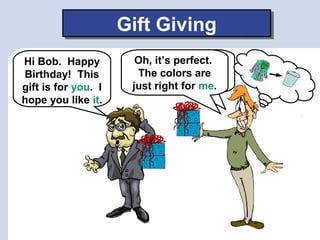
Hi Bob. Happy
Birthday! This
gift is for you. I
hope you like it.
It’s for me? Oh,
thank you. You
shouldn’t have.
Oh, it’s perfect.
The colors are
just right for me.
Re-GiftingRe-Gifting
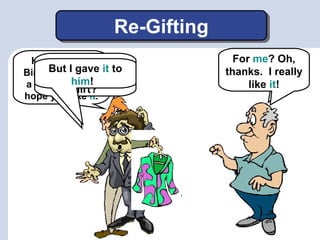
Hi Al. Happy
Birthday! I have
a gift for you. I
hope you like it.
Hey, where did
you get that
shirt?
But I gave it to
him!
Well, Bob gave
it to me.
For me? Oh,
thanks. I really
like it!
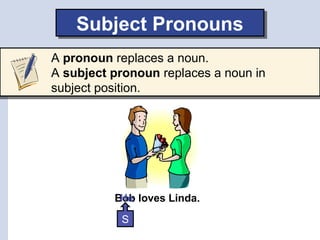
Bob loves Linda.He
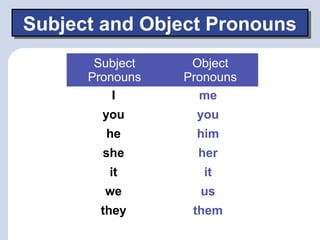
Subject PronounsSubject Pronouns
A pronoun replaces a noun.
A subject pronoun replaces a noun in
subject position.
S
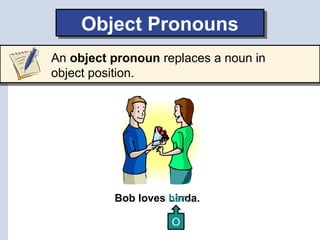
Bob loves Linda.her.
O
Object PronounsObject Pronouns
An object pronoun replaces a noun in
object position.
Subject
Pronouns
Object
Pronouns
me
you
him
her
it
us
them
I
you
he
she
it
we
they
Subject and Object PronounsSubject and Object Pronouns
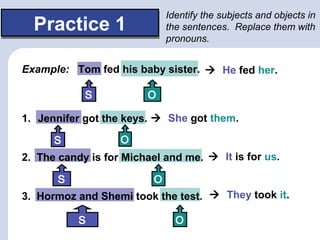
Example: Tom fed his baby sister.
1. Jennifer got the keys.
2. The candy is for Michael and me.
3. Hormoz and Shemi took the test.
S
S
S
 He fed her.
 She got them.
 It is for us.
 They took it.
Practice 1Practice 1
Identify the subjects and objects in
the sentences. Replace them with
pronouns.
O
O
O
O
S
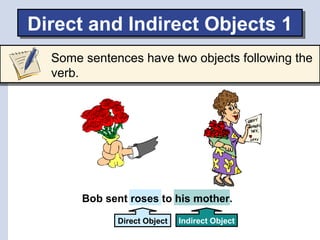
Direct Object
Bob sent roses to his mother.
Direct and Indirect Objects 1Direct and Indirect Objects 1
Some sentences have two objects following the
verb.
Indirect Object
Direct Object
Direct and Indirect Objects 2Direct and Indirect Objects 2
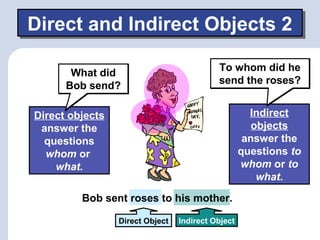
Direct objects
answer the
questions
whom or
what.
Bob sent roses to his mother.
What did
Bob send?
What did
Bob send?
Indirect
objects
answer the
questions to
whom or to
what.
To whom did he
send the roses?
To whom did he
send the roses?
Indirect Object
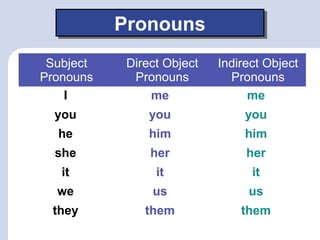
Subject
Pronouns
Direct Object
Pronouns
Indirect Object
Pronouns
me
you
him
her
it
us
them
I
you
he
she
it
we
they
PronounsPronouns
me
you
him
her
it
us
them
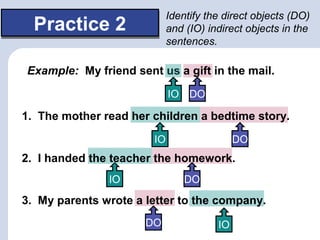
Example: My friend sent us a gift in the mail.
Practice 2Practice 2
Identify the direct objects (DO)
and (IO) indirect objects in the
sentences.
DOIO
DOIO
DOIO
DO IO
1. The mother read her children a bedtime story.
2. I handed the teacher the homework.
3. My parents wrote a letter to the company.
IO
DO
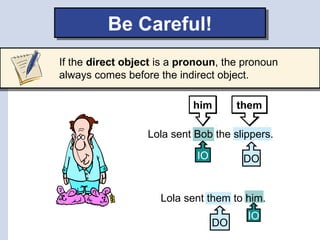
Lola sent them to him.
IO DO
Lola sent Bob the slippers.
Be Careful!Be Careful!
If the direct object is a pronoun, the pronoun
always comes before the indirect object.
himhim themthem
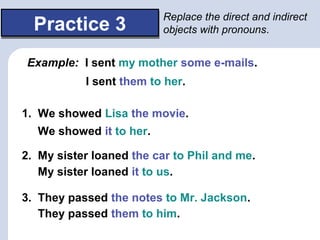
Practice 3Practice 3
Replace the direct and indirect
objects with pronouns.
Example: I sent my mother some e-mails.
1. We showed Lisa the movie.
2. My sister loaned the car to Phil and me.
3. They passed the notes to Mr. Jackson.
I sent them to her.
We showed it to her.
My sister loaned it to us.
They passed them to him.
ReferencesReferences
Copyright © 2006 Pearson Education
and its licensors. All rights reserved.

Subject and object pronouns

  • 1.
    Subject and Object Pronouns; Directand Indirect Objects Gifting and Re-Gifting 7 Focus on Grammar 2 Part VII, Unit 24 By Ruth Luman, Gabriele Steiner, and BJ Wells Copyright © 2006. Pearson Education, Inc. All rights reserved.
  • 2.
    Gift GivingGift Giving HiBob. Happy Birthday! This gift is for you. I hope you like it. It’s for me? Oh, thank you. You shouldn’t have. Oh, it’s perfect. The colors are just right for me.
  • 3.
    Re-GiftingRe-Gifting Hi Al. Happy Birthday!I have a gift for you. I hope you like it. Hey, where did you get that shirt? But I gave it to him! Well, Bob gave it to me. For me? Oh, thanks. I really like it!
  • 4.
    Bob loves Linda.He SubjectPronounsSubject Pronouns A pronoun replaces a noun. A subject pronoun replaces a noun in subject position. S
  • 5.
    Bob loves Linda.her. O ObjectPronounsObject Pronouns An object pronoun replaces a noun in object position.
  • 6.
  • 7.
    Example: Tom fedhis baby sister. 1. Jennifer got the keys. 2. The candy is for Michael and me. 3. Hormoz and Shemi took the test. S S S  He fed her.  She got them.  It is for us.  They took it. Practice 1Practice 1 Identify the subjects and objects in the sentences. Replace them with pronouns. O O O O S
  • 8.
    Direct Object Bob sentroses to his mother. Direct and Indirect Objects 1Direct and Indirect Objects 1 Some sentences have two objects following the verb. Indirect Object
  • 9.
    Direct Object Direct andIndirect Objects 2Direct and Indirect Objects 2 Direct objects answer the questions whom or what. Bob sent roses to his mother. What did Bob send? What did Bob send? Indirect objects answer the questions to whom or to what. To whom did he send the roses? To whom did he send the roses? Indirect Object
  • 10.
  • 11.
    Example: My friendsent us a gift in the mail. Practice 2Practice 2 Identify the direct objects (DO) and (IO) indirect objects in the sentences. DOIO DOIO DOIO DO IO 1. The mother read her children a bedtime story. 2. I handed the teacher the homework. 3. My parents wrote a letter to the company.
  • 12.
    IO DO Lola sent themto him. IO DO Lola sent Bob the slippers. Be Careful!Be Careful! If the direct object is a pronoun, the pronoun always comes before the indirect object. himhim themthem
  • 13.
    Practice 3Practice 3 Replacethe direct and indirect objects with pronouns. Example: I sent my mother some e-mails. 1. We showed Lisa the movie. 2. My sister loaned the car to Phil and me. 3. They passed the notes to Mr. Jackson. I sent them to her. We showed it to her. My sister loaned it to us. They passed them to him.
  • 14.
    ReferencesReferences Copyright © 2006Pearson Education and its licensors. All rights reserved.

Editor's Notes

  • #11 The reason why the indirect object pronouns are fed to the students is because I think that it’s important to point out that in English we use the same pronouns for direct objects as indirect objects unlike a number of other languages.