What they are and how to use them
Spanish Direct Object Nouns and Pronouns
Los pronombres de objeto directo
 Direct objects can be
nouns, e.g., people,
places, things, ideas,
etc. or pronouns that
receive the action of
the verb. This is true
in English and in
Spanish.
Los pronombres de objeto directo
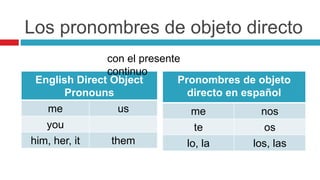
English Direct Object
Pronouns
me us
you
him, her, it them
Pronombres de objeto
directo en español
me nos
te os
lo, la los, las
Los pronombres de objeto directo
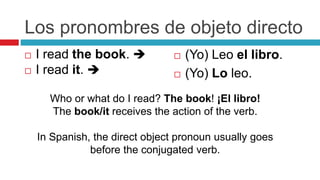
 I read the book. 
 I read it. 
 (Yo) Leo el libro.
 (Yo) Lo leo.
Who or what do I read? The book! ¡El libro!
The book/it receives the action of the verb.
In Spanish, the direct object pronoun usually goes
before the conjugated verb.
Los pronombres de objeto directo
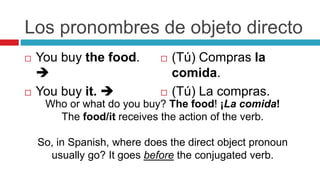
 You buy the food.
 You buy it.
 (Tú) Compras la
comida.
 (Tú) La compras.
Who or what do you buy? The food! ¡La comida!
The food/it receives the action of the verb.
So, in Spanish, where does the direct object pronoun
usually go? It goes before the conjugated verb.
Los pronombres de objeto directo
 She does it (an
activity--no gender)
often. 
 (Ella) Lo hace a
menudo.
Who or what do she do? An activity (no gender)
The activity/it receives the action of the verb.
So, in Spanish, where does the direct object pronoun
usually go?
Los pronombres de objeto directo
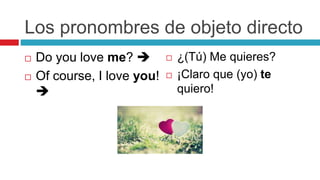
 Do you love me?
 Of course, I love
you!
 ¿(Tú) Me quieres?
 ¡Claro que (yo) te
quiero!
Los pronombres de objeto directo
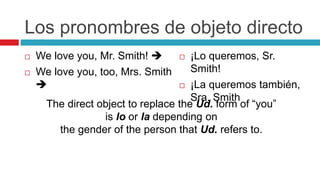
 We love you, Mr. Smith!
 We love you, too, Mrs.
Smith!
 ¡Lo queremos, Sr.
Smith!
 ¡La queremos
también, Sra. Smith
The direct object to replace the Ud. form of “you”
is lo or la depending on
the gender of the person that Ud. refers to.
Los pronombres de objeto directo
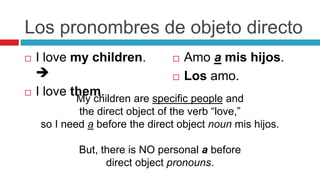
 I love my
children.
 I love them.
 Amo a mis hijos.
 Los amo.
My children are specific people and
the direct object of the verb “love,”
so I need a before the direct object noun mis hijos.
But, there is NO personal a before
direct object pronouns.
Los pronombres de objeto directo
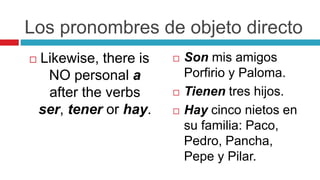
 Likewise, there is
NO personal a
after the verbs
ser, tener or hay.
 Son mis amigos
Porfirio y Paloma.
 Tienen tres hijos.
 Hay cinco nietos en
su familia: Paco,
Pedro, Pancha,
Pepe y Pilar.
Los pronombres de objeto directo
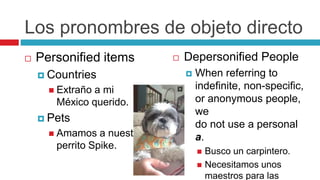
 Personified
items
 Countries
 Extraño a mi
México
querido.
 Pets
 Amamos a
nuestro perrito.
 Depersonified People
 When referring to
indefinite, non-
specific, or
anonymous people,
we do not use a
personal a.
 Busco un carpintero.
 Necesitamos un
médico.
Los pronombres de objeto directo
English Direct Object
Pronouns
me us
you
him, her, it them
Pronombres de objeto
directo en español
me nos
te os
lo, la los, las
con el presente continuo
Los pronombres de objeto directo
 In Spanish, there are two
possible places to put the
direct object pronoun in a
present progressive
sentence.
 Example 1:
 (Tú) Me estás llamando.
 Example 2:
 (Tú) Estás llamándome.
con el presente continuo
Los pronombres de objeto directo
 Example 1:
 (Tú) Me estás
llamando.
 In Example 1, the direct
object pronoun me is
before the conjugated verb,
estás.
 Example 2:
 (Tú) Estás
llamándome.
 In Example 2, the direct
object pronoun me is
connected to the present
participle llamando.
con el presente continuo
Los pronombres de objeto directo
 Note:
 If the direct object pronoun is attached to the present
participle, an accent mark must be placed over the a in
the -ando ending, or the e in -iendo. (llamándome,
llamándote, etc. (barriéndolo, abriendolas, etc.)
con el presente continuo
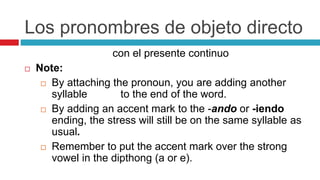
Los pronombres de objeto directo
 Note:
 By attaching the pronoun, you are adding another
syllable to the end of the word.
 By adding an accent mark to the -ando or -iendo
ending, the stress will still be on the same syllable as
usual.
 Remember to put the accent mark over the strong
vowel in the dipthong (a or e).
con el presente continuo
Los pronombres de objeto directo
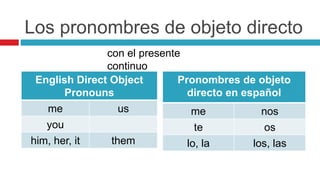
English Direct Object
Pronouns
me us
you
him, her, it them
Pronombres de objeto
directo en español
me nos
te os
lo, la los, las
con el presente continuo
Los pronombres de objeto directo
In Spanish, there are two
possible places to put the
direct object pronoun in a
sentence with an infinitive.
con los infinitivos
Los pronombres de objeto directo
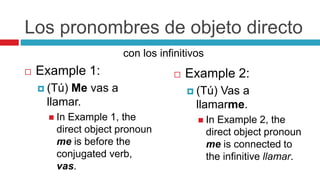
 Example 1:
 (Tú) Me vas a
llamar.
 In Example 1, the
direct object pronoun
me is before the
conjugated verb,
vas.
 Example 2:
 (Tú) Vas a
llamarme.
 In Example 2, the
direct object pronoun
me is connected to
the infinitive, llamar.
con los infinitivos
Los pronombres de objeto directo
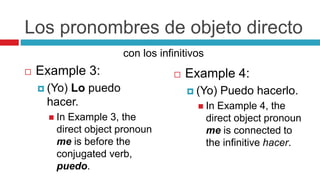
 Example 3:
 (Yo) Lo puedo
hacer.
 In Example 3, the
direct object pronoun
me is before the
conjugated verb,
puedo.
 Example 4:
 (Yo) Puedo hacerlo.
 In Example 4, the
direct object pronoun
me is connected to
the infinitive, hacer.
con los infinitivos
Los pronombres de objeto directo
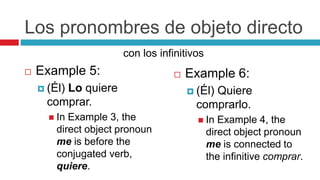
 Example 5:
 (Él) Lo quiere
comprar.
 In Example 3, the
direct object pronoun
me is before the
conjugated verb,
quiere.
 Example 6:
 (Él) Quiere
comprarlo.
 In Example 4, the
direct object pronoun
me is connected to
the infinitive,
comprar.
con los infinitivos
Los pronombres de objeto directo
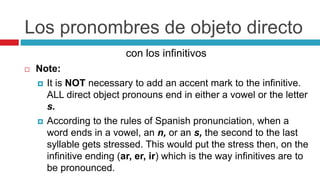
 Note:
 It is NOT necessary to add an accent mark to the infinitive.
ALL direct object pronouns end in either a vowel or the letter
s.
 According to the rules of Spanish pronunciation, when a
word ends in a vowel, an n, or an s, the second to the last
syllable gets stressed. This would put the stress then, on the
infinitive ending (ar, er, ir) which is the way infinitives are to
be pronounced.
con los infinitivos
¡Gracias por su atención!

Spanish Direct object pronouns

  • 1.
    What they areand how to use them Spanish Direct Object Nouns and Pronouns
  • 2.
    Los pronombres deobjeto directo  Direct objects can be nouns, e.g., people, places, things, ideas, etc. or pronouns that receive the action of the verb. This is true in English and in Spanish.
  • 3.
    Los pronombres deobjeto directo English Direct Object Pronouns me us you him, her, it them Pronombres de objeto directo en español me nos te os lo, la los, las
  • 4.
    Los pronombres deobjeto directo  I read the book.   I read it.   (Yo) Leo el libro.  (Yo) Lo leo. Who or what do I read? The book! ¡El libro! The book/it receives the action of the verb. In Spanish, the direct object pronoun usually goes before the conjugated verb.
  • 5.
    Los pronombres deobjeto directo  You buy the food.  You buy it.  (Tú) Compras la comida.  (Tú) La compras. Who or what do you buy? The food! ¡La comida! The food/it receives the action of the verb. So, in Spanish, where does the direct object pronoun usually go? It goes before the conjugated verb.
  • 6.
    Los pronombres deobjeto directo  She does it (an activity--no gender) often.   (Ella) Lo hace a menudo. Who or what do she do? An activity (no gender) The activity/it receives the action of the verb. So, in Spanish, where does the direct object pronoun usually go?
  • 7.
    Los pronombres deobjeto directo  Do you love me?  Of course, I love you!  ¿(Tú) Me quieres?  ¡Claro que (yo) te quiero!
  • 8.
    Los pronombres deobjeto directo  We love you, Mr. Smith!  We love you, too, Mrs. Smith!  ¡Lo queremos, Sr. Smith!  ¡La queremos también, Sra. Smith The direct object to replace the Ud. form of “you” is lo or la depending on the gender of the person that Ud. refers to.
  • 9.
    Los pronombres deobjeto directo  I love my children.  I love them.  Amo a mis hijos.  Los amo. My children are specific people and the direct object of the verb “love,” so I need a before the direct object noun mis hijos. But, there is NO personal a before direct object pronouns.
  • 10.
    Los pronombres deobjeto directo  Likewise, there is NO personal a after the verbs ser, tener or hay.  Son mis amigos Porfirio y Paloma.  Tienen tres hijos.  Hay cinco nietos en su familia: Paco, Pedro, Pancha, Pepe y Pilar.
  • 11.
    Los pronombres deobjeto directo  Personified items  Countries  Extraño a mi México querido.  Pets  Amamos a nuestro perrito.  Depersonified People  When referring to indefinite, non- specific, or anonymous people, we do not use a personal a.  Busco un carpintero.  Necesitamos un médico.
  • 12.
    Los pronombres deobjeto directo English Direct Object Pronouns me us you him, her, it them Pronombres de objeto directo en español me nos te os lo, la los, las con el presente continuo
  • 13.
    Los pronombres deobjeto directo  In Spanish, there are two possible places to put the direct object pronoun in a present progressive sentence.  Example 1:  (Tú) Me estás llamando.  Example 2:  (Tú) Estás llamándome. con el presente continuo
  • 14.
    Los pronombres deobjeto directo  Example 1:  (Tú) Me estás llamando.  In Example 1, the direct object pronoun me is before the conjugated verb, estás.  Example 2:  (Tú) Estás llamándome.  In Example 2, the direct object pronoun me is connected to the present participle llamando. con el presente continuo
  • 15.
    Los pronombres deobjeto directo  Note:  If the direct object pronoun is attached to the present participle, an accent mark must be placed over the a in the -ando ending, or the e in -iendo. (llamándome, llamándote, etc. (barriéndolo, abriendolas, etc.) con el presente continuo
  • 16.
    Los pronombres deobjeto directo  Note:  By attaching the pronoun, you are adding another syllable to the end of the word.  By adding an accent mark to the -ando or -iendo ending, the stress will still be on the same syllable as usual.  Remember to put the accent mark over the strong vowel in the dipthong (a or e). con el presente continuo
  • 17.
    Los pronombres deobjeto directo English Direct Object Pronouns me us you him, her, it them Pronombres de objeto directo en español me nos te os lo, la los, las con el presente continuo
  • 18.
    Los pronombres deobjeto directo In Spanish, there are two possible places to put the direct object pronoun in a sentence with an infinitive. con los infinitivos
  • 19.
    Los pronombres deobjeto directo  Example 1:  (Tú) Me vas a llamar.  In Example 1, the direct object pronoun me is before the conjugated verb, vas.  Example 2:  (Tú) Vas a llamarme.  In Example 2, the direct object pronoun me is connected to the infinitive, llamar. con los infinitivos
  • 20.
    Los pronombres deobjeto directo  Example 3:  (Yo) Lo puedo hacer.  In Example 3, the direct object pronoun me is before the conjugated verb, puedo.  Example 4:  (Yo) Puedo hacerlo.  In Example 4, the direct object pronoun me is connected to the infinitive, hacer. con los infinitivos
  • 21.
    Los pronombres deobjeto directo  Example 5:  (Él) Lo quiere comprar.  In Example 3, the direct object pronoun me is before the conjugated verb, quiere.  Example 6:  (Él) Quiere comprarlo.  In Example 4, the direct object pronoun me is connected to the infinitive, comprar. con los infinitivos
  • 22.
    Los pronombres deobjeto directo  Note:  It is NOT necessary to add an accent mark to the infinitive. ALL direct object pronouns end in either a vowel or the letter s.  According to the rules of Spanish pronunciation, when a word ends in a vowel, an n, or an s, the second to the last syllable gets stressed. This would put the stress then, on the infinitive ending (ar, er, ir) which is the way infinitives are to be pronounced. con los infinitivos
  • 23.
    ¡Gracias por suatención!