





World Languages:
    Next Generation Standards
      Session 1: Presentational Writing and Speaking


Seminole County World Languages
           Workshop
         Dec. 6th, 2011
Our Objectives:
 Understand the how the Sunshine State
  Next Generation World Languages
  Standards impact teaching and learning.
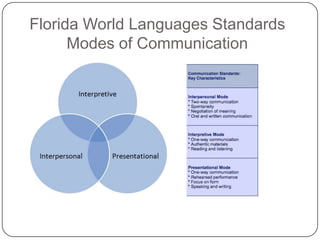
 Identify and Comprehend the “Modes of
  Communication”
 Use “Backward Design” to plan
  instruction
 Collaborate with other teachers to
  Create Standards Based Performance
  Assessment
“Knowing how, when, and why to say what
to whom”

   Those 10 words represent the ultimate
   goal of the World Language Classroom

   Formerly, most teaching in foreign
   language classrooms concentrated on
   the how (grammar) to say what
   (vocabulary).

  Standards for Foreign Language Learning: Executive Summary
         American Council on Teaching Foreign Languages
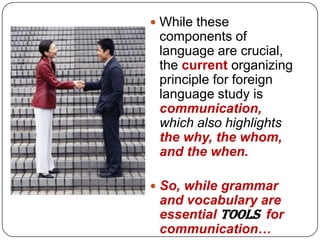
 While these
 components of
 language are crucial,
 the current organizing
 principle for foreign
 language study is
 communication,
 which also highlights
 the why, the whom,
 and the when.

 So, while grammar
 and vocabulary are
 essential tools for
 communication…
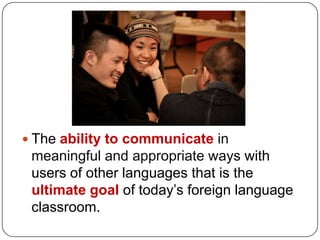
 The ability to communicate in
 meaningful and appropriate ways with
 users of other languages that is the
 ultimate goal of today’s foreign language
 classroom.
Florida World Languages Standards
      Modes of Communication
The New Standards…


         Drum roll, please….
Standard 1: Interpretive
Listening:
The student will be able to understand and interpret
information, concepts, and ideas orally from a
variety of culturally authentic sources on a
variety of topics in the target language.
Standard 2: Interpretive Reading:
  The student will be able to understand and interpret
   information, concepts, and ideas in writing from a
   variety of culturally authentic sources on a
   variety of topics in the target language.
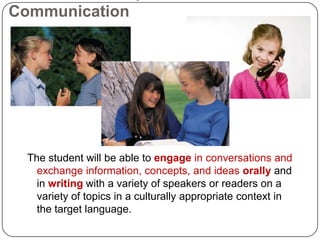
Communication


  The student will be able to engage in conversations and
    exchange information, concepts, and ideas orally and
    in writing with a variety of speakers or readers on a
    variety of topics in a culturally appropriate context in
    the target language.
Standard 4: Presentational
Speaking

The student will be able to present information,
 concepts, and ideas to an audience of listeners
 on a variety of topics in a culturally appropriate
 context in the target language.
Standard 5: Presentational Writing

                  The student will be able
                   to present
                   information,
                   concepts, and ideas
                   to an audience of
                   readers on a variety
                   of topics in a culturally
                   appropriate context in
                   the target language.
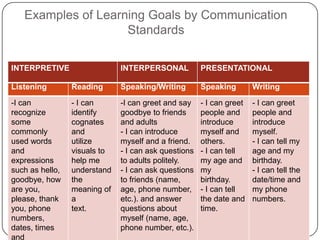
Examples of Learning Goals by Communication
                    Standards

INTERPRETIVE                  INTERPERSONAL           PRESENTATIONAL

Listening        Reading      Speaking/Writing        Speaking        Writing

-I can           - I can      -I can greet and say    - I can greet   - I can greet
recognize        identify     goodbye to friends      people and      people and
some             cognates     and adults              introduce       introduce
commonly         and          - I can introduce       myself and      myself.
used words       utilize      myself and a friend.    others.         - I can tell my
and              visuals to   - I can ask questions   - I can tell    age and my
expressions      help me      to adults politely.     my age and      birthday.
such as hello,   understand   - I can ask questions   my              - I can tell the
goodbye, how     the          to friends (name,       birthday.       date/time and
are you,         meaning of   age, phone number,      - I can tell    my phone
please, thank    a            etc.). and answer       the date and    numbers.
you, phone       text.        questions about         time.
numbers,                      myself (name, age,
dates, times                  phone number, etc.).
and
Florida World Languages
 Intercultural Standards
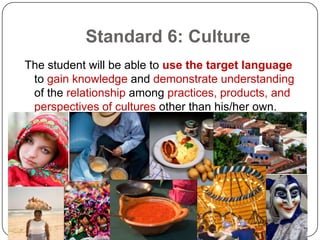
Standard 6: Culture
The student will be able to use the target language
 to gain knowledge and demonstrate understanding
 of the relationship among practices, products, and
 perspectives of cultures other than his/her own.
Connections, Comparisons,
 Communities
Standard 7: Connections
The student will be able to acquire, reinforce, and
 further his/her knowledge of other disciplines
 through the target language.
Standard 8: Comparisons
The student will be able to develop insight into the
 nature of the target language and culture by
 comparing his/her own language(s) and cultures
 to others.
Standard 9: Communities
The student will be able to use the target language
 both within and beyond the school setting to
 investigate and improve his/her world beyond
Where Do We Start?
Backward Design and Language Teaching: How?


 We start “at the end” by determining what the
  learner needs to know and understand and how
  they are going to demonstrate their
  understanding FIRST. We design the WHAT and
  HOW we are going to teach LAST.
 We use National and State Standards to
  determine what students should know NOT
  textbooks!
==================================
 When using the “backward processes” our
  assessment methods:
    -Assess what learners can do with the language and not just
        what they know about the language.
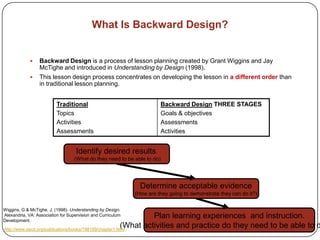
What Is Backward Design?


                Backward Design is a process of lesson planning created by Grant Wiggins and Jay
                 McTighe and introduced in Understanding by Design (1998).
                This lesson design process concentrates on developing the lesson in a different order than
                 in traditional lesson planning.


                          Traditional                                  Backward Design THREE STAGES
                          Topics                                       Goals & objectives
                          Activities                                   Assessments
                          Assessments                                  Activities


                                    Identify desired results.
                                   (What do they need to be able to do)


                                                               Determine acceptable evidence
                                                             (How are they going to demonstrate they can do it?)

Wiggins, G & McTighe, J. (1998). Understanding by Design.
Alexandria, VA: Association for Supervision and Curriculum
Development.
                                                                  Plan learning experiences and instruction.
                                                         (What activities and practice do they need to be able to d
http://www.ascd.org/publications/books/198199/chapter1.html
Backward Design and Language Teaching: HOW?


            Stage 1: Identify Desired Results -
National Standards for World Languages are grouped around five categories (the
  5 C’s), each with sub-categories.
   Communications: Communicate in Languages Other Than English
   Cultures: Gain Knowledge and Understanding of Other Cultures
   Connections: Connect with Other Disciplines and Acquire Information
   Comparisons: Develop Insight into the Nature of Language and Culture
   Communities: Participate in Multilingual Communities at Home & Around
     the World

The state of Florida has defined “Performance Standards” for World Languages,
  and indicated “Benchmarks” for each one.
Backward Design and Language Teaching: HOW?


 Stage 2: Determine Acceptable Evidence - The issue of assessment


                         How will we know if
                         students have
                         achieved desired
                         results?
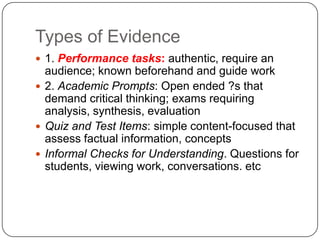
Types of Evidence
 1. Performance tasks: authentic, require an
  audience; known beforehand and guide work
 2. Academic Prompts: Open ended ?s that
  demand critical thinking; exams requiring
  analysis, synthesis, evaluation
 Quiz and Test Items: simple content-focused that
  assess factual information, concepts
 Informal Checks for Understanding. Questions for
  students, viewing work, conversations. etc
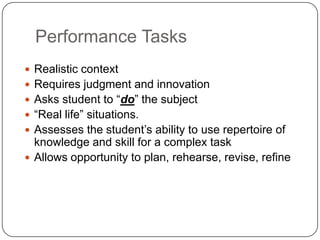
Performance Tasks
 Realistic context
 Requires judgment and innovation
 Asks student to “do” the subject
 “Real life” situations.
 Assesses the student’s ability to use repertoire of
  knowledge and skill for a complex task
 Allows opportunity to plan, rehearse, revise, refine
Backward Design and Language Teaching: HOW?


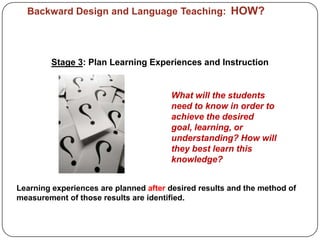
        Stage 3: Plan Learning Experiences and Instruction


                                       What will the students
                                       need to know in order to
                                       achieve the desired
                                       goal, learning, or
                                       understanding? How will
                                       they best learn this
                                       knowledge?


Learning experiences are planned after desired results and the method of
measurement of those results are identified.
BREAK

World languages standards overview

  • 1.
    World Languages: Next Generation Standards Session 1: Presentational Writing and Speaking Seminole County World Languages Workshop Dec. 6th, 2011
  • 2.
    Our Objectives:  Understandthe how the Sunshine State Next Generation World Languages Standards impact teaching and learning.  Identify and Comprehend the “Modes of Communication”  Use “Backward Design” to plan instruction  Collaborate with other teachers to Create Standards Based Performance Assessment
  • 3.
    “Knowing how, when,and why to say what to whom”  Those 10 words represent the ultimate goal of the World Language Classroom  Formerly, most teaching in foreign language classrooms concentrated on the how (grammar) to say what (vocabulary). Standards for Foreign Language Learning: Executive Summary American Council on Teaching Foreign Languages
  • 4.
     While these components of language are crucial, the current organizing principle for foreign language study is communication, which also highlights the why, the whom, and the when.  So, while grammar and vocabulary are essential tools for communication…
  • 5.
     The abilityto communicate in meaningful and appropriate ways with users of other languages that is the ultimate goal of today’s foreign language classroom.
  • 6.
    Florida World LanguagesStandards Modes of Communication
  • 7.
    The New Standards… Drum roll, please….
  • 8.
    Standard 1: Interpretive Listening: Thestudent will be able to understand and interpret information, concepts, and ideas orally from a variety of culturally authentic sources on a variety of topics in the target language.
  • 9.
    Standard 2: InterpretiveReading: The student will be able to understand and interpret information, concepts, and ideas in writing from a variety of culturally authentic sources on a variety of topics in the target language.
  • 10.
    Communication Thestudent will be able to engage in conversations and exchange information, concepts, and ideas orally and in writing with a variety of speakers or readers on a variety of topics in a culturally appropriate context in the target language.
  • 11.
    Standard 4: Presentational Speaking Thestudent will be able to present information, concepts, and ideas to an audience of listeners on a variety of topics in a culturally appropriate context in the target language.
  • 12.
    Standard 5: PresentationalWriting The student will be able to present information, concepts, and ideas to an audience of readers on a variety of topics in a culturally appropriate context in the target language.
  • 13.
    Examples of LearningGoals by Communication Standards INTERPRETIVE INTERPERSONAL PRESENTATIONAL Listening Reading Speaking/Writing Speaking Writing -I can - I can -I can greet and say - I can greet - I can greet recognize identify goodbye to friends people and people and some cognates and adults introduce introduce commonly and - I can introduce myself and myself. used words utilize myself and a friend. others. - I can tell my and visuals to - I can ask questions - I can tell age and my expressions help me to adults politely. my age and birthday. such as hello, understand - I can ask questions my - I can tell the goodbye, how the to friends (name, birthday. date/time and are you, meaning of age, phone number, - I can tell my phone please, thank a etc.). and answer the date and numbers. you, phone text. questions about time. numbers, myself (name, age, dates, times phone number, etc.). and
  • 14.
    Florida World Languages Intercultural Standards
  • 15.
    Standard 6: Culture Thestudent will be able to use the target language to gain knowledge and demonstrate understanding of the relationship among practices, products, and perspectives of cultures other than his/her own.
  • 16.
    Connections, Comparisons, Communities Standard7: Connections The student will be able to acquire, reinforce, and further his/her knowledge of other disciplines through the target language. Standard 8: Comparisons The student will be able to develop insight into the nature of the target language and culture by comparing his/her own language(s) and cultures to others. Standard 9: Communities The student will be able to use the target language both within and beyond the school setting to investigate and improve his/her world beyond
  • 17.
  • 19.
    Backward Design andLanguage Teaching: How?  We start “at the end” by determining what the learner needs to know and understand and how they are going to demonstrate their understanding FIRST. We design the WHAT and HOW we are going to teach LAST.  We use National and State Standards to determine what students should know NOT textbooks! ==================================  When using the “backward processes” our assessment methods: -Assess what learners can do with the language and not just what they know about the language.
  • 20.
    What Is BackwardDesign?  Backward Design is a process of lesson planning created by Grant Wiggins and Jay McTighe and introduced in Understanding by Design (1998).  This lesson design process concentrates on developing the lesson in a different order than in traditional lesson planning. Traditional Backward Design THREE STAGES Topics Goals & objectives Activities Assessments Assessments Activities Identify desired results. (What do they need to be able to do) Determine acceptable evidence (How are they going to demonstrate they can do it?) Wiggins, G & McTighe, J. (1998). Understanding by Design. Alexandria, VA: Association for Supervision and Curriculum Development. Plan learning experiences and instruction. (What activities and practice do they need to be able to d http://www.ascd.org/publications/books/198199/chapter1.html
  • 21.
    Backward Design andLanguage Teaching: HOW? Stage 1: Identify Desired Results - National Standards for World Languages are grouped around five categories (the 5 C’s), each with sub-categories.  Communications: Communicate in Languages Other Than English  Cultures: Gain Knowledge and Understanding of Other Cultures  Connections: Connect with Other Disciplines and Acquire Information  Comparisons: Develop Insight into the Nature of Language and Culture  Communities: Participate in Multilingual Communities at Home & Around the World The state of Florida has defined “Performance Standards” for World Languages, and indicated “Benchmarks” for each one.
  • 22.
    Backward Design andLanguage Teaching: HOW? Stage 2: Determine Acceptable Evidence - The issue of assessment How will we know if students have achieved desired results?
  • 23.
    Types of Evidence 1. Performance tasks: authentic, require an audience; known beforehand and guide work  2. Academic Prompts: Open ended ?s that demand critical thinking; exams requiring analysis, synthesis, evaluation  Quiz and Test Items: simple content-focused that assess factual information, concepts  Informal Checks for Understanding. Questions for students, viewing work, conversations. etc
  • 24.
    Performance Tasks  Realisticcontext  Requires judgment and innovation  Asks student to “do” the subject  “Real life” situations.  Assesses the student’s ability to use repertoire of knowledge and skill for a complex task  Allows opportunity to plan, rehearse, revise, refine
  • 25.
    Backward Design andLanguage Teaching: HOW? Stage 3: Plan Learning Experiences and Instruction What will the students need to know in order to achieve the desired goal, learning, or understanding? How will they best learn this knowledge? Learning experiences are planned after desired results and the method of measurement of those results are identified.
  • 26.